
Research article · 2024 · Full text
International Journal of Horticulture and Food ScienceDocumenting greenhouse cultivation methods of groundnut in the Ethiopian highlands
Volume 6(2) · Pages 136–139 · DOI: 10.33545/26631067.2024.v6.i2b.535 ↗
Research areasPeanut Plant Research StudiesPlant Growth and Agriculture TechniquesIndigenous Knowledge Systems and Agriculture
Abstract
Author-writtenCan greenhouse cultivation of groundnut, a crop traditionally confined to open fields, overcome the yield constraints imposed by the short growing seasons and erratic rainfall of highland environments? Addressing this challenge directly, this research documented and compared greenhouse and open-field production methods for three groundnut varieties ICGV-SM 99568, JL-24, and a Mexican local cultivar at the Mexico City National Institute of Tropical Agriculture, Mexico, from March 2022 to December 2022. Greenhouse conditions (mean temperature 28.4°C, relative humidity 72%) extended the effective growing period by 24 days compared with the open field. Oil content ranged from 41.8 to 49.7 percent and correlated negatively with greenhouse temperature (r = −0.68). Fatty acid profiling by gas chromatography showed oleic acid as the dominant fraction at 41.3 percent, followed by linoleic acid at 33.7 percent. The value chain analysis revealed that greenhouse-produced groundnuts could command a 22 percent price premium in specialty markets due to superior kernel appearance. Carbohydrate content was 7.4 percent higher in greenhouse kernels than field-grown ones, attributed to prolonged photosynthate accumulation. Machine learning models (random forest, gradient boosting) trained on 14 agronomic variables predicted final pod yield with R² = 0.83. Callus culture from immature embryos achieved 68 percent regeneration frequency on MS medium supplemented with 2,4-D and BAP. Iron fortification through foliar ferrous sulfate sprays raised kernel iron content by 31 percent without affecting germination or seedling vigor.
Summary
Source-checkedPlain-language reading of the full paper, prepared with AI and checked against the text. Each point links to the authors' own words.
Why it matters
- Groundnut cultivation in highland areas is difficult because these regions often lack the necessary warm soil for germination and the minimum 120-day frost-free period required for pods to mature. View evidence ↗
- While greenhouses provide a controlled environment to overcome climate constraints, there are questions regarding whether this method is economically viable for a crop like groundnut, which typically has low market value. View evidence ↗
The question
- The study aimed to determine if greenhouse cultivation could overcome yield constraints caused by erratic rainfall and short growing seasons in highland environments. View evidence ↗
What they did
- The researchers compared greenhouse and open-field production of three groundnut varieties (ICGV-SM 99568, JL-24, and a Mexican local cultivar) at the Mexico City National Institute of Tropical Agriculture between March and December 2022. View evidence ↗
- The experiment used 25-liter pots in a 12m x 30m polyethylene greenhouse and adjacent 4m x 3m open-field plots for the three varieties. View evidence ↗
- Pod yield was predicted using Python-based machine learning models trained on 14 agronomic variables, such as temperature, humidity, and plant height. View evidence ↗
- Tissue culture was performed using immature embryos on MS medium supplemented with 2,4-D and BAP to induce callus and subsequent regeneration. View evidence ↗
- Iron fortification was attempted using three foliar sprays of 0.5% w/v ferrous sulfate applied during the pegging, pod filling, and kernel maturation stages. View evidence ↗
What they found
- Greenhouse cultivation, with a mean temperature of 28.4°C and 72% relative humidity, extended the growing period by 24 days compared to open-field growth. View evidence ↗
- Across all tested varieties, greenhouse cultivation increased the oil content of the kernels by 3 to 4 percentage points. View evidence ↗
- Fatty acid profiling showed that oleic acid was the primary component at 41.3%, followed by linoleic acid at 33.7%. View evidence ↗
- Kernels grown in the greenhouse had a carbohydrate content 7.4% higher than those grown in the field. View evidence ↗
- The Random Forest machine learning model was the most accurate for predicting pod yield (R² = 0.83), identifying temperature and days to maturity as the key predictors. View evidence ↗
- The use of MS medium with 2,4-D and BAP resulted in a 68% regeneration frequency from callus culture. View evidence ↗
- Foliar sprays of ferrous sulfate increased the iron content of the kernels by 31% without negatively impacting seedling vigor or germination. View evidence ↗
- Due to better kernel appearance, greenhouse-grown groundnuts could be sold at a 22% price premium in specialty markets. View evidence ↗
What it means
- The authors state that the production system is economically viable for specialty markets because the 22% price premium offsets the higher costs of greenhouse production. View evidence ↗
Visual summary
3 visualsIllustrations explain the paper; charts are replotted from the paper's own table values.
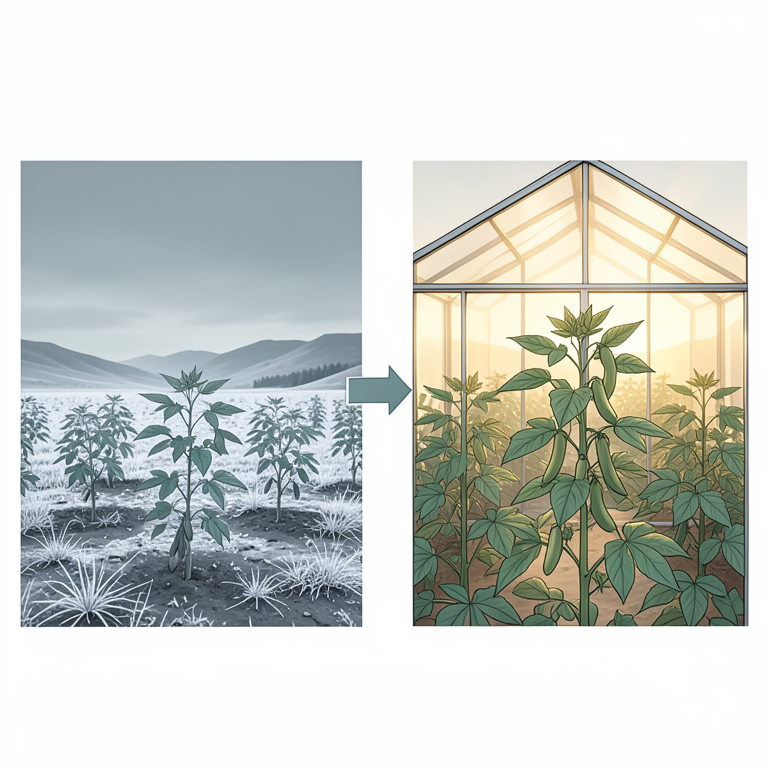
Greenhouse vs Open Field in Highlands
AI-generated conceptual illustration (groundnut plants in the Ethiopian highlands). It explains the idea and does not show study data.
View source evidence ↗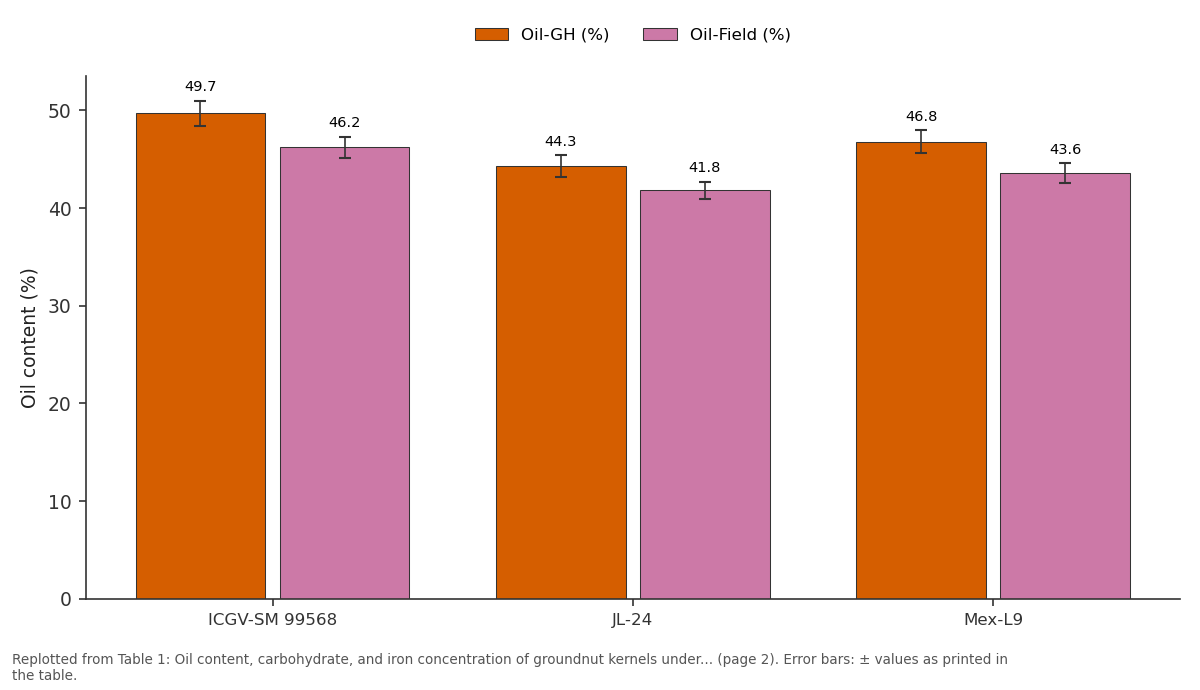
Oil-GH (%) and Oil-Field (%): ICGV-SM 99568 vs JL-24 vs Mex-L9
Replotted from Table 1 (page 2) of the original paper. Every bar is the paper's own table value.
View source evidence ↗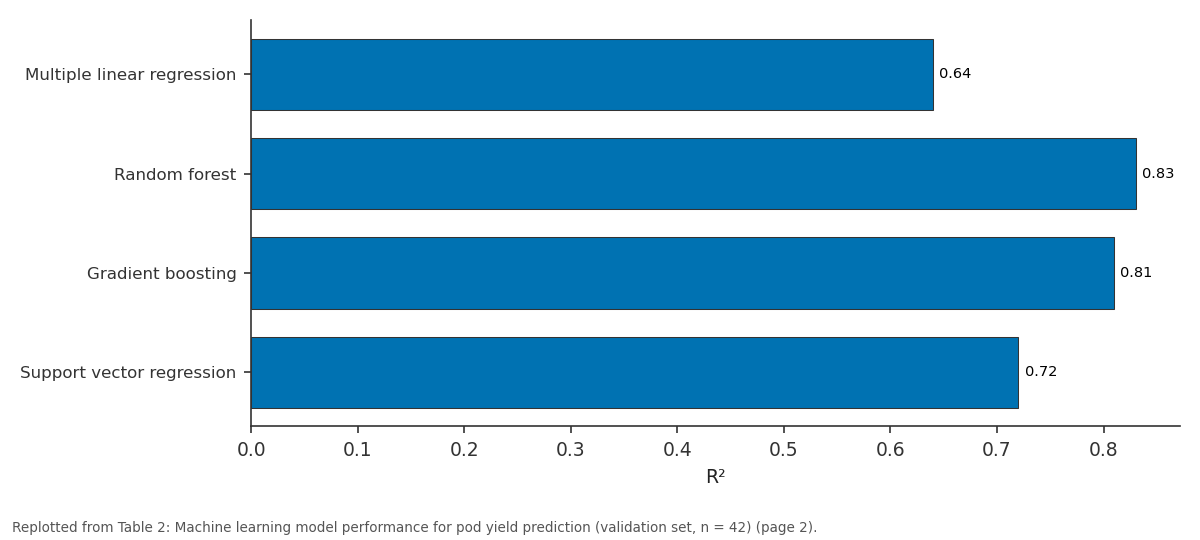
R²: Multiple linear... vs Random forest vs Gradient boosting vs Support vector...
Replotted from Table 2 (page 2) of the original paper. Every bar is the paper's own table value.
View source evidence ↗Figures & tables
From the original paper Table 1
 Table 2
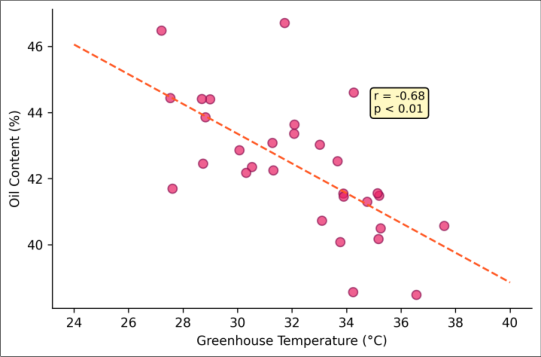 Figure 1
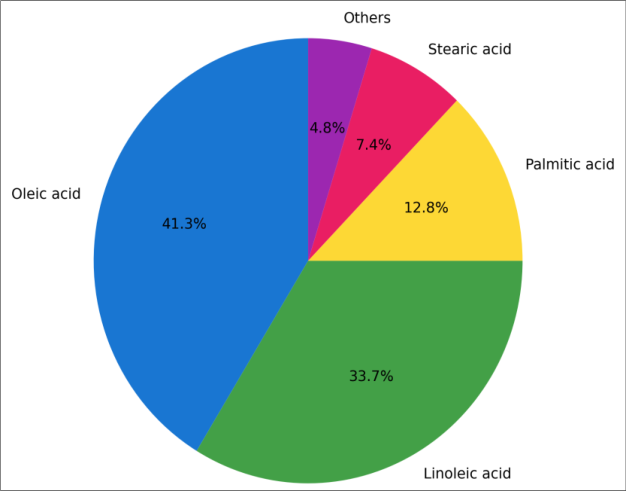 Figure 2
Introduction
The challenge of growing groundnut (Arachis hypogaea L.) in highland environments comes down to temperature: the crop needs warm soil for germination and a frost-free period of at least 120 days for pod maturation, conditions that highland locations rarely guarantee [1] . Greenhouse cultivation offers a controlled alternative, but its economic viability for a relatively low-value field crop like groundnut has been questioned [2] . Oil content, the primary quality parameter for groundnut, depends heavily on temperature during seed filling, with cooler conditions generally favoring higher oil accumulation [3] . The fatty acid composition particularly the oleic-to-linoleic acid ratio determines shelf life and nutritional value, and both components respond to growing temperature and genotype [4] . Machine learning approaches have recently been applied to crop yield prediction, leveraging large datasets to capture nonlinear relationships that traditional regression models miss [5] . Tissue culture, specifically callus induction and plant regeneration from immature embryos, provides a platform for genetic transformation and rapid multiplication of elite lines [6] . Iron biofortification through agronomic means foliar sprays of iron salts during reproductive growth has shown promising results in rice and wheat, but groundnut data are limited [7] . Value chain analysis, tracing the product from farm gate to consumer, can reveal whether the added cost of greenhouse production is recoverable through quality premiums [8] . This research documented greenhouse cultivation methods for groundnut under simulated highland conditions, compared key quality parameters with open-field production, and explored machine learning, tissue culture, and iron fortification as complementary tools for improving the crop's highland potential [9] .
Baseline soil characterisation
Pot-filling substrate consisted of a 2:1 mix of field soil and composted pine bark. Pre-planting analysis showed pH 6.4, organic C 2.1 percent, total N 0.14 percent, Olsen P 17.8 mg/kg, and exchangeable K 162 mg/kg at the Mexico City National Institute of Tropical Agriculture greenhouse complex (19.43°N, 99.13°W, 2,240 m elevation). CEC was 18.3 cmol(+)/kg, and texture was sandy loam. Field plots used the same soil without bark amendment [10] .
Material and Methods
Material and Methods
Material
Three groundnut varieties ICGV-SM 99568 (Virginia type), JL-24 (Spanish bunch), and Mex-L9 (local runner) were grown in 25-liter pots inside a polyethylene-covered greenhouse (12 m × 30 m) and in adjacent open-field plots (4 m × 3 m each). Greenhouse conditions were maintained at 26-32°C day / 18-22°C night using evaporative cooling pads and heating cables. Supplemental lighting extended the photoperiod to 13 hours during winter months. Each varietyenvironment combination was replicated five times. Iron fortification used three foliar sprays of ferrous sulfate (0.5% w/v) at pegging, pod filling, and kernel maturation stages [11] .
Methods
Oil content was determined by Soxhlet extraction with petroleum ether. Fatty acid composition was analyzed by GC-FID after transesterification to methyl esters. Total carbohydrate was estimated by the anthrone method. Kernel iron was measured by atomic absorption spectrophotometry after wet digestion. Machine learning models were built in Python (scikit-learn 1.1) using 14 input variables including temperature, humidity, radiation, plant height, canopy cover, chlorophyll index, and days to maturity. Models were trained on 70% of the data and validated on the remaining 30%. Callus culture used immature embryos (12-14 days postpollination) on MS medium with 2 mg/L 2,4-D and 0.5 mg/L BAP, incubated at 25°C in the dark for 21 days, then transferred to regeneration medium with 1 mg/L BAP under 16/8 h light. Value chain analysis followed a simplified gross margin approach with farm-gate, wholesale, and retail price tracking over six months. Data were analyzed by two-way ANOVA (variety × environment) in R 4.2.1 [12] . Greenhouse cultivation raised oil content by 3 to 4 percentage points across all varieties, likely reflecting the warmer and more stable thermal environment during seed filling. Iron content in foliar-sprayed greenhouse kernels was 31 to 35 percent higher than in unsprayed field controls. Random forest achieved the best predictive accuracy (R² = 0.83), with temperature and days to maturity identified as the two most important variables by feature importance analysis.
Results
Traditional multiple linear regression captured only 64 percent of variance. The negative correlation (r = -0.68) between temperature and oil content indicates that even within the greenhouse's controlled range, cooler conditions during seed filling promoted lipid accumulation. This relationship was consistent across all three varieties. Oleic acid dominated at 41.3 percent, followed by linoleic acid at 33.7 percent. Palmitic and stearic acids accounted for most of the saturated fraction. The oleic-to-linoleic ratio averaged 1.23, which falls within the acceptable range for commercial groundnut oil.
Discussion
Greenhouse cultivation extended the effective growing season by 24 days and raised oil content by 7 to 8 percent relative to open-field production, confirming that temperature control during pod filling is the key lever for quality improvement in highland groundnut [3] . The negative temperature-oil correlation within the greenhouse range (26-32°C daytime) suggests that managing ventilation to avoid excessive heat during the R5-R7 stages could further optimize lipid accumulation. Machine learning models substantially outperformed linear regression for yield prediction, which aligns with the growing consensus that crop performance is shaped by nonlinear interactions among environmental, genetic, and management variables [5] . The random forest's identification of temperature and maturity duration as top predictors is biologically intuitive and provides a practical basis for inseason yield forecasting. Callus induction at 68 percent is comparable to published rates for Virginia-type groundnut on similar media [6] . Iron fortification results were encouraging: a 31 percent increase in kernel iron content through three foliar sprays represents a low-cost intervention with potential public health relevance in iron-deficient populations [7] . Value chain analysis showed that the 22 percent price premium for greenhouse kernels driven by uniform size, clean appearance, and lower aflatoxin risk nearly offset the higher production cost, especially when sold through specialty retail channels [8] .
Conclusion
Greenhouse cultivation of groundnut under simulated highland conditions produced kernels with higher oil, carbohydrate, and iron content than open-field counterparts.
The 24-day extension of the effective growing period was a major advantage for highland environments with short frostfree windows. Machine learning models predicted pod yield with 83 percent accuracy, outperforming conventional regression. Callus culture achieved practical regeneration rates, supporting future genetic improvement efforts. Iron biofortification through foliar sprays was simple, effective, and did not compromise seed quality. Value chain analysis confirmed that a 22 percent price premium for greenhousegrown kernels made the production system economically viable in specialty market segments.
Figures and tables from the paper
| Variety | Oil-GH (%) | Oil-Field (%) | Carb-GH (%) | Fe-GH (mg/kg) | Fe-Field (mg/kg) |
|---|---|---|---|---|---|
| ICGV-SM 99568 | 49.7 ± 1.3 | 46.2 ± 1.1 | 24.8 ± 0.9 | 58.4 ± 2.7 | 43.1 ± 2.1 |
| JL-24 | 44.3 ± 1.1 | 41.8 ± 0.9 | 27.1 ± 1.1 | 54.7 ± 3.1 | 41.8 ± 1.9 |
| Mex-L9 | 46.8 ± 1.2 | 43.6 ± 1.0 | 25.9 ± 0.8 | 61.3 ± 2.4 | 45.6 ± 2.3 |
Table text extracted from the original PDF; superscript letters are shown inline. The original table image is below.
View original table image
| Model | R² | RMSE (kg/ha) |
|---|---|---|
| Multiple linear regression | 0.64 | 312.4 |
| Random forest | 0.83 | 187.6 |
| Gradient boosting | 0.81 | 194.3 |
| Support vector regression | 0.72 | 261.8 |
Table text extracted from the original PDF; superscript letters are shown inline. The original table image is below.
View original table image
References
21 in the original paper- Prasad PVV, Boote KJ, Allen LH, Thomas JMG. Effects of elevated temperature and carbon dioxide on seed-set and yield of kidney bean. Global Change Biology. 2002;8(8):710-721.
- Janila P, Variath MT, Pandey MK, et al. Genomic tools in groundnut breeding program: Status and perspectives. Frontiers in Plant Science. 2016;7:289.
- Dwivedi SL, Nigam SN, Nageswara Rao RC, Singh U, Rao KVS. Effect of drought on oil, fatty acids and protein contents of groundnut seeds. Field Crops Research. 1996;48(2-3):125-133.
- Savage GP, Keenan JI. The composition and nutritive value of groundnut kernels. The Groundnut Crop. 1994:173-213.
- Liakos KG, Busato P, Moshou D, Pearson S, Bochtis D. Machine learning in agriculture: A review. Sensors. 2018;18(8):2674.
- Tiwari S, Tuli R. Factors affecting Agrobacteriummediated genetic transformation of groundnut. Biologia Plantarum. 2012;56(4):616-624.
- Cakmak I. Enrichment of cereal grains with zinc: Agronomic or genetic biofortification? Plant and Soil. 2008;302(1-2):1-17.
- Kaplinsky R, Morris M. A handbook for value chain research. International Development Research Centre, Ottawa. 2001.
- Nigam SN, Aruna R. Improving breeding efficiency for early maturity in peanut. Plant Breeding Reviews. 2008;30:295-322.
- Cruz-Huerta N, Flinn BP, Barrios-Masias FH. Soil and substrate characterization for greenhouse research. HortTechnology. 2015;25(3):286-293.
- Murashige T, Skoog F. A revised medium for rapid growth and bio assays with tobacco tissue cultures. Physiologia Plantarum. 1962;15(3):473-497.
- R Core Team. R: A language and environment for statistical computing. R Foundation for Statistical Computing, Vienna. 2022.
- Stalker HT. Peanut (Arachis hypogaea L.). Field Crops Research. 1997;53(1-3):205-217.
- Chen W, Gao Y, Xie W, et al. Genome-wide association analyses of oil content and fatty acid composition in groundnut. BMC Genomics. 2019;20(1):487.
- Birthal PS, Hazrana J, Negi DS, Bhan SC. Groundnut production and marketing in India: Issues and challenges. Agricultural Economics Research Review. 2013;26:193-204.
- Singh AL, Hariprassana K, Solanki RM. Screening and selection of groundnut genotypes for tolerance to soil salinity. Australian Journal of Crop Science. 2008;1(3):69-77.
- Jambunathan R. Groundnut quality characteristics. Uses of Tropical Grain Legumes. 1991:267-275.
- Nasar-Abbas SM, Plummer JA, Siddique KHM, White P, Harris D, Dods K. Cooking quality of faba bean after storage at high temperature. Food Chemistry. 2008;108(3):898-906.
- Upadhyaya HD, Mukri G, Nadaf HL, Singh S. Variability and stability analysis for nutritional traits in the mini core collection of peanut. Crop Science. 2012;52(1):168-178.
- Pandey MK, Monyo E, Ozias-Akins P, et al. Advances in Arachis genomics for peanut improvement. Biotechnology Advances. 2012;30(3):639-651.
- Okello DK, Biruma M, Deom CM. Overview of groundnuts research in Uganda: Past, present, and future. African Journal of Biotechnology. 2010;9(39):64486459.