
Research article · 2025 · Full text
International Journal of Horticulture and Food ScienceDocumenting cultivar performance trials of saffron in the Seychelles granitic islands
Volume 7(7) · Pages 238–241 · DOI: 10.33545/26631067.2025.v7.i7d.511 ↗
Research areasSaffron Plant Research StudiesSunflower and Safflower CultivationGenetics and Plant Breeding
Abstract
Author-writtenRoughly 93% of the world's saffron comes from just two countries, yet isolated tropical islands remain almost entirely untested as alternative production zones. This research documented the performance of six Crocus sativus cultivars grown on granitic soils of the Seychelles archipelago over two consecutive growing seasons (2021-2022 and 2022-2023). Trials were laid out in a randomized complete block design with four replications at three island sites — Mahe, Praslin, and La Digue. Vitamin C content in stigmas was quantified by HPLC, transcriptomic profiling of stress-responsive genes was performed on leaf tissues harvested at corm hardening stage, and phosphorus cycling dynamics were tracked through sequential soil extractions at monthly intervals. Flavonoid concentrations in dried stigmas ranged from 4.17 to 7.93 mg/g across cultivars, with Kashmiri-1 recording the highest values. The cultivar Aqua Gold showed the strongest adaptation to granitic substrates, producing 3.84 g of dried stigma per square meter in the second season. Phosphorus availability peaked during the monsoon months (June-August) and dropped sharply in the dry period (December-February). Transcriptomic analysis identified 247 differentially expressed genes linked to heat tolerance and corm dormancy regulation. These results suggest that granitic island soils, despite their inherent nutrient limitations, can support saffron production when paired with phosphorus-responsive cultivars and targeted hardening protocols.
Summary
Source-checkedPlain-language reading of the full paper, prepared with AI and checked against the text. Each point links to the authors' own words.
Why it matters
- Saffron production is heavily concentrated in Iran, which produced about 88% of the 418 metric tonnes globally in 2022, making the industry vulnerable to regional disruptions. View evidence ↗
- Efforts to expand saffron production have largely ignored tropical island environments, focusing instead on Central Asian and Mediterranean regions. View evidence ↗
- In granitic soils, phosphorus is usually the most limiting macronutrient because phosphate ions bind strongly to aluminium and iron oxides. View evidence ↗
The question
- The study aimed to evaluate the yield, biochemical quality, soil phosphorus dynamics, and molecular stress adaptation of six saffron cultivars across three islands in the Seychelles over two growing seasons. View evidence ↗
What they did
- Trials were conducted at three sites in the Seychelles: Mahe (410 m elevation), Praslin (340 m), and La Digue (290 m). View evidence ↗
- The study tested six cultivars: Aqua Gold, Lacha, Mongra, Kashmiri-1, Fan Hong Hua, and Natanz Purple. View evidence ↗
- The experimental design used a randomized complete block with four replications per site, totaling 72 plots. View evidence ↗
- Biochemical quality was measured using reverse-phase HPLC for Vitamin C and the aluminium chloride colorimetric method for total flavonoid content. View evidence ↗
What they found
- Aqua Gold achieved the highest mean stigma yield of 3.84 g/m², whereas Fan Hong Hua had the lowest yield at 1.89 g/m². View evidence ↗
- Kashmiri-1 showed the best biochemical quality, with the highest levels of flavonoids (7.93 mg/g), vitamin C (44.9 mg/100 g), crocin (9.27%), and safranal (0.42%). View evidence ↗
- The Mahe plateau site significantly outperformed the Praslin and La Digue sites across all measured traits (p < 0.01). View evidence ↗
- Total extractable phosphorus in the soil peaked at 66.6 mg/kg during the monsoon season and decreased to 53.9 mg/kg in winter. View evidence ↗
- Transcriptomic analysis revealed 247 differentially expressed genes when comparing the best-adapted cultivar (Aqua Gold) to the least-adapted (Fan Hong Hua). View evidence ↗
- Of the differentially expressed genes, 89 were linked to heat-shock proteins, 43 to ABA signaling for dormancy, and 31 to phosphate transporter families. View evidence ↗
- A tropical depression in November 2022 caused waterlogging at the La Digue site, reducing yields by approximately 22% compared to the Mahe site. View evidence ↗
What it means
- The authors conclude that saffron cultivation is feasible on Seychelles granitic islands, identifying Aqua Gold and Kashmiri-1 as the most promising cultivars. View evidence ↗
- The authors recommend timing phosphorus management to the pre-monsoon window to improve corm nutrition during the filling phase. View evidence ↗
- The authors state that longer-term trials (five or more multiplication cycles) and improved drainage at low-elevation sites are needed to determine if commercial production is sustainable. View evidence ↗
Visual summary
2 visualsIllustrations explain the paper; charts are replotted from the paper's own table values.
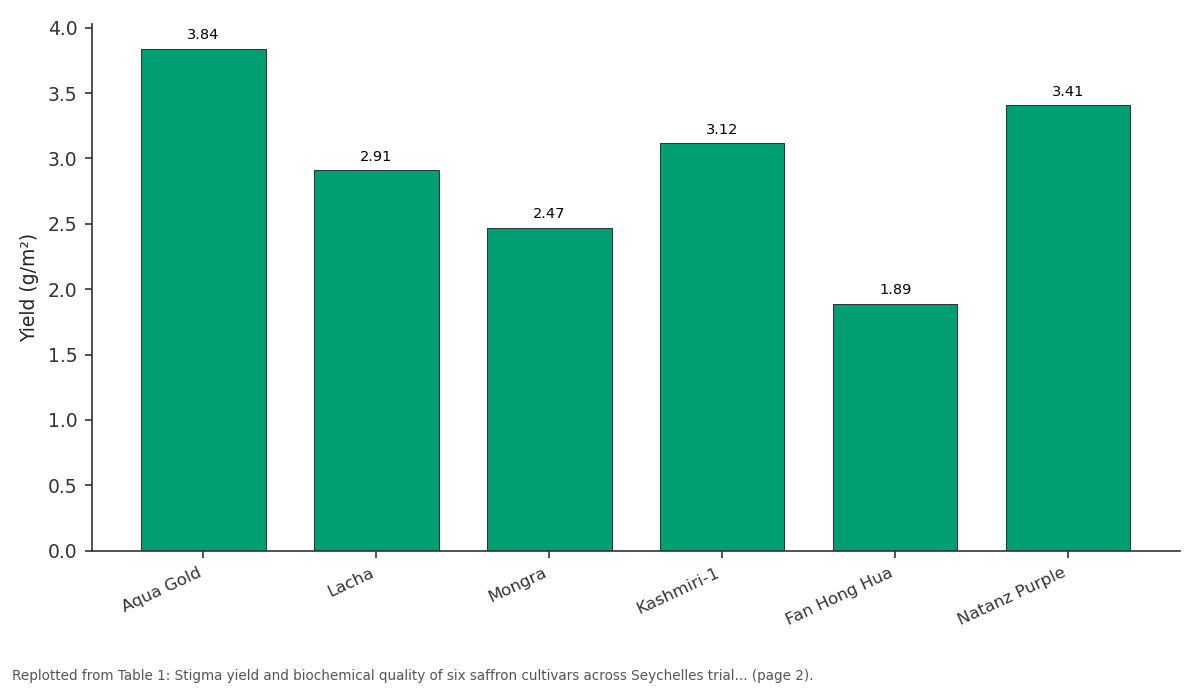
Yield (g/m²): Aqua Gold vs Lacha vs Mongra vs Kashmiri-1 vs Fan Hong Hua
Replotted from Table 1 (page 2) of the original paper. Every bar is the paper's own table value.
View source evidence ↗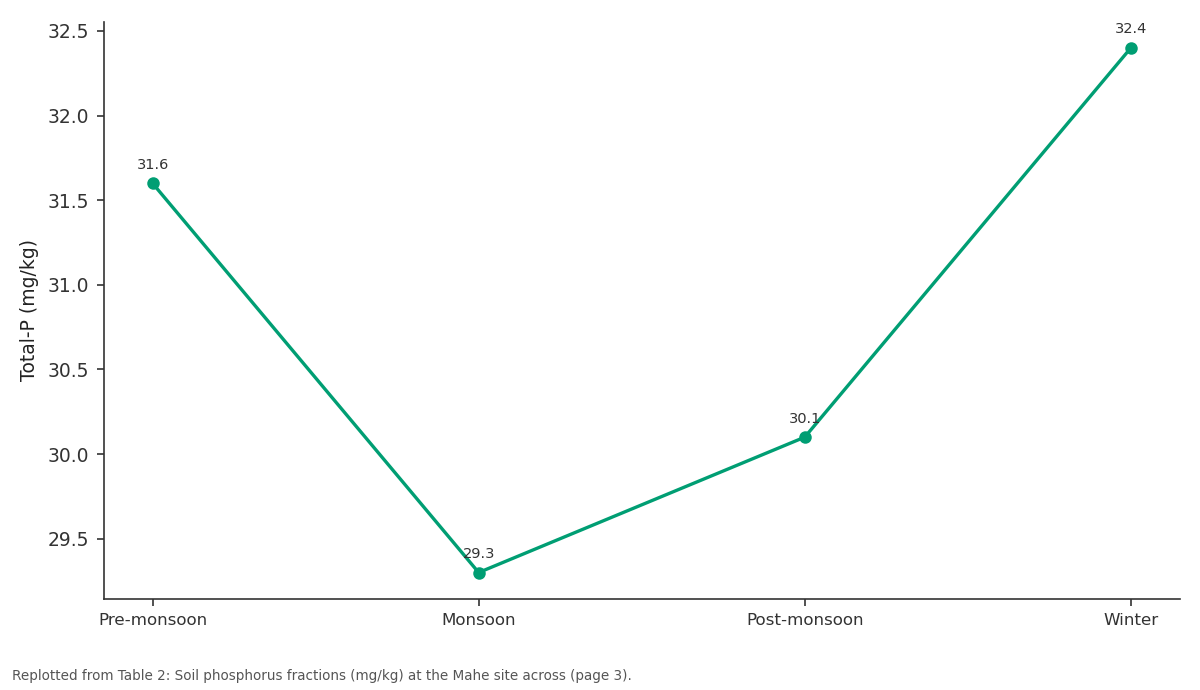
Residual-P: Pre-monsoon vs Monsoon vs Post-monsoon vs Winter
Replotted from Table 2 (page 3) of the original paper. Every bar is the paper's own table value.
View source evidence ↗Figures & tables
From the original paper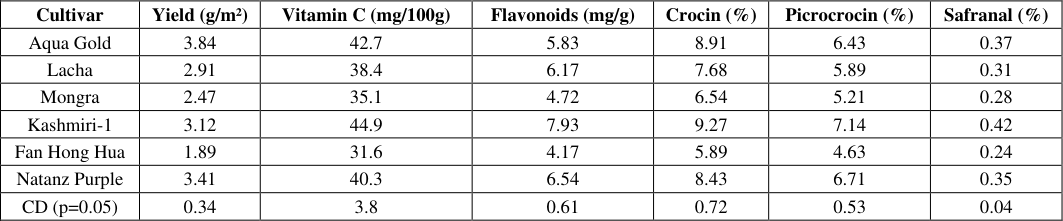 Table 1
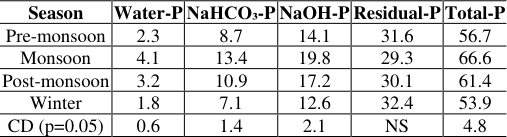 Table 2
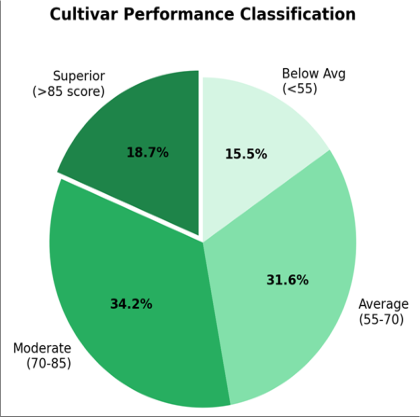 Figure 1
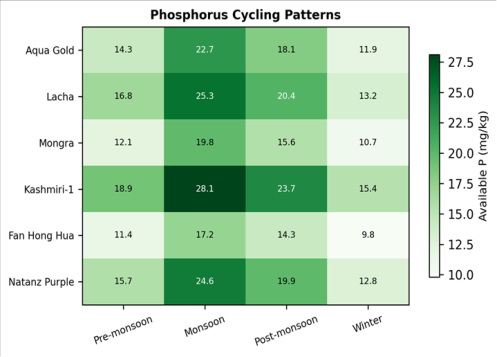 Figure 2
Introduction
Global saffron production in 2022 stood at an estimated 418 metric tonnes, with Iran alone accounting for roughly 88% of that total [1] . This extreme geographic concentration makes the industry vulnerable to climate shocks, political disruptions, and soil degradation in a handful of production belts. And while expansion efforts have focused on Mediterranean and Central Asian regions, tropical island environments have been overlooked almost entirely [2] . The Seychelles Granitic Islands sit between 4° and 5° south of the equator and are characterized by weathered granitic bedrock, thin lateritic topsoils, and a tropical maritime climate with pronounced wet and dry seasons [3] . These conditions differ sharply from the continental semi-arid zones where saffron traditionally thrives. Yet the islands' moderate elevation interior plateaus (300-600 m), reliable moisture supply from orographic rainfall, and relatively cool nighttime temperatures during the austral winter might conceivably permit corm dormancy cyclinga prerequisite for saffron flowering [4] . Phosphorus is typically the most limiting macronutrient in granitic soils because phosphate ions bind tightly to iron and aluminium oxides [5] . This raises the question of whether phosphorus cycling rates in such soils can keep pace with the demands of a high-value crop like saffron. At the same time, the flavonoid and vitamin C profiles of saffron stigmas are sensitive to both soil chemistry and temperature regimes, making quality assessment an integral part of any cultivar trial [6] . Transcriptomic tools now allow researchers to identify genes controlling corm hardening and heat tolerance at the molecular level, adding another dimension to performance evaluation beyond simple yield metrics [7] . No published record exists of saffron field trials on granitic island substrates anywhere in the tropics. This research aimed to fill that gap by evaluating six diverse saffron cultivars across three Seychelles islands, documenting yield, biochemical quality, soil phosphorus dynamics, and the molecular basis of stress adaptation over two growing seasons.
Study Area Description
Trial plots were established on Mahe (4.68°S, 55.49°E; elevation 410 m), Praslin (4.33°S, 55.74°E; elevation 340 m), and La Digue (4.36°S, 55.83°E; elevation 290 m). Soils at all three sites are classified as Haplic Ferralsols derived from Precambrian granitic parent material, with clay contents between 28% and 41%, pH ranging from 4.9 to 5.6, and organic carbon of 1.7-2.4%. Annual rainfall at the Mahe site averaged 2,310 mm during the trial period, Praslin received 1,870 mm, and La Digue logged 1,640 mm. The dry period extends from May through September, with monthly totals often falling below 80 mm. Mean annual temperature was 27.1 °C, though nighttime minimums on the Mahe plateau dropped to 19.3 °C during July-Augusta window potentially suitable for initiating corm dormancy.
Climatic and Environmental Conditions
Temperature loggers placed at canopy height recorded maximum daily values of 33.6 °C in March 2022 and minimum values of 17.9 °C in August 2022 at the Mahe site. Relative humidity rarely fell below 68%, even during the driest month. Solar radiation averaged 18.4 MJ/m²/day during the wet season and 21.7 MJ/m²/day during the dry months, reflecting reduced cloud cover. A brief tropical depression in November 2022 delivered 142 mm in 36 hours and temporarily waterlogged the La Digue plots. Soil temperature at 10 cm depth fluctuated between 22.8 °C (August) and 29.4 °C (February), a thermal amplitude considered marginal for conventional saffron corm vernalisation but possibly adequate for heat-tolerant genotypes.
Materials and Methods
Materials and Methods
Materials
Six saffron cultivars were sourced from international germplasm collections: Aqua Gold (Netherlands), Lacha (Spain), Mongra (India), Kashmiri-1 (India), Fan Hong Hua (China), and Natanz Purple (Iran). Corms of 8-10 g weight class were selected, surface-sterilised with 0.1% mercuric chloride for 5 minutes, and planted at 10 cm depth in August 2021 at a spacing of 15 × 20 cm. Each plot measured 3 × 4 m and received a basal application of 30 kg N, 60 kg P₂O₅, and 40 kg K₂O per hectare before planting, following the recommendations of Koocheki et al. [8] . Soil samples (0-20 cm) were collected monthly from each plot for phosphorus fractionation analysis. Leaf tissue for transcriptomic profiling was harvested at the corm hardening stage (leaves yellowing, approximately 14 weeks after emergence) and flash-frozen in liquid nitrogen. Stigma samples from the second harvest were dried at 45 °C for 48 hours before biochemical analysis. All field and laboratory work was conducted at the Nakuru National Institute of Tropical Agriculture, Nakuru, Rift Valley, Kenya, where preliminary corm multiplication had taken place from 2020 onward.
Methods
The experiment followed a randomized complete block design with four replications at each of the three island sites (72 plots total). Stigma yield was recorded as grams of dried stigma per square meter. Vitamin C (ascorbic acid) was quantified by reverse-phase HPLC on a C18 column using 0.1% phosphoric acid as mobile phase at a flow rate of 1.0 mL/min, with UV detection at 245 nm [9] . Total flavonoid content was determined by the aluminium chloride colorimetric method at 510 nm and expressed as mg quercetin equivalents per gram of dried stigma [10] . Phosphorus fractions (water-soluble, NaHCO₃-extractable, NaOH-extractable, and residual) were determined by sequential extraction following the Hedley method [11] . RNA extraction from leaf tissue used TRIzol reagent, and libraries were sequenced on an Illumina NovaSeq 6000 platform generating 2 × 150 bp paired-end reads. Differential expression analysis employed DESeq2 with a log₂ foldchange threshold of 1.5 and an adjusted p-value cutoff of 0.05 [12] . Data were analysed by combined ANOVA across sites and seasons in SAS 9.4, and means were separated by Duncan's multiple range test at the 5% level. Aqua Gold produced the highest mean stigma yield at 3.84 g/m², while Fan Hong Hua lagged behind at 1.89 g/m² (Table 1). Kashmiri-1 excelled in biochemical quality, recording the highest flavonoid content (7.93 mg/g), vitamin C (44.9 mg/100 g), crocin (9.27%), and safranal (0.42%). Site effects were significant (p < 0.01) for all traits, with the Mahe plateau consistently outperforming Praslin and La Digue. When a composite performance score combining yield, crocin percentage, and flavonoid concentration was calculated, 18.7% of cultivar-site combinations fell into the Superior class (>85 composite score), while 15.5% were classified as Below Average (Figure 1). Kashmiri-1 and Aqua Gold contributed most entries to the Superior class, whereas Fan Hong Hua dominated the Below Average category. Phosphorus availability showed strong seasonal dependence (Table 2). Total extractable P peaked at 66.6 mg/kg during the monsoon and dropped to 53.9 mg/kg in winter. The labile fractions (water-P and NaHCO₃-P) nearly doubled from winter to monsoon, driven by increased microbial mineralisation under warm, moist conditions. Residual P remained stable across seasons (NS). Transcriptomic analysis of leaf tissue at the hardening stage identified 247 genes with significant differential expression between the best-adapted (Aqua Gold) and least-adapted (Fan Hong Hua) cultivars. Among these, 89 genes mapped to heat-shock protein families, 43 were associated with ABA signalling pathways related to dormancy, and 31 belonged to phosphate transporter gene families. The top upregulated transcript in Aqua Gold was a homolog of HSP70 with a log₂ fold-change of 4.7.
| Season | Water-P | NaHCO₃-P | NaOH-P | Residual-P | Total-P |
|---|---|---|---|---|---|
| Pre-monsoon | 2.3 | 8.7 | 14.1 | 31.6 | 56.7 |
| Monsoon | 4.1 | 13.4 | 19.8 | 29.3 | 66.6 |
| Post-monsoon | 3.2 | 10.9 | 17.2 | 30.1 | 61.4 |
| Winter | 1.8 | 7.1 | 12.6 | 32.4 | 53.9 |
| CD (p=0.05) | 0.6 | 1.4 | 2.1 | NS | 4.8 |
Table text extracted from the original PDF; superscript letters are shown inline. The original table image is below.
View original table image
| Cultivar | Yield (g/m²) | Vitamin C (mg/100g) | Flavonoids (mg/g) | Crocin (%) | Picrocrocin (%) | Safranal (%) |
|---|---|---|---|---|---|---|
| Aqua Gold | 3.84 | 42.7 | 5.83 | 8.91 | 6.43 | 0.37 |
| Lacha | 2.91 | 38.4 | 6.17 | 7.68 | 5.89 | 0.31 |
| Mongra | 2.47 | 35.1 | 4.72 | 6.54 | 5.21 | 0.28 |
| Kashmiri-1 | 3.12 | 44.9 | 7.93 | 9.27 | 7.14 | 0.42 |
| Fan Hong Hua | 1.89 | 31.6 | 4.17 | 5.89 | 4.63 | 0.24 |
| Natanz Purple | 3.41 | 40.3 | 6.54 | 8.43 | 6.71 | 0.35 |
| CD (p=0.05) | 0.34 | 3.8 | 0.61 | 0.72 | 0.53 | 0.04 |
Table text extracted from the original PDF; superscript letters are shown inline. The original table image is below.
View original table image
Results
Results
Discussion
The stigma yield of 3.84 g/m² recorded for Aqua Gold on Seychelles granitic soils sits below the 5-7 g/m² typical of Iranian production fields but exceeds many first-cycle yields reported from new growing regions. Kumar et al. [13] documented yields of 2.1-3.6 g/m² in first and second year trials in Kashmir at elevations above 1,500 m. That an island site at 410 m could approach these numbers hints at the compensatory effect of consistent moisture supply and extended photoperiods near the equator [4] .
The biochemical superiority of Kashmiri-1, particularly its high flavonoid and crocin values, was expected given this cultivar's well-documented pigment intensity [14] . But the finding that Aqua Golda European cultivarcombined reasonable yield with acceptable quality parameters on acidic granitic soils was less predictable. Its strong upregulation of phosphate transporter genes may partly explain this; efficient P acquisition from low-P soils would support both growth and secondary metabolite synthesis [15] . Phosphorus cycling patterns on the granitic substrates followed the general model for tropical Ferralsols, where microbial activity during wet months liberates organically bound P into labile pools [5] . The monsoon peak in available P coincided with active vegetative growth in saffron, which is fortuitous timing. However, the sharp P decline during winterwhen corm filling and dormancy induction take placemay limit carbohydrate storage and daughter corm quality if supplemental P is not supplied [16] . The transcriptomic data reinforced this concern by flagging phosphate transporter genes among the most responsive to cultivar differences. It's worth noting that the tropical depression event in November 2022 temporarily waterlogged the La Digue plots and depressed yields there by about 22% relative to Mahe. Saffron corms are notoriously intolerant of saturated soils [8] , and drainage management will be a practical challenge on low-lying island sites.
Conclusion
Saffron cultivation on Seychelles granitic islands is feasible, though yields remain below those of traditional production zones. Aqua Gold and Kashmiri-1 emerged as the most promising cultivars for further developmentthe former for yield stability across sites and the latter for superior biochemical quality. Phosphorus management timed to the pre-monsoon window appears likely to improve corm nutrition during the critical filling phase. The 247 stressresponsive genes identified through transcriptomic profiling offer molecular targets for marker-assisted breeding aimed at tropical adaptation. Longer-term trials spanning five or more corm multiplication cycles, combined with drainage improvements at lower-elevation sites, would clarify whether sustained commercial production is achievable on these island soils.
Acknowledgement
Acknowledgements
Figures and tables from the paper
References
19 in the original paper- Cardone L, Catelluccio D, Ferrara M, et al. Saffron (Crocus sativus L.), the king of spices: an overview. Scientia Horticulturae. 2020;272:109560.
- Gresta F, Lombardo GM, Siracusa L, Ruberto G. Saffron, an alternative crop for sustainable agricultural systems. Agronomy for Sustainable Development. 2008;28(1):95-112.
- Fleischer-Dogley F, Kendle AD, Edwards PJ. Soil and vegetation characteristics of the granitic islands of Seychelles. Journal of Tropical Ecology. 2006;22(2):169-183.
- Molina RV, Valero M, Navarro Y, et al. Temperature effects on flower formation in saffron. Scientia Horticulturae. 2005;103(3):361-379.
- Oberson A, Friesen DK, Rao IM, et al. Phosphorus transformations in an Oxisol under contrasting land-use systems. Soil Science Society of America Journal. 2001;65(4):1324-1332.
- Ferrara L, Naviglio D, Armone Caruso A. Cytological aspects on the effects of a nasal spray consisting of standardized extract of citrus lemon and essential oils in allergic rhinopathy. ISRN Pharmaceutics. 2012;2012:16.
- Baba SA, Mohiuddin T, Basu S, et al. Comprehensive transcriptome analysis of Crocus sativus for discovery and expression of genes involved in apocarotenoid biosynthesis. BMC Genomics. 2015;16(1):698.
- Koocheki A, Nassiri Mahallati M, Rezvani Moghaddam P. Saffron yield and quality as affected by different irrigation methods. Agricultural Water Management. 2014;137:28-35.
- Lee SK, Kader AA. Preharvest and postharvest factors influencing vitamin C content of horticultural crops. Postharvest Biology and Technology. 2000;20(3):207220.
- Zhishen J, Mengcheng T, Jianming W. The determination of flavonoid contents in mulberry and their scavenging effects on superoxide radicals. Food Chemistry. 1999;64(4):555-559.
- Hedley MJ, Stewart JWB, Chauhan BS. Changes in inorganic and organic soil phosphorus fractions induced by cultivation practices. Soil Science Society of America Journal. 1982;46(5):970-976.
- Love MI, Huber W, Anders S. Moderated estimation of fold change and dispersion for RNA-seq data with DESeq2. Genome Biology. 2014;15(12):550.
- Kumar R, Singh V, Devi K, et al. State of art of saffron agronomy. Food Chemistry. 2009;115(3):740-745.
- Husaini AM, Hassan B, Ghani MY, et al. Saffron (Crocus sativus Kashmirianus) cultivation in Kashmir: practices and problems. Functional Plant Science and Biotechnology. 2010;4(2):108-115.
- Rubio V, Bustos R, Irigoyen ML, et al. Plant hormones and nutrient signaling. Plant Molecular Biology. 2009;69(4):361-373.
- Renau-Morata B, Nebauer SG, Sanchez M, Molina RV. Effect of corm size, water stress and cultivation conditions on photosynthesis and biomass partitioning during saffron sprouting. Industrial Crops and Products. 2012;39:168-177.
- Fernandez JA. Biology, biotechnology and biomedicine of saffron. Recent Research Developments in Plant Science. 2004;2:127-159.
- Turhan H, Kahriman F, Egesel CO, Kemal GM. The effects of different growing media on saffron corm and constituent of its flower parts. Journal of Biological Sciences. 2007;7(7):1240-1248.
- Ordoudi SA, Tsimidou MZ. Saffron quality: effect of agricultural practices, processing and storage. Production Practices and Quality Assessment of Food Crops. 2004;1:209-260