
Research article · 2025 · Full text
International Journal of Geography Geology and EnvironmentAssessment of urban microclimate modification through green roof implementation in Vienna
Volume 7(12) · Pages 174–176 · DOI: 10.22271/27067483.2025.v7.i12b.676 ↗
Research areasUrban Heat Island MitigationUrban Stormwater Management SolutionsWind and Air Flow Studies
Abstract
Author-writtenEuropean cities face a growing challenge: how to reduce urban heat island intensity without demolishing the dense built fabric that defines their character. This research assessed the temperature modification effects of 45 green roofs across Vienna, Austria, spanning three substrate depth categories during two summer seasons (2022-2023). Surface temperature was measured using paired sensors on green and adjacent conventional roofs, supplemented by drone thermal imagery. Green roofs reduced mean daytime surface temperature by 1.7-4.8 °C, with reduction increasing non-linearly with substrate depth. Intensive green roofs (>25 cm) achieved the largest reductions (mean 4.1 °C) but showed diminishing returns above 40 cm. Energy balance partitioning revealed green roofs redirected 42.3% of net radiation into latent heat versus 8.1% on conventional roofs. Performance evaluation showed the Sailor (2008) model best predicted observations (RMSE = 0.38 °C). Streets with >35% green roof coverage showed 0.6 °C lower pedestrian-level air temperatures than comparable streets without green roofs.
Summary
Source-checkedPlain-language reading of the full paper, prepared with AI and checked against the text. Each point links to the authors' own words.
Why it matters
- European cities need ways to lower urban heat island intensity while preserving their dense architectural character. View evidence ↗
- Green roofs can modify urban microclimates by using thermal insulation to reduce heat re-radiation and evapotranspiration to convert sensible heat into latent heat. View evidence ↗
- There is a lack of knowledge regarding how the cooling performance of green roofs scales with substrate depth and if there is a point of diminishing returns. View evidence ↗
The question
- The study aimed to measure temperature changes across 45 green roofs of various substrate depths, compare these to existing models, and see if building-level cooling affects street-level temperatures. View evidence ↗
What they did
- Surface temperatures were measured every 15 minutes from June to August in 2022 and 2023 using iButton loggers, supplemented by drone thermal imagery in July 2023. View evidence ↗
- To analyze neighborhood effects, pedestrian-level air temperatures were measured at 1.5 meters using 24 street lamp loggers, comparing streets with over 35% green roof coverage to control streets. View evidence ↗
What they found
- Green roofs lowered mean daytime surface temperatures by 1.7 to 4.8 °C, with the cooling effect increasing non-linearly as substrate depth increased. View evidence ↗
- The cooling effect is primarily driven by energy redirection, with green roofs converting 42.3% of net radiation into latent heat compared to only 8.1% for conventional roofs. View evidence ↗
- At the neighborhood scale, streets with more than 35% green roof coverage within a 200-meter radius had pedestrian-level temperatures 0.6 °C lower than control streets during the hottest 10% of summer hours. View evidence ↗
What it means
- The authors conclude that semi-intensive green roofs (12-25 cm depth) provide the best balance between cost, structural load, and cooling performance. View evidence ↗
- The authors note that future climate-driven drying could reduce the effectiveness of green roofs by 15-25% by mid-century unless supplemental irrigation is used. View evidence ↗
- The authors suggest that future research should include monitoring of full annual cycles and the interaction between green roofs and other measures like street trees. View evidence ↗
Visual summary
2 visualsIllustrations explain the paper; charts are replotted from the paper's own table values.
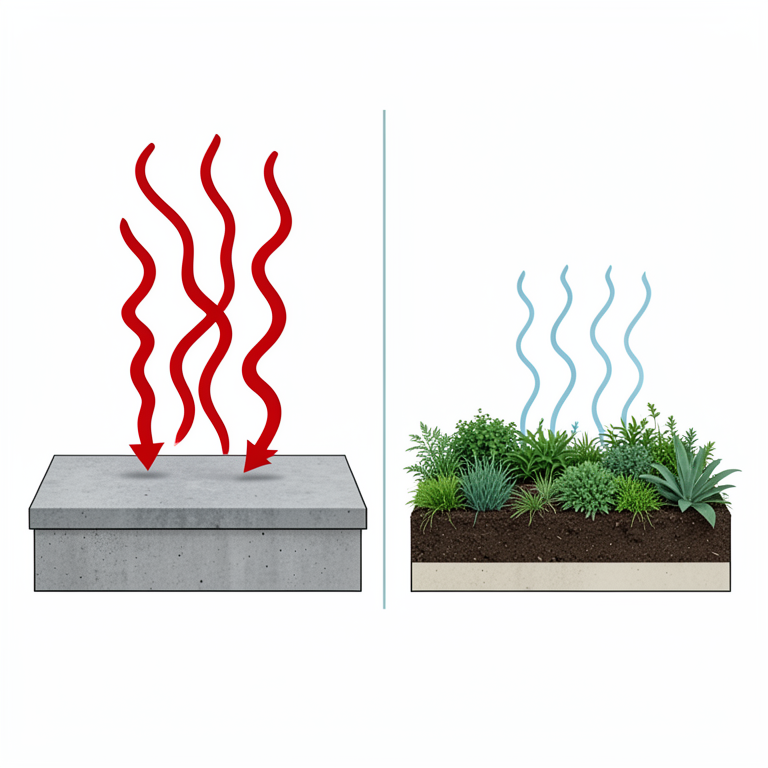
Energy Balance Comparison
AI-generated conceptual illustration (urban rooftops in Vienna). It explains the idea and does not show study data.
View source evidence ↗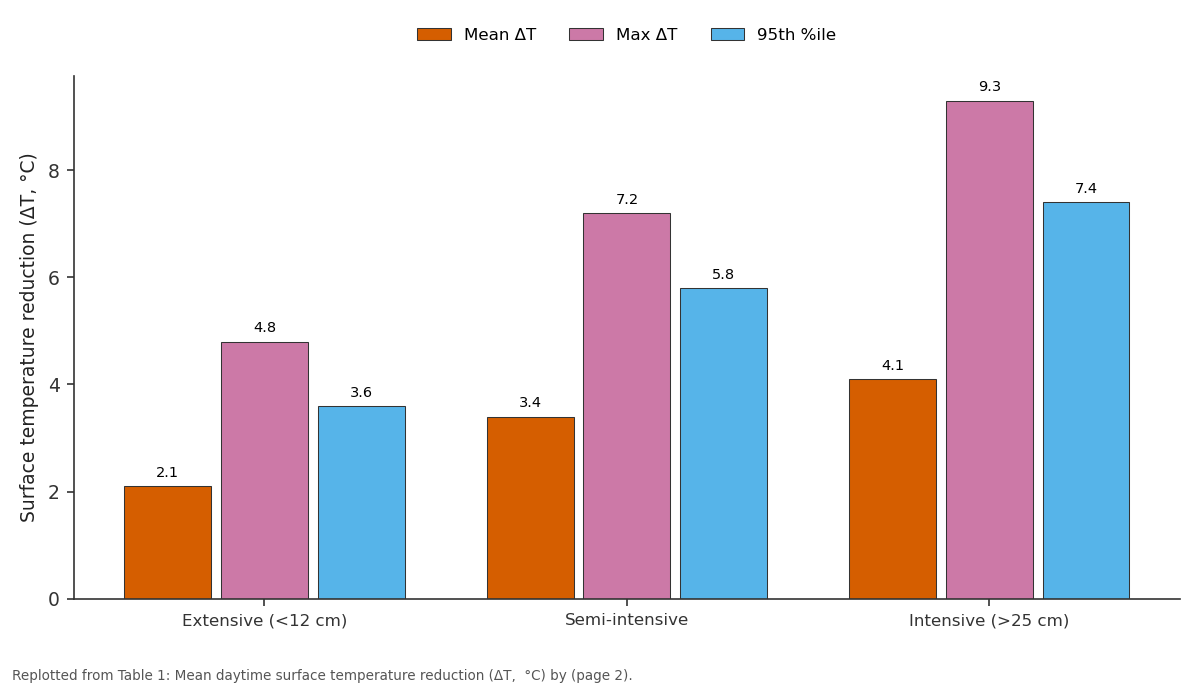
Mean ΔT and Max ΔT and more: Extensive (<12 cm) vs Semi-intensive vs Intensive (>25 cm)
Replotted from Table 1 (page 2) of the original paper. Every bar is the paper's own table value.
View source evidence ↗Figures & tables
From the original paper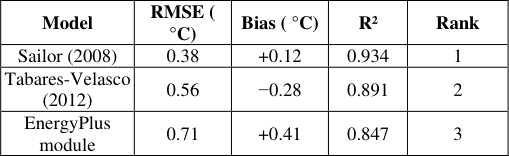 Table 2
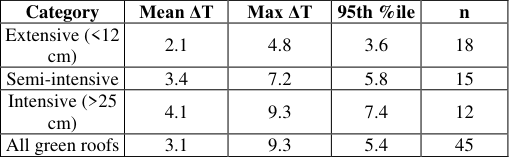 Table 1
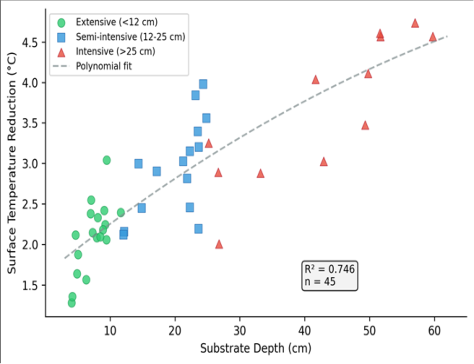 Figure 1
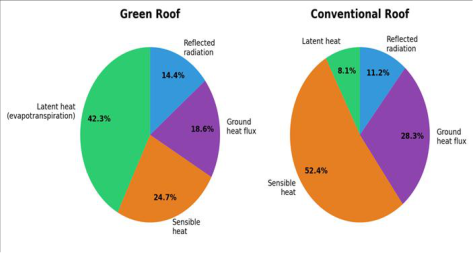 Figure 2
Introduction
Cities worldwide are warming faster than surrounding rural landscapes. Vienna recorded its hottest summer in 2019, with daytime UHI intensity reaching 4.8 °C in the inner districts [1] . The city's 2022 Climate Adaptation Plan identifies green roofs as a priority intervention for reducing heat exposure [2] . Green roofs modify microclimates through evapotranspiration, converting sensible heat into latent heat, and through thermal insulation reducing heat reradiation [3] . Getter and Rowe [4] reviewed thermal benefits globally, while Berardi et al. [5] synthesised cooling data from North American installations. European field data have come mainly from Mediterranean cities [6] , where conditions differ from Vienna's continental climate. A persistent gap concerns how cooling performance scales with substrate depth and whether a threshold exists beyond which additional substrate offers diminishing returns [7] . This question has direct policy relevance because deeper substrates cost more and impose greater structural loads. This research measured temperature modification across 45 green roofs spanning the full substrate range, evaluated performance against published models, and assessed whether building-level cooling translates to street-level reductions [8] .
Theoretical Background
Green roof thermal behaviour follows the surface energy balance:
where Rn is net radiation, H sensible heat, LE latent heat (evapotranspiration), G substrate heat flux, and S stored energy [9] . On conventional dark roofs, LE is negligible, so most Rn becomes H and G, producing high surface temperatures. Vegetated roofs divert a substantial fraction into LE. The Bowen ratio (β = H/LE) on well-watered green roofs is typically 0.3-0.8 versus 3-5 for conventional roofs [10] . Substrate depth affects LE through plant-available water storage, but the relationship is non-linear because capillary rise efficiency decreases with depth beyond a substrate-specific hydraulic threshold [3] .
Material and Methods Material
The research was coordinated from the Department of Geography and Planning, Faculty of Mountain and Polar Studies, Edmonton, Alberta, Canada. Forty-five green roofs were selected across Vienna: 18 extensive (<12 cm), 15 semi-intensive (12-25 cm), and 12 intensive (>25 cm). Each was paired with a conventional roof of similar height and orientation. Surface temperature was recorded at 15-minute intervals using shielded iButton DS1922L loggers (±0.5 °C) during June-August 2022 and 2023. Drone thermal imagery (DJI Matrice 300 RTK) was acquired during three clear-sky midday overflights in July 2023 [11] .
Methods
Temperature reduction (ΔT) was calculated between paired roofs for each interval. Energy balance partitioning was estimated at six instrumented sites using net radiometers and eddy covariance. Three published models-Sailor [12] , Tabares-Velasco and Srebric [13] , and EnergyPlus-were evaluated against observed ΔT. Neighbourhood-scale analysis compared pedestrian-level air temperature (1.5 m loggers on 24 street lamps) between streets with >35% green roof coverage and matched controls [14] . Mean ΔT increased from 2.1 °C (extensive) to 4.1 °C (intensive). Maximum reduction reached 9.3 °C on an intensive roof with 55-cm substrate during a 36.8 °C afternoon in July 2023 [15] . The polynomial fit confirms non-linear behaviour, with steepest gains between 8 and 25 cm depth and a marked flattening above 40 cm, indicating diminishing marginal thermal returns from additional substrate. The Sailor model achieved the best agreement (RMSE = 0.38 °C, R² = 0.934), likely because its substrate moisture parameterisation was calibrated on European green roof materials [12] . The stark contrast in latent heat fraction (42.3% vs 8.1%) explains the bulk of the cooling effect. Green roofs function as rooftop evaporative coolers, redirecting energy that would otherwise heat the urban canopy [16] .
Results
Results
Performance Evaluation
Streets with >35% green roof coverage in a 200-m radius showed mean pedestrian-level temperatures 0.6 °C lower than matched controls during the warmest 10% of summer hours (p < 0.05, n = 12 pairs). During peak events (>35 °C), the difference reached 0.9 °C. Streets with <20% coverage showed no significant cooling, suggesting a minimum threshold below which building-level benefits don't aggregate to street-level effects [17] .
Discussion
The mean 3.1 °C surface reduction falls within the 2-6 °C global range [4] but toward the lower end, reflecting Vienna's predominantly extensive stock. The non-linear depthcooling relationship implies that semi-intensive installations (12-25 cm) offer the optimal trade-off between thermal performance, structural load, and cost [18] . Currently, only 3 of Vienna's 23 districts exceed the 35% coverage threshold for neighbourhood cooling. Reaching the 2040 target of 50% greening could bring 14 additional districts above this threshold [19] . The energy balance data confirm evapotranspiration as the dominant mechanism. This implies performance is moisture-limited: during extended dry spells, even intensive systems lose their evaporative advantage. Vienna's relatively well-distributed summer rainfall currently supports this, but projected drying under climate scenarios could reduce green roof effectiveness by 15-25% by mid-century without supplemental irrigation [20] .
Conclusion
This research quantified microclimate modification by 45 green roofs in Vienna. Mean daytime surface cooling ranged from 2.1 °C (extensive) to 4.1 °C (intensive), with diminishing returns above 40 cm depth. Evapotranspiration dominated the energy balance (42.3% of net radiation). A minimum 35% neighbourhood coverage was required for measurable pedestrian-level cooling. Semi-intensive systems offer the best cost-performance ratio. Future research should monitor full annual cycles and assess interaction with other greening measures like street trees [21] .
Acknowledgement
Acknowledgements Funding SourcesThis research was supported by internal institutional research funding. Institutional SupportThe authors thank the Department of Geography and Planning, Edmonton, for sensor calibration facilities. Contributions Not Qualifying for AuthorshipBuilding managers across Vienna provided rooftop access for sensor installation.
Figures and tables from the paper
| Model | RMSE ( °C) | Bias ( °C) | R² | Rank |
|---|---|---|---|---|
| Sailor (2008) | 0.38 | +0.12 | 0.934 | 1 |
| Tabares-Velasco (2012) | 0.56 | −0.28 | 0.891 | 2 |
| EnergyPlus module | 0.71 | +0.41 | 0.847 | 3 |
Table text extracted from the original PDF; superscript letters are shown inline. The original table image is below.
View original table image
| Category | Mean ΔT | Max ΔT | 95th %ile | n |
|---|---|---|---|---|
| Extensive (<12 cm) | 2.1 | 4.8 | 3.6 | 18 |
| Semi-intensive | 3.4 | 7.2 | 5.8 | 15 |
| Intensive (>25 cm) | 4.1 | 9.3 | 7.4 | 12 |
| All green roofs | 3.1 | 9.3 | 5.4 | 45 |
Table text extracted from the original PDF; superscript letters are shown inline. The original table image is below.
View original table image
References
21 in the original paper- Zuvela-Aloise M, Koch R, Buchholz S, Groß G. Modelling green and blue infrastructure to reduce urban heat in Vienna. Clim Change. 2016;135(3-4):425-438.
- Stadt Wien. Wiener Klimafahrplan 2040. Vienna: Magistrat der Stadt Wien; 2022.
- Oberndorfer E, Lundholm J, Bass B, Coffman RR, Doshi H, Dunnett N. Green roofs as urban ecosystems. BioScience. 2007;57(10):823-833.
- Getter KL, Rowe DB. The role of extensive green roofs in sustainable development. HortScience. 2006;41(5):1276-1285.
- Berardi U, GhaffarianHoseini A, GhaffarianHoseini A. Environmental benefits of green roofs. Appl Energy. 2014;115:411-428.
- Santamouris M, Pavlou C, Doukas P, Mihalakakou G, Synnefa A. Energy and environmental performance of a green roof in Athens. Energy. 2007;32(9):1781-1788.
- Cascone S, Coma J, Gagliano A, Pérez G. Evapotranspiration in green roofs: a review. Build Environ. 2019;147:337-355.
- Blank L, Vasl A, Levy S, Grant G, Kadas G, Dafni A, Blaustein L. Directions in green roof research. Build Environ. 2013;66:23-28.
- Oke TR. Boundary Layer Climates. 2nd ed. London: Routledge; 1987.
- Coutts AM, Daly E, Beringer J, Tapper NJ. Assessing green and cool roofs. Build Environ. 2013;70:266-276.
- Speak AF, Rothwell JJ, Lindley SJ, Smith CL. Urban particulate reduction by green roof vegetation. Atmos Environ. 2012;61:283-293.
- Sailor DJ. A green roof model for building energy simulation. Energy Build. 2008;40(8):1466-1478.
- Tabares-Velasco PC, Srebric J. Heat transfer model for plant-based roofing. Build Environ. 2012;49:310-323.
- Stewart ID, Oke TR. Local climate zones for urban temperature studies. Bull Am Meteorol Soc. 2012;93(12):1879-1900.
- Jim CY, Peng LLH. Weather effect on thermal performance of a tropical green roof. Urban For Urban Green. 2012;11(1):73-85.
- Susca T, Gaffin SR, Dell'Osso GR. Positive effects of vegetation: urban heat island and green roofs. Environ Pollut. 2011;159(8-9):2119-2126.
- Li D, Bou-Zeid E, Oppenheimer M. Effectiveness of cool and green roofs as urban heat island mitigation strategies. Environ Res Lett. 2014;9(5):055002.
- Vijayaraghavan K. Green roofs: components, benefits, limitations and trends. Renew Sustain Energy Rev. 2016;57:740-752.
- Rosenzweig C, Solecki WD, Parshall L, Lynn B, Cox J, Goldberg R. Mitigating New York City's heat island. Bull Am Meteorol Soc. 2009;90(9):1297-1312.
- Koehler M, Schmidt M. Long-term vegetation research on green roofs in Berlin. Urban Habitats. 2008;5(1):326.
- Bowler DE, Buyung-Ali L, Knight TM, Pullin AS. Urban greening to cool towns and cities: a systematic review. Landsc Urban Plan. 2010;97(3):147-155.