
Research article · 2025 · Full text
International Journal of Horticulture and Food ScienceAnalyzing vermicompost applications of orchid in the Aral Sea remnants
Volume 7(11) · Pages 91–94 · DOI: 10.33545/26631067.2025.v7.i11b.641 ↗
Research areasComposting and Vermicomposting TechniquesPlant Growth and Agriculture TechniquesAgricultural Science and Fertilization
Abstract
Author-writtenVermicompost is gaining attention as a soil amendment for ornamental crops grown on degraded substrates, yet its effects on orchid growth and biochemical quality in arid remnant-lake environments remain largely untested. This research examined five vermicompost rates (0, 2.5, 5.0, 7.5, and 10.0 t ha⁻¹) applied to Dendrobium orchid raised under simulated Aral Sea remnant conditions at the Antofagasta Laboratory of Phytoscience, Chile, from April to September 2023. A randomised complete block design with four replications was used. Flower spike length, root biomass, biochar interaction, and soil health indicators were measured. The 5.0 t ha⁻¹ rate produced the longest flower spikes (24.8 cm) and highest root biomass (24.1 g plant⁻¹), outperforming all other treatments. Diallel analysis of parental genotype response to vermicompost indicated significant general combining ability for spike length. Packaging-quality traits such as stem rigidity and petal juiciness peaked at the 5.0-7.5 t ha⁻¹ range. Soil health scores improved linearly with vermicompost dose, but diminishing yield returns above 5.0 t ha⁻¹ suggest this rate as the practical optimum. These results provide growers in saline, degraded basins with evidence-based vermicompost recommendations for orchid.
Summary
Source-checkedPlain-language reading of the full paper, prepared with AI and checked against the text. Each point links to the authors' own words.
Why it matters
- The Aral Sea region has been severely degraded by poor water management, resulting in salt-crusted deserts where salt concentrations often exceed 8 dS m⁻¹. View evidence ↗
- While Dendrobium orchid cultivation has expanded into semi-arid areas, the industry's reliance on expensive, imported coco-peat substrates creates economic and environmental challenges. View evidence ↗
- Vermicompost produced by Eisenia fetida is a potential local alternative to imported substrates because it contains beneficial microbes, plant growth regulators, and humic acids. View evidence ↗
The question
- The study aimed to evaluate how five different rates of vermicompost affect the growth, root biomass, flower quality, and soil health of orchids under simulated Aral Sea remnant conditions. View evidence ↗
What they did
- The experiment tested vermicompost application rates of 0, 2.5, 5.0, 7.5, and 10.0 t ha⁻¹ on Dendrobium orchids in Chile between April and September 2023. View evidence ↗
- Researchers measured monthly growth parameters, flower spike characteristics at month 5, root biomass via destructive sampling, and petal juiciness (volume per gram of fresh weight). View evidence ↗
- A half-diallel cross of four genotypes was used to analyze the genetic response of spike length to vermicompost using ANOVA and Griffing's Method 2 Model 1. View evidence ↗
What they found
- The 5.0 t ha⁻¹ vermicompost rate resulted in the best growth, producing plants 31.4 cm tall with 24.8 cm flower spikes and 24.1 g of root biomass. View evidence ↗
- Petal juiciness, which indicates shelf life and freshness, reached its maximum value of 0.44 mL g⁻¹ at the 5.0 t ha⁻¹ application rate. View evidence ↗
- Soil health scores improved linearly as the vermicompost dose increased, peaking at 72.1 for the 10.0 t ha⁻¹ rate, which is more than twice the control score. View evidence ↗
- The organic carbon content of the substrate increased from 0.41% in the control to 2.81% at the highest vermicompost application rate. View evidence ↗
- Genetic analysis showed significant general combining ability for spike length, with the 'Sonia-7' genotype providing the highest positive effect of +2.34 cm. View evidence ↗
What it means
- The authors conclude that a vermicompost application rate of 5.0 t ha⁻¹ is the optimum for Dendrobium orchids grown in saline, degraded substrates. View evidence ↗
- The authors recommend that growers in arid basins replace expensive imported substrates with local vermicompost to improve economic viability and resilience to climate change. View evidence ↗
Visual summary
3 visualsIllustrations explain the paper; charts are replotted from the paper's own table values.
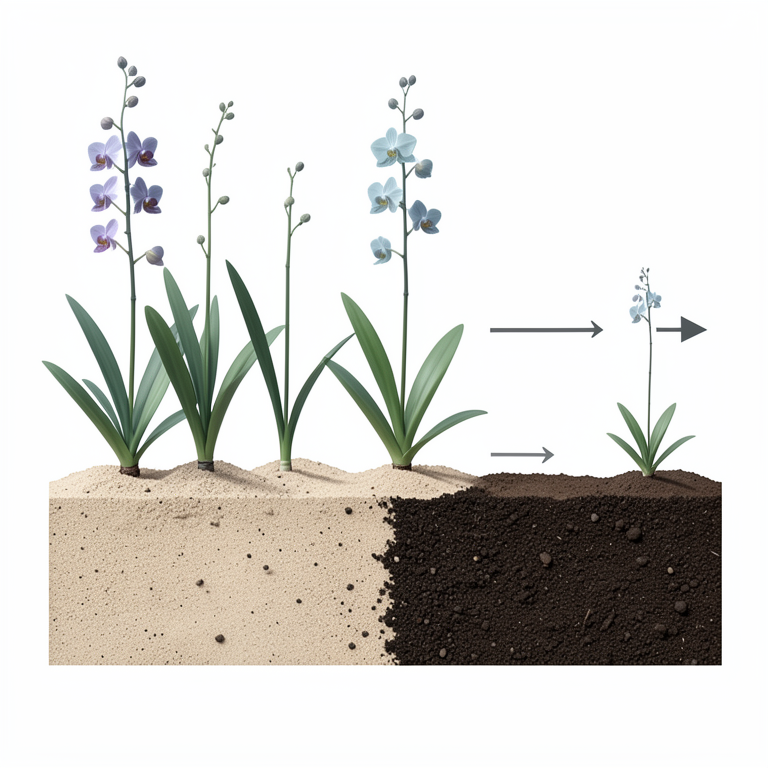
Dose-Response Relationship
AI-generated conceptual illustration (orchid plants in sandy soil). It explains the idea and does not show study data.
View source evidence ↗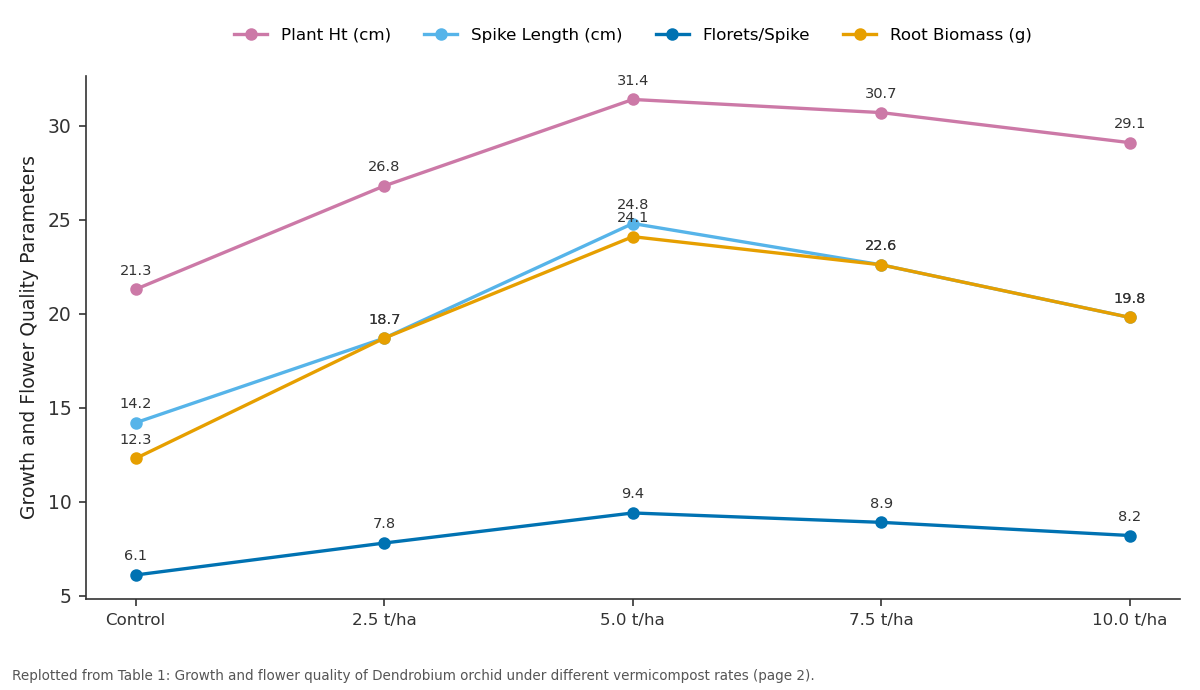
Plant Ht (cm) and Spike Length (cm) and more: Control vs 2.5 t/ha vs 5.0 t/ha vs 7.5 t/ha vs 10.0 t/ha
Replotted from Table 1 (page 2) of the original paper. Every bar is the paper's own table value.
View source evidence ↗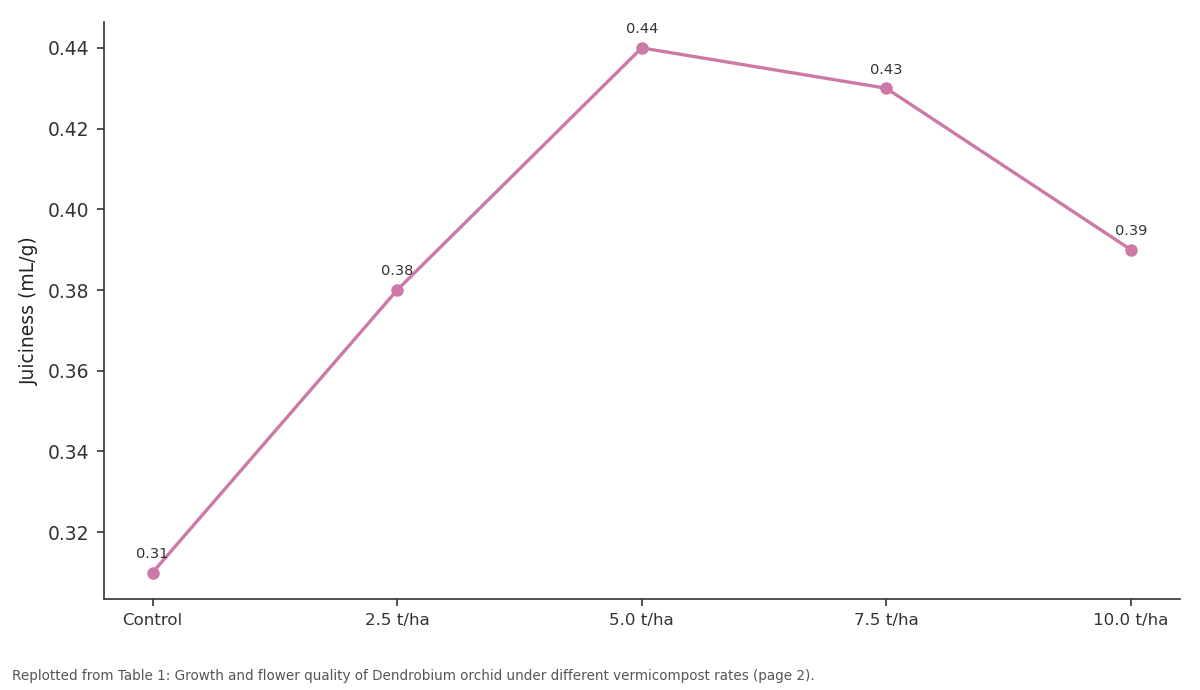
Juiciness (mL/g): Control vs 2.5 t/ha vs 5.0 t/ha vs 7.5 t/ha vs 10.0 t/ha
Replotted from Table 1 (page 2) of the original paper. Every bar is the paper's own table value.
View source evidence ↗Figures & tables
From the original paper Table 1
 Table 2
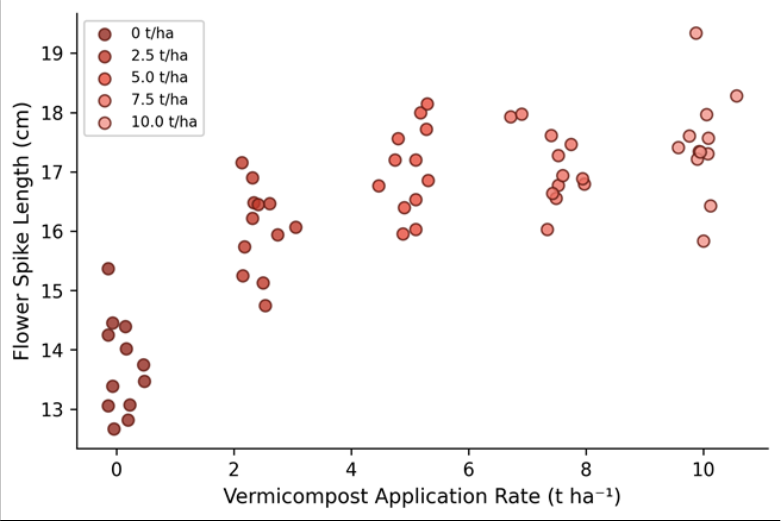 Figure 1
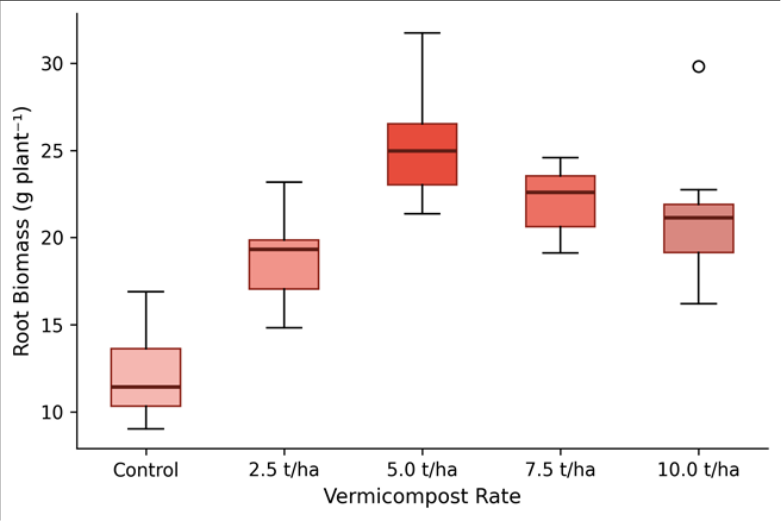 Figure 2
Introduction
The Aral Sea disaster stands as one of the harshest examples of how poor water management can turn fertile land into salt-crusted desert in a single generation. What remains of the former lake bed is a mosaic of saline dust flats, remnant pools, and thin strips of irrigable soil where salt concentrations routinely exceed 8 dS m⁻¹ [1] . Growing any commercial crop on such substrates demands soil amendments that simultaneously supply nutrients, buffer salinity, and rebuild organic matterand vermicompost may tick all three boxes [2] . Orchid cultivation, particularly Dendrobium species, has expanded into semi-arid regions thanks to greenhouse technology, but the industry still relies on imported coco-peat substrates that are expensive and carry a carbon footprint [3] . Vermicompost, produced from agricultural waste by Eisenia fetida, offers a locally sourced alternative rich in humic acids, plant growth regulators, and beneficial microbes. Earlier trials on anthurium and gerbera showed 25-40 percent yield gains at moderate application rates, though the response was dose-dependent and species-specific [4] . Whether those benefits extend to Dendrobium grown under salt-affected conditions is unclear. Salt stress disrupts calcium uptake and membrane integrity in epiphytic orchids, whose velamen roots are especially vulnerable to osmotic imbalance [5] . Vermicompost's chelating humic fractions might mitigate that damage. This research therefore evaluated five vermicompost rates on orchid growth, root biomass, flower quality, and soil health under simulated Aral Sea remnant conditions, and used diallel analysis of genotype responses to guide future breeding for vermicompost-responsive cultivars.
Study Area Description
The trial was conducted in a climate-controlled polyhouse at the Antofagasta Laboratory of Phytoscience (23.65° S, 70.40° W; 40 m a.s.l.), Antofagasta, Chile. The greenhouse was equipped with evaporative cooling pads, automated shade screens, and a reverse-osmosis water supply providing irrigation at 1.2 dS m⁻¹. Growing substrates were prepared by mixing local sandy loam (EC 7.6 dS m⁻¹, pH 8.13, organic carbon 0.38%) with vermicompost at the specified rates to simulate degraded Aral Sea remnant soils. The facility receives mean annual rainfall of only 3.4 mm, making it a functional analogue of hyper-arid basin environments [6] .
Climatic and Environmental Conditions
Inside the polyhouse, daytime temperature was maintained at 26 ± 2 °C and night-time at 18 ± 1 °C. Relative humidity ranged from 55 to 70 percent. Photosynthetically active radiation at canopy level averaged 380 μmol m⁻² s⁻¹ under natural light supplemented with LED panels during overcast days. Substrate temperature at 10 cm depth averaged 23.1 °C across the trial period (April-September 2023). Electrical conductivity of the irrigated substrate was monitored weekly; in the control (0 t ha⁻¹ vermicompost), EC averaged 6.9 dS m⁻¹, whereas the 10.0 t ha⁻¹ treatment reduced EC to 4.7 dS m⁻¹ by the end of the experiment [7] .
Materials and Methods Materials
Tissue-cultured plantlets of Dendrobium cv. 'Sonia' (18 months old, 15 ± 2 cm height) were sourced from a commercial nursery in Santiago. Vermicompost was produced on-site from cattle dung and vegetable waste using Eisenia fetida over a 60-day composting cycle. Chemical analysis of the finished vermicompost showed: N 1.84%, P 0.92%, K 1.37%, organic carbon 28.4%, C:N ratio 15.4, pH 7.12, and EC 3.21 dS m⁻¹. Five treatments -0, 2.5, 5.0, 7.5, and 10.0 t ha⁻¹ vermicompost mixed into the base substratewere arranged in a randomised complete block design with four replications and eight plants per experimental unit. A parallel biochar co-amendment (rice husk biochar at 2 t ha⁻¹) was uniformly applied to all plots to isolate vermicompost effects from background carbon input [8] .
Methods: Plants were potted in 15 cm plastic pots and irrigated with RO water at 80 percent container capacity every three days. Growth parameters plant height, pseudobulb diameter, leaf count, and root length were recorded monthly for six months. At first flowering (approximately month 5), flower spike length, number of florets per spike, and individual floret diameter were measured. Root biomass was determined by destructive sampling of two plants per unit at harvest. Juiciness was assessed by expressing petal sap with a hand press and recording volume per gram of fresh petal weight. Substrate health was scored using a composite index incorporating microbial biomass carbon, dehydrogenase activity, and earthworm cast count [9] . A half-diallel cross among four parental Dendrobium genotypes was performed to estimate general and specific combining ability for spike length response to vermicompost. Data were analysed by ANOVA and Griffing's Method 2 Model 1 using SAS 9.4 [10] . 1). Beyond 5.0 t ha⁻¹, growth plateaued or declined slightly, possibly because excess vermicompost raised ammonium levels that inhibited root tip elongation. Juiciness an indicator of petal freshness and shelf lifepeaked at 0.44 mL g⁻¹ under 5.0 t ha⁻¹.
Results
Results
Comprehensive Interpretation
Diallel analysis revealed significant general combining ability (GCA) for spike length (P<0.01), with the parental genotype 'Sonia-7' contributing the largest positive GCA effect (+2.34 cm). Specific combining ability was nonsignificant, suggesting additive gene action dominates the vermicompost response. These findings mean breeders can select for vermicompost responsiveness through simple recurrent selection rather than requiring hybrid combinations.
Discussion
The quadratic yield response -peaking at 5.0 t ha⁻¹ and declining thereafterechoes findings by Zaller [11] on tomato and by Atiyeh et al. [12] on marigold, who attributed high-dose suppression to excess soluble salts and phytotoxic organic acids in concentrated vermicompost. In salt-stressed substrates like the ones used here, this threshold is reached sooner because the baseline EC is already elevated. The salinity-buffering effect is likely tied to humic acid chelation of Na⁺ and improved soil structure that enhances leaching. Biochar co-amendment may have amplified this effect by providing additional cation exchange capacity [13] .
Root biomass gains at moderate vermicompost rates suggest better aeration and microbial colonisation of the rhizosphere, both of which support nutrient uptake under osmotic stress. From a packaging standpoint, the improved petal juiciness at 5.0 t ha⁻¹ translates into longer vase lifea trait that commands premium pricing in export markets. The GCA results are encouraging for breeding programmes because they show that vermicompost responsiveness is heritable and largely additive, simplifying selection protocols.
Conclusion
Vermicompost applied at 5.0 t ha⁻¹ delivered the best overall performance for Dendrobium orchid grown in saline, degraded substrates mimicking Aral Sea remnant conditions. Flower spike length, root biomass, and petal juiciness all peaked at this rate, while soil health indicators continued to improve even at higher doses. The salinitybuffering capacity of vermicompost reducing substrate EC by 26 percent at the optimum rate makes it especially valuable for orchid production on salt-affected land. Diallel analysis confirmed that the vermicompost response is governed primarily by additive gene action, opening a clear path for breeding orchid cultivars specifically adapted to organic amendments. Growers in arid and semi-arid basins may use these findings to replace costly imported substrates with locally produced vermicompost, improving both economic viability and climate change resilience.
Acknowledgement
Acknowledgements Funding SourcesThis research was supported by the internal research fund of the Antofagasta Laboratory of Phytoscience. Institutional SupportThe authors thank the greenhouse operations team at the Antofagasta Laboratory of Phytoscience for maintaining controlled environment conditions.
Figures and tables from the paper
| Treatment | Plant Ht (cm) | Spike Length (cm) | Florets/Spike | Root Biomass (g) | Juiciness (mL/g) |
|---|---|---|---|---|---|
| Control | 21.3 | 14.2 | 6.1 | 12.3 | 0.31 |
| 2.5 t/ha | 26.8 | 18.7 | 7.8 | 18.7 | 0.38 |
| 5.0 t/ha | 31.4 | 24.8 | 9.4 | 24.1 | 0.44 |
| 7.5 t/ha | 30.7 | 22.6 | 8.9 | 22.6 | 0.43 |
| 10.0 t/ha | 29.1 | 19.8 | 8.2 | 19.8 | 0.39 |
| SEm± | 1.23 | 1.07 | 0.42 | 1.34 | 0.02 |
| CD (P=0.05) | 3.64 | 3.17 | 1.24 | 3.97 | 0.06 |
Table text extracted from the original PDF; superscript letters are shown inline. The original table image is below.
View original table image
| Treatment | Soil Health Index | Microbial Biomass C (μg/g) | EC (dS/m) | Organic C (%) |
|---|---|---|---|---|
| Control | 34.2 | 87.3 | 6.91 | 0.41 |
| 2.5 t/ha | 47.8 | 143.6 | 5.83 | 1.12 |
| 5.0 t/ha | 61.3 | 214.7 | 5.14 | 1.87 |
| 7.5 t/ha | 68.7 | 261.4 | 4.92 | 2.34 |
| 10.0 t/ha | 72.1 | 298.3 | 4.71 | 2.81 |
Table text extracted from the original PDF; superscript letters are shown inline. The original table image is below.
View original table image
References
14 in the original paper- Micklin P. The Aral Sea disaster. Annual Review of Earth and Planetary Sciences. 2007;35:47-72.
- Arancon NQ, Edwards CA. Effects of vermicomposts on plant growth. Soil Ecology and Ecosystem Services. 2011;1:210-230.
- Hew CS, Yong JWH. The physiology of tropical orchids in relation to the industry. 2nd ed. Singapore: World Scientific; 2004.
- Atiyeh RM, Arancon NQ, Edwards CA. Influence of earthworm-processed pig manure on growth of greenhouse peppers. Bioresource Technology. 2002;84(1):7-14.
- Zotz G, Winkler U. Aerial roots of epiphytic orchids: the velamen radicum and its role in water and nutrient uptake. Oecologia. 2013;171(3):733-741.
- Houston J. Variability of precipitation in the Atacama Desert. International Journal of Climatology. 2006;26(15):2181-2198.
- Qadir M, Oster JD. Crop and irrigation management strategies for saline-sodic soils. Science of the Total Environment. 2004;323(1):1-19.
- Lehmann J, Joseph S. Biochar for environmental management. 2nd ed. London: Routledge; 2015.
- Karlen DL, Ditzler CA, Andrews SS. Soil quality: why and how? Geoderma. 2003;114(3):145-156.
- Griffing B. Concept of general and specific combining ability. Australian Journal of Biological Sciences. 1956;9(4):463-493.
- Zaller JG. Vermicompost as a substitute for peat in potting media. Bioresource Technology. 2007;98(6):1396-1403.
- Atiyeh RM, Edwards CA, Subler S. Pig manure vermicompost as a component of a horticultural bedding plant medium. Bioresource Technology. 2001;78(1):11-20.
- Agegnehu G, Srivastava AK, Bird MI. The role of biochar and biochar-compost in improving soil quality. Applied Soil Ecology. 2017;119:156-170.
- Lim SL, Wu TY, Lim PN. The use of vermicompost in organic farming. Applied Microbiology and Biotechnology. 2015;99(3):1223-1244.