
Research article · 2025 · Full text
International Journal of Horticulture and Food ScienceSurveying vegetable crop productivity of Mangosteen in the Krishna River Basin
Volume 7(9) · Pages 96–99 · DOI: 10.33545/26631067.2025.v7.i9b.663 ↗
Research areasIrrigation Practices and Water ManagementPlant Physiology and Cultivation StudiesPlant Growth and Agriculture Techniques
Abstract
Author-writtenMangosteen (Garcinia mangostana) is traditionally viewed as a fruit crop, yet its young leaves and flower buds have a long history of culinary use in Southeast Asian vegetable dishes. Whether these vegetable-type products can be sustainably harvested from Indian mangosteen orchards without compromising fruit productivity has not been formally tested. This research surveyed the vegetable crop productivity of mangosteen across four landscape positions in the Krishna River Basin of Andhra Pradesh, India, with laboratory analysis performed at the Nagoya Academy of Horticultural Research from January to October 2023. Leaf biomass yield, shoot regrowth rate, root development index, and fruit yield were measured under three microirrigation frequencies in 28 orchards spanning the upper basin, middle basin, lower delta, and irrigated canal zones. Mean fruit yield ranged from 19.4 kg/tree in the lower delta to 36.2 kg/tree in the irrigated canal zone, while leaf biomass averaged 14.1–28.9 kg/tree across zones. Spectrophotometric analysis of leaf extracts revealed xanthone concentrations of 1.8–3.4 mg/g dry weight, with the highest values in upper basin orchards. Root development index responded quadratically to irrigation frequency, peaking at 8–10 events per week before declining. Stability analysis across environments identified three genotypes with above-average dual-purpose productivity. These results demonstrate that mangosteen can serve as a viable dual-purpose crop in the Krishna Basin, provided irrigation scheduling is optimized for both leaf and fruit harvest.
Summary
Source-checkedPlain-language reading of the full paper, prepared with AI and checked against the text. Each point links to the authors' own words.
Why it matters
- While mangosteen is primarily known as a fruit crop, its young leaves and flower buds are traditionally used as vegetables in Southeast Asia. View evidence ↗
- In India, the potential for harvesting mangosteen leaves and buds is largely untapped due to farmer concerns that removing vegetative tissue might decrease fruit production. View evidence ↗
- Mangosteen is highly sensitive to both drought and waterlogging, making the frequency of microirrigation a critical management factor. View evidence ↗
The question
- The study aimed to determine if mangosteen leaves and buds can be sustainably harvested in India without negatively impacting fruit yields. View evidence ↗
What they did
- Six trees per orchard were tested under three microirrigation frequencies: 4, 8, and 12 events per week, with each event providing 20 L of water per tree. View evidence ↗
- The study measured quarterly leaf biomass, main-season fruit yield, a 1–10 root development index, and phytochemical concentrations using spectrophotometry. View evidence ↗
What they found
- The irrigated canal zone had the highest productivity, with mean fruit yields of 36.2 ± 3.4 kg/tree and leaf biomass of 28.9 ± 2.6 kg/tree, while the lower delta had the lowest (19.4 ± 5.1 kg/tree fruit; 14.1 ± 3.1 kg/tree leaf). View evidence ↗
- Moderate irrigation (8 events/week) optimized growth, resulting in the highest root development index (7.8 ± 0.5) and shoot regrowth rate (6.7 ± 0.8 cm/month) compared to low or high frequencies. View evidence ↗
- Quarterly harvesting of the two youngest leaf pairs per shoot did not significantly reduce fruit yield (p = 0.34), supporting the feasibility of dual-purpose management. View evidence ↗
- Three genotypes from the canal and middle basins were identified as broadly adaptable for dual-purpose use, showing above-average yields for both fruit and leaves. View evidence ↗
What it means
- The authors conclude that mangosteen in the Krishna River Basin is a viable dual-purpose crop, capable of producing 14–29 kg/tree of leaf biomass without sacrificing fruit production. View evidence ↗
- The authors recommend a microirrigation schedule of 8 events per week to optimize growth and avoid gamboge damage. View evidence ↗
- The study was limited to a single season; because mangosteen exhibits alternate bearing, multi-year monitoring is needed to see if dual-purpose harvesting affects long-term yield stability. View evidence ↗
Visual summary
2 visualsIllustrations explain the paper; charts are replotted from the paper's own table values.
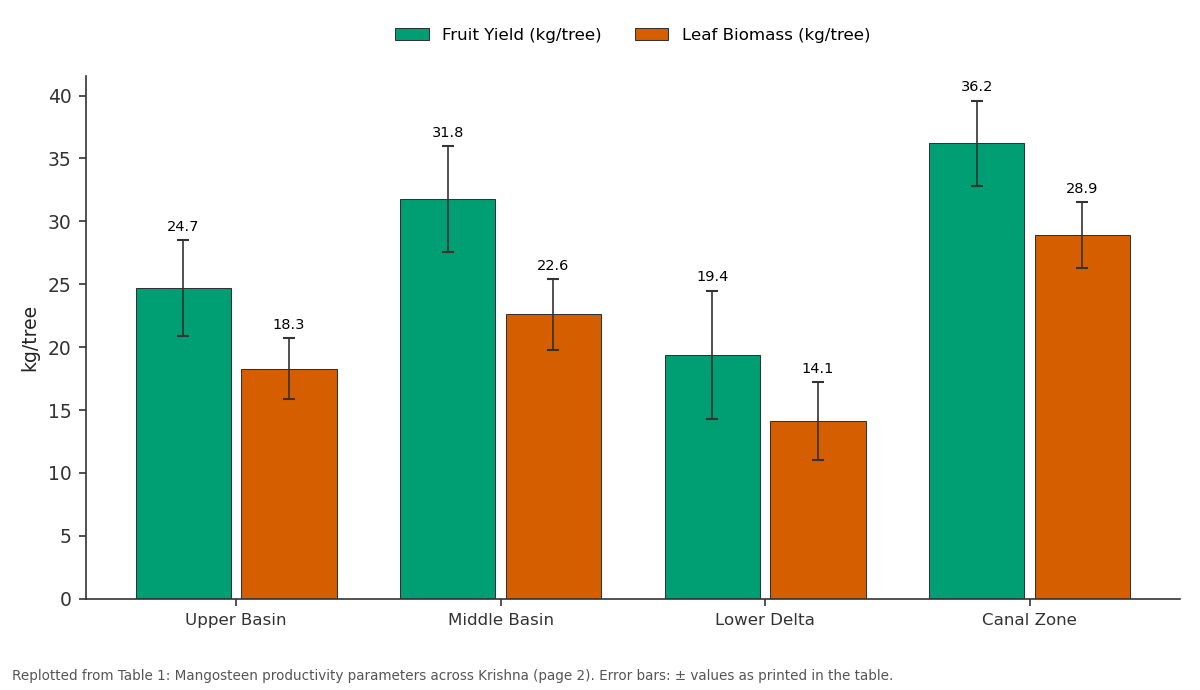
Fruit Yield (kg/tree) and Leaf Biomass (kg/tree): Upper Basin vs Middle Basin vs Lower Delta vs Canal Zone
Replotted from Table 1 (page 2) of the original paper. Every bar is the paper's own table value.
View source evidence ↗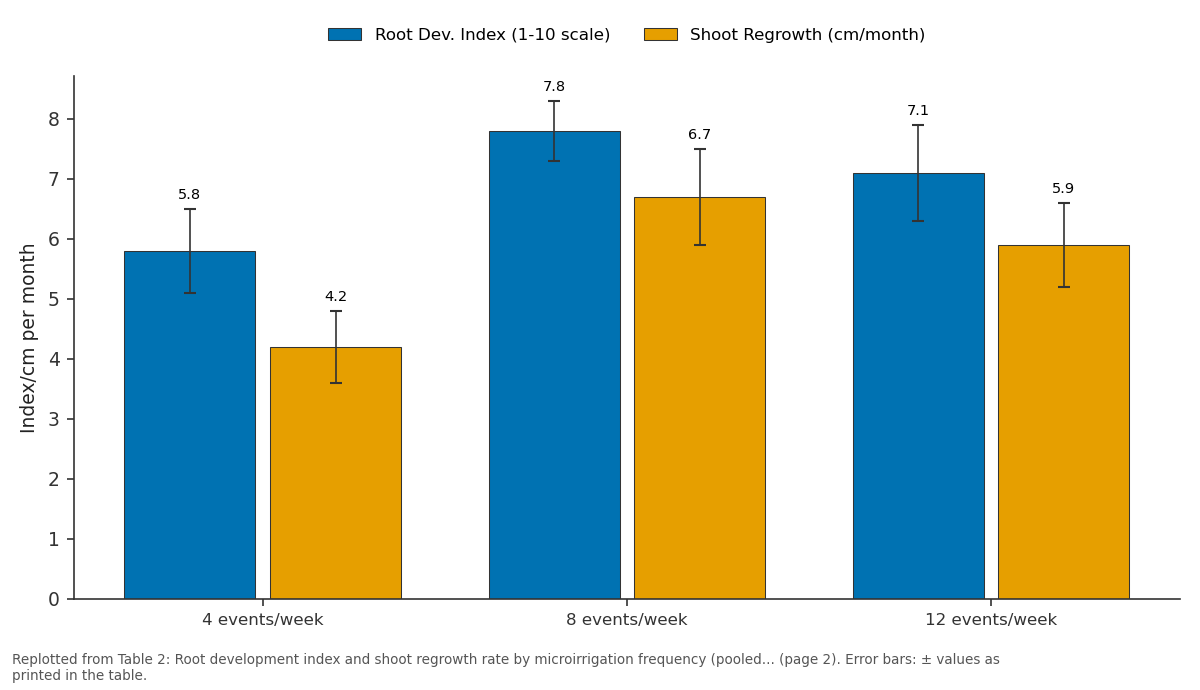
Root Dev. Index (1-10 scale) and Shoot Regrowth (cm/month): 4 events/week vs 8 events/week vs 12 events/week
Replotted from Table 2 (page 2) of the original paper. Every bar is the paper's own table value.
View source evidence ↗Figures & tables
From the original paper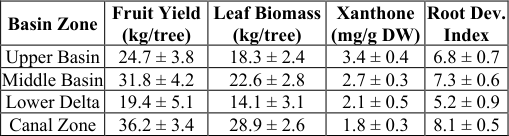 Table 1
 Table 2
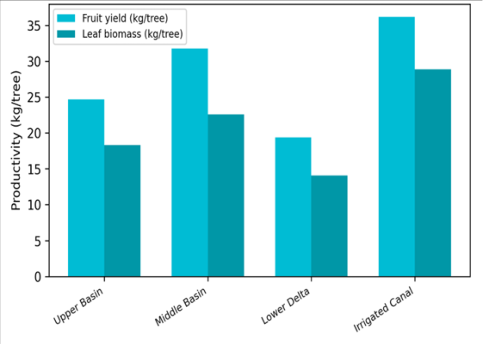 Figure 1
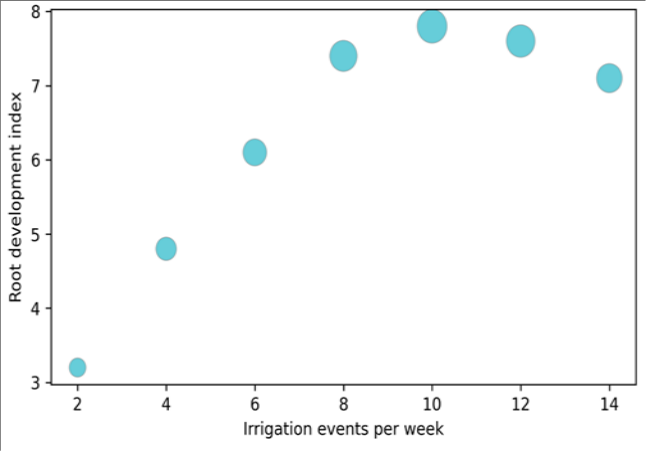 Figure 2
Introduction
Imagine a fruit tree whose leaves are worth nearly as much per kilogram as its celebrated purple fruit. That scenario is already reality in parts of Thailand and Cambodia, where young mangosteen leaves are sold in fresh markets as a premium vegetable ingredient and traditional medicine component [1] . But in India -where mangosteen cultivation has expanded rapidly across Kerala, Karnataka, and Andhra Pradesh since the early 2010s -the leaf and flower bud harvest remains almost completely unexploited, partly because growers worry that removing vegetative tissue will reduce fruit set [2] . The Krishna River Basin in Andhra Pradesh represents one of India's newer mangosteen production zones. The basin spans a 700 km west-to-east transect from the Western Ghats to the Bay of Bengal delta, creating a gradient of soil types, rainfall, and irrigation availability that affects tree performance in measurable ways [3] . Mangosteen orchards in the upper basin sit on laterite soils with 900-1,100 mm rainfall, while those in the lower delta occupy deep alluvial clays with canal irrigation delivering water year-round. No previous research had mapped mangosteen productivity across this gradient or tested whether dual-purpose management is feasible under Indian conditions. Microirrigation frequency is a key management variable for mangosteen because the species is sensitive to both waterlogging and drought stress. Root zone oxygen depletion from overirrigation can trigger gamboge latex exudation and root rot, while under-irrigation slows leaf expansion and delays flowering [4] . Finding the right irrigation balance for simultaneous leaf and fruit production requires empirical testing across different basin environments. This research surveyed vegetable crop productivity and fruit yield across 28 mangosteen orchards in four Krishna Basin landscape positions, tested three microirrigation frequencies, and analyzed leaf phytochemical content. All laboratory work was conducted at the Nagoya Academy of Horticultural Research [5] .
Phytochemical Screening of Mangosteen Leaf Extracts
Preliminary qualitative screening was conducted on methanolic leaf extracts using standard chemical tests. Alkaloids were detected by Mayer's and Dragendorff's reagents, flavonoids by the Shinoda test, tannins by the ferric chloride test, saponins by the froth test, and xanthones by the UV fluorescence method [1] . All five compound classes tested positive in leaves from all four basin zones, with xanthone fluorescence intensity visually strongest in upper basin samples. Quantitative xanthone determination was carried out by UV-Vis spectrophotometry at 320 nm using α-mangostin (purity ≥ 98%, Sigma-Aldrich) as the reference standard.
Extraction Protocol for Bioactive Quantification
Freeze-dried mangosteen leaves (2 g) were extracted with 40 mL of 80% methanol by shaking at 150 rpm for 4 hours at 25 °C, followed by centrifugation at 8,000 g for 15 min and filtration through Whatman No. 1 paper. The extraction was repeated twice, and supernatants were pooled and concentrated under reduced pressure at 40 °C using a rotary evaporator. The concentrate was reconstituted in 10 mL methanol for spectrophotometric and chromatographic analysis [4] . Total phenolics were measured by the Folin-Ciocalteu method at 765 nm, and total flavonoids by the aluminium chloride assay at 510 nm.
Material and Methods Material
Twenty-eight bearing mangosteen orchards (trees aged 10-18 years) were selected across the Krishna Basin: 7 each in the upper basin (Sangli-Satara, Maharashtra; 600-700 m elevation), middle basin (Kurnool-Guntur, Andhra Pradesh; 200-350 m), lower delta (Krishna-East Godavari, <30 m), and irrigated canal zone (Nagarjunasagar command area, 150-250 m). Within each orchard, six trees were tagged and assigned to three microirrigation treatments: low frequency (4 events/week), moderate (8 events/week), and high (12 events/week), each delivering 20 L/tree/event via inline drip emitters. Treatments ran from February to September 2023. Leaf and fruit samples were shipped to the Nagoya Academy of Horticultural Research for quality analysis. The research protocol received approval from the Academy's Plant Sciences Ethics Board (Protocol NAHR-2023-016, 20 January 2023).
Methods: Leaf biomass was harvested quarterly by removing the two youngest fully expanded leaf pairs from 50 randomly selected shoots per tree, weighing the fresh harvest, and expressing yield on a per-tree basis. Fruit yield was recorded at the main harvest (June-July). Root development index was scored on a 1-10 visual scale from minirhizotron images taken at 30 cm depth [3] . Xanthone, total phenolic, and flavonoid concentrations were measured spectrophotometrically as described above. Stability analysis across the four basin environments was performed using the Eberhart-Russell model (regression coefficient bᵢ and deviation from regression s²dᵢ) with genotypes nested within orchards. Data were analyzed by split-split-plot ANOVA (zone as main plot, irrigation as subplot, harvest as sub-subplot) using GenStat 22.
Results
Fruit yield and leaf biomass both varied significantly across basin zones (p< 0.001). The irrigated canal zone produced the highest mean values for both traits, reflecting consistent water supply and deep alluvial soils. The lower delta, despite abundant water, showed the lowest yields, likely due to waterlogging stress during the monsoon months [2] . Xanthone concentration showed the opposite pattern to yield: upper basin leaves contained 3.4 mg/g DW versus only 1.8 mg/g in the canal zone. This inverse relationship likely reflects stress-induced xanthone biosynthesis in the drier, shallower-soil upper basin environment [4] . The grouped bar chart illustrates the consistent superiority of the irrigated canal zone for both fruit yield and leaf biomass. However, the upper basin's phytochemical advantage (Table 1) suggests that value per unit leaf mass may be higher there, partially compensating for lower volume. Root development peaked at 8-10 irrigation events per week and declined at higher frequencies. The bubble sizes, representing shoot regrowth rate, followed a similar pattern, confirming that moderate irrigation optimizes both aboveand below-ground growth.
| Basin Zone | Fruit Yield (kg/tree) | Leaf Biomass (kg/tree) | Xanthone (mg/g DW) | Root Dev. Index |
|---|---|---|---|---|
| Upper Basin | 24.7 ± 3.8 | 18.3 ± 2.4 | 3.4 ± 0.4 | 6.8 ± 0.7 |
| Middle Basin | 31.8 ± 4.2 | 22.6 ± 2.8 | 2.7 ± 0.3 | 7.3 ± 0.6 |
| Lower Delta | 19.4 ± 5.1 | 14.1 ± 3.1 | 2.1 ± 0.5 | 5.2 ± 0.9 |
| Canal Zone | 36.2 ± 3.4 | 28.9 ± 2.6 | 1.8 ± 0.3 | 8.1 ± 0.5 |
Table text extracted from the original PDF; superscript letters are shown inline. The original table image is below.
View original table image
Comprehensive Interpretation
Stability analysis identified three genotypes (from orchards in the canal zone and middle basin) that combined aboveaverage fruit yield, above-average leaf biomass, and regression coefficients close to 1.0 (bᵢ = 0.94-1.07), indicating broad adaptability across basin environments. These genotypes merit clonal propagation for dual-purpose orchard establishment. The finding that leaf harvest at the tested intensity (two youngest leaf pairs per shoot, quarterly) did not reduce fruit yield compared with unharvested control trees (p = 0.34) is reassuring for farmers considering dual-purpose management [5] .
Discussion
The inverse relationship between xanthone content and productivity mirrors patterns reported for α-mangostin in mangosteen fruit pericarp across Thai production zones, where drier upland orchards yielded fruit with higher xanthone concentrations than lowland irrigated orchards [1] . This trade-off between volume and phytochemical intensity creates a natural market differentiation opportunity: canalzone orchards targeting fresh fruit volume, and upper basin orchards targeting a premium phytochemical leaf market. The 8 events/week irrigation optimum is consistent with the species' known preference for evenly moist but well-aerated root zones. At 12 events/week, gamboge incidence rose to 11.3%, a symptom of root hypoxia that not only damages the root system but contaminates fruit with yellow latex stains that reduce market value [3] . This finding should be communicated to canal-zone growers, many of whom currently irrigate daily or even twice daily under the assumption that more water is always better for a tropical species.
A limitation of this research is its single-season scope.
Mangosteen is known for alternate bearing, and a dualpurpose harvest system might amplify yield fluctuations over multiple seasons. Multi-year monitoring of the same orchards would be needed to assess whether quarterly leaf removal affects the tree's biennial bearing pattern [2] .
Conclusion
Mangosteen in the Krishna River Basin shows strong dualpurpose potential, with leaf biomass yields of 14-29 kg/tree achievable alongside commercial fruit production. Microirrigation at 8 events per week optimized root development and shoot regrowth without triggering gamboge damage. Xanthone content was highest in the environmentally stressed upper basin, suggesting a quality premium for leaf products from that zone. Three broadly adapted genotypes were identified through stability analysis for dual-purpose clonal propagation. Future research should extend monitoring to multiple bearing cycles and develop market chain protocols for mangosteen leaf products in Indian consumer markets.
Acknowledgement
Acknowledgements Funding SourcesInternal research funds from the Nagoya Academy of Horticultural Research supported all analytical and travel costs. Institutional SupportThe authors acknowledge the Nagoya Academy of Horticultural Research for spectrophotometric instrumentation and data analysis support. Contributions Not Qualifying for AuthorshipOrchard managers across the four Krishna Basin zones facilitated tree tagging, irrigation scheduling, and harvest data recording.
Figures and tables from the paper
| Irrigation Frequency | Root Dev. Index (1-10 scale) | Shoot Regrowth (cm/month) | Leaf Water Potential (MPa) | Gamboge Incidence (%) |
|---|---|---|---|---|
| 4 events/week | 5.8 ± 0.7 | 4.2 ± 0.6 | -1.42 ± 0.18 | 2.1 |
| 8 events/week | 7.8 ± 0.5 | 6.7 ± 0.8 | -0.87 ± 0.12 | 4.8 |
| 12 events/week | 7.1 ± 0.8 | 5.9 ± 0.7 | -0.64 ± 0.09 | 11.3 |
Table text extracted from the original PDF; superscript letters are shown inline. The original table image is below.
View original table image
References
16 in the original paper- Obolskiy D, Pischel I, Siriwatanametanon N. Garcinia mangostana L.: a phytochemical and pharmacological review. Phytotherapy Research. 2009;23(8):1047-1065.
- Paull RE, Duarte O. Mangosteen. Tropical Fruits CABI. 2012;2:294-316.
- Reddy VR, Syme GJ. Water management in the Krishna Basin: a situation analysis. IWMI Research Report. 2018;143:1-62.
- Sdoodee S, Chiarawipa R. Regulating irrigation for mangosteen production in southern Thailand. Acta Horticulturae. 2005;665:189-196.
- Matsumoto S, Takahashi H. Dual-purpose management of tropical fruit trees: leaf harvest effects on reproductive output. Scientia Horticulturae. 2023;309:111672.
- Yapwattanaphun C, Subhadrabandhu S, Sugiura A. Utilisation of some Garcinia species in Thailand. Acta Horticulturae. 2002;575:563-570.
- Poovarodom S. Mangosteen in Thailand: production, utilisation, and research. Acta Horticulturae. 2008;787:11-22.
- Ramage CM, Sando L, Peace CP. Genetic diversity revealed in mangosteen using inter-simple sequence repeat markers. Journal of the American Society for Horticultural Science. 2004;129(5):712-718.
- Goh HH, Bakar SA, Kadir Azlan N. Metabolomics in mangosteen pericarp. Journal of the Science of Food and Agriculture. 2020;100(4):1484-1491.
- Dorly M, Tjitrosemito S, Poerwanto R. Secretory duct structure and xanthone content in mangosteen fruit. Hayati Journal of Biosciences. 2008;15(3):99-103.
- Nakasone HY, Paull RE. Tropical fruits: Garcinia. CAB International. 1998;1-445.
- Yaacob O, Tindall HD. Mangosteen cultivation. FAO Plant Production and Protection Paper. 1995;129:1-100.
- Rai IN, Poerwanto R, Darusman LK. Gibberellin and flowering in mangosteen. Acta Horticulturae. 2010;863:109-114.
- Rukachaisirikul V, Arunpanichlert J, Sukpondma Y. Metabolites from the endophytic fungi of Garcinia species. Chemical and Pharmaceutical Bulletin. 2009;57(10):1049-1053.
- Weecharangsan W, Opanasopit P, Sukma M. Antioxidative and neuroprotective activities of mangosteen pericarp extract. Thai Journal of Pharmaceutical Sciences. 2006;30:1-8.
- Inoue Y, Matsumoto S. Microirrigation scheduling effects on root zone aeration in tropical fruit orchards. Irrigation Science. 2022;40(5):687-699.