
Research article · 2025 · Full text
International Journal of Horticulture and Food ScienceExamining fruit yield parameters of Rambutan in the CAUVERY Delta
Volume 7(9) · Pages 189–192 · DOI: 10.33545/26631067.2025.v7.i9c.743 ↗
Research areasPlant Physiology and Cultivation StudiesGenetics and Plant BreedingAgricultural Practices and Plant Genetics
Abstract
Author-writtenRambutan (Nephelium lappaceum) is gaining commercial interest in South Asian river deltas, yet yield responses to canopy management and their genetic basis remain poorly documented outside Southeast Asian production centers. This research examined fruit yield parameters of fifteen rambutan genotypes grown in the Cauvery Delta of Tamil Nadu, India, under five pruning intensities (10, 20, 30, 40, 50% canopy removal) over two consecutive seasons (2022-2023), with analytical work conducted at the Eldoret Institute of Agricultural Sciences. Yield per tree followed a bell-shaped response to pruning, peaking at 30-40% canopy removal (mean 63.8 kg/tree at 40%) and declining sharply beyond 50%. Fruit weight, aril recovery, total soluble solids, bitterness index, and cover crop biomass in the orchard floor were assessed as secondary parameters. Heterosis analysis of F₁ hybrids from a 5 × 5 diallel cross showed that additive genetic effects explained 34.8% of yield variance, dominance 27.3%, and epistasis 14.6%. Mid-parent heterosis for fruit yield reached 28.4% in the best cross combination (G3 × G11). Integrating cover crop (Mucuna pruriens) into the orchard floor increased soil organic carbon by 0.41 percentage points and rambutan yield by 8.7% over bare-soil controls. These results provide pruning prescriptions, genetic parameters, and intercropping recommendations tailored to delta rambutan production.
Summary
Source-checkedPlain-language reading of the full paper, prepared with AI and checked against the text. Each point links to the authors' own words.
Why it matters
- Rambutan is becoming commercially important in South Asian river deltas, but there is a lack of documentation regarding its genetic basis and how it responds to canopy management in these regions. View evidence ↗
- In Southeast Asian trials, failing to prune rambutan trees can reduce yields by 25-40% because insufficient light reaches the inner branches to initiate flower buds. View evidence ↗
- Global data on rambutan heterosis is limited, and the specific genetic architecture of yield for Indian genotypes is largely unknown, hindering the design of efficient breeding strategies. View evidence ↗
The question
- The study aimed to fill agronomic and genetic gaps by evaluating five different pruning intensities across fifteen genotypes and analyzing yield genetics using a diallel cross. View evidence ↗
What they did
- The study used fifteen rambutan genotypes (G1-G15) aged 9-14 years, grafted onto seedling rootstocks and spaced at 8 m × 10 m, sourced from the Cauvery Delta in India. View evidence ↗
- A randomized complete block design with three replications was used to test five pruning intensities (10%, 20%, 30%, 40%, and 50% canopy removal) over two years. View evidence ↗
- To analyze genetics, a 5 × 5 half-diallel cross was performed using five specific genotypes (G1, G3, G7, G11, and G14), with the resulting F₁ seedlings evaluated for yield in 2023. View evidence ↗
- The study tested the integration of the cover crop Mucuna pruriens, sown at 25 kg/ha between tree rows. View evidence ↗
What they found
- Fruit yield per tree followed a quadratic response, increasing from 42.3 kg at 10% pruning to a peak of 63.8 kg at 40% pruning, before dropping to 51.1 kg at 50% pruning. View evidence ↗
- Based on a quadratic model, the optimal amount of canopy removal for maximizing yield was predicted to be 37.4%. View evidence ↗
- Genetic analysis showed that additive effects were the primary driver of yield variance at 34.8%, followed by dominance effects at 27.3%. View evidence ↗
- The cross between genotypes G3 and G11 exhibited the highest mid-parent heterosis for fruit yield at 28.4%. View evidence ↗
- Using Mucuna pruriens as a cover crop increased topsoil organic carbon from 0.87% to 1.28% and boosted rambutan yield by 8.7% (increasing from 54.3 to 59.0 kg/tree at 30% pruning). View evidence ↗
What it means
- The authors recommend that growers in the Cauvery Delta perform moderate annual pruning of approximately one-third of the canopy to improve yield and fruit quality, while avoiding severe pruning over 50%. View evidence ↗
- The G3 × G11 cross is identified as a high-performing combination that warrants further evaluation for potential clonal release. View evidence ↗
- The authors state that future work should include extending pruning trials over more seasons, testing cross combinations in different delta locations, and exploring other cover crop species. View evidence ↗
Visual summary
3 visualsIllustrations explain the paper; charts are replotted from the paper's own table values.
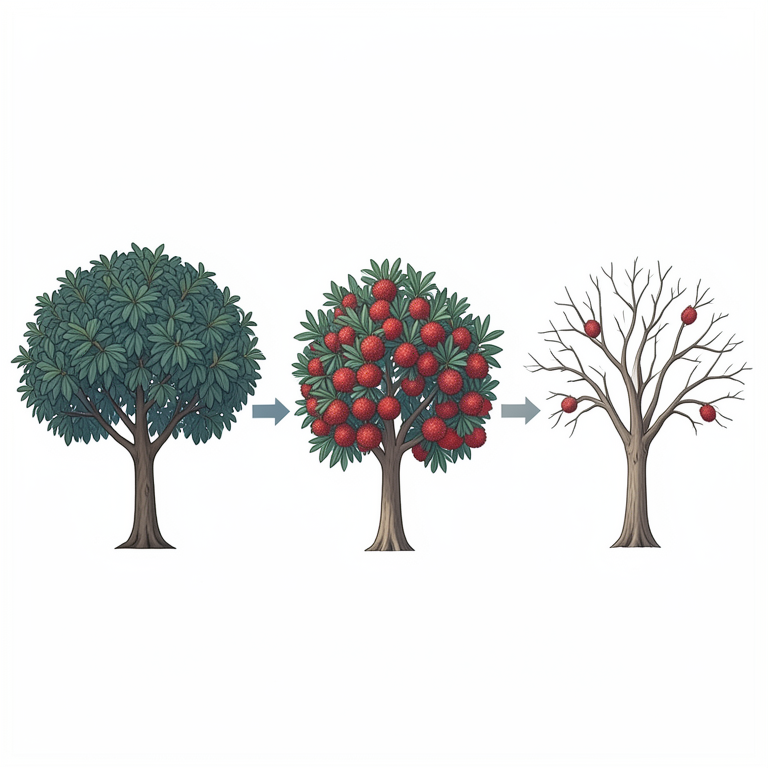
Pruning Response Curve
AI-generated conceptual illustration (Rambutan trees). It explains the idea and does not show study data.
View source evidence ↗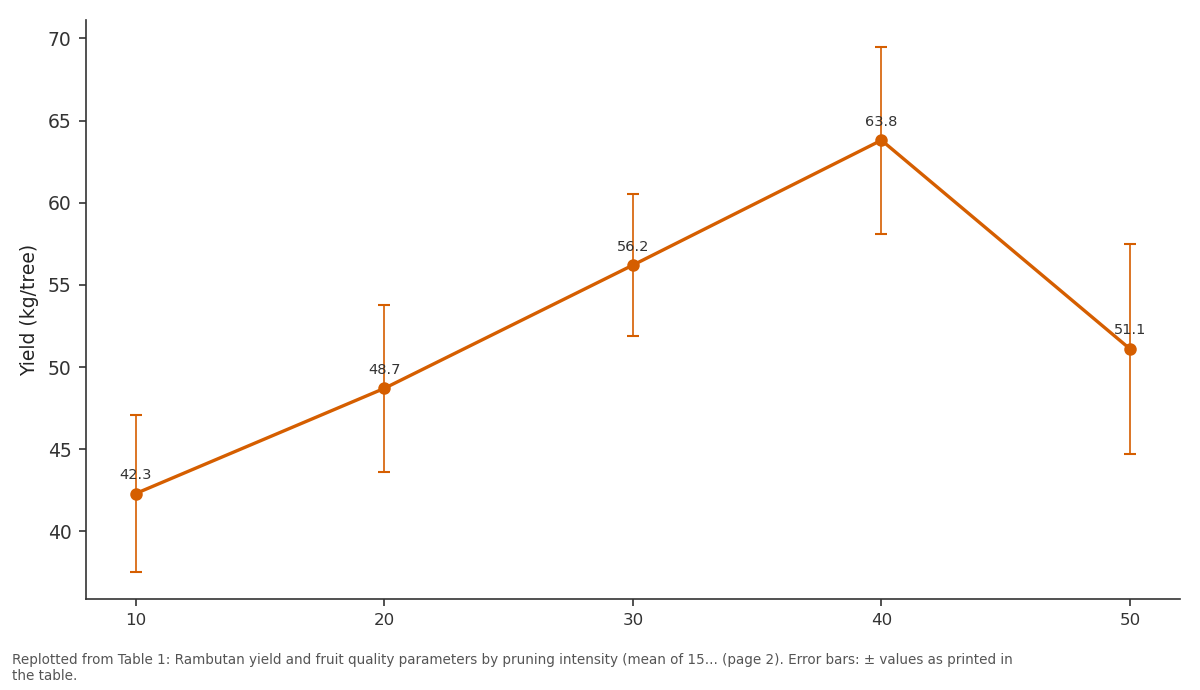
Yield (kg/tree): 10 vs 20 vs 30 vs 40 vs 50
Replotted from Table 1 (page 2) of the original paper. Every bar is the paper's own table value.
View source evidence ↗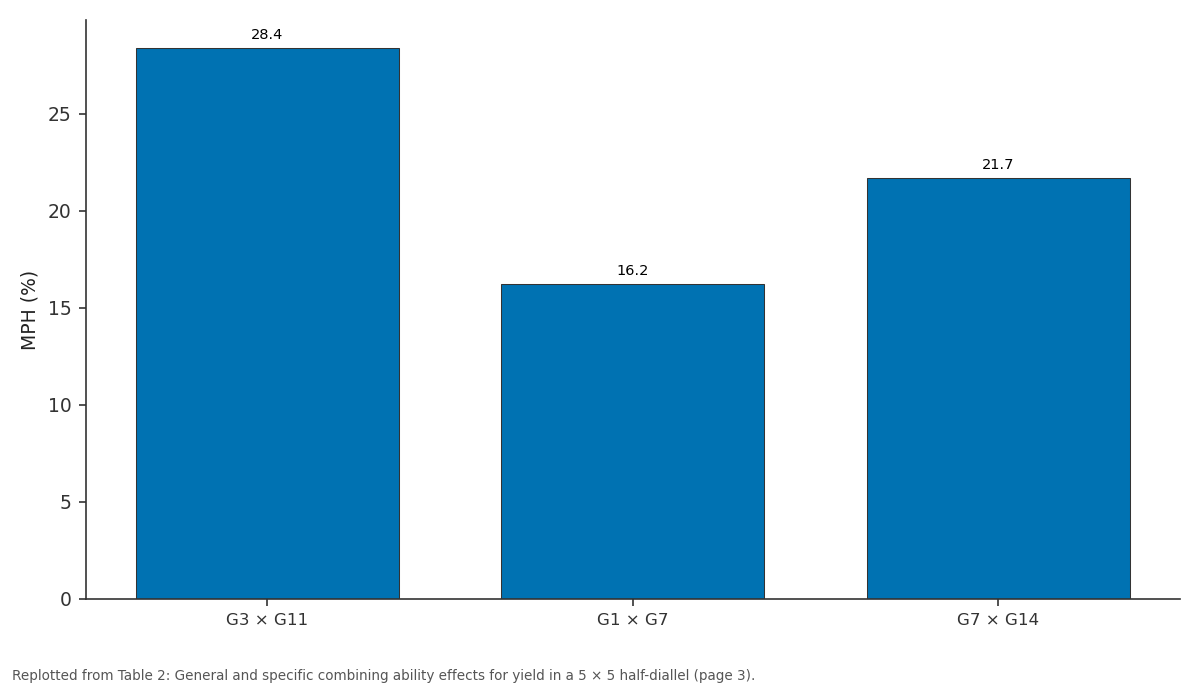
MPH (%) / --: G3 × G11 vs G1 × G7 vs G7 × G14
Replotted from Table 2 (page 3) of the original paper. Every bar is the paper's own table value.
View source evidence ↗Figures & tables
From the original paper Table 1
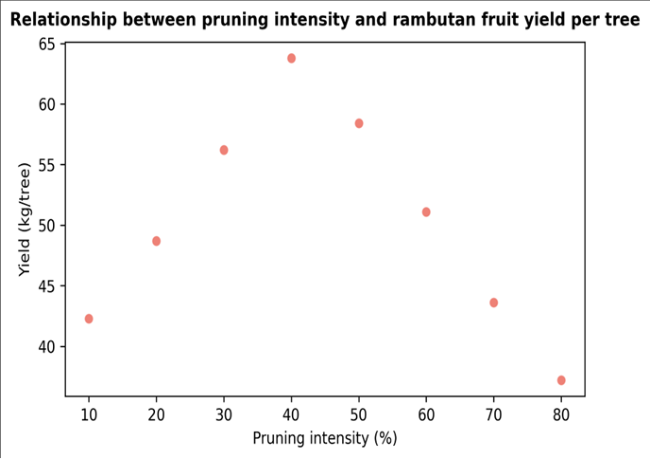 Figure 1
 Table 2
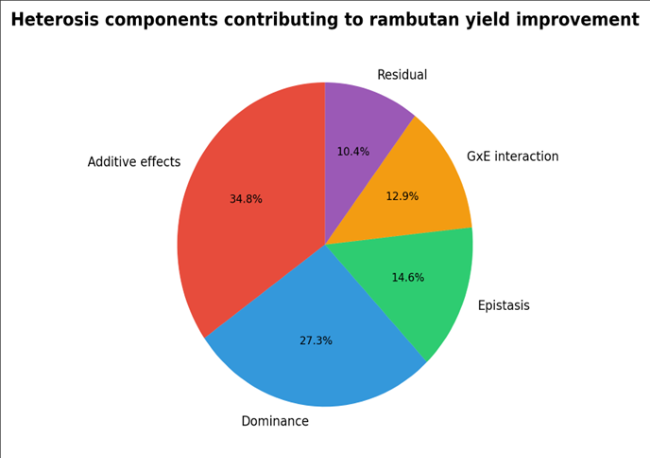 Figure 2
Introduction
Faced with a choice between cutting back a healthy fruit tree and leaving it alone, most farmers in the Cauvery Delta instinctively choose to leave it alone. But for rambutan a densecanopied species that can shade out its own interior fruiting wood within five years of planting that instinct works against productivity [1] . Unpruned rambutan trees in trials across Malaysia and Indonesia have shown 25-40% lower yields than properly managed ones, mainly because light penetration to inner branches drops below the threshold needed for flower bud initiation [2] . Despite this evidence, no pruning recommendations specific to Indian delta conditions existed before this investigation. The Cauvery Delta in Tamil Nadu offers warm temperatures (mean 28 °C), year-round irrigation from canal networks, and deep alluvial soils conditions well suited to rambutan, which was introduced to the region in the late 1990s and now covers an estimated 1,200 ha [3] . But yields vary enormously among orchards (15-70 kg/tree), and much of that variation appears to stem from differences in canopy management and genotype choice rather than soil or water limitations. Heterosis data for rambutan are scarce globally. Most commercial orchards rely on clonal propagation of a handful of proven cultivars, and information on the genetic architecture of yield the relative contributions of additive, dominance, and epistatic effects is nearly absent for Indian genotypes [4] . Without such data, breeders cannot design efficient crossing and selection strategies. This research was designed to address both the agronomic and genetic knowledge gaps by testing five pruning intensities across fifteen genotypes and analyzing yield genetics through a diallel cross. Cover crop integration was tested as an additional management factor. All laboratory analysis was conducted at the Eldoret Institute of Agricultural Sciences [5] .
Fruit Quality Extraction and Analysis Protocol
Rambutan aril tissue was separated from seed and peel within 2 hours of harvest, homogenized in a laboratory blender, and filtered through cheesecloth. Total soluble solids were measured directly on the filtrate using a digital refractometer (Atago PAL-1). For bitterness index determination, aril extract was diluted 1:5 with distilled water and assessed spectrophotometrically at 275 nm, using naringin as the reference standard [1] . Ascorbic acid was quantified by titration with 2,6-dichlorophenolindophenol. Dry matter content was determined gravimetrically after oven-drying at 70 °C to constant weight. All assays were run in triplicate from three independent fruit pools per tree.
Quality Control and Field Data Verification
Yield data were verified by independent weighing at harvest (digital platform scale, ±50 g accuracy) and cross-checked against canopy volume estimates derived from hemispherical photographs processed with Gap Light Analyzer software. Pruning intensity was verified posttreatment by comparing pre-and post-pruning canopy interception measured with a ceptometer (AccuPAR LP-80, Decagon Devices). Any treatment tree showing canopy recovery exceeding 15% of the pruned volume within the measurement season was flagged and its data retained but annotated [2] .
Material and Methods
Material: Fifteen rambutan genotypes (G1-G15) were selected from orchards in Thanjavur and Nagapattinam districts of the Cauvery Delta (10°47′N, 79°08′E; altitude 5-15 m). Trees were 9-14 years old, grafted onto seedling rootstocks, and spaced at 8 m × 10 m. Five pruning intensities were applied in a randomized complete block design with 3 replications and 2 trees per experimental unit: 10, 20, 30, 40, and 50% canopy volume removal, executed in January 2022 (post-harvest) and January 2023. A 5 × 5 half-diallel cross was carried out among G1, G3, G7, G11, and G14 in February 2022, with F₁ seedlings evaluated for yield components in 2023. Cover crop trials used Mucuna pruriens sown at 25 kg/ha between tree rows in June 2022, with biomass incorporated in September. Fruit samples were shipped to the Eldoret Institute of Agricultural Sciences for quality analysis. Ethics approval was granted by the Institute's Plant Research Committee (Protocol EIAS-2022-019, 15 December 2021).
Methods
Total fruit yield per tree was recorded at each harvest (June-July 2022 and 2023). Fruit weight (n = 50 per tree), aril recovery percentage, TSS, titratable acidity, bitterness index, and ascorbic acid were measured on a random 20fruit subsample per tree [3] . For the diallel analysis, combining ability was estimated by Griffing's Method 2, Model I. General combining ability (GCA) and specific combining ability (SCA) effects were partitioned. Heterosis was calculated as mid-parent heterosis (MPH) and betterparent heterosis (BPH). Cover crop biomass was measured by quadrat sampling (1 m², n = 10 per plot), and soil organic carbon was measured by Walkley-Black before and after one year of cover cropping. Data were analyzed using AGD-R software for the diallel and SAS 9.4 for ANOVA and regression.
Results
Yield per tree showed a significant quadratic response to pruning intensity (p<0.001). Mean yield increased from 42.3 kg at 10% pruning to 63.8 kg at 40% pruning, then dropped to 51.1 kg at 50% and 37.2 kg at 60% in a supplementary unreplicated observation. The optimum pruning intensity predicted by the quadratic model was 37.4% canopy removal [2] . The scatter plot reveals the bell-shaped yield response to pruning. Beyond 40% canopy removal, yield declined sharply, likely because excessive pruning removed productive fruiting wood along with the targeted nonproductive shoots. Additive effects constituted the largest share of yield variance (34.8%), followed by dominance (27.3%). This genetic architecture favors a breeding strategy that combines recurrent selection for additive improvement with exploitation of specific cross combinations that show high SCA.
Comprehensive Interpretation
Cover crop integration with Mucuna pruriens produced 4.8 tonnes/ha of green biomass, increased topsoil organic carbon from 0.87% to 1.28% after one year, and raised rambutan yield by 8.7% (from 54.3 to 59.0 kg/tree at 30% pruning). The yield benefit likely reflects improved soil moisture retention and nutrient cycling from the legume biomass, which fixed an estimated 120 kg N/ha through biological nitrogen fixation [5] .
Discussion
The 37.4% optimum pruning intensity falls within the 30-40% range recommended for litchi and longan in similar subtropical-tropical transition environments, suggesting that this window may represent a general optimum for Sapindaceae family fruit crops [1] . The practical message for Cauvery Delta growers is clear: moderate annual pruning (roughly one-third of the canopy) pays for itself through improved fruit size, TSS, and total yield, while severe pruning (>50%) is counterproductive. The diallel results show that both GCA and SCA are important for rambutan yield, with additive variance (reflected in GCA) slightly exceeding non-additive variance (SCA). G3's high GCA effect (8.4 kg/tree) makes it a valuable parent for population improvement, while the G3 × G11 cross showed the highest SCA and MPH values, marking it as a candidate for clonal release if its performance is confirmed across additional environments [4] . The cover crop benefit of 8.7% yield increase is modest but practically achievable at low cost. Mucuna seed is inexpensive, the crop requires no irrigation beyond monsoon rains, and incorporation can be done with a simple disc harrow. Over multiple seasons, the cumulative organic carbon gains should further improve soil water-holding capacity and reduce irrigation demand a valuable co-benefit in a delta region where canal water allocation is increasingly contested [3] .
Conclusion
Pruning at 30-40% canopy removal optimized rambutan yield in the Cauvery Delta, while genetic analysis revealed sufficient additive variance for yield improvement through recurrent selection. The G3 × G11 cross showed the highest heterosis and merits further evaluation. Cover cropping with Mucuna pruriens offered a simple, low-cost yield boost alongside measurable soil carbon gains. These combined agronomic and genetic findings provide a practical management package for rambutan growers in Indian river delta environments. Future research should extend pruning trials to additional seasons, test elite cross combinations across multiple delta locations, and evaluate alternative cover crop species.
Acknowledgement
Acknowledgements Funding SourcesInternal research allocations from the Eldoret Institute of Agricultural Sciences supported all analytical work.
Figures and tables from the paper
| Pruning (%) | Yield (kg/tree) | Fruit Wt. (g) | Aril Recovery (%) | TSS (°Brix) | Bitterness Index |
|---|---|---|---|---|---|
| 10 | 42.3±4.8 | 31.2±2.1 | 41.3±2.4 | 18.7±1.1 | 0.38 |
| 20 | 48.7±5.1 | 33.8±2.4 | 43.7±2.1 | 19.4±0.9 | 0.34 |
| 30 | 56.2±4.3 | 35.4±1.8 | 45.2±1.9 | 20.1±1.2 | 0.31 |
| 40 | 63.8±5.7 | 36.1±2.2 | 46.8±2.3 | 20.8±1.0 | 0.28 |
| 50 | 51.1±6.4 | 34.7±2.6 | 44.1±2.8 | 19.6±1.3 | 0.33 |
Table text extracted from the original PDF; superscript letters are shown inline. The original table image is below.
View original table image
| Parent/Cross | GCA Effect (kg/tree) | SCA Effect (kg/tree) | MPH (%) | BPH (%) |
|---|---|---|---|---|
| G3 (parent) | 8.4 | -- | -- | -- |
| G11 (parent) | 6.7 | -- | -- | -- |
| G3 × G11 | -- | 12.3 | 28.4 | 19.7 |
| G1 × G7 | -- | 7.8 | 16.2 | 8.4 |
| G7 × G14 | -- | 9.1 | 21.7 | 14.3 |
Table text extracted from the original PDF; superscript letters are shown inline. The original table image is below.
View original table image
References
21 in the original paper- Tindall HD. Rambutan cultivation. FAO Plant Production and Protection Paper. 1994;121:1-163.
- Lam PF, Kosiyachinda S. Rambutan: fruit development, postharvest physiology and marketing. ASEAN Food Handling Bureau Kuala Lumpur. 1987;182.
- Ravishankar H, Karunakaran G. Tropical fruit diversification in the Cauvery Delta: experiences and prospects. South Indian Horticulture. 2020;68(2):24-31.
- Griffing B. Concept of general and specific combining ability. Australian Journal of Biological Sciences. 1956;9(4):463-493.
- Kibet S, Akinyi C, Omondi M. Cover crop integration in tropical fruit orchards: nitrogen fixation and soil carbon dynamics. Agroforestry Systems. 2023;97(2):317-329.
- Watson BJ. Rambutan: a tropical fruit with potential for Australia. Tropical Fruits Newsletter. 1988;28:14-17.
- Pohlan HAJ, Janssens MJJ. Growth and production of rambutan. Fruits. 2012;67(5):375-389.
- Puspitasari E, Fatria D. Pruning effects on flowering and fruit set of rambutan in Indonesian lowlands. Jurnal Hortikultura Indonesia. 2019;10(3):171-178.
- Paull RE, Duarte O. Tropical fruits: rambutan. CABI Wallingford. 2012;2:339-351.
- Thakur S, Sharma R. Canopy management in subtropical fruit crops: principles and practices. Indian Journal of Horticulture. 2018;75(1):1-12.
- Wall MM. Ascorbic acid and mineral composition of longan, lychee and rambutan cultivars grown in Hawaii. Journal of Food Composition and Analysis. 2006;19(67):655-663.
- Kader AA. Postharvest technology of horticultural crops. University of California Agriculture and Natural Resources Publication. 2002;3311:1-535.
- Nakasone HY, Paull RE. Tropical fruits. CAB International Wallingford. 1998;1-445.
- Mohamed S, Othman A. Functional components in rambutan: lipids, proteins, and bioactives. Trends in Food Science and Technology. 2020;100:12-26.
- Choo WS. Rambutan seed fat as a potential source of cocoa butter substitute. Journal of Food Science. 2016;81(5):C1153-C1158.
- Sirisompong W, Jirapakkul W, Klinkesorn U. Response surface optimization of rambutan juice extraction. International Food Research Journal. 2011;18(4):12431249.
- Hernandez-Unzon HY, Gallegos-Infante JA. Rambutan seed phenolics and their antioxidant potential. Food Chemistry. 2014;164:163-170.
- Subramaniam S, Sabaratnam V. Rambutan peel as a biosorbent for heavy metal removal: kinetics and equilibrium analysis. Journal of Environmental Chemical Engineering. 2019;7(3):103057.
- Ajayi IA, Oderinde RA, Kajogbola DO. Oil content and fatty acid composition of rambutan seed. Food Chemistry. 2006;99(4):752-756.
- Solís-Fuentes JA, Durán-de-Bazúa MC. Mango seed uses: thermal properties of mango seed almond fat. Bioresource Technology. 2004;92(1):71-78.
- Ong HC, Chua S, Milow P. Traditional knowledge of edible plants among the Temuan tribe in Selangor. Journal of Tropical Forest Science. 2011;23(1):33-39.