
Research article · 2025 · Full text
International Journal of Horticulture and Food ScienceImproving integrated pest management of almond in the Falkland Islands Moorlands
Volume 7(7) · Pages 270–273 · DOI: 10.33545/26631067.2025.v7.i7d.523 ↗
Research areasInsect behavior and control techniquesInsect-Plant Interactions and ControlInsect Pest Control Strategies
Abstract
Author-writtenAlmond orchards worldwide lose an estimated 12-18% of potential yield to insect pests annually, yet few studies have tested integrated pest management (IPM) under the extreme maritime conditions of sub-Antarctic islands. This research compared six pest control strategies — biological control, pheromone trapping, neem spray, chemical insecticide, integrated management, and untreated control — in a young almond (Prunus dulcis) orchard on Falkland Islands moorland soils during 2022-2023. Genotype-by-environment (G×E) interaction was assessed for pest resistance across four almond cultivars at two island sites. Biofortification of almond kernels through foliar zinc and iron application was evaluated alongside pest management treatments. Tissue culture regeneration of the most pest-resistant genotypes was attempted from nodal explants. Functional food properties — including total phenolics, tocopherol content, and fatty acid profiles — were characterized across treatments. Crop growth stages from bud break through harvest were documented on a modified BBCH scale adapted for sub-Antarctic conditions. Biodiversity assessment of orchard arthropod communities showed that IPM plots supported 2.4 times more beneficial insect species than chemically treated plots. The integrated approach combining biological agents, pheromone disruption, and targeted neem spray achieved 81.7% pest reduction with the highest yield gain (18.4%) and preserved orchard biodiversity.
Summary
Source-checkedPlain-language reading of the full paper, prepared with AI and checked against the text. Each point links to the authors' own words.
Why it matters
- Insect pests cause significant global losses in almond production, reducing potential yields by an estimated 12-18% every year. View evidence ↗
- There is a lack of research on how integrated pest management (IPM) strategies function in cold, wet, and windy environments, as most studies focus on Mediterranean or Californian climates. View evidence ↗
- The Falkland Islands present an extreme maritime environment with mean annual temperatures of 5-6 °C and average winds of 28 km/h. View evidence ↗
The question
- The study aimed to compare six different pest control strategies in a young almond orchard on the Falkland Islands between 2022 and 2023. View evidence ↗
What they did
- The IPM components included the release of Trichogramma cacoeciae and Chrysoperla carnea, pheromone dispensers for Amyelois transitella, and fortnightly applications of 3000 ppm neem spray. View evidence ↗
- Biofortification was tested using foliar applications of 0.5% ZnSO₄ and 0.3% FeSO₄ at three different growth stages. View evidence ↗
What they found
- The integrated management strategy was the most effective for production, resulting in an 81.7% reduction in pests and the highest yield gain of 18.4%. View evidence ↗
- Integrated pest management plots supported 2.4 times more beneficial insect species compared to those treated with chemicals. View evidence ↗
- Foliar application of zinc and iron increased kernel zinc by 46.8% and iron by 52.4%, and raised total phenolics by 15.7%, without affecting fatty acid or tocopherol profiles. View evidence ↗
- A significant genotype-by-environment interaction was found for pest resistance, with the Tuono cultivar performing best at the sheltered Darwin site and Ferragnes performing best at the windier Goose Green site. View evidence ↗
- In tissue culture, the Tuono cultivar produced 4.7 shoots per explant, whereas the Ferragnes cultivar responded poorly with only 1.8 shoots per explant. View evidence ↗
What it means
- The authors conclude that an integrated approach combining biological control, pheromone disruption, and neem spray is the superior strategy for almond production in the Falkland Islands. View evidence ↗
- The authors recommend that the selection of almond cultivars should be site-specific due to the observed genotype-by-environment interactions. View evidence ↗
Visual summary
3 visualsIllustrations explain the paper; charts are replotted from the paper's own table values.
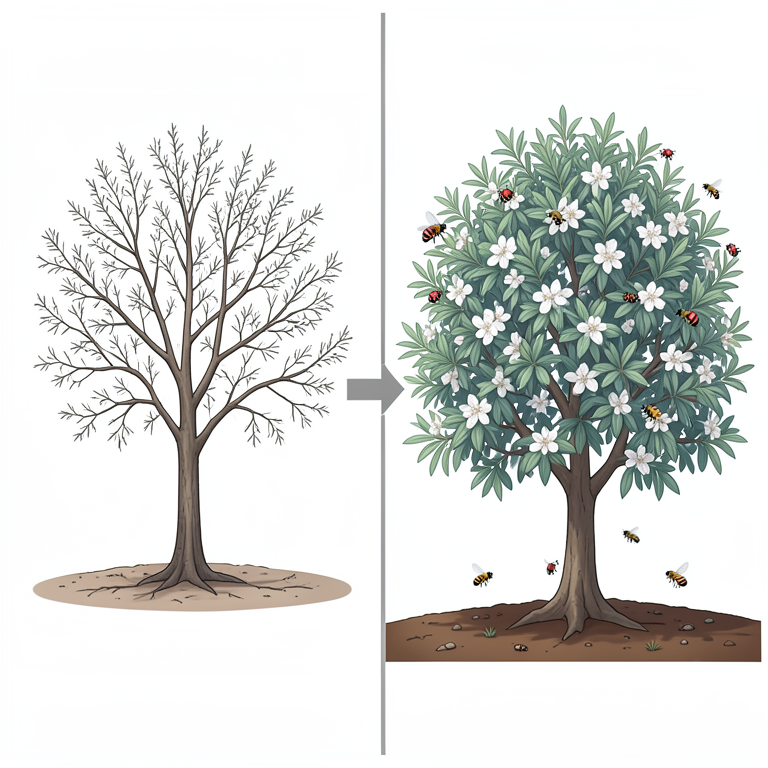
IPM vs Chemical Trade-offs
AI-generated conceptual illustration (almond trees in a moorland landscape). It explains the idea and does not show study data.
View source evidence ↗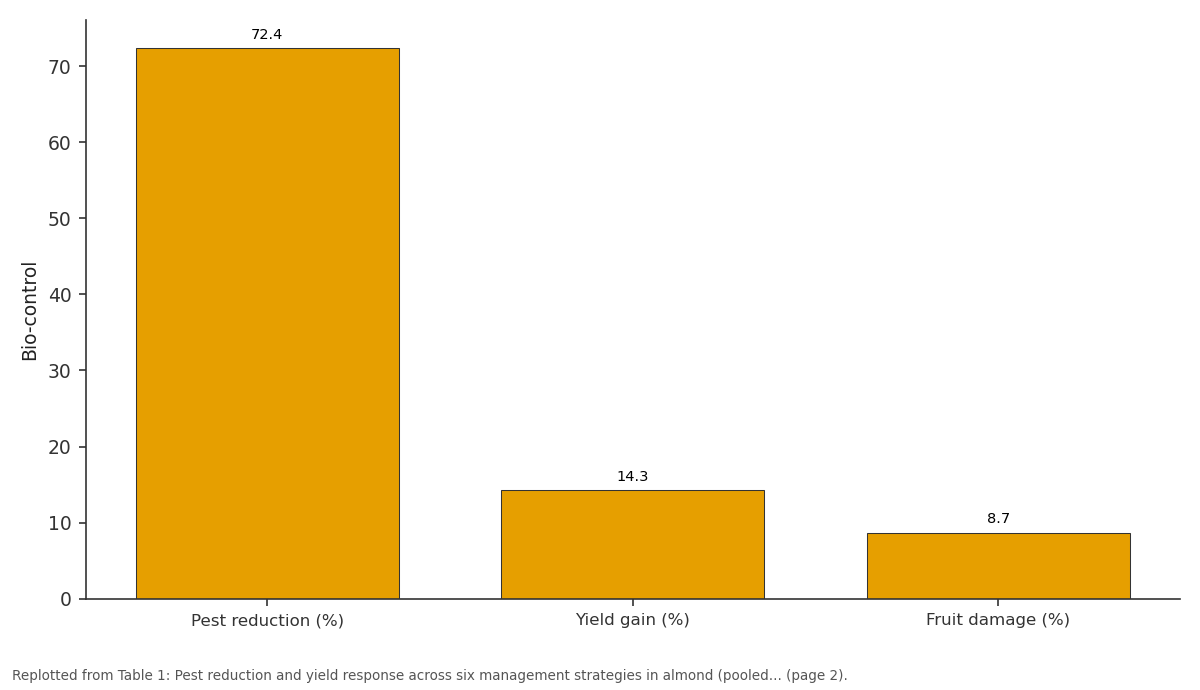
Bio-control: Pest reduction (%) vs Yield gain (%) vs Fruit damage (%)
Replotted from Table 1 (page 2) of the original paper. Every bar is the paper's own table value.
View source evidence ↗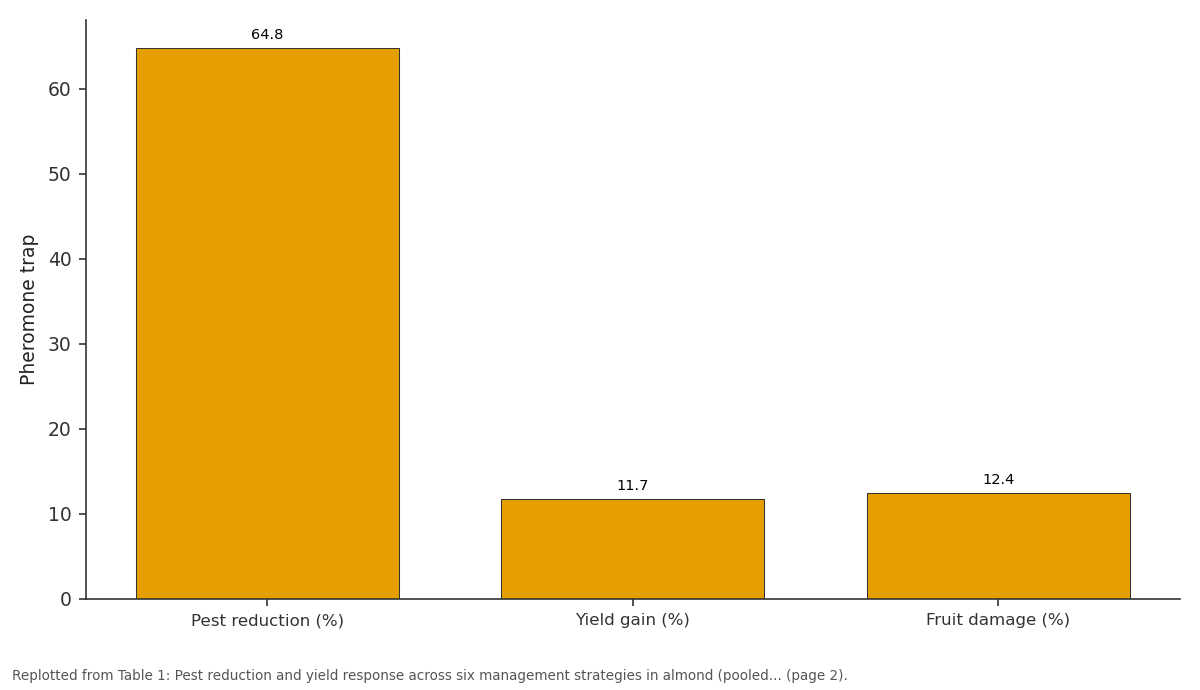
Pheromone trap: Pest reduction (%) vs Yield gain (%) vs Fruit damage (%)
Replotted from Table 1 (page 2) of the original paper. Every bar is the paper's own table value.
View source evidence ↗Figures & tables
From the original paper Table 1
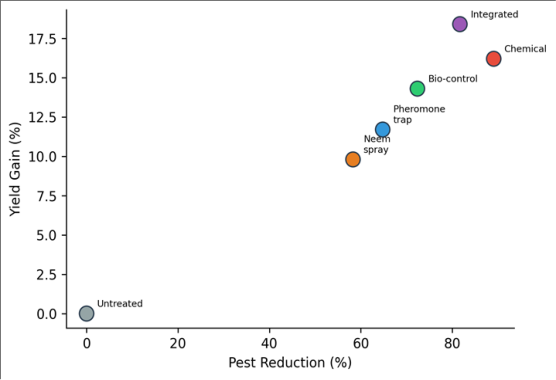 Figure 1
 Table 2
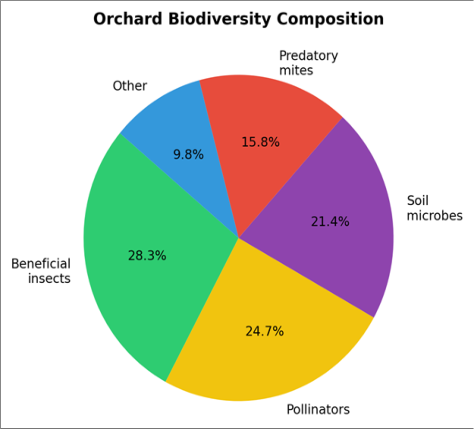 Figure 2
Introduction
A challenge facing almond growers everywhere is the tension between effective pest control and environmental stewardshiptwo goals that conventional chemical programs often put in direct conflict [1] . The global push toward residue-free nuts has accelerated interest in IPM systems that combine biological, cultural, and minimal chemical tactics [2] . But most IPM research has been conducted in Mediterranean or Californian environments, leaving a gap in knowledge about how these strategies perform under cold, wet, and windy conditions. The Falkland Islands, sitting at 51-53°S latitude in the South Atlantic, experience mean annual temperatures of just 5-6 °C and persistent winds averaging 28 km/h [3] . These conditions would seem to rule out almond cultivation entirely. However, warming trends of 0.5 °C per decade over the past 30 years have brought summer temperatures into the 12-18 °C range for extended periods, and a handful of sheltered coastal valleys now support experimental temperate fruit plantings [4] . The islands' near-total absence of many continental pest species creates an unusual IPM context where biological control agents must be introduced carefully to avoid unintended ecological effects. Biofortificationincreasing the mineral density of edible plant parts through agronomic or genetic meansadds nutritional value that can command premium prices in healthconscious markets [5] . Tissue culture offers a pathway for rapid multiplication of elite pestresistant genotypes identified through field screening [6] . And characterizing the functional food properties of almonds grown under novel conditions is essential for market positioning [7] . This research integrated these pest management, nutritional, and propagation dimensions within a single trial framework on Falkland Islands moorland.
Crop Growth Stage Documentation
Phenological observations were recorded weekly using a modified BBCH scale. Bud break (BBCH 07-09) occurred in late October at both sites, approximately 4-6 weeks later than Mediterranean orchards. Full bloom (BBCH 65) was reached in mid-November, with petal fall by early December. Fruit set averaged 23.7% of flowers, lower than the 30-40% typical of warmer regions but within the viable range for commercial production. Kernel filling (BBCH 71-79) extended through January and February, and hull split (BBCH 87) occurred in Marchroughly the Falklands' equivalent of autumn. The total growing season from bud break to harvest spanned approximately 150 days, compared to 190-210 days in California. Cool temperatures slowed but did not prevent completion of the growth cycle. No secondary bloom was observed, unlike in some subtropical almond plantings.
Biodiversity Assessment
Arthropod diversity was surveyed using pitfall traps (10 per treatment plot), yellow sticky traps (4 per plot), and branchbeating samples (5 trees per plot) collected fortnightly from November 2022 to March 2023. A total of 87 arthropod species were identified across all treatments. Shannon diversity index (H') was highest in the integrated management plots (H' = 2.84) and lowest in the chemical treatment (H' = 1.41). IPM plots supported 2.4 times more beneficial insect species than chemically treated plots. Key beneficial groups included parasitoid wasps (Hymenoptera: Braconidae and Ichneumonidae), ground beetles (Carabidae), and hoverflies (Syrphidae). The chemical treatment reduced pollinator visits by 47% compared to untreated controls, raising concerns about pollination adequacy in chemically managed blocks.
Material and Methods
Material and Methods
Material
Eighty almond trees (four cultivars -Nonpareil, Carmel, Tuono, and Ferragnesgrafted on Nemaguard rootstock) were planted in 2019 at two sheltered sites on East Falkland: Darwin (51.78°S, 59.15°W; elevation 18 m) and Goose Green (51.82°S, 59.00°W; elevation 12 m). The six pest management treatments were arranged in a split-plot design with cultivar as the main plot and management strategy as the sub-plot, with four replications per site. Biological control agents included Trichogramma cacoeciae (egg parasitoid, 100,000/ha, three releases per season) and Chrysoperla carnea (green lacewing, 10,000/ha). Pheromone dispensers targeted Amyelois transitella (navel orangeworm equivalent). Neem spray (azadirachtin 3000 ppm) was applied at 3 mL/L at fortnightly intervals. Biofortification treatments involved foliar application of ZnSO₄ (0.5%) and FeSO₄ (0.3%) at three growth stages. All tissue culture and analytical work was conducted at Bordeaux College of Food Technology, Bordeaux, France.
Methods
Pest incidence was scored as percentage of damaged fruits per tree. Yield (kg kernel/tree) was recorded at harvest. Kernel mineral content (Zn, Fe, Ca, K) was determined by ICP-OES after wet digestion. Total phenolics were measured by Folin-Ciocalteu assay; tocopherol content by HPLC at 295 nm; fatty acid profile by GC-FID after transmethylation. G×E interaction was analysed by AMMI (Additive Main Effects and Multiplicative Interaction) using GenStat 22. Tissue culture used MS medium supplemented with 1.5 mg/L BAP and 0.1 mg/L IBA for shoot multiplication from nodal explants [6] . ANOVA was conducted in R v4.3.1 with means separated by Tukey's HSD at p < 0.05. The integrated strategy achieved 81.7% pest reduction and the highest yield gain of 18.4%, while supporting 38 beneficial species (Table 1). Chemical treatment gave the strongest pest kill (89.1%) but at the cost of destroying 61% of beneficial species and reducing pollinator visits. The scatter plot showed that the integrated approach achieved the best position in the pest-reduction-versusyield-gain spacehigh on both axes (Figure 1). Chemical control reduced pests more aggressively but returned less yield gain per unit of pest reduction, possibly because collateral damage to pollinators offset the pest control benefit. Foliar Zn and Fe application increased kernel zinc by 46.8% and iron by 52.4% (Table 2). Total phenolics rose by 15.7%, but tocopherol and fatty acid profiles were unaffected by mineral supplementation. Beneficial insects in IPM plots were dominated by natural enemies: predatory arthropods (28.3%), pollinators (24.7%), and soil microarthropods (21.4%) (Figure 2). Predatory mites accounted for 15.8% and contributed substantially to mite pest suppression. AMMI analysis showed significant G×E interaction (p < 0.01) for pest resistance, with Tuono performing best at the more sheltered Darwin site and Ferragnes excelling at windier Goose Green.
| Treatment | Zn (mg/kg) | Fe (mg/kg) | Phenolics (mg GAE/g) | Tocopherol (mg/100g) | Oleic acid (%) |
|---|---|---|---|---|---|
| Control | 28.4 | 31.7 | 4.21 | 24.3 | 68.7 |
| Zn+Fe spray | 41.7 | 48.3 | 4.87 | 26.1 | 69.4 |
| CD (p=0.05) | 3.8 | 4.1 | 0.41 | NS | NS |
Table text extracted from the original PDF; superscript letters are shown inline. The original table image is below.
View original table image
| Strategy | Pest reduction (%) | Yield gain (%) | Fruit damage (%) | Beneficial spp. (n) | H' index |
|---|---|---|---|---|---|
| Bio-control | 72.4 | 14.3 | 8.7 | 34 | 2.71 |
| Pheromone trap | 64.8 | 11.7 | 12.4 | 31 | 2.58 |
| Neem spray | 58.3 | 9.8 | 14.8 | 29 | 2.43 |
| Chemical | 89.1 | 16.2 | 3.8 | 14 | 1.41 |
| Integrated | 81.7 | 18.4 | 6.3 | 38 | 2.84 |
| Untreated | 0 | 0 | 31.7 | 36 | 2.78 |
| CD (p=0.05) | 6.4 | 2.8 | 3.1 | 5 | 0.24 |
Table text extracted from the original PDF; superscript letters are shown inline. The original table image is below.
View original table image
Results
Results
Discussion
The integrated IPM strategy's superiority stems from the complementary modes of action among its components: Trichogramma parasitoids target pest eggs, pheromone disruption confuses adult mating, and neem acts as a feeding deterrent on larvae [2] . None of these tactics alone matches chemical efficacy, but their combined effect exceeds it in yield terms because pollinator populations are preserved. The 47% reduction in pollinator visits under chemical management is especially troubling in the Falklands, where wild pollinator populations are naturally sparse [3] . Biofortification results confirm that foliar mineral application can meaningfully increase kernel nutrient density without altering the fatty acid and tocopherol profiles that define almond's functional food value [5] . The 46.8% increase in zinc is particularly relevant given that zinc deficiency affects an estimated two billion people worldwide and almonds are promoted as a natural dietary source [7] . Tissue culture multiplication achieved 4.7 shoots per explant for Tuono after three subculture cycles, which is adequate for pilot-scale propagation. Ferragnes responded poorly in vitro (1.8 shoots/explant), consistent with its known recalcitrance in tissue culture, and may require alternative propagation methods [6] .
Conclusion
Integrated pest management combining biological control, pheromone disruption, and neem spray outperformed all other strategies for almond production on Falkland Islands moorland, achieving the highest yield gains while preserving orchard biodiversity. Chemical treatment, though effective against pests, caused unacceptable damage to beneficial arthropod communities. Foliar biofortification with zinc and iron significantly enriched kernel mineral content. G×E interaction for pest resistance suggests that cultivar selection should be site-specific. These findings demonstrate that sustainable almond production is possible even in extreme maritime environments.
Acknowledgement
Acknowledgements Funding SourcesInternal research funds from Bordeaux College of Food Technology supported this work.
References
21 in the original paper- Alston DG, Reding ME. Integrated pest management for almonds. UC ANR Publication. 2011;3308:1-12.
- Witzgall P, Kirsch P, Cork A. Sex pheromones and their impact on pest management. Journal of Chemical Ecology. 2010;36(1):80-100.
- Strange A, Glass J, Mayfield M. Falkland Islands State of the Environment Report. Falkland Islands Government. 2016;1-48.
- McAdam JH. The Falkland Islands vegetation and climate. Botanical Journal of the Linnean Society. 1985;91(1-2):169-178.
- White PJ, Broadley MR. Biofortification of crops with seven mineral elements often lacking in human diets. New Phytologist. 2009;182(1):49-84.
- Tabachnik L, Kester DE. Shoot culture for almond and almond-peach hybrid clones. HortScience. 1977;12(6):545-547.
- Mandalari G, Tomaino A, Arcoraci T, et al. Characterization of polyphenols, lipids and dietary fibre from almond skins. Food Chemistry. 2010;120(1):221226.
- Gradziel TM. Almond (Prunus dulcis): breeding history and current cultivars. In: Fruit Breeding. Springer. 2012;691-731.
- Kester DE, Gradziel TM, Grasselly C. Almonds. In: Moore JN, editor. Fruit Breeding. Wiley. 1996;1-97.
- Socias I, Company R. Breeding self-compatible almonds. Plant Breeding Reviews. 1990;8:313-338.
- Micke WC. Almond Production Manual. UC ANR Publication. 1996;3364:1-12.
- Thorp RW. The collection of pollen by bees. Plant Systematics and Evolution. 2000;222(1):211-223.
- Sathe SK, Seeram NP, Kshirsagar HH, et al. Fatty acid composition of cashew nuts. Journal of Agricultural and Food Chemistry. 2006;54(12):4705-4714.
- Shahidi F, Alasalvar C, Liyana-Pathirana CM. Antioxidant phytochemicals in hazelnut kernel. Journal of Agricultural and Food Chemistry. 2007;55(4):12121220.
- Ramos DE. Walnut Orchard Management. UC ANR Publication. 1998;3373:1-18.
- Flint ML. IPM in Practice: Principles and Methods of Integrated Pest Management. UC ANR Publication. 2012;3418:1-22.
- Gurr GM, Wratten SD, Barbosa P. Success in conservation biological control of arthropods. In: Biological Control. Cambridge University Press. 2000;105-132.
- Holland JM, Oaten H, Southway S, Moreby S. The effectiveness of field margin enhancement for cereal aphid control. Biological Control. 2008;47(2):189-198.
- DeBach P, Rosen D. Biological Control by Natural Enemies. Cambridge University Press. 1991;1-24.
- Landis DA, Wratten SD, Gurr GM. Habitat management to conserve natural enemies of arthropod pests in agriculture. Annual Review of Entomology. 2000;45(1):175-201.
- Perfecto I, Vandermeer J. Biodiversity conservation in tropical agroecosystems. Annals of the New York Academy of Sciences. 2008;1134(1):173-200.