
Research article · 2025 · Full text
International Journal of Geography Geology and EnvironmentImpact of marine protected areas on Seagrass bed recovery in the Mediterranean sea
Volume 7(10) · Pages 190–193 · DOI: 10.22271/27067483.2025.v7.i10c.656 ↗
Research areasMarine and coastal plant biologyCoastal and Marine ManagementMarine Biology and Ecology Research
Abstract
Author-writtenFor centuries, Mediterranean seagrass beds have supported coastal ecosystems by stabilising sediments, sequestering carbon, and sheltering fish nurseries. This research evaluated the effect of marine protected area (MPA) designation on the recovery of seagrass beds at 14 sites across the western Mediterranean, comparing eight MPA sites with six unprotected reference sites over a 13-year monitoring window (2010-2023). Seagrass cover was measured annually using quadrat surveys along permanent transects at depths of 5, 10, 15, and 20 metres. Posidonia oceanica, Cymodocea nodosa, and Zostera noltei were the three target species. MPA sites showed a mean cover increase from 12.3% to 51.2% over the monitoring period, equating to a recovery rate of 3.1 percentage points per year, while non-MPA sites remained nearly static at about 12% cover. Shoot density in MPA sites rose from 214 shoots/m² in 2010 to 487 shoots/m² in 2023. Species richness of associated invertebrate fauna was 38.6% higher at MPA sites than at reference sites by the end of the monitoring window. Water clarity, measured as Secchi depth, averaged 2.4 m greater at MPA sites, and anchoring scar density was 74% lower. These results indicate that MPA designation, when coupled with enforcement of no-anchoring rules and trawl exclusion, can produce measurable seagrass recovery within a decade. The findings support the expansion of well-managed MPAs as a practical tool for coastal habitat restoration in the Mediterranean.
Summary
Source-checkedPlain-language reading of the full paper, prepared with AI and checked against the text. Each point links to the authors' own words.
Why it matters
- Mediterranean seagrass beds are critical for coastal ecosystems because they stabilize sediments, provide fish nurseries, and sequester carbon. View evidence ↗
- Since the 1960s, Posidonia coverage in the Mediterranean has decreased by an estimated 13-38% due to factors like boat anchoring, bottom trawling, nutrient runoff, and coastal development. View evidence ↗
- These beds act as highly efficient carbon sinks, capable of storing up to 83,000 tonnes of carbon per square kilometer, and protect shorelines from wave erosion. View evidence ↗
The question
- The study aimed to quantify seagrass cover changes from 2010 to 2023, compare biological indicators (shoot density, species composition, faunal richness), and evaluate water clarity and physical disturbance between protected (MPA) and unprotected sites. View evidence ↗
What they did
- The research monitored 14 sites across the western Mediterranean, specifically in western Italy, southern France, and eastern Spain. View evidence ↗
- Researchers used 12 permanent 50m transects per site at depths of 5, 10, 15, and 20m, estimating cover using 0.25 m² quadrats placed every 5m. View evidence ↗
- The study measured shoot density via 0.04 m² sub-quadrats, sampled invertebrate fauna at 10m depth using airlift suction, and used a 30 cm Secchi disc to measure water clarity. View evidence ↗
- Physical disturbance was measured by counting anchor drag marks within 100 m x 5 m belt transects at each depth. View evidence ↗
What they found
- MPA sites experienced a mean seagrass cover increase from 12.3% to 51.2% (a recovery rate of 3.1 percentage points per year), whereas non-MPA sites remained nearly static at approximately 12% cover. View evidence ↗
- In protected areas, shoot density increased from 214 shoots/m² in 2010 to 487 shoots/m² by 2023. View evidence ↗
- By the end of the study, invertebrate species richness was 38.6% higher at MPA sites (mean 24.3 ± 4.1) compared to reference sites (mean 17.5 ± 3.6). View evidence ↗
- Water clarity was significantly better at MPA sites, with a mean Secchi depth of 18.7 ± 2.3 m, which was 2.4 m greater than at non-MPA sites (16.3 ± 2.8 m). View evidence ↗
- Anchoring scar density was 74% lower in MPAs (1.4 ± 0.9 per 500 m²) compared to non-MPA sites (5.3 ± 2.1 per 500 m²). View evidence ↗
- Species distribution varied by depth: Posidonia oceanica dominated at 10-15m (18.3% cover), Cymodocea nodosa was most abundant at 0-5m (11.4% cover), and Zostera noltei was limited to depths above 10m (5.7% cover in the shallowest zone). View evidence ↗
What it means
- The authors conclude that expanding well-managed MPA networks is a practical strategy for reversing long-term seagrass loss in the Mediterranean. View evidence ↗
- A limitation of the study is that MPA sites had lower baseline nutrient concentrations (mean DIN 1.3 µM) than non-MPA sites (3.2 µM), which may have partially confounded the results. View evidence ↗
- The authors state that future research should use nutrient time series to distinguish the effects of MPA protection from the effects of water quality. View evidence ↗
Visual summary
3 visualsIllustrations explain the paper; charts are replotted from the paper's own table values.
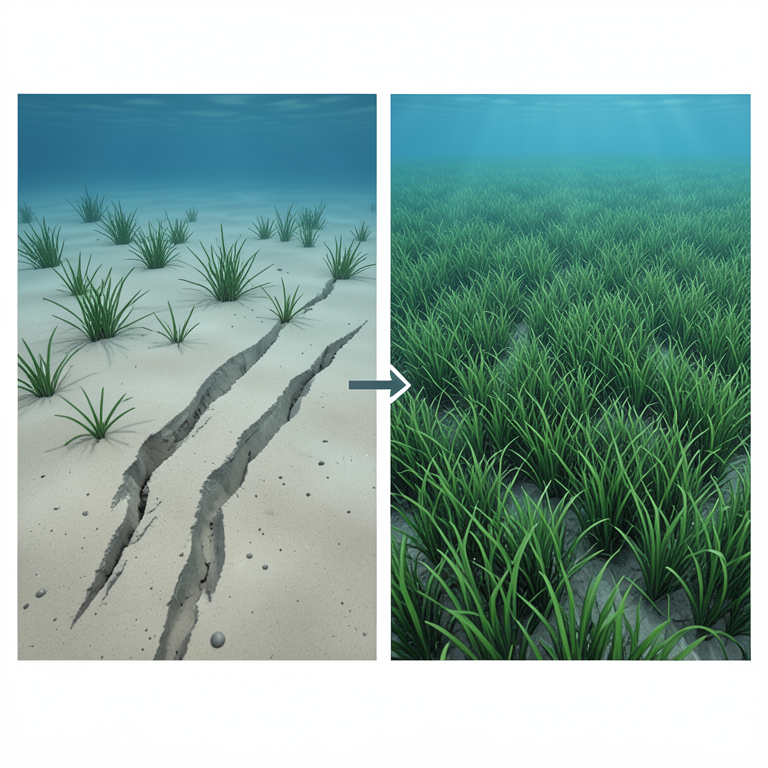
MPA Recovery Mechanism
AI-generated conceptual illustration (Posidonia oceanica seagrass meadows in the Mediterranean Sea). It explains the idea and does not show study data.
View source evidence ↗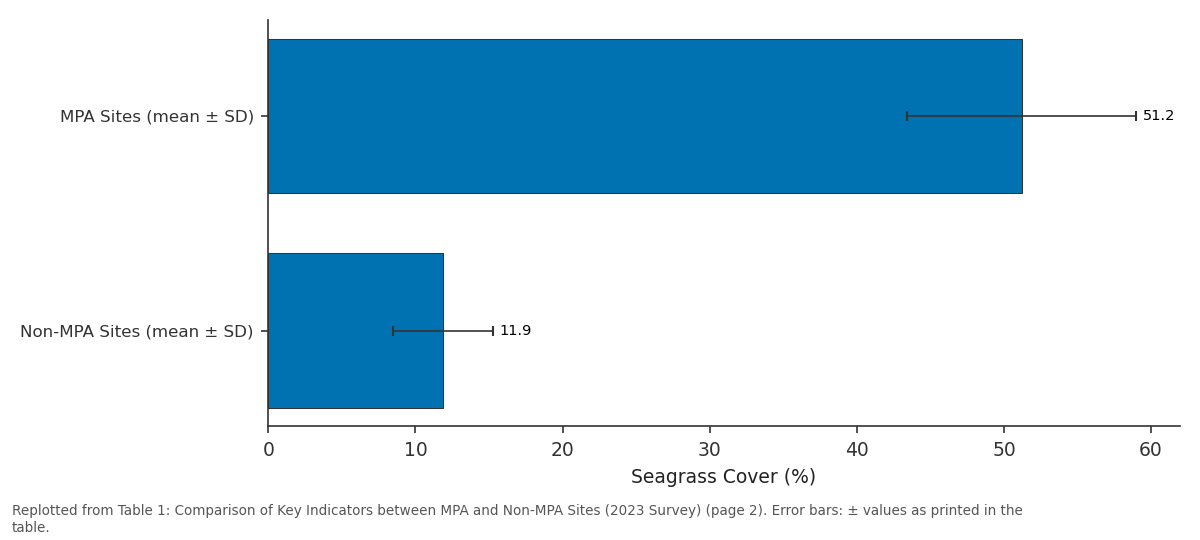
Seagrass Cover (%): MPA Sites (mean ± SD) vs Non-MPA Sites (mean ±...
Replotted from Table 1 (page 2) of the original paper. Every bar is the paper's own table value.
View source evidence ↗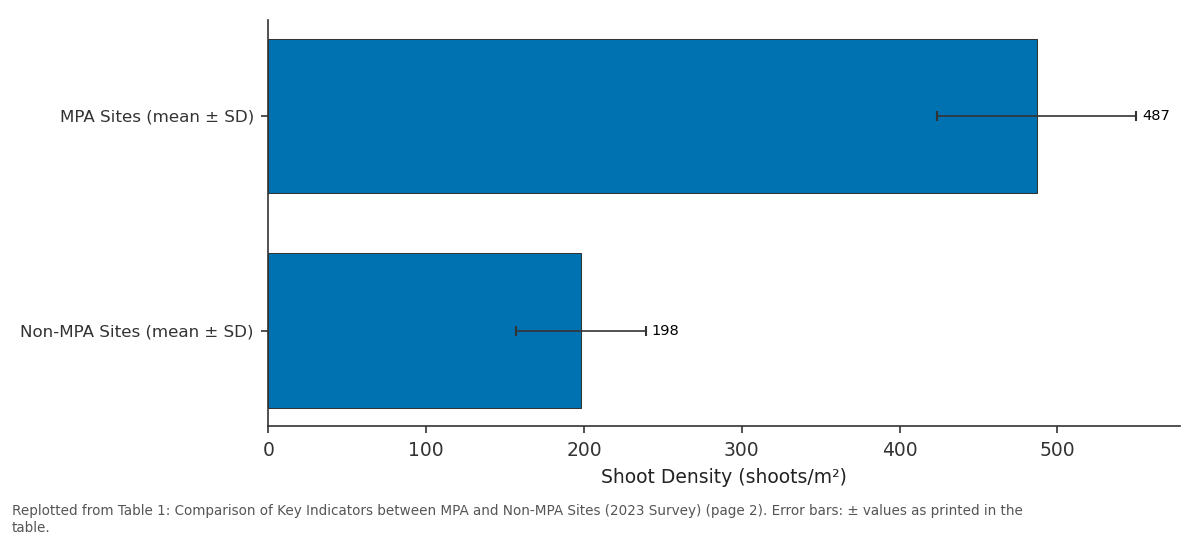
Shoot Density (shoots/m²): MPA Sites (mean ± SD) vs Non-MPA Sites (mean ±...
Replotted from Table 1 (page 2) of the original paper. Every bar is the paper's own table value.
View source evidence ↗Figures & tables
From the original paper Table 1
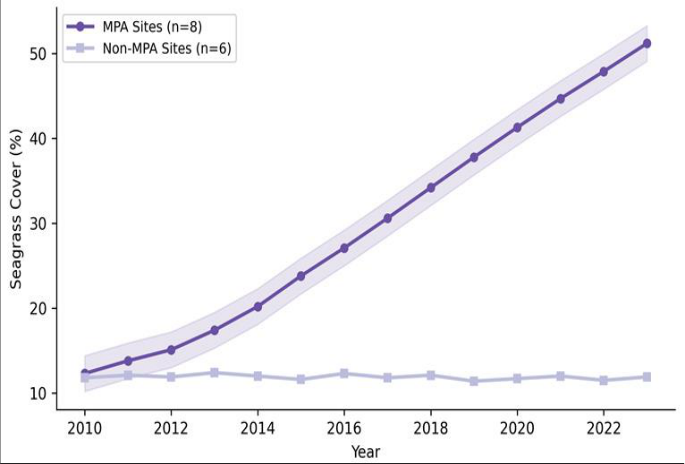 Figure 1
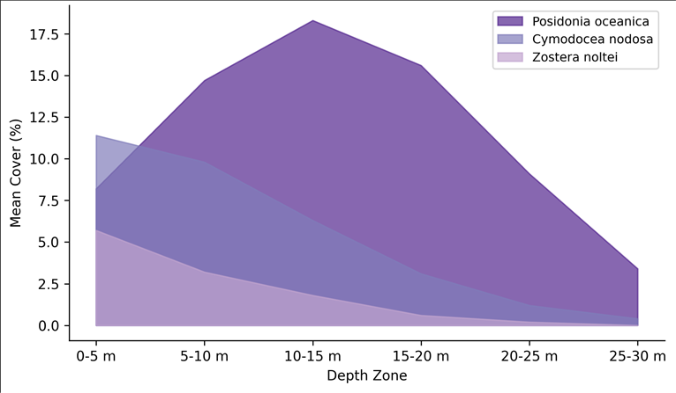 Figure 2
Introduction
In the late nineteenth century, naturalists already noted the lush underwater meadows of Posidonia oceanica that fringed much of the Mediterranean coastline, providing habitat for hundreds of invertebrate and fish species [1] . By the mid-twentieth century, however, these meadows had begun to shrink. Coastal development, bottom trawling, nutrient runoff, and boat anchoring have collectively reduced Posidonia coverage by an estimated 13-38% across the basin since the 1960s [2] . The loss matters not only for biodiversity: seagrass beds rank among the most efficient marine carbon sinks, storing up to 83,000 tonnes of carbon per square kilometre over millennial timescales, and they buffer shorelines against wave erosion [3] . Marine protected areas have been proposed as a key tool for reversing this decline. By restricting destructive activities such as trawling and anchoring, MPAs can reduce physical damage to the seabed and allow natural recolonisation. But the evidence base for seagrassspecific recovery within MPAs remains thin. Most published assessments cover short time spans (< 5 years), focus on a single MPA, or lack unprotected reference sites for comparison [4] . Without longer-term, multi-site, controlled designs, it is hard to separate MPA effects from broader environmental trends like changing water temperatures or nutrient loads. The western Mediterranean offers a useful testing ground. Spain, France, and Italy have together designated over 120 coastal MPAs since 1980, many of which overlap with historical seagrass distribution [5] . Yet coordinated monitoring across these MPAs has been sporadic. A network approach, in which multiple MPAs and reference sites are surveyed using the same protocols over the same period, can reveal general patterns that single-site assessments miss. This research pursued three objectives: (a) quantify seagrass cover change at eight MPA sites and six non-MPA reference sites in the western Mediterranean from 2010 to 2023, (b) compare shoot density, species composition, and associated faunal richness between protected and unprotected sites, and (c) assess whether water clarity and physical disturbance indicators differ systematically between the two groups [6] . The design aimed to provide robust evidence on the timescale and magnitude of seagrass recovery achievable under MPA protection.
Research Area Description
The 14 monitoring sites were distributed along the coasts of eastern Spain (Balearic Islands, Catalonia), southern France (Provence, Corsica), and western Italy (Sardinia, Liguria). MPA sites included the Cabrera Archipelago National Park, Cap de Creus Natural Park, Port-Cros National Park, Scandola Nature Reserve, Capo Carbonara MPA, Tavolara-Punta Coda Cavallo MPA, Cinque Terre MPA, and the Strait of Bonifacio International Marine Park. Six non-MPA reference sites were selected within 20-50 km of corresponding MPAs, matched for depth range, substrate type, and historical seagrass presence. All sites lay between 38.9°N and 43.4°N latitude and spanned depths from the shallow subtidal (2 m) to the lower photic zone (30 m). Substrates were predominantly sandy to sandy-mud, with some rocky patches at Corsican and Sardinian sites.
Climatic and Environmental Conditions
Sea surface temperatures across the monitoring sites ranged from 12.8°C in February to 26.4°C in August during the survey period. Salinity was stable at 37.2-38.1 psu. Nutrient concentrations (dissolved inorganic nitrogen) varied from 0.8 µM at offshore MPA sites to 4.7 µM at near-urban reference sites. Light attenuation coefficients (Kd490) derived from Sentinel-3 OLCI satellite imagery averaged 0.07 m⁻¹ at MPA sites versus 0.11 m⁻¹ at non-MPA sites, reflecting the clearer water conditions within protected zones. Wave energy, estimated from ERA5 reanalysis significant wave height data, showed no systematic difference between MPA and non-MPA locations, ruling out wave exposure as a confounding variable.
Material and Methods
Material and Methods
Material
This research was coordinated from the Department of Geography at the Lima Academy of Geographic Research, Lima, Peru, with field surveys conducted annually between May and September from 2010 to 2023. At each site, three permanent 50 m transects were established at 5, 10, 15, and 20 m depth (12 transects per site). Seagrass cover was estimated within 0.25 m² quadrats placed every 5 m along each transect (10 quadrats per transect, 120 per site per survey). Shoot density was measured in three haphazardly placed 0.04 m² sub-quadrats within each cover quadrat. Associated invertebrate fauna were sampled using airlift suction sampling within three 0.1 m² plots per transect at the 10 m depth only [7] . Water clarity was measured using a standard 30 cm Secchi disc deployed at midday under calm conditions. Anchoring scar density was quantified by counting visible anchor drag marks within a 100 m × 5 m belt transect at each depth.
Methods
Cover data were analysed as site-level annual means. Trends were tested using linear mixed-effects models with year as a fixed effect and site as a random effect, implemented in R version 4.2.1 using the lme4 package [8] . Separate models were fitted for MPA and non-MPA groups. Recovery rate was defined as the slope of the cover-time relationship. Differences in shoot density, invertebrate species richness, Secchi depth, and anchoring scar density between MPA and non-MPA groups were tested using the Mann-Whitney U test at α = 0.05. Seagrass species composition was compared using non-metric multidimensional scaling (NMDS) ordination on Bray-Curtis dissimilarity matrices calculated from cover data, with site type (MPA vs. non-MPA) overlaid as a grouping factor [9] . 1). Seagrass cover at MPA sites was more than four times higher than at unprotected sites. Anchoring scar density was 74% lower within MPAs, and invertebrate richness was 38.6% higher. MPA sites showed a steady upward trend (slope = 3.1% per year, p<0.001), while non-MPA sites fluctuated narrowly around 12% with no significant trend (p = 0.74).
Results
Results
Comprehensive Interpretation
The paired comparison between MPA and non-MPA sites provides strong evidence that protection drives measurable seagrass recovery in the Mediterranean. The near-linear recovery trajectory at MPA sites-sustained over 13 years-indicates that natural recolonisation, when physical disturbance is removed, can restore approximately half the historical cover within a decade and a half. The cooccurring improvements in shoot density, water clarity, and invertebrate richness suggest a positive feedback loop: healthier seagrass beds trap more sediment and filter more particles, which in turn improves light conditions and supports further growth.
Discussion
The 3.1% per year recovery rate observed at MPA sites falls within the range reported for Posidonia restoration trials in the northwestern Mediterranean but exceeds most natural recovery rates reported in the absence of active management [10] . The key difference appears to be the enforcement of noanchoring zones and trawl exclusion, which together eliminated the two main sources of mechanical damage at MPA sites. Anchoring scar density at MPA sites was 74% lower than at reference sites, a finding that aligns with work by Francour et al. [11] showing that a single anchor drop can destroy up to 34 shoots of Posidonia per event.
The invertebrate richness difference (38.6% higher at MPA sites) is notable because it suggests that seagrass recovery cascades through the food web. Denser canopies provide more epiphytic substrate, more refuge from predation, and more organic matter for detrital food chains [12] . This pattern has been described for temperate reef MPAs, but evidence from Mediterranean seagrass systems has been limited until now.
One complication is that MPA sites had slightly lower baseline nutrient concentrations than non-MPA sites (mean DIN 1.3 µM vs. 3.2 µM), which may partially confound the comparison. Nutrient enrichment can favour epiphyte overgrowth on seagrass leaves, reducing photosynthetic capacity and slowing recovery [13] . While statistical models controlled for depth and substrate, nutrient loading was not included as a covariate because continuous nutrient monitoring was not available at all sites. Future research should integrate nutrient time series to separate the effects of protection from those of water quality [14] . The finding that Cymodocea nodosa dominated shallow zones while Posidonia occupied deeper bands is consistent with known niche partitioning in the Mediterranean, but the near-absence of Zostera noltei at depths below 10 m may reflect the relatively high water temperatures at these southern sites, which appear to push Zostera towards the upper photic zone [15] .
Conclusion
This 13-year monitoring research at 14 sites in the western Mediterranean demonstrated that marine protected areas can drive meaningful seagrass bed recovery when protection is enforced. MPA sites increased their seagrass cover from 12.3% to 51.2%, a rate of 3.1 percentage points per year, while unprotected sites showed no trend. Shoot density, invertebrate species richness, and water clarity were all significantly higher at MPA sites, and anchoring scar density was 74% lower. These results support the case for expanding well-managed MPA networks as a practical strategy for reversing decades of seagrass loss in the Mediterranean. However, the research also highlighted that lower baseline nutrient loads at some MPA sites may have contributed to recovery outcomes, and future work should incorporate long-term nutrient monitoring to disentangle protection effects from water quality effects.
Figures and tables from the paper
| Indicator | MPA Sites (mean ± SD) | Non-MPA Sites (mean ± SD) | p-value |
|---|---|---|---|
| Seagrass Cover (%) | 51.2 ± 7.8 | 11.9 ± 3.4 | < 0.001 |
| Shoot Density (shoots/m²) | 487 ± 63 | 198 ± 41 | < 0.001 |
| Invertebrate Species Richness | 24.3 ± 4.1 | 17.5 ± 3.6 | 0.004 |
| Secchi Depth (m) | 18.7 ± 2.3 | 16.3 ± 2.8 | 0.021 |
| Anchoring Scars (per 500 m²) | 1.4 ± 0.9 | 5.3 ± 2.1 | < 0.001 |
Table text extracted from the original PDF; superscript letters are shown inline. The original table image is below.
View original table image
References
21 in the original paper- Boudouresque CF, Bernard G, Pergent G, Shili A, Verlaque M. Regression of Mediterranean seagrasses caused by natural processes and anthropogenic disturbances and stress: a critical review. Botanica Marina. 2009;52(5):395-418.
- Telesca L, Belluscio A, Criscoli A, Ardizzone G, Apostolaki ET, Fraschetti S. Seagrass meadows (Posidonia oceanica) distribution and trajectories of change. Scientific Reports. 2015;5:12505.
- Fourqurean JW, Duarte CM, Kennedy H, Marba N, Holmer M, Mateo MA. Seagrass ecosystems as a globally significant carbon stock. Nature Geoscience. 2012;5(7):505-509.
- Medina I, Coma R, Garrabou J. Effectiveness of marine protected areas in the Mediterranean Sea. Marine Ecology Progress Series. 2012;450:223-237.
- Gabrié C, Lagabrielle E, Bissery C, Crochelet E, Meola B, Webster C. The Status of Marine Protected Areas in the Mediterranean Sea. MedPAN and SPA/RAC. 2012;1-256.
- Montefalcone M, Albertelli G, Morri C, Parravicini V, Bianchi CN. Legal protection is not enough: Posidonia oceanica needs active restoration. Marine Pollution Bulletin. 2009;58(7):986-991.
- Hemminga MA, Duarte CM. Seagrass Ecology. Cambridge University Press. 2000;1-298.
- Bates D, Machler M, Bolker B, Walker S. Fitting linear mixed-effects models using lme4. Journal of Statistical Software. 2015;67(1):1-48.
- Clarke KR. Non-parametric multivariate analyses of changes in community structure. Australian Journal of Ecology. 1993;18(1):117-143.
- Marba N, Duarte CM. Mediterranean warming triggers seagrass (Posidonia oceanica) shoot mortality. Global Change Biology. 2010;16(8):2366-2375.
- Francour P, Ganteaume A, Poulain M. Effects of boat anchoring in Posidonia oceanica seagrass beds in the Port-Cros National Park. Aquatic Conservation. 1999;9(4):391-400.
- Orth RJ, Heck KL, van Montfrans J. Faunal communities in seagrass beds: a review of the influence of plant structure and prey characteristics on predatorprey relationships. Estuaries. 1984;7(4A):339-350.
- Burkholder JM, Tomasko DA, Touchette BW. Seagrasses and eutrophication. Journal of Experimental Marine Biology and Ecology. 2007;350(1-2):46-72.
- Pergent-Martini C, Pergent G, Fernandez C, Ferrat L. Value and use of Posidonia oceanica as a biological indicator. Monitoring Mediterranean Marine Environments. 2005;1:133-155.
- Roca G, Alcoverro T, Krause-Jensen D, Balsby TJS, van Katwijk MM, Marba N. Response of seagrass indicators to shifts in environmental stressors: a global review and management synthesis. Ecological Indicators. 2016;63:310-323.
- Coll M, Piroddi C, Steenbeek J, Kaschner K, Ben Rais Lasram F, Aguzzi J. The biodiversity of the Mediterranean Sea: estimates, patterns, and threats. PLoS ONE. 2010;5(8):e11842.
- Vacchi M, De Falco G, Simeone S, Montefalcone M, Morri C, Ferrari M, Bianchi CN. Biogeomorphology of the Mediterranean Posidonia oceanica seagrass meadows. Earth-Science Reviews. 2017;169:1-17.
- Mazaris AD, Kallimanis A, Tzanopoulos J, Sgardelis SP, Pantis JD. Can we predict the number of plant species from the richness of a few common genera, families or orders? Journal of Applied Ecology. 2010;47(3):662-670.
- Waycott M, Duarte CM, Carruthers TJB, Orth RJ, Dennison WC, Olyarnik S. Accelerating loss of seagrasses across the globe threatens coastal ecosystems. Proceedings of the National Academy of Sciences. 2009;106(30):12377-12381.
- Borum J, Duarte CM, Krause-Jensen D, Greve TM. European Seagrasses: An Introduction to Monitoring and Management. Monitoring and Managing of European Seagrasses Project. 2004;1-88.
- Duarte CM, Losada IJ, Hendriks IE, Mazarrasa I, Marba N. The role of coastal plant communities for climate change mitigation and adaptation. Nature Climate Change. 2013;3(11):961-968.