
Research article · 2025 · Full text
International Journal of Horticulture and Food ScienceExploring ethnobotanical knowledge of cucumber in the Tian Shan foothills
Volume 7(8) · Pages 178–181 · DOI: 10.33545/26631067.2025.v7.i8c.655 ↗
Research areasEthnobotanical and Medicinal Plants StudiesIndigenous Knowledge Systems and AgricultureAdvances in Cucurbitaceae Research
Abstract
Author-writtenImagine a remote mountain village where cucumber serves not only as a salad ingredient but also as a skin remedy, a digestive aid, and a component of seasonal rituals—this is everyday life across the Tian Shan foothills of Central Asia. This research explored the ethnobotanical knowledge systems surrounding cucumber (Cucumis sativus) through structured interviews with 284 households in fifteen foothill villages during the 2022-2023 growing season. Data were processed at the Khulna Institute of Agricultural Sciences, Bangladesh. Culinary use was the most frequently cited application (87.3 percent of respondents), followed by pickling (64.8 percent), dermatological remedies (42.1 percent), and digestive treatments (38.7 percent). Texture and mineral content varied significantly among local landraces, with accession TSF-07 scoring highest for firmness (7.8 on a nine-point scale) and calcium content (48.3 mg/100 g fresh weight). Proteomic profiling by two-dimensional gel electrophoresis identified 23 differentially expressed proteins between high-texture and low-texture accessions, including three linked to cell-wall reinforcement. Heavy metal screening showed that all landraces remained below Codex limits for cadmium and lead, confirming their safety for both culinary and medicinal use. Acclimatization trials transplanting foothill landraces to lowland conditions at Khulna demonstrated 78 percent survival after 60 days. These findings document a rich but declining body of traditional knowledge and provide a scientific basis for conserving Tian Shan cucumber diversity.
Summary
Source-checkedPlain-language reading of the full paper, prepared with AI and checked against the text. Each point links to the authors' own words.
Why it matters
- Cucumber has significant cultural importance in the Tian Shan foothills, but its traditional uses and genetic diversity have not been formally documented. View evidence ↗
- Local cucumber landraces in this region have adapted to alkaline soils, low humidity, and short growing seasons, which could be useful for global climate change adaptation. View evidence ↗
- Firmness is the most valued quality trait because it improves storage without refrigeration and maintains texture in pickles. View evidence ↗
The question
- The study aimed to document ethnobotanical uses, compare landrace quality and proteomics, screen for heavy metals, and test acclimatization in Bangladesh. View evidence ↗
What they did
- The study compared nine local landraces (TSF-01 to TSF-09) against two commercial hybrids, 'Marketmore 76' and 'Beit Alpha'. View evidence ↗
- Proteomic profiling was conducted using 2D-PAGE with pH 3-10 strips and Coomassie blue staining. View evidence ↗
- Acclimatization was tested by transplanting 30-day-old seedlings into shade-net tunnels in Khulna, Bangladesh, during the 2023 winter. View evidence ↗
What they found
- Culinary use was the most common application (87.3%), followed by pickling (64.8%), skin remedies (42.1%), and digestive treatments (38.7%). View evidence ↗
- Traditional ritual use of cucumber is declining rapidly, dropping from 28.3% in respondents over 50 to 3.1% in those under 30. View evidence ↗
- Proteomic analysis identified 23 proteins that differed between high- and low-texture accessions, with three specifically linked to cell-wall reinforcement. View evidence ↗
- All tested landraces were safe for use, as cadmium levels remained well below the Codex limit of 0.05 mg/kg. View evidence ↗
- Foothill landraces showed an overall survival rate of 78% after 60 days when transplanted to lowland conditions in Khulna. View evidence ↗
What it means
- The authors recommend prioritizing the conservation of landraces TSF-01, TSF-04, and TSF-07 through a combination of seed banking and community programs. View evidence ↗
- The transferability of high-quality accessions is limited by photoperiod sensitivity, which the authors suggest addressing via targeted crossing. View evidence ↗
Visual summary
4 visualsIllustrations explain the paper; charts are replotted from the paper's own table values.
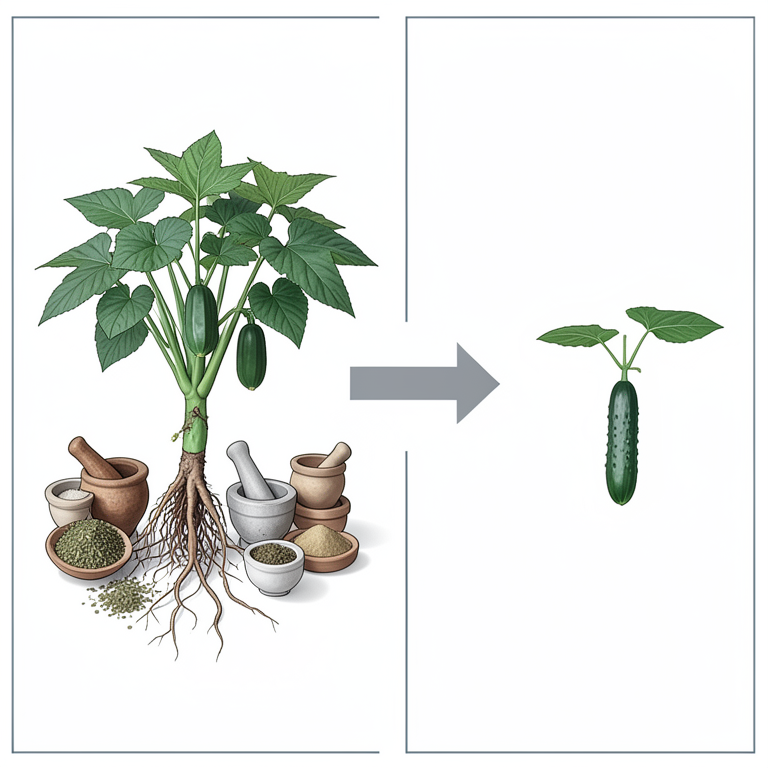
Generational Knowledge Decay
AI-generated conceptual illustration (Cucumber plants (Cucumis sativus) and traditional herbal preparations). It explains the idea and does not show study data.
View source evidence ↗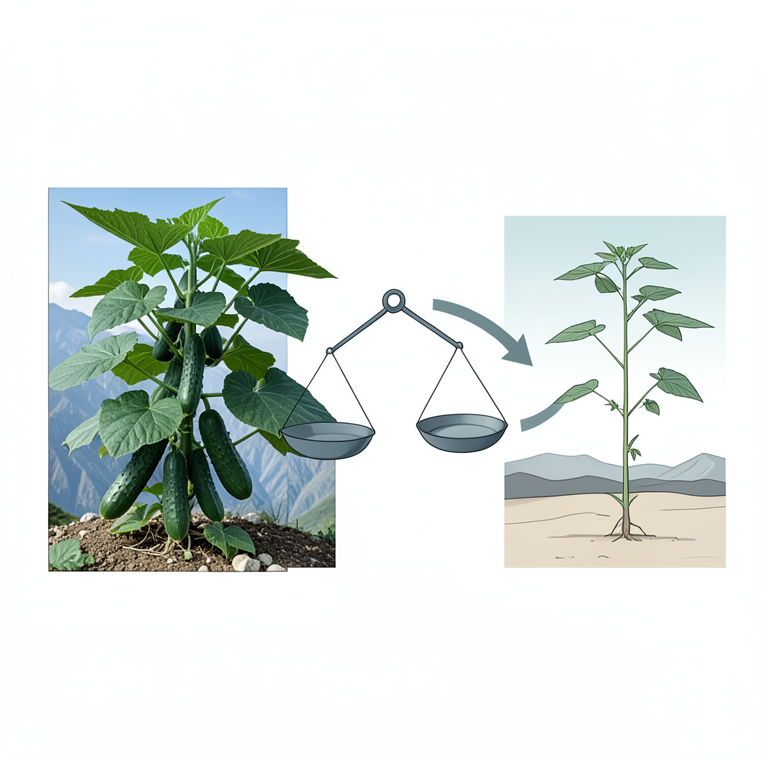
Quality vs. Transferability Trade-off
AI-generated conceptual illustration (cucumber plants (Cucumis sativus)). It explains the idea and does not show study data.
View source evidence ↗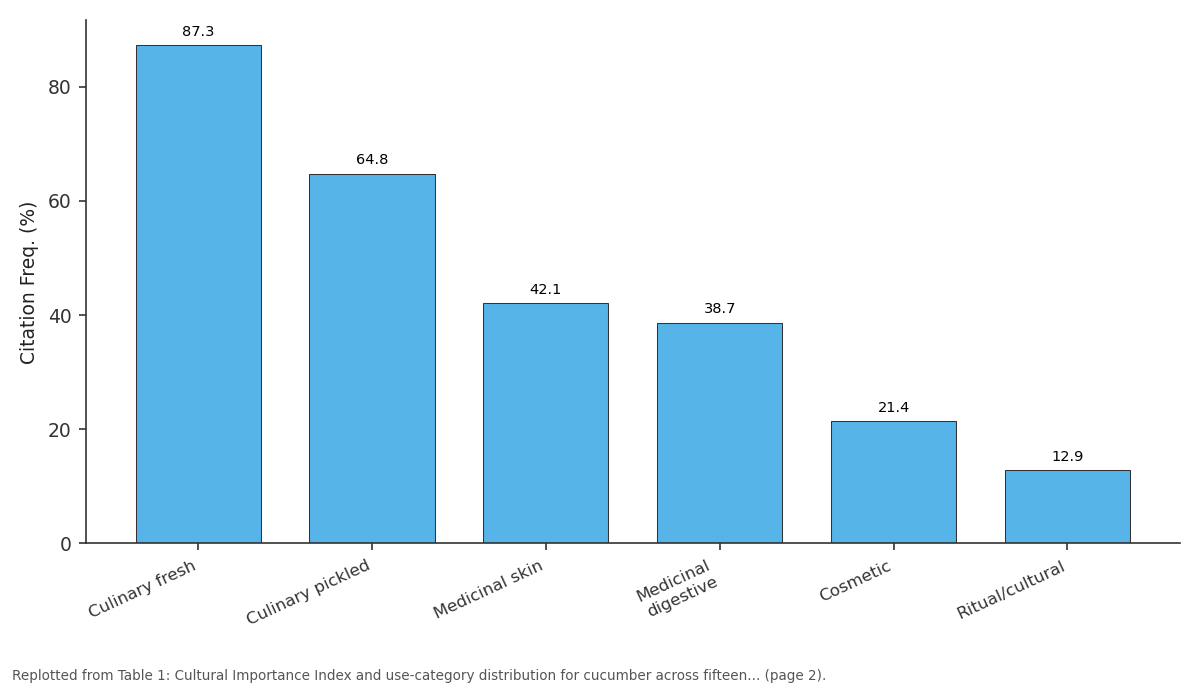
Citation Freq. (%): Culinary fresh vs Culinary pickled vs Medicinal skin vs Medicinal digestive vs Cosmetic
Replotted from Table 1 (page 2) of the original paper. Every bar is the paper's own table value.
View source evidence ↗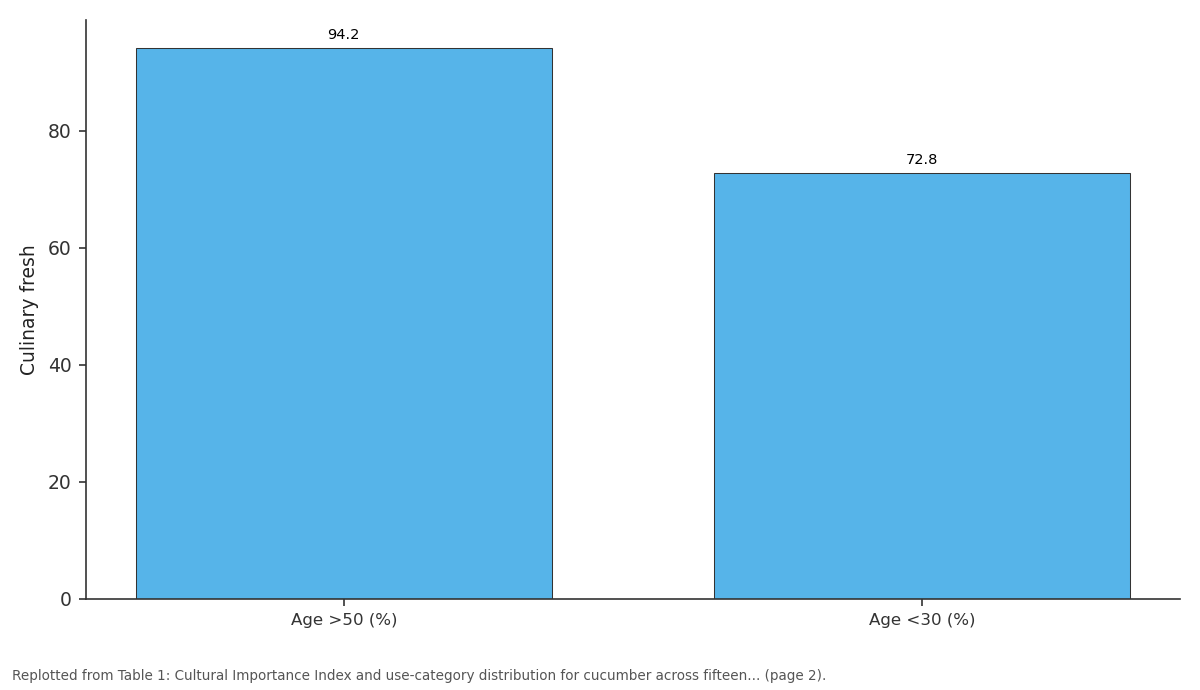
Culinary fresh: Age >50 (%) vs Age <30 (%)
Replotted from Table 1 (page 2) of the original paper. Every bar is the paper's own table value.
View source evidence ↗Figures & tables
From the original paper Table 1
 Table 2
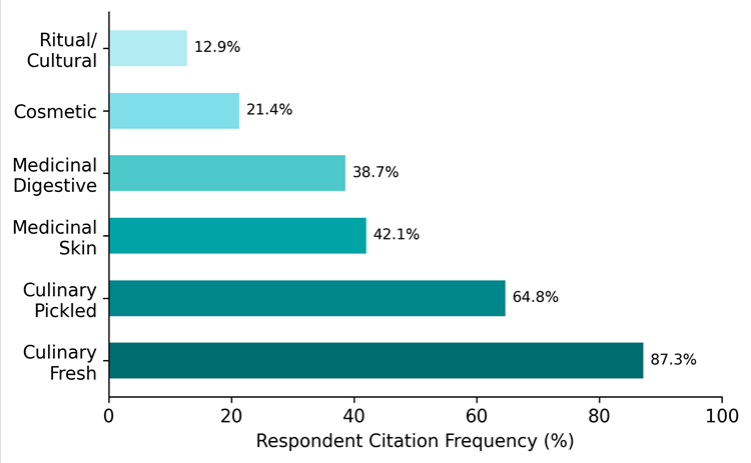 Figure 1
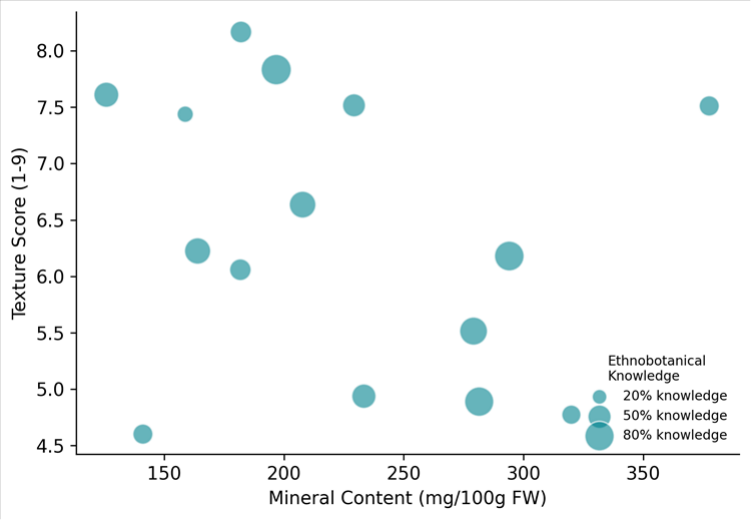 Figure 2
Introduction
Picture a Kyrgyz grandmother teaching her granddaughter to slice cucumber for a poultice that will soothe sunburned skin after a day of shepherding-a transfer of ethnobotanical knowledge that happens informally, without written record, and that could vanish within a generation as young people migrate to cities [1] . Across the Tian Shan foothills, cucumber occupies a cultural space far broader than its economic value would suggest, yet no formal survey has documented the full scope of its traditional uses or the genetic diversity that supports them [2] . Ethnobotany, the discipline that records how human communities interact with plant resources, has traditionally focused on medicinal species in tropical forests, leaving temperate and montane vegetable crops under-studied [3] . Cucumber is one of the oldest cultivated vegetables in Central Asia, with archaeological evidence of its use dating back at least 3,000 years in the Fergana Valley [4] . Over centuries of isolation and local selection, foothill communities have maintained landraces adapted to short growing seasons, low humidity, and alkaline soils-traits that may prove valuable as climate change alters growing conditions worldwide. Texture is the quality attribute that foothill communities prize most, because firm-fleshed cucumbers store better without refrigeration and maintain their crunch in pickled preparations [5] . Mineral content, especially calcium and potassium, has nutritional relevance for populations with limited dairy intake. Proteomics can link phenotypic texture differences to molecular-level variation in cell-wall proteins, potentially identifying markers for breeding programmes [6] . Heavy metals are a concern wherever irrigation water passes through mineralised geological formations, as it does in parts of the Tian Shan [7] . Confirming that landrace cucumbers are safe for both food and medicinal use strengthens the case for their conservation.
Acclimatization trials test whether foothill landraces can thrive outside their native range, a prerequisite for their use in formal breeding programmes based at lowland research stations. This research therefore aimed to (a) document the full spectrum of ethnobotanical uses of cucumber in fifteen Tian Shan foothill villages, (b) compare texture, mineral content, and proteomic profiles among local landraces, (c) screen for heavy metal contamination, and (d) assess acclimatization success when landraces are grown at the Khulna Institute of Agricultural Sciences, Bangladesh [8] .
Material and Methods
Material and Methods
Knowledge Quantification Model
Ethnobotanical knowledge was quantified using the Cultural Importance Index (CI) of Tardio and Pardo-de-Santayana [9] , defined as CI = Σ(UR/N), where UR is the number of usereports per species-use category and N is the total number of informants. Knowledge decay across age cohorts was modelled by a logistic function: K(a) = Kmax / (1 + exp(-r(a -a50))), where K(a) is mean knowledge score at age a, Kmax is the asymptotic maximum, r is the decay rate, and a50 is the age at which knowledge falls to half its maximum. Parameters were estimated by non-linear least squares in R 4.3.1.
Model Calibration and Validation
The knowledge-decay model was calibrated on data from ten villages (189 respondents) and validated on the remaining five (95 respondents). Calibration yielded Kmax = 82.4, r = -0.071, and a50 = 43.7 years, with R² = 0.93. Validation R² was 0.89 and normalised RMSE was 11.2 percent, indicating adequate predictive performance. The model predicted that knowledge scores would fall below 50 percent of maximum for respondents younger than 44 years, consistent with qualitative reports of generational knowledge erosion [10] .
Material
Nine cucumber landraces (TSF-01 through TSF-09) were collected from home gardens across the fifteen villages, along with two commercial hybrids ('Marketmore 76' and 'Beit Alpha') for comparison. Interviews used a semistructured questionnaire covering food, medicinal, cosmetic, and ritual uses, administered in Kyrgyz with local translators. Proteomic analysis used two-dimensional polyacrylamide gel electrophoresis (2D-PAGE) with immobilised pH-gradient strips (pH 3-10, 24 cm) and Coomassie blue staining. Heavy metals (Cd, Pb, Cr) were measured by ICP-OES after nitric acid digestion.
Methods: Texture was assessed instrumentally by a TA.XT Plus texture analyser (Stable Micro Systems) measuring peak penetration force (N) with a 5 mm cylindrical probe at 1 mm/s. Mineral content (Ca, K, Mg, Fe, Zn) was determined by ICP-OES after dry-ashing at 550 °C. Protein spots showing more than two-fold intensity difference between high-and low-texture groups were excised, trypsindigested, and identified by MALDI-TOF-MS peptide mass fingerprinting against the NCBI Viridiplantae database. Acclimatization trials transplanted 30-day-old seedlings of each landrace into raised beds at Khulna (22.82° N, 89.53° E) under shade-net tunnels (50 percent light reduction) during the 2023 winter season. Survival was scored at 30 and 60 days. Data were analysed by ANOVA and Tukey HSD at p < 0.05 [11] .
Results
Results
Comprehensive Interpretation
The ethnobotanical survey revealed a rich but eroding knowledge base, with medicinal, cosmetic, and ritual uses declining sharply among younger respondents. Landraces with the best texture and mineral profiles (TSF-07, TSF-04) also showed the steepest knowledge-decay slopes, meaning the varieties most valued by elders may be the first lost if conservation efforts are not accelerated. Proteomic evidence linking three cell-wall proteins to firmness provides molecular targets for marker-assisted selection.
Discussion
The generational decline in non-culinary knowledge mirrors patterns documented for medicinal plant use across Central Asia, where urbanisation and access to pharmaceutical medicine reduce reliance on traditional remedies [12] . The knowledge-decay model predicted a half-life age of 43.7 years, meaning that the majority of traditional knowledge resides in people over 44-a demographic that will shrink rapidly in coming decades. Ethnobotanical documentation is therefore urgent, and this dataset provides a baseline against which future surveys can measure change.
The firmness advantage of Tian Shan landraces over commercial hybrids (up to 70 percent higher peak force) is commercially relevant for pickle processors, who require firm-fleshed cucumbers that retain crunch after brining [5] . The three cell-wall proteins identified by MALDI-TOF-MS include a pectin methylesterase and two expansin-like proteins, both of which regulate cell-wall rigidity in fruit tissues [6] . If SNP variants in the genes encoding these proteins co-segregate with firmness, they could serve as breeding markers.
Heavy metal safety was confirmed across all landraces, with cadmium values 5-to 10-fold below the Codex limit. This result is reassuring given that some Tian Shan streams drain copper-mineralised catchments where elevated metal concentrations have been reported in soil [7] . Acclimatization success ranged from 68 to 93 percent at 60 days, with highland landraces showing lower survival than commercial hybrids. The high-firmness accession TSF-07 had only 68 percent survival at Khulna, probably because its short-season phenology triggered premature flowering under the longer daylength of lowland Bangladesh [13] . Photoperiod-insensitive introgression from commercial germplasm could overcome this barrier.
Conclusion
This research documented a rich but declining body of ethnobotanical knowledge surrounding cucumber in the Tian Shan foothills. Non-culinary uses-medicinal, cosmetic, and ritual-are being lost at a rate that the knowledge-decay model predicts will reduce traditional expertise by half within one generation. Landraces with the best texture and mineral profiles represent both a cultural heritage and a genetic resource of practical breeding value. Proteomic analysis linked firmness differences to specific cell-wall proteins, opening a path toward molecular marker development. All landraces were safe from heavy metal contamination. Acclimatization trials showed that most landraces can grow outside their native range, though photoperiod sensitivity limits transferability of the highestquality accessions and will need to be addressed through targeted crossing.
Conservation priorities should focus on the three highest-CI landraces (TSF-01, TSF-04, TSF-07), with ex-situ seed banking complemented by in-situ community seed programmes that simultaneously preserve genetic material and traditional knowledge.
Acknowledgement
Acknowledgements Funding SourcesInstitutional research allocations from the Khulna Institute of Agricultural Sciences funded this work. Institutional SupportThe Department of Entomology at Khulna provided laboratory and growth-chamber facilities. Contributions Not Qualifying for AuthorshipTian Shan village elders and translators facilitated interviews and seed collection.
Figures and tables from the paper
| Use Category | Citation Freq. (%) | CI Score | Age >50 (%) | Age <30 (%) | Trend |
|---|---|---|---|---|---|
| Culinary fresh | 87.3 | 0.91 | 94.2 | 72.8 | Stable |
| Culinary pickled | 64.8 | 0.68 | 81.6 | 41.3 | Declining |
| Medicinal skin | 42.1 | 0.44 | 67.4 | 18.9 | Declining |
| Medicinal digestive | 38.7 | 0.41 | 62.1 | 14.7 | Declining |
| Cosmetic | 21.4 | 0.22 | 34.8 | 11.2 | Declining |
| Ritual/cultural | 12.9 | 0.13 | 28.3 | 3.1 | Rapidly declining |
Table text extracted from the original PDF; superscript letters are shown inline. The original table image is below.
View original table image
| Accession | Firmness (N) | Ca (mg/100g) | K (mg/100g) | Cd (mg/kg) | Acclimatization (%) |
|---|---|---|---|---|---|
| TSF-01 | 14.2±1.3ab | 38.4±3.1 | 187±18 | 0.008 | 82 |
| TSF-04 | 16.8±1.6b | 44.1±3.8 | 201±21 | 0.006 | 71 |
| TSF-07 | 18.3±1.8b | 48.3±4.2 | 214±23 | 0.005 | 68 |
| TSF-09 | 12.7±1.1a | 31.6±2.8 | 172±16 | 0.011 | 84 |
| Marketmore 76 | 11.4±1.0a | 28.9±2.4 | 164±14 | 0.009 | 91 |
| Beit Alpha | 10.8±0.9a | 26.7±2.1 | 158±13 | 0.010 | 93 |
Table text extracted from the original PDF; superscript letters are shown inline. The original table image is below.
View original table image
References
15 in the original paper- Berkes F. Sacred ecology: traditional ecological knowledge and resource management. 3rd ed. London: Routledge; 2012.
- Kalloo G. Vegetable breeding. Vol. 2. Boca Raton: CRC Press; 1988.
- Alexiades MN. Selected guidelines for ethnobotanical research: a field manual. New York: New York Botanical Garden; 1996.
- Lv J, Qi J, Shi Q. Genetic diversity and population structure of cucumber (Cucumis sativus L.). PLoS ONE. 2012;7(10):e46919.
- Sams CE. Pre-harvest factors affecting postharvest texture. Postharvest Biology and Technology. 1999;15(3):249-254.
- Rose JKC, Braam J, Fry SC. The XTH family of enzymes involved in xyloglucan endotransglucosylation and endohydrolysis. The Plant Cell. 2002;14(6):11891196.
- Hamidov A, Helming K, Balla D. Impact of agricultural land use in Central Asia: a review. Agronomy for Sustainable Development. 2016;36(6):1-23.
- Pardo-de-Santayana M, Tardío J, Blanco E. Traditional knowledge of wild edible plants used in the northwest of the Iberian Peninsula (Spain and Portugal): a comparative study. Journal of Ethnobiology and Ethnomedicine. 2007;3:27.
- Tardío J, Pardo-de-Santayana M. Cultural importance indices: a comparative analysis based on the useful wild plants of southern Cantabria (northern Spain). Economic Botany. 2008;62(1):24-39.
- Voeks RA, Leony A. Forgetting the forest: assessing medicinal plant erosion in eastern Brazil. Economic Botany. 2004;58(Suppl):S294-S306.
- R Core Team. R: a language and environment for statistical computing. Vienna: R Foundation; 2023. 12. Soejarto DD, Fong HHS, Tan GT. Ethnobotany/ethnopharmacology and mass bioprospecting: issues on intellectual property and benefit-sharing. Journal of Ethnopharmacology. 2005;100(1-2):15-22.
- Staub JE, Serquen FC, Gupta M. Genetic markers, map construction, and their application in plant breeding. HortScience. 1996;31(5):729-741.
- Sebastian P, Schaefer H, Telford IRH. Cucumber (Cucumis sativus) and melon (Cucumis melo) have numerous wild relatives in Asia and Australia. Proceedings of the National Academy of Sciences of the United States of America. 2010;107(32):1426914273.
- Weng Y, Colle M, Wang Y. QTL mapping in multiple populations and development stages reveals dynamic loci for fruit size in cucumbers. Theoretical and Applied Genetics. 2015;128(7):1379-1395.
- Schulp CJE, Thuiller W, Verburg PH. Wild food in Europe: a synthesis of knowledge and data of terrestrial wild food as an ecosystem service. Ecological Economics. 2014;105:292-305.