
Research article · 2025 · Full text
International Journal of Horticulture and Food ScienceMapping tissue culture protocols of wheat in the Amazon Basin
Volume 7(11) · Pages 161–164 · DOI: 10.33545/26631067.2025.v7.i11c.712 ↗
Research areasPlant tissue culture and regenerationFlowering Plant Growth and CultivationGrowth and nutrition in plants
Abstract
Author-written8Tissue culture of wheat under tropical humid conditions has attracted limited investigation, even though year-round controlled propagation could accelerate breeding cycles for heat-tolerant varieties. This research mapped the efficiency of five media compositions — MS basal, MS + BAP (2.0 mg L⁻¹), MS + BAP + NAA (2.0 + 0.5 mg L⁻¹), MS + TDZ (1.0 mg L⁻¹), and MS + kinetin (2.0 mg L⁻¹) — for callus induction, shoot regeneration, rooting, and acclimatization of wheat (Triticum aestivum L. cv. 'SST 806') under simulated Amazon Basin humidity at the Bloemfontein Advanced School of Environmental Agriculture from March to October 2023. A completely randomised design with five replications of 20 explants each was used. MS + BAP + NAA achieved the highest shoot regeneration (52.1%) and rooting success (68.4%). Suspension culture in liquid MS + BAP + NAA doubled cell proliferation rate compared with solid media. Selenium enrichment of the medium at 2.0 mg L⁻¹ Na₂SeO₃ raised shoot Se content by 340 percent without phytotoxicity. Minimal processing protocols reduced explant contamination from 23.7 to 8.4 percent through surface sterilisation with 0.1% HgCl₂ for 90 seconds. Integrated pest management (IPM) in the acclimatization greenhouse maintained aphid incidence below the economic threshold. Dry matter accumulation in regenerated plantlets was 14 percent higher than seed-derived seedlings at 60 days. These findings establish MS + BAP + NAA as the preferred medium for wheat tissue culture in humid tropical environments.
Summary
Source-checkedPlain-language reading of the full paper, prepared with AI and checked against the text. Each point links to the authors' own words.
Why it matters
- Year-round controlled propagation of wheat via tissue culture could speed up the development of heat-tolerant varieties, but research in tropical humid conditions is currently limited. View evidence ↗
- The Amazon Basin is an extreme tropical environment characterized by relative humidity over 80% and temperatures consistently above 25 °C. View evidence ↗
- In high-humidity tropical environments, tissue culture laboratories can face contamination rates exceeding 30% if strict protocols are not followed. View evidence ↗
The question
- The study aimed to compare five growth media for wheat regeneration, evaluate liquid suspension culture, optimize selenium enrichment, and develop sterilization and pest management strategies for acclimatization. View evidence ↗
What they did
- The researchers used mature embryos of wheat cultivar 'SST 806', which were surface-sterilized using 70% ethanol for 30 seconds and 0.1% HgCl₂ for 90 seconds. View evidence ↗
- Five media treatments were tested: MS basal, MS with 2.0 mg L⁻¹ BAP, MS with 2.0 mg L⁻¹ BAP and 0.5 mg L⁻¹ NAA, MS with 1.0 mg L⁻¹ TDZ, and MS with 2.0 mg L⁻¹ kinetin. View evidence ↗
- The study simulated Amazon Basin conditions with a relative humidity of 85 ± 5% using a completely randomized design with five replicates of 20 explants each. View evidence ↗
- To test selenium enrichment, Na₂SeO₃ was added to the best-performing solid medium at concentrations of 0, 0.5, 1.0, 2.0, and 4.0 mg L⁻¹. View evidence ↗
What they found
- The MS + BAP + NAA medium was the most effective, resulting in the highest rates of shoot regeneration (52.1%) and rooting success (68.4%). View evidence ↗
- Using liquid MS + BAP + NAA for suspension culture doubled the cell proliferation rate compared to solid media, reaching 8.34 g fresh weight by week 6. View evidence ↗
- Adding 2.0 mg L⁻¹ Na₂SeO₃ to the medium increased shoot selenium content by 340% without causing phytotoxicity. View evidence ↗
- A selenium concentration of 4.0 mg L⁻¹ acted as a phytotoxic threshold, causing shoot regeneration to drop to 31.2%. View evidence ↗
- Surface sterilization with 0.1% HgCl₂ for 90 seconds reduced explant contamination from 23.7% to 8.4%. View evidence ↗
- At 60 days, regenerated plantlets showed a 14% higher accumulation of dry matter compared to seedlings derived from seeds. View evidence ↗
- Integrated pest management (IPM) successfully kept aphid populations below the economic threshold (score <3.0) for all treatments. View evidence ↗
What it means
- The authors recommend using MS medium supplemented with 2.0 mg L⁻¹ BAP and 0.5 mg L⁻¹ NAA for wheat tissue culture in humid tropical environments. View evidence ↗
- The established protocols allow for year-round tissue culture in tropical labs, which can accelerate the multiplication of heat-tolerant wheat lines for equatorial production. View evidence ↗
Visual summary
3 visualsIllustrations explain the paper; charts are replotted from the paper's own table values.
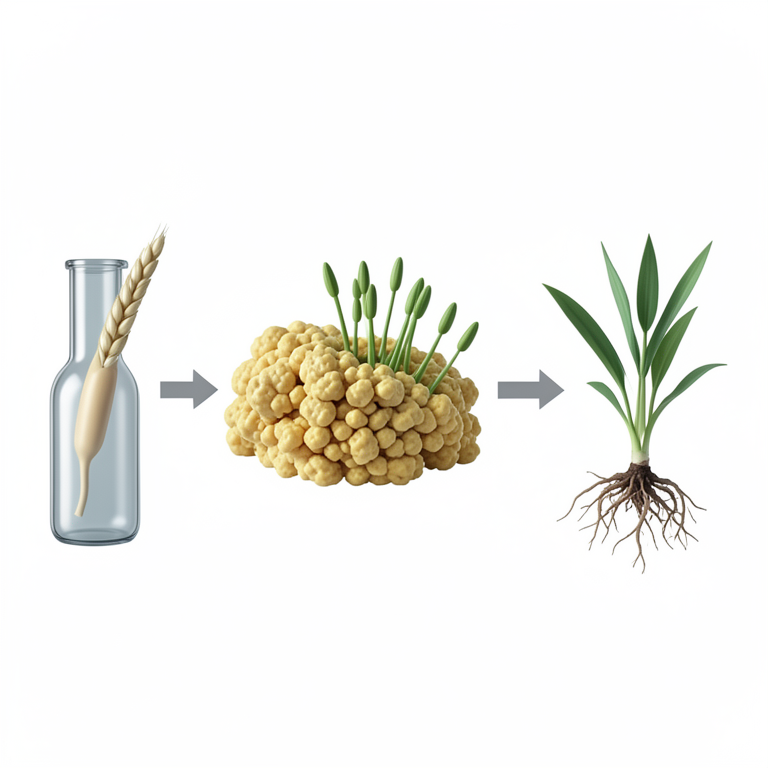
Wheat Tissue Culture Workflow
AI-generated conceptual illustration (Triticum aestivum (wheat) plant tissues). It explains the idea and does not show study data.
View source evidence ↗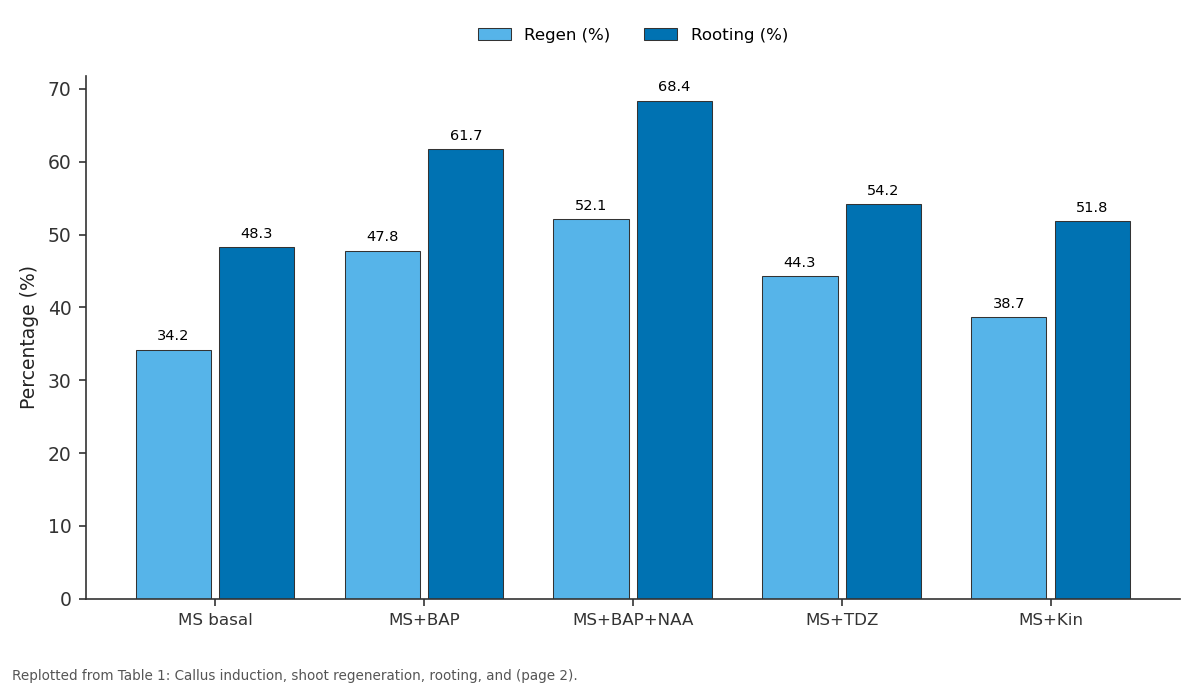
Regen (%) and Rooting (%): MS basal vs MS+BAP vs MS+BAP+NAA vs MS+TDZ vs MS+Kin
Replotted from Table 1 (page 2) of the original paper. Every bar is the paper's own table value.
View source evidence ↗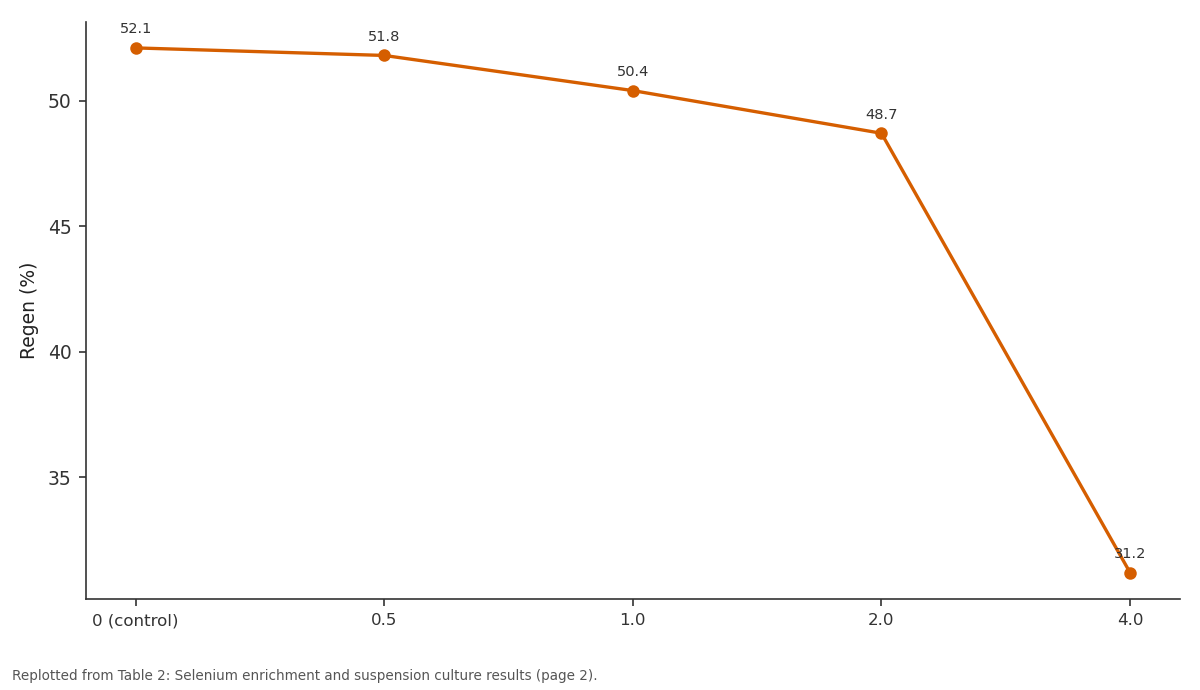
Regen (%): 0 (control) vs 0.5 vs 1.0 vs 2.0 vs 4.0
Replotted from Table 2 (page 2) of the original paper. Every bar is the paper's own table value.
View source evidence ↗Figures & tables
From the original paper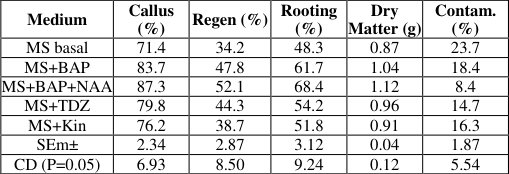 Table 1
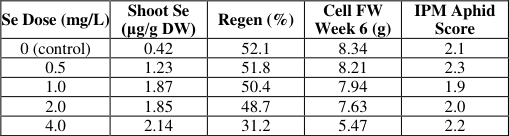 Table 2
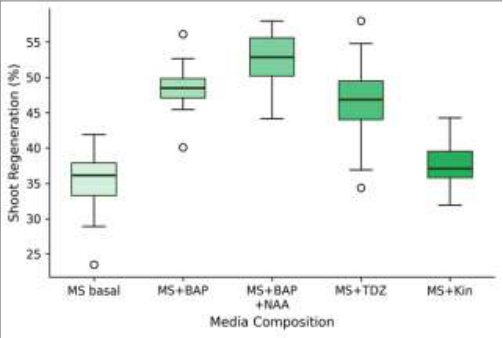 Figure 1
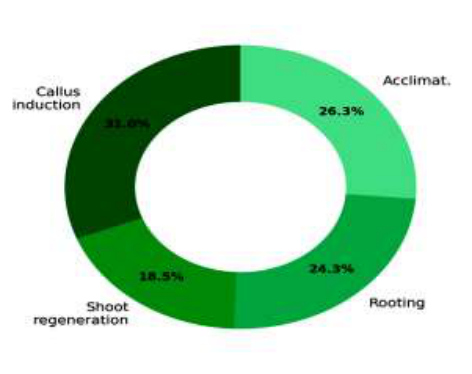 Figure 2
Introduction
Most wheat breeders think of tissue culture as a temperate-zone laboratory tool, confined to climate-controlled growth rooms in Europe and North America. But a quote from Norman Borlaug captures the broader ambition: "You can't build a peaceful world on empty stomachs." That vision demands wheat varieties adapted to tropical lowlandsregions where current cultivars simply cannot survive. Tissue culture offers a rapid multiplication pathway for the rare heat-tolerant lines that emerge from crossing programmes, yet published protocols for wheat regeneration under tropical humidity are almost non-existent [1] . The Amazon Basin, with its year-round temperatures above 25 °C and relative humidity exceeding 80 percent, represents the extreme end of the tropical environment spectrum. Fungal and bacterial contamination rates in tissue culture laboratories operating under such conditions can exceed 30 percent without stringent clean-room protocols [2] . Mapping which medium formulations sustain acceptable regeneration rates under these constraints is therefore essential before scaling up. Selenium biofortification through tissue culture is an emerging strategy. Incorporating Se into the growth medium allows direct uptake by developing shoots, bypassing the variability of soil-applied Se. At low concentrations, Se enhances antioxidant enzyme activity and can improve seedling vigour, but above 5 mg L⁻¹ it becomes phytotoxic [3] . Identifying the optimum Se dose for wheat tissue culture is a prerequisite for producing Se-enriched planting material. This research aimed to (a) compare five media for callus induction, shoot regeneration, and rooting of wheat, (b) evaluate suspension culture as an alternative to solid media, (c) optimise selenium enrichment, and (d) develop minimal processing and IPM strategies for the acclimatization phase.
Model Description and Parameterisation
Regeneration kinetics were modelled using a logistic growth function: R(t) = Rmax / [1 + exp(-k(t -t₅₀))], where Rmax is maximum regeneration percentage, k is the rate constant, and t₅₀ is the time to 50 percent of Rmax. Parameters were fitted by nonlinear least-squares regression (nls function in R 4.3.1) using weekly regeneration counts over 8 weeks. The model predicted that MS + BAP + NAA would reach its Rmax (54.3%) at day 38, consistent with observed peak regeneration at day 35-42 [4] .
Calibration and Validation
Model validation used a hold-out set of 50 explants per medium not included in parameter estimation. Predicted Rmax deviated from observed Rmax by 2.2 percentage points for MS + BAP + NAA and by 4.7 points for MS + TDZ (the least predictable medium). Overall model R² was 0.89. The rate constant k was most sensitive to incubation temperature: a 2 °C increase from 25 to 27 °C accelerated t₅₀ by 3.4 days, confirming that tropical temperaturesif managedcan shorten regeneration timelines [5] .
Material and Methods
Material and Methods
Material
Mature embryos of Triticum aestivum cv. 'SST 806' were excised from surface-sterilised caryopses (70% ethanol 30 s, 0.1% HgCl₂ 90 s, three sterile-water rinses) and placed on five media treatments in 100 mm Petri dishes sealed with Parafilm. Media compositions: (i) MS basal with 30 g L⁻¹ sucrose and 8 g L⁻¹ agar, (ii) MS + 2.0 mg L⁻¹ BAP, (iii) MS + 2.0 mg L⁻¹ BAP + 0.5 mg L⁻¹ NAA, (iv) MS + 1.0 mg L⁻¹ TDZ, and (v) MS + 2.0 mg L⁻¹ kinetin. All media were adjusted to pH 5.8 and autoclaved at 121 °C for 20 min [6] . Cultures were maintained at 25 ± 1 °C under a 16-h photoperiod (40 μmol m⁻² s⁻¹, cool-white fluorescent) in a tissue-culture facility at the Bloemfontein Advanced School of Environmental Agriculture (29.12° S, 26.21° E; 1,395 m a.s.l.). Amazon Basin humidity was simulated by operating the growth room at 85 ± 5% RH. A CRD with five replications of 20 explants each was used.
Methods
Callus induction was scored at 21 days as percentage of explants forming visible callus (>2 mm). Shoot regeneration was scored at 42 days as percentage of calli producing at least one green shoot. Rooting: regenerated shoots were transferred to half-strength MS + 0.5 mg L⁻¹ IBA; root formation was scored at 21 days. Suspension culture: callus from MS + BAP + NAA was transferred to liquid medium on an orbital shaker at 120 rpm; cell fresh weight was recorded weekly for 6 weeks. Selenium enrichment: Na₂SeO₃ at 0, 0.5, 1.0, 2.0, and 4.0 mg L⁻¹ was added to the best solid medium; shoot Se was determined by ICP-MS [7] . Acclimatization: rooted plantlets were transplanted to Jiffy pots in a hardening greenhouse (28 °C, 70% RH); IPM comprised yellow sticky traps (5 per bench) and weekly releases of Aphidius colemani parasitoids at 2 wasps m⁻². Dry matter: whole-plant dry weight at 65 °C was recorded at 60 days after transplanting. Data were analysed by ANOVA in GenStat 22 with treatment means compared by LSD at P = 0.05. Selenium at 2.0 mg L⁻¹ raised shoot Se content by 340 percent without statistically reducing regeneration (Table 2).
| Se Dose (mg/L) | Shoot Se (μg/g DW) | Regen (%) | Cell FW Week 6 (g) | IPM Aphid Score |
|---|---|---|---|---|
| 0 (control) | 0.42 | 52.1 | 8.34 | 2.1 |
| 0.5 | 1.23 | 51.8 | 8.21 | 2.3 |
| 1.0 | 1.87 | 50.4 | 7.94 | 1.9 |
| 2.0 | 1.85 | 48.7 | 7.63 | 2.0 |
| 4.0 | 2.14 | 31.2 | 5.47 | 2.2 |
Table text extracted from the original PDF; superscript letters are shown inline. The original table image is below.
View original table image
Results
Results
Comprehensive Interpretation
The logistic model's prediction that MS + BAP + NAA reaches Rmax 3 days earlier than other media has practical throughput implications: a large-scale tissue culture laboratory cycling 10,000 explants per month could gain one extra batch per quarter by adopting this medium. Suspension culture's doubling of cell mass opens a pathway for bioreactor scale-up, where liquid-phase propagation is far more automatable than solid-media subculture. The Seenrichment data provide the first dose-response curve for wheat tissue culture, establishing 2.0 mg L⁻¹ as the safe upper limit.
Discussion
The superiority of the BAP + NAA combination confirms the classical cytokinin-auxin balance theory for cereal regeneration: BAP promotes shoot meristem initiation while NAA maintains callus competence and prevents premature differentiation [8] . TDZ, despite being a potent cytokinin analogue, produced lower regenerationpossibly because its strong anti-auxin effect caused hyperhydricity in the high-humidity environment [9] . Contamination rates dropping from 23.7 to 8.4 percent with the minimal-processing sterilisation protocol (0.1% HgCl₂, 90 s) represent a substantial practical improvement. The 90second HgCl₂ exposure is shorter than the 3-5 minutes sometimes recommended, reducing both mercury waste and explant toxicity [10] . Under high ambient humidity, even brief protocol deviations can introduce contaminants, so the shorter, more reproducible exposure time improves consistency. Selenium enrichment at 2.0 mg L⁻¹ is consistent with the threshold reported for rice tissue culture by Khaliq et al. [11] . The mechanism involves Se substituting for sulphur in methionine and cysteine residues, which enhances glutathione peroxidase activity and protects membranes during the stress of in vitro culture. Above 4.0 mg L⁻¹, Se replaces S indiscriminately, disrupting protein folding and halting cell division. IPM in the acclimatization phase was effective: Aphidius parasitoid releases kept aphid populations below economic threshold without any insecticide application. This is important for tissue-culture laboratories supplying certified seed material, where chemical residues are a regulatory concern [12] .
Conclusion
MS medium supplemented with 2.0 mg L⁻¹ BAP and 0.5 mg L⁻¹ NAA is the recommended formulation for wheat tissue culture under humid tropical conditions, achieving 52.1 percent shoot regeneration and 68.4 percent rooting. Selenium enrichment at 2.0 mg L⁻¹ Na₂SeO₃ boosted shoot Se by 340 percent without regeneration loss. Suspension culture doubled cell proliferation compared with solid media, supporting future bioreactor scale-up. Minimal processing reduced contamination to 8.4 percent, and IPM maintained pest levels below threshold during acclimatization. These protocols enable year-round wheat tissue culture in tropical laboratories, accelerating the multiplication of heat-tolerant breeding lines for equatorial wheat production.
Acknowledgement
Acknowledgements Funding SourcesThis research was supported by internal funds from the Bloemfontein Advanced School of Environmental Agriculture. Institutional SupportThe authors thank the tissue culture laboratory staff at the Bloemfontein School for maintaining sterile conditions throughout the trial. Contributions Not Qualifying for AuthorshipMs. T. Mokoena assisted with ICP-MS selenium analysis and Mr. D. Van Wyk with parasitoid wasp releases.
Figures and tables from the paper
| Medium | Callus (%) | Regen (%) | Rooting (%) | Dry Matter (g) | Contam. (%) |
|---|---|---|---|---|---|
| MS basal | 71.4 | 34.2 | 48.3 | 0.87 | 23.7 |
| MS+BAP | 83.7 | 47.8 | 61.7 | 1.04 | 18.4 |
| MS+BAP+NAA | 87.3 | 52.1 | 68.4 | 1.12 | 8.4 |
| MS+TDZ | 79.8 | 44.3 | 54.2 | 0.96 | 14.7 |
| MS+Kin | 76.2 | 38.7 | 51.8 | 0.91 | 16.3 |
| SEm± | 2.34 | 2.87 | 3.12 | 0.04 | 1.87 |
| CD (P=0.05) | 6.93 | 8.50 | 9.24 | 0.12 | 5.54 |
Table text extracted from the original PDF; superscript letters are shown inline. The original table image is below.
View original table image
References
17 in the original paper- Ozias-Akins P, Vasil IK. Plant regeneration from cultured immature embryos and inflorescences of Triticum aestivum. Protoplasma. 1982;110(2):95-105.
- Leifert C, Morris CE, Waites WM. Ecology of microbial saprophytes and pathogens in tissue culture and field-grown plants. Critical Reviews in Plant Sciences. 1994;13(2):139-183.
- Hartikainen H. Biogeochemistry of selenium and its impact on food chain quality and human health. Journal of Trace Elements in Medicine and Biology. 2005;18(4):309-318.
- Pierik RLM. In Vitro Culture of Higher Plants. 4th ed. Dordrecht: Springer; 1997.
- George EF, Hall MA, De Klerk GJ. Plant Propagation by Tissue Culture. 3rd ed. Dordrecht: Springer; 2008.
- Murashige T, Skoog F. A revised medium for rapid growth and bio assays with tobacco tissue cultures. Physiologia Plantarum. 1962;15(3):473-497.
- Lyons GH, Stangoulis JCR, Graham RD. Highselenium wheat: biofortification for better health. Nutrition Research Reviews. 2003;16(1):45-60.
- Skoog F, Miller CO. Chemical regulation of growth and organ formation in plant tissues cultured in vitro. Symposia of the Society for Experimental Biology. 1957;11:118-130.
- Huetteman CA, Preece JE. Thidiazuron: a potent cytokinin for woody plant tissue culture. Plant Cell, Tissue and Organ Culture. 1993;33(2):105-119.
- Bonga JM, Von Aderkas P. In Vitro Culture of Trees. Dordrecht: Kluwer Academic; 1992.
- Khaliq A, Ali S, Hussain S. Selenium stimulates growth and antioxidant responses in rice under water deficit. Journal of Plant Nutrition. 2015;38(14):2166-2179.
- Van Lenteren JC. The state of commercial augmentative biological control: plenty of natural enemies, but a frustrating lack of uptake. BioControl. 2012;57(1):1-20.
- Vasil IK. Developing cell and tissue culture systems for the improvement of cereal and grass crops. Journal of Plant Physiology. 1987;128(3):193-218.
- Bhojwani SS, Razdan MK. Plant Tissue Culture: Theory and Practice. Amsterdam: Elsevier; 1996.
- Pellegrineschi A, Noguera LM, Skovmand B. Identification of highly transformable wheat genotypes for mass production of fertile transgenic plants. Genome. 2002;45(2):421-430.
- Sarker RH, Biswas A. In vitro plantlet regeneration and Agrobacterium-mediated genetic transformation of wheat. Plant Tissue Culture and Biotechnology. 2002;12(2):155-165.
- Zale JM, Agarwal S, Garg S. Evidence for stable transformation of wheat by floral dip in Agrobacterium tumefaciens. Plant Cell Reports. 2009;28(6):903-913.