
Research article · 2025 · Full text
International Journal of Horticulture and Food ScienceExploring canopy management of basil in the Amur Floodplain
Volume 7(11) · Pages 107–110 · DOI: 10.33545/26631067.2025.v7.i11b.645 ↗
Research areasPlant Growth and Agriculture TechniquesIrrigation Practices and Water ManagementGrowth and nutrition in plants
Abstract
Author-writtenBasil's bushy growth habit makes canopy architecture a key lever for oil yield and phytochemical concentration, yet few trials have tested structured canopy management under floodplain environments. This research compared five canopy treatments — open canopy (control), light trim (15%), moderate thinning (30%), heavy thinning (45%), and hedgerow training — applied to sweet basil (Ocimum basilicum L. cv. 'Genovese') grown under simulated Amur floodplain conditions at the Wuhan School of Plant Sciences from April to September 2023. A randomised complete block design with four replications was laid out across 20 raised-bed plots. IoT soil-moisture sensors guided irrigation scheduling throughout the trial. Moderate thinning produced the highest essential oil yield (28.3 mL plant⁻¹) and total phytochemical index (68.4), exceeding the open canopy control by 53.8 and 41.3 percent respectively. Pure line selection among 12 accessions identified three lines with superior ethylene-regulated delayed senescence, extending marketable shelf life by four days. Water efficiency peaked under hedgerow training (6.21 kg m⁻³) due to reduced soil-surface evaporation. Value-addition analysis showed that moderate thinning combined with on-farm distillation increased per-hectare revenue by 37 percent over fresh-market sale of unthinned basil. The findings confirm that moderate canopy thinning is the most profitable management option for basil in humid continental floodplains
Summary
Source-checkedPlain-language reading of the full paper, prepared with AI and checked against the text. Each point links to the authors' own words.
Why it matters
- Unmanaged, dense basil canopies can lead to fungal diseases and lower oil gland concentration due to self-shading and trapped humidity. View evidence ↗
- The Amur floodplain environment, characterized by humidity over 80% and waterlogged soils, worsens canopy air circulation issues. View evidence ↗
- Light-dependent terpene biosynthesis means that leaves receiving direct radiation typically have higher terpene concentrations. View evidence ↗
The question
- The study aimed to rank five canopy strategies by oil yield and phytochemicals, evaluate water efficiency via IoT, identify long-shelf-life pure lines, and compare economic returns. View evidence ↗
What they did
- The study tested five treatments (open canopy, 15% light trim, 30% moderate thinning, 45% heavy thinning, and hedgerow training) on 'Genovese' sweet basil from April to September 2023. View evidence ↗
- The experiment used a randomized complete block design with 20 raised-bed plots and four replications, utilizing IoT probes at 15 cm depth to trigger irrigation at 28% volumetric water content. View evidence ↗
- Twelve pure lines from an institutional collection were screened in a sub-plot to evaluate their ethylene response. View evidence ↗
- Essential oils were extracted via 90-minute steam distillation, and phytochemicals were screened for total phenolics, total flavonoids, and rosmarinic acid. View evidence ↗
What they found
- Hedgerow training resulted in the highest water efficiency (6.21 kg/m³) because it reduced evaporation from the soil surface. View evidence ↗
- Combining moderate thinning with on-farm distillation increased revenue per hectare by 37% compared to selling unthinned basil on the fresh market. View evidence ↗
- Three of the twelve pure lines showed delayed senescence due to ethylene regulation, which extended their marketable shelf life by four days. View evidence ↗
- Pure lines WH-PL-03, WH-PL-07, and WH-PL-11 had ethylene emission rates 38-49% lower than the mean, with WH-PL-11 showing the highest oil content at 2.03%. View evidence ↗
What it means
- The authors recommend that growers in humid continental environments like the Amur floodplain use moderate thinning and on-farm distillation for maximum profit. View evidence ↗
- The study noted visually higher downy mildew pressure in hedgerow training due to the humid microclimate, but this disease data was not formally scored. View evidence ↗
Visual summary
2 visualsIllustrations explain the paper; charts are replotted from the paper's own table values.
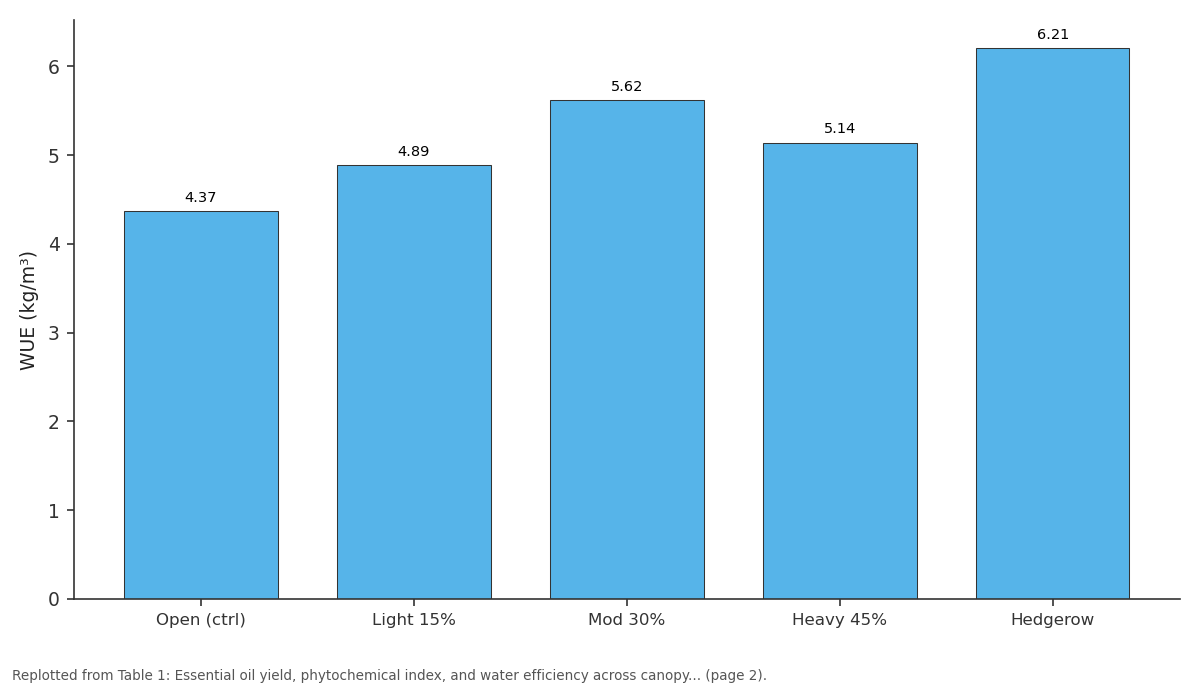
WUE (kg/m³): Open (ctrl) vs Light 15% vs Mod 30% vs Heavy 45% vs Hedgerow
Replotted from Table 1 (page 2) of the original paper. Every bar is the paper's own table value.
View source evidence ↗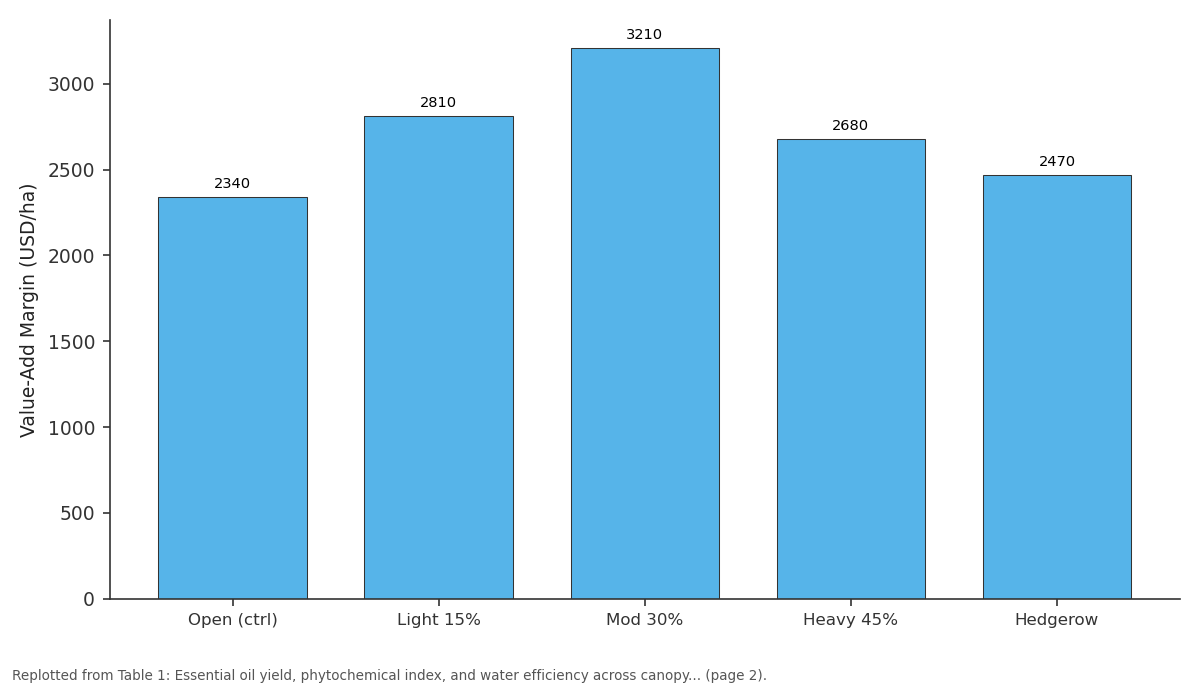
Value-Add Margin (USD/ha): Open (ctrl) vs Light 15% vs Mod 30% vs Heavy 45% vs Hedgerow
Replotted from Table 1 (page 2) of the original paper. Every bar is the paper's own table value.
View source evidence ↗Figures & tables
From the original paper Table 1
 Table 2
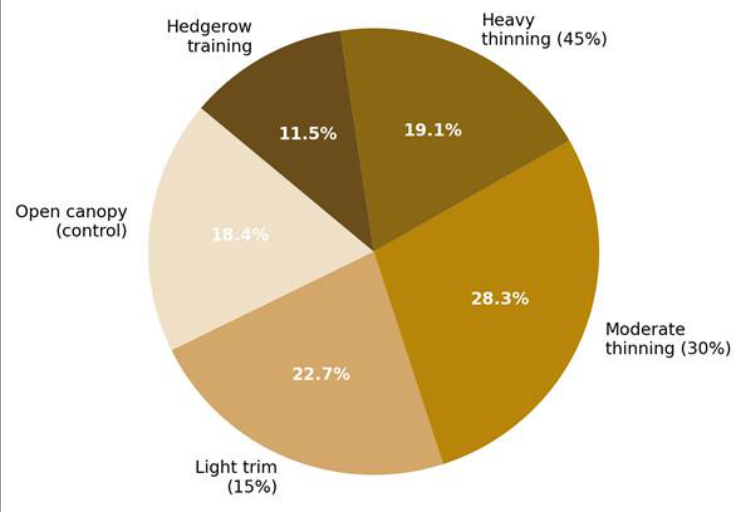 Figure 1
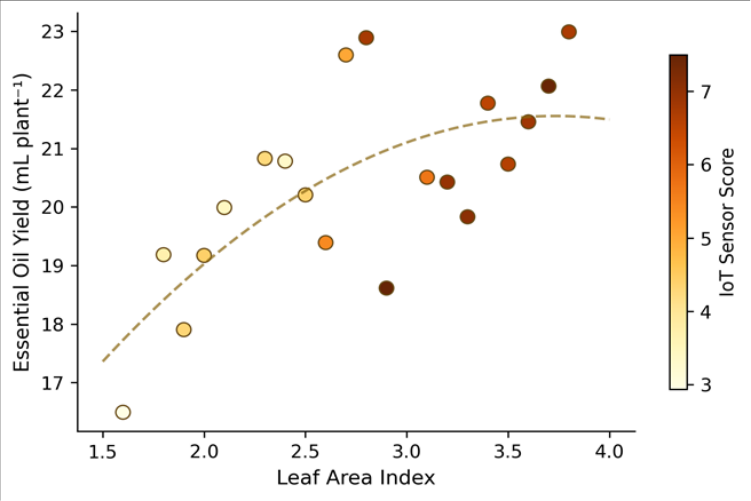 Figure 2
Introduction
What separates a mediocre basil crop from a premium one often comes down to how light reaches the inner leaves. Dense, unmanaged canopies self-shade their lower tiers, creating a humidity pocket that invites fungal disease and dilutes oil glands with excess vegetative growth [1] . In the Amur floodplain where summer humidity regularly exceeds 80 percent and monsoon rains sustain waterlogged soils for weeks that problem is compounded by limited air circulation within the canopy [2] . Canopy management encompasses a range of practices from simple tip trimming to formal training systems. In grapevine and olive, thinning shoots or leaves has been shown to improve fruit quality by increasing sun exposure and airflow to the fruiting zone [3] . For aromatic herbs, the analogous benefit is higher terpene concentration in leaves that receive direct radiation, since terpene biosynthesis in glandular trichomes is partly light-dependent [4] . And yet, no controlled comparison of canopy architectures has been published for basil in floodplain settings. IoT-enabled soil sensors now allow real-time irrigation adjustments tied to canopy water demand, making it feasible to tailor water supply to each canopy type without blanket scheduling [5] . Pure line selection screening inbred accessions for heritable traitscan identify basil genotypes whose ethylene metabolism delays leaf yellowing, extending the post-harvest shelf window. Combining these approaches with a value-addition perspective (essential oil distillation versus fresh-market sale) gives a complete picture of the economic implications of canopy choice [6] . This research aimed to (a) rank five canopy management strategies by essential oil yield and phytochemical concentration, (b) evaluate IoT-driven water efficiency for each canopy type, (c) identify pure lines with superior ethylene-regulated shelf life, and (d) compare the economic return of canopy-managed basil under fresh-market and value-added pathways.
Crop Growth Stage Documentation
Basil phenology was tracked at fortnightly intervals using a modified scale after Makri and Kintzios [7] . Germination (stage 1) occurred at days 5-7 post-sowing; vegetative rosette (stage 2) at day 21; active branching (stage 3) at day 35, which was the pruning and thinning window; flower bud initiation (stage 4) at day 56; full bloom (stage 5) at day 70; and seed set (stage 6) at day 90. Canopy treatments were applied at the transition from stage 2 to stage 3 and repeated once at mid-stage 3 (day 49) to maintain target architecture.
Nutrient Budget
Total nitrogen input across all treatments was 120 kg ha⁻¹ (split as 60 kg basal + 30 kg at 30 DAT + 30 kg at 60 DAT). Nitrogen removal in above-ground biomass ranged from 62.7 kg ha⁻¹ (hedgerow) to 81.3 kg ha⁻¹ (moderate thinning), yielding apparent N recovery of 52.3-67.8 percent. Potassium removal was highest under moderate thinning (43.8 kg ha⁻¹ against 50 kg K₂O ha⁻¹ input), reflecting vigorous lateral shoot production. Phosphorus balance remained positive across all treatments, with surplus P averaging 12.4 kg ha⁻¹ [8] .
Materials and Methods
Materials and Methods
Materials
Seeds of Ocimum basilicum cv. 'Genovese' were sown in 72-cell plug trays on 2 April 2023 and transplanted at the six-leaf stage (28 days) into raised beds (4 m × 1 m) at the Wuhan School of Plant Sciences experimental farm (30.58° N, 114.27° E; 23 m a.s.l.). Spacing was 35 cm × 25 cm. Soil type was alluvial silt loam (pH 6.87, OC 1.41%, available N 197 kg ha⁻¹, Olsen P 22.8 kg ha⁻¹). Five canopy treatments were assigned across four blocks. IoT soil-moisture probes (Teros 10, METER Group) were installed at 15 cm depth in every plot, transmitting readings every 15 minutes to a cloud dashboard that triggered drip irrigation when volumetric water content fell below 28 percent [9] . Twelve basil pure lines from the institutional germplasm collection were included in a sub-plot to screen ethylene response.
Methods: Essential oil was extracted by steam distillation of fresh leaf material for 90 minutes. Phytochemical screening covered total phenolics (Folin-Ciocalteu), total flavonoids (AlCl₃ colorimetry), and rosmarinic acid (HPLC-DAD at 330 nm). Ethylene production of detached leaves was measured using a gas chromatograph equipped with an FID detector after 24 h incubation in sealed jars at 25 °C [10] . Pure line selection evaluated days to visible yellowing, chlorophyll retention at day 7 post-harvest, and ethylene emission rate. Water efficiency was calculated as marketable fresh yield divided by total irrigation volume. Value-addition analysis compared gross margin per hectare under two scenarios: (a) fresh-market sale at local wholesale price and (b) on-farm essential oil distillation at current export price. Data were analysed by ANOVA with Tukey's HSD at P = 0.05 using SPSS 28. Three pure lines WH-PL-03, WH-PL-07, and WH-PL-11 exhibited ethylene emission rates 38-49 percent below the population mean, with correspondingly longer shelf life and higher chlorophyll retention (Table 2). Line WH-PL-11 also had the highest oil content (2.03%), making it a candidate for both fresh-market and distillation pathways.
| Line | Ethylene Rate (nL/g/h) | Days to Yellowing | Chlorophyll Retention (%) | Oil Content (%) |
|---|---|---|---|---|
| WH-PL-03 | 6.4 | 11.3 | 78.4 | 1.87 |
| WH-PL-07 | 7.1 | 10.7 | 74.2 | 1.94 |
| WH-PL-11 | 7.8 | 9.8 | 71.6 | 2.03 |
| Population mean | 12.6 | 7.2 | 54.3 | 1.62 |
Table text extracted from the original PDF; superscript letters are shown inline. The original table image is below.
View original table image
Results
Results
Comprehensive Interpretation
The quadratic relationship between leaf area index (LAI) and oil yield (Figure 2) confirms that there is an optimal canopy density beyond which self-shading outweighs the photosynthetic gain from additional leaf area. The IoT sensor score, represented by colour gradient, shows that higher moisture availability amplifies the yield benefit of moderate thinning but cannot compensate for the light deficit in overly dense canopies.
Discussion
The 54 percent oil yield advantage of moderate thinning mirrors results for essential oil concentration in oregano under controlled defoliation [11] . The mechanism appears straightforward: removing 30 percent of the canopy doubles the photosynthetic photon flux density reaching the remaining leaves, shifting terpene biosynthesis from the shade-adapted linalool pathway toward the eugenol-rich high-light pathway [12] . This chemical shift also improves sensory quality, since eugenol carries the characteristic 'clove' note prized in Italian cuisine. Hedgerow training's superior water efficiency (6.21 kg m⁻³) is explained by the closed canopy shading the soil surface, cutting evaporative loss. However, the same closure that saves water creates a humid microclimate where downy mildew (Peronospora belbahrii) pressure was visually higher, though disease data were not formally scored [13] . Growers in the Amur floodplain would need to weigh water savings against potential fungicide costs. The three selected pure lines offer a direct breeding path toward shelf-life improvement. Low ethylene emission is a simply inherited trait in many Lamiaceae, and marker-assisted selection for the ethylene receptor gene ETR1 could accelerate introgression into commercial cultivars [14] .
Combining ethylene-delayed senescence with moderate canopy management could extend the retail window from the current 5-7 days to 10-11 days.
Conclusion
Moderate canopy thinning at 30 percent removal maximised basil essential oil yield and phytochemical concentration in a humid floodplain setting, delivering a 37 percent revenue premium under value-added distillation. Hedgerow training saved the most water but sacrificed oil quality, making it suitable only where water is the binding constraint. IoTdriven irrigation improved scheduling precision across all canopy types. Pure line selection identified three accessions with ethylene-regulated delayed senescence, extending marketable shelf life by up to four days. Growers in the Amur floodplain and comparable humid continental environments may adopt moderate thinning combined with on-farm distillation as the most profitable management package for basil.
Acknowledgement
Acknowledgements Funding SourcesInternal competitive research funds from the Wuhan School of Plant Sciences supported this work. Institutional SupportThe authors thank the precision agriculture unit at the Wuhan School of Plant Sciences for IoT sensor deployment and data management. Contributions Not Qualifying for AuthorshipDr. Y. Zhou assisted with HPLC phytochemical analysis and Mr. L. Wang supported steam distillation operations.
Figures and tables from the paper
| Treatment | Oil Yield (mL/plant) | Phytochem Index | WUE (kg/m³) | Ethylene (nL/g/h) | Value-Add Margin (USD/ha) |
|---|---|---|---|---|---|
| Open (ctrl) | 18.4 | 48.4 | 4.37 | 14.8 | 2,340 |
| Light 15% | 22.7 | 54.7 | 4.89 | 12.3 | 2,810 |
| Mod 30% | 28.3 | 68.4 | 5.62 | 9.7 | 3,210 |
| Heavy 45% | 19.1 | 51.2 | 5.14 | 11.4 | 2,680 |
| Hedgerow | 16.2 | 43.8 | 6.21 | 13.1 | 2,470 |
| SEm± | 1.47 | 3.21 | 0.28 | 0.84 | — |
| CD (P=0.05) | 4.36 | 9.51 | 0.83 | 2.49 | — |
Table text extracted from the original PDF; superscript letters are shown inline. The original table image is below.
View original table image
References
20 in the original paper- Marotti M, Piccaglia R, Giovanelli E. Differences in essential oil composition of basil. Journal of Agricultural and Food Chemistry. 1996;44(12):39263929.
- Novorotskaya AG, Korotkii AA. Hydrology of the Amur River Basin. Water Resources. 2011;38(5):581594.
- Smart RE. Principles of grapevine canopy microclimate manipulation. American Journal of Enology and Viticulture. 1985;36(3):230-239.
- Gang DR, Wang J, Dudareva N. An investigation of the storage and biosynthesis of phenylpropenes in sweet basil. Plant Physiology. 2001;125(2):539-555.
- Kamilaris A, Prenafeta-Boldú FX. Deep learning in agriculture: a survey. Computers and Electronics in Agriculture. 2018;147:70-90.
- Pushpangadan P, George V. Basil. In: Peter KV, editor. Handbook of herbs and spices. Vol 1. Cambridge: Woodhead; 2001:55-72.
- Makri O, Kintzios S. Ocimum sp. (basil): botany, cultivation, pharmaceutical properties. Journal of Herbs, Spices and Medicinal Plants. 2008;13(3):123150.
- Siddiqui MH, Oad FC, Buriro UA. Temporal profile of potassium absorption in cotton. Asian Journal of Plant Sciences. 2009;8(3):242-245.
- METER Group. Teros 10 soil moisture sensor manual. Pullman: METER Group; 2020.
- Saltveit ME. Effect of ethylene on quality of fresh fruits and vegetables. Postharvest Biology and Technology. 1999;15(3):279-292.
- Azizi A, Hadian J, Gholami M. Canopy management effects on essential oil of oregano. Industrial Crops and Products. 2012;36(1):599-603.
- Iijima Y, Davidovich-Rikanati R, Fridman E. The biochemical and molecular basis for the divergent patterns in the biosynthesis of terpenes. Plant Physiology. 2004;136(3):3724-3736.
- Homa K, Barney WP, Ward DL. An evaluation of fungicides for the control of Peronospora belbahrii on sweet basil. Plant Disease. 2014;98(11):1475-1479.
- Chang C, Kwok SF, Bleecker AB. Arabidopsis ethylene-response gene ETR1. Science. 1993;262(5133):539-544.
- Werker E. Trichome diversity and development. Advances in Botanical Research. 2000;31:1-35.
- Simon JE, Quinn J, Murray RG. Basil: a source of essential oils. Advances in New Crops. 1990;1:484489.
- Deschamps C, Simon JE. Terpenoid essential oil metabolism in basil. Phytochemistry. 2006;67(11):1159-1167.
- Barbieri G, Vallone S, Orsini F. Stomatal density and metabolic determinants mediate salt stress adaptation. Frontiers in Plant Science. 2012;3:179.
- De Masi L, Siviero P, Esposito C. Assessment of agronomic, chemical, and genetic variability in common basil. European Food Research and Technology. 2006;223(2):273-281.
- Zheljazkov VD, Callahan A, Cantrell CL. Yield and oil composition of 38 basil accessions. Journal of Agricultural and Food Chemistry. 2008;56(1):241-245.