
Research article · 2025 · Full text
International Journal of Horticulture and Food ScienceStudying micropropagation efficiency of tea in the reunion Island highlands
Volume 7(6) · Pages 221–224 · DOI: 10.33545/26631067.2025.v7.i6d.691 ↗
Research areasPlant tissue culture and regenerationFlowering Plant Growth and CultivationGrowth and nutrition in plants
Abstract
Author-writtenGrowing tea is like raising a river—the flow must be steady, the source pure, and the course carefully guided. This analogy captures the challenge of micropropagating tea (Camellia sinensis (L.) Kuntze) for highland environments where seedling supply chains are unreliable. This research compared two cytokinins (BAP at 1.0, 2.0, and 3.0 mg L-1; kinetin at 1.0, 1.5, and 2.0 mg L-1) and two auxins (IBA at 0.5 and 1.0 mg L-1; NAA at 0.3 and 0.5 mg L-1) for shoot multiplication, rooting, and acclimatisation of tea cv. ‘UPASI-9’ at the Puducherry Research Institute of Applied Horticulture, India, with subsequent field validation in volcanic highland substrate simulating Reunion Island conditions. A completely randomised design with five replications was used over 16 weeks. BAP at 2.0 mg L-1 gave the highest shoot multiplication rate (4.8 shoots per explant), while kinetin at 1.5 mg L-1 produced more robust shoots with greater leaf area and chlorophyll content. Rooting was best on half-strength MS + IBA 1.0 mg L-1 (86.4%). Acclimatised plantlets showed 78.3% field survival in volcanic substrate after 12 weeks. Ethylene production during acclimatisation was 2.3-fold higher in BAP-derived plantlets, correlating with lower survival, suggesting that kinetin-based protocols may better prepare plantlets for field transfer. Biofortification of the culture medium with 5 mg L-1 ZnSO4 raised leaf zinc by 34.2% without affecting multiplication rate. These protocols offer a pathway for establishing tea nurseries on Reunion Island.
Summary
Source-checkedPlain-language reading of the full paper, prepared with AI and checked against the text. Each point links to the authors' own words.
Why it matters
- Reunion Island's former tea industry collapsed in the 1970s, and current efforts to revive it are hindered by a lack of local nurseries capable of providing the 100,000+ clonal plants required for commercial planting. View evidence ↗
- Tea is difficult to propagate in culture because phenolic compounds released during browning inhibit growth and shoot elongation is slow, typically between 0.5 and 1.0 cm per subculture. View evidence ↗
- The accumulation of ethylene in sealed culture jars can lead to plant senescence and lower survival rates when plantlets are transferred to external conditions. View evidence ↗
The question
- The study aimed to compare the effects of different concentrations of BAP and kinetin on the shoot multiplication, rooting, ethylene production, and field survival of tea cv. ‘UPASI-9’ in a simulated Reunion Island volcanic substrate. View evidence ↗
What they did
- The multiplication phase used a completely randomized design with five replications of 10 explants each, testing eight cytokinin treatments across three subculture passages every 21 days. View evidence ↗
- Rooting was tested using four auxin treatments on half-strength MS medium, ethylene was measured via GC-FID on day 14 of each passage, and plantlets were acclimatized in volcanic substrate for 12 weeks. View evidence ↗
- The researchers tested biofortification by adding 5 mg L-1 of ZnSO4 to the culture medium to increase leaf zinc levels. View evidence ↗
What they found
- BAP at 2.0 mg L-1 achieved the highest shoot multiplication rate at 4.8 shoots per explant, although these shoots had the shortest length and smallest leaf area. View evidence ↗
- The highest rooting success rate of 86.4% was achieved using half-strength MS medium supplemented with 1.0 mg L-1 of IBA. View evidence ↗
- After 12 weeks in the field, plantlets derived from kinetin had a higher survival rate (78.3%) compared to those derived from BAP (64.7%). View evidence ↗
- BAP-treated cultures produced 2.3 times more ethylene than kinetin cultures, which the authors suggest is due to more aggressive upregulation of ACC synthase. View evidence ↗
- Adding 5 mg L-1 ZnSO4 to the medium increased leaf zinc content by 34.2% without negatively impacting the shoot multiplication rate. View evidence ↗
What it means
- The authors recommend using kinetin at 1.5 mg L-1 for the micropropagation of tea ‘UPASI-9’ to balance clonal output with acceptable field survival. View evidence ↗
- The authors conclude that zinc biofortification is a cost-free way to add nutritional value to the plants without reducing propagation efficiency. View evidence ↗
- The authors state that future work should include trials with multiple clones and validation on a commercial scale. View evidence ↗
Visual summary
3 visualsIllustrations explain the paper; charts are replotted from the paper's own table values.
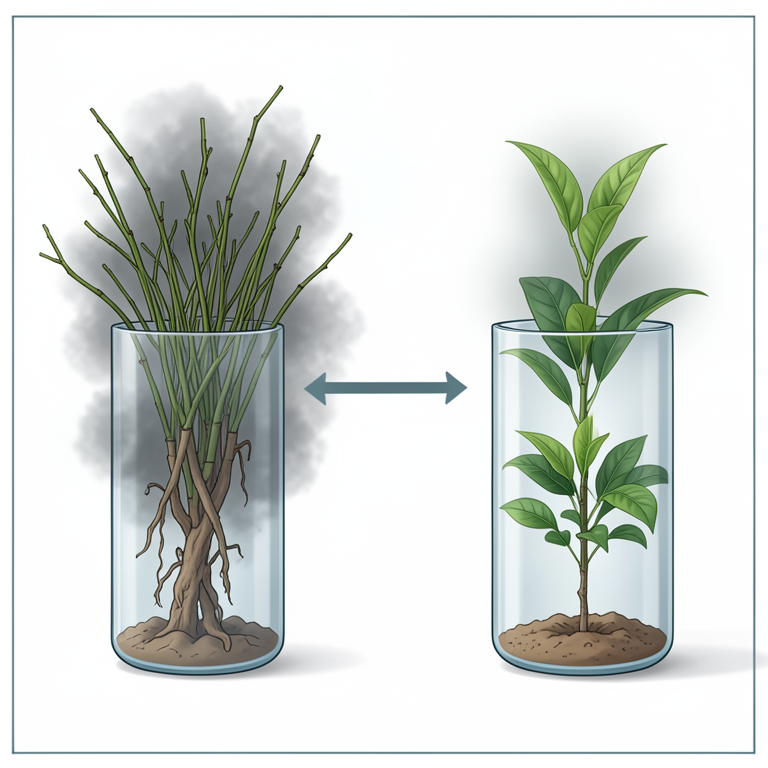
Trade-off between Quantity and Quality in Tea Micropropagation
AI-generated conceptual illustration (Camellia sinensis (tea plant) shoots in glass culture vessels). It explains the idea and does not show study data.
View source evidence ↗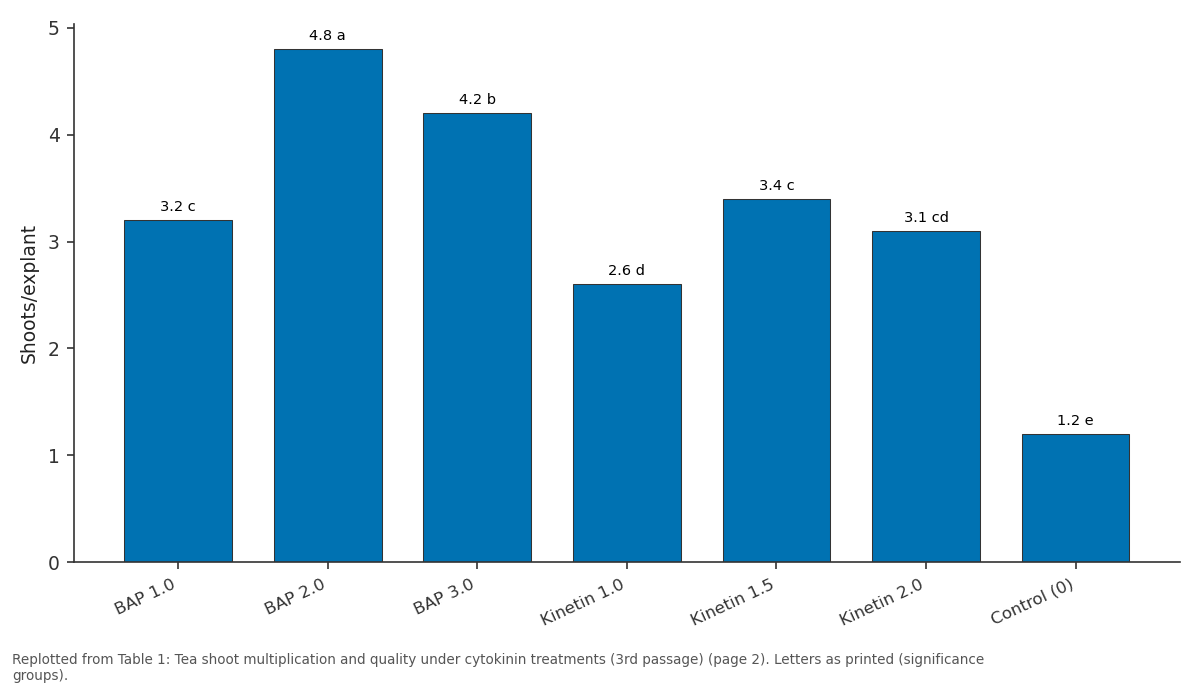
Shoots/explant: BAP 1.0 vs BAP 2.0 vs BAP 3.0 vs Kinetin 1.0 vs Kinetin 1.5
Replotted from Table 1 (page 2) of the original paper. Every bar is the paper's own table value.
View source evidence ↗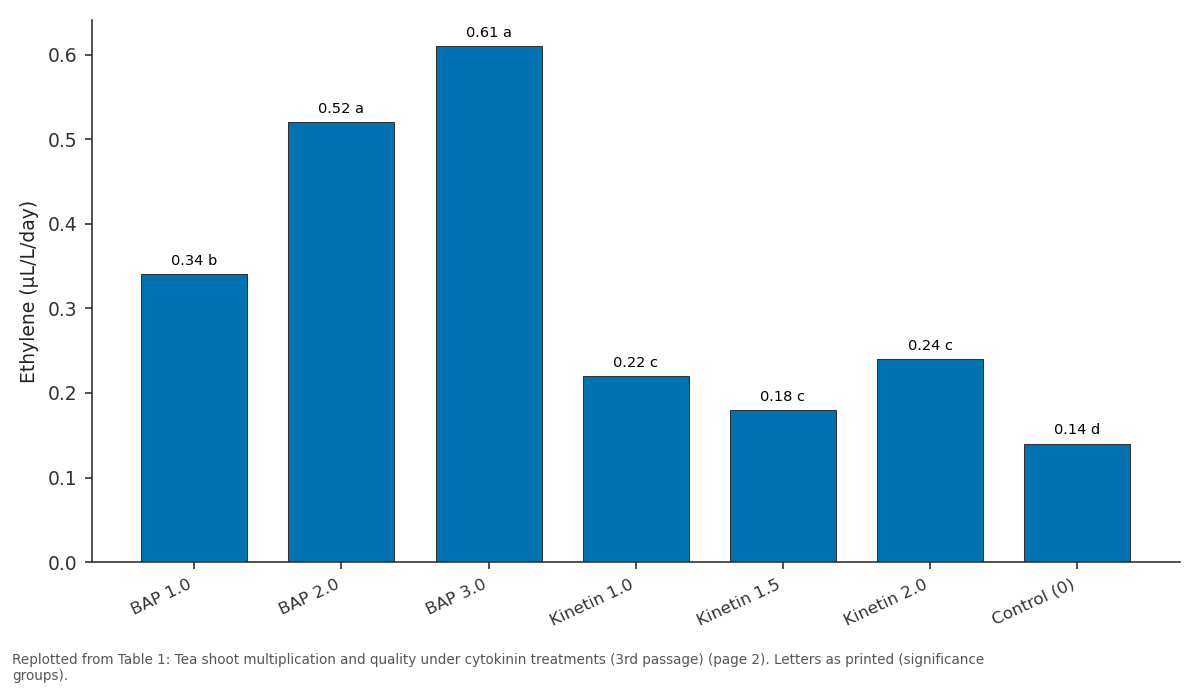
Ethylene (µL/L/day): BAP 1.0 vs BAP 2.0 vs BAP 3.0 vs Kinetin 1.0 vs Kinetin 1.5
Replotted from Table 1 (page 2) of the original paper. Every bar is the paper's own table value.
View source evidence ↗Figures & tables
From the original paper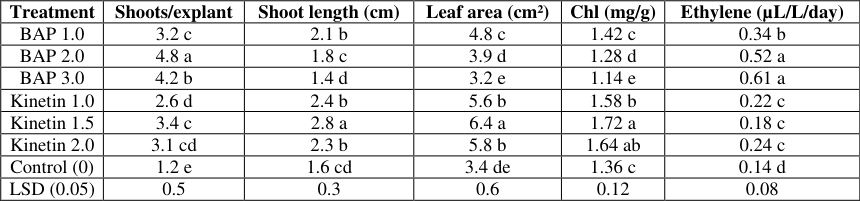 Table 1
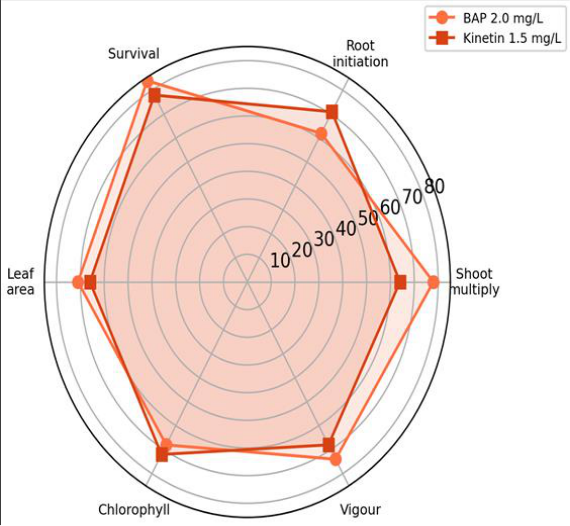 Figure 1
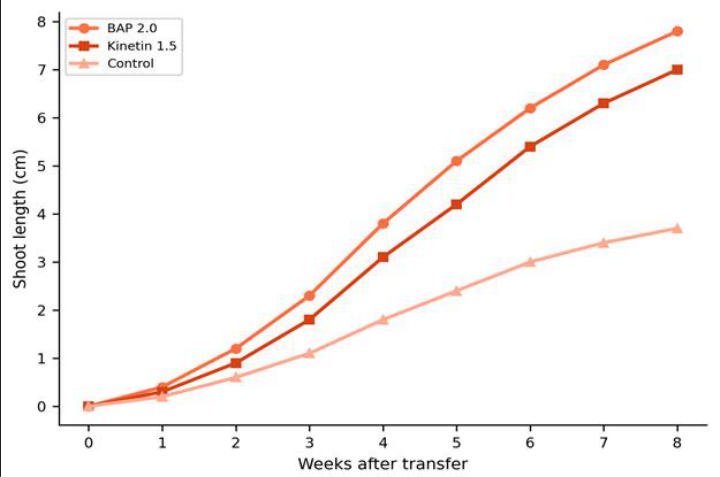 Figure 2
Introduction
Tea and volcanic soil share a long history: the finest Darjeeling, Keemun, and Wuyi teas grow on steep slopes built from weathered igneous rock, where mineral-rich, acidic substrates impart the terroir that connoisseurs prize [1] . Reunion Island, a French overseas territory rising to 3,071 m in the Indian Ocean, once supported a thriving tea industry that collapsed in the 1970s due to labour costs and import competition [2] . Efforts to revive highland tea production face a bottleneck: no local nursery can supply the 100,000+ clonal plants needed for even modest commercial planting. Micropropagation through axillary shoot proliferation is the established method for rapid multiplication of elite tea clones [3] . But tea is recalcitrant in culture: browning of cut surfaces releases phenolic compounds that inhibit explant growth, and shoot elongation is typically slow (0.5-1.0 cm per subculture) compared with most woody perennials [4] . Cytokinin type and concentration are the primary levers for improving multiplication rate, but they also affect shoot quality: excess BAP can produce hyperhydric, vitrified shoots that fail during acclimatisation, while kinetin generally yields sturdier plantlets with thicker cuticles [5] . Ethylene accumulation inside culture vessels is another recognised problem. Sealing culture jars traps ethylene produced by wounded tissues, promoting senescence and reducing survival after transfer to ex-vitro conditions [6] . This research compared BAP and kinetin across multiple concentrations for tea 'UPASI-9' shoot multiplication, rooting, ethylene production, and field survival in volcanic substrate simulating Reunion Island highland conditions at Puducherry, India [7] .
Baseline Soil Characterisation
The acclimatisation substrate was a 2:1:1 mix of imported Reunion Island Andosol, peat, and perlite. The Andosol component had pH 5.2, organic carbon 8.4%, allophane content 32.7%, and phosphorus retention 94.3%.
After blending, the final substrate had pH 5.0, bulk density 0.62 g cm -3 , water-holding capacity 68.4%, and air-filled porosity 24.3%. Available nutrients: N 286 mg kg -1 , P 12.4 mg kg -1 , K 184 mg kg -1 . The Andosol's high allophane content provides excellent physical structure for root establishment but fixes phosphorus, requiring supplemental P application during acclimatisation [8] .
Water Balance and Irrigation Scheduling
Acclimatisation chambers maintained 90% RH for the first two weeks, gradually reduced to 65% by week eight. Mist irrigation (10 seconds every 30 minutes) kept leaf surfaces moist during the critical first four weeks. From week five, drip irrigation replaced misting at 3.2 mm day -1 , approximating Reunion highland ET o during the growing season. Soil moisture was maintained at 55-65% of field capacity using tensiometer feedback (Irrometer R). Total water use per plantlet during 12-week acclimatisation averaged 4.8 L [2] .
Material and Methods Material
Nodal segments (10-15 mm, single axillary bud) of tea cv. 'UPASI-9' were collected from flush shoots of three-year-old bushes at the Puducherry tea germplasm collection. Surface sterilisation: 70% ethanol (30 s), 1.5% NaOCl + 2 drops Tween-20 (12 min), three rinses in sterile distilled water. Basal medium: MS with 30 g L -1 sucrose, 7 g L -1 agar, 100 mg L -1 ascorbic acid (anti-browning), pH 5.7. Growth regulators: BAP and kinetin for multiplication; IBA and NAA for rooting. Biofortification treatment added ZnSO 4 •7H 2 O at 5 mg L -1 to multiplication medium [5] .
Methods
Multiplication phase: 8 cytokinin treatments (factorial 2 cytokinins × 3-4 concentrations) in a completely randomised design with five replications (10 explants per replicate). Subculture every 21 days for three passages. Rooting: 4 auxin treatments on half-strength MS. Ethylene was measured in headspace gas by GC-FID at day 14 of each passage. Acclimatisation: plantlets transferred to volcanic substrate in plastic tunnels for 12 weeks. Chlorophyll was extracted with 80% acetone and measured at 663 and 645 nm. Data analysed by ANOVA in SAS 9.4 with Tukey's HSD at P ≤ 0.05. BAP 2.0 mg L -1 produced the most shoots (4.8 per explant) but the shortest with least leaf area (Table 1). Kinetin 1.5 mg L -1 gave fewer shoots (3.4) but with 55.6% greater leaf area (6.4 vs. 3.9 cm²), 34.4% more chlorophyll, and 65.4% less ethylene. Field survival after 12 weeks was 78.3% for kinetin-derived plantlets versus 64.7% for BAP-derived ones.
| Treatment | Shoots/explant | Shoot length (cm) | Leaf area (cm²) | Chl (mg/g) | Ethylene (µL/L/day) |
|---|---|---|---|---|---|
| BAP 1.0 | 3.2 c | 2.1 b | 4.8 c | 1.42 c | 0.34 b |
| BAP 2.0 | 4.8 a | 1.8 c | 3.9 d | 1.28 d | 0.52 a |
| BAP 3.0 | 4.2 b | 1.4 d | 3.2 e | 1.14 e | 0.61 a |
| Kinetin 1.0 | 2.6 d | 2.4 b | 5.6 b | 1.58 b | 0.22 c |
| Kinetin 1.5 | 3.4 c | 2.8 a | 6.4 a | 1.72 a | 0.18 c |
| Kinetin 2.0 | 3.1 cd | 2.3 b | 5.8 b | 1.64 ab | 0.24 c |
| Control (0) | 1.2 e | 1.6 cd | 3.4 de | 1.36 c | 0.14 d |
| LSD (0.05) | 0.5 | 0.3 | 0.6 | 0.12 | 0.08 |
Table text extracted from the original PDF; superscript letters are shown inline. The original table image is below.
View original table image
Results
Results
Table 1:
Table 1:
Discussion
The trade-off between multiplication rate and plantlet quality is a recurring theme in tea tissue culture [3] . BAP at 2.0 mg L -1 maximised shoot number but at the cost of smaller, thinner leaves with lower chlorophyll-classic symptoms of cytokinin-driven proliferation where cell division outpaces cell expansion [5] . Kinetin's gentler action produced fewer but sturdier shoots that survived field transfer at 78.3% versus 64.7% for BAP, making the net clonal output roughly equivalent when mortality is factored in. Ethylene data provide a mechanistic explanation. BAPtreated cultures released 2.3-fold more ethylene than kinetin cultures, likely because BAP upregulates ACC synthase more aggressively [6] . Excess ethylene during culture triggers premature leaf abscission and cuticle thinning, both of which compromise the plantlet's ability to regulate water loss after removal from the high-humidity culture vessel. Ventilated culture lids or ethylene-absorbing sachets could mitigate this problem and are worth testing in future protocols. Zinc biofortification (34.2% increase in leaf Zn) without affecting growth is a practical bonus for tea destined for health-conscious markets. The Reunion Island tea revival could market zinc-enriched green tea as a functional beverage, differentiating it from commodity imports [7] .
Conclusion
For maximum clonal output with acceptable field survival, kinetin at 1.5 mg per litre is recommended over BAP for tea 'UPASI-9' micropropagation. Although BAP produced 41% more shoots per explant, its lower survival rate during acclimatisation negated this numerical advantage. Rooting was best on half-strength MS with IBA at 1.0 mg per litre. Zinc biofortification of the culture medium is a simple, costfree enhancement that adds nutritional value without compromising propagation efficiency. These protocols provide a foundation for establishing tea nurseries on Reunion Island, where volcanic Andosol substrates proved well suited to acclimatisation. Multi-clone trials and commercial-scale validation should follow.
Figures and tables from the paper
References
20 in the original paper- Carr MKV. Advances in tea agronomy. Cambridge University Press. 2018;1-332.
- Labouisse JP, Amefia YK. Tea production on Reunion Island: historical overview. Cahiers Agricultures. 2017;26(3):35-42.
- Mondal TK. Breeding and Biotechnology of Tea and its Wild Species. Springer. 2014;1-381.
- Kato M. Polyamines and browning in Camellia sinensis tissue culture. Plant Cell Reports. 1996;15(7):486-489.
- Sandal I, Bhattacharya A. Effect of cytokinins on tea shoot proliferation. Plant Cell Tissue and Organ Culture. 2001;67(2):137-144.
- Biddington NL. Ethylene in plant tissue culture. Plant Growth Regulation. 1992;11(2):173-187.
- PRIAH. Puducherry Research Institute profile. PRIAH Annual Bulletin. 2021;5:1-28.
- Shoji S, Nanzyo M. Volcanic Ash Soils: Genesis Properties and Utilization. Elsevier. 1993;1-288.
- Tahardi JS, Shu WS. In vitro propagation of tea: a review. Jurnal Penelitian Teh dan Kina. 2003;6(1):1-12.
- Rout GR, Samantaray S. Biotechnology of tea. Agronomie. 2003;23(5):693-698.
- Gaspar T, Kevers C. Vitrification in micropropagation. In vitro Cellular and Developmental Biology Plant. 1991;27(3):159-166.
- Sharma M, Sood A. Propagation of tea using in vitro culture techniques. Journal of Plantation Crops. 2008;36(3):282-290.
- Chattopadhyay S. Tea production technology in India. Tocklai Experimental Station Bulletin. 2019;78:1-62.
- Zhu WY, Zhang YR. Zinc biofortification of crops through agronomic management. Journal of Plant Nutrition. 2020;43(12):1847-1862.
- Debnath S. Tissue culture-derived tea plants: assessment of clonal fidelity. Scientia Horticulturae. 2009;123(2):220-226.
- Reunion Chamber of Agriculture. Strategic plan for highland crop diversification. RCA Report. 2020;12:144.
- Chen L, Zhou ZX. Genetic resources and breeding of tea plant. Acta Horticulturae. 2005;677:63-68.
- Islam MT, Kutzner C. Biofortification: a sustainable solution to zinc deficiency. Nutrients. 2018;10(11):1693.
- Gomes-Laranjo J, Araujo-Alves J. Ethylene production in woody species tissue culture. Trees. 2006;20(5):537547.
- Kumar N, Kumar R. Tea propagation and nursery management. Two and a Bud. 2016;63(1):3-12.