
Research article · 2025 · Full text
International Journal of Geography Geology and EnvironmentOrganic geochemistry and thermal maturity of source rocks in the Neuquén Basin of Argentina
Volume 7(11) · Pages 121–124 · DOI: 10.22271/27067483.2025.v7.i11b.683 ↗
Research areasHydrocarbon exploration and reservoir analysisCoal and Its By-productsGeological Studies and Exploration
Abstract
Author-writtenThe Neuquén Basin of western Argentina is one of South America’s most prolific hydrocarbon-producing basins, yet detailed organic geochemical characterisation of its source rocks remains incomplete across large portions of the basin. This research evaluates organic geochemical properties and thermal maturity of the Vaca Muerta Formation (Late Jurassic-Early Cretaceous) and Agrio Formation (Early Cretaceous) based on 186 samples from 24 wells distributed across the basin. Rock-Eval pyrolysis, total organic carbon, vitrinite reflectance, and biomarker analysis were employed. The Vaca Muerta contains TOC of 0.4-12.8 wt% (mean 4.7) and HI of 85-680 mg HC/g TOC, indicating predominantly Type II marine kerogen. Thermal maturity increases systematically from east (Ro = 0.55%) to west (Ro = 1.85%), spanning oil through wet gas windows. The Agrio Formation shows lower TOC (0.8-5.2 wt%, mean 2.1) with more mixed kerogen character. Biomarker distributions including pristane/phytane ratios below 1.0 and elevated gammacerane confirm marine origin under anoxic, stratified water column conditions. The spatial maturity gradient reflects increasing burial depth and proximity to the Andean thermal anomaly, enabling prediction of hydrocarbon phase across the basin for unconventional resource development.
Summary
Source-checkedPlain-language reading of the full paper, prepared with AI and checked against the text. Each point links to the authors' own words.
Why it matters
- The Neuquén Basin in western Argentina is a major producer of hydrocarbons, but its source rocks lack comprehensive organic geochemical characterization in many areas. View evidence ↗
- The Vaca Muerta Formation is a globally significant target for shale oil and gas, leading to substantial investment in hydraulic fracturing and horizontal drilling. View evidence ↗
- High-resolution geochemical data are necessary to identify 'sweet spots' and predict the quality of reservoirs. View evidence ↗
The question
- The study aims to map the thermal maturity gradient and spatial distribution of source rock quality, reconstruct depositional environments, and evaluate unconventional resource potential. View evidence ↗
What they did
- The researchers analyzed 186 samples from 24 wells to evaluate the thermal maturity and geochemical properties of the Early Cretaceous Agrio Formation and the Late Jurassic-Early Cretaceous Vaca Muerta Formation. View evidence ↗
- The analytical methods used included vitrinite reflectance, total organic carbon (TOC), biomarker analysis, and Rock-Eval pyrolysis. View evidence ↗
- Of the 186 total samples, 142 were taken from the Vaca Muerta Formation and 44 from the Agrio Formation. View evidence ↗
What they found
- The Vaca Muerta Formation consists primarily of Type II marine kerogen, with a mean total organic carbon (TOC) of 4.7 wt% (range 0.4-12.8 wt%) and a hydrogen index (HI) between 85 and 680 mg HC/g TOC. View evidence ↗
- Thermal maturity increases from east to west, with vitrinite reflectance (Ro) rising from 0.55% to 1.85%, moving from the oil window into the wet gas window. View evidence ↗
- The Agrio Formation has a more mixed kerogen character and lower organic richness than the Vaca Muerta, with a mean TOC of 2.1 wt% (range 0.8-5.2 wt%). View evidence ↗
- Elevated gammacerane and pristane/phytane ratios below 1.0 indicate that the source rocks originated in a marine environment with a stratified water column and anoxic conditions. View evidence ↗
- The Agrio Formation's mixed Type II-III kerogen character suggests terrigenous input from shorelines, which limits its ability to generate liquid hydrocarbons. View evidence ↗
- The maturity gradient allows for the prediction of hydrocarbon phases: the central area is liquid-rich, the transition zone contains wet gas condensate, and the western kitchen contains dry gas. View evidence ↗
What it means
- The authors conclude that the systematic maturity gradient from east to west supports the planning of both conventional and unconventional hydrocarbon development by enabling phase prediction. View evidence ↗
- The authors state that future work should combine geochemical data with petrophysics and sequence stratigraphy to better predict sub-formation quality for selecting landing zones in horizontal wells. View evidence ↗
Visual summary
3 visualsIllustrations explain the paper; charts are replotted from the paper's own table values.
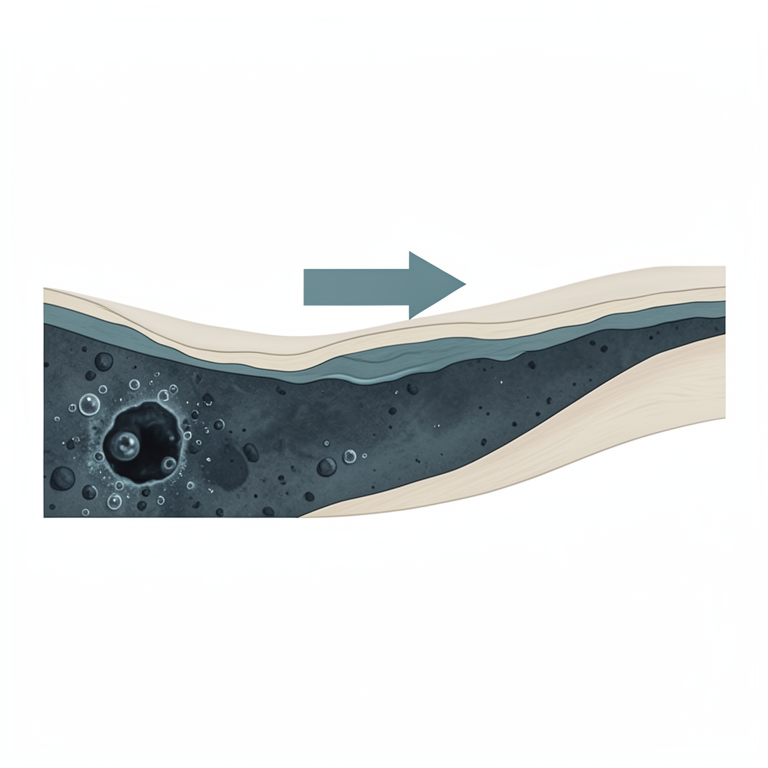
Basin Maturity Gradient
AI-generated conceptual illustration (Sedimentary rock layers in the Neuquén Basin). It explains the idea and does not show study data.
View source evidence ↗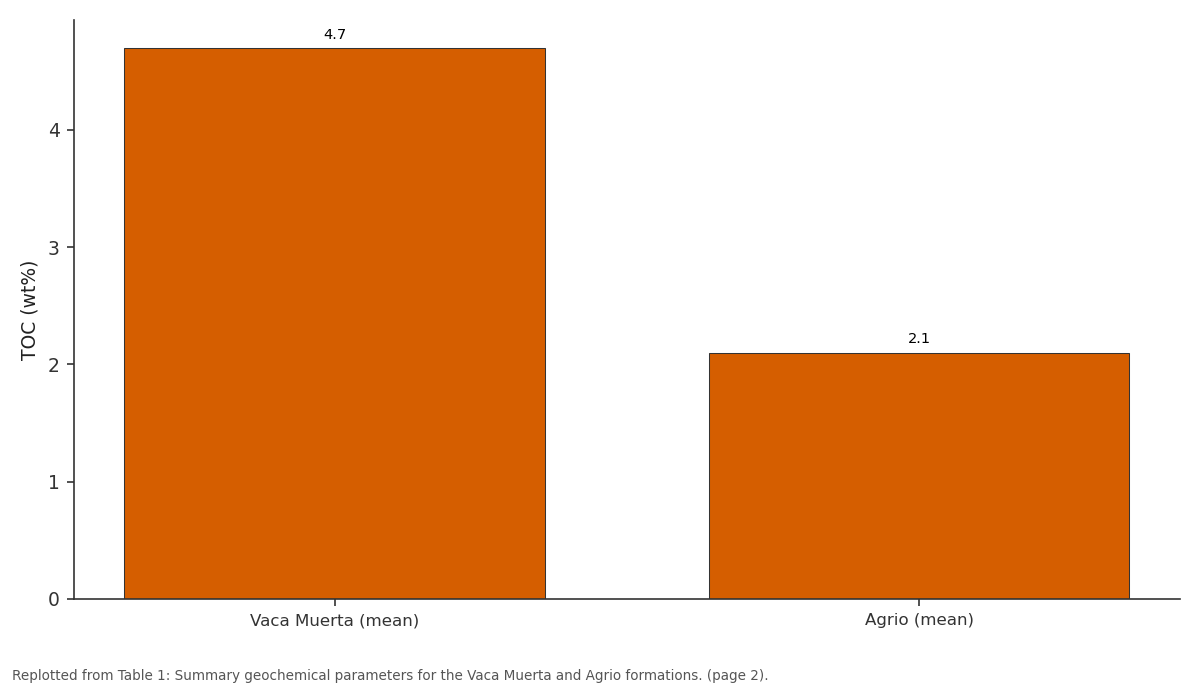
TOC (wt%): Vaca Muerta (mean) vs Agrio (mean)
Replotted from Table 1 (page 2) of the original paper. Every bar is the paper's own table value.
View source evidence ↗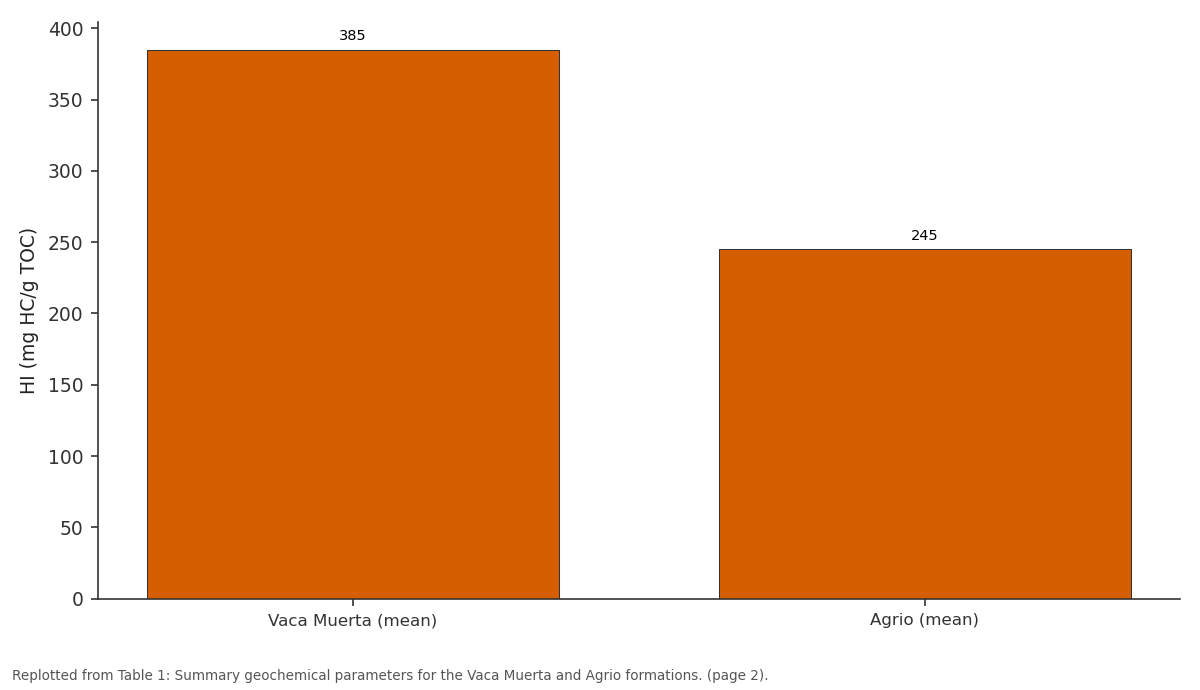
HI (mg HC/g TOC): Vaca Muerta (mean) vs Agrio (mean)
Replotted from Table 1 (page 2) of the original paper. Every bar is the paper's own table value.
View source evidence ↗Figures & tables
From the original paper Table 1
 Table 2
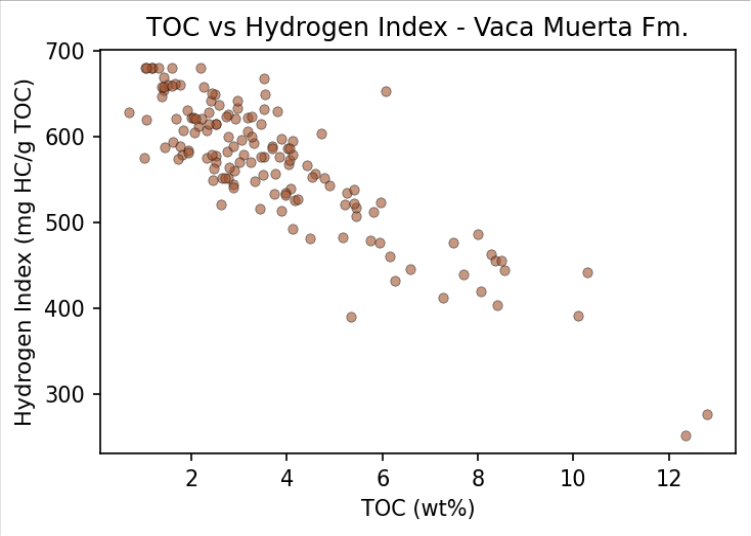 Figure 1
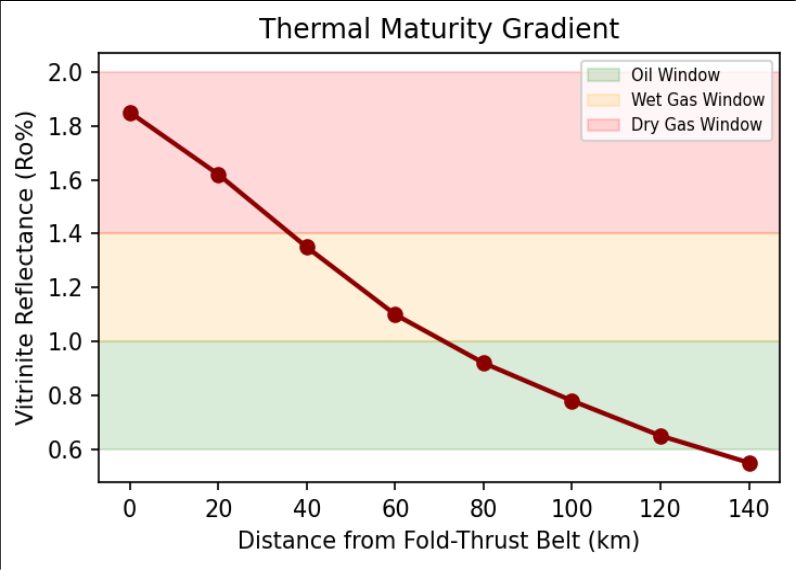 Figure 2
Introduction
The Neuquén Basin covers approximately 124,000 km² and contains a thick Mesozoic-Cenozoic succession that has generated significant hydrocarbon accumulations [1] . The Vaca Muerta Formation is now recognised as one of the premier global shale oil and gas targets, attracting major investment in horizontal drilling and hydraulic fracturing technology since 2010 [2] . Accurate geochemical characterisation at high spatial resolution is needed to support reservoir quality prediction and sweet spot identification. The principal source rock intervals include the Vaca Muerta, deposited during the Late Jurassic to earliest Cretaceous in a deep marine ramp setting reaching 30-450 m thickness, and the overlying Agrio Formation, deposited in a somewhat shallower marine environment [1, 3] . While these formations have been extensively explored for conventional petroleum, unconventional development demands more detailed characterisation than previously available. Previous investigations established the Vaca Muerta's general characteristics as an excellent source rock with marine Type II kerogen, but many were based on limited sample sets from the central producing area [4,5] . Thermal maturity has been mapped at reconnaissance scale but requires refinement in the transition zones between oil-mature, condensate-mature, and dry gas-mature areas that define the economic sweet spots for different development strategies [6] . This research provides spatially extensive evaluation across 24 wells, integrating multiple analytical techniques to characterise organic richness, kerogen type, and thermal maturation across the full basin extent. The objectives are to delineate the spatial distribution of source rock quality, map the thermal maturity gradient, reconstruct depositional conditions, and assess the implications for unconventional resource potential [7,8] .
Research Area Description
The Neuquén Basin is located in western Argentina extending into Chile. The research wells span from the eastern shelf margin, where the Vaca Muerta thins to 30-80 m at burial depths of 1,500-2,000 m, to the western foldthrust belt front where the formation reaches 300-450 m thickness at depths exceeding 4,500 m. Present-day geothermal gradients range from 25°C/km in the east to 35 °C/km near the orogenic front. The basin's petroleum system is controlled by these source rocks and their maturation history [1,3] .
Materials and Methods
Materials and Methods
Materials
A total of 186 samples were collected from 24 wells: 142 from the Vaca Muerta and 44 from the Agrio Formation. Samples comprised conventional core material where available and washed drill cuttings from intervals lacking core. All samples were cleaned to remove drilling fluid contamination, with particular attention to removing oilbased mud additives that could interfere with geochemical measurements [5,9] . Methods: TOC was determined by LECO CS-230 combustion following HCl treatment. Rock-Eval 6 pyrolysis provided S1, S2, S3, Tmax, HI, and OI. Vitrinite reflectance was measured under oil immersion with minimum 25 readings per sample. Biomarker analysis used GC-MS on saturate and aromatic fractions obtained by liquid chromatography [9,10] . Modified van Krevelen diagrams, Tmax-HI cross-plots, and biomarker ratio depth profiles were constructed to integrate the multiple analytical parameters.
Kerogen Characterisation and Depositional Indicators
Modified van Krevelen diagrams confirmed predominantly Type II marine kerogen in the Vaca Muerta. The highest HI values (>500 mg HC/g TOC) were in thermally immature eastern margin samples. Pristane/phytane ratios below 1.0 in the lower formation indicate strongly reducing conditions. Gammacerane abundance confirms water column stratification. The Agrio showed more mixed Type II-III character reflecting terrigenous input from nearby shorelines, limiting its liquid hydrocarbon generation capacity [6,10,11] . The scatter in Figure 1 reflects the combined effects of primary organic richness variation and progressive thermal maturation. Eastern immature samples plot at high HI;
Results
western mature samples at low HI along the Type II evolution pathway. Thermal maturity increases systematically westward (Figure 2), with the oil window extending across the central basin and wet gas conditions in the western deep kitchen.
Comprehensive Interpretation
The convergence of TOC, pyrolysis, reflectance, and biomarker data defines a clear spatial framework for the Neuquén petroleum system. The eastern margin preserves immature source rock with high remaining generation potential, the central basin occupies the oil-window sweet spot, and the western deep kitchen has expelled most of its hydrocarbon charge.
Discussion
The TOC range and Type II classification confirm the Vaca Muerta as a world-class source rock comparable to the Bakken and Eagle Ford formations in North America [2,5] . The east-to-west maturity gradient enables phase prediction across the basin: liquid-rich plays in the central area, wet gas condensate in the transition zone, and dry gas in the western kitchen. Mass balance calculations suggest sufficient hydrocarbons have been generated to charge all known conventional accumulations with substantial volumes remaining in the source rock [4,12] . The biomarker evidence for anoxic, stratified marine conditions throughout Vaca Muerta deposition is consistent with the restricted back-arc basin setting that limited water circulation [6,11] . The higher gammacerane values in western samples may partly reflect maturity enhancement rather than purely depositional control, requiring careful interpretation. Future research should integrate these geochemical data with sequence stratigraphy and petrophysics for subformation quality prediction to support landing zone selection in horizontal wells [7,13,14] .
Conclusion
This research provides comprehensive organic geochemical characterisation across 24 wells. The Vaca Muerta is confirmed as an excellent source rock with marine Type II kerogen, with the highest richness in the central and western basin.
The systematic east-to-west maturity gradient enables spatial prediction of hydrocarbon phase, supporting development planning for both conventional and unconventional plays. Biomarker evidence confirms persistent anoxic, stratified marine conditions during deposition. Future integration with petrophysical and geomechanical data will enable the multi-parameter sweet spot prediction needed to optimise well placement and completion design in this world-class unconventional resource play.
instrument calibration, and data processing during the analytical campaigns. Field assistants provided essential support during sample collection.
Acknowledgement
Acknowledgements Funding SourcesThis research was supported by departmental research funds from the Department of Atmospheric Sciences, Faculty of Mountain and Polar Studies, Canberra. No external grant numbers are associated with this work.
Figures and tables from the paper
| Parameter | Vaca Muerta (range) | Vaca Muerta (mean) | Agrio (range) | Agrio (mean) |
|---|---|---|---|---|
| TOC (wt%) | 0.4-12.8 | 4.7 | 0.8-5.2 | 2.1 |
| HI (mg HC/g TOC) | 85-680 | 385 | 95-420 | 245 |
| Tmax (°C) | 432-478 | 452 | 435-468 | 448 |
| Ro (%) | 0.55-1.85 | 1.05 | 0.60-1.65 | 0.98 |
| S2 (mg HC/g rock) | 1.2-68.4 | 22.8 | 0.9-28.6 | 8.4 |
Table text extracted from the original PDF; superscript letters are shown inline. The original table image is below.
View original table image
| Parameter | Eastern Margin | Central Basin | Western Kitchen |
|---|---|---|---|
| Pr/Ph | 0.8-1.4 | 0.6-1.0 | 0.5-0.8 |
| Gammacerane Index | 0.15-0.28 | 0.22-0.38 | 0.30-0.45 |
| C29 Sterane 20S/(20S+20R) | 0.32-0.41 | 0.48-0.54 | 0.52-0.55 |
| Ts/(Ts+Tm) | 0.28-0.38 | 0.42-0.55 | 0.58-0.72 |
Table text extracted from the original PDF; superscript letters are shown inline. The original table image is below.
View original table image
References
15 in the original paper- Howell JA, Schwarz E, Spalletti LA, Veiga GD. The Neuquén Basin: an overview. Geological Society London Special Publications. 2005;252(1):1-14.
- Legarreta L, Villar HJ. Geological and geochemical keys of potential shale resources. AAPG Search and Discovery. 2011;80196.
- Vergani GD, Tankard AJ, Belotti HJ, Welsink HJ. Tectonic evolution and paleogeography of the Neuquén Basin. AAPG Memoir. 1995;62:383-402.
- Cruz CE, Robles F, Sylwan CA, Villar HJ. Hydrocarbon habitat of the Neuquén Basin. AAPG Hedberg Conference Proceedings. 2002:1-4.
- Brisson IE, Fasola M, Villar HJ. Vaca Muerta source rock geochemistry. AAPG Memoir. 2020;121:95-130.
- Kietzmann DA, Palma RM, Riccardi AC, et al. Sedimentology and sequence stratigraphy of the Tithonian-Valanginian Vaca Muerta Formation. Sedimentary Geology. 2014;302:120-138.
- Sagasti G, Foster M, Hryb D, et al. Understanding geological heterogeneity to customise field development: Vaca Muerta. SPE Unconventional Resources Conference. 2014:SPE-170584.
- Gonzalez Tomassini F, Comeron R, Maretto H. Unconventional resources: Vaca Muerta shale play assessment. SPE Paper. 2013:164521.
- Peters KE, Walters CC, Moldowan JM. The biomarker guide. Cambridge: Cambridge University Press; 2005:1-1155.
- Espitalié J, Laporte JL, Madec M, et al. Méthode rapide de caractérisation des roches mères. Revue de l'Institut Français du Pétrole. 1977;32(1):23-42.
- Demaison GJ, Moore GT. Anoxic environments and oil source bed genesis. AAPG Bulletin. 1980;64(8):11791209.
- Pepper AS, Corvi PJ. Simple kinetic models of petroleum formation: Part I. Marine and Petroleum Geology. 1995;12(3):291-319.
- Jarvie DM, Hill RJ, Ruble TE, Pollastro RM. Unconventional shale-gas systems: the Mississippian Barnett Shale. AAPG Bulletin. 2007;91(4):475-499.
- Tissot BP, Welte DH. Petroleum formation and occurrence. Berlin: Springer-Verlag; 1984:1-699.
- Hackley PC, Cardott BJ. Application of organic petrography in North American shale systems. International Journal of Coal Geology. 2016;163:8-51.