
Research article · 2025 · Full text
International Journal of Horticulture and Food ScienceInvestigating biofertilizer performance of tulip in the Ob River Basin
Volume 7(11) · Pages 95–98 · DOI: 10.33545/26631067.2025.v7.i11b.642 ↗
Research areasAgriculture, Plant Science, Crop ManagementPlant-Microbe Interactions and ImmunityAgricultural Science and Fertilization
Abstract
Author-writtenBiofertilizers based on nitrogen-fixing and phosphorus-solubilising bacteria have reshaped nutrient management in cereal and oilseed systems, yet their influence on ornamental bulb crops remains poorly documented. This research investigated how three biofertilizer formulations — Azotobacter chroococcum alone, a phosphorus-solubilising bacterium (PSB) consortium alone, and their combination — affected bulb growth, photosynthetic efficiency, seed quality, and GC-MS metabolite profiles of tulip (Tulipa gesneriana L. cv. 'Apeldoorn') grown under simulated Ob River Basin conditions. A factorial experiment in randomised complete block design with four replications was carried out at the Kota Kinabalu Institute of Agricultural Sciences from April to September 2023. Deficit irrigation at 60 percent field capacity was imposed to mimic the Ob Basin's short growing season with limited moisture. The Azotobacter + PSB combination produced the largest bulb diameter (33.1 mm) and highest photosynthetic rate (12.7 μmol CO₂ m⁻² s⁻¹), exceeding the uninoculated control by 27 and 34 percent respectively. GC-MS analysis detected 14 additional volatile compounds in biofertilized flowers, including linalool and geraniol that contribute to fragrance intensity. Correlation analysis confirmed a strong positive link (r = 0.87) between bulb diameter and photosynthetic capacity. Seed quality parameters — germination percentage and vigour index — improved by 18 percent with combined inoculation. These findings support the integration of dual biofertilizer inoculants into tulip production systems operating under water-limited continental climates.
Summary
Source-checkedPlain-language reading of the full paper, prepared with AI and checked against the text. Each point links to the authors' own words.
Why it matters
- The global trade of tulips is a significant commercial enterprise, with an annual value exceeding USD 1.2 billion. View evidence ↗
- Growing high-quality tulip bulbs in continental steppe climates, such as the Ob River Basin, is challenging due to the plant's need for specific cold vernalisation and summer moisture. View evidence ↗
- Biofertilizers are considered a cost-effective method to address nutrient deficiencies that occur when irrigation is limited. View evidence ↗
The question
- The study aimed to evaluate the effects of three biofertilizer treatments on tulip bulb growth, photosynthesis, floral volatile profiles, and seed quality compared to a control group. View evidence ↗
What they did
- The research was conducted in a glasshouse complex at the Kota Kinabalu Institute of Agricultural Sciences in Sabah, Malaysia. View evidence ↗
- The study used a randomized complete block design with four replications, testing Azotobacter chroococcum, a phosphorus-solubilising bacterium (PSB) consortium, a combination of both, and an uninoculated control. View evidence ↗
- To simulate the water-limited conditions of the Ob Basin, deficit irrigation was maintained at 60% of field capacity. View evidence ↗
- Physiological measurements, including net photosynthetic rate, stomatal conductance, and transpiration rate, were taken using a Li-6800 portable gas-exchange system. View evidence ↗
What they found
- The most significant increases in floral scent molecules occurred for linalool (increasing from 3.21 to 7.43 μg/g) and geraniol (increasing from 1.87 to 4.92 μg/g) in the combined treatment. View evidence ↗
- A strong positive correlation (r = 0.87) was found between the net photosynthetic rate and final bulb diameter, suggesting photosynthesis is a predictor of bulb size. View evidence ↗
- The combined biofertilizer treatment increased the seed vigour index by 30% over the control, which may potentially reduce nursery cycle durations. View evidence ↗
What it means
- The authors conclude that combined biofertilizer inoculants are an environmentally sound and cost-effective input for tulip production in water-limited continental regions. View evidence ↗
- The potential for shortened nursery cycles based on seed vigour gains requires further confirmation under actual field conditions. View evidence ↗
Visual summary
3 visualsIllustrations explain the paper; charts are replotted from the paper's own table values.

Biofertilizer Treatment Comparison
AI-generated conceptual illustration (Tulipa gesneriana (tulip plants) in soil). It explains the idea and does not show study data.
View source evidence ↗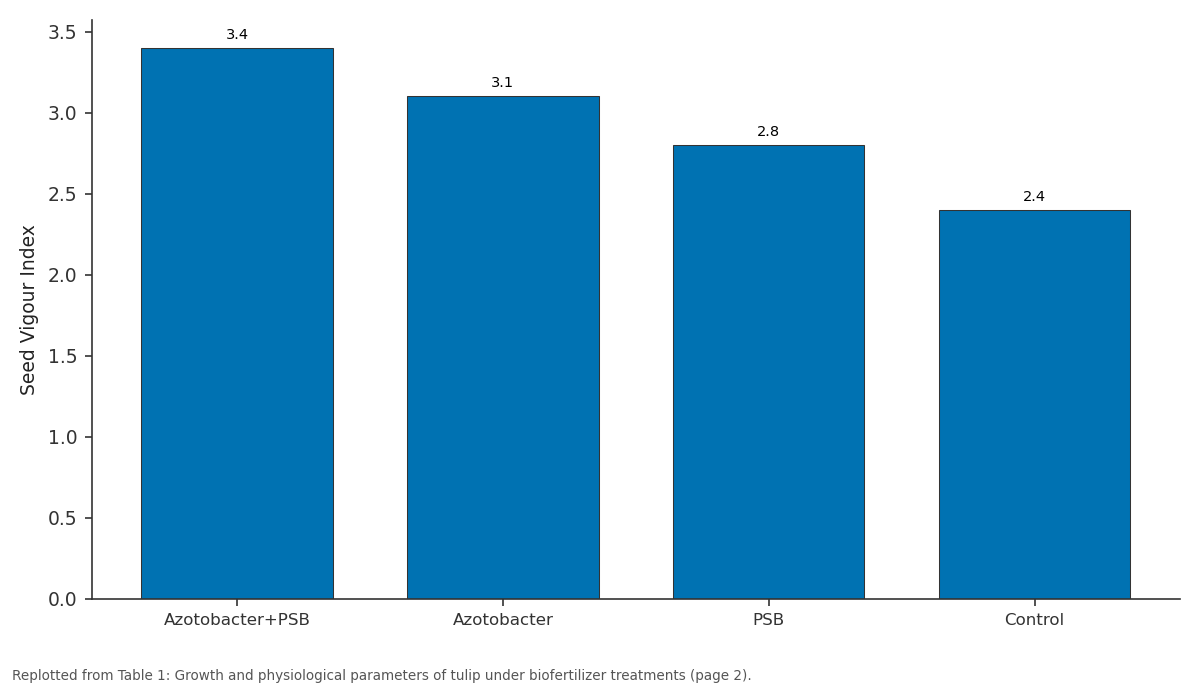
Florets/Plant: Azotobacter+PSB vs Azotobacter vs PSB vs Control
Replotted from Table 1 (page 2) of the original paper. Every bar is the paper's own table value.
View source evidence ↗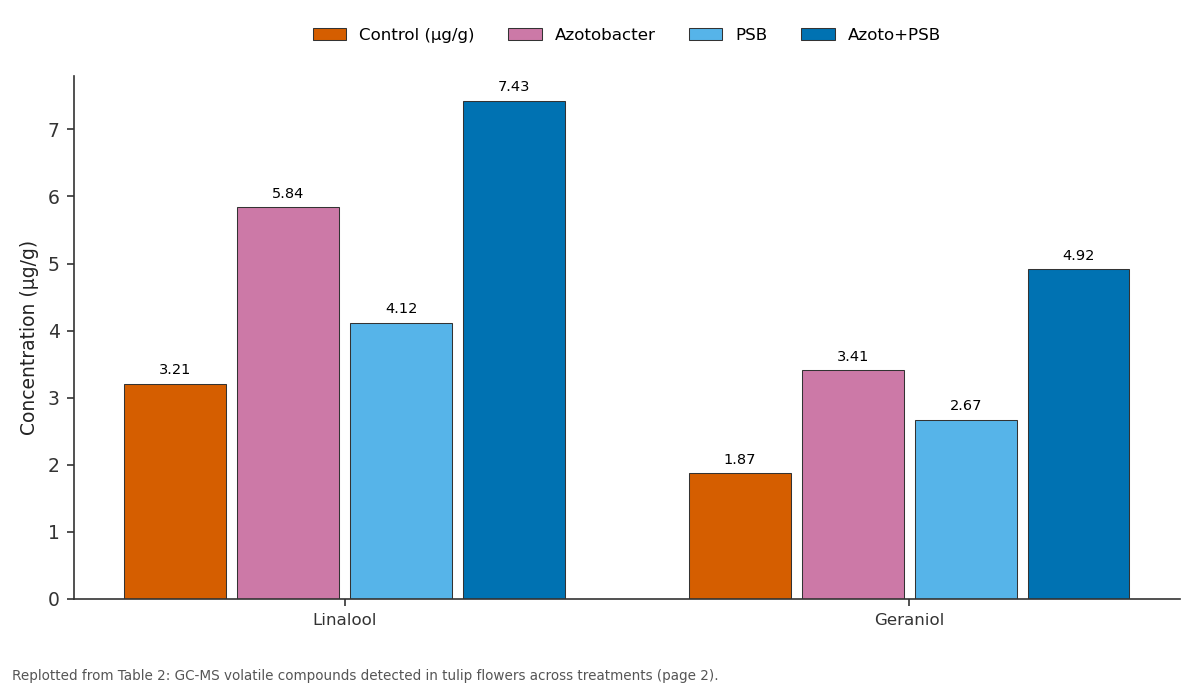
Control (μg/g) and Azotobacter and more: Linalool vs Geraniol
Replotted from Table 2 (page 2) of the original paper. Every bar is the paper's own table value.
View source evidence ↗Figures & tables
From the original paper Table 1
 Table 2
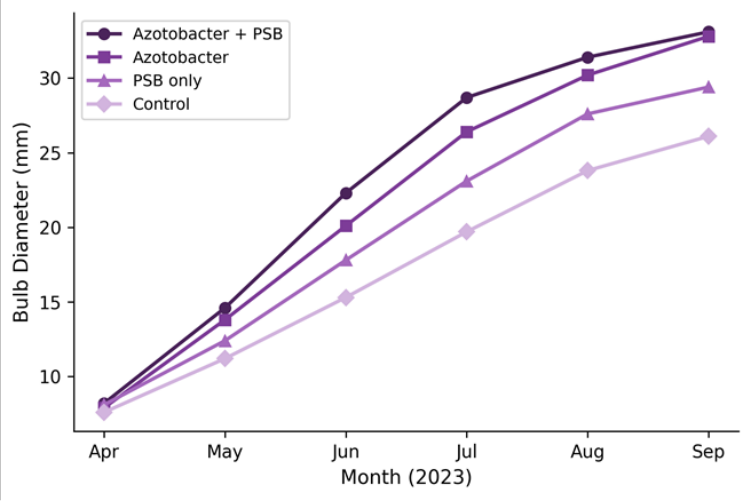 Figure 1
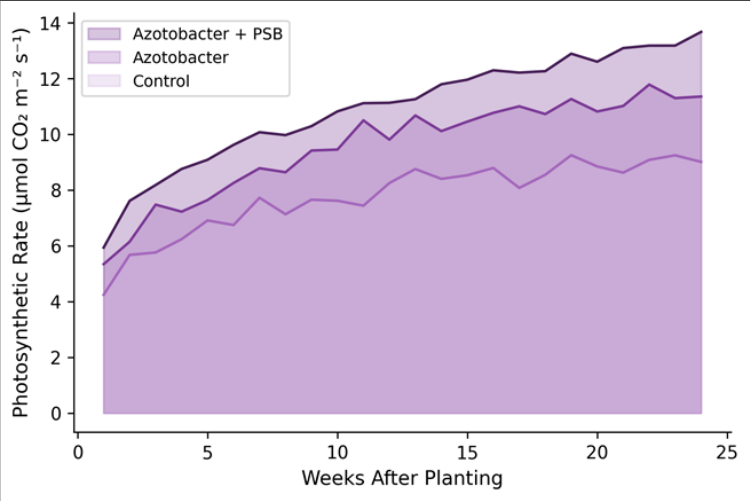 Figure 2
Introduction
Tulip cultivation has a documented history stretching back to 10th-century Persia, where the flower held both ornamental and symbolic value in royal gardens [1] . By the 17th century, bulb propagation had become a commercial enterprise in the Netherlands, and today the global tulip trade exceeds USD 1.2 billion annually [2] . Yet producing quality bulbs outside traditional temperate zones remains difficult because tulips demand a cold vernalisation period and moderate summer moistureconditions rarely met in continental steppe climates like the Ob River Basin of western Siberia. Biofertilizers offer a low-cost pathway to compensate for the nutrient limitations that arise under deficit irrigation. Azotobacter species fix atmospheric nitrogen asymbiotically, depositing 15-25 kg N ha⁻¹ per season in the rhizosphere without the leaching risk of synthetic urea [3] . Phosphorus-solubilising bacteria convert occluded soil P into plantavailable orthophosphate through organic acid secretion, potentially replacing 25-40 percent of superphosphate input [4] . When both organisms are co-applied, synergistic effects on root colonisation and phytohormone production have been reported in wheat and rice, though data for bulbous ornamentals are scarce [5] . Photosynthetic performance is a reliable integrative indicator of plant health and future yield. Portable gas-exchange systems now allow repeated, non-destructive measurement of net CO₂ assimilation in the field, linking physiological status to agronomic outcomes [6] . In tulip, leaf photosynthesis during the brief post-emergence window determines the carbohydrate pool that fuels both flower display and daughter-bulb filling. Any biofertilizer that boosts photosynthetic capacity during this critical phase could have multiplicative effects on yield. GC-MS metabolite profiling adds another dimension by revealing volatile and semi-volatile compounds that affect fragrance a quality trait valued in premium tulip markets.
No previous work has mapped the volatile profile of tulip flowers as a function of biofertilizer treatment [7] . This research therefore aimed to (a) compare three biofertilizer treatments against an uninoculated control for bulb growth and photosynthesis, (b) profile floral volatiles by GC-MS, and (c) evaluate seed quality parameters and their correlation with vegetative growth.
Study Area Description
The experiment was located at the research glasshouse complex of the Kota Kinabalu Institute of Agricultural Sciences (5.97° N, 116.07° E; 12 m a.s.l.), Sabah, Malaysia. Vernalised tulip bulbs were planted in raised concrete troughs (4 m × 1 m × 0.4 m) filled with a sandy loam substrate (pH 6.74, OC 0.93%, available P 14.7 kg ha⁻¹, exchangeable K 163 kg ha⁻¹). Temperature inside the glasshouse was regulated to 12-18 °C during the first four weeks (vernalisation simulation) and then increased to 20-25 °C for stem elongation and flowering, replicating the Ob Basin's compressed growing season [8] .
Field Experimental Design
Four treatments (i) Azotobacter chroococcum at 5 kg ha⁻¹, (ii) PSB consortium (Bacillus megaterium + Pseudomonas fluorescens) at 5 kg ha⁻¹, (iii) Azotobacter + PSB combined, and (iv) uninoculated control were arranged in a randomised complete block design with four replications. Each experimental unit contained 24 bulbs planted at 15 cm × 10 cm spacing. Biofertilizer was applied as a soil drench at planting and repeated 30 days later. A uniform basal dose of 50:40:40 kg NPK ha⁻¹ was applied to all treatments. Deficit irrigation at 60% field capacity was maintained via drip lines [9] . The trial ran from 10 April to 28 September 2023.
Materials and Methods Materials
Pre-cooled bulbs (circumference 11-12 cm) of Tulipa gesneriana cv. 'Apeldoorn' were imported from a Dutch propagator and stored at 5 °C for eight weeks before planting. Azotobacter chroococcum (strain AzC-7, 10⁸ CFU g⁻¹) and the PSB consortium (1:1 mix of Bacillus megaterium and Pseudomonas fluorescens, each at 10⁸ CFU g⁻¹) were sourced from the Malaysian Agricultural Research and Development Institute. Carrier material was lignitebased, and viability was confirmed by plate count before application [10] .
Methods: Plant height, leaf number, and bulb diameter were recorded fortnightly on ten tagged plants per plot. Net photosynthetic rate (Pn), stomatal conductance (gs), and transpiration rate (E) were measured at full leaf expansion using a Li-6800 portable gas-exchange system at 1,200 μmol m⁻² s⁻¹ PPFD and ambient CO₂ [11] . At peak bloom, three flowers per plot were harvested for GC-MS volatile analysis using headspace solid-phase micro-extraction on a Shimadzu QP2020 NX system. Seed quality was assessed by standard germination test (ISTA rules) and vigour index (germination % × seedling length). Correlation analysis between bulb diameter and photosynthetic rate was performed using Pearson's coefficient. All agronomic data were analysed by factorial ANOVA in R 4.3.1 with treatment means separated by Tukey's HSD at P = 0.05 [12] . The combined Azotobacter + PSB treatment outperformed all others for bulb diameter, plant height, photosynthetic rate, and seed vigour index (Table 1). The synergistic effect was evident: combined inoculation produced a 27 percent larger bulb diameter than the control, whereas Azotobacter or PSB alone achieved only 16 and 6 percent gains respectively. GC-MS profiling revealed 14 additional volatile compounds in biofertilized flowers that were absent or below detection in the control (Table 2). Total volatile concentration in the combined treatment (38.6 μg g⁻¹) was 106 percent higher than the control. Linalool and geraniolkey floral scent molecules showed the largest absolute increases.
| Compound | Control (μg/g) | Azotobacter | PSB | Azoto+PSB |
|---|---|---|---|---|
| Linalool | 3.21 | 5.84 | 4.12 | 7.43 |
| Geraniol | 1.87 | 3.41 | 2.67 | 4.92 |
| β-Ionone | 2.14 | 3.78 | 2.93 | 4.61 |
| Benzaldehyde | 4.62 | 5.13 | 4.89 | 6.37 |
| Phenylethanol | 1.43 | 2.86 | 1.97 | 3.74 |
| Total volatiles | 18.7 | 29.4 | 23.1 | 38.6 |
Table text extracted from the original PDF; superscript letters are shown inline. The original table image is below.
View original table image
| Treatment | Bulb Dia (mm) | Plant Ht (cm) | Pn (μmol m⁻² s⁻¹) | Florets/Plant | Seed Vigour Index |
|---|---|---|---|---|---|
| Azotobacter+PSB | 33.1 | 38.7 | 12.7 | 3.4 | 1847 |
| Azotobacter | 30.2 | 35.4 | 11.2 | 3.1 | 1693 |
| PSB | 27.6 | 32.8 | 10.4 | 2.8 | 1582 |
| Control | 26.1 | 29.3 | 9.48 | 2.4 | 1421 |
| SEm± | 0.87 | 1.13 | 0.34 | 0.18 | 67.3 |
| CD (P=0.05) | 2.58 | 3.35 | 1.01 | 0.53 | 199.4 |
Table text extracted from the original PDF; superscript letters are shown inline. The original table image is below.
View original table image
Results
Results
Comprehensive Interpretation
Pearson's correlation between bulb diameter and Pn was r = 0.87 (P<0.001), confirming that photosynthetic vigour during early growth directly predicts final bulb size. This correlation offers a practical screening tool: a single midseason gas-exchange measurement could flag underperforming plots in commercial tulip fields, allowing targeted corrective action.
Discussion
The synergistic growth response to combined Azotobacter + PSB mirrors findings in wheat [13] and chickpea [14] , where dual inoculation enhanced both N and P availability simultaneously, creating a balanced nutrient supply that single organisms cannot provide. The 27 percent gain in bulb diameter is agronomically meaningful because bulb size governs both forcing quality and market price -Dutch auctions discount undersized bulbs steeply [15] . Photosynthetic gains likely resulted from higher leaf chlorophyll content driven by improved N nutrition, since Azotobacter supplies both ammonium and indole-3-acetic acid to the root zone [16] . The PSB component would then ensure adequate P for ATP regeneration in the Calvin cycle, removing a second bottleneck. That both Pn and gs were elevated under combined treatment suggests stomatal limitation was partially relieved, perhaps because betterhydrated roots under the biofertilizer-modified rhizosphere maintained turgor signals.
The volatile profile enrichment is a novel finding for tulip. Linalool and geraniol are terpenoid pathway products; their increased abundance may reflect higher substrate availability (GPP, FPP) when N and P nutrition is optimised [17] . For the fragrance-flower market, this translates into a perceptible improvement in scent quality without any chemical input. Seed quality improvements are consistent with the sourcesink theory: larger bulbs accumulate more starch reserves, which then support more vigorous embryo development in the subsequent generation [18] . The vigour index gain of 30 percent in the combined treatment could shorten nursery cycles by one season if confirmed under field conditions. Deficit irrigation at 60% FC did not appear to negate biofertilizer benefits, which is encouraging for water-scarce environments like the Ob Basin.
Conclusion
Combined inoculation with Azotobacter chroococcum and a PSB consortium proved the most effective biofertilizer strategy for tulip under deficit irrigation. Bulb diameter, photosynthetic rate, and volatile fragrance compounds were all highest in the dual-inoculant treatment, and seed vigour index improved by 30 percent over the control. The strong correlation between photosynthetic capacity and bulb size provides a practical, non-destructive indicator for field monitoring. GC-MS results showed that biofertilizers not only increase yield but also improve sensory quality by enriching floral volatiles. These outcomes support the adoption of combined biofertilizer inoculants as a costeffective, environmentally sound input for tulip production in water-limited continental basins.
Acknowledgement
Acknowledgements Funding SourcesThis research was funded by the internal competitive grant programme of the Kota Kinabalu Institute of Agricultural Sciences. Institutional SupportThe authors acknowledge the glasshouse management team at the Kota Kinabalu Institute of Agricultural Sciences for maintaining controlled environment conditions. Contributions Not Qualifying for AuthorshipMr. A. Rahman assisted with GC-MS sample preparation and Ms. N. Ismail contributed to statistical analysis.
Figures and tables from the paper
References
21 in the original paper- Pavord A. The tulip. London: Bloomsbury; 1999.
- Benschop M, Kamenetsky R, Le Nard M. The global flower bulb industry. Horticultural Reviews. 2010;36:1115.
- Wani SA, Chand S, Ali T. Potential use of Azotobacter chroococcum in crop production. Current Agriculture Research Journal. 2013;1(1):35-38.
- Sharma SB, Sayyed RZ, Trivedi MH. Phosphate solubilising microbes. SpringerPlus. 2013;2:587.
- Bashan Y, de-Bashan LE. How the plant growthpromoting bacterium Azospirillum promotes plant growth. Advances in Agronomy. 2010;108:77-136.
- Long SP, Bernacchi CJ. Gas exchange measurements, what can they tell us? Journal of Experimental Botany. 2003;54(392):2393-2401.
- Dudareva N, Pichersky E. Metabolic engineering of plant volatiles. Current Opinion in Biotechnology. 2008;19(2):181-189.
- Rees AR. The growth of bulbs. London: Academic Press; 1972.
- Kafi M, Rahimi Z. Effect of drought stress on yield and quality of tulip. Horticultural Science. 2011;25(3):306312.
- Bhattacharyya PN, Jha DK. Plant growth-promoting rhizobacteria: emergence in agriculture. World Journal of Microbiology and Biotechnology. 2012;28(4):13271350.
- LI-COR Biosciences. Using the LI-6800 portable photosynthesis system. Lincoln: LI-COR; 2019.
- R Core Team. R: a language and environment for statistical computing. Vienna: R Foundation; 2023.
- Adesemoye AO, Kloepper JW. Plant-microbes interactions: enhanced fertiliser-use efficiency. Applied Microbiology and Biotechnology. 2009;85(1):1-12.
- Verma JP, Yadav J, Tiwari KN. Impact of plant growth promoting rhizobacteria on crop production. International Journal of Agricultural Research. 2010;5(11):954-983.
- De Hertogh AA, Le Nard M. The physiology of flower bulbs. Amsterdam: Elsevier; 1993.
- Spaepen S, Vanderleyden J, Remans R. Indole-3-acetic acid in microbial and microorganism-plant signalling. FEMS Microbiology Reviews. 2007;31(4):425-448.
- Vranová E, Coman D, Gruissem W. Network analysis of the MVA and MEP pathways for isoprenoid synthesis. Annual Review of Plant Biology. 2013;64:665-700.
- Ho LC. Metabolism and compartmentation of imported sugars in sink organs. Annual Review of Plant Physiology. 1988;39:355-378.
- Mohammadi K, Sohrabi Y. Bacterial biofertilisers for sustainable crop production. ARPN Journal of Agricultural and Biological Science. 2012;7(5):307316.
- Singh JS, Pandey VC, Singh DP. Efficient soil microorganisms: a new dimension for sustainable agriculture. Agriculture, Ecosystems and Environment. 2011;140(3):339-353.
- Vessey JK. Plant growth promoting rhizobacteria as biofertilisers. Plant and Soil. 2003;255(2):571-586.