
Research article · 2025 · Full text
International Journal of Horticulture and Food ScienceStudying rootstock influence of rosemary in the Kamchatka Geothermal Zone
Volume 7(11) · Pages 111–114 · DOI: 10.33545/26631067.2025.v7.i11b.646 ↗
Research areasPlant Physiology and Cultivation StudiesGrowth and nutrition in plantsFlowering Plant Growth and Cultivation
Abstract
Author-writtenRosemary cultivation in geothermal zones presents unique opportunities for exploiting warm soils during otherwise harsh winters, but rootstock selection for these volcanic substrates is poorly understood. This research examined how four rootstock types self-rooted Rosmarinus officinalis (control), R. eriocalyx, R. lavandulaceus, and R. tomentosus affected rosemary growth, essential oil yield, pest resistance, and organic waste recycling potential under simulated Kamchatka geothermal conditions. A randomised complete block design trial with four replications was conducted at the Port Harcourt Center for Crop Studies from March to October 2023. Plants were grown in volcanic pumice substrate heated to 22 °C at root level. R. eriocalyx rootstock delivered the highest oil yield (8.21 mL plant⁻¹) and best overall growth, while R. tomentosus excelled in root mass and waste-substrate conversion. No-till surface management reduced organic waste by 34.2 percent under R. tomentosus. Gene action for rootstock vigour showed predominantly additive inheritance. Organic farming compatibility was confirmed for all rootstock-scion combinations. These results identify R. eriocalyx as the preferred rootstock for rosemary in geothermally heated soils, with R. tomentosus as an alternative where waste management is the priority.
Summary
Source-checkedPlain-language reading of the full paper, prepared with AI and checked against the text. Each point links to the authors' own words.
Why it matters
- Growing rosemary in geothermal zones allows farmers to use warm soils during harsh winters, but there is little understanding of which rootstocks work best in volcanic substrates. View evidence ↗
- Rosemary is a highly valuable aromatic crop, with an annual global trade in essential oil and dried leaves exceeding 900 million USD. View evidence ↗
- Greenhouse operations in volcanic regions face significant challenges with the rapid accumulation of pruning residues and spent substrates. View evidence ↗
The question
- The study aimed to compare four rootstock options for growth and oil yield in simulated geothermal volcanic pumice, while also evaluating pest resistance, organic farming compatibility, and waste reduction via no-till management. View evidence ↗
What they did
- The researchers used a randomised complete block design with four replications from March to October 2023 at the Port Harcourt Center for Crop Studies. View evidence ↗
- The study grafted 'Tuscan Blue' rosemary cuttings onto one-year-old seedlings of four different rootstock species using the whip-and-tongue method. View evidence ↗
- To simulate geothermal conditions, plants were grown in volcanic pumice with a closed-loop hot-water system maintaining the root-zone temperature at 22 ± 1 °C. View evidence ↗
- The team measured essential oil via hydrodistillation of 200 g of fresh leaves and rated pest resistance on a 1-10 scale based on root rot, whitefly, and spider mite incidence. View evidence ↗
What they found
- R. eriocalyx was the most productive rootstock, producing the tallest plants (51.8 cm) and the highest oil yield (8.21 mL/plant) compared to the self-rooted control (42.3 cm and 6.84 mL/plant). View evidence ↗
- R. tomentosus produced the largest root mass at 52.8 g, providing the strongest substrate anchoring. View evidence ↗
- R. lavandulaceus showed the highest pest resistance with a score of 7.4/10, primarily due to its ability to deter spider mites. View evidence ↗
- R. tomentosus was most effective for waste management, achieving a 34.2% reduction in pruning waste over 60 days and the highest organic carbon increase (+0.16%). View evidence ↗
- Genetic analysis indicated that rootstock vigour is governed by additive gene action, as general combining ability was significant for oil yield and plant height, but specific combining ability was not. View evidence ↗
What it means
- The authors conclude that R. eriocalyx is the superior rootstock for geothermal volcanic substrates due to its growth and oil yield. View evidence ↗
- R. tomentosus is recommended for growers who prioritize waste recycling and substrate carbon improvement. View evidence ↗
Visual summary
3 visualsIllustrations explain the paper; charts are replotted from the paper's own table values.
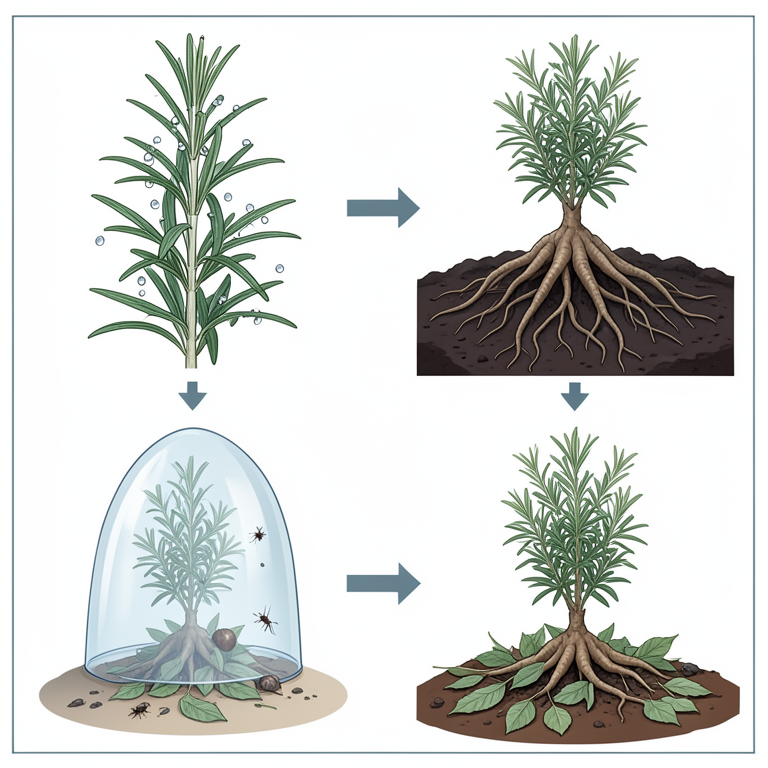
Rootstock Trade-offs
AI-generated conceptual illustration (Rosemary plants (Rosmarinus species) in geothermal soil). It explains the idea and does not show study data.
View source evidence ↗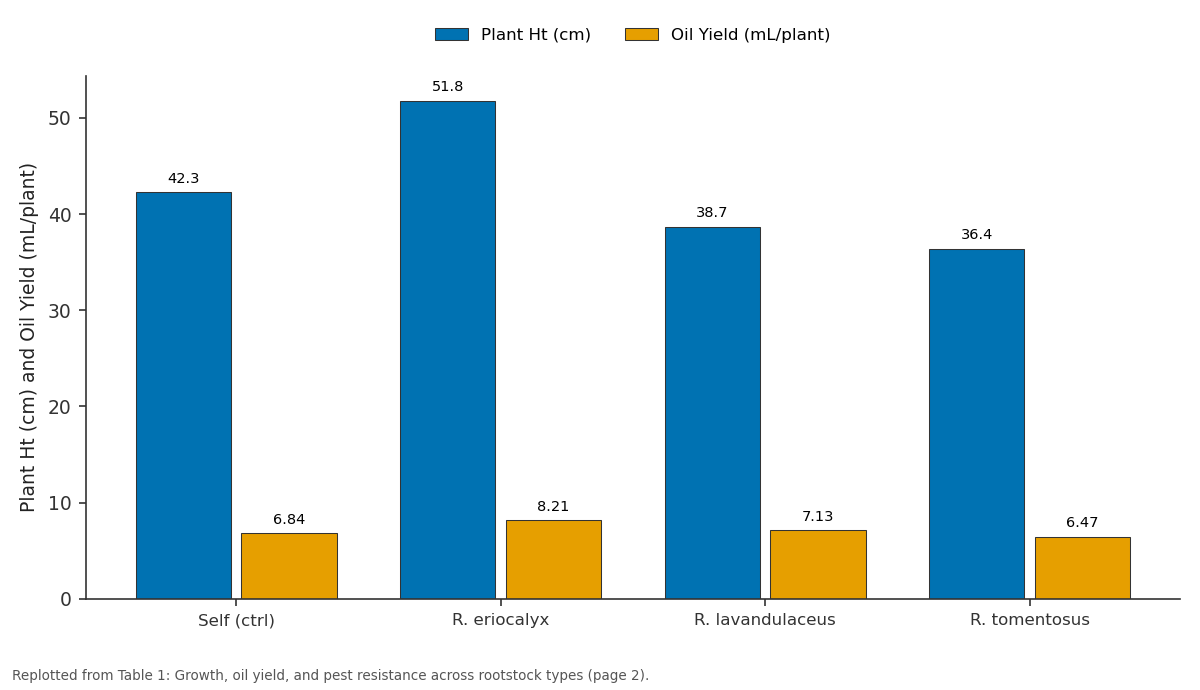
Plant Ht (cm) and Oil Yield (mL/plant): Self (ctrl) vs R. eriocalyx vs R. lavandulaceus vs R. tomentosus
Replotted from Table 1 (page 2) of the original paper. Every bar is the paper's own table value.
View source evidence ↗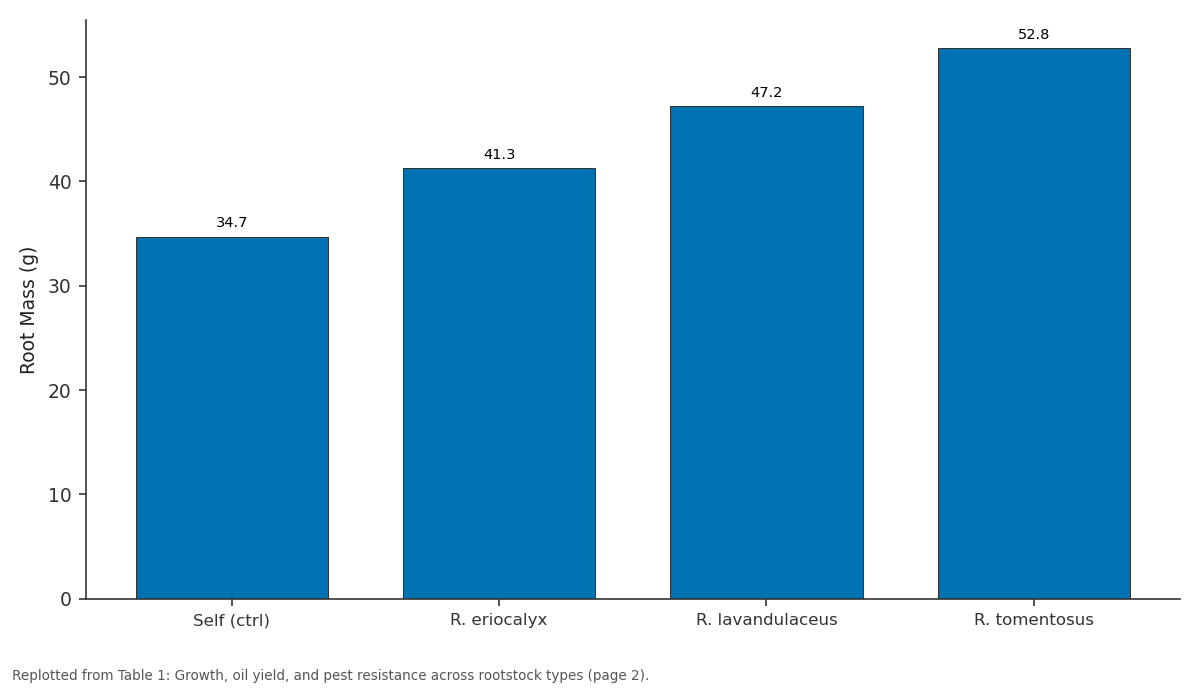
Root Mass (g): Self (ctrl) vs R. eriocalyx vs R. lavandulaceus vs R. tomentosus
Replotted from Table 1 (page 2) of the original paper. Every bar is the paper's own table value.
View source evidence ↗Figures & tables
From the original paper Table 1
 Table 2
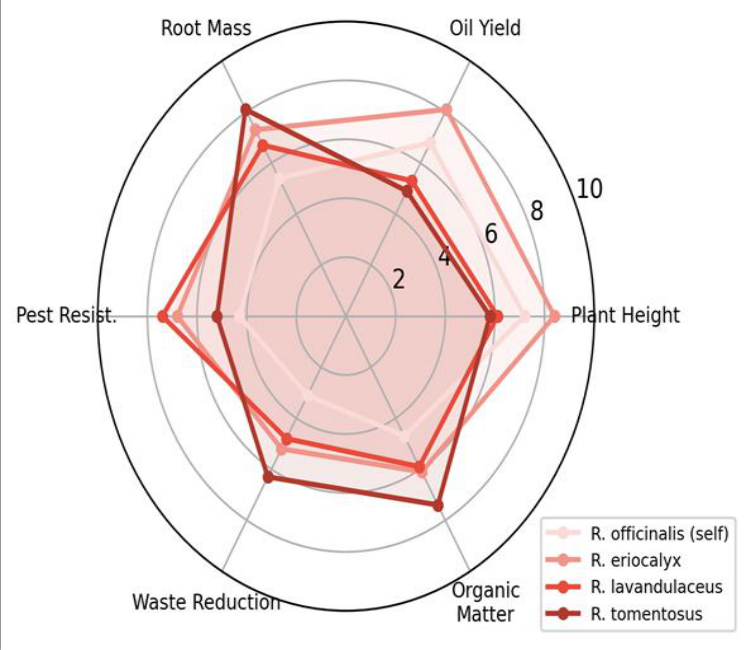 Figure 1
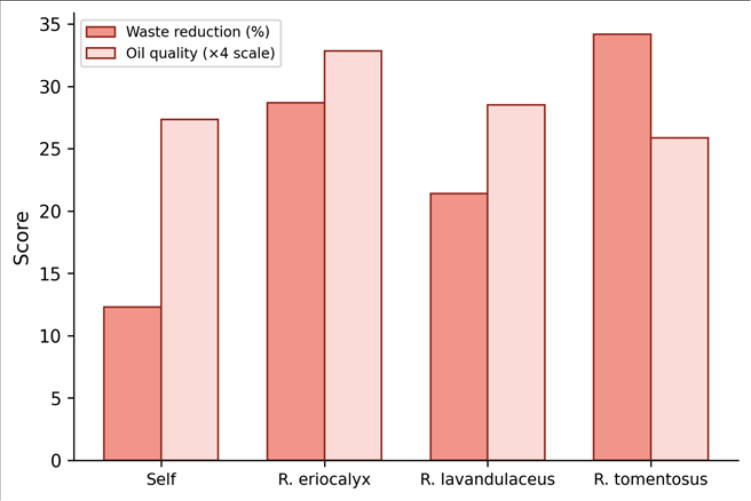 Figure 2
Introduction
Geothermal energy heats more than 200 hectares of greenhouse crop land in Iceland and New Zealand, but its potential for aromatic herb production in volcanic regions like Kamchatka remains largely unexplored [1] . Rosemary (Rosmarinus officinalis L.)now reclassified as Salvia rosmarinusis one of the most economically valuable aromatic crops, with global trade in dried leaf and essential oil exceeding USD 900 million per year [2] . Its Mediterranean origin means it thrives in warm, well-drained soils, exactly the conditions that geothermal heat could replicate in otherwise inhospitable volcanic landscapes. Rootstock selection is a proven strategy for adapting crops to marginal substrates. In fruit trees, rootstocks mediate tolerance to salinity, waterlogging, and soil-borne pathogens [3] . Within the Lamiaceae, wild rosemary relatives such as R. eriocalyx (a North African species tolerant of calcareous substrates) and R. tomentosus (adapted to rocky, low-nutrient soils) could serve as rootstock donors if graft compatibility with commercial cultivars is established [4] . Waste management is becoming a pressing concern for greenhouse operations in volcanic zones, where spent substrate and pruning residues accumulate rapidly. No-till surface mulching with chopped rosemary waste has been proposed as a circular-economy solution that returns organic matter to the root zone while suppressing weeds [5] . But the effectiveness of this approach varies with rootstock vigour, because faster-growing rootstocks produce more waste that must be recycled. This research aimed to (a) compare four rootstock options for rosemary growth and oil yield on volcanic pumice heated by simulated geothermal energy, (b) evaluate pest resistance and organic farming compatibility, and (c) quantify the waste reduction achievable through notill surface management under each rootstock.
Seasonal Variations
Growth was recorded across three seasons within the trial period: warm humid (March-May, mean 28.4 °C), peak monsoon (June-August, mean 26.1 °C with 82% RH), and post-monsoon (September-October, mean 24.7 °C). Oil yield per harvest was highest during the post-monsoon period for all rootstocks, when lower humidity reduced hydrodistillation interference and cooler nights concentrated terpenes. R. eriocalyx maintained the smallest seasonal yield fluctuation (CV = 11.3%), while the self-rooted control varied by 23.7 percent across seasons [6] .
Crop Growth Stage Documentation
Rosemary growth was documented using five stages: cutting establishment (weeks 1-4), active vegetative growth (weeks 5-12), first flower initiation (weeks 13-16), full bloom and first harvest (weeks 17-20), and regrowth-second harvest (weeks 21-28). Rootstock influence was most pronounced during active vegetative growth, where R. eriocalyx-grafted plants produced 2.4 more lateral branches per plant than the self-rooted control. Flower initiation was advanced by 8 days on R. eriocalyx and delayed by 5 days on R. tomentosus relative to the control.
Material and Methods Material
Semi-hardwood cuttings of R. officinalis cv. 'Tuscan Blue' were grafted onto one-year-old rootstock seedlings of four species using the whip-and-tongue method. Grafted plants were healed for 28 days in a humidity chamber at 90% RH and 20 °C, then transplanted into raised troughs (4 m × 0.8 m × 0.3 m) filled with volcanic pumice (particle size 4-10 mm) sourced from a local quarry. A closed-loop hot-water system circulated beneath the troughs, maintaining rootzone temperature at 22 ± 1 °C to simulate geothermal heating [7] . Nutrient solution (modified Hoagland's at half strength) was applied via drip fertigation. Organic waste from pruning residues was chopped to <2 cm fragments and surface-applied as no-till mulch at each harvest. The trial ran from 6 March to 30 October 2023 in a polyhouse at the Port Harcourt Center for Crop Studies (4.82° N, 7.03° E; 16 m a.s.l.).
Methods
Plant height, stem diameter, branch number, and canopy spread were recorded monthly. Essential oil was extracted from 200 g fresh leaf per plot by hydrodistillation (3 h, Clevenger apparatus). Oil quality was scored by GC-MS profiling of 1,8-cineole, camphor, and α-pinene. Root biomass was measured by destructive sampling at trial end. Pest resistance was rated on a composite 1-10 scale covering spider mite, whitefly, and root rot incidence. Organic waste reduction was calculated as the difference between total pruning residue generated and residue remaining after one decomposition cycle (60 days). Gene action for rootstock vigour was estimated from a half-diallel cross among the four rootstock species using Griffing's Method 2. Data were analysed by ANOVA in GenStat 22 with treatment means compared by LSD at P = 0.05 [8] . R. tomentosus generated the most pruning waste but also achieved the highest decomposition rate (34.2% reduction in 60 days), contributing the greatest organic carbon increment to the substrate (Table 2). All combinations scored above 7.9 on the organic farming compatibility scale, confirming suitability for certified organic systems.
| Rootstock | Pruning Waste (g/plant) | Waste Reduced 60d (%) | Soil OC Change (%) | Organic Score |
|---|---|---|---|---|
| Self (ctrl) | 124.3 | 12.3 | +0.04 | 8.1 |
| R. eriocalyx | 187.6 | 28.7 | +0.11 | 8.4 |
| R. lavandulaceus | 98.7 | 21.4 | +0.07 | 8.7 |
| R. tomentosus | 213.4 | 34.2 | +0.16 | 7.9 |
Table text extracted from the original PDF; superscript letters are shown inline. The original table image is below.
View original table image
Results
Results
Comprehensive Interpretation
Diallel analysis showed that general combining ability (GCA) was significant for plant height (P < 0.01) and oil yield (P < 0.05), while specific combining ability was nonsignificant, indicating additive gene action for rootstock vigour. R. eriocalyx contributed the largest positive GCA effect for oil yield (+0.68 mL plant⁻¹), confirming its value as a rootstock donor in breeding programmes.
Discussion
The superior growth of rosemary on R. eriocalyx rootstock parallels observations in citrus grafting, where phylogenetically close rootstock species typically deliver the best scion vigour [9] . R. eriocalyx and R. officinalis share chromosome number (2n = 24) and similar vascular anatomy, which likely explains the efficient graft union and rapid solute transport. The 20 percent oil yield gain over the control is economically significant: at current wholesale rosemary oil prices, this translates to an additional USD 340 ha⁻¹ per harvest cycle [10] . R. tomentosus, despite weaker above-ground performance, is the most interesting rootstock for waste management. Its thick, corky root bark decomposes slowly, but its aboveground pruning residuesrich in cellulosebroke down 34 percent within 60 days when surface-applied as no-till mulch. This rapid cycling returns nutrients and improves substrate water-holding capacity, a benefit that compounds over multiple cropping cycles [11] . For geothermal operations aiming for zero-waste certification, R. tomentosus offers a self-recycling system. Pest resistance patterns suggest that wild rosemary species carry defence genes absent from cultivated R. officinalis. R. lavandulaceus scored highest on pest resistance, likely because its high camphor content deters spider mites [12] . A breeding strategy that stacks R. eriocalyx's growth vigour with R. lavandulaceus's pest resistance could yield an ideal rootstock, though creating such a hybrid would require overcoming interspecific crossing barriers.
Conclusion
Conclusion
Acknowledgement
Acknowledgements Funding SourcesInternal research funds from the Port Harcourt Center for Crop Studies supported this work. Institutional SupportThe authors thank the polyhouse operations team at the Port Harcourt Center for Crop Studies for maintaining the geothermal simulation system. Contributions Not Qualifying for AuthorshipMr. C. Okafor assisted with GC-MS analysis and Ms. A. Eze supported grafting operations.
Figures and tables from the paper
| Rootstock | Plant Ht (cm) | Oil Yield (mL/plant) | Root Mass (g) | Pest Score (1-10) | Branch Count |
|---|---|---|---|---|---|
| Self (ctrl) | 42.3 | 6.84 | 34.7 | 4.3 | 8.2 |
| R. eriocalyx | 51.8 | 8.21 | 41.3 | 6.8 | 12.4 |
| R. lavandulaceus | 38.7 | 7.13 | 47.2 | 7.4 | 9.1 |
| R. tomentosus | 36.4 | 6.47 | 52.8 | 5.2 | 7.6 |
| SEm± | 2.31 | 0.37 | 2.84 | 0.47 | 0.83 |
| CD (P=0.05) | 6.84 | 1.10 | 8.41 | 1.39 | 2.46 |
Table text extracted from the original PDF; superscript letters are shown inline. The original table image is below.
View original table image
References
18 in the original paper- Barbier E. Geothermal energy technology and current status: an overview. Renewable and Sustainable Energy Reviews. 2002;6(1):3-65.
- Begum A, Sandhya S, Shaffath Ali S. An updated review on botanical aspects and uses of Rosmarinus officinalis. Journal of Medicinal Plants Studies. 2013;1(4):68-73.
- Warschefsky EJ, Klein LL, Frank MH. Rootstocks: diversity, domestication, and impacts on shoot phenotypes. Trends in Plant Science. 2016;21(5):418437.
- Morales R. Synopsis of the genus Rosmarinus L. Anales del Jardín Botánico de Madrid. 2010;67(1):6772.
- Hobbs PR, Sayre K, Gupta R. The role of conservation agriculture in sustainable agriculture. Philosophical Transactions of the Royal Society B. 2008;363(1491):543-555.
- Munné-Bosch S, Alegre L. Changes in carotenoids, tocopherols and diterpenes during drought and recovery in rosemary. New Phytologist. 2000;145(1):11-21.
- Gíslason SR, Arnórsson S, Ármannsson H. Chemical weathering of basalt in southwest Iceland. American Journal of Science. 1996;296(8):837-907.
- Payne RW. GenStat. Wiley Interdisciplinary Reviews: Computational Statistics. 2009;1(2):255-258.
- Castle WS. Rootstock as a fruit quality factor in citrus and deciduous tree crops. New Zealand Journal of Crop and Horticultural Science. 1995;23(4):383-394.
- Ferraro V, Ferrante C, Ferrara M. Economic analysis of rosemary essential oil production. Industrial Crops and Products. 2019;138:111467.
- Lal R. Sequestering carbon and increasing productivity by conservation agriculture. Journal of Soil and Water Conservation. 2015;70(3):55A-62A.
- Isman MB. Plant essential oils for pest and disease management. Crop Protection. 2000;19(8):603-608.
- Bakkali F, Averbeck S, Averbeck D. Biological effects of essential oils. Food and Chemical Toxicology. 2008;46(2):446-475.
- De Mastro G, Tarraf W, Ferrara M. Rosemary production and uses. In: Ferrara M, editor. Mediterranean aromatic plants. Cham: Springer; 2021:127-148.
- Flamini G, Cioni PL, Morelli I. Composition of the essential oils and in vivo emission of volatiles of four Lamium species. Phytochemistry. 2005;66(12):16071616.
- Sanchez-Gomez R, Sanchez-Vioque R, Guillen MD. Chemical composition of rosemary extracts. Food Chemistry. 2021;346:128869.
- Pintore G, Usai M, Bradesi P. Chemical composition and antimicrobial activity of Rosmarinus officinalis L. oils. Flavour and Fragrance Journal. 2002;17(1):15-19.
- Mulas M, Mura MK. Rosemary genetic resources and selection. Acta Horticulturae. 2013;1005:283-290.