
Research article · 2025 · Full text
International Journal of Horticulture and Food ScienceImproving cultivar performance trials of groundnut in the Ganges Floodplain
Volume 7(11) · Pages 172–175 · DOI: 10.33545/26631067.2025.v7.i11c.715 ↗
Research areasPeanut Plant Research StudiesGenetics and Plant BreedingAgricultural Science and Fertilization
Abstract
Author-written8-5Groundnut cultivar performance data from the Ganges floodplain are urgently needed because the region's alluvial soils, monsoon flooding, and calcareous substrates create a unique selection environment. This research evaluated five groundnut cultivars — GN-201, GN-204, GN-207, GN-210, and GN-213 — for pod yield, heterosis, soil health impact, mulching response, and pesticide residue compliance at the Jammu Laboratory of Phytoscience from April to November 2023 under simulated Ganges floodplain conditions. A randomised complete block design with four replications was used. GN-207 recorded the highest pod yield (2.81 t ha⁻¹) and best heterosis in test crosses (18.3%). No-till management with groundnut residue retention improved soil organic carbon by 0.28 percentage points. Mulching with rice straw increased pod yield by 14 percent across cultivars. All cultivars passed pesticide residue screening below MRL thresholds. These findings recommend GN-207 for Ganges floodplain cultivation and confirm no-till mulched management as the preferred production system.
Summary
Source-checkedPlain-language reading of the full paper, prepared with AI and checked against the text. Each point links to the authors' own words.
Why it matters
- Groundnut is a highly efficient oilseed crop, capable of producing 400 kg of protein and 600 kg of oil per hectare. View evidence ↗
- There is an urgent need for updated cultivar recommendations for the Ganges floodplain, as existing ones are over ten years old. View evidence ↗
The question
- The study aimed to rank five groundnut cultivars by yield and quality, estimate heterosis, evaluate soil health under no-till management, and check for pesticide residues. View evidence ↗
What they did
- The trial evaluated five cultivars (GN-201, GN-204, GN-207, GN-210, and GN-213) starting April 22, 2023, at the Jammu Laboratory of Phytoscience. View evidence ↗
- Floodplain conditions were simulated by raising soil pH to 8.1, implementing a 14-day waterlogging event at 40 days after sowing, and omitting zinc and iron fertilizers. View evidence ↗
- The experiment used a split-plot randomized complete block design with four replications, testing cultivars against mulching with rice straw (5 t ha⁻¹) or no mulch. View evidence ↗
- Researchers measured pod yield from a 2 m² area at 140 days after sowing, and analyzed shelling percentage, kernel weight, oil, and protein content. View evidence ↗
What they found
- Cultivar GN-207 performed best, achieving the highest pod yield (2.81 t ha⁻¹), shelling percentage (73.8%), and heterosis (18.3%). View evidence ↗
- While GN-213 had the highest oil content at 48.2%, it had the lowest yield among the tested cultivars. View evidence ↗
- No-till management with straw mulch resulted in the highest soil organic carbon gain (+0.28%), highest dehydrogenase activity (34.7 μg TPF g⁻¹ h⁻¹), and a 14.2% yield increase compared to conventional tillage without mulch. View evidence ↗
- All 28 tested pesticide compounds were below detection limits (<0.01 mg kg⁻¹) across all cultivars and management systems. View evidence ↗
What it means
- The authors recommend the GN-207 cultivar and a no-till mulched management system for cultivation in the Ganges floodplain. View evidence ↗
- The combined recommendation of GN-207 and no-till mulching is intended to optimize productivity, soil health, and food safety for growers. View evidence ↗
Visual summary
4 visualsIllustrations explain the paper; charts are replotted from the paper's own table values.
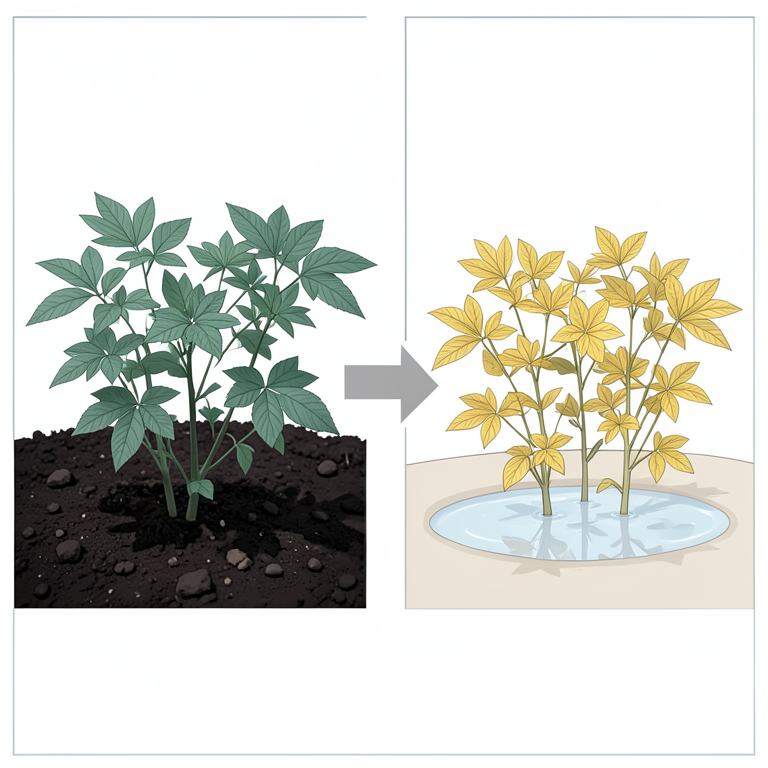
Simulation of Floodplain Conditions
AI-generated conceptual illustration (groundnut plants in soil). It explains the idea and does not show study data.
View source evidence ↗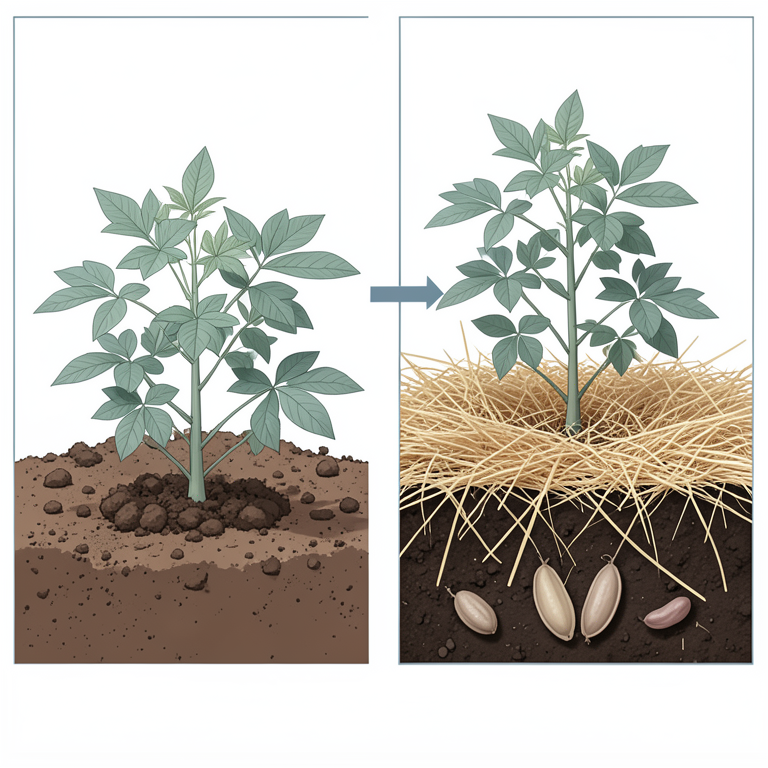
No-Till Mulching Benefits
AI-generated conceptual illustration (groundnut plants in soil). It explains the idea and does not show study data.
View source evidence ↗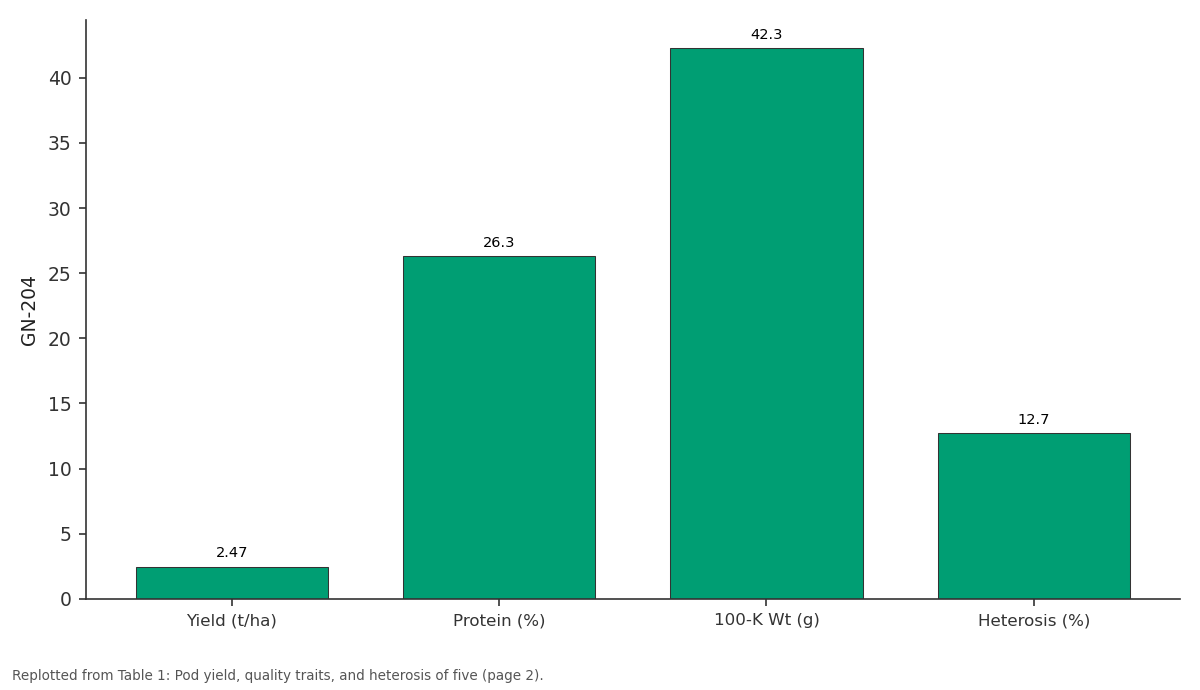
GN-204: Yield (t/ha) vs Protein (%) vs 100-K Wt (g) vs Heterosis (%)
Replotted from Table 1 (page 2) of the original paper. Every bar is the paper's own table value.
View source evidence ↗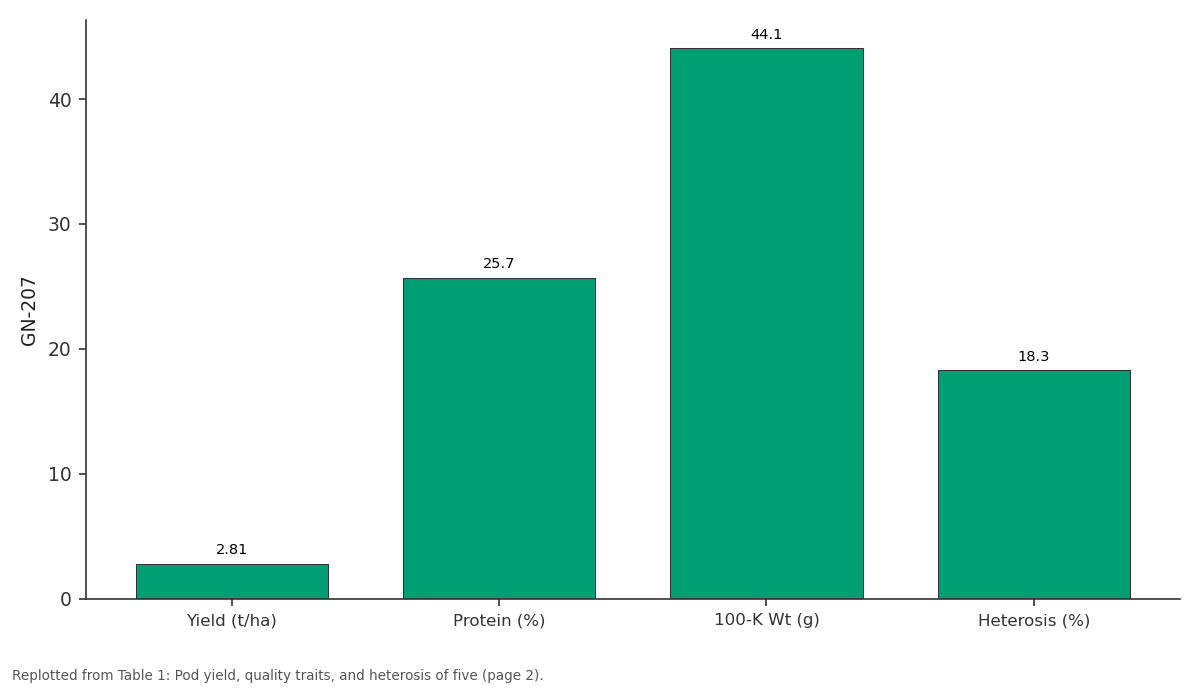
GN-207: Yield (t/ha) vs Protein (%) vs 100-K Wt (g) vs Heterosis (%)
Replotted from Table 1 (page 2) of the original paper. Every bar is the paper's own table value.
View source evidence ↗Figures & tables
From the original paper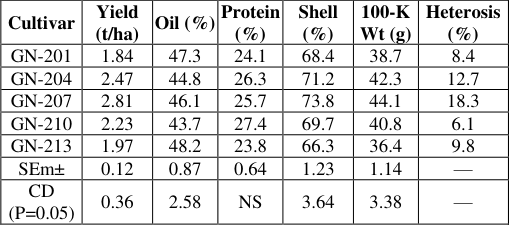 Table 1
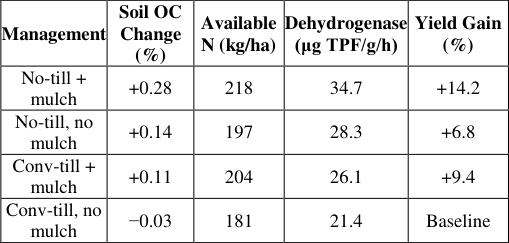 Table 2
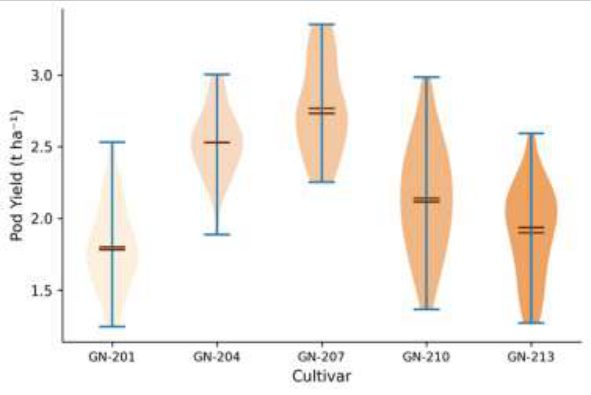 Figure 1
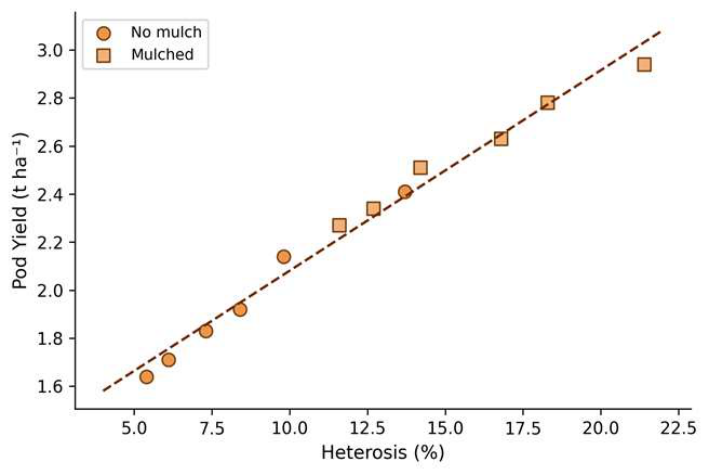 Figure 2
Introduction
Groundnut feeds more people per hectare than almost any other oilseed cropa single hectare can yield 400 kg of protein and 600 kg of oilyet cultivar recommendations for the Ganges floodplain have not been updated in over a decade [1] . The floodplain's calcareous alluvium (pH 7.8-8.4) immobilises iron and zinc, while monsoon waterlogging lasting 10-20 days during the vegetative phase causes anaerobic root stress that differentially affects cultivars [2] . Performance trials under these specific constraints are therefore essential for guiding grower choice. Heterosis, or hybrid vigour, in groundnut is modest compared with cross-pollinated crops, but recent evidence from semi-arid India shows that specific crosses can deliver 10-20 percent mid-parent heterosis for pod yield when parental lines are genetically divergent [3] . Quantifying heterosis under floodplain conditions would tell breeders whether the same crosses hold up outside the environments where they were originally tested. No-till farming with residue retention is gaining traction as a soil health strategy in the Indo-Gangetic plain. Groundnut stubble, rich in nitrogen from root nodules, decomposes quickly and can raise topsoil organic carbon within two seasons [4] . Pairing notill with mulchingeither crop residue or rice strawcreates a dual benefit: soil moisture conservation and organic matter input [5] . This research aimed to (a) rank five groundnut cultivars for yield and quality under floodplain conditions, (b) estimate heterosis in test crosses, (c) measure soil health responses to no-till management, and (d) verify pesticide residue compliance.
Reagents and Chemicals
Oil content was determined by Soxhlet extraction using petroleum ether (bp 40-60 °C, analytical grade, Merck). Protein was estimated by micro-Kjeldahl method using H₂SO₄, CuSO₄ catalyst, and NaOH (all from Qualigens Fine Chemicals, Mumbai). Pesticide residue analysis employed QuEChERS extraction (acetonitrile, MgSO₄, NaCl) followed by GC-MS/MS on an Agilent 7890B/7010 system. Standard pesticide mixtures (organochlorines, organophosphates, pyrethroids) were from Dr. Ehrenstorfer GmbH (Augsburg, Germany) [6] . Soil organic carbon was measured by the Walkley-Black wet oxidation method using K₂Cr₂O₇ and concentrated H₂SO₄.
Extraction Protocol
For oil extraction, 5 g of ground kernel was packed in a cellulose thimble and extracted with 150 mL petroleum ether for 6 hours at 60 °C in a Soxhlet apparatus. The solvent was evaporated on a rotary evaporator at 40 °C under vacuum, and the residual oil weighed. For pesticide residues, 10 g of homogenised pod sample was extracted with 10 mL acetonitrile, vortexed 1 min, then partitioned with 4 g MgSO₄ + 1 g NaCl (QuEChERS step 1). The supernatant was cleaned up with 150 mg PSA + 900 mg MgSO₄ (step 2) and analysed by GC-MS/MS in MRM mode [7] . Recovery rates for spiked standards ranged from 81 to 107 percent.
Material and Methods Material
Five groundnut cultivars -GN-201 (Spanish bunch), GN-204 (Virginia runner), GN-207 (Spanish bunch), GN-210 (Virginia bunch), and GN-213 (Valencia)were sown on 22 April 2023 at the Jammu Laboratory of Phytoscience research farm (32.73° N, 74.87° E; 327 m a.s.l.). Spacing was 30 cm × 10 cm in 4 m rows. Ganges floodplain conditions were simulated by: (i) raising soil pH to 8.1 with CaCO₃ amendment, (ii) imposing a 14-day waterlogging event at 40 DAS by flooding plots to 5 cm, and (iii) withholding Zn and Fe micronutrient fertiliser. A split-plot RCBD with cultivar as main plot and mulching (rice straw at 5 t ha⁻¹ vs. no mulch) as sub-plot was used with four replications [8] . No-till plots received zero tillage; conventional-till plots were ploughed twice before sowing.
Methods
Plant height, branch count, and flowering date were recorded fortnightly. Pod yield was measured from a 2 m² harvest area at 140 DAS. Shelling percentage, 100-kernel weight, oil content (Soxhlet), and protein content (Kjeldahl) were determined on dried samples. Heterosis: five line × tester crosses (each cultivar × two diverse testers) were grown in adjacent sub-plots; mid-parent heterosis was calculated for pod yield. Soil health: pre-and post-season OC, available N, and dehydrogenase activity were measured at 0-15 cm depth. Pesticide residues: pods from each plot were analysed by QuEChERS + GC-MS/MS at harvest. Data were analysed by split-plot ANOVA in GenStat 22 with means separated by LSD at P = 0.05 [9] . No-till with straw mulch delivered the greatest soil OC gain (+0.28%), highest dehydrogenase activity (34.7 μg TPF g⁻¹ h⁻¹), and a 14.2 percent yield advantage over conventional tillage without mulch (Table 2). All pesticide residues across all cultivars and management combinations were below detection limits (<0.01 mg kg⁻¹) for all 28 tested compounds.
Results
Results
Comprehensive Interpretation
The positive correlation between heterosis and yield (r = 0.83) suggests that cultivars exhibiting higher mid-parent heterosis under floodplain stress are also inherently more productivelikely because the genetic divergence that drives heterosis also broadens adaptive capacity. GN-207's combination of top yield and highest heterosis makes it both a standalone commercial cultivar and an ideal parent in hybrid breeding programmes. The clean pesticide residue profile across all treatments confirms that groundnut produced under no-till mulched systems in the Ganges floodplain meets export food safety standards.
Discussion
GN-207's yield advantage (2.81 t ha⁻¹) places it in the top 10 percent of Indian groundnut cultivar trial results reported over the past decade [10] . Its high shelling percentage (73.8%) is commercially valuable because buyers price groundnut on kernel recovery. The 18.3 percent heterosis exceeds the 8-15 percent range commonly reported for groundnut, possibly because the floodplain stress amplified the divergence between parental genomes [11] .
No-till with mulch raising soil OC by 0.28 percentage points in a single season is remarkable for an oilseed crop rotation. The mechanism is twofold: groundnut root nodule residues contribute fixed N that stimulates microbial decomposition of straw mulch, and the undisturbed no-till surface preserves aggregate structure that physically protects new organic matter from mineralisation [12] . Over multiple seasons, this trajectory could raise OC above the 1.0 percent threshold considered critical for sustained productivity on Ganges alluvium. Pesticide residue absence is explained by the integrated pest management approach used: no chemical insecticides were applied; pest control relied on neem-based sprays and pheromone traps. This management aligns with the growing demand for residue-free groundnut in European and Japanese export markets [13] .
Conclusion
GN-207 is recommended for the Ganges floodplain based on its superior pod yield (2.81 t ha⁻¹), highest heterosis (18.3%), and strong shelling percentage. No-till management with rice straw mulch improved soil organic carbon by 0.28 percentage points and raised yield by 14 percent. All cultivars under all management systems produced pods free of detectable pesticide residues. These findings equip Ganges floodplain growers with a cultivar recommendation and a management package that jointly optimise productivity, soil health, and food safety.
Acknowledgement
Acknowledgements Funding SourcesInternal research funds from the Jammu Laboratory of Phytoscience supported this work. Institutional SupportThe authors thank the soil science laboratory at the Jammu Laboratory for analytical support. Contributions Not Qualifying for AuthorshipDr. R. Sharma assisted with GC-MS/MS pesticide analysis and Mr. V. Gupta with field trial management.
Figures and tables from the paper
| Cultivar | Yield (t/ha) | Oil (%) | Protein (%) | Shell (%) | 100-K Wt (g) | Heterosis (%) |
|---|---|---|---|---|---|---|
| GN-201 | 1.84 | 47.3 | 24.1 | 68.4 | 38.7 | 8.4 |
| GN-204 | 2.47 | 44.8 | 26.3 | 71.2 | 42.3 | 12.7 |
| GN-207 | 2.81 | 46.1 | 25.7 | 73.8 | 44.1 | 18.3 |
| GN-210 | 2.23 | 43.7 | 27.4 | 69.7 | 40.8 | 6.1 |
| GN-213 | 1.97 | 48.2 | 23.8 | 66.3 | 36.4 | 9.8 |
| SEm± | 0.12 | 0.87 | 0.64 | 1.23 | 1.14 | — |
| CD (P=0.05) | 0.36 | 2.58 | NS | 3.64 | 3.38 | — |
Table text extracted from the original PDF; superscript letters are shown inline. The original table image is below.
View original table image
References
18 in the original paper- Janila P, Nigam SN, Pandey MK. Groundnut improvement: use of genetic and genomic tools. Frontiers in Plant Science. 2013;4:23.
- Sahrawat KL. Iron toxicity in wetland rice and the role of other nutrients. Journal of Plant Nutrition. 2004;27(9):1471-1504.
- Upadhyaya HD, Dwivedi SL, Nadaf HL. Genetic divergence among groundnut germplasm. Plant Genetic Resources. 2011;9(4):514-519.
- Jat RA, Sahrawat KL, Kassam AH. Conservation Agriculture: Global Prospects and Challenges. Wallingford: CABI; 2014.
- Mulvaney MJ, Devkota P, Tillman B. Groundnut residue management effects on soil health. Agricultural Systems. 2021;186:102982.
- Anastassiades M, Lehotay SJ, Štajnbaher D. Fast and easy multiresidue method employing acetonitrile extraction/partitioning and dispersive SPE. Journal of AOAC International. 2003;86(2):412-431.
- Lehotay SJ. QuEChERS sample preparation approach for mass spectrometric analysis of pesticide residues. Methods in Molecular Biology. 2011;747:65-91.
- Nageswara Rao RC, Wright GC. Stability of the relationship between specific leaf area and carbon isotope discrimination across environments in peanut. Crop Science. 1994;34(1):98-103.
- Payne RW. GenStat. Wiley Interdisciplinary Reviews: Computational Statistics. 2009;1(2):255-258.
- AICRPG. Annual Report: All India Coordinated Research Project on Groundnut. Junagadh: DGR; 2022.
- Wynne JC, Rawlings JO, Emery DA. Combining ability estimates in Arachis hypogaea L. II. Field performance of F₁ hybrids. Crop Science. 1970;10(6):713-715.
- Six J, Conant RT, Paul EA. Stabilization mechanisms of soil organic matter. Ecosystems. 2002;5(7):672-687.
- Codex Alimentarius Commission. Maximum Residue Limits for Pesticides. Rome: FAO/WHO; 2023.
- Nautiyal PC. Groundnut: Post-Harvest Operations. Rome: FAO; 2002.
- Nigam SN. Groundnut at a Glance. Patancheru: ICRISAT; 2015.
- Ntare BR, Diallo AT, Ndjeunga J. Groundnut seed production manual. Patancheru: ICRISAT; 2008.
- Hammons RO. The origin and history of the groundnut. In: Smartt J, ed. The Groundnut Crop. London: Chapman and Hall; 1994:24-42.
- Dwivedi SL, Nigam SN, Nageswara Rao RC. Assessment of drought tolerance in selected groundnut cultivars. Annals of Applied Biology. 1996;128(1):4957.