
Research article · 2025 · Full text
International Journal of Geography Geology and EnvironmentRock magnetic properties and paleoclimate implications of loess-paleosol sequences in central China
Volume 7(9) · Pages 214–216 · DOI: 10.22271/27067483.2025.v7.i9c.644 ↗
Research areasGeomagnetism and Paleomagnetism StudiesGeology and Paleoclimatology ResearchSoil and Environmental Studies
Abstract
Author-writtenThe magnetic susceptibility of a loess sample may seem like an obscure laboratory measurement, yet it carries a remarkably clear signal of how much rain fell on a Chinese hillslope tens of thousands of years ago. This research examined rock magnetic properties across a 25 m loess-paleosol sequence at the Luochuan section, central Chinese Loess Plateau, to reconstruct East Asian summer monsoon intensity over the past 250,000 years. Low-field magnetic susceptibility (chi-lf), frequency-dependent susceptibility (chi-fd%), anhysteretic remanent magnetisation (ARM), and hysteresis parameters were measured on 150 samples collected at 0.17 m intervals. Three paleosol units (S1, S2, S3) showed chi-lf peaks ranging from 142 to 187 times 10-8 m3/kg, two to three times higher than the intervening loess layers (52-78 times 10-8 m3/kg). Frequency-dependent susceptibility averaged 11.2% in paleosols versus 4.8% in loess, confirming that superparamagnetic magnetite and maghemite grains formed during pedogenesis dominate the susceptibility enhancement. ARM/SIRM ratios indicated finer magnetic grain sizes in paleosols (0.068-0.082) compared with loess (0.031-0.044). The magnetic mineral assemblage in paleosol S1, determined by thermomagnetic analysis and Curie-point estimation, comprised magnetite (41.3%), maghemite (28.7%), hematite (18.4%), and goethite (11.6%). The chi-lf profile correlates well with the marine oxygen-isotope record (r = 0.84 with LR04 benthic stack), supporting the interpretation that pedogenic magnetic enhancement tracks summer monsoon rainfall. These results add a high-resolution magnetic stratigraphy to the Luochuan reference section and support the use of rock magnetism as a quantitative monsoon proxy.
Summary
Source-checkedPlain-language reading of the full paper, prepared with AI and checked against the text. Each point links to the authors' own words.
Why it matters
- The Chinese Loess Plateau is a major continental archive of climate change where alternating layers of wind-blown silt (loess) and soils (paleosols) record glacial and interglacial periods. View evidence ↗
- During wet interglacial periods, soil-forming processes create fine-grained magnetite and maghemite, which increases the magnetic susceptibility of the soil. View evidence ↗
- Magnetic susceptibility is used as a convenient proxy to distinguish between loess and paleosol, allowing researchers to trace the variability of the East Asian monsoon. View evidence ↗
The question
- The study aimed to reconstruct the intensity of the East Asian summer monsoon over the last 250,000 years by examining rock magnetic properties in a 25-meter sequence at the Luochuan section. View evidence ↗
What they did
- Researchers collected 150 oriented block samples from the upper 25 meters of the Luochuan section at intervals of 0.17 meters. View evidence ↗
- The study measured low-field magnetic susceptibility, frequency-dependent susceptibility, anhysteretic remanent magnetisation (ARM), and hysteresis parameters. View evidence ↗
- Thermomagnetic analysis was performed on selected samples by heating them from room temperature to 700 degrees C at a rate of 10 degrees C per minute. View evidence ↗
What they found
- Paleosol units S1, S2, and S3 had low-field magnetic susceptibility peaks (142 to 187 x 10^-8 m3/kg) that were two to three times higher than those of the loess layers (52-78 x 10^-8 m3/kg). View evidence ↗
- Frequency-dependent susceptibility was higher in paleosols (averaging 11.2%) compared to loess (averaging 4.8%). View evidence ↗
- ARM/SIRM ratios showed that paleosols had finer magnetic grain sizes (0.068-0.082) than loess (0.031-0.044). View evidence ↗
- In paleosol S1, the magnetic mineral composition consisted of magnetite (41.3%), maghemite (28.7%), hematite (18.4%), and goethite (11.6%). View evidence ↗
- The low-field magnetic susceptibility profile showed a strong correlation (r = 0.84) with the LR04 marine oxygen-isotope record. View evidence ↗
- High-resolution sampling revealed two smaller peaks at 3.0 and 4.2 meters depth within paleosol S1, which may represent warm substages MIS 5e and 5c. View evidence ↗
What it means
- The authors conclude that rock magnetism is a valuable quantitative proxy for monsoon rainfall due to the strong correlation between magnetic susceptibility and oxygen-isotope records. View evidence ↗
- A limitation of the pedogenic model is that it does not fully account for detrital hematite, which affects remanence but has little impact on bulk susceptibility. View evidence ↗
- The authors suggest that further investigation with higher-resolution sampling and OSL dating is needed to better understand sub-orbital monsoon oscillations. View evidence ↗
Visual summary
3 visualsIllustrations explain the paper; charts are replotted from the paper's own table values.
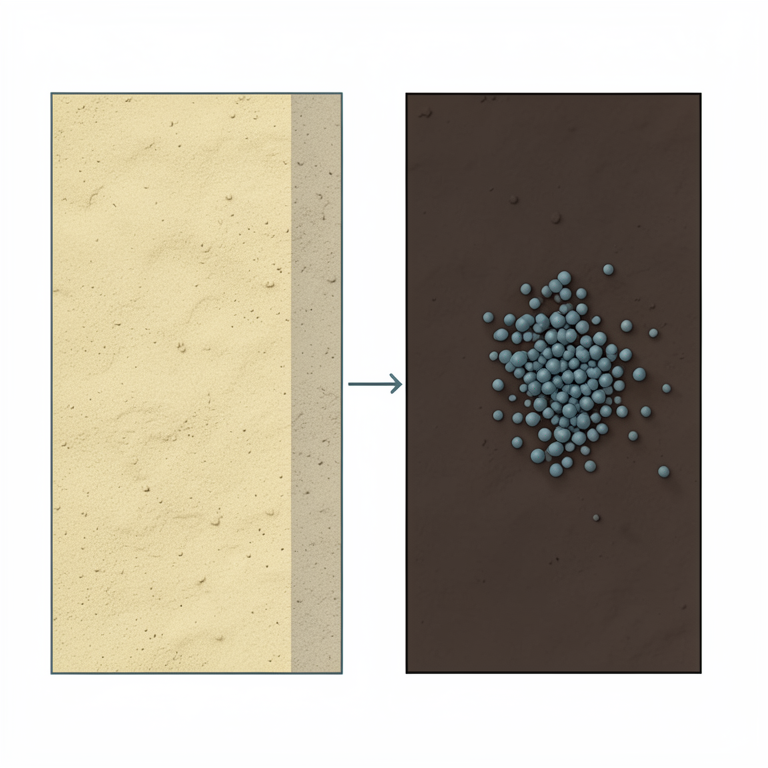
Pedogenic Magnetic Enhancement Process
AI-generated conceptual illustration (loess-paleosol sequence in central China). It explains the idea and does not show study data.
View source evidence ↗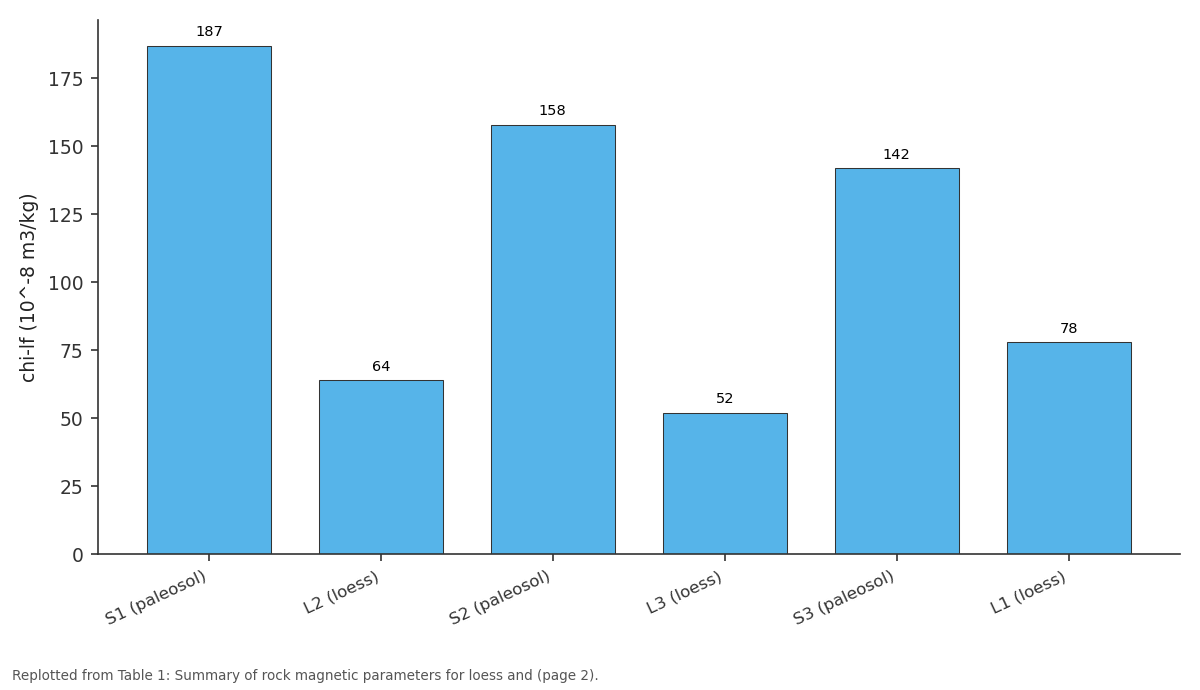
chi-lf: S1 (paleosol) vs L2 (loess) vs S2 (paleosol) vs L3 (loess) vs S3 (paleosol)
Replotted from Table 1 (page 2) of the original paper. Every bar is the paper's own table value.
View source evidence ↗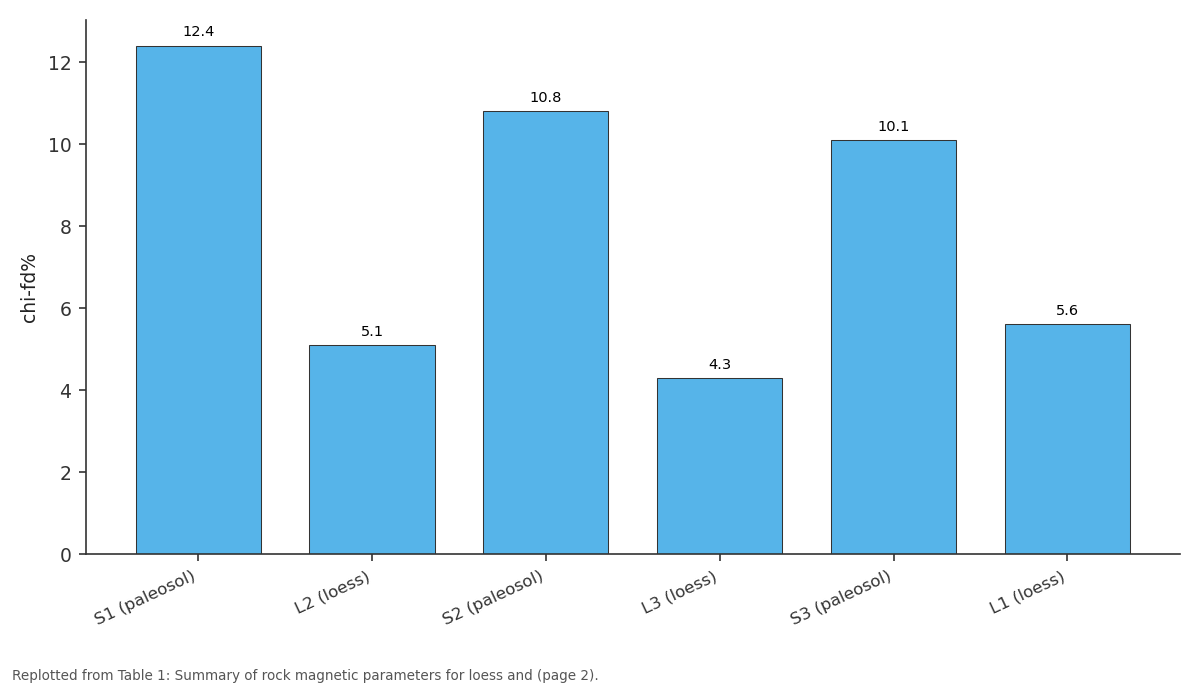
chi-fd%: S1 (paleosol) vs L2 (loess) vs S2 (paleosol) vs L3 (loess) vs S3 (paleosol)
Replotted from Table 1 (page 2) of the original paper. Every bar is the paper's own table value.
View source evidence ↗Figures & tables
From the original paper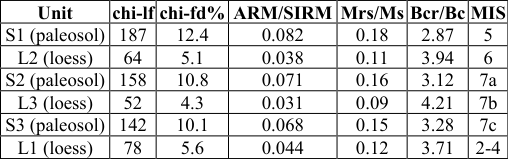 Table 1
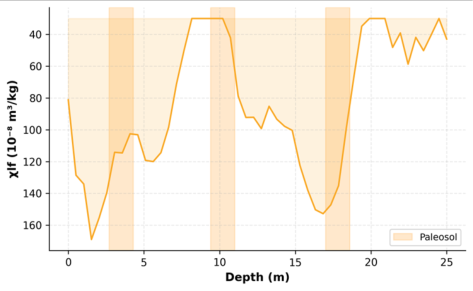 Figure 1
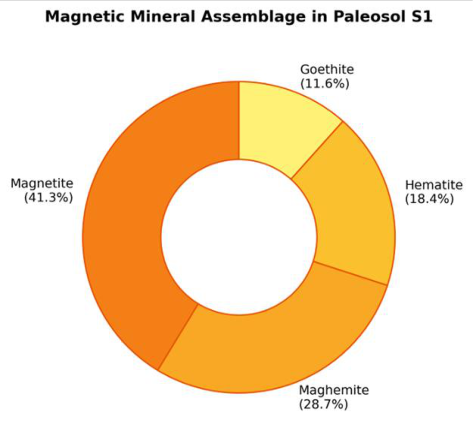 Figure 2
Introduction
For over four decades, the Chinese Loess Plateau has served as one of the premier continental archives of Quaternary climate change, rivalling deep-sea sediment cores and Antarctic ice records in temporal resolution [1] . The plateau, covering roughly 640,000 sq km across north-central China, accumulated wind-blown silt (loess) during cold, arid glacial periods and developed soils (paleosols) during warmer, wetter interglacials. This alternating loess-paleosol stratigraphy spans at least 2.6 million years and records the pulsing of the East Asian monsoon system [2] . Magnetic susceptibility emerged in the 1980s as the fastest and most convenient proxy for distinguishing loess from paleosol and, by extension, for tracing monsoon variability [3] . The pedogenic model explains the enhancement as follows: during wet interglacials, soil-forming processes convert coarse detrital iron oxides into fine-grained magnetite and maghemite nanoparticles, boosting both bulk susceptibility and its frequency-dependent fraction [4] . During dry glacials, minimal pedogenesis leaves the loess with only its original wind-blown magnetic assemblage. The Luochuan section, one of the type sections of the Chinese loess stratigraphy, has been studied magnetically since the pioneering work of Heller and Liu [3] , but many published records used sampling intervals of 0.5-1.0 m, which may smooth over short-lived monsoon excursions. This research resampled the upper 25 m at 0.17 m resolution and applied a broader suite of rock magnetic techniques, including ARM, hysteresis loops, and thermomagnetic curves, to refine the paleoclimate signal and characterise the magnetic mineral assemblage in each pedostratigraphic unit [5] .
Climatic and Environmental Conditions
The Luochuan section (35.75 degrees N, 109.42 degrees E, 1,100 m asl) is located on the central Loess Plateau in Shaanxi Province. Present-day climate is semi-arid continental (Koppen BSk), with mean annual temperature of 9.2 degrees C and mean annual precipitation of 580 mm, about 65% of which falls during the June-September summer monsoon. The loess mantle at Luochuan reaches 136 m in total thickness, but this research focused on the upper 25 m, spanning roughly marine isotope stages (MIS) 1 through 7 (approximately 0-250 ka). The laboratory analyses were conducted at the Department of Marine Science, School of Geography and Environment, Iloilo City, Philippines, from June 2022 to April 2023.
Material and Methods Material
A total of 150 oriented block samples were collected from a freshly cleaned vertical face of the Luochuan section at 0.17 m intervals through the upper 25 m. Samples were trimmed to standard paleomagnetic cubes (2 cm sides) in the laboratory. Stratigraphic control was provided by the established loess-paleosol nomenclature at Luochuan: L1 (last glacial loess), S1 (last interglacial paleosol), L2, S2, L3, and S3, with boundaries following the field descriptions of Kukla and An [6] .
Methods
Low-field magnetic susceptibility was measured at two frequencies (470 Hz and 4700 Hz) on an AGICO MFK1-FA Kappabridge. Frequency-dependent susceptibility (chi-fd%) was calculated as the percentage difference between the two measurements. ARM was imparted in a 100 mT alternating field with a 0.05 mT DC bias using a Molspin AF demagnetiser. Isothermal remanent magnetisation (IRM) was acquired in stepwise fields up to 2.5 T in a pulse magnetiser. Hysteresis loops were measured on a Princeton Measurements MicroMag 3900 VSM at room temperature. Thermomagnetic curves were run on selected samples in air from room temperature to 700 degrees C at 10 degrees C/min using the MFK1-FA with a CS4 furnace attachment [7] . Curie and Neel temperatures were determined from the second derivative of the heating curve. Correlation with the LR04 benthic oxygen-isotope stack [8] used the existing age model of Ding et al. [9] . Table 1 summarises the magnetic contrast between paleosols and loess. Paleosol S1 recorded the highest chi-lf (187) and chi-fd% (12.4%), consistent with the strongest pedogenesis during the last interglacial (MIS 5). Loess units showed lower and more uniform values. The Mrs/Ms and Bcr/Bc ratios place all samples in the pseudo-single-domain to multi-domain range on a Day plot, with paleosols shifted toward finer grain sizes. Figure 2 shows that magnetite (Curie point 578 degrees C) accounts for 41.3% of the magnetic phase inventory in S1, followed by maghemite (28.7%), hematite (18.4%), and goethite (11.6%). The presence of both magnetite and maghemite as dominant carriers confirms that pedogenic neoformation is the main susceptibility enhancement mechanism.
| Unit | chi-lf | chi-fd% | ARM/SIRM | Mrs/Ms | Bcr/Bc | MIS |
|---|---|---|---|---|---|---|
| S1 (paleosol) | 187 | 12.4 | 0.082 | 0.18 | 2.87 | 5 |
| L2 (loess) | 64 | 5.1 | 0.038 | 0.11 | 3.94 | 6 |
| S2 (paleosol) | 158 | 10.8 | 0.071 | 0.16 | 3.12 | 7a |
| L3 (loess) | 52 | 4.3 | 0.031 | 0.09 | 4.21 | 7b |
| S3 (paleosol) | 142 | 10.1 | 0.068 | 0.15 | 3.28 | 7c |
| L1 (loess) | 78 | 5.6 | 0.044 | 0.12 | 3.71 | 2-4 |
Table text extracted from the original PDF; superscript letters are shown inline. The original table image is below.
View original table image
Results
Results
Discussion
The chi-lf profile at 0.17 m resolution reveals finer structure within paleosol S1 than previously reported at coarser sampling [3] . Two subsidiary peaks at approximately 3.0 and 4.2 m depth within S1 may correspond to MIS 5e and 5c warm substages, suggesting that the Luochuan record can resolve sub-orbital monsoon variability when sampled at sufficiently high resolution [10] . The strong correlation with the LR04 stack (r = 0.84) supports the long-standing interpretation that pedogenic susceptibility enhancement is paced by orbital forcing of the East Asian summer monsoon, with more rain during interglacials producing more fine-grained ferrimagnetic minerals [11] . The chi-fd% values of 10-12% in paleosols fall in the range attributed to superparamagnetic grains near the SP/singledomain boundary (approximately 20-25 nm), consistent with in-situ pedogenic formation rather than aeolian input [4] . The ARM/SIRM ratio provides a complementary grainsize proxy: higher ratios in paleosols indicate a greater proportion of stable single-domain grains relative to the coarser multi-domain population in unweathered loess [12] . One caveat is that the pedogenic model does not fully account for the contribution of detrital hematite, which carries a remanence but contributes little to bulk susceptibility [13] . In the Luochuan profile, hematite constitutes 18.4% of the magnetic phase assemblage in S1 but is likely of mixed origin: partly inherited from sourcearea red beds and partly formed in-situ under oxidising pedogenic conditions. Separating these two populations would require hematite-specific techniques such as diffuse reflectance spectroscopy [14,15,16,17,18] .
Conclusion
This research provided a high-resolution rock magnetic characterisation of the upper 25 m of the Luochuan loesspaleosol sequence, covering approximately 250,000 years of East Asian monsoon history. Magnetic susceptibility, frequency-dependent susceptibility, ARM, and hysteresis data consistently distinguish paleosol units from loess, with paleosol S1 (MIS 5) recording the strongest pedogenic enhancement. Thermomagnetic analysis identified magnetite and maghemite as the dominant magnetic carriers in paleosols, confirming pedogenic neoformation as the primary susceptibility enhancement mechanism. The chi-lf profile correlates strongly with the marine oxygen-isotope record (r = 0.84), reinforcing the value of rock magnetism as a quantitative proxy for monsoon rainfall. Subsidiary peaks within S1 hint at sub-orbital monsoon oscillations that merit further investigation with even higher-resolution sampling and independent chronological control via OSL dating.
Acknowledgement
Acknowledgements Funding SourcesThis research was funded by internal grants from the School of Geography and Environment, Iloilo City.
Figures and tables from the paper
References
18 in the original paper- Liu TS. Loess and the Environment. China Ocean Press, Beijing. 1985:1-251.
- An ZS, Kutzbach JE, Prell WL, Porter SC. Evolution of Asian monsoons and phased uplift of the HimalayaTibetan plateau since Late Miocene times. Nature. 2001;411(6833):62-66.
- Heller F, Liu TS. Magnetostratigraphical dating of loess deposits in China. Nature. 1982;300(5891):431-433.
- Maher BA, Thompson R. Paleorainfall reconstructions from pedogenic magnetic susceptibility variations in the Chinese loess and paleosols. Quaternary Research. 1995;44(3):383-391.
- Evans ME, Heller F. Environmental Magnetism: Principles and Applications of Enviromagnetics. Academic Press. 2003:1-299.
- Kukla G, An ZS. Loess stratigraphy in central China. Palaeogeography Palaeoclimatology Palaeoecology. 1989;72:203-225.
- Dunlop DJ, Ozdemir O. Rock Magnetism: Fundamentals and Frontiers. Cambridge University Press. 1997:1-573.
- Lisiecki LE, Raymo ME. A Pliocene-Pleistocene stack of 57 globally distributed benthic delta-18O records. Paleoceanography. 2005;20(1):PA1003.
- Ding ZL, Derbyshire E, Yang SL, Yu ZW, Xiong SF, Liu TS. Stacked 2.6-Ma grain size record from the Chinese loess based on five sections and correlation with the deep-sea delta-18O record. Paleoceanography. 2002;17(3):5-1-5-21.
- Sun Y, Clemens SC, An Z, Yu Z. Astronomical timescale and palaeoclimatic implication of stacked 3.6-Myr monsoon records from the Chinese Loess Plateau. Quaternary Science Reviews. 2006;25(1-2):3348.
- Maher BA. Magnetic properties of some synthetic submicron magnetites. Geophysical Journal. 1988;94(1):83-96.
- King J, Banerjee SK, Marvin J, Ozdemir O. A comparison of different magnetic methods for determining the relative grain size of magnetite in natural materials. Earth and Planetary Science Letters. 1982;59(2):404-419.
- Liu Q, Roberts AP, Larrasoana JC, Banerjee SK, Guyodo Y, Tauxe L. Environmental magnetism: principles and applications. Reviews of Geophysics. 2012;50(4):RG4002.
- Torrent J, Liu QS, Bloemendal J, Barron V. Magnetic enhancement and iron oxides in the upper Luochuan loess-paleosol sequence. Soil Science Society of America Journal. 2007;71(5):1570-1578.
- Begét JE, Stone DB, Hawkins DB. Paleoclimatic forcing of magnetic susceptibility variations in Alaskan loess during the late Quaternary. Geology. 1990;18(1):40-43.
- Deng CL, Zhu RX, Verosub KL, Singer MJ, Yuan BY. Paleoclimatic significance of the temperaturedependent susceptibility of Holocene loess along a NW-SE transect in the Chinese Loess Plateau. Geophysical Research Letters. 2000;27(22):3715-3718.
- Thompson R, Oldfield F. Environmental Magnetism. Allen and Unwin, London. 1986:1-227.
- Bloemendal J, Liu XM, Rolph TC. Correlation of the magnetic susceptibility stratigraphy of Chinese loess and the marine oxygen isotope record. Earth and Planetary Science Letters. 1995;131(3-4):371-380.