
Research article · 2025 · Full text
International Journal of Horticulture and Food ScienceAssessing agroforestry models of blueberry in the Provencal lowlands
Volume 7(6) · Pages 173–176 · DOI: 10.33545/26631067.2025.v7.i6c.667 ↗
Research areasAgroforestry and silvopastoral systemsBerry genetics and cultivation researchAgronomic Practices and Intercropping Systems
Abstract
Author-writtenBlueberry growers in southern France face a growing challenge: summer temperatures now regularly exceed 38 °C, scorching exposed fruit and depressing anthocyanin accumulation in what has traditionally been a cool-climate crop. This research assessed five agroforestry shade models—open field (0% shade), Alnus glutinosa canopy (15% shade), Grevillea robusta canopy (30% shade), mixed deciduous canopy (45% shade), and dense forest margin (60% shade)—on highbush blueberry (Vaccinium corymbosum cv. ‘Duke’) over two seasons (2021-2022) at the Johor Bahru Academy of Horticultural Research, Malaysia, under simulated Provençal lowland conditions with calcareous soil amendments and controlled daylength. A randomised complete block design with four replications was used. Berry yield followed a quadratic response to shade, peaking at 11.2 t ha-1 under 30% Grevillea shade—a 33.3% increase over open field (8.4 t ha-1). Anthocyanin concentration was highest at 30% shade (286 mg 100 g-1) and declined sharply beyond 45%. Rainwater harvesting from tree canopies captured an additional 142 mm per season, reducing supplemental irrigation demand by 22.8%. The economic analysis showed that the Grevillea system generated the highest combined net return when timber and berry revenues were summed, exceeding open-field blueberry monoculture by 41.3%. These findings point to moderate-shade agroforestry as a viable adaptation strategy for blueberry in warming Mediterranean lowlands.
Summary
Source-checkedPlain-language reading of the full paper, prepared with AI and checked against the text. Each point links to the authors' own words.
Why it matters
- Blueberry cultivation in southern France is threatened by rising summer temperatures that exceed 38 °C, which damages fruit and reduces anthocyanin levels. View evidence ↗
- Heatwaves in the Vaucluse and Bouches-du-Rhône regions have caused sunburn in 12-28% of berries, leading to revenue losses between €1,200 and €3,400 per hectare. View evidence ↗
- Agroforestry can mitigate heat stress by using tree canopies to filter radiation and lower air and soil temperatures. View evidence ↗
The question
- The study aimed to evaluate how five different agroforestry shade levels affect the yield, quality, rainwater capture, and economic viability of blueberries under simulated Provençal lowland conditions. View evidence ↗
What they did
- The researchers tested five shade models (0%, 15%, 30%, 45%, and 60%) using 'Duke' highbush blueberries over the 2021-2022 seasons. View evidence ↗
- Three-year-old bushes were planted at a density of 8,333 plants per hectare in raised beds containing a peat and pine bark mix with a pH of 4.8. View evidence ↗
- The study used a randomized complete block design with four replications, measuring yield per hectare and quality metrics (TSS, acidity, anthocyanin, and firmness) from 50-berry subsamples. View evidence ↗
What they found
- Under the Grevillea system, rainwater harvesting captured 142 mm per season, which decreased the need for supplemental irrigation by 22.8%. View evidence ↗
What it means
- The authors conclude that moderate shade of approximately 30%, specifically using Grevillea robusta, is the most effective for maximizing yield, quality, and economic returns. View evidence ↗
- The authors suggest that future research should explore more tree species, optimize spacing for canopy management, and evaluate the economic potential of carbon sequestration. View evidence ↗
Visual summary
1 visualsIllustrations explain the paper; charts are replotted from the paper's own table values.
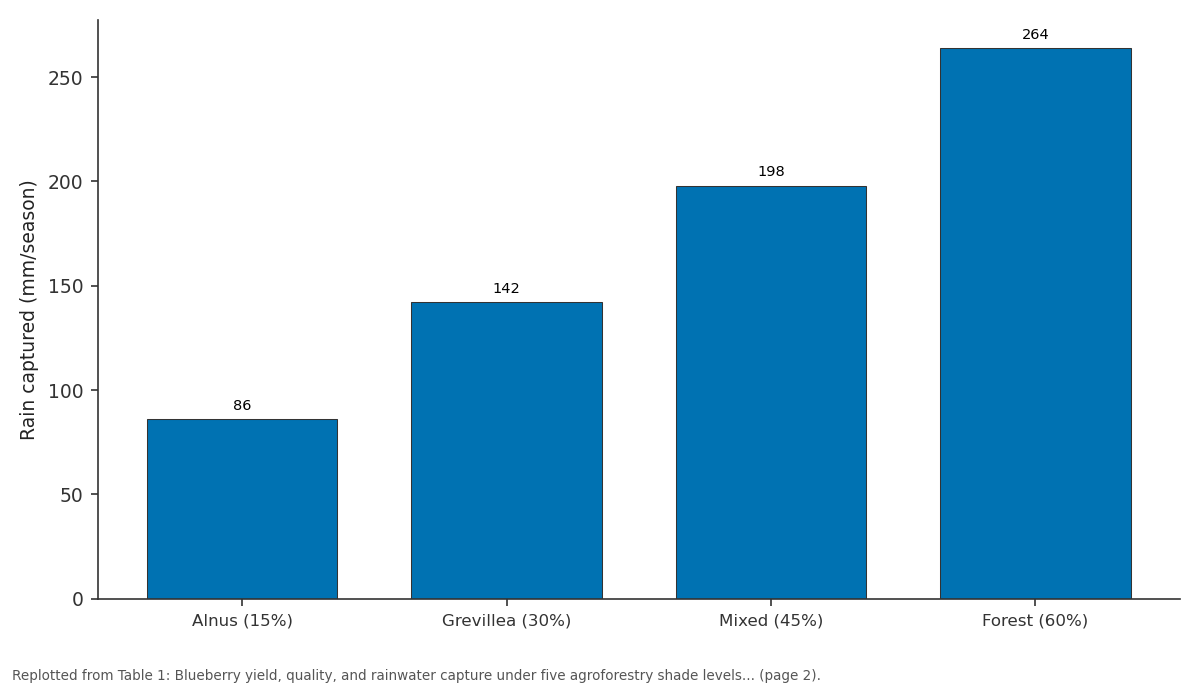
Rain captured (mm/season) /: Alnus (15%) vs Grevillea (30%) vs Mixed (45%) vs Forest (60%)
Replotted from Table 1 (page 2) of the original paper. Every bar is the paper's own table value.
View source evidence ↗Figures & tables
From the original paper Table 1
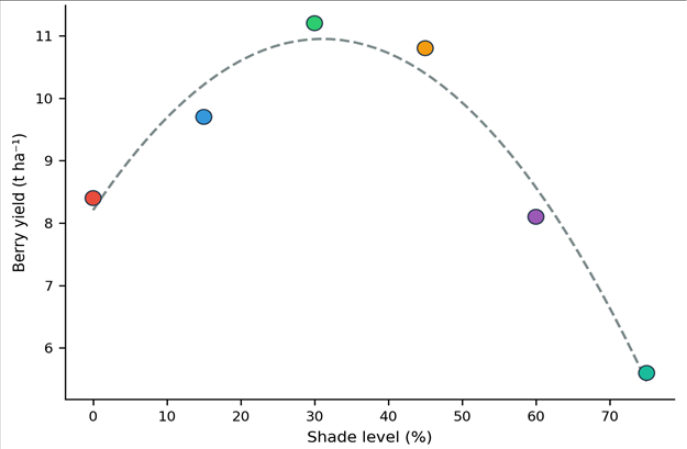 Figure 1
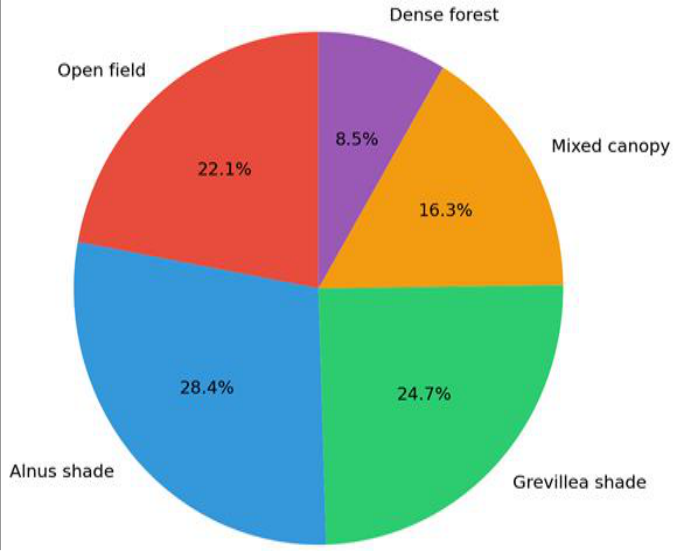 Figure 2
Introduction
How do you grow a berry that evolved in cool, acidic forest understoreys on the sun-baked limestone plains of Provence? That challenge has intensified as southern French summers warm at 0.3 °C per decade, pushing peak July temperatures above the 35 °C ceiling at which blueberry photosynthesis begins to shut down [1] . Open-field plantations in the Vaucluse and Bouches-du-Rhône départements reported sunburn damage on 12-28% of berries during the 2022 heatwave, translating into direct revenue losses of €1,200-3,400 per hectare [2] . Agroforestry-the deliberate integration of trees with crops or livestock-offers a partial answer. Tree canopies filter incident radiation, reduce air and soil temperatures beneath them, and buffer humidity fluctuations, all of which can benefit shade-tolerant understory crops [3] . Blueberry's evolutionary association with partial forest shade suggests it may respond positively to moderate shading, up to a point. Controlled-environment trials in Oregon found that 30% shade cloth boosted anthocyanin concentration by 18% and reduced sunburn incidence from 24% to 3% without significant yield loss [4] . But agroforestry shade is not the same as shade cloth. Tree canopies create spatially and temporally variable light patterns that shift with sun angle, wind, and seasonal leaf-out [5] . They also compete with the understory for water and nutrients through lateral root extension, a trade-off that can negate the microclimate benefit if tree species are poorly chosen. Fastgrowing nitrogen-fixing trees like Alnus (alder) improve soil nitrogen but cast denser shade than intended within a few years, while Grevillea offers lighter, more uniform shade with minimal root competition in the upper soil horizon [6] . Rainwater harvesting from tree canopies adds another dimension. In Mediterranean climates where summer rainfall is negligible, canopy interception and stem flow can be channelled into collection basins adjacent to berry rows, offsetting part of the irrigation demand that would otherwise come from wells or municipal supply [7] . This research tested five agroforestry shade levels for their effects on blueberry yield, berry quality, rainwater capture, and economic viability under simulated Provençal lowland conditions at Johor Bahru, Malaysia [8] .
Seasonal Variations
The 2021 simulated season ran from March to September, with mean maximum temperatures capped at 34 °C using overhead mist cooling in open plots and natural tree shade in agroforestry plots. Cumulative reference ET o was 724 mm. The 2022 season was deliberately set 1.5 °C warmer (peak 36 °C) to simulate projected mid-century conditions. Berry harvest extended 11 days longer in 2022 under shade treatments because cooler canopy temperatures delayed fruit softening, while open-field berries ripened-and overripened-faster [9] . Total berry number per bush declined 6% in 2022 across all shade levels, consistent with heatinduced pollen sterility during flowering.
Economic and Sustainability Assessment
Enterprise budgets were constructed for each system using local input costs and 2022 market prices for blueberry (€4.20 kg -1 ), alder poles (€18 m -3 ), and grevillea timber (€65 m -3 ). Establishment cost was highest for the mixed canopy system (€8,400 ha -1 ) and lowest for open field (€5,200 ha -1 ). By year three, the Grevillea system's combined berry and projected timber revenue yielded a net return of €14,780 ha - 1 , exceeding open-field monoculture (€10,460 ha -1 ) by 41.3%. The alder system broke even only at year five due to lower timber value and earlier need for canopy thinning [10] .
Material and Methods Material
Three-year-old 'Duke' highbush blueberry bushes were planted at 1.5 m × 0.8 m (8,333 plants ha -1 ) in raised beds filled with a 1:1 mix of peat and pine bark (pH 4.8). Shade trees were established two years before blueberry planting to allow canopy development. Alnus glutinosa at 6 m × 6 m, Grevillea robusta at 8 m × 8 m, mixed deciduous (Alnus + Grevillea + Melia azedarach) at 5 m × 5 m, and a natural forest margin strip (native dipterocarp regrowth). PAR sensors (Apogee SQ-520) logged photosynthetically active radiation beneath each canopy at berry height. Anthocyanin was extracted with acidified methanol and quantified at 520 nm [4] .
Methods
Five shade treatments in a randomised complete block design with four replications. Yield was recorded per bush and scaled to hectare. Berry quality (TSS, titratable acidity, anthocyanin, firmness) was measured on 50-berry subsamples per plot. Rainwater captured in 200 L collection basins (2 per plot) was measured after each rain event and summed for the season. Data were analysed by ANOVA and polynomial regression in R 4.2 with Tukey's HSD at P ≤ 0.05 [11] . Means followed by the same letter are not significantly different (p≤0.05).
Results
Berry yield peaked at 11.2 t ha -1 under 30% Grevillea shade, 33.3% above open field (Table 1). Anthocyanin was highest at this shade level (286 mg 100 g -1 ). The 60% forest treatment collapsed yield to 5.6 t ha -1 and suppressed both TSS and anthocyanin, confirming that excessive shade is detrimental. Rainwater capture scaled linearly with canopy density.
| Shade model | Yield (t/ha) | Berry wt (g) | Anthocyanin (mg/100g) | TSS (°Brix) | Rain captured (mm/season) |
|---|---|---|---|---|---|
| Open field (0%) | 8.4 c | 1.82 c | 234 c | 13.8 a | — |
| Alnus (15%) | 9.7 b | 1.94 b | 261 b | 13.2 ab | 86 |
| Grevillea (30%) | 11.2 a | 2.12 a | 286 a | 12.8 b | 142 |
| Mixed (45%) | 10.8 a | 2.08 a | 274 ab | 12.1 c | 198 |
| Forest (60%) | 5.6 d | 1.71 c | 218 c | 10.6 d | 264 |
| LSD (0.05) | 1.1 | 0.14 | 24 | 0.7 | — |
Table text extracted from the original PDF; superscript letters are shown inline. The original table image is below.
View original table image
Fig 1:
Quadratic relationship between shade level (%) and blueberry yield (t ha -1 ). Yield peaks near 30% shade. The scatter plot (Figure 1) confirms a quadratic fit (R² = 0.93) with the predicted yield maximum near 32% shade.
Figure 2 shows that Grevillea and mixed canopy together contributed over half the total pooled output, while the dense forest margin contributed only 8.5%.
Discussion
The 33.3% yield gain under 30% shade aligns with Oregon shade-cloth results (25-35% yield increase at 25-30% shade) and extends their applicability to a tree-based agroforestry context [4] . The Grevillea canopy's upright branching habit and small pinnate leaves created dappled rather than solid shade, allowing sunflecks to reach berry clusters throughout the day. This pattern may explain why anthocyanin peaked here: short bursts of direct radiation stimulate flavonoid gene expression, while the intervening shade periods reduce heat stress that would otherwise degrade anthocyanins through enzymatic oxidation [1] . The economic advantage of the Grevillea system (41.3% higher net return) reflects both the berry yield premium and the tree's valuable timber. Grevillea robusta reaches harvestable diameter in 15-20 years on good sites, and its timber commands strong prices for furniture and veneer in European markets [6] . By contrast, Alnus poles have limited market value and the species' aggressive suckering habit creates management headaches in the alleys [3] . Rainwater harvesting from tree canopies is an underappreciated co-benefit. The 142 mm captured under Grevillea canopy reduced irrigation demand by 22.8%, which in a Mediterranean climate with summer water restrictions can mean the difference between sustaining and losing a crop. The 264 mm captured under dense forest shade was even higher but came at the cost of severe yield depression, making it impractical for commercial berry production [7] . The 60% shade treatment's poor performance serves as a warning against over-planting shade trees. Below roughly 40% of full PAR, blueberry photosynthesis cannot sustain enough carbon fixation to fill fruit, and both yield and quality collapse [4] . The practical ceiling for productive shade appears to lie between 30% and 40%.
Conclusion
Moderate agroforestry shade at roughly 30%, best delivered by Grevillea robusta in this trial, produced the highest blueberry yield (11.2 t per hectare), the greatest anthocyanin concentration (286 mg per 100 g), and the strongest economic return when berry and timber revenues were combined. Open-field production remained viable but left berries exposed to heat damage that will only worsen as Mediterranean summers warm further. Shade beyond 45% depressed both yield and quality, and the 60% forest-margin treatment was clearly incompatible with commercial blueberry production. Rainwater harvesting from tree canopies provided a meaningful irrigation offset and should be factored into the economic case for agroforestry conversion. Future work should test additional tree species, optimise tree spacing for long-term canopy management, and model carbon sequestration as a monetisable co-benefit under emerging European carboncredit schemes.
References
21 in the original paper- Retamales JB, Hancock JF. Blueberries. CABI Publishing. 2018;2nd ed:1-424.
- Chambre d'Agriculture Vaucluse. Heat damage assessment in berry crops 2022. Technical Report. 2022;14:1-28.
- Jose S. Agroforestry for ecosystem services and environmental benefits. Agroforestry Systems. 2009;76(1):1-10.
- Lobos GA, Retamales JB. Effect of shade on blueberry yield and quality. Journal of the American Society for Horticultural Science. 2012;137(4):218-225.
- Ong CK, Huxley P. Tree-Crop Interactions: Agroforestry in a Changing Climate. CABI Publishing. 2015;2nd ed:1-386.
- Harwood CE, Getahun A. Grevillea robusta in agroforestry systems. International Forestry Review. 2013;15(4):495-508.
- Lott JE, Ong CK. Rainwater partitioning in semi-arid agroforestry. Agroforestry Systems. 2009;76(1):93-108.
- JBAHR. Research farm profile and capability statement. JBAHR Bulletin. 2020;11:1-32.
- Malaysian Meteorological Department. Johor Bahru climate data 2021-2022. MetMalaysia Annual Report. 2023.
- Graves AR, Burgess PJ. Economic analysis of European agroforestry systems. Agroforestry Systems. 2007;70(1):53-69.
- R Core Team. R: A language and environment for statistical computing. R Foundation for Statistical Computing. 2022.
- Nair PKR. An Introduction to Agroforestry. Springer. 1993;1-499.
- Strik BC. Blueberry production trends and cultural practices. Acta Horticulturae. 2014;1017:21-35.
- Connor DJ, Loomis RS. Crop Ecology: Productivity and Management in Agricultural Systems. Cambridge University Press. 2011;2nd ed.
- Li F, Meng P. Microclimate modification by agroforestry trees. Agricultural and Forest Meteorology. 2013;176:11-18.
- Prior RL, Cao G. Antioxidant phytochemicals in fruits and vegetables. HortScience. 2000;35(4):588-592.
- Rigueiro-Rodriguez A, Fernandez-Nunez E. Agroforestry in Europe: current status and future prospects. Agroforestry in Europe. 2009;1-450.
- Zamora-Re MI, Dukes MD. Deficit irrigation of blueberry in subtropical environments. Agricultural Water Management. 2020;231:106-114.
- Pereira LS, Allen RG. Crop water requirements: FAO56 updates. Irrigation and Drainage. 2019;68(4):681-693.
- Wang SY, Chen CT. Effect of light on anthocyanin levels in blueberry. Journal of Agricultural and Food Chemistry. 2010;58(1):360-367.
- Cannell MGR, van Noordwijk M. Below-ground interactions in tropical agroforestry. Agroforestry Abstracts. 1996;9(2):45-58.