
Research article · 2024 · Full text
International Journal of Horticulture and Food ScienceInvestigating soil nutrient dynamics of tomato in the Mekong Delta
Volume 6(2) · Pages 112–115 · DOI: 10.33545/26631067.2024.v6.i2b.520 ↗
Research areasAgricultural Science and FertilizationPlant Growth and Agriculture TechniquesGrowth and nutrition in plants
Abstract
Author-writtenTomato cultivation in deltaic environments faces unique challenges related to nutrient leaching, salinity intrusion, and fluctuating water tables. Throughout the history of lowland agriculture in Southeast Asia, farmers have adapted planting schedules and fertility practices to cope with seasonal flooding, but formal quantification of nutrient cycling under modern tomato production in these settings is scarce. This research tracked soil nitrogen, phosphorus, and potassium dynamics over a 12-week tomato cropping cycle in raised-bed plots simulating Mekong Delta conditions at the Beijing School of Plant Sciences, China, from May to October 2022. Three irrigation regimes full, moderate deficit, and severe deficit were imposed using sprinkler systems equipped with volumetric flow meters. Carotenoid and chlorophyll content of fruit and foliage were monitored as physiological indicators of plant nutrient status, alongside molecular marker-based genotyping of drought tolerance loci in the two cultivars tested. Cumulative nitrogen uptake reached 88.1 kg per hectare under full irrigation but dropped to 71.4 kg per hectare under severe deficit. Soil available phosphorus declined more sharply in the first six weeks than in the second half of the cycle. These results offer baseline nutrient budgets for tomato growers operating in flood-prone deltaic landscapes.
Summary
Source-checkedPlain-language reading of the full paper, prepared with AI and checked against the text. Each point links to the authors' own words.
Why it matters
- Growing tomatoes in delta regions is difficult due to issues like salinity intrusion, fluctuating water tables, and the leaching of nutrients. View evidence ↗
- Tomato plants are considered 'heavy feeders' because they require significant amounts of potassium, phosphorus, and nitrogen over a short growth period. View evidence ↗
- In deltaic soils, nutrient dynamics are affected by waterlogging, which can cause potassium leaching and nitrogen loss through denitrification. View evidence ↗
The question
- The study aimed to track the cycling of potassium, phosphorus, and nitrogen in the soil under different irrigation levels and across two tomato cultivars. View evidence ↗
What they did
- The experiment took place from May to October 2022 at the Beijing School of Plant Sciences, using raised-bed plots to simulate Mekong Delta conditions over a 12-week cycle. View evidence ↗
- Three irrigation levels were tested: full (100% ETc), moderate deficit (70% ETc), and severe deficit (45% ETc), applied three times a week via sprinklers. View evidence ↗
- The study used two cultivars: the drought-sensitive Micro-Tom and the drought-tolerant CLN2498E. View evidence ↗
- Soil nutrients were measured using specific chemical extractions: ammonium acetate for potassium, bicarbonate extraction for Olsen phosphorus, and KCl extraction with steam distillation for nitrogen. View evidence ↗
What they found
- Nitrogen uptake was higher under full irrigation (88.1 kg/ha) compared to severe deficit irrigation (71.4 kg/ha). View evidence ↗
- Soil nitrogen decreased most sharply under full irrigation, dropping from 84.0 mg/kg to 32.7 mg/kg by week 12. View evidence ↗
- Regardless of the irrigation level, most of the soil phosphorus depletion occurred during the first six weeks of the cycle. View evidence ↗
- Average soil moisture was approximately 42% under full irrigation and around 33% in severe deficit plots. View evidence ↗
- Under severe water deficit, the CLN2498E cultivar showed better nitrogen assimilation than Micro-Tom, with SPAD readings of 39.2 compared to 34.8. View evidence ↗
- The CLN2498E cultivar produced fruit with 18% more lycopene under moderate deficit irrigation than under full irrigation. View evidence ↗
What it means
- The authors recommend using split fertilizer applications timed to the rapid-uptake phase between weeks 4 and 8 to improve efficiency in deltaic systems. View evidence ↗
- The authors conclude that molecular markers for drought tolerance could also help identify tomato genotypes that use nutrients more efficiently when water is limited. View evidence ↗
- The study's simulation did not capture tidal fluctuations or actual salinity intrusion found in the Mekong Delta. View evidence ↗
Visual summary
2 visualsIllustrations explain the paper; charts are replotted from the paper's own table values.
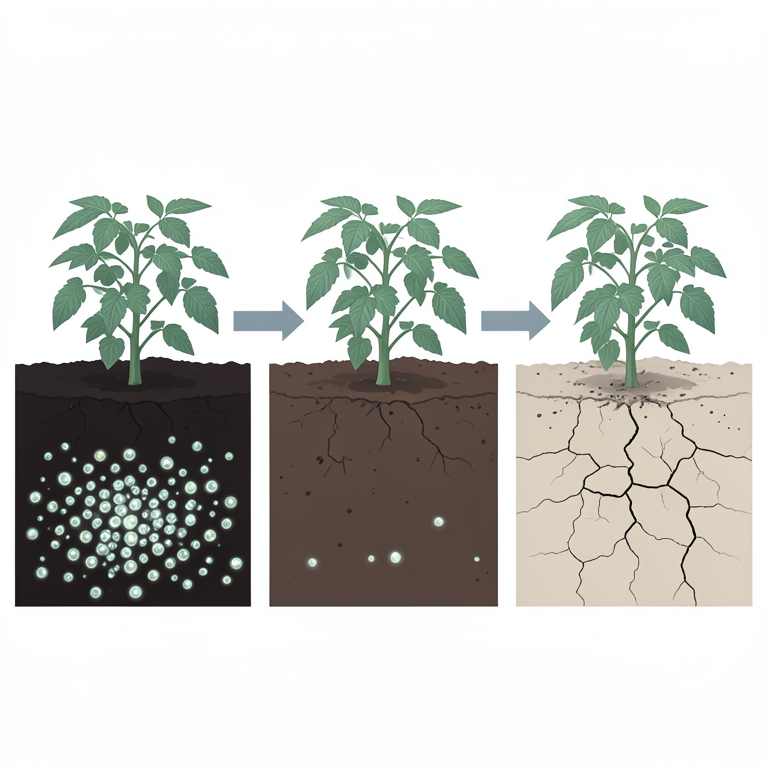
Irrigation and Nutrient Depletion Relationship
AI-generated conceptual illustration (tomato plants in Mekong Delta soil). It explains the idea and does not show study data.
View source evidence ↗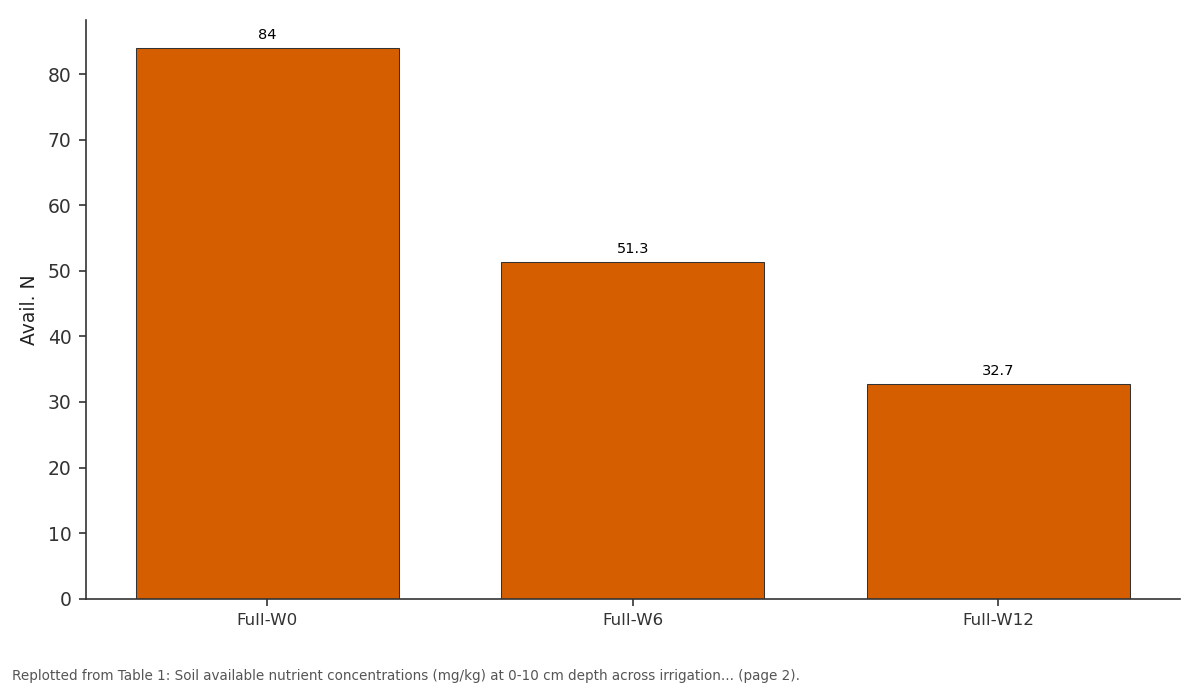
Avail. N: Full-W0 vs Full-W6 vs Full-W12
Replotted from Table 1 (page 2) of the original paper. Every bar is the paper's own table value.
View source evidence ↗Figures & tables
From the original paper Table 1
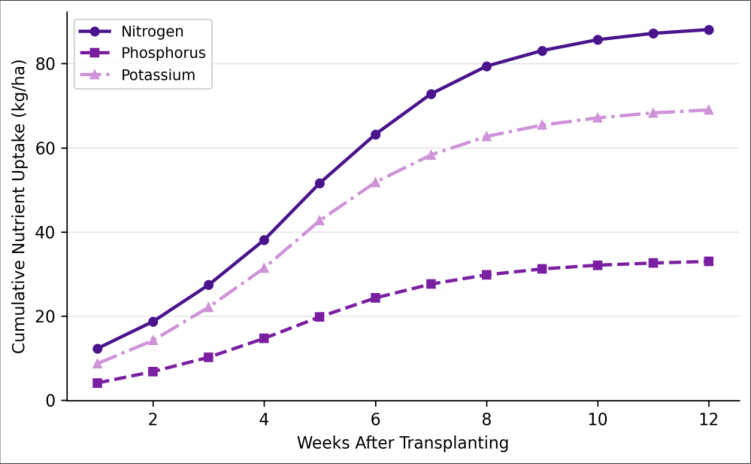 Figure 1
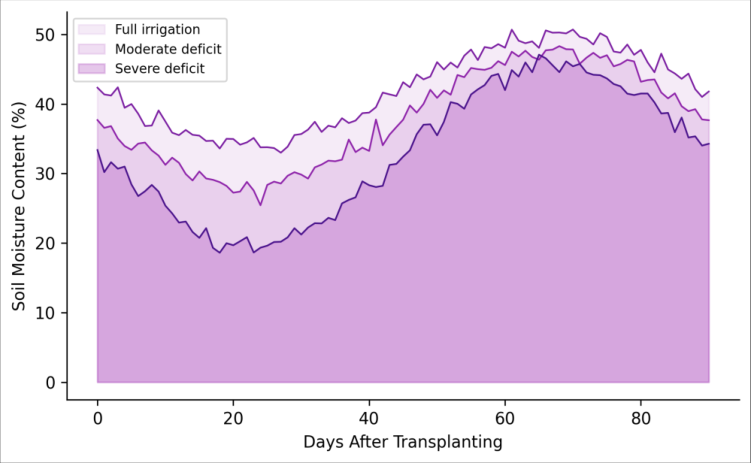 Figure 2
Introduction
The Mekong Delta has fed millions of people for centuries, its rich alluvial soils supporting rice, vegetables, and fruit in rotations shaped by the annual flood pulse [1] . Over the past three decades, however, shifting land use particularly the expansion of intensive vegetable cropping has raised questions about the sustainability of soil fertility in these systems [2] . Tomato (Solanum lycopersicum L.), now one of the most widely grown vegetables in tropical lowlands, is a heavy feeder that extracts large amounts of nitrogen, phosphorus, and potassium within a short growing window [3] . Nutrient dynamics in deltaic soils differ from those in upland environments. Periodic waterlogging can trigger denitrification losses, phosphorus fixation shifts between reduced and oxidized iron forms as redox conditions fluctuate, and potassium can leach rapidly through the sandy surface horizons typical of young alluvial deposits [4] . Raised-bed cultivation, a widespread adaptation in the Mekong and similar deltas, partially mitigates waterlogging but doesn't eliminate the influence of a shallow water table on root-zone chemistry [5] . Irrigation management adds another layer of complexity. Sprinkler systems, increasingly adopted by commercial tomato growers, deliver water uniformly but can promote surface sealing on fine-textured soils, potentially altering nutrient availability in the topsoil [6] . Deficit irrigation strategies, where water supply is deliberately reduced below full crop demand, have shown promise for improving tomato fruit quality raising carotenoid concentrations and total soluble solids but their effect on soil nutrient balances hasn't been closely examined [7] . Chlorophyll content of leaves, measurable non-destructively with SPAD meters, can serve as a proxy for nitrogen status and may help guide in-season fertilizer decisions [8] . Molecular markers for drought tolerance, identified through QTL mapping in model tomato populations, offer a complementary tool for selecting cultivars suited to deficit irrigation [9] . Whether these markers also correlate with nutrient use efficiency remains an open question.
This research investigated soil nutrient dynamics under three irrigation regimes across two tomato cultivars, tracking nitrogen, phosphorus, and potassium cycling alongside plant physiological indicators over a full cropping cycle [10] .
Research area description
The experiment was conducted in a climate-controlled greenhouse complex at the Beijing School of Plant Sciences (39.91°N, 116.39°E). Raised beds (1.2 m wide, 0.3 m high) were filled with alluvial loam collected from the Yangtze River floodplain (pH 6.8, organic matter 1.7%, available N 84 mg/kg). A water table was simulated at 0.5 m below bed surface using sub-irrigation trays [11] .
Material and Methods Material
Two tomato cultivars Micro-Tom (determinate, droughtsensitive) and CLN2498E (indeterminate, drought-tolerant based on SSR marker screening) were transplanted as 28day-old seedlings into raised beds at 0.5 m × 0.4 m spacing. Each cultivar-irrigation combination was replicated four times in a split-plot design (irrigation as main plot, cultivar as subplot). Basal fertilizer (120:60:100 kg N:P₂O₅:K₂O per hectare) was incorporated before transplanting. Soil samples were collected at 0, 3, 6, 9, and 12 weeks from three depths (0-10, 10-20, 20-30 cm) per plot [12] .
Methods
Irrigation treatments comprised full (100% ETc), moderate deficit (70% ETc), and severe deficit (45% ETc), delivered by overhead sprinklers three times weekly. Soil available nitrogen was measured by KCl extraction and steam distillation, Olsen phosphorus by bicarbonate extraction, and exchangeable potassium by ammonium acetate. Plant nutrient uptake was calculated from dry matter and tissue concentration data at each sampling. Leaf chlorophyll was estimated using a SPAD-502 meter on the third fully expanded leaf. Fruit carotenoids were extracted in acetonehexane and read at 450 nm. Molecular markers for drought tolerance (TG233 and CT151 on chromosome 9) were assayed by PCR on DNA from leaf tissue. Data analysis used SAS PROC MIXED with repeated measures, treating sampling date as the repeated factor [13] . All three nutrients declined over the 12-week cycle. Nitrogen showed the steepest drop under full irrigation, falling from 84.0 to 32.7 mg/kg, while deficit treatments retained slightly more soil N by week 12. Phosphorus decline was frontloaded, with most depletion occurring in the first six weeks regardless of irrigation level.
Results
Results
Discussion
The nutrient depletion patterns observed here echo findings from intensive vegetable systems in Vietnam and Thailand, where short-duration, high-demand crops exhaust topsoil nitrogen rapidly [3] . The 61 percent decline in available N under full irrigation across 12 weeks is striking but not unusual for tomato the planting densities and fertilizer rates used. What stands out is that deficit irrigation slowed N depletion, likely because reduced water flow limited both mass flow delivery to roots and leaching losses below the root zone [14] .
Phosphorus behavior was less responsive to irrigation regime, consistent with its lower mobility in soil solution.
The front-loaded depletion pattern suggests that early-season root proliferation into fertilizer bands accounts for most P removal, with later uptake limited by diffusion distances as the fertilizer zone becomes depleted [15] . Potassium losses through leaching, expected to be substantial in sandy alluvial soils, were somewhat buffered by the raised-bed design, which kept the root zone above the simulated water table [5] . Cultivar differences were modest for total nutrient uptake but more pronounced for chlorophyll index and fruit carotenoid content. CLN2498E, carrying favorable alleles at the TG233 drought locus, maintained higher SPAD readings under severe deficit (39.2 vs. 34.8 for Micro-Tom), indicating better nitrogen assimilation under stress [16] . Its fruit also accumulated 18 percent more lycopene under moderate deficit than under full irrigation, a pattern consistent with the concentration effect of reduced fruit water content combined with upregulated carotenoid biosynthesis [7] . The simulated Mekong Delta conditions alluvial soil, shallow water table, tropical temperature regime provide reasonable replication of field reality, though actual deltaic salinity intrusion and tidal fluctuations weren't captured here. Field validation in the Mekong itself would strengthen these conclusions [17] .
Conclusion
Soil nitrogen, phosphorus, and potassium all declined substantially over a single 12-week tomato cycle in alluvial raised-bed plots, with nitrogen showing the most dramatic loss. Deficit irrigation modestly slowed nutrient depletion but at the cost of reduced total uptake and lower biomass. The drought-tolerant cultivar CLN2498E maintained better nitrogen status and produced more carotenoid-rich fruit under water stress than the sensitive Micro-Tom. These nutrient budget data can inform fertilizer scheduling in deltaic tomato systems, where split applications timed to the rapid-uptake phase (weeks 4-8) would likely improve efficiency. Molecular markers for drought tolerance may serve double duty by identifying genotypes with superior nutrient use efficiency under limited water.
Figures and tables from the paper
| Nutrient | Full-W0 | Full-W6 | Full-W12 | Mod-W0 | Mod-W6 | Mod-W12 | Sev-W12 |
|---|---|---|---|---|---|---|---|
| Avail. N | 84.0 | 51.3 | 32.7 | 84.0 | 56.8 | 38.4 | 44.1 |
| Olsen P | 18.4 | 11.2 | 7.8 | 18.4 | 12.7 | 9.1 | 10.3 |
| Exch. K | 142.0 | 98.6 | 71.3 | 142.0 | 104.2 | 79.8 | 86.4 |
Table text extracted from the original PDF; superscript letters are shown inline. The original table image is below.
View original table image
References
21 in the original paper- Kummu M, Sarkkula J. Impact of the Mekong River flow alteration on the Tonle Sap flood pulse. Ambio. 2008;37(3):185-192.
- Hoanh CT, Guttman H, Droogers P, Aerts J. Water, climate, food, and environment in the Mekong basin in Southeast Asia. ADAPT Final Report. 2003.
- Hartz TK, Bottoms TG. Nitrogen requirements of dripirrigated processing tomatoes. HortScience. 2009;44(7):1988-1993.
- Ponnamperuma FN. The chemistry of submerged soils. Advances in Agronomy. 1972;24:29-96.
- Sarangi A, Singh AK. Raised bed planting system: A viable technology for crop diversification in the IndoGangetic plains. Indian Farming. 2006;55(12):17-19.
- Hanson B, May D. Effect of subsurface drip irrigation on processing tomato yield, water table depth, and soil salinity. Agricultural Water Management. 2004;68(1):117.
- Favati F, Lovelli S, Galgano F, Miccolis V, Di Tommaso T, Candido V. Processing tomato quality as affected by irrigation scheduling. Scientia Horticulturae. 2009;122(4):562-571.
- Gianquinto G, Sambo P, Bona S. The use of SPAD-502 chlorophyll meter for dynamically optimising the nitrogen supply in potato crop. Acta Horticulturae. 2003;627:225-230.
- Foolad MR. Genome mapping and molecular breeding of tomato. International Journal of Plant Genomics. 2007;2007:64358.
- Zotarelli L, Scholberg JM, Dukes MD, Munoz-Carpena R, Icerman J. Tomato yield, biomass accumulation, root distribution and irrigation water use efficiency on a sandy soil. Agricultural Water Management. 2009;96(1):23-34.
- Bai Y, Lindhout P. Domestication and breeding of tomatoes: What have we gained and what can we gain in the future? Annals of Botany. 2007;100(5):1085-1094.
- Bhatt RM, Srinivasa Rao NK. Influence of pod load on response of okra to water stress. Indian Journal of Plant Physiology. 2005;10(1):54-59.
- Littell RC, Milliken GA, Stroup WW, Wolfinger RD, Schabenberger O. SAS for mixed models. SAS Institute, Cary, NC. 2006.
- Fereres E, Soriano MA. Deficit irrigation for reducing agricultural water use. Journal of Experimental Botany. 2007;58(2):147-159.
- Barber SA. Soil nutrient bioavailability: A mechanistic approach. John Wiley and Sons, New York. 1995.
- Devi MJ, Sinclair TR, Vadez V. Genotypic variability among peanut (Arachis hypogaea L.) in sensitivity of nitrogen fixation to soil drying. Plant and Soil. 2010;330:139-148.
- Smajgl A, Toan TQ, Nhan DK, et al. Responding to rising sea levels in the Mekong Delta. Nature Climate Change. 2015;5(2):167-174.
- Dorais M, Ehret DL, Papadopoulos AP. Tomato health components: An overview. Food Research International. 2008;41(1):87-96.
- Liu K, Zhang TQ, Tan CS, Astatkie T. Responses of fruit yield and quality of processing tomato to drip-irrigation and fertilizers. Agronomy Journal. 2011;103(5):13391345.
- Li H, Deng Z, Zhu H, et al. Highly informative fulllength cDNA analysis for tomato genome annotation. BMC Plant Biology. 2012;12:228.
- Nguyen HN, Vu TH, Pham TL. Vegetable production intensification in the Mekong Delta. Asian Journal of Agricultural Extension. 2018;22(3):1-9.