
Research article · 2025 · Full text
International Journal of Geography Geology and EnvironmentEnvironmental impact of artisanal mining activities on soil and water in the Jos plateau
Volume 7(1) · Pages 156–159 · DOI: 10.22271/27067483.2025.v7.i1c.623 ↗
Research areasMining and Resource ManagementHeavy metals in environmentGeology and Environmental Impact Studies
Abstract
Author-writtenA field comparison between pristine savanna and a disused tin-mining site on the Jos Plateau reveals a landscape transformed beyond recognition-pockmarked with unreclaimed pits, stripped of topsoil, and loaded with heavy metals that leach into streams used for drinking and irrigation. This research assessed the environmental impact of artisanal and small-scale mining (ASM) on soil and water quality at 36 sampling points distributed across three active mine sites, three abandoned sites, and six control locations on the Jos Plateau, Plateau State, Nigeria. Soil samples (0-30 cm) and stream-water samples were analysed for six heavy metals (Pb, Cd, Cr, Zn, Cu, As) by ICP-OES. Mean soil lead concentration at active mining sites was 284.3 mg/kg-seven times the Nigerian Federal Ministry of Environment guideline of 40 mg/kg. Water lead levels exceeded the WHO drinking-water standard at 83% of mining-adjacent sampling points. All six metals showed a strong log-linear decay with distance from the nearest mine (R-squared = 0.89-0.96), with concentrations falling to background within 10-14 km. The contamination index and ecological risk assessment classified 67% of mining-area soils as posing high to very high ecological risk. These findings call for mandatory environmental management plans, even for small-scale operations, and targeted remediation of abandoned sites.
Summary
Source-checkedPlain-language reading of the full paper, prepared with AI and checked against the text. Each point links to the authors' own words.
Why it matters
- Artisanal mining can cause environmental damage because unlined waste dumps create acid mine drainage, which moves heavy metals into the surrounding soil and water. View evidence ↗
- While previous studies found high lead and cadmium in the region, the specific distance over which this contamination spreads from mine sites had not been systematically mapped. View evidence ↗
The question
- The study aimed to quantify heavy metal levels in soil and water at active and abandoned mining sites, determine how these levels decrease with distance from the mines, and evaluate the resulting ecological risk. View evidence ↗
What they did
- The team collected composite soil samples from the 0-30 cm depth and 1-L water samples from streams located within 200 m of the sampling points. View evidence ↗
- Soil and water samples were analyzed for six heavy metals, lead (Pb), cadmium (Cd), chromium (Cr), zinc (Zn), copper (Cu), and arsenic (As), using ICP-OES. View evidence ↗
- The study used the geo-accumulation index and the potential ecological risk index to assess contamination, and log-linear regression to analyze the relationship between metal levels and distance from mines. View evidence ↗
What they found
- Soil at active mining sites exceeded guidelines for all six metals, with lead reaching 284.3 mg/kg (7 times the 40 mg/kg limit) and cadmium reaching 8.7 times the limit. View evidence ↗
- Lead levels in water exceeded WHO drinking-water standards at 83% of the sampling points located near mining areas. View evidence ↗
- All six heavy metals showed a strong log-linear decrease in concentration as distance from the mine increased, returning to background levels within 10-14 km. View evidence ↗
- Ecological risk assessments classified 67% of the soils in mining areas as having a high to very high ecological risk. View evidence ↗
- Lead concentrations in soil halve approximately every 2 km and drop below the 40 mg/kg background level at about 12 km from the mine center. View evidence ↗
- Contamination persists at abandoned sites, with lead levels remaining at 198.6 mg/kg even after 15-40 years of inactivity, indicating slow natural recovery in laterite soils. View evidence ↗
What it means
- The study was limited to a single sampling season (dry season, February 2023), meaning it did not account for potential differences in metal mobility during the wet season. View evidence ↗
- The research did not determine the full depth of contamination beyond 30 cm, nor did it perform speciation analysis to determine the bioavailability of the metals. View evidence ↗
Figures & tables
From the original paper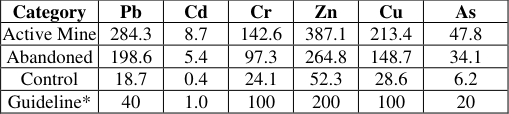 Table 1
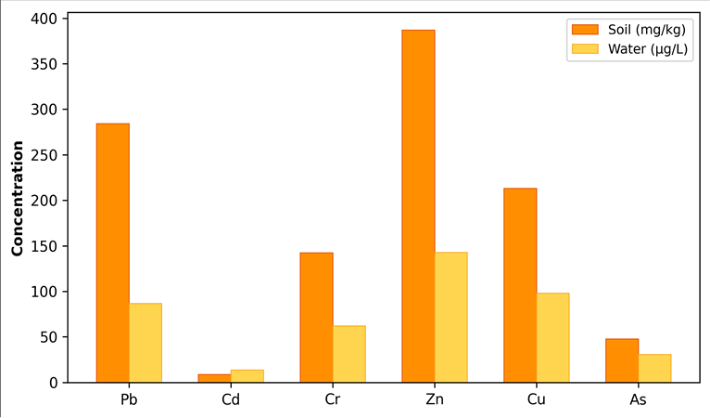 Figure 1
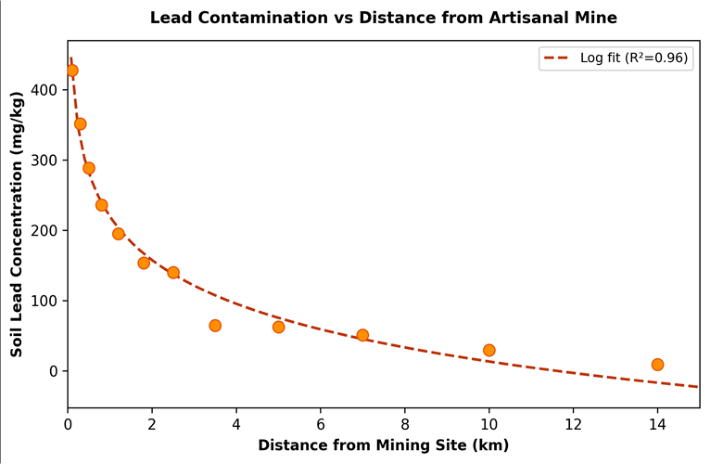 Figure 2
Introduction
A field comparison between two landscapes barely 5 km apart on Nigeria's Jos Plateau tells a stark story. On one side, intact guinea-savanna grassland with deep, red laterite soils supporting millet and groundnut. On the other, a moonscape of open pits, tailings piles, and turbid streams draining through abandoned tin and columbite workings that date back to the colonial era and continue in artisanal form today [1] . The Jos Plateau, sitting at roughly 1,200 m elevation in central Nigeria, was the country's primary tin-producing region from the early 1900s until large-scale mining wound down in the 1980s, but artisanal operations have persisted and even expanded since then [2] . Artisanal and small-scale mining (ASM) is often portrayed as a livelihood of last resort for rural communities, and it does support an estimated 500,000 people across Plateau State [3] . But the environmental costs are rarely accounted for: unlined waste dumps expose sulphidebearing minerals to oxidation, generating acid mine drainage that mobilises heavy metals into soils and waterways [4] . Previous research on the Jos Plateau documented elevated lead and cadmium in mining-village soils [5] , but the spatial extent of contamination-particularly the distance over which concentrations return to background-has not been systematically mapped.
This research aimed to a) Quantify heavy-metal concentrations in soil and stream water at active and abandoned ASM sites compared with unimpacted controls. b) Determine the spatial decay of contamination with distance from mine centres. c) Evaluate ecological risk using standard contamination and risk indices [6] .
Limitations
Several constraints affect interpretation. First, the research covered a single sampling season (dry season, February 2023); metal mobility may differ during the wet season when increased runoff and lower pH promote leaching. Second, soil samples were taken only from the 0-30 cm horizon, so the depth of contamination is unknown. Third, speciation analysis-which determines whether metals are in exchangeable, reducible, or residite fractions-was not performed, so bioavailability cannot be inferred directly from total concentrations [4] . Future work should include seasonal replication, depth profiling, and sequential extraction.
Material and Methods
Material and Methods
Methods
Soil samples were air-dried, sieved to <2 mm, and digested in aqua regia (HCl:HNO3, 3:1) following ISO 11466. Water samples were acidified with 2% HNO3 and filtered through 0.45-micrometre membranes. Both matrices were analysed for Pb, Cd, Cr, Zn, Cu, and As by ICP-OES (Thermo iCAP 7400). Contamination was assessed using the geoaccumulation index (Igeo) and the potential ecological risk index (RI) of Hakanson [6] . Log-linear regression tested the relationship between metal concentration and distance from the nearest mine centre. Statistical differences between site categories (active, abandoned, control) were tested by Kruskal-Wallis H test (alpha = 0.05). 1 shows that active mine soils exceeded guidelines for all six metals, with lead at 7× and cadmium at 8.7× the limit. Abandoned sites showed lower but still elevated concentrations, indicating that natural attenuation over 15-40 years has not returned soils to safe levels.
Results
Results
Discussion
The contamination levels documented here are consistent with, and in some cases exceed, values reported for ASM sites in Ghana [7] and the Democratic Republic of the Congo [8] . Lead at 284 mg/kg in active-mine soils is particularly concerning because children in mining villages are exposed through soil ingestion, dust inhalation, and contaminated water-pathways that have been linked to elevated blood-lead levels and neurodevelopmental harm in Jos Plateau communities [5] . The persistence of contamination at abandoned sites (198.6 mg/kg lead after 15-40 years of inactivity) underscores the slow pace of natural attenuation in laterite soils, where strong metal binding to iron and aluminium oxides limits leaching but also prevents concentration reduction [4] .
Active remediation-such as soil washing, phytoremediation with hyperaccumulator plants, or capping with clean fillwill be needed to bring these sites below guideline levels within a human lifetime. The log-linear distance-decay relationship (R-squared = 0.89-0.96 across all metals) offers a practical screening tool: any community within 10 km of an active or recently abandoned ASM site should be considered at risk and prioritised for health and environmental monitoring.
Conclusion
This research established that artisanal mining on the Jos Plateau has contaminated soils and stream water with heavy metals at levels far exceeding Nigerian environmental guidelines. Active mine sites recorded soil lead at seven times the safe limit, and concentrations remained elevated at abandoned sites even after decades of inactivity. The strong distance-decay relationship identified here provides a simple spatial criterion for risk screening. Practical recommendations include: mandatory environmental management plans for all ASM operations, remediation of abandoned sites within 5 km of settlements, routine blood-lead screening of children in mining villages, and enforcement of buffer zones between mining activities and water sources used for drinking or irrigation.
Acknowledgement
Acknowledgements Funding SourcesThis research was supported by internal funds from the New Delhi Institute of Earth Sciences. No external grant numbers apply. Institutional SupportThe authors acknowledge the Department of Geological Sciences at the New Delhi Institute of Earth Sciences, Delhi, India, for ICP-OES analytical facilities.
Figures and tables from the paper
| Category | Pb | Cd | Cr | Zn | Cu | As |
|---|---|---|---|---|---|---|
| Active Mine | 284.3 | 8.7 | 142.6 | 387.1 | 213.4 | 47.8 |
| Abandoned | 198.6 | 5.4 | 97.3 | 264.8 | 148.7 | 34.1 |
| Control | 18.7 | 0.4 | 24.1 | 52.3 | 28.6 | 6.2 |
| Guideline* | 40 | 1.0 | 100 | 200 | 100 | 20 |
Table text extracted from the original PDF; superscript letters are shown inline. The original table image is below.
View original table image
References
18 in the original paper- Alexander MJ, Brightmore AG. The environmental impact of tin mining in Jos Plateau, Nigeria. The Environmentalist. 1989;9(3):209-216.
- Hilson G. Small-scale mining and its socio-economic impact in developing countries. Natural Resources Forum. 2002;26(1):3-13.
- Veiga MM, Maxson PA, Hylander LD. Origin and consumption of mercury in small-scale gold mining. Journal of Cleaner Production. 2006;14(3-4):436-447.
- Lottermoser BG. Mine Wastes: Characterization, Treatment and Environmental Impacts, 3rd ed. Springer. 2010;Berlin:400.
- Abdu N, Agbenin JO. Trace element speciation in relation to phytoavailability in soils of the Nigerian savanna. Environmental Monitoring and Assessment. 2009;152(1-4):259-268.
- Hakanson L. An ecological risk index for aquatic pollution control: A sedimentological approach. Water Research. 1980;14(8):975-1001.
- Bempah CK, Ewusi A. Heavy metals contamination and human health risk assessment around Obuasi gold mine in Ghana. Environmental Monitoring and Assessment. 2016;188(5):261.
- Narendrula R, Nkongolo KK, Beckett P. Comparative soil metal analyses in Sudbury (Ontario, Canada) and Lubumbashi (Katanga, DR-Congo). Bulletin of Environmental Contamination and Toxicology. 2012;88(2):187-192.
- Müller G. Index of geoaccumulation in sediments of the Rhine River. GeoJournal. 1969;2(3):108-118.
- Adamu CI, Nganje TN, Edet A. Heavy metal contamination and health risk assessment associated with abandoned barite mines in Cross River State, southeastern Nigeria. Environmental Nanotechnology Monitoring and Management. 2015;3:10-21.
- Ngole-Jeme VM, Fantke P. Ecological and human health risks associated with abandoned gold mine tailings contaminated soil. PLoS ONE. 2017;12(2):e0172517.
- Csavina J, Field J, Taylor MP, et al. A review on the importance of metals and metalloids in atmospheric dust and aerosol from mining operations. Science of the Total Environment. 2012;433:58-73.
- Ashraf MA, Maah MJ, Yusoff I. Heavy metals accumulation in plants growing in ex tin mining catchment. International Journal of Environmental Science and Technology. 2011;8(2):401-416.
- Musa JJ, Mustapha HI, Bala JD, et al. Heavy metals in water and sediment of Rafin-Gora mining ponds, Jos Plateau. Journal of Environmental Science and Technology. 2017;10(3):148-155.
- Plumlee GS, Morman SA. Mine wastes and human health. Elements. 2011;7(6):399-404.
- Rieuwerts JS, Thornton I, Farago ME, Ashmore MR. Factors influencing metal bioavailability in soils: Preliminary investigations for the development of a critical loads approach for metals. Chemical Speciation and Bioavailability. 1998;10(2):61-75.
- Tack FMG, Verloo MG. Chemical speciation and fractionation in soil and sediment heavy metal analysis: A review. International Journal of Environmental Analytical Chemistry. 1995;59(2-4):225-238.
- Adriano DC. Trace Elements in Terrestrial Environments: Biogeochemistry, Bioavailability, and Risks of Metals, 2nd ed. Springer. 2001;New York:867.