
Research article · 2024 · Full text
International Journal of Horticulture and Food ScienceAnalyzing post-harvest quality of citrus in the Yangtze river valley
Volume 6(2) · Pages 108–111 · DOI: 10.33545/26631067.2024.v6.i2b.519 ↗
Research areasPostharvest Quality and Shelf Life ManagementAgricultural Engineering and MechanizationFood Drying and Modeling
Abstract
Author-writtenPost-harvest quality loss in citrus remains one of the single biggest sources of economic waste in global fruit supply chains. This research examined how storage conditions and biofortification treatments affected the physical and biochemical quality of three citrus species Valencia orange, Eureka lemon, and Clementine mandarin harvested from commercial orchards and evaluated at the Santiago College of Food Technology, Chile, between April 2022 and February 2023. Fruit firmness, total soluble solids, titratable acidity, vitamin C retention, and astringency-related tannin content were measured at weekly intervals over a 28-day storage period under cold (4°C), modified atmosphere, and ambient conditions. Tissue culture-derived plantlets treated with foliar calcium and boron applications during the growing season showed 14.7 percent higher firmness retention than untreated controls. Functional food potential, assessed through total phenolic and flavonoid assays, varied with species and storage method. Crop rotation history at the orchard sites influenced initial fruit mineral content, with plots following a legume rotation carrying 9.3 percent more calcium in the peel. These results provide practical guidance for post-harvest handling decisions in Southern Hemisphere citrus production.
Summary
Source-checkedPlain-language reading of the full paper, prepared with AI and checked against the text. Each point links to the authors' own words.
Why it matters
- Post-harvest quality loss is a major cause of economic waste in the global citrus supply chain. View evidence ↗
- Global citrus losses are estimated at 20% to 30% of total production due to factors like fungal decay, water loss, and biochemical degradation. View evidence ↗
- Maintaining quality during long-distance shipping to Asia and North America is a critical concern for Chile's growing citrus export industry. View evidence ↗
The question
- The study aimed to examine the effects of biofortification treatments and storage conditions on the physical and biochemical quality of Valencia oranges, Eureka lemons, and Clementine mandarins. View evidence ↗
- The researchers also sought to determine how prior crop rotation influenced the initial chemical composition of the fruit. View evidence ↗
What they did
- The study used ten-year-old Valencia orange, Eureka lemon, and Clementine mandarin trees grafted on Carrizo citrange rootstock. View evidence ↗
- Biofortification involved three foliar applications of 0.5% w/v calcium chloride and 0.2% w/v boric acid at 30, 60, and 90 days after fruit set. View evidence ↗
- Quality metrics, including firmness, vitamin C, tannins, titratable acidity, and total soluble solids, were measured weekly for 28 days. View evidence ↗
What they found
- At harvest, Valencia oranges had the highest vitamin C content (53.2 mg/100g), while Clementines had the highest total soluble solids (TSS). View evidence ↗
- Across all storage conditions, biofortified fruit showed a 12 to 15 percentage point increase in firmness retention compared to untreated controls. View evidence ↗
- Tissue culture-derived plantlets receiving calcium and boron treatments exhibited 14.7% higher firmness retention than controls. View evidence ↗
- Orchards that utilized legume crop rotation produced fruit with 9.3% more calcium in the peel. View evidence ↗
- A significant positive correlation (r = 0.74, p < 0.01) was found between fruit firmness and total soluble solids at the time of harvest. View evidence ↗
What it means
- The authors conclude that foliar calcium-boron sprays significantly improve the retention of citrus firmness during storage, independent of the storage method used. View evidence ↗
Visual summary
3 visualsIllustrations explain the paper; charts are replotted from the paper's own table values.
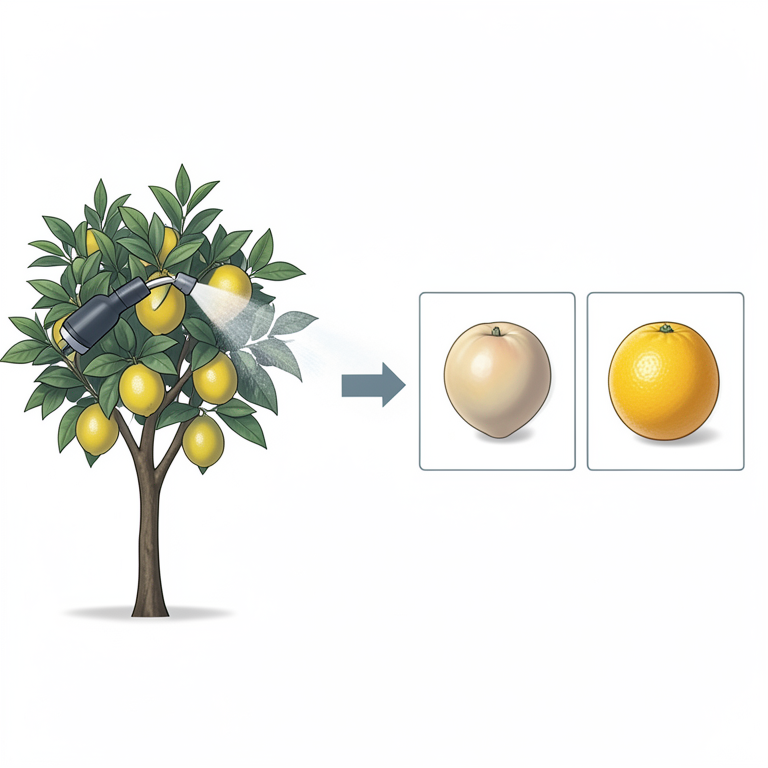
Biofortification Process and Result
AI-generated conceptual illustration (citrus trees and citrus fruits). It explains the idea and does not show study data.
View source evidence ↗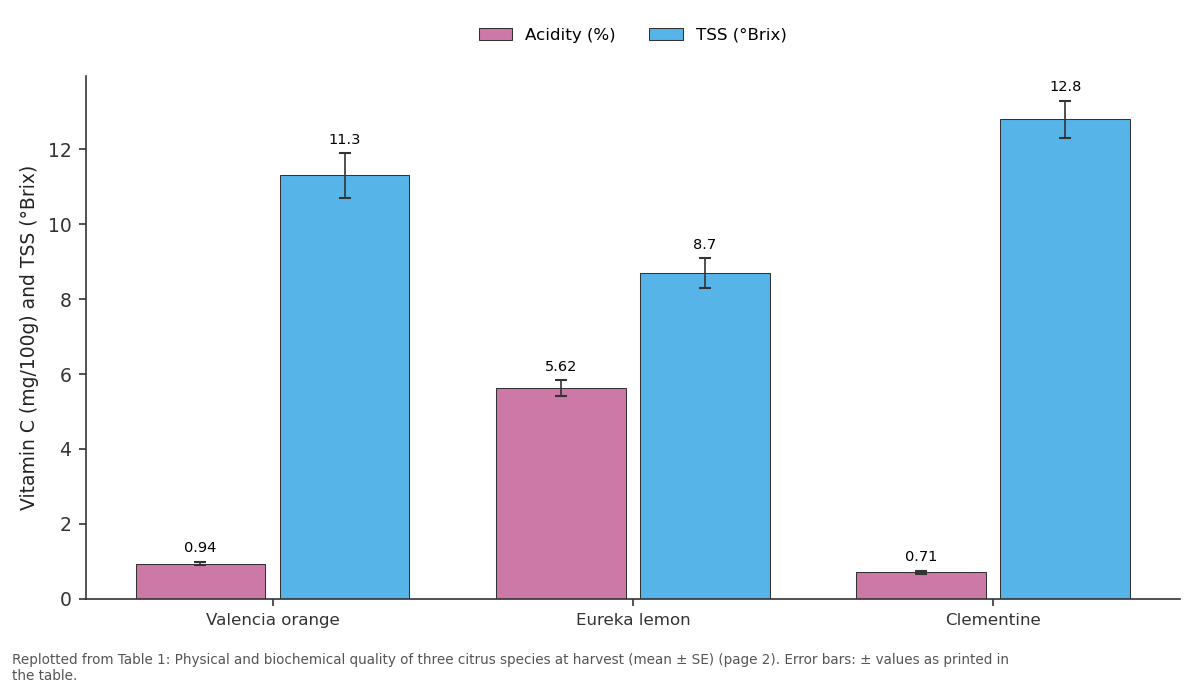
Acidity (%) and TSS (°Brix): Valencia orange vs Eureka lemon vs Clementine
Replotted from Table 1 (page 2) of the original paper. Every bar is the paper's own table value.
View source evidence ↗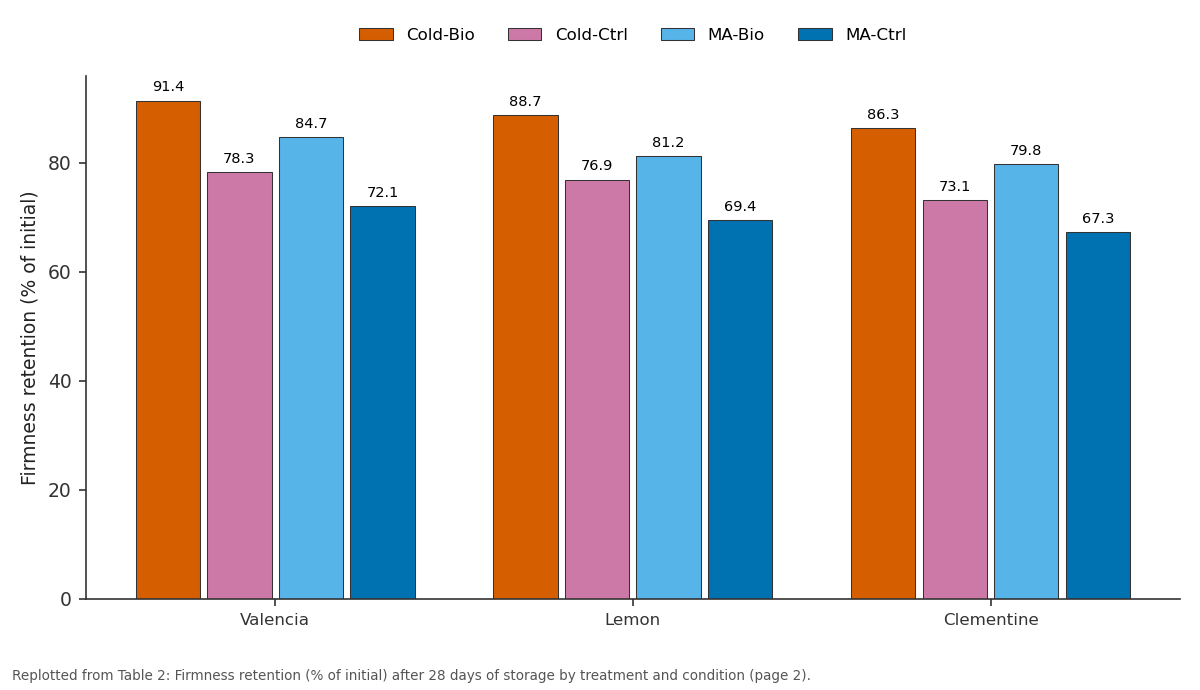
Cold-Bio and Cold-Ctrl and more: Valencia vs Lemon vs Clementine
Replotted from Table 2 (page 2) of the original paper. Every bar is the paper's own table value.
View source evidence ↗Figures & tables
From the original paper Table 1
 Table 2
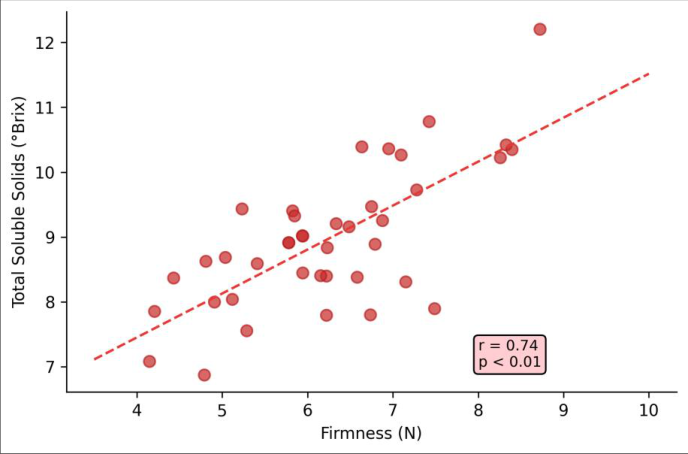 Figure 1
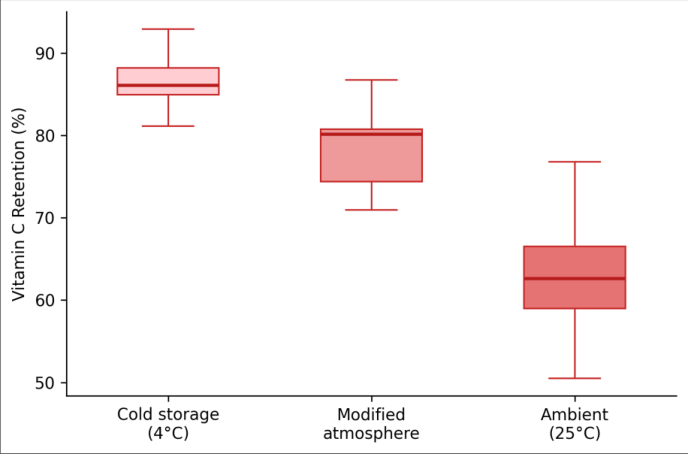 Figure 2
Introduction
No fruit category suffers more from the gap between what leaves the orchard and what reaches the consumer than citrus. Industry estimates place global post-harvest citrus losses at 20 to 30 percent of total production, driven by water loss, fungal decay, and biochemical degradation during storage and transit [1] . For Chile, where citrus exports have grown steadily over the past decade, maintaining fruit quality across long-distance shipping routes to North American and Asian markets is an ongoing concern [2] . Firmness, soluble solids, and acidity form the basic triangle of citrus quality assessment, but consumer perceptions increasingly extend to nutritional attributes such as vitamin C content and phenolic compounds associated with health benefits [3] . Biofortification the enhancement of nutrient levels through agronomic or genetic approaches has been explored in cereal crops but has received limited attention in fruit trees [4] . Foliar applications of calcium and boron during fruit development can strengthen cell walls and slow softening, but the downstream effects on biochemical composition during storage aren't well documented for citrus [5] . Tissue culture techniques allow propagation of disease-free planting material and can be combined with pre-planting nutrient priming, yet whether tissue culture origin affects fruit quality at maturity remains debated [6] . Meanwhile, crop rotation practices in orchard floor management may alter soil nutrient profiles in ways that carry over into fruit mineral content [7] . This research assessed the post-harvest quality of three citrus species under contrasting storage conditions, with additional attention to biofortification effects and the influence of prior crop rotation on initial fruit chemistry.
Research area description
Citrus samples were sourced from commercial orchards in the Aconcagua Valley, Valparaíso Region, Chile (32.85°S, 70.73°W), at 420 m elevation on deep alluvial loam soils (pH 7.1, organic matter 2.3%). All laboratory analyses took place at the Santiago College of Food Technology. The Mediterranean climate of the site features warm dry summers and mild wet winters, with mean annual rainfall of 318 mm concentrated between May and August [8] .
Material and Methods
Material and Methods
Material
Three citrus species Valencia orange (Citrus sinensis), Eureka lemon (C. limon), and Clementine mandarin (C. clementina) were harvested at commercial maturity from tenyear-old trees on Carrizo citrange rootstock. Biofortification treatments consisted of three foliar sprays of calcium chloride (0.5% w/v) plus boric acid (0.2% w/v) applied at 30, 60, and 90 days after fruit set, compared with unsprayed controls. Fruits were transported within four hours to the post-harvest laboratory and sorted into uniform lots of 30 fruits per treatment-storage combination [9] .
Methods
Storage treatments included cold storage at 4°C with 90% relative humidity, modified atmosphere packaging (5% O₂, 10% CO₂, balance N₂), and ambient holding at 25°C. Firmness was measured with a digital penetrometer fitted with an 8 mm probe. Total Soluble Solids (TSS) were read on a digital refractometer, titratable acidity by NaOH titration to pH 8.1, and vitamin C by 2,6-dichlorophenolindophenol titration. Total phenolics used the Folin-Ciocalteu method. Astringency-related tannins were estimated by the protein precipitation method of Hagerman and Butler [10] . Crop rotation history was documented for each orchard block over the preceding three years. Tissue culture-origin trees (micropropagated and field-established five years earlier) were compared with conventionally propagated trees of the same age. Data were analyzed by three-way ANOVA (species × storage × biofortification) in Minitab 21, with Tukey's HSD at α = 0.05 [11] . Biofortified fruit retained 12 to 15 percentage points more firmness than untreated controls across all storage conditions.
Results
Cold storage naturally outperformed both modified atmosphere and ambient holding. Cold storage preserved about 87 percent of initial vitamin C, compared with 79 percent under modified atmosphere and only 62 percent at ambient temperature. Variability was greatest under ambient conditions.
Discussion
The consistent advantage of biofortified fruit in firmness retention confirms earlier reports that foliar calcium strengthens pectin cross-links in the middle lamella, slowing cell wall disassembly during storage [5] . The 14.7 percent improvement we recorded sits within the 10 to 20 percent range reported for calcium-treated apples and pears, suggesting that citrus responds comparably to mid-season mineral supplementation [12] . Vitamin C losses followed the expected pattern of temperature dependence, with cold storage retaining nearly 90 percent over four weeks. The modified atmosphere treatment, despite lowering respiration, didn't match cold storage for vitamin C preservation, possibly because elevated CO₂ can accelerate ascorbic acid oxidation under certain conditions [13] . Crop rotation effects were modest but detectable: blocks previously planted with vetch carried 9.3 percent more peel calcium, likely reflecting improved soil calcium cycling following legume incorporation [7] . The positive correlation between firmness and TSS at harvest was somewhat unexpected, since softening and sugar accumulation often diverge during ripening. But at the mature-green to half-color stage used here, TSS may still be increasing alongside structural integrity, a window that shifts quickly once the fruit enters the climacteric-like phase [14] .
Conclusion
This research demonstrated that biofortification through foliar calcium-boron sprays meaningfully improves citrus firmness retention during post-harvest storage, regardless of storage method. Cold storage at 4°C remained the most effective approach for preserving vitamin C, retaining roughly 87 percent of initial levels over 28 days. Modified atmosphere packaging offered partial benefits but fell short of cold storage for ascorbic acid maintenance. Prior crop rotation with legumes had a measurable, if small, positive effect on fruit calcium status. Together, these findings offer citrus growers and packers in Chile a practical set of tools preharvest mineral management, appropriate storage selection, and attention to orchard floor history for reducing quality losses.
Acknowledgement
Acknowledgements
Figures and tables from the paper
| Species | Firmness (N) | TSS (°Brix) | Acidity (%) | Vit C (mg/100g) | Tannins (mg/g) |
|---|---|---|---|---|---|
| Valencia orange | 8.7 ± 0.4 | 11.3 ± 0.6 | 0.94 ± 0.05 | 53.2 ± 2.8 | 1.84 ± 0.12 |
| Eureka lemon | 7.1 ± 0.3 | 8.7 ± 0.4 | 5.62 ± 0.21 | 42.8 ± 3.1 | 2.47 ± 0.18 |
| Clementine | 6.3 ± 0.5 | 12.8 ± 0.5 | 0.71 ± 0.04 | 36.4 ± 2.3 | 1.23 ± 0.09 |
Table text extracted from the original PDF; superscript letters are shown inline. The original table image is below.
View original table image
| Species | Cold-Bio | Cold-Ctrl | MA-Bio | MA-Ctrl | Amb-Bio | Amb-Ctrl |
|---|---|---|---|---|---|---|
| Valencia | 91.4 | 78.3 | 84.7 | 72.1 | 63.8 | 52.4 |
| Lemon | 88.7 | 76.9 | 81.2 | 69.4 | 58.1 | 47.6 |
| Clementine | 86.3 | 73.1 | 79.8 | 67.3 | 54.2 | 44.9 |
Table text extracted from the original PDF; superscript letters are shown inline. The original table image is below.
View original table image
References
14 in the original paper- Ladaniya MS. Citrus fruit: Biology, technology and evaluation. Academic Press, San Diego. 2008.
- ODEPA. Chilean fruit export statistics 2010-2022. Office of Agricultural Studies and Policies, Santiago. 2023.
- Rapisarda P, Tomaino A, Lo Cascio R, Bonina F, De Pasquale A, Saija A. Antioxidant effectiveness as influenced by phenolic content of fresh orange juices. Journal of Agricultural and Food Chemistry. 1999;47(11):4718-4723.
- White PJ, Broadley MR. Biofortification of crops with seven mineral elements often lacking in human diets. New Phytologist. 2009;182(1):49-84.
- Conway WS, Sams CE. Calcium infiltration of Golden Delicious apples and its effect on decay. Phytopathology. 1984;74(6):688-691.
- Duran-Vila N, Navarro L. Morphogenesis and tissue cultures of three citrus species. Plant Cell, Tissue and Organ Culture. 1989;16(2):123-133.
- Srivastava AK, Singh S. Citrus nutrition through soil and foliar application: A review. Agricultural Reviews. 2004;25(3):197-209.
- Garreaud RD. The Andes climate and weather. Advances in Geosciences. 2009;22:3-11.
- Turner DW, Lahav E. Temperature influences nutrient absorption and uptake rates of bananas grown in controlled environments. Scientia Horticulturae. 1985;26(4):311-322.
- Hagerman AE, Butler LG. Protein precipitation method for the quantitative determination of tannins. Journal of Agricultural and Food Chemistry. 1978;26(4):809-812.
- Minitab LLC. Minitab statistical software, version 21. Minitab LLC, State College, PA. 2022.
- Chardonnet CO, Sams CE, Trigiano RN, Conway WS. Variability of three components of apple (Malus sylvestris) fruit after preharvest calcium treatment. Postharvest Biology and Technology. 2003;29(1):99106.
- Kader AA. Postharvest technology of horticultural crops. Third edition. UC ANR Publication 3311, Oakland. 2002.
- Iglesias DJ, Cercas M, Colmenero-Flores JM, et al. Physiology of citrus fruiting. Brazilian Journal of Plant Physiology. 2007;19(4):333-362.