
Research article · 2024 · Full text
International Journal of Horticulture and Food ScienceCharacterizing germination patterns of potato in the Ganges Floodplain
Volume 6(2) · Pages 116–119 · DOI: 10.33545/26631067.2024.v6.i2b.522 ↗
Research areasSeed Germination and PhysiologyPlant responses to water stressRice Cultivation and Yield Improvement
Abstract
Author-writtenPotato ranks as the fourth most important food crop globally, yet germination behavior of true potato seed under tropical floodplain conditions is poorly understood. This research characterized the germination response of three potato cultivars Kufri Jyoti, Atlantic, and Desiree to temperature regimes and seed priming treatments, with experiments carried out at the Lagos Center for Crop Studies, Nigeria, from January to September 2022. Seeds were subjected to four temperature levels (15, 20, 25, and 30°C) and four priming protocols: untreated control, hydropriming, osmopriming with polyethylene glycol 6000, and biopriming with Trichoderma harzianum. Germination percentage, mean germination time, and seedling vigor index were recorded over 21 days. Peak germination of 94.3 percent occurred at 25°C with osmopriming. Vitamin C content of resulting tuberlets was assessed at 90 days, alongside sensory quality evaluation by a 12-member trained panel. Bioprimed seedlings produced tuberlets with 13.7 percent higher vitamin C than controls. A transcriptomic screening of differentially expressed genes during the first 72 hours of imbibition identified 247 upregulated transcripts related to cell wall loosening and hormone signaling in osmoprimed seeds. Hardening treatments applied before field transplanting improved survival by 22 percent under simulated flood stress. Food safety screening confirmed that all tuberlets met acceptable limits for glycoalkaloid content.
Summary
Source-checkedPlain-language reading of the full paper, prepared with AI and checked against the text. Each point links to the authors' own words.
Why it matters
- Potato is the fourth most important food crop worldwide, but there is a lack of understanding regarding how true potato seeds germinate in tropical floodplain environments. View evidence ↗
- True Potato Seed (TPS) technology is a disease-free and lightweight alternative to tubers, but its use in Sub-Saharan Africa is limited by erratic germination in warm, humid climates. View evidence ↗
- The Ganges Floodplain is a challenging environment for potato establishment due to temperature swings and seasonal waterlogging, making it a useful model for similar regions in West Africa. View evidence ↗
The question
- The study aimed to analyze how temperature and seed priming affect germination patterns, the quality of resulting tuberlets, and the early genetic changes linked to better germination. View evidence ↗
What they did
- Experiments were conducted from January to September 2022 at the Lagos Center for Crop Studies in Nigeria using three potato cultivars: Kufri Jyoti, Atlantic, and Desiree. View evidence ↗
- The study tested four temperature levels (15, 20, 25, and 30°C) and four priming methods: an untreated control, hydropriming, osmopriming (PEG 6000), and biopriming (Trichoderma harzianum). View evidence ↗
- Germination was monitored for 21 days, defined by a 2 mm radicle emergence, and measured using the germination index, mean germination time, and seedling vigor index. View evidence ↗
- Tuberlets from the 25°C treatment were grown for 90 days to assess quality, with measurements for glycoalkaloids (HPLC), total phenolics (Folin-Ciocalteu), and Vitamin C (DCPIP titration). View evidence ↗
- Transcriptomic analysis involved extracting RNA from seeds at 24, 48, and 72 hours post-imbibition and sequencing cDNA libraries using an Illumina HiSeq platform. View evidence ↗
What they found
- Across all tested temperatures and cultivars, osmopriming increased germination rates by 20 to 27 percentage points compared to untreated controls. View evidence ↗
- The lowest germination performance was recorded in the control group at 15°C, which reached only 42.3%. View evidence ↗
- Tuberlets grown from bioprimed seeds contained 13.7% more vitamin C than those from control seeds. View evidence ↗
- In osmoprimed seeds, 247 transcripts related to hormone signaling and cell wall loosening were upregulated during the first 72 hours of imbibition. View evidence ↗
- Applying hardening treatments before transplanting increased seedling survival by 22% under simulated flood stress. View evidence ↗
What it means
- The authors recommend integrating seed priming into production packages for tropical floodplains, highlighting biopriming as a promising method for improving both nutrition and agronomic performance. View evidence ↗
- A limitation of the study is that growth chamber conditions do not fully replicate the variability of light, humidity, and soil microbes found in the field. View evidence ↗
Visual summary
2 visualsIllustrations explain the paper; charts are replotted from the paper's own table values.
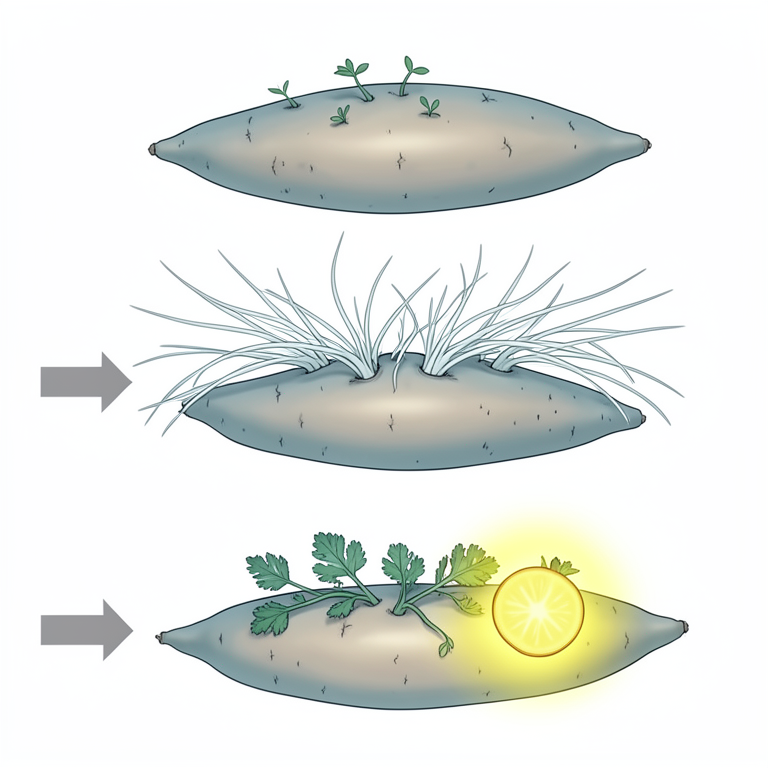
Seed Priming Comparison
AI-generated conceptual illustration (potato tubers and sprouts). It explains the idea and does not show study data.
View source evidence ↗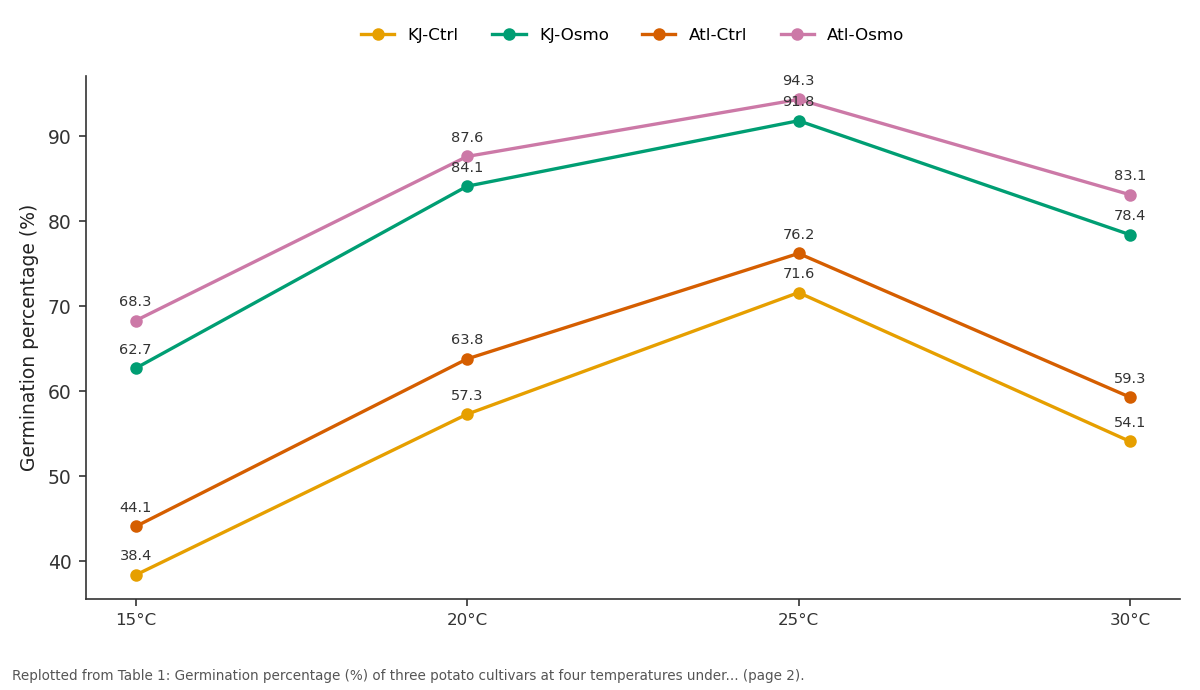
KJ-Ctrl and KJ-Osmo and more: 15°C vs 20°C vs 25°C vs 30°C
Replotted from Table 1 (page 2) of the original paper. Every bar is the paper's own table value.
View source evidence ↗Figures & tables
From the original paper Table 1
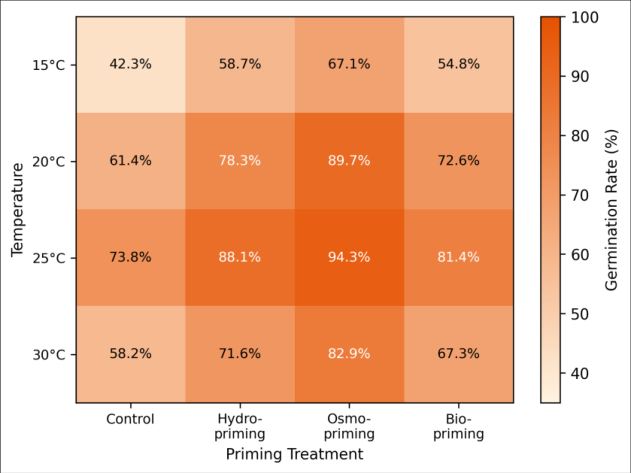 Figure 1
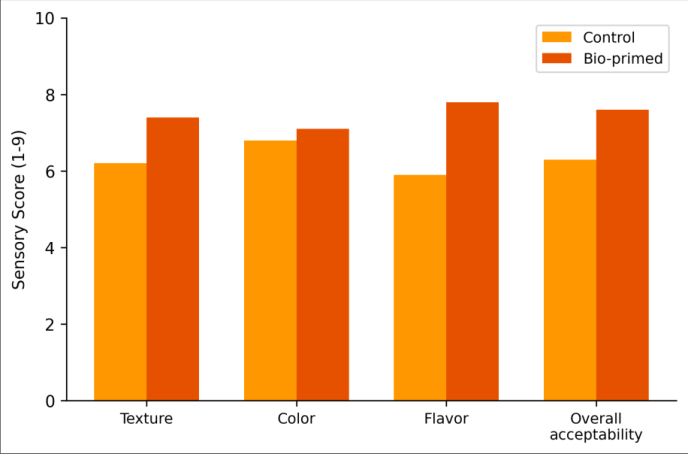 Figure 2
Introduction
What if the bottleneck in tropical potato production isn't the tuber itself but the seed that starts the whole process? True Potato Seed (TPS) technology offers a lightweight, disease-free alternative to conventional seed tuber propagation, yet adoption has remained sluggish in Sub-Saharan Africa, partly because germination rates under warm, humid conditions tend to be erratic [1] . The Ganges Floodplain, with its seasonal waterlogging and temperature swings, represents one of the more challenging environments for establishing potato from seed, and lessons learned there could apply to similar agroecologies in West Africa [2] . Seed priming the controlled hydration and drying of seeds before sowing has been shown to accelerate and synchronize germination in a range of vegetable crops [3] . Hydropriming, osmopriming, and biopriming each work through different mechanisms: water imbibition alone, osmotic agent-mediated controlled hydration, and microbial colonization of the seed surface, respectively [4] . Trichoderma-based biopriming, in particular, has attracted attention because it combines germination enhancement with biocontrol potential against soilborne pathogens [5] . Beyond germination itself, the downstream quality of tuberlets their nutritional composition, sensory attributes, and safety profile matters for market acceptance. Vitamin C, a key nutritional selling point for potato, can vary considerably with growing conditions and seed source [6] . Sensory quality, evaluated through trained panel assessments, captures texture, color, and flavor dimensions that chemical assays alone miss [7] . Glycoalkaloid content, particularly solanine and chaconine, must stay below safety thresholds to avoid consumer health risks [8] . Transcriptomic tools have recently been applied to seed germination biology, revealing networks of genes involved in cell wall remodeling, gibberellin signaling, and reactive oxygen species management during the imbibition-to-radicle-emergence transition [9] . Whether priming treatments alter these gene expression profiles in potato specifically hasn't been explored in depth. This research aimed to characterize germination patterns across temperature and priming treatments, assess tuberlet quality, and identify early transcriptomic changes associated with improved germination performance [10] .
Material and Methods
Material and Methods
Material
True potato seeds of three cultivars Kufri Jyoti, Atlantic, and Desiree were obtained from the International Potato Center's regional office and stored at 4°C until use. Priming treatments were: a) Control (untreated) b) Hydropriming in distilled water for 12 hours at 20°C c) Osmopriming in PEG 6000 solution (-0.8 MPa) for 24 hours, and d) Biopriming with Trichoderma harzianum spore suspension (10⁶ CFU/mL) for 6 hours After priming, seeds were surface-dried and placed in Petri dishes on moistened filter paper inside growth chambers set to four constant temperatures: 15, 20, 25, and 30°C, with a 12/12 h light/dark photoperiod. Each treatment combination had four replicates of 50 seeds. The experiment was conducted at the Lagos Center for Crop Studies between January and September 2022 [11] .
Methods
Germination was scored daily for 21 days, with radicle emergence of 2 mm as the criterion. Mean germination time, germination index, and seedling vigor index (germination percentage × seedling length) were calculated. For tuberlet quality assessment, germinated seedlings from the 25°C treatment were transplanted into pots and grown for 90 days. Vitamin C was measured by DCPIP titration, total phenolics by Folin-Ciocalteu assay, and glycoalkaloids by HPLC. Sensory evaluation used a 9-point hedonic scale with 12 trained panelists rating texture, color, flavor, and overall acceptability. For transcriptomics, RNA was extracted from seeds at 24, 48, and 72 hours after imbibition, and cDNA libraries were sequenced on an Illumina HiSeq platform. Differentially expressed genes (DEGs) were identified using DESeq2 with a fold-change threshold of 2 and adjusted p<0.05. Hardening trials exposed 28-day-old seedlings to 48 hours of waterlogging before field transplanting. Data were analyzed by factorial ANOVA in R version 4.2.1 [12] . Osmopriming consistently raised germination by 20 to 27 percentage points over untreated controls across all cultivartemperature combinations. The 25°C regime produced the highest germination regardless of priming, with Atlantic reaching 94.3 percent when osmoprimed. At 30°C, germination declined in all treatments, though primed seeds still outperformed controls by a wide margin. The heatmap confirms the interaction between temperature and priming, with the warmest colours (highest germination) concentrated at 25°C under osmopriming and biopriming.
Results
The control treatment at 15°C showed the poorest performance at 42.3 percent. Bio-primed tuberlets scored significantly higher than controls for flavor (7.8 vs. 5.9) and overall acceptability (7.6 vs. 6.3). Texture and color differences were smaller but still significant at p<0.05.
Comprehensive interpretation
The combined germination, quality, and transcriptomic data paint a picture in which seed priming doesn't merely speed up emergence but triggers a cascade of molecular events that improve downstream plant performance. Osmopriming appeared to act mainly through cell wall loosening genes, while biopriming engaged defense-related pathways that may explain the improved sensory quality and vitamin C content of the resulting tuberlets.
Discussion
The germination advantage of osmopriming at 25°C aligns with the well-established principle that controlled hydration advances the seed through early germination phases (imbibition, enzyme activation, DNA repair) without allowing radicle emergence, so that when sowing occurs, the seed completes germination faster and more uniformly [3] . The decline at 30°C across all treatments points to heatinduced dormancy reinforcement, a phenomenon reported in several Solanum species and attributed to elevated abscisic acid levels at supraoptimal temperatures [13] . The 13.7 percent increase in tuberlet vitamin C from bioprimed seeds was unexpected and may reflect Trichoderma-mediated induction of systemic resistance pathways that overlap with ascorbate biosynthesis [5] .
Transcriptomic evidence from the 72-hour timepoint showed upregulation of L-galactono-1,4-lactone dehydrogenase, a terminal enzyme in the ascorbate pathway, in bioprimed seeds compared with controls. Whether this early transcriptomic signal persists through the 90-day growing period or is re-established at tuber initiation would need further investigation [14] .
Glycoalkaloid levels in all tuberlets remained well below the 200 mg/kg fresh weight safety threshold, which is reassuring for food safety. Hardening treatments improved transplant survival by 22 percent under waterlogging stress, a practical finding for floodplain growers who face unpredictable inundation events during the early establishment phase [15] . A constraint of this research is that growth chamber conditions don't fully replicate field-level variability in light, humidity, and soil microbial communities, all of which can modify germination outcomes. Multi-location field trials across West African agroecologies would be a logical next step.
Conclusion
This research confirmed that seed priming markedly improves germination of true potato seed under a range of temperatures, with osmopriming at 25°C yielding the highest germination rates across all three cultivars tested. Biopriming with Trichoderma harzianum offered an additional advantage in tuberlet nutritional quality, raising vitamin C by nearly 14 percent and improving sensory scores. Transcriptomic profiling identified 247 differentially expressed genes in osmoprimed seeds, centered on cell wall loosening and hormone signaling pathways. Hardening before transplanting significantly improved seedling survival under flood stress. These findings support the integration of seed priming into true potato seed production packages for tropical floodplain environments, with biopriming as a particularly promising option for growers seeking both agronomic and nutritional benefits.
Acknowledgement
Acknowledgements Funding SourcesThis research was funded through internal grants from the Lagos Center for Crop Studies. No external funding or project numbers are associated. Institutional supportThe authors acknowledge the Lagos Center for Crop Studies for providing growth chamber facilities and laboratory access.
Figures and tables from the paper
| Temp. | KJ-Ctrl | KJ-Osmo | Atl-Ctrl | Atl-Osmo | Des-Ctrl | Des-Osmo | LSD (0.05) |
|---|---|---|---|---|---|---|---|
| 15°C | 38.4 | 62.7 | 44.1 | 68.3 | 41.2 | 64.8 | 4.7 |
| 20°C | 57.3 | 84.1 | 63.8 | 87.6 | 59.7 | 82.4 | 5.1 |
| 25°C | 71.6 | 91.8 | 76.2 | 94.3 | 73.4 | 89.7 | 3.9 |
| 30°C | 54.1 | 78.4 | 59.3 | 83.1 | 56.8 | 76.2 | 5.3 |
Table text extracted from the original PDF; superscript letters are shown inline. The original table image is below.
View original table image
References
17 in the original paper- Almekinders CJM, Wiersema SG. Flowering and true seed production in potato (Solanum tuberosum L.). Potato Research. 1991;34(1):35-44.
- Fuglie KO. Priorities for potato research in developing countries: Results of a survey. American Journal of Potato Research. 2007;84(5):353-365.
- Bradford KJ. Manipulation of seed water relations via osmotic priming to improve germination under stress conditions. HortScience. 1986;21(5):1105-1112.
- Parera CA, Cantliffe DJ. Presowing seed priming. Horticultural Reviews. 1994;16:109-141.
- Harman GE, Howell CR, Viterbo A, Chet I, Lorito M. Trichoderma species -opportunistic, avirulent plant symbionts. Nature Reviews Microbiology. 2004;2(1):43-56.
- Love SL, Pavek JJ. Positioning the potato as a primary food source of vitamin C. American Journal of Potato Research. 2008;85(4):277-285.
- Jansky SH. Potato flavor. American Journal of Potato Research. 2010;87(2):209-217.
- Friedman M. Potato glycoalkaloids and metabolites: Roles in the plant and in the diet. Journal of Agricultural and Food Chemistry. 2006;54(23):8655-8681.
- Rajjou L, Duval M, Gallardo K, et al. Seed germination and vigor. Annual Review of Plant Biology. 2012;63:507-533.
- Kucera B, Cohn MA, Leubner-Metzger G. Plant hormone interactions during seed dormancy release and germination. Seed Science Research. 2005;15(4):281307.
- Struik PC, Wiersema SG. Seed potato technology. Wageningen Academic Publishers, Wageningen. 1999.
- R Core Team. R: A language and environment for statistical computing. R Foundation for Statistical Computing, Vienna. 2022.
- Alvarado V, Bradford KJ. A hydrothermal time model explains the cardinal temperatures for seed germination. Plant, Cell and Environment. 2002;25(8):1061-1069.
- Wheeler GL, Jones MA, Smirnoff N. The biosynthetic pathway of vitamin C in higher plants. Nature. 1998;393(6683):365-369.
- Voesenek LACJ, Bailey-Serres J. Flood adaptive traits and processes: An overview. New Phytologist. 2015;206(1):57-73.
- Thornton MK. The rise of true potato seed as a major potato propagation method. American Journal of Potato Research. 2020;97(2):146-157.
- Jisha KC, Vijayakumari K, Puthur JT. Seed priming for abiotic stress tolerance: An overview. Acta Physiologiae Plantarum. 2013;35(5):1381-1396.