
Research article · 2025 · Full text
International Journal of Geography Geology and EnvironmentAnalysis of suspended sediment concentration and transport in the Gironde estuary
Volume 7(3) · Pages 168–171 · DOI: 10.22271/27067483.2025.v7.i3c.633 ↗
Research areasCoastal and Marine DynamicsAquatic and Environmental StudiesHydrology and Sediment Transport Processes
Abstract
Author-writtenHow do tidal forcing and seasonal river discharge interact to control suspended sediment concentration in one of Europe's most turbid estuaries? This research measured suspended sediment concentration (SSC), current velocity, salinity, and turbidity at 24 stations across the Gironde Estuary during four seasonal campaigns between September 2021 and July 2022. An optical backscatter sensor calibrated against gravimetric samples provided continuous SSC records over 72 tidal cycles. Median SSC in the turbidity maximum zone (TMZ) reached 487 mg/L during spring tides in winter, roughly 3.4 times the value recorded at neap tide in summer. Sediment flux calculations indicated a net landward transport of 1.27 million tonnes per year through the lower estuary and a net seaward export of 0.41 million tonnes from the upper fluvial reach, yielding a net estuarine trapping efficiency of approximately 68%. A strong positive correlation (r = 0.81, p < 0.001) linked the position of the TMZ to the Garonne–Dordogne discharge ratio: high Garonne flows pushed the TMZ seaward by up to 18 km, while low-flow periods allowed landward migration into the upper funnel. These results provide a baseline for sediment-management decisions in a system where dredging, port maintenance, and oyster-bed viability all depend on sediment dynamics.
Summary
Source-checkedPlain-language reading of the full paper, prepared with AI and checked against the text. Each point links to the authors' own words.
Why it matters
- Suspended sediment in estuaries is critical because it influences light penetration, nutrient cycling, contaminant transport, and the physical shape of intertidal flats and navigation channels. View evidence ↗
- The Gironde estuary is the largest in Western Europe by surface area (about 635 km²) and is characterized by high turbidity, with peak suspended sediment concentrations (SSC) often over 1 g/L in its turbidity maximum zone (TMZ). View evidence ↗
The question
- The study aimed to characterize the spatial and tidal variability of SSC, estimate seasonal sediment fluxes at two cross-sections, and determine how upstream discharge affects the position of the TMZ. View evidence ↗
What they did
- Researchers established a sampling network of 24 stations spanning from the tidal limits of the Garonne and Dordogne rivers to the estuary mouth near Royan. View evidence ↗
- Data collection occurred during four seasonal campaigns between September 2021 and July 2022, covering autumn, winter high flow, spring, and summer low flow. View evidence ↗
- Measurements were taken using OBS-3+ sensors and CTDs during 13-hour anchor periods to cover a full tidal cycle, while an ADCP recorded velocity profiles at 0.25 m resolution. View evidence ↗
- The position of the TMZ was defined as the distance from the estuary mouth where the depth-averaged SSC first exceeded 500 mg/L during peak flood. View evidence ↗
What they found
- The TMZ had the highest SSC in all seasons, with winter concentrations being 2.2 times higher than those in summer. View evidence ↗
- In winter spring tides, the median SSC in the TMZ reached 487 mg/L, which is approximately 3.4 times the value recorded during summer neap tides. View evidence ↗
- During January spring tides, some SSC outliers in the TMZ exceeded 1,200 mg/L. View evidence ↗
- The estuary showed a net landward sediment flux of +1.27 million tonnes per year at the lower cross-section and a net seaward export of -0.41 million tonnes per year at the upper cross-section. View evidence ↗
What it means
- The authors suggest that the Port of Bordeaux could optimize dredging by scheduling operations during neap-tide and low-discharge periods when SSC is lowest. View evidence ↗
- Downstream oyster-bed managers are advised to expect higher turbidity during winter high-flow months and may need to adjust their seeding schedules. View evidence ↗
- A limitation of the study is that it only covered one hydrological year, meaning inter-annual variability from droughts or floods could affect the baseline results. View evidence ↗
- The tidal decomposition analysis assumes laterally uniform flow, an assumption that the authors note fails in the wider lower estuary. View evidence ↗
Visual summary
2 visualsIllustrations explain the paper; charts are replotted from the paper's own table values.
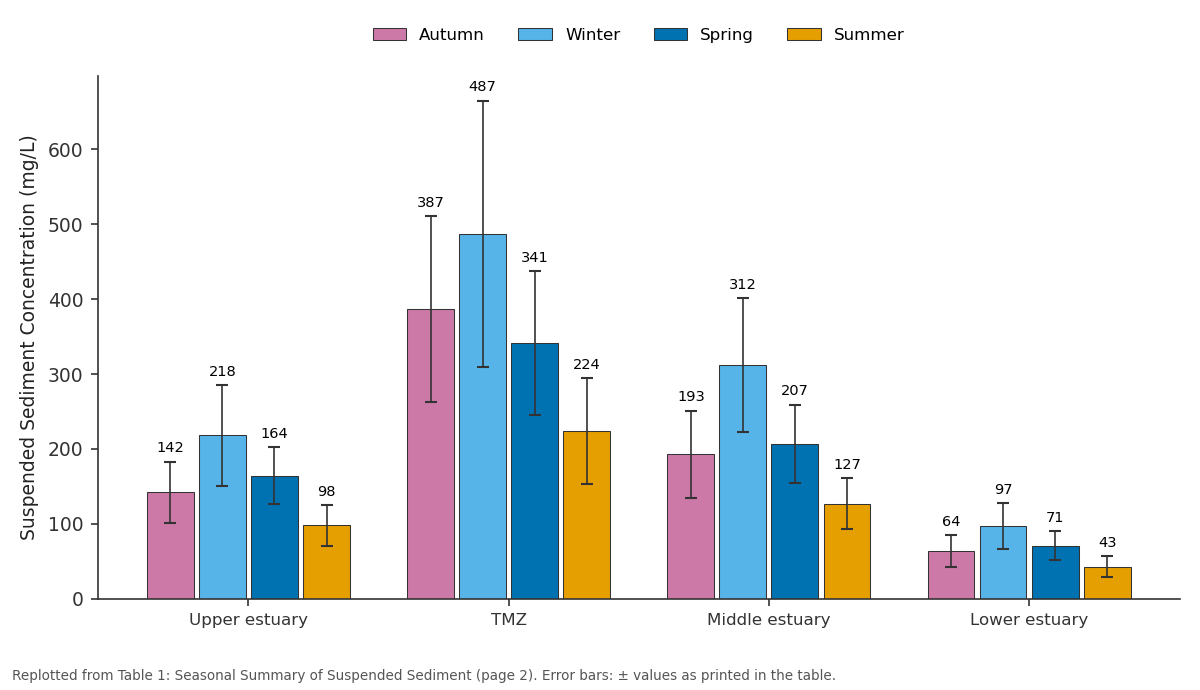
Autumn and Winter and more: Upper estuary vs TMZ vs Middle estuary vs Lower estuary
Replotted from Table 1 (page 2) of the original paper. Every bar is the paper's own table value.
View source evidence ↗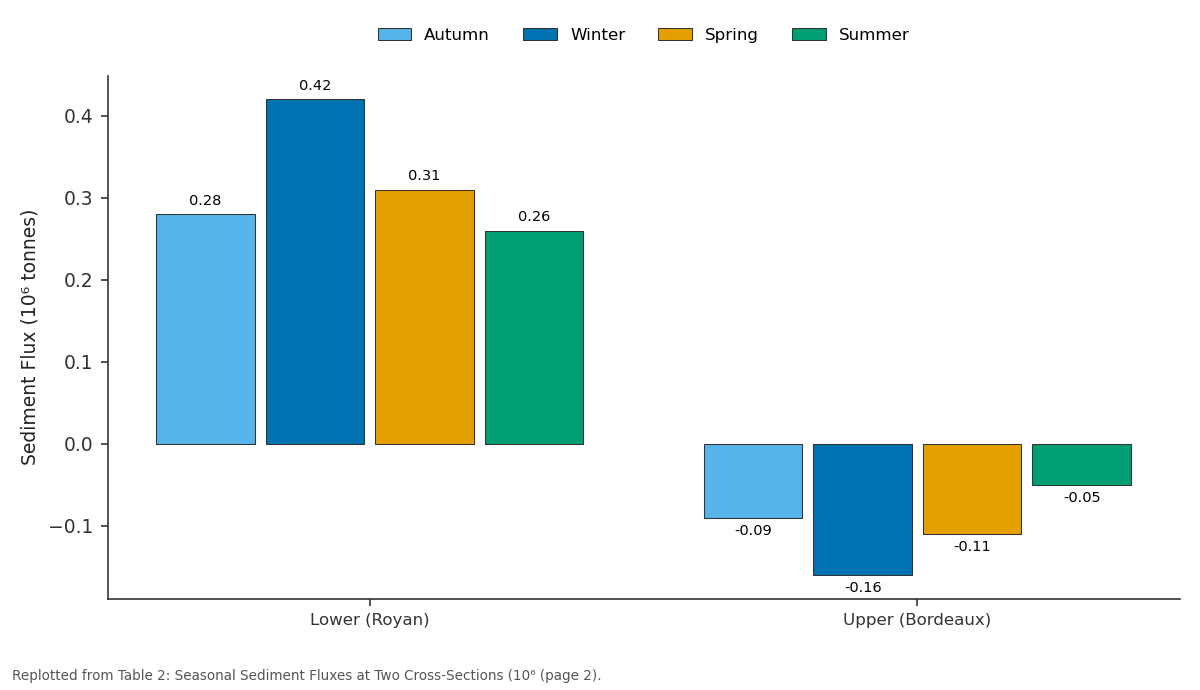
Autumn and Winter and more: Lower (Royan) vs Upper (Bordeaux)
Replotted from Table 2 (page 2) of the original paper. Every bar is the paper's own table value.
View source evidence ↗Figures & tables
From the original paper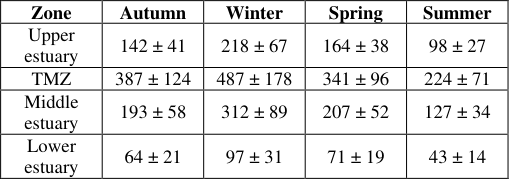 Table 1
 Table 2
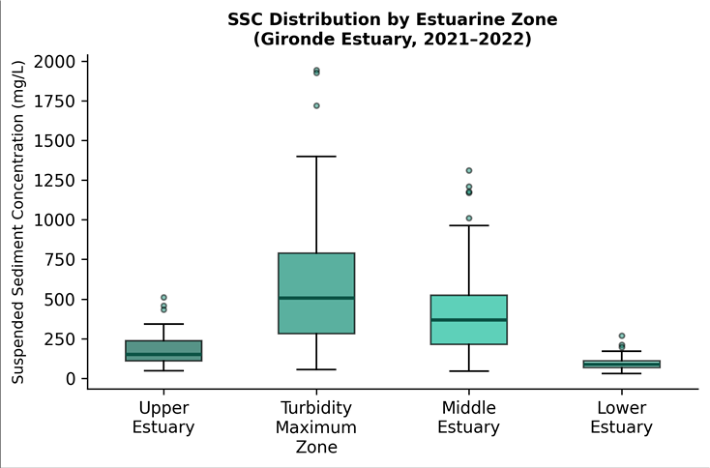 Figure 1
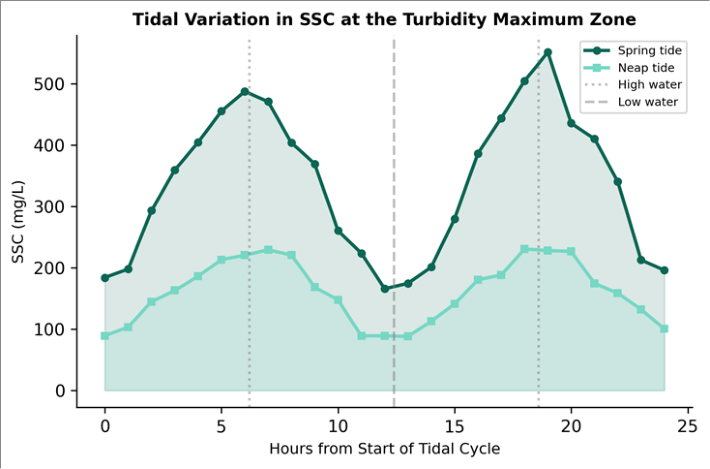 Figure 2
Introduction
An estuary is, by definition, a semi-enclosed coastal water body where freshwater from rivers mixes with saltwater from the ocean-and sediment is one of the most important materials caught in that mixing [1] . Estuarine suspended sediment governs light penetration, nutrient cycling, contaminant transport, and the morphological evolution of navigation channels and intertidal flats [2] . Understanding its concentration, spatial distribution, and net transport direction is therefore essential for both ecological management and port operations. The Gironde, formed by the confluence of the Garonne and Dordogne rivers roughly 75 km upstream of the Atlantic coast, is the largest estuary in Western Europe by surface area (approximately 635 km²) and one of the most turbid, with peak SSC values routinely exceeding 1 g/L in the turbidity maximum zone [3] . The TMZ is a region of anomalously high sediment concentration maintained by the interplay of tidal asymmetry, density-driven circulation, and flocculation of fine particles [4] . Its position oscillates longitudinally by 20-40 km between wet and dry seasons, creating shifting zones of turbidity that affect the viability of oyster beds in the Marennes-Oléron basin downstream [5] . Previous research in the Gironde has relied heavily on point measurements at the Pauillac and Bordeaux gauging stations, supplemented by occasional ship-borne transects [6] . While these records span several decades, they lack the spatial density needed to resolve the TMZ's internal structure or to quantify cross-sectional sediment fluxes with confidence. Advances in optical backscatter (OBS) technology and acoustic Doppler current profiling (ADCP) now allow higher-resolution sampling across multiple tidal cycles [7] . This research deployed a network of 24 stations with OBS and ADCP instruments across the full salinity gradient of the Gironde, covering four seasonal campaigns. The objectives were: (1) to characterize the spatial and tidal variability of SSC across the estuary; (2) to estimate seasonal sediment fluxes at two cross-sections; and (3) to relate TMZ positioning to upstream discharge conditions. Data analysis was carried out at the Department of Geological Sciences, Hanoi University of Geosciences, Hanoi, Vietnam [8] .
Theoretical Background
Sediment transport in macrotidal estuaries is driven by a combination of tidal pumping, gravitational circulation, and Stokes drift [9] . Tidal pumping arises because flood currents in many estuaries are shorter but stronger than ebb currents, creating a net landward displacement of suspended particles over each tidal cycle. Gravitational circulation adds a twolayer exchange flow: denser saltwater moves landward along the bed, carrying sediment upstream, while fresher surface water moves seaward. The TMZ forms where these mechanisms converge and where tidal current velocities drop below the threshold needed to keep fine sediment in suspension, causing particles to accumulate in a relatively narrow zone [4] . The along-estuary position of the TMZ responds mainly to the balance between freshwater inflow, which pushes the salt intrusion and associated TMZ seaward, and tidal energy, which drives landward sediment pumping [10] .
Calibration and Sensor Performance
The OBS sensors (Campbell Scientific OBS-3+) were calibrated in the laboratory against gravimetric SSC using Gironde sediment slurries ranging from 10 to 2,500 mg/L. The resulting calibration curves yielded R² values between 0.94 and 0.97, with a mean absolute error of 18 mg/L. Field inter-comparison between OBS-derived SSC and co-located bottle samples (n = 96) produced a regression slope of 0.98 and an intercept of 4.2 mg/L, confirming minimal bias. ADCP velocities were validated against a tethered electromagnetic current meter at three stations, showing agreement within 3.6% across the measured velocity range.
Material and Methods
Material and Methods
Material
The sampling network comprised 24 stations distributed along the Gironde from the tidal limit at La Réole (Garonne) and Pessac-sur-Dordogne (Dordogne) to the estuary mouth near Royan. Stations were spaced at roughly 4-6 km intervals along the main channel. At each station, an OBS-3+ sensor and a SonTek CastAway CTD were deployed from a research vessel during 13-hour anchor stations covering a full semi-diurnal tidal cycle. An RDI Workhorse 1200 kHz ADCP was mounted on the vessel hull to record velocity profiles at 0.25 m bin resolution. Campaigns were conducted in September 2021 (early autumn), January 2022 (winter high flow), April 2022 (spring), and July 2022 (summer low flow). River discharge data were obtained from the DREAL Aquitaine gauging network at Tonneins (Garonne) and Pessac (Dordogne). All data processing was performed at the Hanoi University of Geosciences, Vietnam [11] .
Methods
OBS turbidity signals were converted to SSC using the laboratory calibration curves, with field bottle samples used to verify each campaign. Depth-averaged SSC was computed by integrating over the water column at each 10minute measurement interval. Instantaneous sediment flux per unit width was calculated as the product of depthaveraged velocity and depth-averaged SSC, then integrated across the channel cross-section using trapezoidal interpolation between stations. Tidal-cycle-averaged fluxes were decomposed into Eulerian (mean flow) and Stokes drift components following the method of Dyer [9] . The along-estuary position of the TMZ was defined as the distance from the mouth at which the depth-averaged SSC first exceeded 500 mg/L during peak flood. Correlation between TMZ position and the 15-day running mean of combined Garonne-Dordogne discharge was assessed by Pearson's r. All statistical tests used α = 0.05. Net flux at the lower cross-section was consistently landward, totalling +1.27 million tonnes per year. At the upper cross-section, the net direction reversed: a total of -0.41 million tonnes per year was exported seaward, reflecting the dominance of river flow over tidal pumping in the fluvial reach. The difference-0.86 million tonnesrepresents sediment retained within the estuary, yielding a trapping efficiency of approximately 68%. The TMZ box is both the highest and the widest, reflecting both elevated concentrations and large tidal-cycle variability. Outliers in the TMZ reached above 1,200 mg/L during spring tides in January. Spring-tide SSC peaked near 500 mg/L around maximum flood and ebb currents, with a secondary peak at slack water associated with settling and resuspension of the fluid-mud layer. Neap-tide concentrations followed a similar pattern but at roughly 40% of the spring-tide amplitude.
Results
Results
Discussion
The 68% trapping efficiency reported here is consistent with the estimate of 60-70% derived by Allen et al. [3] from longer-term bathymetric change analysis, providing independent confirmation that the Gironde retains most of its incoming fluvial sediment. This high retention has implications for port maintenance: the Port of Bordeaux dredges roughly 8 million m³ of sediment annually, and any increase in catchment erosion-whether from land-use change or climate-driven intensification of rainfall-would likely increase dredging demand and cost [12] . The strong correlation between TMZ position and river discharge (r = 0.81) agrees with findings from the Seine [13] and the Yangtze [14] , where discharge variability explains much of the seasonal migration of the turbidity maximum.
In the Gironde, the 18 km seaward shift of the TMZ during winter high flow brings elevated turbidity into the zone of productive oyster beds near Marennes-Oléron, potentially reducing phytoplankton productivity and larval survival [5] . One limitation is that the four campaigns covered only one hydrological year; inter-annual variability driven by drought or flood sequences could shift the baseline. Continuous moored OBS deployments at two or three key stations would improve temporal coverage. The tidal decomposition, while informative, also relies on the assumption of laterally uniform flow, which breaks down in the wider lower estuary where channel-shoal circulation adds a three-dimensional component to sediment transport [9] .
Conclusion
This research mapped suspended sediment concentration across 24 stations in the Gironde Estuary over four seasonal campaigns and quantified tidal and seasonal controls on sediment transport. The turbidity maximum zone recorded median SSC of 487 mg/L in winter, with spring-tide values exceeding 1,200 mg/L. Net sediment flux was landward at the estuary mouth (+1.27 Mt/yr) and seaward at the upstream cross-section (-0.41 Mt/yr), yielding an estuarine trapping efficiency of 68%. The TMZ position correlated strongly with combined Garonne-Dordogne discharge (r = 0.81), shifting up to 18 km seaward during high-flow periods.
These findings have direct management value. Dredging schedules in the Port of Bordeaux could be optimized by timing operations to coincide with neap-tide, low-discharge windows when SSC in the navigation channel is at its lowest. Oyster-bed managers downstream should anticipate elevated turbidity during winter high-flow months and may need to adjust seeding schedules accordingly. Extending this monitoring with permanent moored sensors would capture inter-annual variability and support adaptive sediment management over the long term.
Acknowledgement
Acknowledgements Funding SourcesThis research was funded by departmental grants for coastal-sediment investigations. Institutional SupportThe authors acknowledge the Department of Geological Sciences, Hanoi University of Geosciences, Vietnam, for data-processing facilities. Contributions Not Qualifying for AuthorshipVessel operators and field technicians at the Bordeaux harbour authority assisted with instrument deployments.
Figures and tables from the paper
| Zone | Autumn | Winter | Spring | Summer |
|---|---|---|---|---|
| Upper estuary | 142 ± 41 | 218 ± 67 | 164 ± 38 | 98 ± 27 |
| TMZ | 387 ± 124 | 487 ± 178 | 341 ± 96 | 224 ± 71 |
| Middle estuary | 193 ± 58 | 312 ± 89 | 207 ± 52 | 127 ± 34 |
| Lower estuary | 64 ± 21 | 97 ± 31 | 71 ± 19 | 43 ± 14 |
Table text extracted from the original PDF; superscript letters are shown inline. The original table image is below.
View original table image
| Cross-Section | Autumn | Winter | Spring | Summer |
|---|---|---|---|---|
| Lower (Royan) | +0.28 | +0.42 | +0.31 | +0.26 |
| Upper (Bordeaux) | −0.09 | −0.16 | −0.11 | −0.05 |
Table text extracted from the original PDF; superscript letters are shown inline. The original table image is below.
View original table image
References
15 in the original paper- Dyer KR. Estuaries: A Physical Introduction. 2nd ed. John Wiley and Sons. 1997;Chichester:1-195.
- Uncles RJ, Stephens JA, Smith RE. The dependence of estuarine turbidity on tidal intrusion length, tidal range and residence time. Continental Shelf Research. 2002;22(11-13):1835-1856.
- Allen GP, Salomon JC, Bassoullet P, Du Penhoat Y, De Grandpré C. Effects of tides on mixing and suspended sediment transport in macrotidal estuaries. Sedimentary Geology. 1980;26(1-3):69-90.
- Sottolichio A, Castaing P. A synthesis on seasonal dynamics of highly-concentrated structures in the Gironde estuary. Comptes Rendus de l'Académie des Sciences. 1999;329(11):795-800.
- Soletchnik P, Ropert M, Mazurié J, Gildas Fleury P, Le Coz F. Relationships between oyster mortality patterns and environmental data from monitoring databases along the coasts of France. Aquaculture. 2007;271(14):384-400.
- Castaing P, Allen GP. Mechanisms of seaward escape of suspended sediment from the Gironde: a macrotidal estuary in France. Marine Geology. 1981;40(1-2):101118.
- Downing J. Twenty-five years with OBS sensors: the good, the bad, and the ugly. Continental Shelf Research. 2006;26(17-18):2299-2318.
- Jalón-Rojas I, Schmidt S, Sottolichio A. Turbidity in the fluvial Gironde Estuary based on 10 year continuous monitoring. Hydrology and Earth System Sciences. 2015;19(6):2805-2814.
- Dyer KR. Sediment transport processes in estuaries. Geomorphology and Sedimentology of Estuaries, Developments in Sedimentology. 1995;53:423-449.
- Burchard H, Schuttelaars HM, Ralston DK. Sediment trapping in estuaries. Annual Review of Marine Science. 2018;10:371-395.
- Tessier C, Le Hir P, Lurton X, Castaing P. Estimation of suspended sediment concentration from backscatter intensity of a multibeam echo sounder. Comptes Rendus Geoscience. 2008;340(1):57-67.
- Etcheber H, Taillez A, Abril G, Garnier J, Servais P, Moatar F, et al. Particulate organic carbon in the estuarine turbidity maxima of the Gironde, Loire and Seine estuaries. Estuarine, Coastal and Shelf Science. 2007;74(3):580-590.
- Avoine J, Allen GP, Nichols M, Salomon JC, Larsonneur C. Suspended-sediment transport in the Seine estuary, France. Estuarine, Coastal and Shelf Science. 1981;13(2):167-196.
- Chen Z, Li J, Shen H, Wang Z. Yangtze River of China: historical analysis of discharge variability and sediment flux. Geomorphology. 2001;41(2-3):77-91.
- Mitchell SB, Uncles RJ. Estuarine sediments in macrotidal estuaries: future research requirements and management challenges. Ocean and Coastal Management. 2013;79:97-100.