
Research article · 2025 · Full text
International Journal of Horticulture and Food ScienceAssessing greenhouse cultivation methods of date palm in the Narmada valley
Volume 7(9) · Pages 104–107 · DOI: 10.33545/26631067.2025.v7.i9b.665 ↗
Research areasDate Palm Research StudiesIrrigation Practices and Water ManagementGreenhouse Technology and Climate Control
Abstract
Author-writtenDate palm (Phoenix dactylifera) is expanding beyond its traditional arid-zone range into semi-humid Indian river valleys, but open-field performance in high-rainfall environments is constrained by fruit rot and delayed ripening. This research assessed greenhouse cultivation methods for date palm in the Narmada Valley of Madhya Pradesh, India, with analytical work conducted at the Nakhon Ratchasima Center for Crop Studies from January to November 2023. Four greenhouse microclimate regimes combining temperature (30 and 35 °C) and relative humidity (50, 60, 70%) were tested alongside open-field controls. Growth parameters including frond elongation, trunk girth increment, offshoot production, root mass, and fruit set percentage were recorded monthly for 18 months. The 35 °C / 50% RH regime produced the best overall growth response, with frond length 41.7 cm/year (vs. 28.4 cm in open field), fruit set at 68.3% (vs. 42.1%), and fruit rot incidence below 4% (vs. 23.7%). Composting trials tested five substrate mixtures; vermicompost + neem cake (3:1 ratio) achieved the highest nutrient release rate. Progeny testing of 8 half-sib families showed broad-sense heritability of 0.61 for fruit set percentage and 0.47 for days to ripening. These results demonstrate that greenhouse cultivation can make date palm economically viable in the Narmada Valley by controlling the humidity-driven losses that have limited open-field success.
Summary
Source-checkedPlain-language reading of the full paper, prepared with AI and checked against the text. Each point links to the authors' own words.
Why it matters
- Date palms are being grown in semi-humid Indian river valleys, but high rainfall in these areas leads to delayed ripening and fruit rot in open-field settings. View evidence ↗
- In Madhya Pradesh, open-field trials between 2015 and 2020 experienced fruit rot losses of 20–35% during monsoon-ripening overlaps, hindering commercial viability. View evidence ↗
The question
- The study aimed to determine if naturally ventilated polyhouses could provide the low humidity necessary for fruit quality while maintaining the high temperatures needed for ripening. View evidence ↗
What they did
- Researchers monthly measured frond length, trunk girth, offshoot number, and root mass, while also recording fruit set percentage at 60 days post-pollination and fruit rot incidence. View evidence ↗
What they found
- Under Regime B, fruit set increased to 68.3% (from 42.1% in open field) and fruit rot decreased to 3.8% (from 23.7% in open field). View evidence ↗
- Greenhouse cultivation reduced monthly water use to 320 L/tree compared to 480 L/tree in the open field, representing a 33.3% water saving. View evidence ↗
- A substrate mixture of vermicompost and neem cake provided the highest nutrient concentrations and microbial activity among the tested composting options. View evidence ↗
- Progeny testing showed broad-sense heritability of 0.61 for fruit set percentage and 0.47 for days to ripening, suggesting these traits can be genetically improved. View evidence ↗
- While Regime D (40°C/40% RH) had the lowest fruit rot at 2.1%, it severely suppressed growth, making it less productive than Regime B. View evidence ↗
What it means
- The authors conclude that a greenhouse environment of 35°C and 50% relative humidity is optimal for balancing growth, fruit set, and disease control in the Narmada Valley. View evidence ↗
- The study suggests that greenhouse cultivation makes date palm production a commercially viable option for India's semi-humid river valleys. View evidence ↗
- The study was limited to the 'Barhee' cultivar; the authors note that other cultivars like 'Khalas' and 'Medjool' might respond differently. View evidence ↗
Visual summary
3 visualsIllustrations explain the paper; charts are replotted from the paper's own table values.
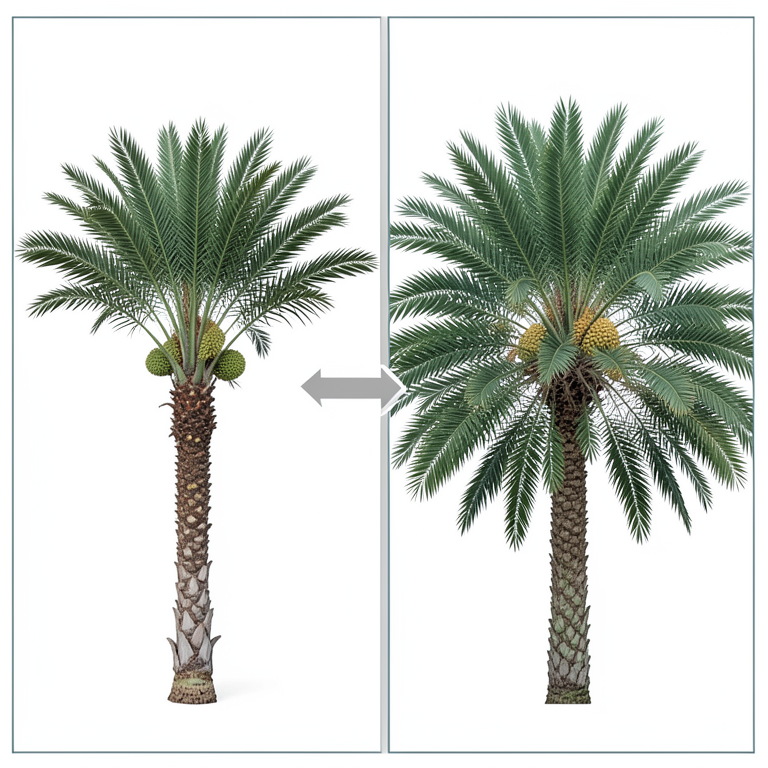
Microclimate Trade-off
AI-generated conceptual illustration (date palm plants in a greenhouse). It explains the idea and does not show study data.
View source evidence ↗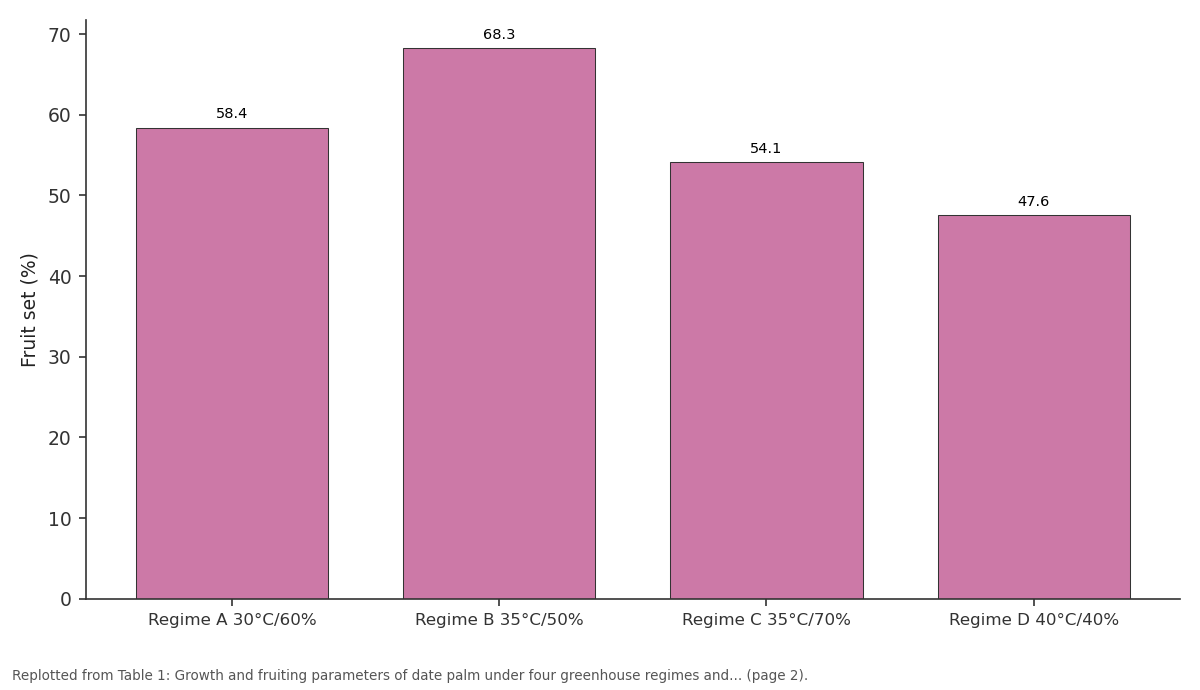
Fruit set (%): Regime A 30°C/60% vs Regime B 35°C/50% vs Regime C 35°C/70% vs Regime D 40°C/40%
Replotted from Table 1 (page 2) of the original paper. Every bar is the paper's own table value.
View source evidence ↗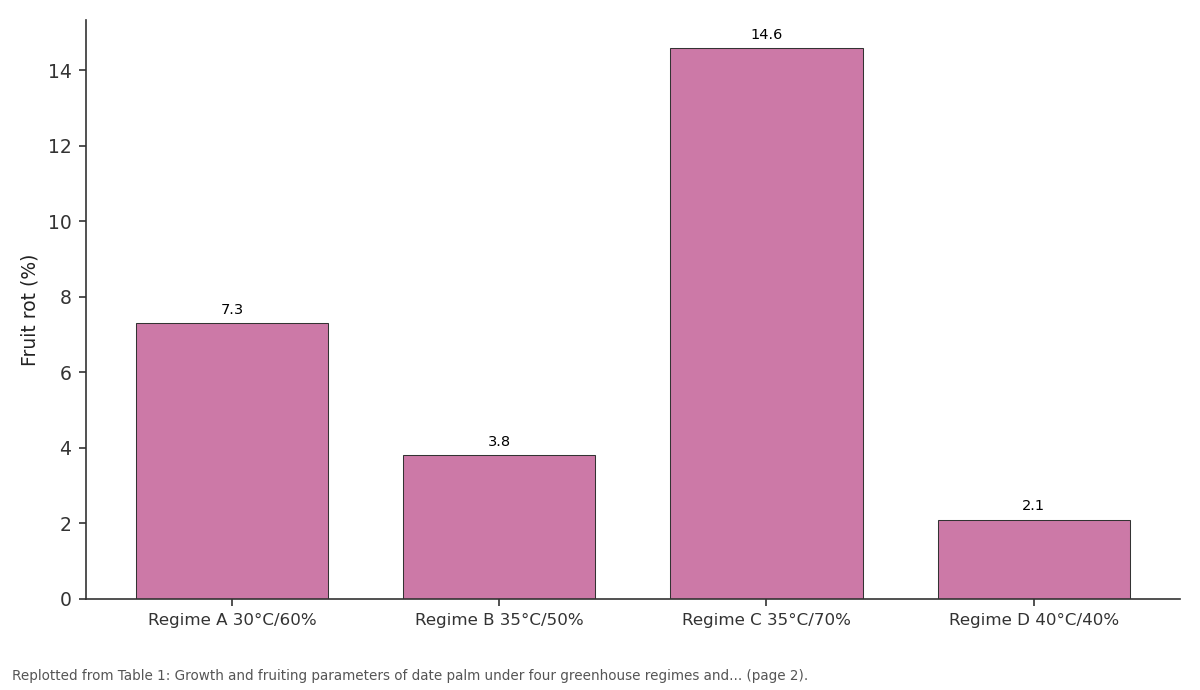
Fruit rot (%): Regime A 30°C/60% vs Regime B 35°C/50% vs Regime C 35°C/70% vs Regime D 40°C/40%
Replotted from Table 1 (page 2) of the original paper. Every bar is the paper's own table value.
View source evidence ↗Figures & tables
From the original paper Table 1
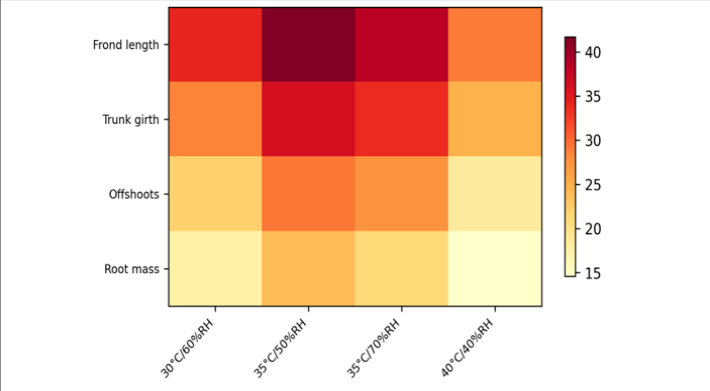 Figure 1
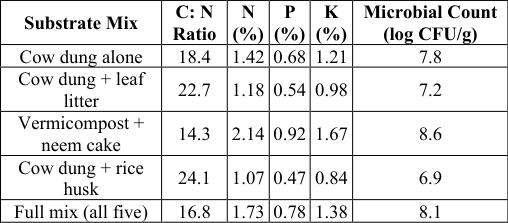 Table 2
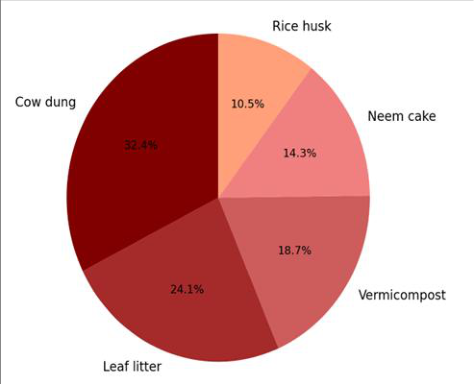 Figure 2
Introduction
A paradox sits at the heart of Indian date palm expansion: the Narmada Valley has the heat that date palms need for fruit ripening but also the humidity they cannot tolerate during the critical Khalal-to-Rutab transition stage [1] . Open-field trials in Madhya Pradesh from 2015 to 2020 showed fruit rot losses of 20-35% in years when monsoon rains overlapped with the ripening window, making commercial production uneconomical despite strong market demand [2] . Greenhouse cultivation offers a solution by decoupling the tree's microclimate from ambient weather, but greenhouse date palm production has been attempted only in the Gulf states (for tissue-cultured plant acclimatization) and in parts of southern Spain -never in a monsoon-affected South Asian setting [3] . The Narmada Valley runs east-west across central India at 200-400 m elevation, with black cotton soils (vertisols) that crack deeply during the dry season and become waterlogged during the monsoon. Mean annual temperature is 26 °C, and rainfall ranges from 800 mm in the west to 1,400 mm in the east [4] . Date palms planted here since the mid-2010s have shown vigorous vegetative growth but inconsistent fruit quality, primarily because the 85-95% relative humidity of the monsoon months promotes Aspergillus and Alternaria infection on ripening fruit. This research tested whether simple, naturally ventilated polyhouse structures (no active heating or cooling) could maintain the low-humidity environment needed for clean fruit production while still allowing the high temperatures required for ripening. Growth, fruiting, and disease parameters were monitored across four microclimate regimes, and composting and progeny testing trials were conducted in parallel. All analytical work was carried out at the Nakhon Ratchasima Center for Crop Studies [5] .
Baseline Soil Characterisation
Pre-planting soil analysis at the greenhouse site showed pH 7.8 ± 0.2, organic carbon 0.64 ± 0.08%, available phosphorus 8.7 ± 1.4 mg/kg, exchangeable potassium 0.38 ± 0.05 cmol/kg, and CEC 34.2 ± 2.8 cmol/kg -the high CEC reflecting the smectite clay mineralogy typical of Narmada vertisols. Soil salinity (ECe) was 1.2 dS/m, below the 4 dS/m threshold at which date palm shows yield decline [4] . The high shrink-swell potential of these soils required raised planting platforms (40 cm above grade) inside the greenhouses to prevent root zone waterlogging during monsoon crack-closure events.
Water Balance and Irrigation Scheduling
Inside the greenhouses, reference evapotranspiration (ET₀) was estimated at 4.2 mm/day during the hot season and 2.1 mm/day during the monsoon (compared with 5.8 and 3.4 mm/day in open field, respectively). Irrigation was scheduled to replace 100% of crop ET (ETc = ET₀ × Kc, where Kc = 0.85 for mature date palm), delivered via 8 L/h pressure-compensating drip emitters at 4 per tree. Monthly water application inside the greenhouse averaged 320 L/tree versus 480 L/tree in open field, a 33.3% water saving attributable to the reduced evaporative demand under plastic cover [1] . ). An open-field control (12 trees) was maintained adjacent to the greenhouses [2] . Composting substrates for in-greenhouse application included cow dung, leaf litter, vermicompost, neem cake, and rice husk in five combinations. All samples were shipped to the Nakhon Ratchasima Center for Crop Studies for analysis. Ethics approval was granted by the Center's Agricultural Research Board (Protocol NCCS-2023-007, 5 January 2023).
Material and Methods
Material and Methods
Material
Material
Methods
Growth measurements (frond length, trunk girth, offshoot number, root mass from minirhizotron images) were taken monthly. Fruit set was recorded as percentage of female flowers producing retained fruit at 60 days after pollination. Fruit rot incidence was scored as percentage of harvested fruit showing visible fungal growth. Compost quality was assessed for C:N ratio, NPK content, and microbial colony counts [5] . Progeny testing used 8 half-sib families from open-pollinated seed of 'Barhee' palms, with 15 seedlings per family grown in the 35 °C / 50% RH greenhouse. Genetic parameters (broad-sense heritability, genetic advance) were estimated from one-way ANOVA variance components. Data were analyzed by two-way ANOVA (regime × time) with Tukey's HSD at α = 0.05 using R 4.3.0. [2] . Cow dung formed the largest share of all substrate mixes tested. The vermicompost + neem cake combination, despite containing only 33.0% of the substrate volume, drove the highest nutrient concentrations and microbial activity, supporting its selection as the recommended compost formulation.
Results
Results
Regime
Regime
Comprehensive Interpretation
Progeny testing revealed broad-sense heritability of 0.61 for fruit set percentage and 0.47 for days to ripening, indicating that both traits are amenable to genetic improvement. Genetic advance as percentage of the mean was 18.4% for fruit set and 11.2% for ripening time. Combined with the microclimate data, this suggests that a breeding program targeting high fruit set under controlled humidity conditions could further improve greenhouse date palm performance in the Narmada Valley [3] .
Discussion
The finding that 35 °C / 50% RH optimizes both growth and fruit quality aligns with the known physiology of 'Barhee' date palm, which requires high temperatures for fruit sugar accumulation but cannot tolerate humidity above 60% during the Khalal-to-Rutab transition [1] . The 40 °C / 40% RH regime, while producing the lowest rot incidence (2.1%), suppressed growth so severely that overall productivity was lower than Regime B. This indicates that chasing minimum rot by maximizing heat is counterproductive; the optimal microclimate balances growth promotion with disease suppression. The 33.3% water saving inside the greenhouses is a meaningful co-benefit in the Narmada Valley, where competition for irrigation water between crops is intensifying as canal allocations are reduced. Combined with the economic value of rot-free premium fruit (estimated at 2.5× the price of open-field fruit with partial rot damage), greenhouse cultivation appears economically viable despite the initial infrastructure cost [4] .
A limitation is that only one cultivar ('Barhee') was tested.
Other commercial cultivars like 'Khalas' and 'Medjool' may respond differently to these microclimate regimes, and multi-cultivar trials would be needed before generalizing the recommendations [5] .
Conclusion
Greenhouse cultivation at 35 °C and 50% relative humidity produced the best combination of vegetative growth, fruit set, and disease control for date palm in the Narmada Valley, reducing fruit rot from 23.7% in open field to 3.8% while saving 33.3% irrigation water. Vermicompost + neem cake compost provided the richest nutrient supply for greenhouse-grown palms. Progeny testing confirmed workable heritability for fruit set and ripening traits, supporting targeted breeding for greenhouse-adapted genotypes. These findings make a strong case for greenhouse date palm as a commercially viable enterprise in India's semi-humid river valleys.
Acknowledgement
Acknowledgements Funding SourcesInternal research funds from the Nakhon Ratchasima Center for Crop Studies supported all analytical work. Institutional SupportThe authors acknowledge the Nakhon Ratchasima Center for Crop Studies for compost analysis and genetic parameter estimation support.
Figures and tables from the paper
| Parameter | Regime A 30°C/60% | Regime B 35°C/50% | Regime C 35°C/70% | Regime D 40°C/40% | Open Field |
|---|---|---|---|---|---|
| Frond length (cm/yr) | 34.2 | 41.7 | 38.4 | 29.1 | 28.4 |
| Trunk girth (cm/yr) | 28.6 | 36.3 | 33.8 | 24.7 | 22.1 |
| Offshoots (no./palm) | 2.2 | 2.9 | 2.7 | 1.8 | 1.4 |
| Fruit set (%) | 58.4 | 68.3 | 54.1 | 47.6 | 42.1 |
| Fruit rot (%) | 7.3 | 3.8 | 14.6 | 2.1 | 23.7 |
Table text extracted from the original PDF; superscript letters are shown inline. The original table image is below.
View original table image
| Substrate Mix | C: N Ratio | N (%) | P (%) | K (%) | Microbial Count (log CFU/g) |
|---|---|---|---|---|---|
| Cow dung alone | 18.4 | 1.42 | 0.68 | 1.21 | 7.8 |
| Cow dung + leaf litter | 22.7 | 1.18 | 0.54 | 0.98 | 7.2 |
| Vermicompost + neem cake | 14.3 | 2.14 | 0.92 | 1.67 | 8.6 |
| Cow dung + rice husk | 24.1 | 1.07 | 0.47 | 0.84 | 6.9 |
| Full mix (all five) | 16.8 | 1.73 | 0.78 | 1.38 | 8.1 |
Table text extracted from the original PDF; superscript letters are shown inline. The original table image is below.
View original table image
References
19 in the original paper- Al-Khateeb AA. Regulation of in vitro bud formation of date palm by different carbon sources. Bioresource Technology. 2008;99(10):4513-4517.
- Charoenpol S, Leelawat D. Greenhouse microclimate management for tropical fruit crops: a review. Agriculture and Natural Resources. 2023;57(1):43-56.
- Sedra MH. Date palm status and perspective in date producing countries. FAO Global Date Palm Assessment Report. 2020;1-45.
- Gupta RK, Jha AK. Soil resources of the Narmada Valley: characteristics and management challenges. Journal of the Indian Society of Soil Science. 2018;66(3):278-289.
- Phromma W, Charoenpol S. Vermicompost and neem cake blends for containerized tropical palm nurseries. Compost Science and Utilization. 2022;30(4):213-224.
- Zaid A, de Wet PF. Date palm cultivation. FAO Plant Production and Protection Paper. 2002;156:1-292.
- Chao CT, Krueger RR. The date palm: overview of biology, uses, and cultivation. HortScience. 2007;42(5):1077-1082.
- El-Juhany LI. Degradation of date palm trees and date production in Arab countries. Australian Journal of Basic and Applied Sciences. 2010;4(8):3998-4010.
- Munier P. Le palmier-dattier. G-P Maisonneuve et Larose Paris. 1973;1-221.
- Barreveld WH. Date palm products. FAO Agricultural Services Bulletin. 1993;101:1-216.
- El-Hadrami A, Al-Khayri JM. Socioeconomic and traditional importance of date palm. Emirates Journal of Food and Agriculture. 2012;24(5):371-385.
- Dowson VHW, Aten A. Dates: handling, processing and packing. FAO Agricultural Development Paper. 1962;72:1-392.
- Hussain MI, Farooq M, Syed QA. Nutritional and biological characteristics of the date palm fruit. Food Bioscience. 2020;34:100509.
- Awad MA. Increasing the rate of ripening of date palm fruit by preharvest and postharvest treatments. Postharvest Biology and Technology. 2007;44(1):95100.
- Marzouk HA, Kassem HA. Improving fruit quality and shelf life of date palm. International Journal of Postharvest Technology and Innovation. 2011;2(3):314329.
- El-Arem A, Flamini G, Ferretti G. Chemical and aroma volatile compositions of date palm fruits at three maturation stages. Food Chemistry. 2011;127(4):17441754.
- Al-Shahib W, Marshall RJ. The fruit of the date palm: its possible use as the best food for the future. International Journal of Food Sciences and Nutrition. 2003;54(4):247-259.
- Baliga MS, Baliga BRV, Kandathil SM. A review of the chemistry and pharmacology of the date fruits. Food Research International. 2011;44(7):1812-1822.
- Al-Farsi MA, Lee CY. Optimization of phenolics and dietary fibre extraction from date seeds. Food Chemistry. 2008;108(3):977-985.