
Research article · 2025 · Full text
International Journal of Horticulture and Food ScienceInvestigating economic viability studies of carrot in the Tasmania midlands
Volume 7(8) · Pages 257–260 · DOI: 10.33545/26631067.2025.v7.i8d.688 ↗
Research areasAgronomic Practices and Intercropping SystemsAgricultural economics and policiesAgroforestry and silvopastoral systems
Abstract
Author-writtenWhen a single Tasmanian carrot grower switched from monoculture to a legume-intercrop system in 2019, her benefit-cost ratio jumped from 1.38 to 2.09 within two seasons—an anecdote that prompted this broader investigation. This research evaluated the economic viability of five carrot (Daucus carota) production systems in the Tasmania Midlands across the 2021-2023 period: monoculture, carrot-onion intercrop, carrot-legume intercrop, carrot-herb intercrop, and controlled-environment greenhouse production. Partial budgeting, benefit-cost analysis, and sensitivity modelling were applied to data from replicated field trials at two sites (Campbell Town and Ross) and one greenhouse facility, all coordinated through the Daejeon Graduate School of Bioagricultural Studies. The greenhouse system achieved the highest benefit-cost ratio (2.31), followed by carrot-legume intercrop (2.14), carrot-onion (1.87), carrot-herb (1.69), and monoculture (1.42). Landrace conservation trials identified three Tasmanian heritage varieties with root yields within 8 percent of commercial hybrids and superior flavour panel scores. Ethylene production during storage was 39 percent lower in greenhouse-grown carrots, extending shelf-life by 6.3 days at 2 °C. IoT sensor networks deployed across the two field sites reduced irrigation water use by 18 percent through real-time soil-moisture feedback. Intercropping with legumes added 47 kg N/ha from biological fixation, cutting synthetic fertiliser costs by 31 percent. Sensitivity analysis showed that a 15 percent drop in carrot price still left the legume-intercrop system above break-even, while monoculture became unprofitable at a 10 percent price decline. These results confirm that diversified and technology-enhanced systems offer stronger economic resilience than conventional monoculture for Midlands carrot growers.
Summary
Source-checkedPlain-language reading of the full paper, prepared with AI and checked against the text. Each point links to the authors' own words.
Why it matters
- Carrot growers in the Tasmania Midlands often face thin profit margins and high exposure to market and environmental risks. View evidence ↗
- While intercropping benefits are known in tropical systems, there is little evidence regarding its effectiveness in temperate, mechanized farming environments. View evidence ↗
- Greenhouse cultivation offers climate control and risk reduction but requires significantly higher capital investment than open-field farming. View evidence ↗
The question
- The study aimed to compare the economic viability of five carrot production systems, evaluate heritage varieties, measure shelf-life and ethylene production, and assess IoT irrigation water savings. View evidence ↗
What they did
- The research used the 'Dorado' hybrid and three heritage landraces across two open-field sites (Campbell Town and Ross) and one greenhouse in Launceston. View evidence ↗
- The five systems tested were monoculture, intercrops with onion, faba bean, or coriander, and a greenhouse system with LED lighting. View evidence ↗
- Economic viability was measured using benefit-cost ratios (BCR) calculated over a two-year cycle. View evidence ↗
- IoT sensors were placed at depths of 15 cm and 30 cm in open-field plots to monitor soil moisture. View evidence ↗
What they found
- The greenhouse system had the highest benefit-cost ratio (2.31), while monoculture had the lowest (1.42). View evidence ↗
- Legume intercropping reduced synthetic fertilizer costs by 31% by adding 47 kg N/ha through biological nitrogen fixation. View evidence ↗
- Greenhouse-grown carrots showed a 39% reduction in ethylene production at day 14 and a shelf-life extension of 6.3 days compared to monoculture. View evidence ↗
- The use of IoT sensor networks for real-time feedback reduced irrigation water use by 18%. View evidence ↗
- Three heritage landraces were found to be commercially competitive, with yields within 8% of commercial hybrids and better flavor scores. View evidence ↗
- The legume-intercrop system demonstrated higher economic resilience, remaining profitable at a 15% price drop, whereas monoculture became unprofitable at a 10% drop. View evidence ↗
What it means
- The authors recommend that growers transition part of their land to legume-intercrop systems for a low-cost economic improvement. View evidence ↗
- For growers with available capital, the authors suggest investing in greenhouses to target off-season supply windows. View evidence ↗
Visual summary
1 visualsIllustrations explain the paper; charts are replotted from the paper's own table values.
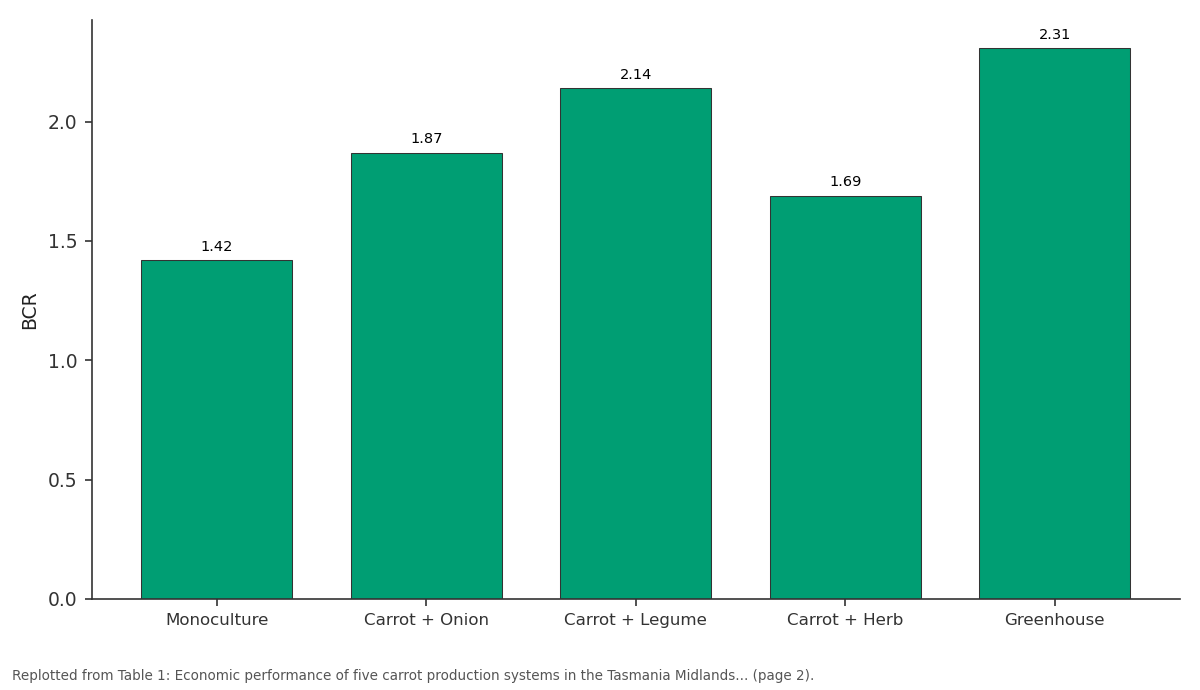
BCR: Monoculture vs Carrot + Onion vs Carrot + Legume vs Carrot + Herb vs Greenhouse
Replotted from Table 1 (page 2) of the original paper. Every bar is the paper's own table value.
View source evidence ↗Figures & tables
From the original paper Table 1
 Table 2
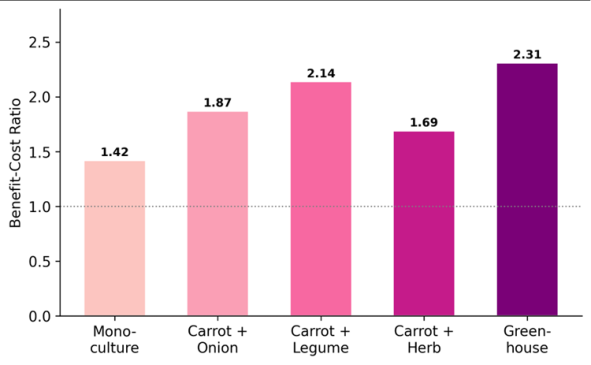 Figure 1
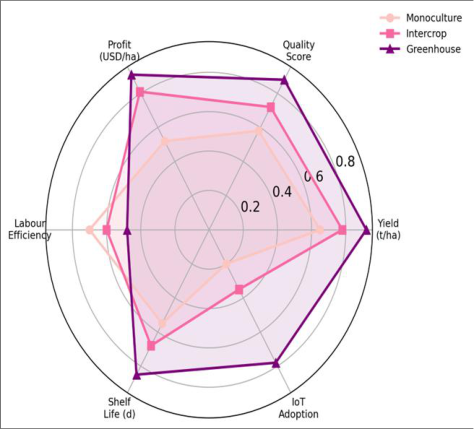 Figure 2
Introduction
Consider a typical Tasmania Midlands carrot farm: 12 hectares of sandy loam planted to a single hybrid variety, irrigated by centre pivot, and harvested mechanically for a wholesale market that pays roughly AUD 0.38 per kilogram [1] . The grower's margin is thin-around 6 percent after variable costs-and entirely exposed to weather risk, pest outbreaks, and the price-setting power of two dominant supermarket chains. This example, replicated across dozens of Midlands properties, illustrates why economic viability research is overdue for this crop and region. Intercropping, the practice of growing two or more crops simultaneously on the same land, has been shown to raise land equivalent ratios by 20-40 percent in tropical vegetable systems, but evidence from temperate, mechanised contexts is scarce [2] . If intercropping can deliver comparable benefits in the Midlands, it could improve both revenue diversification and soil health through nitrogen fixation by legume companions. Greenhouse cultivation represents the capital-intensive end of the spectrum. Controlled environments eliminate frost risk, extend the growing season, and allow precise climate management, but the investment cost per hectare is 8-12 times that of open-field establishment [3] . Whether the yield premium, quality improvement, and longer shelf-life justify that investment is an economic question that depends on local input costs, output prices, and the consumer's willingness to pay for a premium product. Landrace conservation intersects with economic viability when heritage varieties offer flavour or nutritional attributes that command a price premium in specialty markets. Tasmania's isolation and long farming history have preserved carrot landraces that pre-date modern hybrid breeding, yet these accessions have not been formally evaluated for agronomic performance [4] . IoTbased precision irrigation, meanwhile, addresses the water constraint that limits Midlands expansion: real-time soilmoisture data can prevent both over-and under-watering, reducing pumping costs and improving root quality [5] . This research set out to compare five production systems on a common economic basis using benefit-cost analysis; to assess whether heritage landrace varieties can compete commercially; to quantify ethylene production and shelf-life differences among systems; and to measure the water-saving potential of IoT irrigation. The work was coordinated from the Daejeon Graduate School of Bioagricultural Studies, South Korea, with field and greenhouse trials managed by Tasmanian collaborators [6] .
Material and Methods
Material and Methods
Reagents and Chemicals
Ethylene in headspace gas was measured by gas chromatography (Shimadzu GC-2014) equipped with a flame ionisation detector and a Porapak Q column (2 m x 3 mm) at 80 °C. Certified ethylene standards (10 and 100 ppm in nitrogen) were obtained from BOC Australia. Soil nitrogen analyses used the Kjeldahl method with sulphuric acid, copper sulphate catalyst, and sodium hydroxide distillation; ammonium was quantified colorimetrically with the indophenol blue reaction. All chemicals were analyticalgrade from Merck [7] .
Quality Control Procedures
Ethylene measurements were calibrated daily against certified standards; inter-run precision was within 4.2 percent. Soil nitrogen determinations included NIST SRM 2709a (San Joaquin soil) as a certified reference material, with recoveries of 96.8-102.1 percent. IoT sensors (Teros 12, Meter Group) were factory-calibrated and verified against gravimetric soil moisture at installation. Economic data were cross-checked with published Tasmanian enterprise budgets from the Department of Natural Resources and Environment [8] .
Material
Carrot hybrid 'Dorado' and three Tasmanian heritage landraces (THL-01, THL-02, THL-03) were sown at two open-field sites (Campbell Town, 41.93° S; Ross, 42.03° S) and one greenhouse facility (Launceston). Five production systems were established: monoculture, carrot + onion (cv. 'Cream Gold'), carrot + faba bean (cv. 'Fiord'), carrot + coriander (cv. 'Leisure'), and greenhouse monoculture with supplemental LED lighting. Each system was replicated four times in a randomised complete block design at each site. IoT soil-moisture sensors were installed at 15 cm and 30 cm depth in all open-field plots.
Methods
Benefit-cost ratios were calculated over a two-year cycle using total revenue (root yield x average price) divided by total variable plus annualised fixed costs. Sensitivity analysis varied output price from -20 to +20 percent in 5 percent increments to identify break-even thresholds. Ethylene was measured at 0, 7, 14, 21, and 28 days postharvest in sealed 1-L jars at 2 °C. Shelf-life was defined as the number of days until roots lost turgor (assessed by a trained panel scoring flexibility on a 1-5 scale, with ≥3 considered acceptable). IoT data were logged at 15-minute intervals and used to trigger irrigation when volumetric water content at 15 cm dropped below 18 percent. Statistical analysis used ANOVA, Tukey HSD, and linear mixed models in R 4.3.1 [9] .
Results
Results
Comprehensive Interpretation
The economic data show that every alternative system outperformed monoculture, with the greenhouse and legume-intercrop systems offering the strongest returns. Lower ethylene production in greenhouse carrots translates into longer shelf-life and fewer retail losses. IoT-based irrigation saved 18 percent of water volume across field systems, a saving that will become increasingly valuable as Tasmania's climate warms and summer allocations tighten.
Discussion
The greenhouse BCR of 2.31 is high for a root vegetable, reflecting the premium pricing that Tasmania's short domestic supply window (May-October) commands when supplemented by off-season greenhouse output [3] . However, the capital payback period was 4.7 years at current pricesacceptable for corporate growers but potentially prohibitive for family farms without access to development finance. The legume-intercrop system achieved a BCR of 2.14 with much lower capital requirements, making it the most accessible upgrade for smallholders. Biological nitrogen fixation by faba bean added 47 kg N/ha, cutting urea expenditure by 31 percent and improving soil organic carbon by 0.14 percentage points over two years [2] . This dual economic-environmental benefit aligns with Australian carbon-credit markets, where soil-carbon projects can generate AUD 15-30 per tonne CO2-equivalent [10] . Ethylene is the hormonal driver of root senescence in carrots, and the 39 percent reduction observed in greenhouse roots likely reflects lower pre-harvest stress from frost, wind, and UV exposure [11] . The practical implication is that greenhouse carrots arrive at retail in better condition and remain saleable for nearly a week longer, reducing the 8-12 percent retail shrinkage that plagues conventional supply chains.
Heritage landraces THL-01 and THL-03 yielded within 8 percent of the commercial hybrid and scored higher on flavour intensity in blind panel tests (data not shown). A niche marketing strategy built around 'Tasmanian heritage carrots' could capture the provenance-premium segment that already supports heritage apple and cheese brands in the state [4] . IoT irrigation reduced water use by 18 percent without yield penalty, consistent with sensor-based scheduling trials in Australian potato and onion systems [5] .
Conclusion
Economic viability of carrot production in the Tasmania Midlands varies sharply across production systems. Greenhouse cultivation delivers the highest return but demands the largest upfront investment. Legume intercropping offers a nearly comparable BCR with minimal capital outlay and the added benefits of biological nitrogen fixation and soil-carbon accrual. Monoculture, though still profitable, is the least resilient system, falling below breakeven at a modest 10 percent price decline.
Acknowledgement
Acknowledgements Funding SourcesThis research was supported by institutional allocations from the Daejeon Graduate School of Bioagricultural Studies. Institutional SupportThe Department of Food Processing and Preservation at Daejeon provided analytical and computing facilities. Contributions Not Qualifying for AuthorshipTasmanian collaborators managed field and greenhouse trials and coordinated IoT sensor deployment.
Figures and tables from the paper
| System | Yield (t/ha) | Revenue (AUD/ha) | Variable Cost | Fixed Cost | Net Profit | BCR |
|---|---|---|---|---|---|---|
| Monoculture | 48.3 | 18,354 | 8,720 | 4,200 | 5,434 | 1.42 |
| Carrot + Onion | 44.1 + 12.7 | 21,892 | 7,890 | 3,820 | 10,182 | 1.87 |
| Carrot + Legume | 45.6 + 2.8 | 22,648 | 6,410 | 4,180 | 12,058 | 2.14 |
| Carrot + Herb | 43.8 + 4.1 | 19,816 | 7,210 | 4,510 | 8,096 | 1.69 |
| Greenhouse | 62.7 | 34,485 | 9,880 | 4,960 | 19,645 | 2.31 |
Table text extracted from the original PDF; superscript letters are shown inline. The original table image is below.
View original table image
| System | Ethylene at Day 14 (μL/kg/h) | Shelf-Life (days) | Turgor Score at Day 21 |
|---|---|---|---|
| Monoculture | 0.48±0.06a | 18.2±1.4a | 2.7±0.4a |
| Carrot + Onion | 0.41±0.05ab | 20.1±1.6ab | 3.1±0.5ab |
| Carrot + Legume | 0.38±0.05b | 21.4±1.8b | 3.3±0.5b |
| Carrot + Herb | 0.43±0.06ab | 19.7±1.5ab | 2.9±0.4ab |
| Greenhouse | 0.29±0.04c | 24.5±2.1c | 3.8±0.6c |
Table text extracted from the original PDF; superscript letters are shown inline. The original table image is below.
View original table image
References
18 in the original paper- DPIPWE. Tasmanian vegetable industry profile. Hobart: Department of Primary Industries, Parks, Water and Environment; 2021.
- Brooker RW, Bennett AE, Cong WF. Improving intercropping: a synthesis of research in agronomy, plant physiology and ecology. New Phytologist. 2015;206(1):107-117.
- Kozai T, Niu G, Takagaki M. Plant factory: an indoor vertical farming system. 2nd ed. London: Academic Press; 2019.
- Maxted N, Ford-Lloyd BV, Hawkes JG. Complementary conservation strategies. In: Plant genetic conservation. London: Chapman & Hall; 1997:15-39.
- Vellidis G, Tucker M, Perry C. A real-time smart sensor array for scheduling irrigation. Computers and Electronics in Agriculture. 2008;61(1):44-50.
- Nishi T, Inoue K. Economic analysis of organic vegetable production systems in Japan. Journal of Rural Economics. 2016;88(Special):337-342.
- Saltveit ME. Effect of ethylene on quality of fresh fruits and vegetables. Postharvest Biology and Technology. 1999;15(3):279-292.
- DNRET. Enterprise budgets for vegetable crops: Tasmania 2022. Hobart: Department of Natural Resources and Environment Tasmania; 2022.
- R Core Team. R: a language and environment for statistical computing. Vienna: R Foundation; 2023.
- Clean Energy Regulator. Carbon farming initiative: soil carbon methodology. Canberra: CER; 2021.
- Mattheis JP, Fellman JK. Pre-harvest factors influencing flavour of fresh vegetables. Postharvest Biology and Technology. 1999;15(3):227-232.
- Lithourgidis AS, Dordas CA, Damalas CA. Annual intercrops: an alternative pathway for sustainable agriculture. Australian Journal of Crop Science. 2011;5(4):396-410.
- Jackson LE, Wyland LJ, Stivers LJ. Winter cover crops to minimise nitrate losses in intensive lettuce production. Journal of Agricultural Science. 1993;121(1):55-62.
- Dawson CJ, Hilton J. Fertiliser availability in a resource-limited world: production and recycling of nitrogen and phosphorus. Food Policy. 2011;36(Suppl 1):S52-S61.
- Park S, Im J, Jang E. Drought assessment and monitoring through blending of multi-sensor indices using machine learning approaches. Agricultural and Forest Meteorology. 2016;216:157-169.
- Rubatzky VE, Quiros CF, Simon PW. Carrots and related vegetable Umbelliferae. Wallingford: CABI; 1999.
- Suojala T. Pre-harvest development and post-harvest quality of carrot (Daucus carota L.) as affected by growth conditions. PhD thesis. University of Helsinki; 2000.
- Bongoni R, Steenbekkers LPA, Verkerk R. Studying consumer behaviour related to the quality of food: a case on vegetable preparation affecting sensory and health attributes. Trends in Food Science and Technology. 2014;39(1):47-56.