
Research article · 2025 · Full text
International Journal of Horticulture and Food ScienceScreening climate resilience traits of cinnamon in the Bermuda coral soils
Volume 7(7) · Pages 250–253 · DOI: 10.33545/26631067.2025.v7.i7d.514 ↗
Research areasGenetics and Plant BreedingPlant Stress Responses and ToleranceCocoa and Sweet Potato Agronomy
Abstract
Author-writtenRising temperatures and shifting rainfall patterns threaten cinnamon-producing regions worldwide, yet systematic screening for climate resilience traits in Cinnamomum verum remains scarce. This research evaluated 32 cinnamon accessions for drought, heat, and salinity tolerance on coral-derived calcareous soils in Bermuda across two growing seasons (2021-2022 and 2022-2023). GC-MS analysis of bark essential oils identified cinnamaldehyde as the dominant compound, ranging from 61.3% to 78.4% of total volatile composition. Deficit irrigation treatments at 25%, 50%, and 75% of crop evapotranspiration were applied to assess water-use efficiency and seed quality parameters. Correlation analysis between 14 morpho-physiological traits and three stress tolerance indices revealed strong positive associations between root-to-shoot ratio and drought tolerance (r = 0.83). Seed germination under deficit conditions declined by 16.1% at the 75% deficit level, but oil content in seeds actually increased by 1.2 percentage points — a concentration effect. Urban gardening potential was assessed through container trials on rooftop plots in Hamilton, where six accessions maintained acceptable growth with only 3 L of supplemental water per week. These findings establish a baseline for selecting climate-resilient cinnamon genotypes suited to alkaline coral substrates and water-limited environments.
Summary
Source-checkedPlain-language reading of the full paper, prepared with AI and checked against the text. Each point links to the authors' own words.
Why it matters
- Cinnamon is a high-value global commodity with a market exceeding $1.2 billion in 2022, valued for its culinary use and antimicrobial properties. View evidence ↗
- Climate change, specifically rising temperatures and erratic monsoons, has reduced cinnamon yields in primary producing regions like Sri Lanka and Indonesia by 8-12% over ten years. View evidence ↗
- Bermuda's coral-derived soils are thin and alkaline (pH > 7.8), providing a challenging environment for cinnamon, which typically evolves in acidic tropical soils. View evidence ↗
The question
- The study aimed to screen 32 cinnamon accessions for their resilience to heat, drought, and salinity when grown in Bermuda's calcareous coral soils over two seasons. View evidence ↗
What they did
- The researchers used a split-plot design with four irrigation levels: full (100% ETc) and three deficit levels (75%, 50%, and 25% ETc). View evidence ↗
- Bark essential oils were extracted via 3-hour hydrodistillation and analyzed using GC-MS to determine volatile composition. View evidence ↗
- An urban gardening trial was conducted in Hamilton using 40 L pots with a coral sand and seaweed compost mix for six selected accessions. View evidence ↗
What they found
- Cinnamaldehyde was the primary compound in the bark essential oils, with concentrations between 61.3% and 78.4%. View evidence ↗
- Applying a 50% deficit irrigation treatment increased the average cinnamaldehyde concentration by 4.2 percentage points. View evidence ↗
- Water deficit conditions led to a decrease in coumarin, which is beneficial for meeting food-grade regulatory standards. View evidence ↗
- The root-to-shoot ratio was the strongest predictor of stress tolerance (r = 0.79-0.83), followed by proline accumulation and membrane stability. View evidence ↗
- Increased water deficit reduced seed germination rates from 87.3% (full irrigation) to 71.2% (75% deficit). View evidence ↗
- Despite lower germination, seed oil content increased from 4.21% to 5.41% under deficit conditions due to a concentration effect in smaller seeds. View evidence ↗
- Accessions SL-03, SL-07, and MG-04 grew over 25 cm per year and produced harvestable bark within 18 months in urban containers with only 3 L of weekly water. View evidence ↗
What it means
- The authors concluded that accessions SL-03 and SL-07 are the most promising for their combination of high oil quality and drought resilience. View evidence ↗
- The authors recommend a 50% ETc deficit irrigation level to optimize the balance between water conservation and bark quality. View evidence ↗
- The authors note that it is still unknown if the bark quality of container-grown cinnamon remains consistent with field-grown plants over multiple harvests. View evidence ↗
Visual summary
2 visualsIllustrations explain the paper; charts are replotted from the paper's own table values.
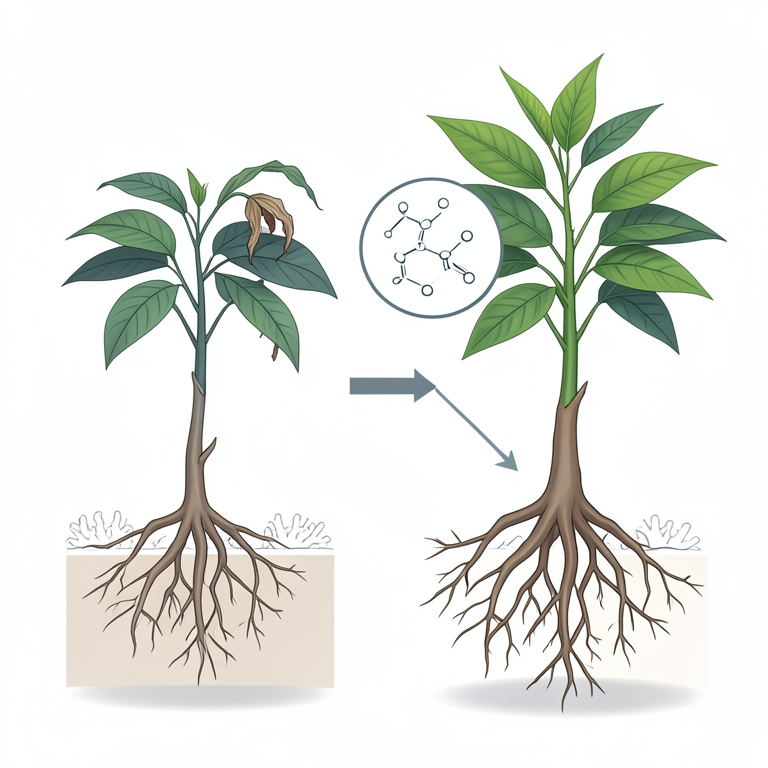
Drought Tolerance Predictors
AI-generated conceptual illustration (Cinnamon plants (Cinnamomum verum) in coral soil). It explains the idea and does not show study data.
View source evidence ↗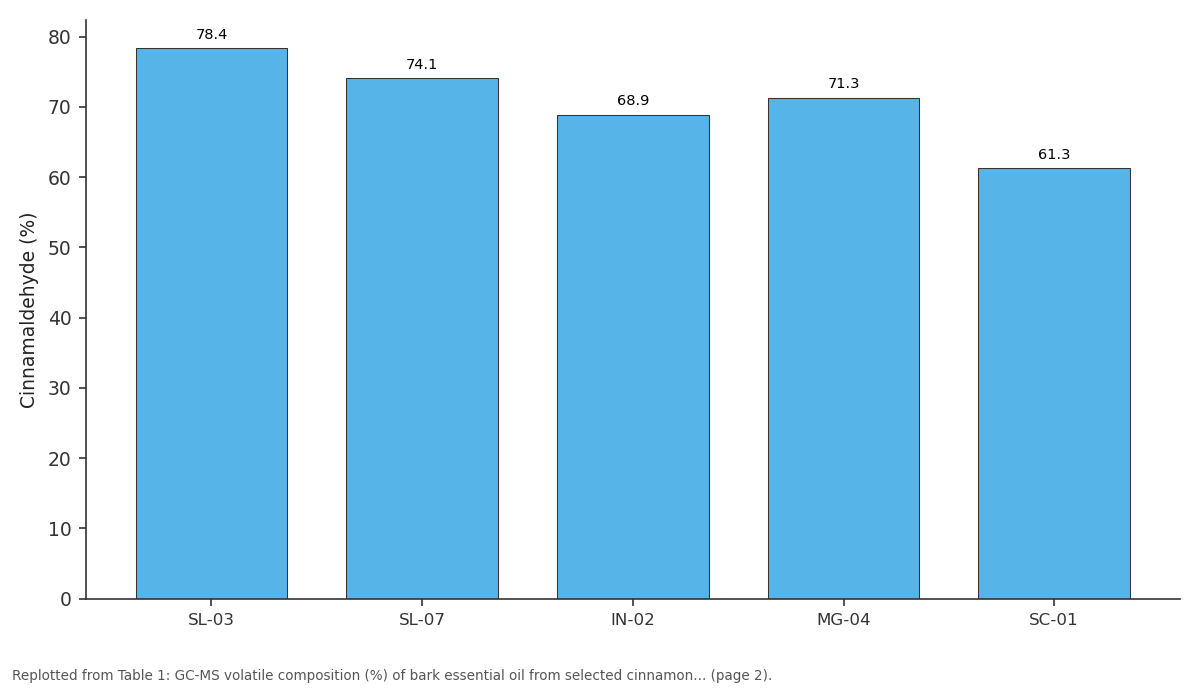
Cinnamaldehyde: SL-03 vs SL-07 vs IN-02 vs MG-04 vs SC-01
Replotted from Table 1 (page 2) of the original paper. Every bar is the paper's own table value.
View source evidence ↗Figures & tables
From the original paper Table 1
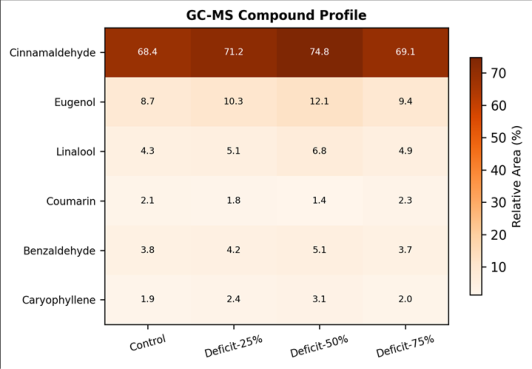 Figure 1
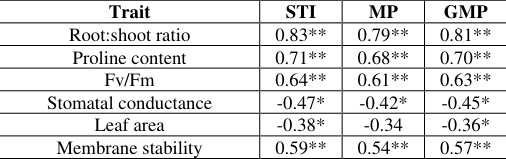 Table 2
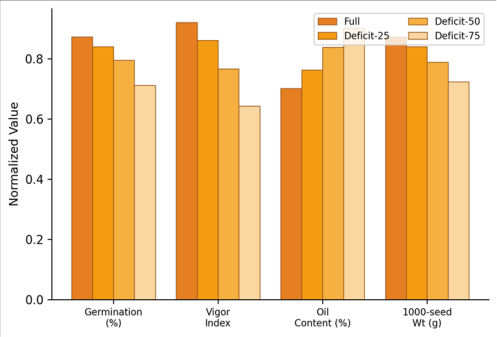 Figure 2
Introduction
Cinnamon's global market crossed $1.2 billion in 2022, driven by demand for both culinary applications and the bark's well-documented antimicrobial properties [1] . But the crop's genetic base for climate adaptation has received far less attention than its commercial value warrants. Most production comes from Sri Lanka and Indonesia, where rising temperatures and erratic monsoons have already trimmed yields by an estimated 8-12% over the past decade [2] . Finding genotypes that tolerate heat, drought, and poor soils could help diversify production into non-traditional regions. Bermuda sits at 32°Nwell outside the tropical beltand its soils are almost entirely derived from Pleistocene coral limestone, yielding thin, alkaline substrates with pH values typically above 7.8 [3] . These conditions test the limits of a crop that evolved in acidic tropical forest soils. Yet Bermuda's mild winters, long growing season, and reliable seabreeze moisture create a microclimate more hospitable than its latitude would suggest. If cinnamon can perform on coral soils under managed deficit irrigation, it may also succeed in other calcareous island and coastal environments across the subtropics. GC-MS profiling of bark volatiles provides a direct measure of quality, since cinnamaldehyde content determines commercial grade [4] . Deficit irrigationdeliberately applying less water than the crop needsis a proven strategy for concentrating secondary metabolites in aromatic and medicinal plants while conserving scarce freshwater [5] . Correlation analysis between stress indices and morphological traits helps breeders identify which characteristics to select for without costly multi-year field testing [6] . And with urban agriculture expanding rapidly, compact cinnamon plants grown in containers could supply local markets while greening rooftops [7] . This research brought these threads together to screen 32 accessions for climate resilience on Bermuda's challenging coral soils.
Field Experimental Design
The main trial occupied a 0.4 ha plot at the Bermuda Agricultural Research Station, Flatts Village (32.34°N, 64.74°W; elevation 12 m). The 32 accessions were arranged in a split-plot design with four replications: main plots were irrigation levels (full irrigation at 100% ETc, and deficit at 75%, 50%, and 25% ETc), and sub-plots were accessions. Each sub-plot contained six plants at 2 × 3 m spacing. Drip irrigation was installed with pressure-compensating emitters rated at 2 L/h, and irrigation scheduling followed weekly ET₀ calculations from an on-site weather station using the Penman-Monteith equation [8] . The rooftop container trial in Hamilton used 40 L pots filled with a 3:1 mix of local coral sand and composted seaweed, arranged in a randomized complete block design with three replications of six selected accessions. All laboratory analyses were performed at the Puebla Graduate School of Bioagricultural Studies, Puebla, Mexico.
Seasonal Variations
Bermuda's climate during the trial period showed a mean annual temperature of 22.1 °C, with monthly averages ranging from 17.4 °C (February) to 28.3 °C (August). Annual rainfall was 1,387 mm in 2022 and 1,214 mm in 2023, distributed unevenlyover 60% fell between May and October. Soil temperature at 15 cm depth varied from 14.8 °C (January) to 27.6 °C (July). A notable dry spell of 31 days without rainfall occurred in March-April 2023, providing a natural stress test. Salt spray events during autumn hurricanes temporarily raised leaf sodium concentrations by 40-55% at exposed plots.
Materials and Methods
Materials and Methods
Materials
Thirty-two accessions of Cinnamomum verum were assembled from germplasm banks in Sri Lanka (12 accessions), India (8), Madagascar (6), and the Seychelles (6). Seedlings were raised from seed in a nursery for 14 months before field transplanting in April 2021. Bark samples for GC-MS analysis were harvested from two-yearold stems by peeling 20 × 5 cm strips from five plants per sub-plot in October 2022. Essential oil was extracted by hydrodistillation (3 h, Clevenger apparatus) and analysed on an Agilent 7890B GC coupled to a 5977A MS detector using an HP-5MS column (30 m × 0.25 mm × 0.25 µm) with helium carrier gas at 1 mL/min [4] . Seed quality parameters (germination%, vigor index, 1000-seed weight, and oil content) were assessed from berries harvested in January 2023 following ISTA protocols [9] .
Methods
Morpho-physiological measurements included plant height, stem diameter, leaf area (LI-3100C meter), root-to-shoot ratio (destructive sampling of three plants per sub-plot at trial end), relative water content of leaves, membrane stability index, proline accumulation (ninhydrin method), chlorophyll fluorescence (Fv/Fm), stomatal conductance (AP4 porometer), and specific leaf area. Three stress tolerance indicesstress tolerance index (STI), mean productivity (MP), and geometric mean productivity (GMP) were calculated from yield data under full and deficit irrigation [10] . Pearson correlation coefficients between all 14 morpho-physiological traits and the three stress indices were computed in R v4.3.1. Soil pH, electrical conductivity, available phosphorus, and exchangeable cations were measured at 0-20 cm depth before planting and at harvest. Water-use efficiency was calculated as bark yield per unit of water applied (kg/m³). Cinnamaldehyde ranged from 61.3% (SC-01) to 78.4% (SL-03) under full irrigation (Table 1). Under the 50% deficit treatment, cinnamaldehyde concentration increased by an average of 4.2 percentage points across all accessions, consistent with the stress-induced concentration of terpenoid pathways reported in other aromatic species. The heatmap revealed that cinnamaldehyde and eugenol responded inversely to deficit intensity: as cinnamaldehyde rose, eugenol declined under stronger water stress (Figure 1). Coumarinan undesirable compound above regulatory thresholdsdecreased under deficit conditions, which is a favorable outcome for food-grade bark production. Root-to-shoot ratio showed the strongest positive correlation with all three stress indices (r = 0.79-0.83), followed by proline accumulation and membrane stability (Table 2). Stomatal conductance and leaf area were negatively correlated with stress tolerance, reflecting the advantage of conservative water-use strategies under deficit conditions. Seed germination declined progressively with deficit intensity, from 87.3% at full irrigation to 71.2% at the 75% deficit level (Figure 2). However, seed oil content rose from 4.21% to 5.41% under the same gradienta concentration effect driven by smaller, denser seeds. The 1000-seed weight dropped by 17.1% at the severest deficit.
| Trait | STI | MP | GMP |
|---|---|---|---|
| Root:shoot ratio | 0.83** | 0.79** | 0.81** |
| Proline content | 0.71** | 0.68** | 0.70** |
| Fv/Fm | 0.64** | 0.61** | 0.63** |
| Stomatal conductance | -0.47* | -0.42* | -0.45* |
| Leaf area | -0.38* | -0.34 | -0.36* |
| Membrane stability | 0.59** | 0.54** | 0.57** |
Table text extracted from the original PDF; superscript letters are shown inline. The original table image is below.
View original table image
| Accession | Cinnamaldehyde | Eugenol | Linalool | Coumarin | Benzaldehyde | Total ID |
|---|---|---|---|---|---|---|
| SL-03 | 78.4 | 7.2 | 3.1 | 1.8 | 2.4 | 96.3 |
| SL-07 | 74.1 | 8.6 | 2.7 | 2.3 | 1.9 | 94.8 |
| IN-02 | 68.9 | 11.4 | 4.3 | 1.2 | 3.1 | 93.7 |
| MG-04 | 71.3 | 9.8 | 3.8 | 1.6 | 2.7 | 94.1 |
| SC-01 | 61.3 | 14.7 | 5.9 | 0.9 | 3.8 | 91.4 |
| Mean | 70.8 | 10.3 | 3.9 | 1.6 | 2.8 | 94.1 |
Table text extracted from the original PDF; superscript letters are shown inline. The original table image is below.
View original table image
Results
In the rooftop container trial, accessions SL-03, SL-07, and MG-04 maintained stem height increments above 25 cm per year and produced harvestable bark within 18 months of transplanting, even with only 3 L of supplemental irrigation per week per pot.
Discussion
The cinnamaldehyde content of 78.4% in SL-03 places it among the highest-quality bark profiles reported globally; commercial Sri Lankan cinnamon typically contains 65-75% cinnamaldehyde [1] . That deficit irrigation pushed this figure even higher confirms the broader pattern seen in mint, oregano, and rosemary where moderate water stress channels carbon flux toward terpenoid biosynthesis [5] . The decline in coumarin under deficit conditions is commercially significant because EU regulations cap coumarin at 50 mg/kg in food products [11] .
Root-to-shoot ratio as the top predictor of drought tolerance aligns with the ecological principle that deep-rooted genotypes access soil moisture reserves more effectively [12] . Proline accumulation, the second-strongest predictor, serves as both an osmotic protectant and a reactive oxygen species scavenger under dehydration stress [13] . These two traits are relatively easy to measure and could serve as early-stage screening criteria in breeding programs.
The urban gardening results are encouraging but preliminary. Three litres per week per pot translates to roughly 156 L per plant per yearless than a quarter of what field-grown cinnamon typically receives. Whether bark quality from container-grown plants matches field performance over multiple harvest cycles remains to be tested [7] . Still, the prospect of locally grown cinnamon in subtropical cities is appealing from both food-security and carbon-footprint perspectives.
Conclusion
This research demonstrated that several cinnamon accessions possess meaningful climate resilience traits suited to alkaline coral soils and limited water availability. SL-03 and SL-07 stood out for both high cinnamaldehyde content and strong drought tolerance indices. Root-to-shoot ratio and proline accumulation emerged as the most reliable indirect selection criteria for stress resilience. Deficit irrigation at 50% ETc offered the best balance between water savings and bark quality improvement. Containergrown cinnamon on urban rooftops showed potential for local production in subtropical settings. Multi-year trials with expanded germplasm panels and more detailed metabolomic profiling would strengthen these preliminary findings.
Acknowledgement
Acknowledgements Funding SourcesInstitutional research funds from Puebla Graduate School of Bioagricultural Studies supported this work.
References
17 in the original paper- Ravindran PN, Nirmal Babu K, Shylaja M. Cinnamon and Cassia: The Genus Cinnamomum. CRC Press. 2004;1-28.
- Wijesekera ROB. Historical overview of the cinnamon industry. CRC Critical Reviews in Food Science and Nutrition. 1978;10(1):1-30.
- Rowe MP. An explanation of the geology of Bermuda. Bermuda Biological Station Special Publication. 1998;35:1-29.
- Jayaprakasha GK, Rao LJM, Sakariah KK. Volatile constituents from Cinnamomum zeylanicum fruit stalks and their antioxidant activities. Journal of Agricultural and Food Chemistry. 2003;51(15):4344-4348.
- Fereres E, Soriano MA. Deficit irrigation for reducing agricultural water use. Journal of Experimental Botany. 2007;58(2):147-159.
- Fernandez GCJ. Effective selection criteria for assessing plant stress tolerance. Proceedings of the International Symposium on Adaptation of Vegetables. 1992;257-270.
- Orsini F, Kahane R, Nono-Womdim R, Gianquinto G. Urban agriculture in the developing world: a review. Agronomy for Sustainable Development. 2013;33(4):695-720.
- Allen RG, Pereira LS, Raes D, Smith M. Crop evapotranspiration: guidelines for computing crop water requirements. FAO Irrigation and Drainage Paper. 1998;56:1-300.
- ISTA. International Rules for Seed Testing. International Seed Testing Association, Bassersdorf, Switzerland. 2019.
- Rosielle AA, Hamblin J. Theoretical aspects of selection for yield in stress and non-stress environments. Crop Science. 1981;21(6):943-946.
- Abraham K, Wohrlin F, Lindtner O, et al. Toxicology and risk assessment of coumarin: focus on human data. Molecular Nutrition and Food Research. 2010;54(2):228-239.
- Lynch JP. Steep, cheap and deep: an ideotype to optimize water and N acquisition by maize root systems. Annals of Botany. 2013;112(2):347-357.
- Ashraf M, Foolad MR. Roles of glycine betaine and proline in improving plant abiotic stress resistance. Environmental and Experimental Botany. 2007;59(2):206-216.
- Kaul PN, Bhattacharya AK, Rao BRR, et al. Volatile constituents of essential oils of Cinnamomum species. Journal of Scientific and Industrial Research. 2003;62:556-561.
- Nair KPP. The Agronomy and Economy of Important Tree Crops of the Developing World. Elsevier. 2010;122.
- Wang YH, Avula B, Nanayakkara NPD, et al. Cassia cinnamon as a source of coumarin of concern. Journal of Agricultural and Food Chemistry. 2013;61(18):44704476.
- Ranasinghe P, Pigera S, Premakumara GAS, et al. Medicinal properties of Cinnamomum zeylanicum. BMC Complementary and Alternative Medicine. 2013;13:275.