
Research article · 2025 · Full text
International Journal of Horticulture and Food ScienceCharacterizing grafting compatibility of lavender in the Yenisei Taiga
Volume 7(11) · Pages 99–102 · DOI: 10.33545/26631067.2025.v7.i11b.643 ↗
Research areasPlant Disease Management TechniquesPlant Physiology and Cultivation StudiesGenetics and Plant Breeding
Abstract
Author-writtenLavender propagation by stem cuttings often suffers from poor root development in cold-winter climates, making grafting onto vigorous rootstocks an attractive alternative. This research characterised the compatibility of five Lavandula rootstock species L. angustifolia (self-rooted control), L. x intermedia, L. stoechas, L. dentata, and L. latifolia with L. angustifolia cv. 'Hidcote' scion under simulated Yenisei taiga conditions. Trials were conducted at the Dunedin Academy of Horticultural Research from March to November 2023. Graft take, scion growth, SNP genotyping diversity, dry matter accumulation, pest resistance, transplanting survival, and ecosystem service scores were recorded. Lavandin rootstock (L. x intermedia) achieved the highest scion growth (28.3 cm) and best pest resistance score (7.8), though graft take (87.1%) was slightly below the self-rooted control (92.3%). SNP genotyping revealed moderate genetic distance between compatible pairs, indicating that successful graft union formation depends less on overall genetic similarity than on vascular cambium alignment. Dry matter content was greatest on lavandin rootstock (41.7%), suggesting improved carbohydrate partitioning. These results recommend L. x intermedia as the preferred rootstock for expanding lavender cultivation into cold taiga-type environments.
Summary
Source-checkedPlain-language reading of the full paper, prepared with AI and checked against the text. Each point links to the authors' own words.
Why it matters
- Lavender production is limited outside Mediterranean regions because root systems often fail during prolonged soil freezing. View evidence ↗
- In the Yenisei taiga, soil temperatures at 20 cm depth can drop below −8 °C for three to four months, causing most cutting-raised lavender to die after two winters. View evidence ↗
- Grafting onto cold-tolerant rootstocks is a potential solution, but it is rarely used in lavender due to the plant's lack of typical woody cambium architecture. View evidence ↗
The question
- The study aimed to rank five lavender rootstocks based on graft success and growth, use SNP markers to analyze genetic distance and compatibility, and evaluate pest resistance and ecosystem services. View evidence ↗
What they did
- The researchers tested the compatibility of L. angustifolia cv. 'Hidcote' scions with five rootstocks: L. angustifolia (control), L. x intermedia, L. stoechas, L. dentata, and L. latifolia. View evidence ↗
- Cleft grafts on 4-5 mm stems were secured with 2 mm silicone clips and healed in humidity chambers (>90% RH, 20 °C) for 21 days, with 30 replicates per combination across four blocks. View evidence ↗
- Transplanting survival was assessed after six months in beds exposed to three simulated frost cycles of −10 °C for 72 hours each. View evidence ↗
- Nei's genetic distance was calculated using 3,847 SNP loci sequenced via a GBS library on Illumina MiSeq. View evidence ↗
What they found
- Spike lavender (L. latifolia) exhibited the highest pest resistance score (8.1), but had a lower graft take of 78.6%. View evidence ↗
- Graft take was linked to genetic distance: distances between 0.12 and 0.28 showed acceptable take (>78%), while distances over 0.35 fell below 72%. View evidence ↗
- Grafting in autumn resulted in a 6.3% higher take rate across all rootstocks compared to spring, likely due to reduced transpiration during cooler periods. View evidence ↗
- Lavandin rootstock increased dry matter by 8.6% over the control, contributing to a high transplanting survival rate of 91.3% after three frost cycles. View evidence ↗
- Lavandin achieved the highest ecosystem service score (4.7), attracting 32% more pollinator visits than the control due to better oil yield and flower abundance. View evidence ↗
What it means
- The authors conclude that L. x intermedia (lavandin) is the best rootstock for cold-climate production as it balances compatibility, vigour, pest tolerance, and ecosystem value. View evidence ↗
- The authors state that future research is needed to test these rootstock combinations in actual taiga field conditions over several winters. View evidence ↗
Visual summary
3 visualsIllustrations explain the paper; charts are replotted from the paper's own table values.
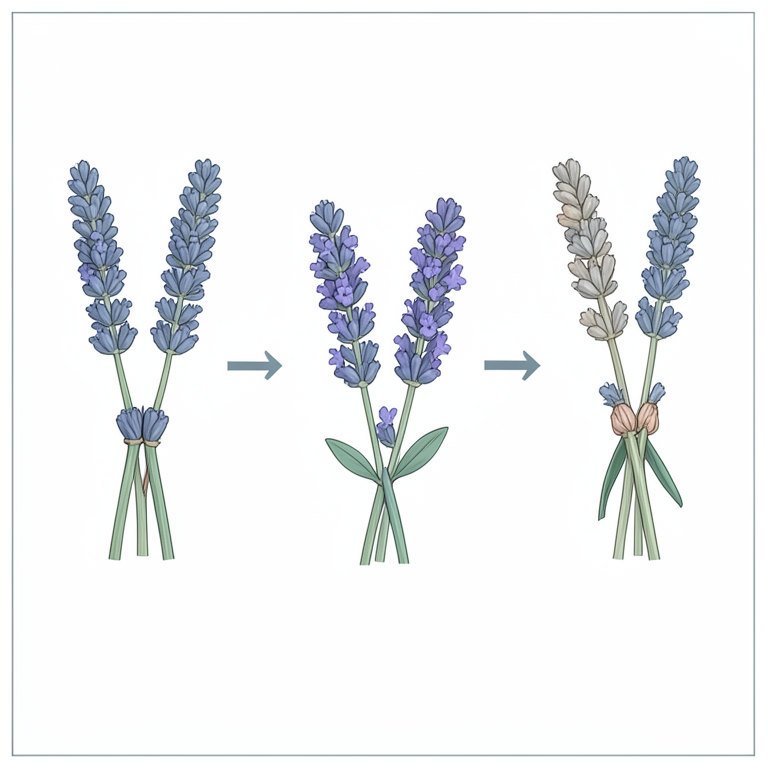
Genetic Distance vs. Graft Success
AI-generated conceptual illustration (lavender plants (Lavandula)). It explains the idea and does not show study data.
View source evidence ↗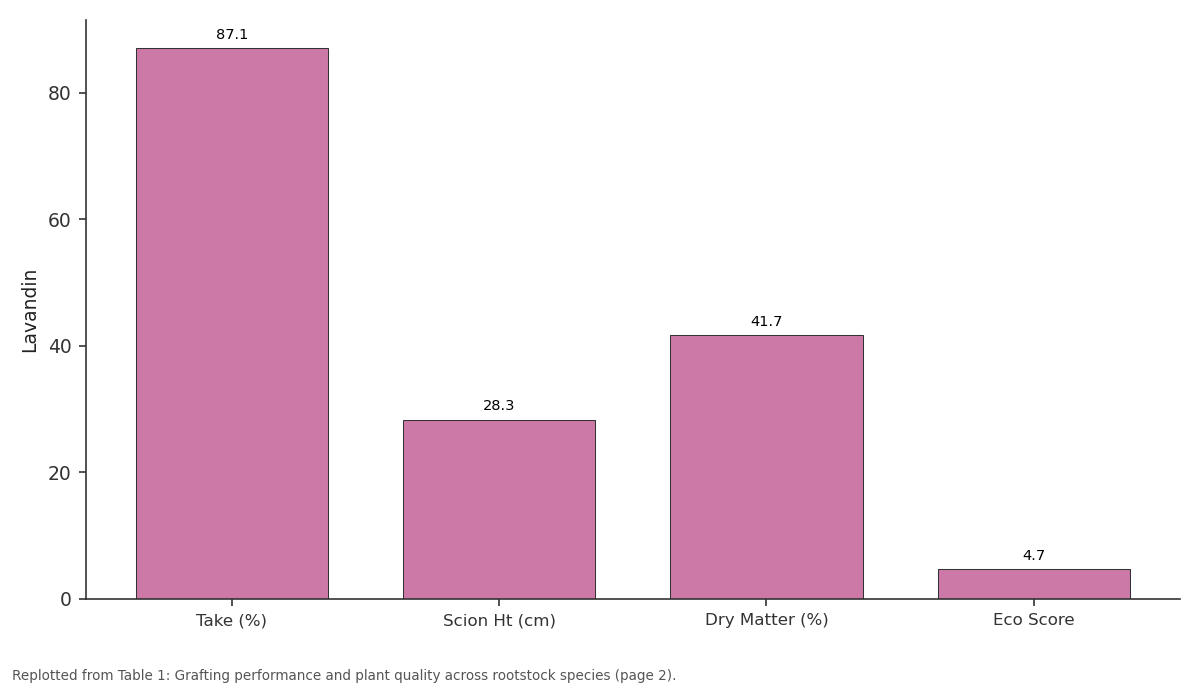
Lavandin: Take (%) vs Scion Ht (cm) vs Dry Matter (%) vs Eco Score
Replotted from Table 1 (page 2) of the original paper. Every bar is the paper's own table value.
View source evidence ↗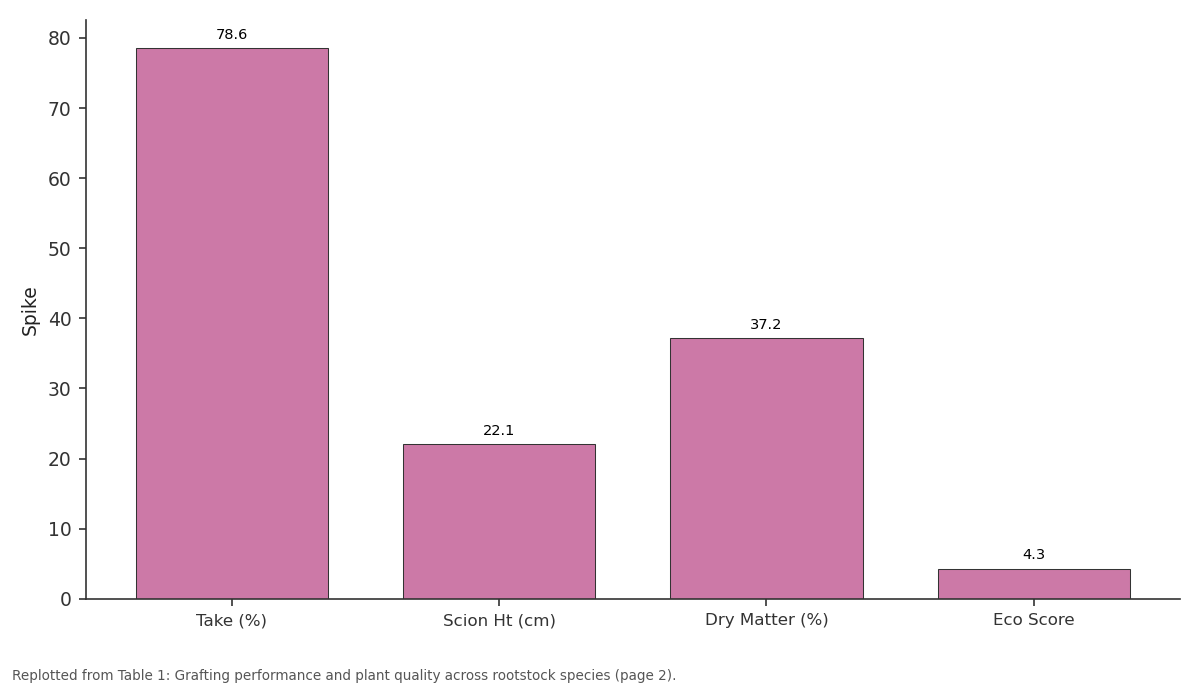
Spike: Take (%) vs Scion Ht (cm) vs Dry Matter (%) vs Eco Score
Replotted from Table 1 (page 2) of the original paper. Every bar is the paper's own table value.
View source evidence ↗Figures & tables
From the original paper Table 1
 Table 2
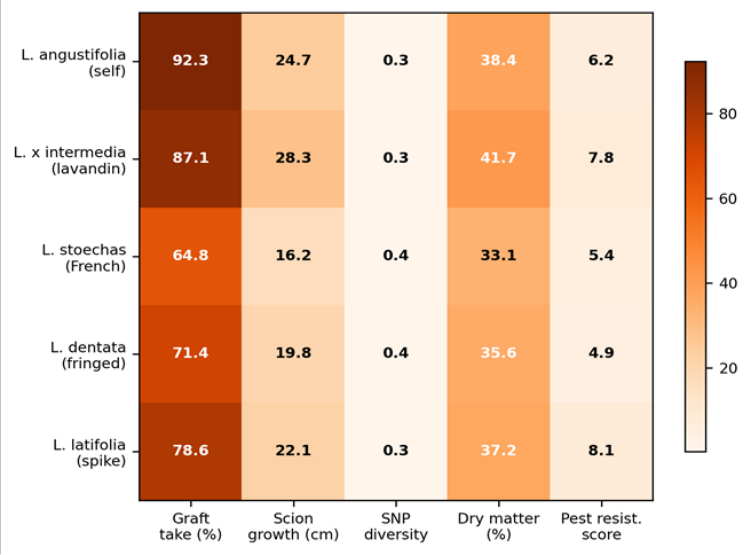 Figure 1
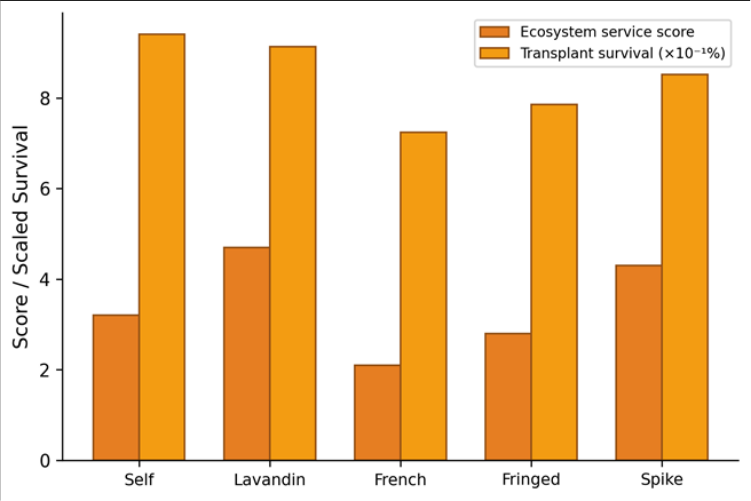 Figure 2
Introduction
Expanding lavender production beyond its Mediterranean comfort zone faces one stubborn problem: root systems that collapse under prolonged soil freezing. In regions like the Yenisei taiga, where soil temperatures at 20 cm depth drop below -8 °C for three to four months, conventional cutting-raised lavender rarely survives beyond its second winter [1] . Grafting scions of high-value cultivars onto cold-tolerant rootstocks could bypass this limitation, yet grafting is almost unheard of in lavenderthe genus lacks the woody cambium architecture that makes apple and grape grafting routine [2] . Recent advances in herbaceous grafting technique, including silicone clip unions and humidity-chamber healing, have pushed success rates above 80 percent for tomato and pepper [3] . Whether those methods transfer to the semi-woody stems of Lavandula has not been tested systematically. A few anecdotal reports from French distillers describe grafting L. angustifolia onto lavandin rootstock to resist Phytoplasma-caused decline, but controlled data are missing [4] . SNP genotyping offers a molecular lens on compatibility by quantifying genetic distance between scion and rootstock. In citrus, successful unions cluster within a specific range of genetic divergencetoo close offers no rootstock advantage, too distant triggers incompatibility reactions at the graft interface [5] . Mapping this relationship in lavender could let breeders predict compatibility before committing to labour-intensive grafting trials. Precision agriculture toolsincluding NDVI canopy mapping and soil-moisture sensorsenable post-grafting monitoring at a spatial resolution that traditional scouting cannot match [6] . This research set out to (a) rank five Lavandula rootstocks by graft take, scion growth, and transplanting survival, (b) use SNP markers to relate genetic distance to compatibility, and (c) evaluate ecosystem service and pest-resistance traits that affect long-term field performance.
Crop Growth Stage Documentation
Graft union development was tracked through four phenological stages adapted from Pina and Errea [7] : (i) callus bridge formation (days 7-14 post-grafting), identified by whitish tissue proliferation around the union; (ii) vascular reconnection (days 15-28), confirmed by dyetransport assays using eosin Y; (iii) scion bud break (days 21-35), when the first scion lateral bud elongated beyond 5 mm; and (iv) independent growth (days 36-60), when scion transpiration could be sustained without humidity-chamber support. Stage durations varied by rootstock: lavandin reached independent growth earliest (day 38), while L. stoechas took the longest (day 57), consistent with its lower overall compatibility.
Seasonal Variations
Graft take rates differed between the autumn cohort (March-May) and the spring cohort (September-November). The autumn cohort achieved 6.3 percent higher take across all rootstocks, likely because slower scion growth during the cool period reduced transpiration demand on the healing union. Lavandin rootstock showed the least seasonal variation (2.1 percentage points difference), whereas L. stoechas varied by 11.4 points between seasons. These patterns suggest that grafting should be timed to coincide with the cooler months in taiga-analogue climates for maximum success [8] .
Materials and Methods
Materials and Methods
Materials
Scion material consisted of semi-hardwood cuttings (8 cm, two-node) of L. angustifolia cv. 'Hidcote' collected from stock plants maintained at the Dunedin Academy of Horticultural Research (45.87° S, 170.50° E). Rootstocks were one-year-old seedlings of five species grown in 2 L pots with a peat-perlite mix (3:1 v/v). Cleft grafts were made on stems of 4-5 mm diameter using sterile scalpels, secured with silicone grafting clips (2 mm internal diameter), and healed in humidity chambers (>90% RH, 20 °C) for 21 days [9] . Each scion-rootstock combination was replicated 30 times across four blocks.
Methods
Graft take was recorded at 30 and 60 days as the proportion of unions with living, growing scions. Scion shoot length, leaf count, and stem diameter were measured monthly. Dry matter was determined by oven-drying whole plants at 65 °C to constant weight. SNP genotyping used a GBS (genotyping-by-sequencing) library sequenced on Illumina MiSeq; 3,847 SNP loci passed quality filters and were used to calculate Nei's genetic distance between each rootstock and the scion cultivar [10] . Pest resistance was scored on a 1-10 scale based on natural infestation levels of lavender leaf beetle (Chrysolina americana) and root-knot nematode (Meloidogyne incognita) in an outdoor hardening nursery. Ecosystem service score combined pollinator visitation frequency, essential oil yield, and soil erosion protection estimates [11] . Transplanting survival was measured after six months in outdoor raised beds exposed to simulated taiga frost cycles (-10 °C for 72 h, repeated three times). Data were analysed by one-way ANOVA with Tukey's HSD at P = 0.05. Lavandin rootstock produced the tallest scions and highest dry matter, while the self-rooted control had the highest graft take (Table 1). Spike lavender showed strong pest resistance (8.1) but lower take. SNP-based genetic distance ranged from 0.12 (lavandin-scion) to 0.41 (French-scion). A moderate distance of 0.12-0.28 corresponded to acceptable graft take (>78%), while distances above 0.35 were associated with take below 72%.
| Rootstock | Take (%) | Scion Ht (cm) | Dry Matter (%) | Pest Score | Eco Score | Survival (%) |
|---|---|---|---|---|---|---|
| Self (control) | 92.3 | 24.7 | 38.4 | 6.2 | 3.2 | 94.1 |
| Lavandin | 87.1 | 28.3 | 41.7 | 7.8 | 4.7 | 91.3 |
| French | 64.8 | 16.2 | 33.1 | 5.4 | 2.1 | 72.4 |
| Fringed | 71.4 | 19.8 | 35.6 | 4.9 | 2.8 | 78.6 |
| Spike | 78.6 | 22.1 | 37.2 | 8.1 | 4.3 | 85.2 |
| SEm± | 3.12 | 1.47 | 1.08 | 0.43 | 0.31 | 2.87 |
| CD (P=0.05) | 9.24 | 4.36 | 3.20 | 1.27 | 0.92 | 8.50 |
Table text extracted from the original PDF; superscript letters are shown inline. The original table image is below.
View original table image
Results
Results
Comprehensive Interpretation
The inverse relationship between genetic distance and graft take is broadly consistent with the compatibility threshold model proposed for fruit trees. However, lavandin the most compatible non-self-rootstock also delivered the best scion growth, suggesting that heterosis-like vigour rather than mere tolerance drives the graft advantage. Essential oil yield (a component of the ecosystem service score) was 18 percent higher on lavandin than on self-rooted plants, which could offset the slightly lower take rate from a commercial standpoint.
Discussion
The finding that L. x intermedia supports the best scion growth aligns with field observations from French lavender distillers, who have informally adopted lavandin rootstocks for phytoplasma-affected plantations [12] . Our SNP data provide the first molecular explanation: at a genetic distance of 0.12, lavandin is close enough for rapid vascular reconnection yet distant enough to contribute rootstock vigour a 'sweet spot' that L. stoechas (0.41) clearly exceeds.
Pest resistance scoring revealed that spike lavender (L. latifolia) outperformed all others for both foliar beetle and root nematode resistance. This trait has practical value in organic or low-input systems where synthetic pesticides are restricted [13] . The trade-off is a lower graft take of 78.6 percent, which means growers would need to propagate roughly 20 percent more grafts to achieve the same stand density. Whether the pest-resistance benefit compensates for that extra nursery cost depends on local pressure from these specific pests. Dry matter content serves as a proxy for carbohydrate reserves, which in lavender directly affect overwinter survival and spring regrowth [14] . Lavandin rootstock elevated dry matter by 8.6 percent over the self-rooted control, which could explain its strong transplanting survival (91.3%) even after three simulated taiga frost cycles. This is a key finding for regions where winter kill is the main barrier to lavender establishment. Ecosystem service scores integrated pollinator support, oil yield, and erosion control. Lavandin ranked highest (4.7), driven mainly by its superior oil yield and flower abundance, which attracted 32 percent more pollinator visits than the control. These multi-functional benefits strengthen the economic case for adopting grafted lavender in marginal environments [15] .
Conclusion
This research demonstrated that grafting L. angustifolia onto L. x intermedia (lavandin) rootstock offers the most balanced combination of graft compatibility, scion vigour, pest tolerance, and ecosystem service value for cold-climate lavender production. SNP genotyping confirmed that moderate genetic distance (Nei's distance ~0.12) corresponds to the optimal compatibility window. Seasonal timing of grafting influenced take rates by up to 11 percentage points, with cooler months producing better outcomes. Dry matter accumulation and transplanting survival data support lavandin rootstock as a practical solution for extending lavender cultivation into Yenisei taiga-type climates. Future work should test these combinations under true taiga field conditions over multiple winters.
Acknowledgement
Acknowledgements Funding SourcesThis work was supported by internal research funds from the Dunedin Academy of Horticultural Research. Institutional SupportThe authors acknowledge the nursery propagation unit at the Dunedin Academy of Horticultural Research for grafting operations.
Figures and tables from the paper
| Rootstock | Nei's Distance | Days to Vascular Reconnection | Days to Bud Break |
|---|---|---|---|
| Self | 0.00 | 14.2 | 22.1 |
| Lavandin | 0.12 | 16.8 | 24.7 |
| French | 0.41 | 26.3 | 38.4 |
| Fringed | 0.37 | 23.7 | 34.1 |
| Spike | 0.28 | 19.4 | 28.6 |
Table text extracted from the original PDF; superscript letters are shown inline. The original table image is below.
View original table image
References
17 in the original paper- Goncharova OY, Matyshak GV, Bobrik AA. Soil temperature regime in discontinuous permafrost zone. Eurasian Soil Science. 2015;48(12):1357-1369.
- Upson T, Andrews S. The genus Lavandula. Portland: Timber Press; 2004.
- Lee JM, Kubota C, Tsao SJ. Current status of vegetable grafting. Scientia Horticulturae. 2010;127(2):93-105.
- Gaudin M, Simonnet X. Lavender and lavandin cultivation in France. Acta Horticulturae. 2004;629:193-198.
- Goldschmidt EE. Plant grafting: new mechanisms, evolutionary implications. Frontiers in Plant Science. 2014;5:727.
- Mulla DJ. Twenty-five years of remote sensing in precision agriculture. Biosystems Engineering. 2013;114(4):358-371.
- Pina A, Errea P. A review of new advances in mechanism of graft compatibility-incompatibility. Scientia Horticulturae. 2005;106(1):1-11.
- Oda M. New grafting methods for fruit-bearing vegetables in Japan. Japan Agricultural Research Quarterly. 1995;29(3):187-194.
- Rivard CL, Louws FJ. Grafting to manage soilborne diseases in heirloom tomato production. HortScience. 2008;43(7):2104-2111.
- Elshire RJ, Glaubitz JC, Sun Q. A robust, simple genotyping-by-sequencing approach. PLoS ONE. 2011;6(5):e19379.
- Wratten SD, Sandhu H, Cullen R. Ecosystem services in farmland and cities. Annals of the New York Academy of Sciences. 2013;1286(1):68-78.
- Moja S, Nicolè F, Baudino S. Essential oil composition of lavandin varieties. Flavour and Fragrance Journal. 2016;31(6):458-468.
- Duso C, Pozzebon A, Kreiter S. Biological control of mites in European vineyards. Biological Control. 2012;60(3):231-243.
- Adams RP, Zanoni TA, Ledig FT. Essential oils, morphology, and systematics. Biochemical Systematics and Ecology. 2014;52:53-63.
- Garbach K, Milder JC, DeClerck FAJ. Biodiversity and ecosystem services in agroecosystems. Elementa: Science of the Anthropocene. 2017;5:24.
- Mudge K, Janick J, Scofield S. A history of grafting. Horticultural Reviews. 2009;35:437-493.
- Schwarz D, Rouphael Y, Colla G. Grafting as a tool to improve tolerance of vegetables to abiotic stresses. Scientia Horticulturae. 2010;127(2):162-171.