
Research article · 2026 · Full text
International Journal of Geography Geology and EnvironmentFood security, quality, and sustainability: A review of strategies for achieving 2030 SDGs in India and globally
Volume 8(5) · Pages 23–27 · DOI: 10.22271/27067483.2026.v8.i5a.749 ↗
Research areasFood Security and Socioeconomic DynamicsAgricultural Economics and PracticesAgriculture Sustainability and Environmental Impact
Abstract
Author-writtenFood security and food quality are central to achieving the United Nations Sustainable Development Goals (SDGs), particularly SDG 2 (Zero Hunger) and its interlinkages with health, poverty reduction, and environmental sustainability. This review paper analyzes the role of food security and food quality in achieving sustainable development in India and globally within the target timeline of 2030 and the extended vision toward 2047. Based on recent global reports, research studies, and policy frameworks (2023-2026), the paper highlights progress, challenges, and future strategies. Despite improvements in food production and availability, issues such as malnutrition, climate change, and inequality remain significant barriers. The study concludes that integrated approaches combining food security, quality, sustainability, and governance are essential to achieving SDGs.
Summary
Source-checkedPlain-language reading of the full paper, prepared with AI and checked against the text. Each point links to the authors' own words.
Why it matters
- Food security and quality are essential for meeting UN Sustainable Development Goals, especially SDG 2 (Zero Hunger), as they link to poverty reduction, health, and the environment. View evidence ↗
- The UN's SDG 2 specifically aims to end hunger, improve nutrition, and promote sustainable agriculture by the year 2030. View evidence ↗
- Food security is defined as the constant physical and economic access for all people to safe, sufficient, and nutritious food. View evidence ↗
The question
- The paper aims to analyze how food security and quality contribute to sustainable development in India and globally, targeting the 2030 goals and a vision for 2047. View evidence ↗
What they did
- The authors conducted a review based on policy frameworks, research studies, and global reports published between 2023 and 2026. View evidence ↗
What they found
- In 2024, approximately 673 million people, representing 8.2% of the global population, experienced hunger. View evidence ↗
- As of 2024, while 8.2% of the world population faces hunger, a larger portion (28%) faces moderate or severe food insecurity. View evidence ↗
- In India, more than 195 million people are undernourished, and 35.5% of children under the age of five experience stunting. View evidence ↗
- India faces a significant challenge with approximately 307 million people experiencing food insecurity. View evidence ↗
- The National Food Security Act of 2013 provides a legal entitlement to subsidized food grains for approximately 81 crore people in India. View evidence ↗
- The 2025 Sustainable Development Report ranked India 143rd out of 193 countries with an overall SDG score of 65.0. View evidence ↗
- Global acute food insecurity affected 266 million people in 2025. View evidence ↗
- Approximately 720 million people worldwide were undernourished in 2024. View evidence ↗
What it means
- The authors conclude that achieving the SDGs requires integrated approaches that combine governance, sustainability, food quality, and food security. View evidence ↗
- To meet the target timeline and the vision of Viksit Bharat @2047, a holistic approach integrating technology, governance, sustainability, and nutrition is necessary. View evidence ↗
Visual summary
1 visualsIllustrations explain the paper; they do not show study data.
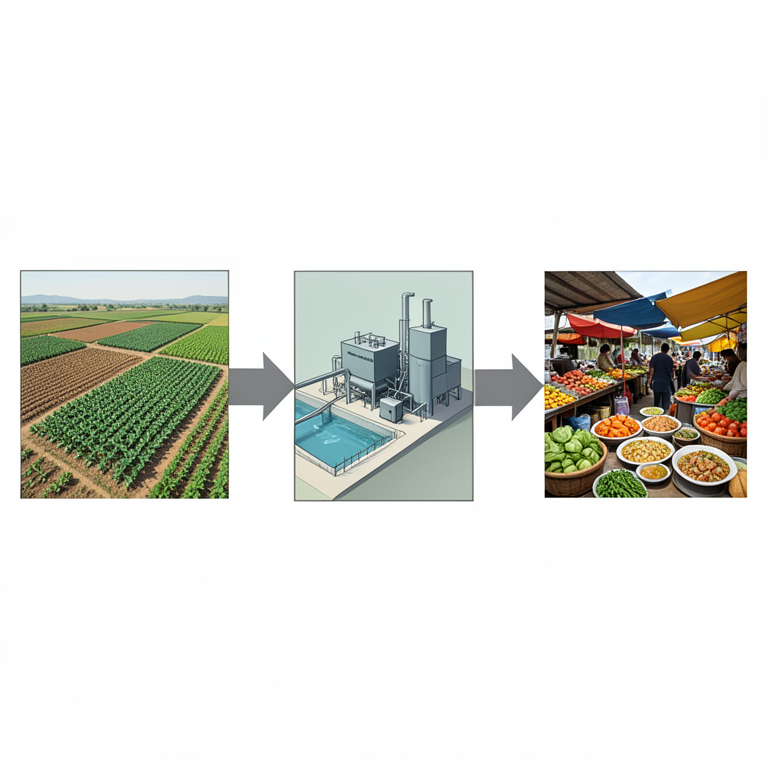
Integrated Approach to SDGs
AI-generated conceptual illustration (Agricultural landscapes and food systems in India). It explains the idea and does not show study data.
View source evidence ↗Introduction
Food security and food quality are critical determinants of sustainable development. The United Nations defined Sustainable Development Goal 2 (SDG 2) as ending hunger, achieving food security, improving nutrition, and promoting sustainable agriculture by 2030. Food security encompasses four pillars: • Availability • Accessibility • Utilization • Stability NAAS Rating (2026): 4.5 IJGGE 2026; 8(5): 23-27 Kumar P Executive Assistant, Haryana Dairy Development Co- operative Federation Limited, Government of Haryana, Haryana, India Jyoti Trained Graduate Teacher (Science), The Sanskar Plateau School, Hisar, Haryana, India Anita Masters of Arts, Swami Vivekanand Subharti University, Meerut, Uttar Pradesh, India Somveer Assistant Manager, Haryana Dairy Development Co- operative Federation Limited, Government of Haryana, Haryana, India Kumar P Executive Assistant, Haryana Dairy Development Co- operative Federation Limited, Government of Haryana, Haryana, India https://www.geojournal.net Globally, despite progress, hunger remains a serious concern. Around 673 million people (8.2% of the global population) experienced hunger in 2024.
India, despite being a major food producer, faces a paradox of surplus production and nutritional deficiency. 2. Concept of Food Security and Food Quality Food security exists when all people have constant physical and economic access to sufficient, safe, and nutritious food that meets dietary needs. It encompasses four main pillars- availability, access, utilization, and stability-often with sustainability and agency increasingly included. Food quality refers to the nutritional value, safety, and hygiene of this food. 3.
Food Security Food security is defined as access to sufficient, safe, and nutritious food for all people at all times. 4.3 SDG Progress • Hunger reduction progress is slow and uneven • Many countries are off track to achieve SDG 2 by 2030 5. Food Security Scenario in India India faces a "food paradox": it is a top global food producer yet struggles with widespread undernourishment, ranking 105th out of 127 countries in the 2024 Global Hunger Index with a score of 27.3, signaling serious hunger. Over 195 million people are undernourished, and 35.5% of children under five suffer from stunting 5.1 Achievements • Increased food grain production • Expanded Public Distribution System (PDS) • National Food Security Act implementation 5.2 Challenges • High population with food insecurity (~307 million) • Child malnutrition and stunting • Regional disparities 5.3 Government Initiatives India ensures food security through the National Food Security Act (NFSA) 2013, which legally entitles ~81 crore people to subsidized food grains. Key initiatives include PMGKAY (free food grains), PM POSHAN (mid-day meals), National Food Security Mission (crop production), and price controls via Bharat Dal/Atta.
These programs address availability, accessibility, and affordability of food. 3.1 Food Quality Food quality includes: • Nutritional value • Safety standards • Hygiene and processing quality • Food quality directly impacts: • Human health • Productivity • Economic development 4. Global Status of Food Security and SDGs Global food security is in a critical state, with hunger and malnutrition rising, far from the 2030 Zero Hunger (SDG 2) target. As of 2024, approximately 8.2% of the world population faces hunger, with 28% facing moderate or severe food insecurity. Driven by conflict, economic shocks, and climate change, over 673 million people are undernourished. 4.1 Hunger and Malnutrition Trends There are approx. 720 million people globally were undernourished in 2024.
Acute food insecurity affected 266 million people in 2025 across the globe. 4.2 Climate Change Impact • Extreme heat is reducing crop yields and livestock productivity • Food systems are being pushed to the brink due to climate stress • Climate change could significantly worsen global food insecurity https://www.geojournal.net 8. Challenges in Achieving SDGs According to the Sustainable Development Report 2025, India's SDG score is 65.0, ranking 143 out of 193 countries. Progress is visible in areas like health, energy access, and digital connectivity, but major challenges remain in gender equality, the environment, and institutional strength. 8.1 Climate Change • Extreme heat reduces agricultural productivity • Increases food insecurity 8.2 Population Growth • Rising demand for food • Pressure on resources 8.3 Food Loss and Waste • Significant post-harvest losses 8.4 Inequality • Unequal food distribution • Rural-urban disparities 9. Role of Sustainable Agriculture • Sustainable agriculture ensures: • Efficient resource use • Climate resilience • Biodiversity conservation UN recommends • Investment in resilient agri-food systems • Improved infrastructure and policies 10.
Role of Technology and Innovation Technology acts as a critical enabler and catalyst for innovation, accelerating the creation of new products, services, and business models while optimizing operational efficiency. It drives innovation by facilitating data-driven decision-making, enabling rapid prototyping, and fostering collaboration via tools like AI, cloud computing, and IoT. • National Food Security Act (NFSA) • Mid-Day Meal Scheme • Poshan Abhiyaan • India aims to ensure affordable and nutritious food access for all by 2027. 6. Role of Food Quality in Sustainable Development Food quality is central to sustainable development, linking human health directly to environmental stewardship and economic viability. High-quality, nutritious food ensures better health (SDG 3), while sustainable production methods protect ecosystems (SDG 15) and reduce food waste (SDG 12).
It promotes food security by minimizing waste and encouraging resilient, efficient agricultural systems. 6.1 Nutrition and Health • Food quality ensures: • Balanced diet • Reduced malnutrition • Improved immunity 6.2 Economic Productivity • Healthy populations contribute to: • Higher labor productivity • Economic growth 6.3 Food Safety • Prevention of foodborne diseases • Compliance with international standards 7. Link Between Food Security, Food Quality, and SDGs Food security and quality contribute to multiple SDGs: SDG Contribution 1. SDG 1 (No Poverty) Reduces hunger-related poverty 2. SDG 2 (Zero Hunger) Ensures food availability 3.
SDG 3 (Good Health) Improves nutrition 4. SDG 12 (Responsible Consumption) Promotes sustainable food systems 5. SDG 13 (Climate Action) Supports resilient agriculture https://www.geojournal.net 10.1 Digital Agriculture • Precision farming • Data-driven decision-making 10.2 Food Processing Technologies • Improved food quality • Reduced wastage 10.3 Biotechnology • Enhanced crop yield • Nutritional fortification 11. Opportunities for India and the World 11.1 Strengthening Food Systems • Integrated supply chains • Cold storage infrastructure 11.2 Policy and Governance have made progress, significant challenges remain.
A holistic approach integrating nutrition, sustainability, technology, and governance is essential to achieve SDGs within the target timeline and beyond (Viksit Bharat @2047).
Conclusion
Food security and food quality are fundamental to achieving sustainable development goals. While India and the world https://www.geojournal.net 3. Statista. Food security in India - statistics & facts. 2024. https://www.statista.com/topics/5013/food-security-in- india/ 4.
United Nations India. Nutrition and food security initiatives. 2023. https://india.un.org/en/sdgs/2 5. GK Today. State of food and nutrition in the world 2025. 2025. https://www.gktoday.in/topic/state-of-food- and-nutrition-in-the-world-2025/ 6.
Reuters. Global report on food crises. 2026. https://www.reuters.com/world/global-report-food- crises-2026/ 7. The Guardian. Extreme heat and food systems. 2026. https://www.theguardian.com/environment/2026/extre me-heat-food-systems 8.
Times of India. Climate impact on agriculture and food systems. 2026. https://timesofindia.indiatimes.com/india/climate- impact-on-agriculture/articleshow/2026.cms
References
2 in the original paper- FAO, IFAD, UNICEF, WFP, WHO. The state of food • Better implementation of food security programs 11.3 Global Cooperation security and nutrition in the world 2025. Rome: FAO; 2025.
- Our World in Data. Sustainable Development Goal 2: zero hunger. 2023. https://ourworldindata.org/sustainable-development- goal-2 • International trade • Knowledge sharing