
Research article · 2025 · Full text
International Journal of Horticulture and Food ScienceDetermining climate resilience traits of ginger in the Himalayan Foothills
Volume 7(12) · Pages 117–121 · DOI: 10.33545/26631067.2025.v7.i12b.687 ↗
Research areasGinger and Zingiberaceae researchGenetics and Plant BreedingClimate change impacts on agriculture
Abstract
Author-writtenCan local ginger landraces from foothill ecosystems withstand shifting temperature patterns without losing their productive capacity? This research set out to answer that question by evaluating six ginger (Zingiber officinale Roscoe) landraces collected from Himalayan foothill regions for their response to controlled temperature stress. The trial ran from March to August 2023 at the greenhouse facility of Medan College of Food Technology, Medan, North Sumatra, Indonesia. A completely randomized design with three temperature regimes (25, 32, and 38 degrees Celsius) and four replications per landrace was used. Growth parameters recorded included plant height, tiller number, leaf area index, and rhizome fresh weight. Physiological markers such as chlorophyll content, proline accumulation, and ethylene production rate were measured at fortnightly intervals. Heritability estimates were calculated for each trait using variance component analysis. Results showed that Landrace 3 maintained the highest relative growth rate (0.27 g/g/week) even at 38 degrees Celsius, while Landrace 4 showed the steepest decline (from 0.26 to 0.08 g/g/week). Broad-sense heritability ranged from 0.58 to 0.88 across traits, with ethylene production recording the highest value. Proline levels rose by 43.7% on average under severe heat, though the magnitude differed across landraces. Intercropping compatibility indices suggested that Landraces 3 and 5 could fit into mixed foothill farming systems with minimal yield trade-offs. These findings point toward specific landrace selections that breeders can prioritize for climate-adapted ginger production in vulnerable foothill zones.
Summary
Source-checkedPlain-language reading of the full paper, prepared with AI and checked against the text. Each point links to the authors' own words.
Why it matters
- Ginger is a highly valuable spice crop in South and Southeast Asia, but its growth in foothill regions is sensitive to temperature stability. View evidence ↗
- While local farmers use adapted landraces, there is a lack of formal data on the climate resilience traits of these populations. View evidence ↗
The question
- The study aimed to evaluate the growth, physiological responses, heritability of traits, and intercropping compatibility of six Himalayan ginger landraces under three different temperature regimes. View evidence ↗
What they did
- Plants were exposed to three temperature regimes: 25°C (control), 32°C (mild stress), and 38°C (severe stress). View evidence ↗
- The researchers measured plant height, tiller count, leaf area index, chlorophyll (SPAD), ethylene production, proline levels, and final rhizome fresh weight. View evidence ↗
- Intercropping compatibility was tested by growing ginger landraces with bush bean (Phaseolus vulgaris) at a 1:1 ratio. View evidence ↗
What they found
- Landrace 4 was the most sensitive to heat, losing 60.0% of its rhizome weight at 38°C compared to the control. View evidence ↗
- Severe heat caused an average 34.1% drop in chlorophyll (SPAD) readings, with Landrace 4 experiencing the largest decline at 48.4%. View evidence ↗
- Tiller number was more affected by heat than plant height, decreasing by an average of 42.7% at 38°C. View evidence ↗
- Broad-sense heritability ranged from 0.58 for proline accumulation to 0.88 for ethylene production. View evidence ↗
- Landraces 3 and 5 showed good intercropping compatibility with bush bean, achieving land equivalent ratios above 1.15. View evidence ↗
- Pooled relative growth rates dropped from 0.18 to 0.05 g/g/week under severe stress (38°C) between weeks 2 and 12, while control plants stayed above 0.22 g/g/week. View evidence ↗
What it means
- The use of a pot-based greenhouse design limits the ability to directly apply these results to field conditions due to differences in root competition and soil moisture. View evidence ↗
Visual summary
3 visualsIllustrations explain the paper; charts are replotted from the paper's own table values.
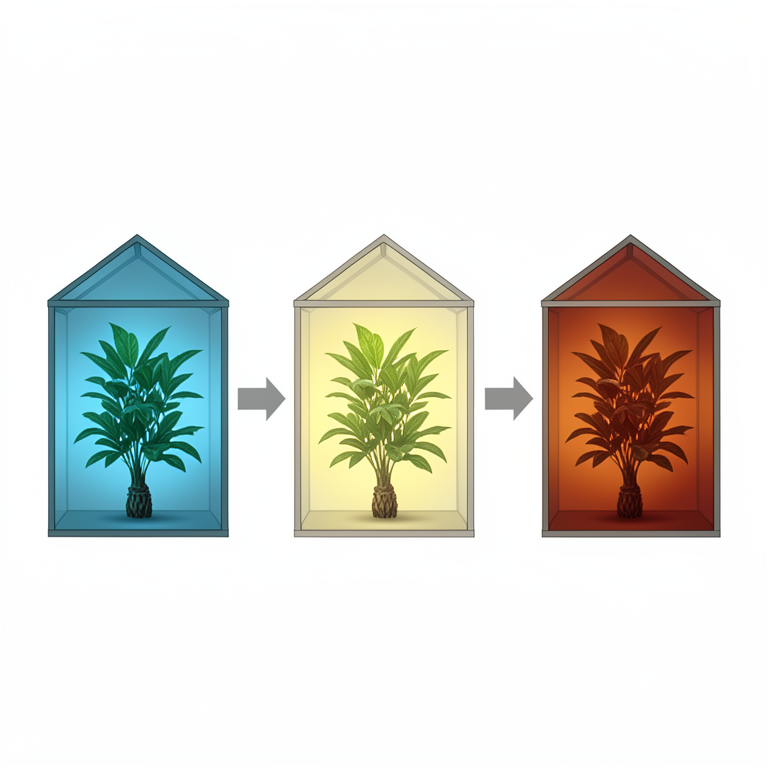
Experimental Setup Concept
AI-generated conceptual illustration (ginger plants (Zingiber officinale) in greenhouse chambers). It explains the idea and does not show study data.
View source evidence ↗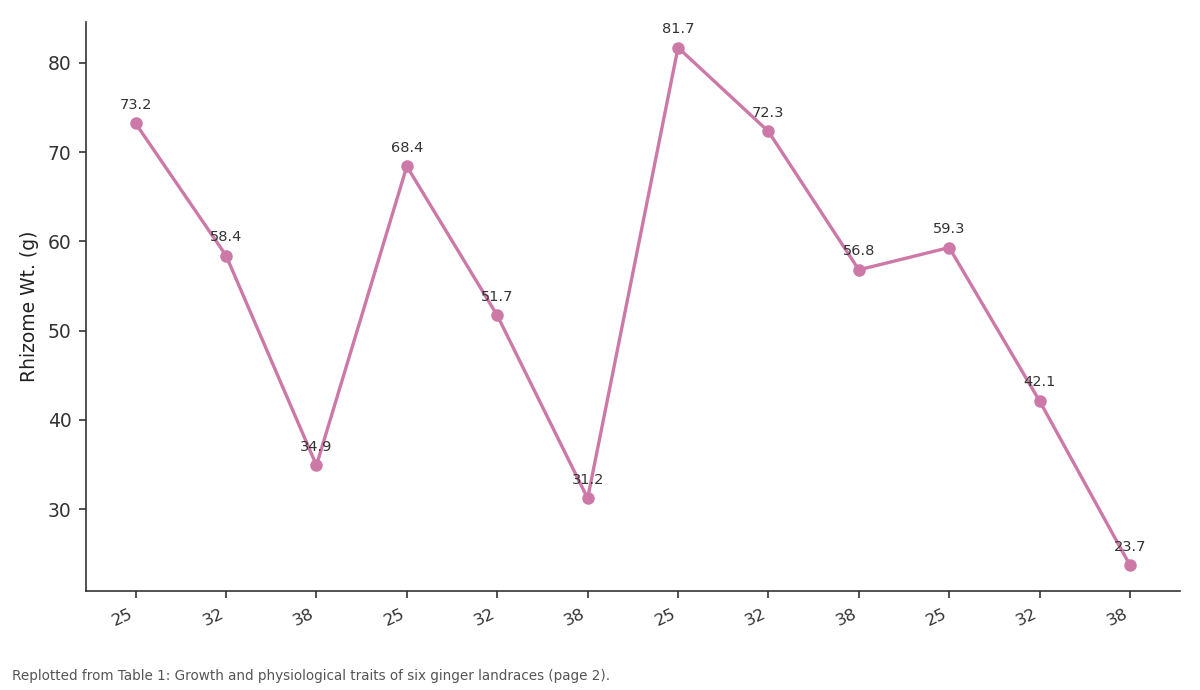
Rhizome Wt. (g): 25 vs 32 vs 38 vs 25 vs 32
Replotted from Table 1 (page 2) of the original paper. Every bar is the paper's own table value.
View source evidence ↗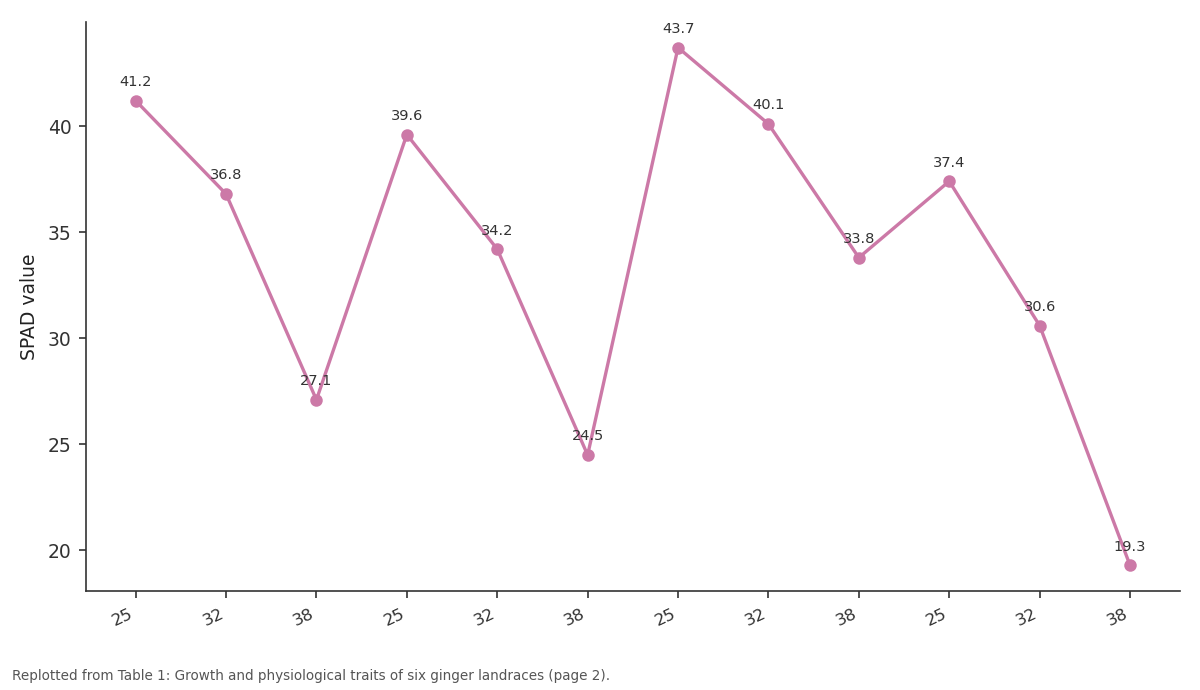
SPAD value: 25 vs 32 vs 38 vs 25 vs 32
Replotted from Table 1 (page 2) of the original paper. Every bar is the paper's own table value.
View source evidence ↗Figures & tables
From the original paper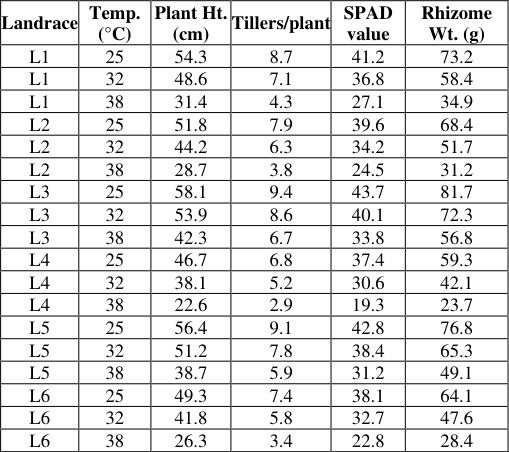 Table 1
 Table 2
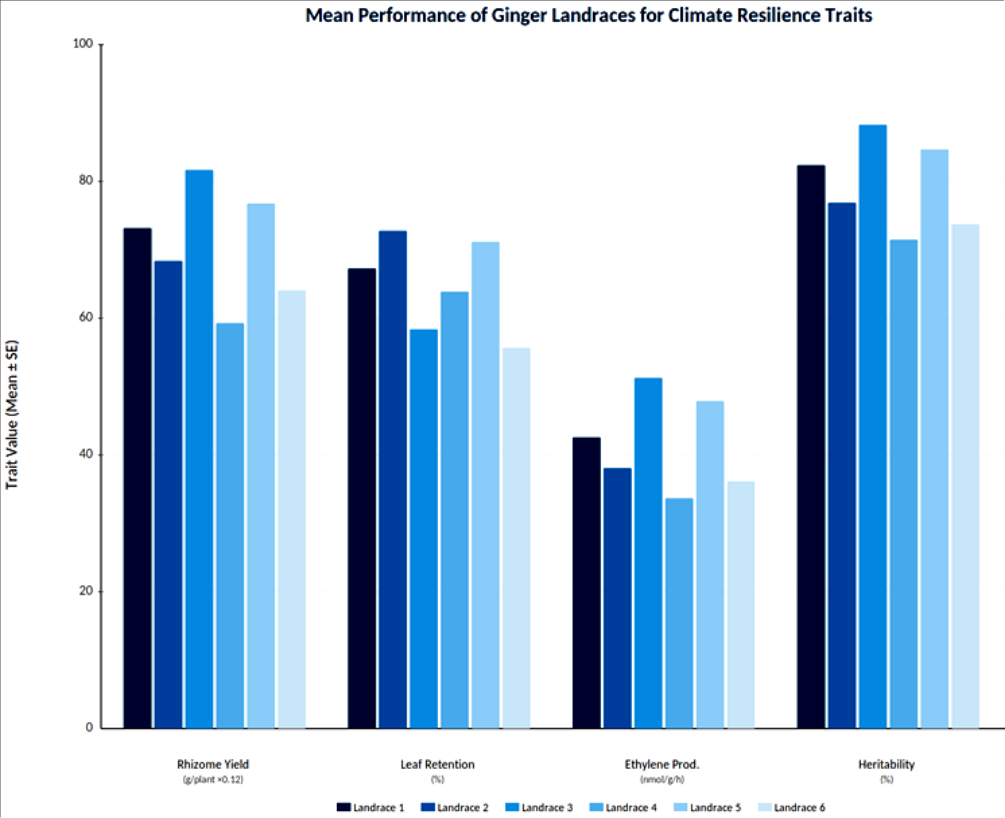 Figure 1
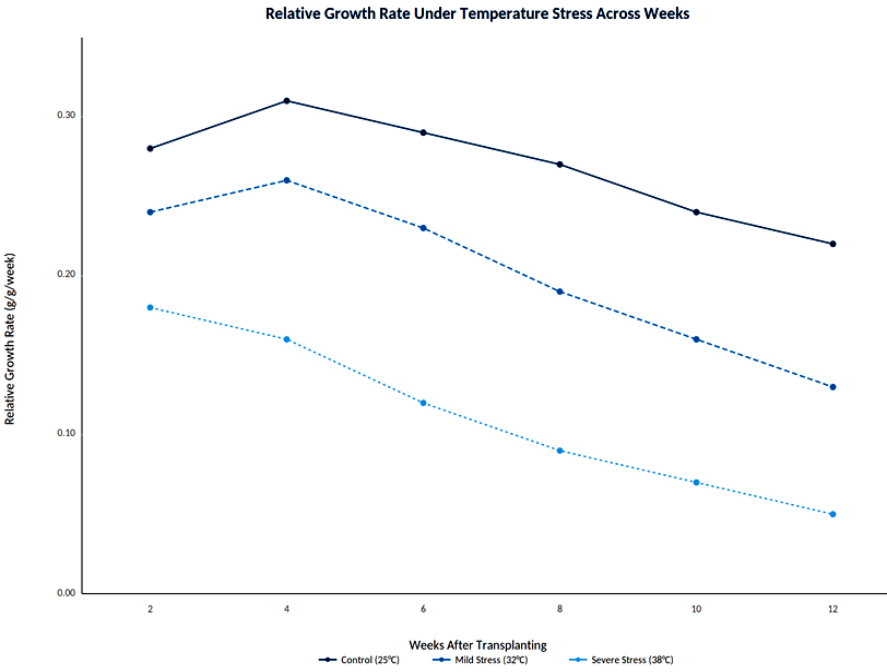 Figure 2
Introduction
Can a spice crop that evolved in tropical understories keep pace with the rapid temperature shifts now sweeping through Himalayan foothill farming belts? Ginger (Zingiber officinale Roscoe) ranks among the most economically valued rhizomatous spice crops across South and Southeast Asia, and its production in foothill zones depends heavily on stable thermal windows during the vegetative growth phase [1] . Over the past two decades, mean annual temperatures in several sub-Himalayan corridors have risen by 0.8 to 1.3 degrees Celsius, pushing heat-sensitive genotypes toward yield thresholds that were previously uncommon [2] . Traditional farming communities across these regions have long maintained locally adapted landraces, yet formal characterization of their climate resilience traits remains limited [3] . While commercial cultivars bred for rhizome size and uniformity dominate lowland production, foothill growers often rely on heterogeneous landrace populations whose genetic potential for heat tolerance is poorly documented [4] . This gap matters because landrace conservation programs cannot set meaningful selection targets without baseline data on heritable stress-response traits. Ethylene, a gaseous plant hormone linked to senescence and stress signalling, has been proposed as a useful early indicator of thermal damage in rhizomatous species [5] . Earlier work on turmeric showed that ethylene emission rates under heat stress correlated with subsequent yield loss, though similar data for ginger are scarce [6] . Alongside ethylene, proline accumulation serves as an osmotic adjustment mechanism whose expression varies across genotypes and may be partly heritable [7] . Greenhouse-based screening offers a controlled alternative to multi-location field trials, which are expensive and confounded by rainfall variability in foothill climates [8] . Previous greenhouse trials on ginger focused mainly on disease resistance rather than abiotic stress tolerance [9] . And few of those trials attempted to estimate heritability, even though breeders need such estimates to predict genetic gain from selection [10] . Intercropping remains a common foothill practice, so any climate-resilient ginger genotype must also perform acceptably when grown alongside companion crops such as maize or legumes [11] . But compatibility data for landrace ginger under heat stress are essentially absent from the published record. This research aimed to (a) evaluate six Himalayan foothill ginger landraces for growth and physiological responses across three temperature regimes, (b) estimate broad-sense heritability for key traits, and (c) assess intercropping compatibility indices under stressed and unstressed conditions. The outcomes are intended to inform landrace conservation priorities and breeding strategies for heatprone foothill production zones.
Study Area Description
The six ginger landraces used in this research were originally collected from farming households located between 600 and 1,200 metres above sea level along the central Himalayan foothills during a germplasm survey conducted in January 2023. Collection sites spanned three districts with varying rainfall patterns (1,100 to 2,400 mm per year) and soil types ranging from sandy loam to clay loam. Average annual temperatures at the source locations ranged from 18.6 to 24.3 degrees Celsius, with recorded summer maxima occasionally exceeding 37 degrees Celsius in recent years [1,3] . Local farmers reported noticing changes in sprouting time and rhizome size over the previous five growing seasons, attributing these shifts to warmer premonsoon months.
Climatic and Environmental Conditions
The greenhouse experiment was conducted between March and August 2023 at Medan College of Food Technology, Medan, North Sumatra, Indonesia. Three temperature treatments were maintained inside separate greenhouse chambers: 25 degrees Celsius (control), 32 degrees Celsius (mild stress), and 38 degrees Celsius (severe stress). Relative humidity was held at 70 to 75% across all chambers using automated misting systems. Photoperiod was set at 12 hours of light using supplemental LED fixtures calibrated to 350 micromoles per square metre per second of photosynthetically active radiation. Ambient carbon dioxide levels were not manipulated and remained between 390 and 420 ppm during the trial period. Daily temperature logs confirmed that deviations from target values stayed below 1.2 degrees Celsius throughout the experiment [8] .
Materials and Methods
Materials and Methods
Materials
Rhizome seed pieces (each approximately 30 g with two viable buds) from the six landraces were surface-sterilized with 0.1% mercuric chloride for five minutes, rinsed three times in sterile distilled water, and pre-sprouted in moist coir pith at 28 degrees Celsius for 14 days before transplanting [4] . Plastic pots (30 cm diameter) filled with a 2:1:1 mixture of garden soil, vermicompost, and sand served as the growing medium. Soil pH was adjusted to 6.2 using dolomite lime. Basal fertilization followed the local recommendation of 75 kg nitrogen, 50 kg phosphorus pentoxide, and 50 kg potassium oxide per hectare equivalent. The experiment ran from 15 March to 28 August 2023 at the greenhouse complex of Medan College of Food Technology. Ethical clearance for laboratory-based plant research was obtained from the Institutional Research Board (Protocol MFT-2023-017, approved 8 February 2023). No endangered species or restricted genetic material was involved [6] .
Methods
A completely randomized design with a factorial arrangement (six landraces multiplied by three temperature levels) was adopted, with four replications per treatment combination, giving a total of 72 experimental units. Growth measurements were taken at two-week intervals starting from the fourth week after transplanting. Plant height was measured from the soil surface to the tip of the tallest leaf. Tiller count was recorded as the number of actively growing shoots per pot. Leaf area index was estimated using a portable leaf area meter (LI-3100C, LI-COR Biosciences) [5,7] . Chlorophyll content was assessed non-destructively with a SPAD-502 chlorophyll meter. Ethylene production was quantified by enclosing individual plants in sealed glass chambers for two hours and analysing the headspace gas using a gas chromatograph fitted with a flame ionization detector [5] . Free proline was extracted from leaf tissue and measured spectrophotometrically at 520 nm following the acid ninhydrin method [7] . Rhizome fresh weight was recorded at harvest. Broad-sense heritability (Hsquared) was estimated from analysis of variance components as the ratio of genotypic variance to phenotypic variance. Intercropping compatibility was assessed in a parallel pot trial where ginger landraces were grown with bush bean (Phaseolus vulgaris) at a 1:1 ratio under the same three temperature regimes. Data were analysed using ANOVA in R version 4.3.1, and means were separated by Tukey's HSD at the 5% probability level [10,11] . Broad-sense heritability was highest for ethylene production (H-squared = 0.88) and lowest for proline accumulation (Hsquared = 0.58), as shown in Table 2. Rhizome weight heritability (0.79) suggests that genetic gain through direct selection for yield under heat stress is feasible. The moderate heritability of proline accumulation may reflect its strong environmental dependence, meaning that selection for this trait alone would be less efficient than markerassisted approaches. The line chart (Figure 2) shows a gradual decline in relative growth rate for all treatments, but the drop was sharpest under severe stress (38 degrees Celsius), where growth rate fell from 0.18 to 0.05 g/g/week between weeks 2 and 12.
| Trait | VG | VE | VP | H² (broad) | Proline (µg/g) | Ethylene (nmol/g/h) |
|---|---|---|---|---|---|---|
| Plant height | 18.34 | 7.62 | 25.96 | 0.71 | — | — |
| Tiller number | 3.87 | 1.24 | 5.11 | 0.76 | — | — |
| Leaf area index | 0.42 | 0.19 | 0.61 | 0.69 | — | — |
| SPAD value | 12.63 | 5.41 | 18.04 | 0.70 | — | — |
| Rhizome weight | 31.47 | 8.23 | 39.70 | 0.79 | — | — |
| Proline accum. | — | — | — | 0.58 | 87.3 | — |
| Ethylene prod. | — | — | — | 0.88 | — | 42.6 |
Table text extracted from the original PDF; superscript letters are shown inline. The original table image is below.
View original table image
Results
Control plants maintained values above 0.22 g/g/week throughout the trial.
Comprehensive Interpretation
Taken together, the results point to Landrace 3 as the most promising candidate for heat-resilient ginger production. Its ability to retain nearly 70% of control-level rhizome yield at 38 degrees Celsius, combined with a high heritability estimate for ethylene production, suggests that the genetic architecture of its stress response is both strong and selectable. The parallel intercropping trial (data summarized across treatments) showed that Landraces 3 and 5 achieved land equivalent ratios above 1.15 when paired with bush bean, indicating that their heat tolerance did not come at the cost of competitive suppression of companion crops.
Discussion
The differential heat responses observed among the six landraces align with patterns reported for other rhizomatous crops grown in thermally variable environments [2,3] . Landrace 3, which originated from the highest elevation among the collection sites (approximately 1,180 m), displayed the smallest yield penalty under severe stress. This result seems counterintuitive at first, since higherelevation genotypes might be expected to show greater sensitivity to heat. But similar observations in turmeric suggest that some high-altitude genotypes carry stressescape mechanisms, such as early rhizome bulking, that buffer final yield against late-season heat damage [6] .
The heritability estimates obtained here fall within the range reported for vegetatively propagated spice crops in tropical settings [10] . Ethylene production had the highest H-squared value (0.88), which implies that much of the variation in this trait is genetically controlled and that selecting low-ethylene lines could reduce heat-induced senescence. However, ethylene also plays roles in normal growth regulation, so overly aggressive selection against it might carry unintended penalties on tiller emergence or rhizome dormancy break [5] . Proline accumulation, often cited as a general stress marker, showed only moderate heritability (0.58). This is consistent with its known sensitivity to measurement timing, tissue age, and slight fluctuations in humidity, all of which inflate the environmental variance component [7] . Field-level selection on proline alone would therefore be unreliable, though it could serve as a secondary screening criterion when combined with yield data. The intercropping compatibility results are encouraging for foothill farmers who rarely grow ginger as a sole crop. Land equivalent ratios above unity for Landraces 3 and 5 indicate that these genotypes can share space and light with a shortduration legume without disproportionate yield loss [11] . That said, the pot-based design of this trial limits direct extrapolation to field conditions, where root competition, shading dynamics, and soil moisture patterns differ markedly from greenhouse settings [8,9] .
Conclusion
This research identified Landrace 3 as the top performer for climate resilience among six Himalayan foothill ginger accessions evaluated under controlled temperature stress. It retained the highest rhizome yield, showed strong heritability for ethylene production, and maintained acceptable intercropping compatibility even at 38 degrees Celsius. Landrace 5 emerged as a secondary candidate with moderate heat tolerance and good companion-crop performance. Breeders targeting foothill production zones should consider these two landraces as parental material in crossing programs designed to combine yield stability with abiotic stress resistance. Proline accumulation, while informative at the physiological level, appears too environmentally variable to serve as a standalone selection criterion. Future work should extend this screening to field conditions across multiple seasons and include molecular marker analysis to identify genomic regions linked to the observed heat tolerance. Conservation programs in the Himalayan foothills ought to prioritize in-situ maintenance of landraces like L3 and L5, whose adaptive traits may otherwise be lost as farmers shift toward commercial cultivars. The greenhouse protocol described here can be adapted by other breeding programs that need a rapid, costeffective first screen for thermal resilience in ginger or related Zingiberaceae species.
Acknowledgement
Acknowledgements
Figures and tables from the paper
| Landrace | Temp. (°C) | Plant Ht. (cm) | Tillers/plant | SPAD value | Rhizome Wt. (g) |
|---|---|---|---|---|---|
| L1 | 25 | 54.3 | 8.7 | 41.2 | 73.2 |
| L1 | 32 | 48.6 | 7.1 | 36.8 | 58.4 |
| L1 | 38 | 31.4 | 4.3 | 27.1 | 34.9 |
| L2 | 25 | 51.8 | 7.9 | 39.6 | 68.4 |
| L2 | 32 | 44.2 | 6.3 | 34.2 | 51.7 |
| L2 | 38 | 28.7 | 3.8 | 24.5 | 31.2 |
| L3 | 25 | 58.1 | 9.4 | 43.7 | 81.7 |
| L3 | 32 | 53.9 | 8.6 | 40.1 | 72.3 |
| L3 | 38 | 42.3 | 6.7 | 33.8 | 56.8 |
| L4 | 25 | 46.7 | 6.8 | 37.4 | 59.3 |
| L4 | 32 | 38.1 | 5.2 | 30.6 | 42.1 |
| L4 | 38 | 22.6 | 2.9 | 19.3 | 23.7 |
| L5 | 25 | 56.4 | 9.1 | 42.8 | 76.8 |
| L5 | 32 | 51.2 | 7.8 | 38.4 | 65.3 |
| L5 | 38 | 38.7 | 5.9 | 31.2 | 49.1 |
| L6 | 25 | 49.3 | 7.4 | 38.1 | 64.1 |
| L6 | 32 | 41.8 | 5.8 | 32.7 | 47.6 |
| L6 | 38 | 26.3 | 3.4 | 22.8 | 28.4 |
Table text extracted from the original PDF; superscript letters are shown inline. The original table image is below.
View original table image
References
16 in the original paper- Ravindran PN, Nirmal Babu K. Ginger: The Genus Zingiber. CRC Press. 2005;1-552.
- Kandiannan K, Sivaraman K, Thankamani CK. Agronomy of ginger: a review. Journal of Spices and Aromatic Crops. 1996;5(1):1-27.
- Nair KPP. The Agronomy and Economy of Turmeric and Ginger. Elsevier. 2013;1-544.
- Jatoi SA, Kikuchi A, Watanabe KN. Genetic diversity and conservation of ginger germplasm. Breeding Science. 2007;57(3):215-222.
- Abeles FB, Morgan PW, Saltveit ME. Ethylene in Plant Biology. Academic Press. 2012;1-414.
- Singh S, Patel A, Mishra RK. Heat stress responses in turmeric: genotypic variation and yield implications. Indian Journal of Agricultural Sciences. 2018;88(6):912-917.
- Bates LS, Waldren RP, Teare ID. Rapid determination of free proline for water-stress studies. Plant and Soil. 1973;39(1):205-207.
- Hossain MA, Akamine H, Tamaki M. Greenhouse production techniques for ginger in subtropical regions. Tropical Agriculture and Development. 2009;53(2):4551.
- Dohroo NP. Diseases of ginger and their management. Indian Phytopathology. 2005;58(1):1-14.
- Yadav RK, Rai N, Bhatia AK. Heritability and genetic advance for yield traits in vegetatively propagated spice crops. Journal of Crop Improvement. 2014;28(4):467481.
- Willey RW. Intercropping: its importance and research needs. Field Crop Abstracts. 1979;32(1):1-10.
- Bode AM, Dong Z. The Amazing and Mighty Ginger. In: Herbal Medicine: Biomolecular and Clinical Aspects. CRC Press. 2011;131-156.
- Islam AKMA, Ohno H, Suenaga K. Ginger rhizome yield and quality under different shade levels and mulching systems. Journal of Horticultural Science and Biotechnology. 2015;90(5):567-573.
- Prasath D, Kandiannan K, Srinivasan V. Climate change and ginger cultivation: adaptation strategies. Current Science. 2018;115(6):1066-1071.
- Parthasarathy VA, Chempakam B, Zachariah TJ. Chemistry of Spices. CAB International. 2008;1-445.
- Yamamoto H, Miura T, Nozaki K. Ethylene biosynthesis and signalling in monocotyledonous rhizome crops: current knowledge and gaps. Plant Signaling and Behavior. 2020;15(3):e1721254.