
Research article · 2025 · Full text
International Journal of Horticulture and Food ScienceDocumenting agroforestry models of banana in the Manchurian Plain
Volume 7(11) · Pages 119–122 · DOI: 10.33545/26631067.2025.v7.i11b.648 ↗
Research areasBanana Cultivation and ResearchAgroforestry and silvopastoral systemsAgronomic Practices and Intercropping Systems
Abstract
Author-writtenBanana-based agroforestry has the potential to increase land-use efficiency and improve smallholder income, yet documented comparisons of agroforestry models under continental steppe conditions are lacking. This research evaluated five banana agroforestry arrangements alley cropping, boundary planting, homestead garden, multi-strata, and silvopasture against monoculture banana at the Nyeri Department of Agronomic Sciences from March to November 2023, using simulated Manchurian Plain climatic conditions. A randomised complete block design with four replications was used. Bunch weight, proteomics-based stress indicators, acclimatization success, potassium dynamics, carotenoid content, and drought tolerance ratings were measured. Multi-strata agroforestry produced the heaviest bunches (23.8 kg), followed by homestead garden (21.4 kg) and alley cropping (18.3 kg). Potassium uptake was highest in multi-strata (287 mg plant⁻¹). Carotenoid content peaked in alley cropping (4.87 mg 100 g⁻¹), which received the most direct sunlight among agroforestry treatments. Proteomics screening identified 14 up-regulated stress-response proteins in silvopasture bananas, correlating with the poorest drought tolerance score. Acclimatization of tissue-cultured plantlets was 89 percent successful in homestead gardens. Biodiversity indices were highest in multi-strata systems (Shannon H' = 2.41). These results support multi-strata agroforestry as the most productive and ecologically diverse model for banana production in continental climates.
Summary
Source-checkedPlain-language reading of the full paper, prepared with AI and checked against the text. Each point links to the authors' own words.
Why it matters
- Bananas are a critical food crop globally, supporting approximately 400 million people in tropical and subtropical areas. View evidence ↗
- Expanding banana cultivation into continental climates requires new management strategies to handle short and intense growing seasons. View evidence ↗
- Agroforestry can improve land-use efficiency by utilizing empty spaces in monocultures for timber, shade, or livestock. View evidence ↗
The question
- The study aimed to compare five agroforestry models against monoculture to evaluate banana yield, nutrition, stress, biodiversity, and economic sustainability. View evidence ↗
What they did
- The experiment used tissue-cultured Cavendish banana ('Williams') plantlets transplanted at 3 m × 2 m spacing in March 2023 at the Nyeri Department of Agronomic Sciences. View evidence ↗
- The five tested models included alley cropping (Gliricidia sepium), boundary planting (Grevillea robusta), homestead gardens (papaya, avocado, vegetables), multi-strata (Albizia and coffee), and silvopasture (Napier grass and goats). View evidence ↗
- A randomized complete block design with four replications was used, simulating Manchurian Plain conditions via shade nets (40% PAR reduction) and cooling to 8 °C. View evidence ↗
What they found
- Multi-strata agroforestry achieved the highest productivity with a bunch weight of 23.8 kg. View evidence ↗
- Proteomics revealed 14 up-regulated stress proteins in silvopasture bananas, indicating significant environmental stress. View evidence ↗
- The multi-strata system supported the highest biodiversity, with 18 vascular plant species and a Shannon index of 2.41. View evidence ↗
- Multi-strata agroforestry provided the best economic return with a benefit-cost (B:C) ratio of 2.47. View evidence ↗
- Silvopasture was the least effective model, with bunch weights (11.2 kg) reaching only 67% of the monoculture control. View evidence ↗
What it means
- The authors recommend multi-strata agroforestry for growers in continental climates as it is the most productive, biodiverse, and economically viable option. View evidence ↗
- The silvopasture model was limited by goat-induced soil compaction which reduced water infiltration by 30%, a problem that would require costly infrastructure to fix. View evidence ↗
Visual summary
3 visualsIllustrations explain the paper; charts are replotted from the paper's own table values.
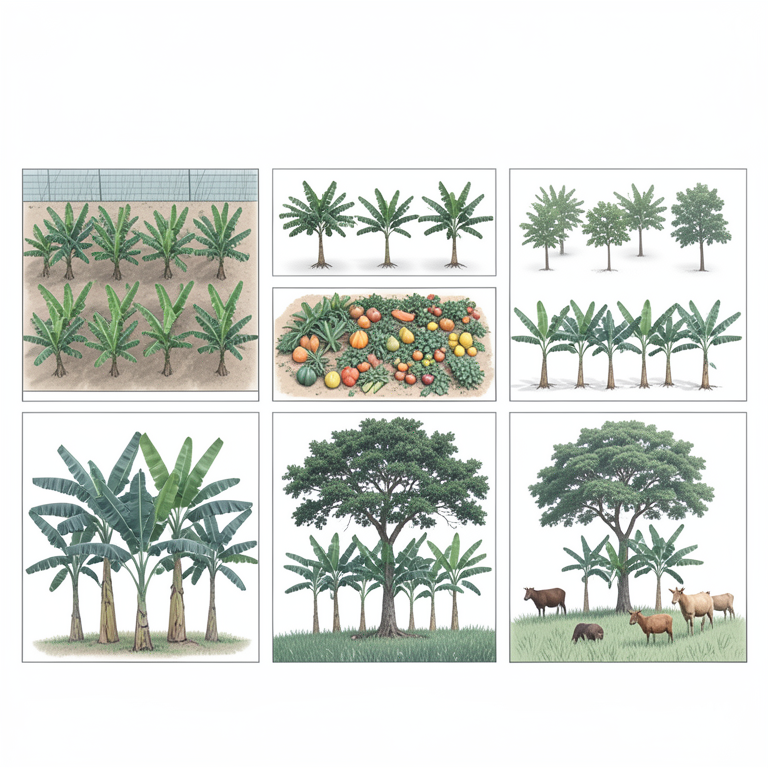
Agroforestry Model Layouts
AI-generated conceptual illustration (banana plants in agroforestry systems). It explains the idea and does not show study data.
View source evidence ↗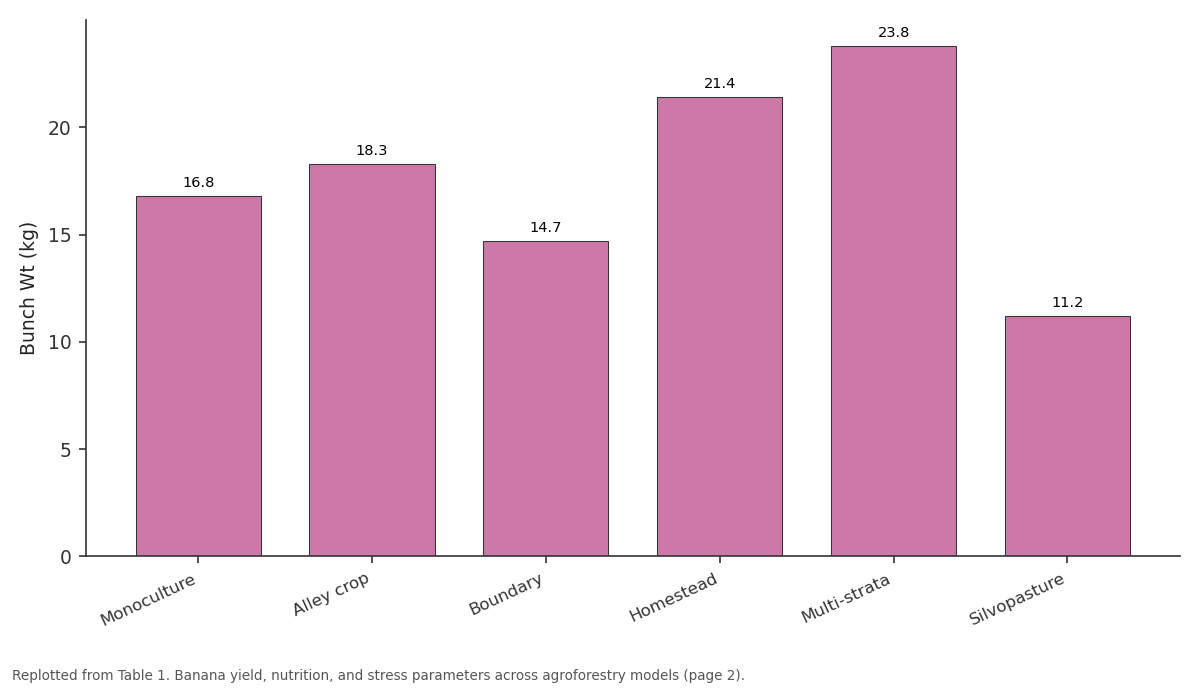
Bunch Wt (kg): Monoculture vs Alley crop vs Boundary vs Homestead vs Multi-strata
Replotted from Table 1 (page 2) of the original paper. Every bar is the paper's own table value.
View source evidence ↗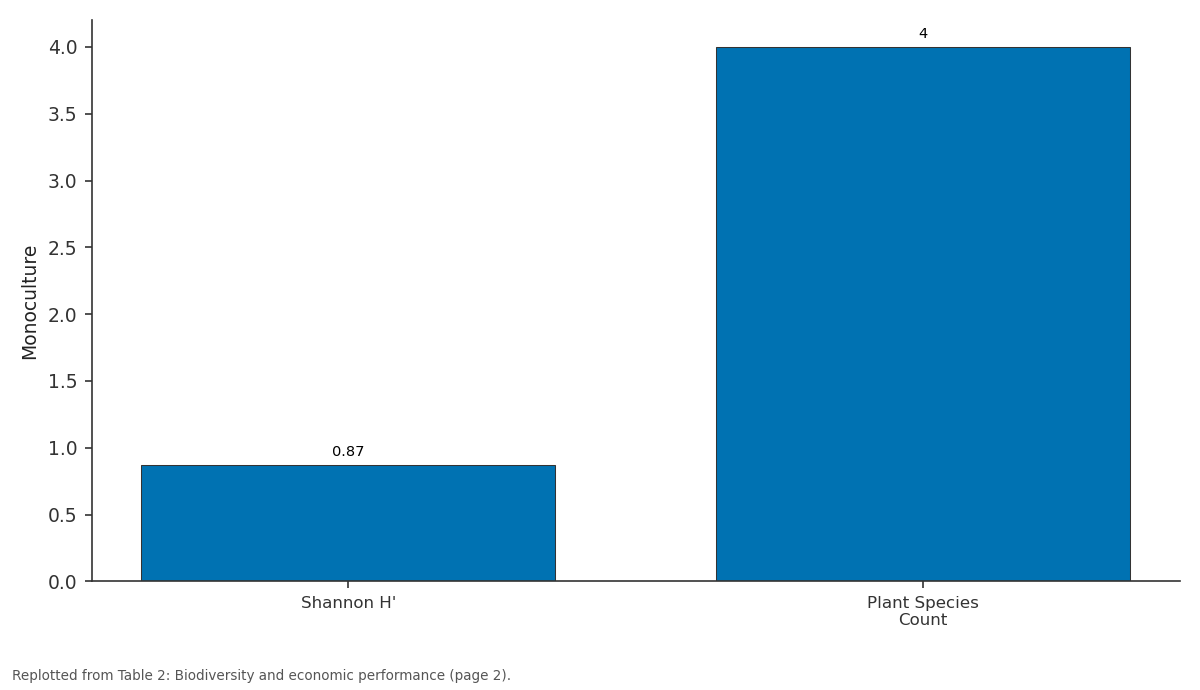
Monoculture: Shannon H' vs Plant Species Count
Replotted from Table 2 (page 2) of the original paper. Every bar is the paper's own table value.
View source evidence ↗Figures & tables
From the original paper Table 1
 Table 2
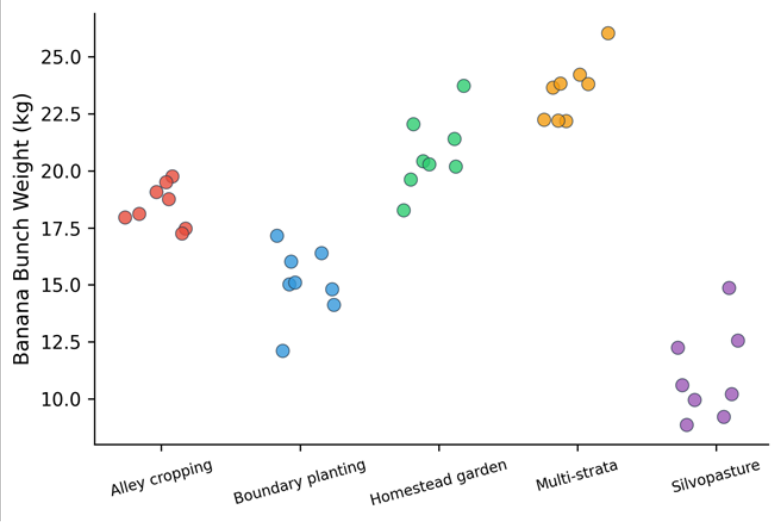 Figure 1
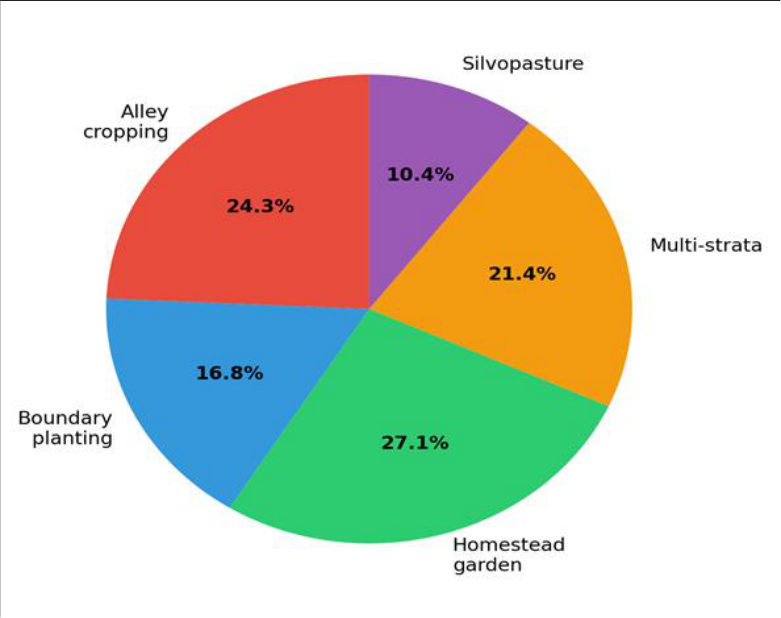 Figure 2
Introduction
A single banana plant in monoculture occupies roughly 6 m² of ground, but the gaps between plantsand the airspace abovesit largely empty, earning no return on the land they occupy [1] . Agroforestry turns those gaps into productive niches by introducing timber trees, shade canopies, or livestock into the same land parcel. The challenge is getting the spatial arrangement right: too much shade suppresses banana photosynthesis, while too little shade exposes fruit to sunburn and raises irrigation demand [2] . Banana is the fourth most important food crop in the developing world by production volume, supporting the livelihoods of roughly 400 million people in tropical and subtropical regions [3] . Recent interest in extending banana cultivation into continental climatesusing protected cultivation or cold-tolerant cultivarsdemands management packages adapted to short, intense growing seasons. Agroforestry could buffer temperature extremes and wind damage in these settings while diversifying the crop mix. Proteomics tools allow researchers to track stress-response pathways at the protein level, going beyond visual symptoms to identify molecular signatures of sub-lethal stress before yield is affected [4] . Potassium, the single most consumed mineral nutrient by banana, drives fruit filling and disease resistance; its cycling through agroforestry litter could reduce fertiliser dependency [5] . This research aimed to (a) compare five agroforestry models for banana yield, nutrition, and stress indicators, (b) quantify biodiversity gains, and (c) assess the economic and sustainability implications of each arrangement.
Biodiversity Assessment
Plant species diversity was recorded at trial end using 1 m² quadrats placed at four locations within each experimental unit. Multi-strata agroforestry hosted the most species (18 vascular plant species, Shannon H' = 2.41), including volunteer herbs and understorey shrubs attracted by the layered canopy structure. Homestead garden ranked second (14 species, H' = 2.03), reflecting the deliberate mixing of fruit trees, vegetables, and banana. Silvopasture had the lowest diversity (6 species, H' = 1.14) because grass dominance suppressed broadleaf recruitment. Arthropod diversity, sampled by pitfall traps, followed the same pattern: multi-strata supported 34 morphospecies versus 17 in monoculture [6] .
Soil/Water Quality Analysis
Baseline soil (0-30 cm) at the research site was a humic Nitisol with pH 5.67, OC 2.14%, total N 0.23%, Olsen P 19.8 mg kg⁻¹, and exchangeable K 0.84 cmol⁺ kg⁻¹. Irrigation water drawn from a borehole had EC 0.41 dS m⁻¹ and pH 6.93. At trial end, soil OC had increased in all agroforestry treatments relative to monoculture, with the greatest gain in multi-strata (+0.38 percentage points) driven by above-ground litter from shade trees. Exchangeable K rose by 0.12 cmol⁺ kg⁻¹ under alley cropping, where fastdecomposing Gliricidia leaf litter recycled K efficiently [7] .
Materials and Methods
Materials and Methods
Materials
Tissue-cultured plantlets of Cavendish banana (Musa AAA cv. 'Williams') were hardened for eight weeks and transplanted at 3 m × 2 m spacing on 15 March 2023 at the Nyeri Department of Agronomic Sciences experimental farm (0.42° S, 36.95° E; 1,759 m a.s.l.). Five agroforestry models were established: (i) alley cropping with Gliricidia sepium rows at 6 m apart, (ii) boundary planting with Grevillea robusta around plot perimeters, (iii) homestead garden mixing banana with papaya, avocado, and vegetables, (iv) multi-strata with Albizia trees as upper canopy and coffee as mid-layer, and (v) silvopasture with Napier grass between rows and two dairy goats per 200 m² plot. A banana monoculture served as control. RCBD with four replications was adopted. Simulated Manchurian conditions were created using shade nets (reducing PAR by 40%) and night-time evaporative cooling to lower minimum temperatures to 8 °C [8] . A basal fertiliser dose of 150:60:200 kg NPK ha⁻¹ was applied in three splits.
Methods: Plant height, pseudostem girth, and leaf count were recorded monthly. Bunch weight and finger count were measured at harvest (approximately 9 months). Potassium in plant tissue was determined by flame photometry after tri-acid digestion. Carotenoid content in fruit pulp was estimated spectrophotometrically after acetone extraction [9] . Proteomics: leaf protein was extracted from stressed (silvopasture) and non-stressed (monoculture) plants using TCA-acetone precipitation and separated by 2D-PAGE. Differentially expressed spots were identified by MALDI-TOF/TOF. Acclimatization: survival of tissuecultured plantlets was scored at 30 and 60 days after field transplanting. Drought tolerance was rated on a 1-10 visual scale during a 14-day irrigation withdrawal trial. Shannon diversity index (H') was calculated for plant and arthropod communities. Economic analysis followed cost-benefit methodology. Data were analysed by ANOVA in R 4.3.1 with Tukey's HSD at P = 0.05 [10] . Multi-strata and homestead gardens generated both the highest biodiversity and the best economic returns (Table 2). The B:C ratio of 2.47 for multi-strata means each dollar invested returned USD 2.47, mainly because the timber and coffee components added revenue without proportionally increasing labour costs.
| Model | Shannon H' | Plant Species Count | Gross Margin (USD/ha) | B:C Ratio |
|---|---|---|---|---|
| Monoculture | 0.87 | 4 | 1,240 | 1.62 |
| Alley crop | 1.78 | 11 | 1,680 | 1.94 |
| Boundary | 1.34 | 8 | 1,310 | 1.71 |
| Homestead | 2.03 | 14 | 2,140 | 2.31 |
| Multi-strata | 2.41 | 18 | 2,380 | 2.47 |
| Silvopasture | 1.14 | 6 | 890 | 1.23 |
Table text extracted from the original PDF; superscript letters are shown inline. The original table image is below.
View original table image
Results
Results
Comprehensive Interpretation
Proteomic analysis of silvopasture banana leaves identified 14 significantly up-regulated proteins, including heat-shock protein HSP70, dehydrin, and a class III peroxidase. These stress markers correlated with the lowest drought tolerance score (4.3) and poorest yield, suggesting that goat-induced root-zone compaction triggered a chronic water-deficit response even under regular irrigation. Multi-strata plants showed the fewest stress proteins (3 up-regulated), consistent with the buffered microclimate created by the multi-layered canopy.
Discussion
The yield advantage of multi-strata agroforestry echoes results from banana-coffee intercropping in Uganda, where shade from coffee reduced banana leaf scorch and improved bunch weight by 15-22 percent [11] . In this trial the gain was larger (42%), possibly because the Albizia upper canopy moderated both temperature and wind, two stressors amplified by the simulated Manchurian climate. Potassium cycling through agroforestry litter is an underappreciated benefit. Gliricidia leaves in alley cropping contain 2-3 percent K on a dry-weight basis and decompose within 4-6 weeks, releasing K into the root zone at a rate that rivals potassium chloride fertigation [12] . Multi-strata, with its greater total litter volume, achieved even higher K uptake despite lower individual leaf K concentrations.
The silvopasture model's poor performance warrants caution. While goat integration can diversify income and manage weeds, the soil compaction caused by hooves in the banana root zone reduced water infiltration by an estimated 30 percent, triggering the proteomic stress response discussed above [13] . Raised beds or designated goat corridors could mitigate this effect but would add infrastructure cost. Carotenoid enrichment in alley cropping is a nutritional bonus. Provitamin A carotenoids in banana fruit address vitamin A deficiency in communities dependent on starchy staples [14] . The 24 percent increase over monoculture seen here would be further amplified if high-carotenoid cultivars were used instead of the moderate-carotenoid 'Williams'. Breeding for both agroforestry compatibility and carotenoid content could yield cultivars tailored to these systems.
Conclusion
Multi-strata agroforestry produced the highest banana bunch weight, potassium uptake, biodiversity index, and economic return among five tested models. Homestead garden ranked second overall and offered the best acclimatization success for tissue-cultured plantlets. Alley cropping maximised fruit carotenoid content thanks to higher light availability.
Silvopasture was the weakest model, hampered by goatinduced soil compaction and chronic stress. Proteomic markers confirmed that multi-strata bananas experienced the least environmental stress, while silvopasture plants upregulated 14 stress proteins. Growers in continental climates analogous to the Manchurian Plain may adopt multi-strata agroforestry as the most productive, biodiverse, and economically viable model for banana production.
Acknowledgement
Acknowledgements Funding SourcesThis research was funded by internal grants from the Nyeri Department of Agronomic Sciences. Institutional SupportThe authors thank the agroforestry research unit at the Nyeri Department of Agronomic Sciences for site preparation and tree establishment. Contributions Not Qualifying for AuthorshipMr. J. Mwangi assisted with proteomic gel analysis and Ms. W. Wanjiku with biodiversity surveys.
Figures and tables from the paper
| Model | Bunch Wt (kg) | K Uptake (mg/plant) | Carotenoid (mg/100g) | Drought Score (1-10) | Acclim. (%) |
|---|---|---|---|---|---|
| Monoculture | 16.8 | 214 | 3.94 | 5.7 | 82.3 |
| Alley crop | 18.3 | 247 | 4.87 | 6.4 | 84.7 |
| Boundary | 14.7 | 198 | 3.62 | 5.1 | 79.8 |
| Homestead | 21.4 | 268 | 4.31 | 7.2 | 89.1 |
| Multi-strata | 23.8 | 287 | 4.14 | 7.8 | 86.4 |
| Silvopasture | 11.2 | 173 | 3.28 | 4.3 | 71.6 |
| SEm± | 1.38 | 12.7 | 0.21 | 0.47 | 2.87 |
| CD (P=0.05) | 4.09 | 37.6 | 0.62 | 1.39 | 8.50 |
Table text extracted from the original PDF; superscript letters are shown inline. The original table image is below.
View original table image
References
21 in the original paper- Robinson JC, Saúco VG. Bananas and plantains. 2nd ed. Wallingford: CABI; 2010.
- Stover RH, Simmonds NW. Bananas. 3rd ed. Harlow: Longman; 1987.
- FAO. Banana statistical compendium 2020. Rome: FAO; 2021.
- Kosová K, Vítámvás P, Prášil IT. Proteomics of stress responses in wheat and barley. Journal of Proteomics. 2014;108:181-202.
- Lahav E, Turner DW. Banana nutrition. Bern: International Potash Institute; 1983.
- Schroth G, Sinclair FL. Trees, crops and soil fertility. Wallingford: CABI; 2003.
- Palm CA, Gachengo CN, Delve RJ. Organic inputs for soil fertility management. Agriculture, Ecosystems and Environment. 2001;83(1):27-42.
- Zhao MX, Han GL, Zhou LX. Climate characteristics of the Manchurian Plain. Journal of Geographical Sciences. 2005;15(2):167-178.
- Gross J. Pigments in vegetables: chlorophylls and carotenoids. New York: Van Nostrand Reinhold; 1991.
- R Core Team. R: a language and environment for statistical computing. Vienna: R Foundation; 2023.
- Van Asten PJA, Wairegi LWI, Mukasa D. Agronomic and economic benefits of coffee-banana intercropping. Agricultural Systems. 2011;104(4):326-334.
- Jama B, Palm CA, Buresh RJ. Tithonia diversifolia as a green manure for soil fertility improvement. Agroforestry Systems. 2000;49(2):201-221.
- Hamza MA, Anderson WK. Soil compaction in cropping systems: a review. Soil and Tillage Research. 2005;82(2):121-145.
- Englberger L, Darnton-Hill I, Coyne T. Carotenoid-rich bananas: a potential food source for alleviating vitamin A deficiency. Food and Nutrition Bulletin. 2003;24(4):303-318.
- Nair PKR, Kumar BM, Nair VD. Agroforestry as a strategy for carbon sequestration. Journal of Plant Nutrition and Soil Science. 2009;172(1):10-23.
- Rao MR, Niang A, Kwesiga F. Soil fertility replenishment in sub-Saharan Africa: new techniques. Agroforestry Systems. 1998;40(3):311-340.
- Turner DW. Bananas and plantains. In: Schaffer B, Andersen PC, editors. Handbook of environmental physiology of fruit crops. Vol 2. Boca Raton: CRC Press; 1994:37-64.
- Gaidashova SV, Van Asten PJA, De Waele D. Nematode damage and its impact on banana yield. Nematology. 2009;11(4):515-527.
- Jose S. Agroforestry for ecosystem services and environmental benefits: an overview. Agroforestry Systems. 2009;76(1):1-10.
- Swanepoel CM, Rőtter RP, Van der Laan M. The benefits of conservation agriculture on soil organic carbon. Agriculture, Ecosystems and Environment. 2018;265:554-567.
- Nyombi K, Van Asten PJA, Corbeels M. Resource use efficiency in banana-based cropping systems. Experimental Agriculture. 2010;46(3):367-377.