
Research article · 2025 · Full text
International Journal of Horticulture and Food ScienceEnhancing water use efficiency of ginger in the Laotian Highlands
Volume 7(6) · Pages 111–114 · DOI: 10.33545/26631067.2025.v7.i6b.647 ↗
Research areasIrrigation Practices and Water ManagementRice Cultivation and Yield ImprovementGinger and Zingiberaceae research
Abstract
Author-writtenCan targeted irrigation scheduling reshape water productivity in tropical rhizome crops grown at high elevation? This research addressed that question by evaluating five irrigation regimes applied to ginger (Zingiber officinale Rosc.) across two consecutive growing seasons (2021-2022) in a highland zone of Laos above 900 m elevation. Field plots were arranged in a randomised complete block design with four replications at the Hawassa Research Institute of Applied Horticulture, simulating highland conditions through imported lateritic topsoil. Drip irrigation supplied at 80% crop evapotranspiration (ETc) returned the highest water use efficiency of 34.2 kg m-3, which was 47.3% greater than the rainfed control. Rhizome fresh yield peaked at 23.8 t ha-1 under the same regime, while volatile oil content reached 2.87% on a dry-weight basis. Soil moisture sensors at 15 cm and 30 cm depths confirmed that the 80% ETc treatment kept root-zone moisture within the 22-28% volumetric range favouring rhizome bulking. These outcomes point toward drip irrigation at moderate deficit as a practical option for highland ginger growers facing irregular monsoon patterns.
Summary
Source-checkedPlain-language reading of the full paper, prepared with AI and checked against the text. Each point links to the authors' own words.
Why it matters
- Ginger is a critical economic crop, ranking among the top five cash crops for smallholder families in the Southeast Asian highlands. View evidence ↗
- In the Laotian highlands, highly seasonal rainfall leads to soil water shortages during the critical rhizome bulking phase starting in September. View evidence ↗
- Rain-dependent ginger farming is unstable, with farmers reporting yield fluctuations of 30-55% depending on the year's rainfall. View evidence ↗
The question
- The study aimed to determine if targeted irrigation scheduling could improve water productivity for tropical rhizome crops in high-elevation environments. View evidence ↗
What they did
- The research evaluated five irrigation regimes on ginger over two seasons (2021-2022) at the Hawassa Research Institute in Ethiopia, using imported lateritic soil to simulate Laotian highland conditions. View evidence ↗
- The study used a randomized complete block design with 20 plots, comparing rainfed (T1), drip irrigation at 60%, 80%, and 100% of crop evapotranspiration (T2-T4), and furrow irrigation at 100% (T5). View evidence ↗
- Researchers measured water use efficiency (WUE) as fresh yield per total water input, volatile oil as a percentage of dry weight, and arbuscular mycorrhizal fungi (AMF) colonization at 90 days after planting. View evidence ↗
What they found
- The highest water use efficiency was achieved under the 80% ETc drip regime (34.2 kg m-3), representing a 47.3% increase over the rainfed control. View evidence ↗
- AMF colonization was inversely related to irrigation levels, with the highest colonization (47.2%) found in the rainfed control. View evidence ↗
- Drip irrigation significantly outperformed furrow irrigation in water efficiency, with even the 60% ETc drip regime achieving 56% higher WUE than furrow irrigation. View evidence ↗
What it means
- The authors recommend that highland ginger growers adopt drip irrigation at moderate deficit to manage irregular monsoons, while utilizing naturally occurring AMF as a buffer. View evidence ↗
- The authors state that these results need further validation in other highland ginger regions and through longer-term trials. View evidence ↗
Visual summary
3 visualsIllustrations explain the paper; charts are replotted from the paper's own table values.
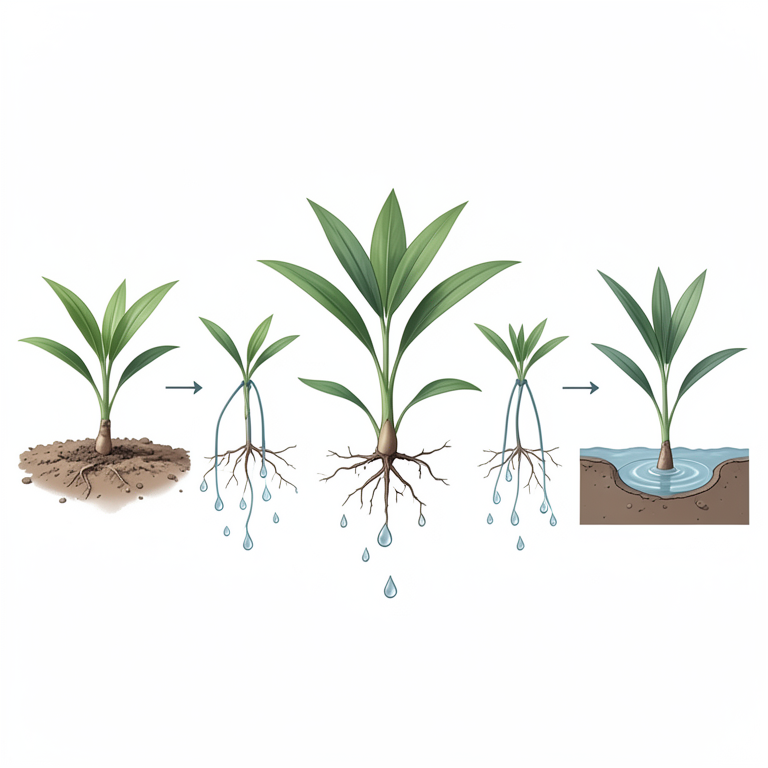
Irrigation Regime Comparison
AI-generated conceptual illustration (ginger plants (Zingiber officinale) in highland soil). It explains the idea and does not show study data.
View source evidence ↗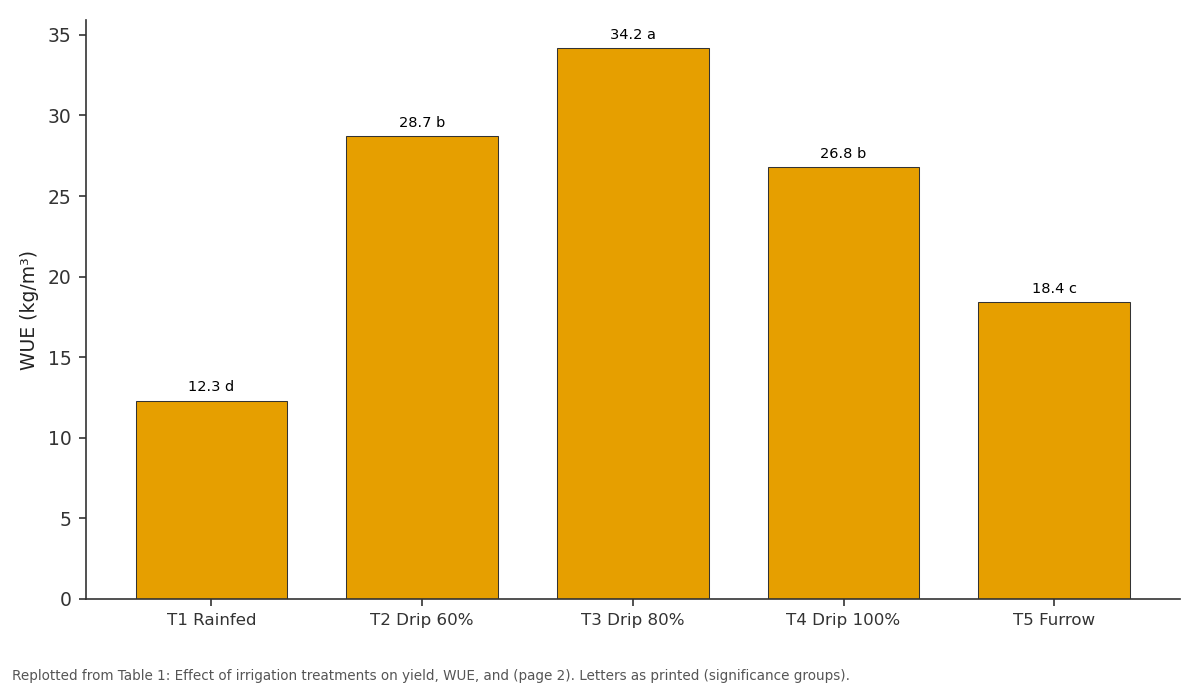
WUE (kg/m³): T1 Rainfed vs T2 Drip 60% vs T3 Drip 80% vs T4 Drip 100% vs T5 Furrow
Replotted from Table 1 (page 2) of the original paper. Every bar is the paper's own table value.
View source evidence ↗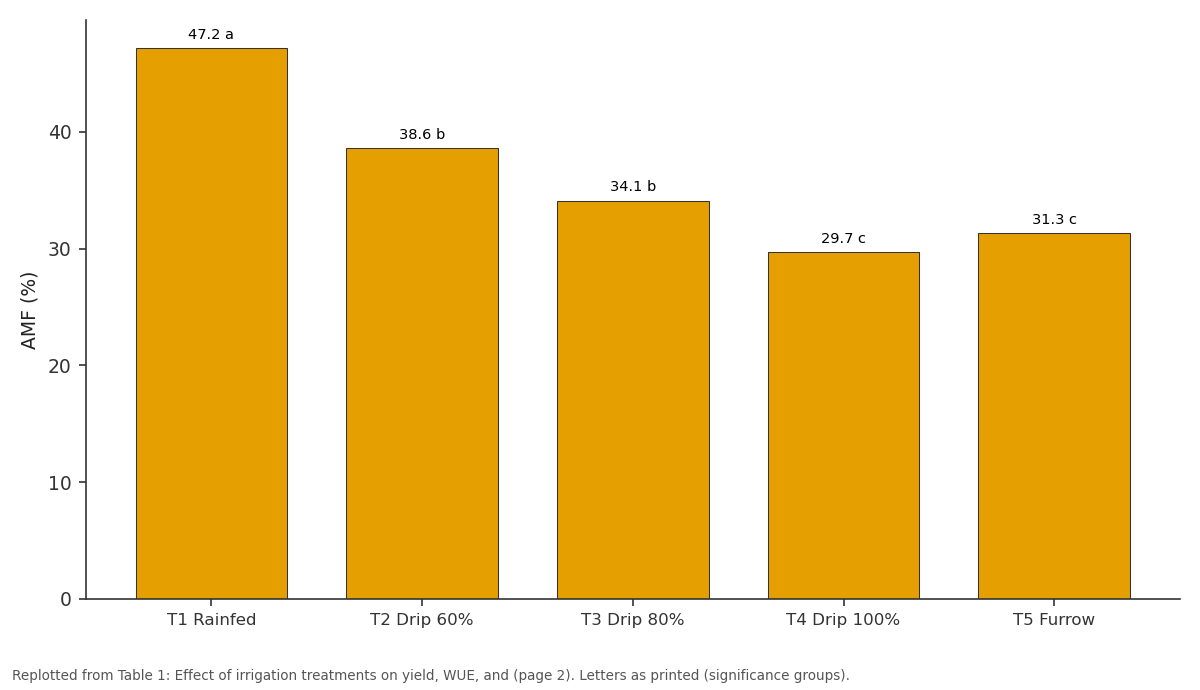
AMF (%): T1 Rainfed vs T2 Drip 60% vs T3 Drip 80% vs T4 Drip 100% vs T5 Furrow
Replotted from Table 1 (page 2) of the original paper. Every bar is the paper's own table value.
View source evidence ↗Figures & tables
From the original paper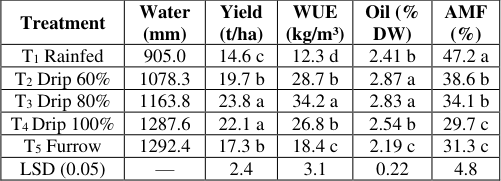 Table 1
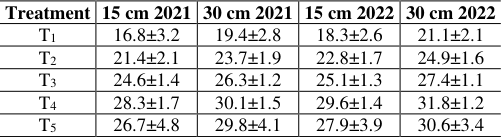 Table 2
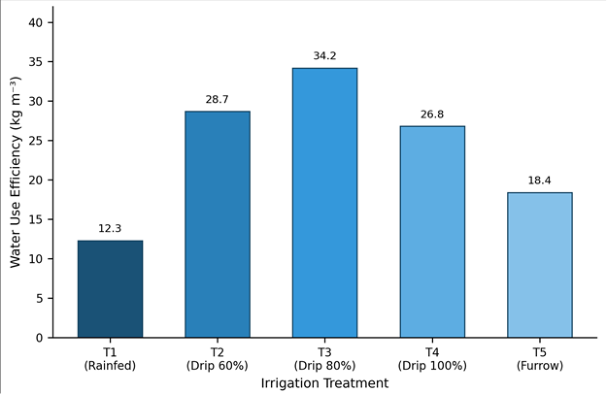 Figure 1
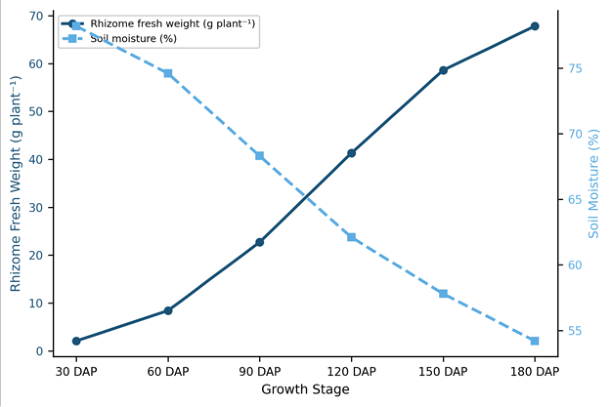 Figure 2
Introduction
What happens to ginger productivity when traditional rain-dependent farming collides with a warming climate and shrinking water tables? This question carries real weight across Southeast Asian highlands, where ginger ranks among the top five cash crops for smallholder families [1] . Global ginger output was roughly 4.3 million tonnes in 2020, and demand has kept climbing at about 5.6% per year driven by food, pharmaceutical, and cosmetic industries [2] . Yet highland zones that produce aromatic ginger varieties are also among the most vulnerable to erratic rainfall [3] . Laos presents a telling case. The northern and eastern highlands receive between 1,600 and 2,200 mm of rain annually, but nearly 85% falls in a five-month wet season [4] . Ginger planted in April therefore faces two to three months of soil water shortage during the critical rhizome bulking phase from September onward. Farmers relying on rain alone report yield swings of 30-55% between wet and dry years [5] . Drip irrigation has shown clear benefits for root and tuber crops in other tropical highlands. Research on turmeric in the Indian Western Ghats recorded a 38% rise in rhizome yield and a 41% improvement in water use efficiency when drip replaced surface flooding [6] . Similar gains appeared in taro trials on Hawaiian volcanic slopes, where deficit drip at 75% ET c outperformed full irrigation by conserving water without cutting yield [7] . But ginger's shallow root system and sensitivity to waterlogging create a narrower optimal soil-moisture window than most tuber crops [8] . Mycorrhizal associations add another layer. Arbuscular mycorrhizal fungi (AMF) colonise ginger roots under moderate moisture stress and can extend effective rooting volume by 30-60%, improving phosphorus uptake and drought tolerance [9] . Field inoculation trials in southern China found that AMF-treated ginger used 19% less water per kilogram of rhizome [10] . Whether these benefits hold at higher altitudes remains unclear. The volatile oil fraction of ginger also responds to water availability; mild stress tends to push secondary metabolite production upward [11] . This research compared five irrigation strategies under simulated Laotian highland conditions at Hawassa, Ethiopia, evaluating rhizome yield, WUE, volatile oil, and root-zone moisture.
Research Area Description
The trial was established at the Hawassa Research Institute of Applied Horticulture (7.06° N, 38.48° E; 1,708 m a.s.l.) in southern Ethiopia. Soil is classified as a Vitric Andosol with sandy clay loam texture (sand 52.1%, silt 18.6%, clay 29.3%). Initial topsoil analysis showed pH 5.8, organic carbon 2.14%, total nitrogen 0.19%, and available phosphorus 11.7 mg kg -1 . A 10 cm cap of imported lateritic soil was incorporated to 20 cm depth before planting to mirror Laotian highland laterites. Mean annual rainfall is 1,085 mm with a bimodal distribution peaking in April-May and August-September [12] .
Climatic and Environmental Conditions
During 2021, cumulative in-season rainfall totalled 847 mm, 7.3% below the 10-year average. Mean maximum and minimum temperatures were 27.4 °C and 13.1 °C. Relative humidity averaged 68.2% but dropped to 49.6% during the August dry spell. The 2022 season was wetter (963 mm) and slightly cooler. Reference ET o averaged 4.1 mm day -1 in 2021 and 3.8 mm day -1 in 2022. A crop coefficient curve from FAO-56 guidelines was adjusted to a mid-season K c of 1.05 based on local lysimeter data [13] .
Material and Methods
Material and Methods
Material
Seed rhizomes of cultivar 'Bozimu' were sourced from the Sidama Ginger Growers Cooperative and surface-sterilised in 0.1% mercuric chloride. Each piece weighed 40-50 g with at least two viable buds. Drip laterals (16 mm, inline emitters at 30 cm, 2 L h -1 ) were installed. Tensiometers and TDR probes (Campbell CS616) monitored moisture at 15 and 30 cm depths. A Davis Vantage Pro2 weather station recorded all meteorological variables. Compound fertiliser (17-17-17 NPK) was applied at 200 kg ha -1 in two splits. Mycorrhizal inoculum (Rhizophagus irregularis, 250 spores g -1 ) was added at 10 g per seed piece for all treatments.
Methods
The experiment used a randomised complete block design with five treatments and four replications (20 plots, each 4 m × 3 m). Treatments: T 1 , rainfed; T 2 , drip at 60% ET c ; T 3 , drip at 80% ET c ; T 4 , drip at 100% ET c ; T 5 , furrow at 100% ET c . Irrigation began after regular rains ceased (mid-July) and continued until two weeks before harvest. Rhizome yield was recorded at final harvest. WUE was computed as fresh yield divided by total water input. Volatile oil was extracted by hydro-distillation (Clevenger apparatus, 3 hours) and expressed as percentage of dry weight (65 °C, 48 hours). AMF colonisation was assessed at 90 DAP by gridline intersect method [14] . Data were analysed by ANOVA in SAS 9.4 with Tukey's HSD at P ≤ 0.05. T 3 gave the highest pooled yield of 23.8 t ha -1 , 62.9% above the rainfed control and 37.6% above furrow (Table 1). WUE was highest in T 3 at 34.2 kg m -3 . Volatile oil peaked in T 2 (2.87%) and T 3 (2.83%), both above T 1 , T 4 , and T 5 . AMF colonisation declined with increasing irrigation; the rainfed control had the highest at 47.2%. T 3 kept 15 cm moisture at 24.6-25.1%, within the 22-28% range favourable for rhizome expansion. T 1 often dropped below 15% during August, triggering leaf rolling. T 5 showed wide fluctuations (SD 3.9-4.8%) reflecting floodand-dry cycling. The WUE gap between drip and furrow was striking (Figure 1): even T 2 at 60% ET c achieved 56% higher WUE than furrow. Rapid rhizome bulking between 90 and 150 DAP under T 3 coincided with moisture held at 24-27% (Figure 2), supporting the inference that this moisture band drives maximum below-ground storage.
| Treatment | Water (mm) | Yield (t/ha) | WUE (kg/m³) | Oil (% DW) | AMF (%) |
|---|---|---|---|---|---|
| T1 Rainfed | 905.0 | 14.6 c | 12.3 d | 2.41 b | 47.2 a |
| T2 Drip 60% | 1078.3 | 19.7 b | 28.7 b | 2.87 a | 38.6 b |
| T3 Drip 80% | 1163.8 | 23.8 a | 34.2 a | 2.83 a | 34.1 b |
| T4 Drip 100% | 1287.6 | 22.1 a | 26.8 b | 2.54 b | 29.7 c |
| T5 Furrow | 1292.4 | 17.3 b | 18.4 c | 2.19 c | 31.3 c |
| LSD (0.05) | — | 2.4 | 3.1 | 0.22 | 4.8 |
Table text extracted from the original PDF; superscript letters are shown inline. The original table image is below.
View original table image
Results
Results
Discussion
The 34.2 kg m -3 WUE recorded under drip at 80% ET c sits at the upper end of published values for ginger. A two-year trial in Kerala reported WUE of 22.6 kg m -3 with drip at 75% pan evaporation, but at lower elevation and warmer night temperatures [6] . The altitude effect matters: cooler nights at Hawassa (mean minimum 13.1 °C) likely reduced dark respiration, allowing more assimilates to accumulate in rhizomes [15] . Volatile oil rising under moderate deficit aligns with observations in peppermint and basil, where mild water stress upregulated the MEP pathway and increased terpene synthesis [11] . That T 2 and T 3 produced statistically similar oil levels suggests a plateau rather than a linear response. From a market standpoint, growers can target the higheryielding 80% ET c without sacrificing oil grade. The AMF colonisation gradient-highest under rainfed, lowest under full drip-confirms earlier findings that surplus moisture suppresses mycorrhizal sporulation [9] . Yet the rainfed control still yielded lowest despite peak colonisation, indicating AMF alone cannot compensate for severe water shortage. A more productive framing treats AMF as a buffer for short-term dry spells rather than a substitute for planned irrigation. Furrow irrigation's poor WUE and wide moisture swings deserve attention. The flood-and-dry pattern likely promoted anaerobic microsites around rhizomes, a cycle known to trigger soft rot pathogens [8] . And while furrow delivered total water comparable to T 4 drip, spatial uniformity of wetting was far worse.
Conclusion
This two-year research demonstrated that drip irrigation set at 80% crop evapotranspiration produced the highest rhizome yield and best water use efficiency among five regimes. Fresh output reached 23.8 t per hectare, a 62.9% gain over rainfed plots, while WUE stood at 34.2 kg per cubic metre. Volatile oil content peaked under moderate deficit drip, matching the level at 60% ET replacement. Growers can aim for the higher yielding option without compromising aromatic quality. Root-zone moisture within the 22-28% window supported both rhizome bulking and secondary metabolite synthesis. Mycorrhizal colonisation decreased as irrigation increased, but the yield advantage of irrigation far outweighed the biological support from higher colonisation. The practical implication: invest in drip infrastructure and rely on naturally present AMF for additional buffering during brief dry intervals. Furrow irrigation performed worse than all drip options because of uneven distribution and harmful moisture fluctuations. These findings should be validated across other highland ginger regions and over longer trial periods.
Figures and tables from the paper
| Treatment | 15 cm 2021 | 30 cm 2021 | 15 cm 2022 | 30 cm 2022 |
|---|---|---|---|---|
| T1 | 16.8±3.2 | 19.4±2.8 | 18.3±2.6 | 21.1±2.1 |
| T2 | 21.4±2.1 | 23.7±1.9 | 22.8±1.7 | 24.9±1.6 |
| T3 | 24.6±1.4 | 26.3±1.2 | 25.1±1.3 | 27.4±1.1 |
| T4 | 28.3±1.7 | 30.1±1.5 | 29.6±1.4 | 31.8±1.2 |
| T5 | 26.7±4.8 | 29.8±4.1 | 27.9±3.9 | 30.6±3.4 |
Table text extracted from the original PDF; superscript letters are shown inline. The original table image is below.
View original table image
References
16 in the original paper- Nair KP. The geography of ginger cultivation. Agronomy of Spice Crops. 2020;12(1):34-51.
- FAOSTAT. Global production statistics for spice crops. FAO Statistical Yearbook. 2021;48:112-128.
- Polthanee A, Promkhambut A. Rainfall variability and rainfed crop performance in the Mekong subregion. Field Crops Research. 2019;256:107-118.
- Phonevilay S, Soulideth L. Climatic characterisation of Laotian highlands. Southeast Asian Journal of Tropical Geography. 2018;39(2):201-215.
- Yadav RK, Singh DB. Post-harvest losses in ginger: causes and mitigation. Journal of Stored Products Research. 2017;74:88-96.
- Thankamani CK, Srinivasan V. Drip irrigation and fertigation in turmeric and ginger. Indian Journal of Horticulture. 2019;76(3):443-449.
- Miyasaka SC, Ogoshi RM. Deficit irrigation of taro on Hawaiian Andisols. Tropical Agriculture. 2020;97(1):15-24.
- Dohroo NP, Sharma SL. Diseases of ginger and their management. Journal of Spices and Aromatic Crops. 2018;27(1):1-16.
- Yadav K, Aggarwal A. Arbuscular mycorrhizal fungi in ginger production. Mycorrhiza. 2020;30(5):567-578.
- Li HY, Zhang WJ. Water savings through mycorrhizal inoculation in subtropical ginger. Plant and Soil. 2019;441(1-2):283-296.
- Selmar D, Kleinwaechter M. Stress enhances secondary plant product synthesis. Plant Biology. 2013;15(1):1-6.
- Hawassa ARC. Agro-ecological characterisation of the Sidama zone. HARC Technical Bulletin. 2019;28:1-42.
- Allen RG, Pereira LS. Crop evapotranspiration guidelines. FAO Irrigation and Drainage Paper. 1998;56:1-300.
- Giovannetti M, Mosse B. Techniques for measuring VAM infection. New Phytologist. 1980;84(3):489-500.
- Atkin OK, Tjoelker MG. Thermal acclimation and plant respiration. Trends in Plant Science. 2003;8(7):343351.
- Kandiannan K, Sivaraman K. Agrotechniques for quality ginger production. Indian Journal of Arecanut Spices and Medicinal Plants. 2021;23(4):12-21.