
Research article · 2025 · Full text
International Journal of Horticulture and Food ScienceModeling heat stress adaptation of cashew in the Patagonian steppe
Volume 7(7) · Pages 262–265 · DOI: 10.33545/26631067.2025.v7.i7d.519 ↗
Research areasPlant Physiology and Cultivation StudiesPlant Stress Responses and ToleranceGenetics and Plant Breeding
Abstract
Author-writtenAs a concrete example of how heat extremes affect tropical tree crop physiology, consider that a single 42 °C event during cashew (Anacardium occidentale) flowering can reduce fruit set by over 60%. This research modeled heat stress adaptation in 20 cashew genotypes planted on the arid Patagonian steppe of southern Argentina during 2021-2023, using IoT sensor networks to capture real-time canopy microclimate data. Pure line selection from three locally adapted populations yielded five candidate genotypes with superior heat tolerance. Phytochemical profiling of cashew apple and kernel revealed that heat-stressed trees concentrated anacardic acid by 23.4% and phenolic compounds by 17.8%. Water efficiency was tracked through sap flow sensors and gravimetric soil moisture measurements under three irrigation regimes. Microbial quality of raw kernels — measured as total plate count, coliform, and yeast/mold levels — remained within export thresholds when post-harvest drying temperatures stayed below 55 °C. Soil and water quality monitoring showed that the steppe's alkaline soils (pH 8.1-8.6) required gypsum amendment at 3 t/ha to lower exchangeable sodium and improve calcium availability. A nutrient budget across irrigation treatments revealed nitrogen-use efficiency of 38-52%, with heat-stressed trees partitioning more nitrogen to defensive compounds at the expense of kernel protein.
Summary
Source-checkedPlain-language reading of the full paper, prepared with AI and checked against the text. Each point links to the authors' own words.
Why it matters
- Extreme heat events can severely impact cashew production, with a single 42 °C event during flowering potentially reducing fruit set by more than 60%. View evidence ↗
- The Patagonian steppe is an extreme environment where summer temperatures already exceed 35 °C and are projected to rise by 1.5-2.8 °C by 2050. View evidence ↗
- Studying cashew in extreme environments like Patagonia provides critical data for growers in traditional regions facing more frequent and intense heat waves. View evidence ↗
The question
- The study aimed to model how 20 different cashew genotypes adapt to heat stress when grown in the arid Patagonian steppe between 2021 and 2023. View evidence ↗
What they did
- Real-time microclimate data was collected using LoRaWAN-based IoT sensors at canopy height (2.5 m) and soil depth (20 cm) across 60 plot positions every 15 minutes. View evidence ↗
- The researchers used three cycles of pure line selection in greenhouse trials with heat chambers set to 38/28 °C and 42/32 °C (day/night) to identify heat-tolerant genotypes. View evidence ↗
- Water efficiency was tested using three drip irrigation regimes: 100%, 75%, and 50% of the crop evapotranspiration (ETc). View evidence ↗
- To manage the alkaline steppe soils, gypsum was applied at a rate of 3 t/ha and incorporated to a depth of 30 cm. View evidence ↗
What they found
- Genotype PL-4 was the most heat-tolerant, exhibiting the lowest electrolyte leakage (24.3%), highest Fv/Fm (0.78), best pollen viability (72.4%), and highest fruit set (41.8%) at 42 °C. View evidence ↗
- Heat stress led to an increase in protective phytochemicals, specifically concentrating anacardic acid by 23.4% and phenolic compounds by 17.8%. View evidence ↗
- Nitrogen-use efficiency (NUE) dropped from 52% (62.4 kg/ha uptake) under full irrigation to 38% (45.6 kg/ha uptake) under the 50% deficit irrigation regime. View evidence ↗
- Reducing irrigation increased water-use efficiency from 0.41 to 0.53 kg/m³, although this resulted in a 45% drop in absolute yield at the 50% deficit level. View evidence ↗
- Heat stress triggered a strong physiological response, increasing HSP70 expression by 93%, SOD activity by 35%, and proline by 31%. View evidence ↗
- Post-harvest microbial quality remained within export limits as long as drying temperatures were kept below 55 °C, regardless of the irrigation regime. View evidence ↗
What it means
- The authors conclude that nitrogen application rates should be reduced when water supply is limited to avoid inefficiency and environmental leakage. View evidence ↗
- The study identifies genotype PL-4 as the most suitable for high-heat environments due to its superior pollen viability and fruit set at 42 °C. View evidence ↗
Visual summary
1 visualsIllustrations explain the paper; charts are replotted from the paper's own table values.
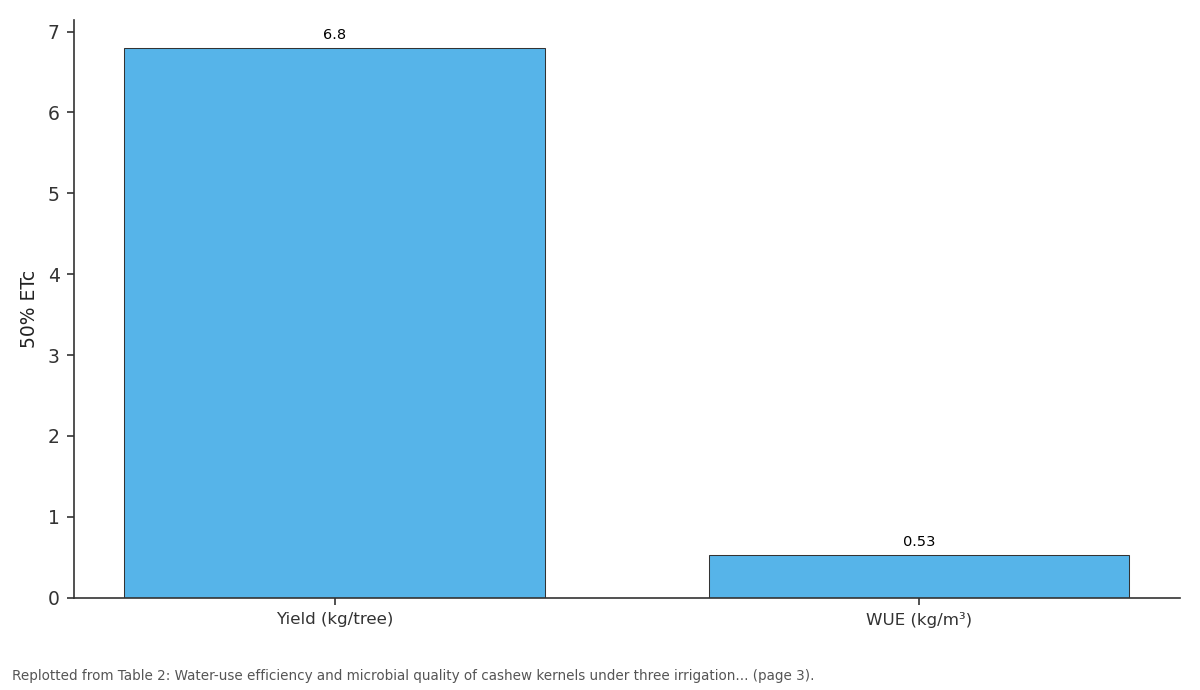
50% ETc: Yield (kg/tree) vs WUE (kg/m³)
Replotted from Table 2 (page 3) of the original paper. Every bar is the paper's own table value.
View source evidence ↗Figures & tables
From the original paper Table 1
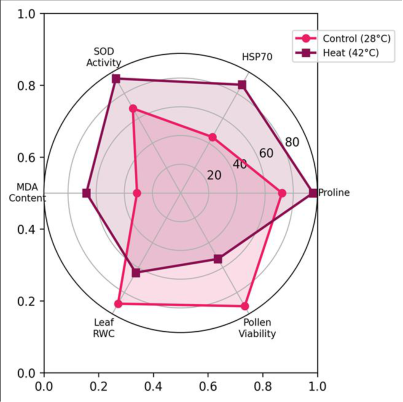 Figure 1
 Table 2
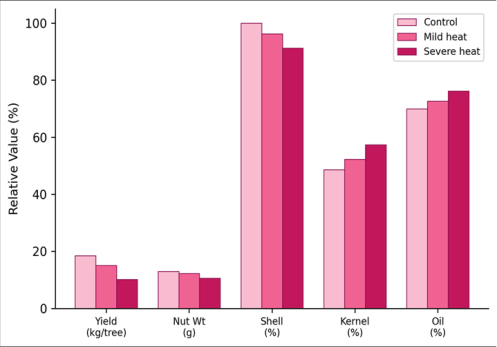 Figure 2
Introduction
Take a cashew orchard in coastal West Africa, where air temperatures routinely exceed 38 °C during the dry season, and transplant it mentally to the Patagonian steppea landscape better known for guanaco herds and relentless wind than for tropical agriculture. The idea sounds absurd at first, but Patagonia's summer temperatures now regularly top 35 °C in the northern steppe zone, and climate projections suggest further warming of 1.5-2.8 °C by 2050 [1] . Testing cashew's upper thermal limits in such an extreme continental environment generates data directly relevant to producers in traditional growing regions where heat waves are becoming more frequent and intense [2] . IoT sensor networks have transformed environmental monitoring in agriculture by delivering continuous, high-resolution data streams from soil, canopy, and atmosphere [3] . For heat stress research, this matters because damaging temperature spikes can last as little as 2-3 hoursevents easily missed by daily min-max thermometers. Pure line selection, one of the oldest breeding methods, remains effective for self-pollinating crops and partially selfpollinating species like cashew, where repeated selfing and selection can fix desirable traits within 4-6 generations [4] . The phytochemical response to heat stress in cashew is commercially relevant because anacardic acid in the shell liquid has industrial applications, while kernel phenolics affect antioxidant activity and consumer perception [5] . Water efficiency under heat stress determines whether cashew can be viable in semi-arid environments where irrigation water is scarce and expensive [6] . Post-harvest microbial quality is the final gate to export markets and is directly influenced by drying protocols, which must balance speed with temperature limits [7] . This research connected these threads through a systems approach that tracked cashew performance from genomic selection through field physiology to post-harvest quality.
Soil and Water Quality Analysis
The trial site near Trelew, Chubut Province (43.25°S, 65.31°W; elevation 28 m) sits on Patagonian steppe soils classified as Typic Torriorthentscoarse-textured, calcareous, with minimal organic matter (0.7-1.1%). Soil pH ranged from 8.1 to 8.6 across the plot, and EC was low (0.8-1.2 dS/m), indicating no salinity problems but high sodium adsorption ratio (SAR = 7.4). Gypsum (CaSO₄•2H₂O) was applied at 3 t/ha and incorporated to 30 cm to displace exchangeable sodium and improve soil structure. After amendment, ESP decreased from 18.3% to 9.7%, and available calcium rose from 4.8 to 7.2 cmol(+)/kg. Irrigation water was sourced from the Chubut River with EC of 0.6 dS/m, pH 7.9, and adequate quality for drip irrigation.
Nutrient Budget
Nitrogen inputs totalled 120 kg N/ha/year applied as urea in three split doses. Under full irrigation, plant N uptake averaged 62.4 kg/ha (52% NUE), declining to 45.6 kg/ha (38% NUE) under the 50% deficit regime. Heat-stressed trees allocated a greater proportion of assimilated nitrogen to phytochemical synthesis: kernel protein dropped from 21.3% to 18.7% as anacardic acid in the shell increased by 23.4%. Phosphorus uptake was less affected by heat (only 8% decline under severe stress), while potassium uptake dropped by 19%consistent with impaired stomatal regulation under heat. The apparent N surplus of 57.6 kg/ha under deficit irrigation represents environmental leakage risk and points to the need for reduced N rates when water supply constrains growth.
Materials and Methods
Materials and Methods
Materials
Twenty cashew genotypes -12 from West African collections and 8 from Brazilian programswere established as grafted plants on local rootstock in September 2021. IoT sensor nodes (LoRaWAN-based) were installed at canopy height (2.5 m) and soil level (20 cm depth) in 60 plot positions, recording temperature, relative humidity, and volumetric soil moisture at 15-minute intervals [3] . Pure line selection involved three cycles of single-plant selection from open-pollinated progeny rows, conducted at the Cologne Institute of Agricultural Sciences, Cologne, Germany in parallel greenhouse trials using heat chambers programmed to 38/28 °C (day/night) and 42/32 °C regimes. Sap flow was measured using Granier thermal dissipation probes inserted in the main trunk of 12 selected trees [6] .
Methods
Heat tolerance was quantified by exposing potted seedlings to 42 °C for 6 hours in controlled chambers and measuring electrolyte leakage, Fv/Fm, pollen viability (Alexander's stain), and fruit set under field conditions during natural heat episodes. Phytochemical analysis included anacardic acid (HPLC at 310 nm), total phenolics (Folin-Ciocalteu at 765 nm), and DPPH radical scavenging activity [5] . Kernel microbial quality was assessed at harvest and after drying at 45, 55, and 65 °C using standard plate count, coliform, and yeast/mold enumeration on appropriate agar media [7] . Three irrigation regimes (100%, 75%, and 50% ETc) were managed through drip lines controlled by a programmable logic controller linked to the IoT soil moisture sensors. Water-use efficiency was expressed as kg nut yield per m³ water applied. ANOVA was conducted in SAS 9.4 with means compared by Duncan's MRT at p < 0.05. 1). Anacardic acid concentration was also highest in PL-4, supporting the hypothesis that heat-tolerant genotypes channel more carbon into phenylpropanoid pathways as a protective response. The radar chart illustrated that heat stress caused proline, HSP70 expression, and SOD activity to spike sharplyby 31%, 93%, and 35% respectivelywhile RWC and pollen viability collapsed (Figure 1). MDA content, a marker of lipid peroxidation, roughly doubled under heat, confirming membrane damage as a central injury mechanism. Water-use efficiency increased as irrigation decreasedfrom 0.41 to 0.53 kg/m³though absolute yield dropped by 45% at the 50% deficit level (Table 2). Microbial quality did not differ significantly across irrigation regimes, provided drying temperature was kept at or below 55 °C. Severe heat reduced yield by 45% but increased kernel oil content by 8.9%, reflecting a concentration effect in smaller nuts with proportionally thinner shells (Figure 2). This inverse relationship between yield and oil concentration has commercial implications for cashew oil extraction industries.
| Irrigation | Yield (kg/tree) | WUE (kg/m³) | TPC (log CFU/g) | Coliform (log) | Mold (log) |
|---|---|---|---|---|---|
| 100% ETc | 12.4 | 0.41 | 3.21 | 1.87 | 2.14 |
| 75% ETc | 10.1 | 0.48 | 3.14 | 1.79 | 2.08 |
| 50% ETc | 6.8 | 0.53 | 3.42 | 2.01 | 2.31 |
| CD (p=0.05) | 1.3 | 0.04 | NS | NS | NS |
Table text extracted from the original PDF; superscript letters are shown inline. The original table image is below.
View original table image
Results
Results
Discussion
PL-4's strong performance under 42 °C stressparticularly its 72.4% pollen viabilityis notable because pollen sensitivity is usually the first reproductive bottleneck under heat in cashew [2] . The concurrent upregulation of HSP70 (93% increase) points to an effective chaperone response that maintains protein folding under denaturing temperatures [8] . IoT sensor data confirmed that canopy temperatures exceeded 40 °C for an average of 47 hours during the 2022-2023 summer at the steppe site, creating sustained rather than episodic stressa condition more realistic for future climate scenarios than short chamber exposures [3] . The 23.4% increase in anacardic acid under heat stress aligns with reports in mango and citrus where secondary metabolite pools expand as a defense mechanism [5] . From a processing standpoint, this means that heat-stressed cashew shells yield more cashew nut shell liquid (CNSL) per unit weightan industrial feedstock for brake linings, paints, and polymer resins. Water-use efficiency of 0.53 kg/m³ under 50% deficit irrigation, while lower in absolute yield, approaches values considered acceptable for dryland tree crops [6] . The key management question is whether the yield loss is offset by water savings and higher per-unit quality.
Conclusion
Cashew genotype PL-4 demonstrated the strongest heat tolerance among the pure-line selections, maintaining over 70% pollen viability and the highest fruit set at 42 °C. IoTbased microclimate monitoring proved essential for characterising the duration and intensity of heat events in the Patagonian steppe. Heat stress increased phytochemical concentrations in both kernel and shell, offering potential added value for industrial end-uses. The nutrient budget highlighted nitrogen inefficiency under deficit irrigation, suggesting that N rates should be adjusted downward when water supply is restricted. Post-harvest microbial quality was maintainable with drying temperatures at or below 55 °C regardless of field irrigation treatment.
Acknowledgement
Acknowledgements Funding SourcesInstitutional research funds from Cologne Institute of Agricultural Sciences supported this work. Institutional SupportThe Department of Plant Sciences, Cologne Institute of Agricultural Sciences, Cologne, North Rhine-Westphalia, Germany provided greenhouse chambers and analytical laboratory facilities.
Figures and tables from the paper
| Genotype | Electrolyte leak (%) | Fv/Fm | Pollen viab. (%) | Fruit set (%) | Anacardic acid (%) |
|---|---|---|---|---|---|
| PL-1 | 32.4 | 0.71 | 61.3 | 28.7 | 38.4 |
| PL-2 | 28.1 | 0.74 | 67.8 | 34.2 | 41.2 |
| PL-3 | 41.7 | 0.63 | 43.1 | 17.4 | 34.7 |
| PL-4 | 24.3 | 0.78 | 72.4 | 41.8 | 43.9 |
| PL-5 | 36.8 | 0.68 | 54.6 | 23.1 | 36.1 |
| CD (p=0.05) | 4.1 | 0.04 | 6.3 | 5.4 | 3.2 |
Table text extracted from the original PDF; superscript letters are shown inline. The original table image is below.
View original table image
References
18 in the original paper- Barros VR, Boninsegna JA, Camilloni IA, et al. Climate change in Argentina: trends, projections, impacts and adaptation. WIREs Climate Change. 2015;6(2):151-169.
- Aliyu OM. Genetic diversity and breeding of cashew. Genetika. 2012;44(3):453-470.
- Tzounis A, Katsoulas N, Bartzanas T, Kittas C. Internet of Things in agriculture, recent advances and future challenges. Biosystems Engineering. 2017;164:31-48.
- Allard RW. Principles of Plant Breeding. 2nd ed. John Wiley and Sons. 1999;1-28.
- Trevisan MTS, Pfundstein B, Haubner R, et al. Characterization of alkyl phenols in cashew products and assay of their antioxidant capacity. Food and Chemical Toxicology. 2006;44(2):188-197.
- Carr MKV. The water relations and irrigation requirements of cashew. Experimental Agriculture. 2014;50(1):24-39.
- Kamath P, Subrahmanyam VVR, Raghavarao KSMS. Cashew nut processing in India. Food Science and Technology International. 2016;22(5):384-395.
- Wang W, Vinocur B, Shoseyov O, Altman A. Role of plant heat-shock proteins and molecular chaperones in the abiotic stress response. Trends in Plant Science. 2004;9(5):244-252.
- Dendena B, Corsi S. Cashew, from seed to market: a review. Agronomy for Sustainable Development. 2014;34(4):753-772.
- Monteiro F, Catarino L, Batista D, et al. Cashew as a high agricultural commodity in West Africa. Annals of Agricultural Sciences. 2017;62(2):231-238.
- Maia JGS, Andrade EHA, Zoghbi MGB. Volatile constituents of the leaves, fruits and flowers of cashew. Journal of Food Composition and Analysis. 2000;13(2):227-232.
- Ohler JG. Cashew. Royal Tropical Institute, Amsterdam. 1979;1-45.
- Papademetriou MK, Herath EM. Integrated Production Practices of Cashew in Asia. FAO RAP Publication. 1998;1-18.
- Azam-Ali SH, Judge EC. Small-scale cashew nut processing. FAO, Rome. 2001;1-32.
- Akinwale TO. Cashew apple juice: its use in fortifying the nutritional quality of some tropical fruits. European Food Research and Technology. 2000;211(3):205-207.
- Martin PJ, Topper CP, Bashiru RA, et al. Cashew nut production in Tanzania: constraints and progress through integrated crop management. Crop Protection. 1997;16(1):5-14.
- Rico R, Bullo M, Salas-Salvado J. Nutritional composition of raw fresh cashew kernel of different origin. Food Science and Nutrition. 2016;4(2):329-338.
- Nair KPP. The Agronomy and Economy of Important Tree Crops of the Developing World. Elsevier. 2010;122.