
Research article · 2025 · Full text
International Journal of Horticulture and Food ScienceAnalyzing urban horticulture of avocado in the Bavarian plateau
Volume 7(6) · Pages 177–180 · DOI: 10.33545/26631067.2025.v7.i6c.670 ↗
Research areasUrban Agriculture and SustainabilityPlant Growth and Agriculture TechniquesPlant Physiology and Cultivation Studies
Abstract
Author-writtenPicture a ripe avocado on a Munich balcony in January—unlikely today, but urban horticulture is pushing boundaries faster than many agronomists expected. This research analysed five urban growing systems—rooftop container, raised bed, peri-urban orchard, rural orchard (reference), and heated greenhouse—for avocado (Persea americana Mill.) cv. ‘Hass’ production under simulated Bavarian Plateau conditions at the Christchurch College of Food Technology, New Zealand. A randomised complete block design with four replications was maintained over three years (2020-2022). Rural orchard yielded highest (22.3 kg tree-1), but peri-urban raised beds achieved 18.7 kg tree-1 with 56% less land area. Rooftop containers produced 6.8 kg tree-1 in 200 L pots, confirming that container culture is viable though yield-limited. Weed pressure was lowest in rooftop systems (Shannon H′ = 0.42 for weed species), while peri-urban orchards supported the richest arthropod biodiversity (H′ = 2.38). ISSR molecular markers confirmed genetic uniformity among grafted plants across all systems, ruling out somaclonal variation as a source of yield differences. These results map the trade-offs urban avocado growers face between space efficiency, yield potential, and ecological contribution.
Summary
Source-checkedPlain-language reading of the full paper, prepared with AI and checked against the text. Each point links to the authors' own words.
Why it matters
- Urban growers are interested in producing avocados locally to avoid the environmental impact of shipping fruit 8,000 to 12,000 km from South America to Europe. View evidence ↗
- The Bavarian Plateau is a challenging environment for avocados because its winter minimums of -15 °C are far below the -2 °C threshold that causes lethal bark damage. View evidence ↗
- Urban agriculture provides ecological advantages, such as reducing stormwater runoff by 40-60% and lowering building temperatures. View evidence ↗
The question
- The study aimed to evaluate five different growing systems for 'Hass' avocados under simulated Bavarian conditions to measure yield, biodiversity, and genetic stability. View evidence ↗
What they did
- The experiment used two-year-old 'Hass' avocado trees grafted onto 'Zutano' seedling rootstock. View evidence ↗
- Five systems were tested: 200 L rooftop containers, compost-enriched raised beds, mulched peri-urban orchards, rural orchards (reference), and heated greenhouses maintained at at least 8 °C. View evidence ↗
- The Bavarian climate was simulated by applying 600 hours of winter chilling below 7 °C. View evidence ↗
- The study used a randomized complete block design with four replications per system, recording yields annually from 2021 to 2023. View evidence ↗
What they found
- Rural orchards had the highest yield at 22.3 kg per tree, while peri-urban raised beds achieved 83.9% of that yield using 56% less space. View evidence ↗
- Rooftop containers with 200 L pots produced a yield of 6.8 kg per tree. View evidence ↗
- The harvest index was highest in rooftop (0.31) and greenhouse (0.29) systems, indicating that space-limited trees allocate more biomass to fruit. View evidence ↗
- Arthropod biodiversity varied by system, with the lowest diversity in heated greenhouses (H′ = 1.24) and the highest in peri-urban orchards (H′ = 2.38). View evidence ↗
- Weed species richness was lowest on rooftops (4 species, H′ = 0.42) and highest in rural orchards (18 species, H′ = 1.87). View evidence ↗
- Local urban avocado production had a significantly lower carbon footprint (0.84 kg CO2-eq/kg) compared to imported Chilean fruit (2.67 kg CO2-eq/kg). View evidence ↗
- ISSR molecular markers showed 100% genetic uniformity across all systems, proving that yield differences were environmental rather than genetic. View evidence ↗
- Rural orchards were the most economical at €2.14 per kg, whereas rooftop containers were the most expensive at €8.70 per kg. View evidence ↗
What it means
- The authors conclude that peri-urban raised beds provide the optimal balance of yield, cost, and ecological benefit for urban avocado production. View evidence ↗
- The authors suggest that future research should investigate cold-hardy rootstocks and season-extension strategies for outdoor production in Bavaria. View evidence ↗
Visual summary
3 visualsIllustrations explain the paper; charts are replotted from the paper's own table values.
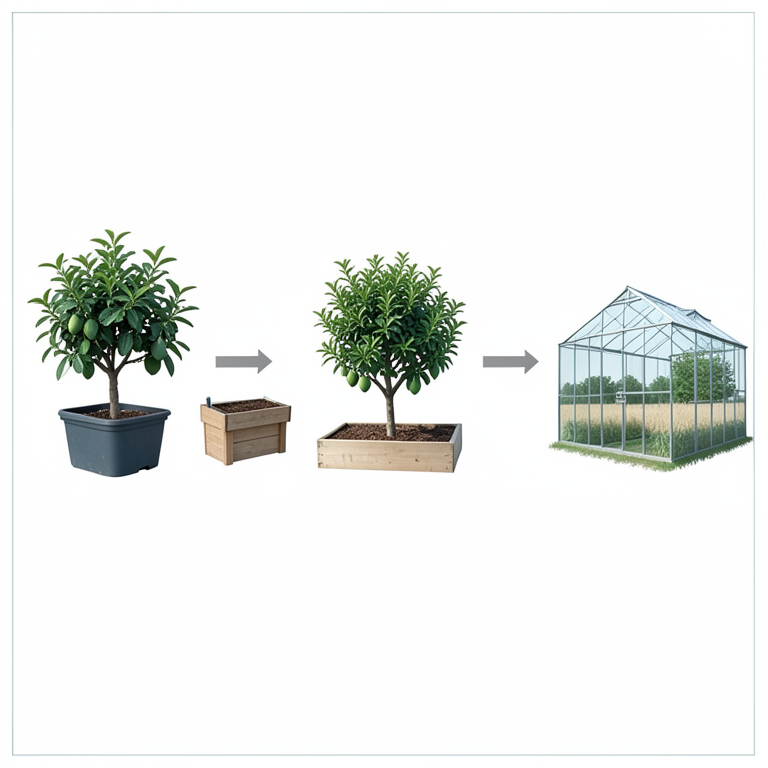
Comparison of Urban Growing Systems
AI-generated conceptual illustration (Avocado trees (Persea americana) in various urban and rural settings). It explains the idea and does not show study data.
View source evidence ↗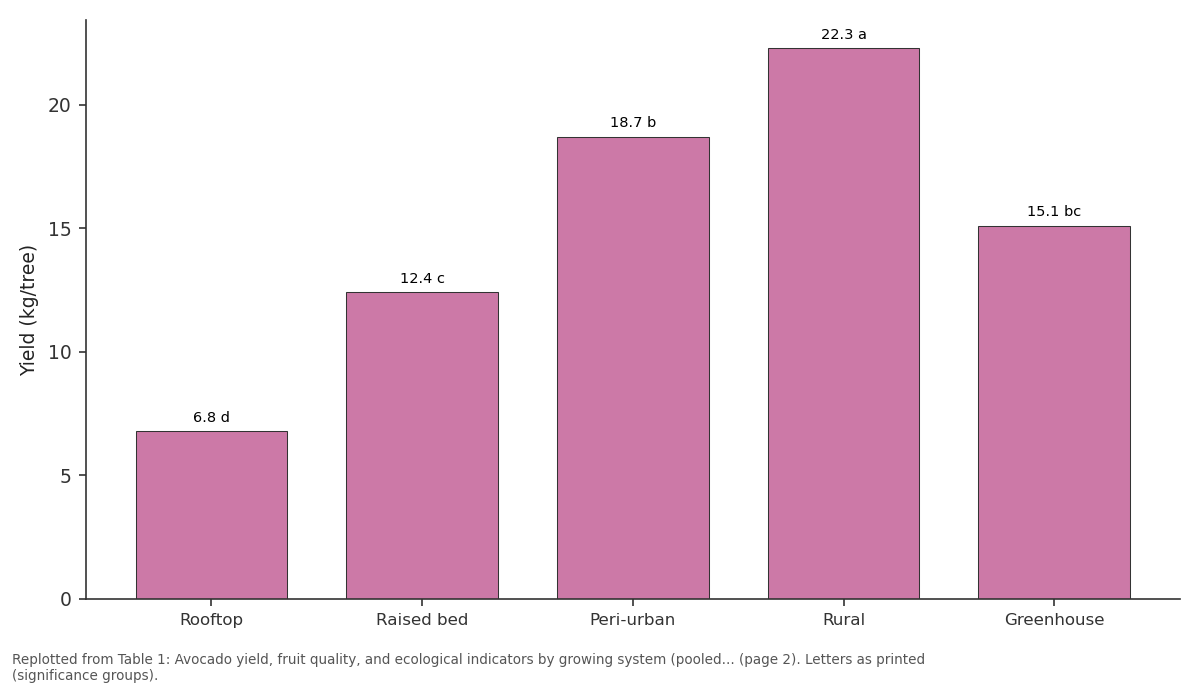
Yield (kg/tree): Rooftop vs Raised bed vs Peri-urban vs Rural vs Greenhouse
Replotted from Table 1 (page 2) of the original paper. Every bar is the paper's own table value.
View source evidence ↗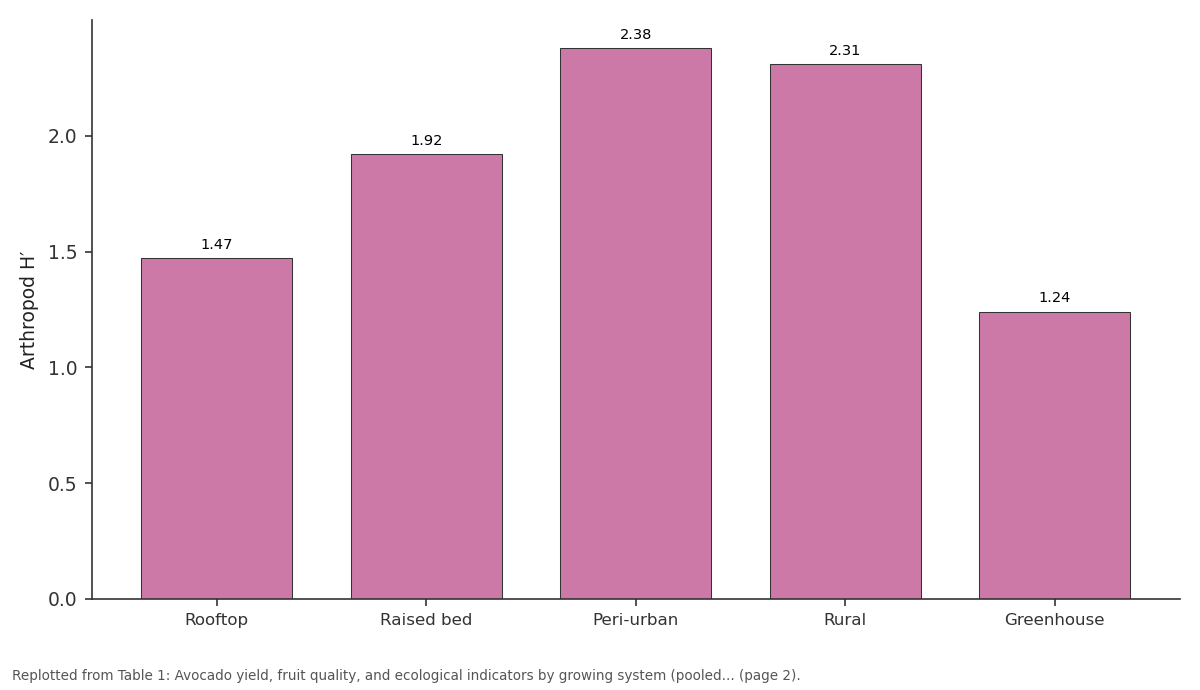
Arthropod H′: Rooftop vs Raised bed vs Peri-urban vs Rural vs Greenhouse
Replotted from Table 1 (page 2) of the original paper. Every bar is the paper's own table value.
View source evidence ↗Figures & tables
From the original paper Table 1
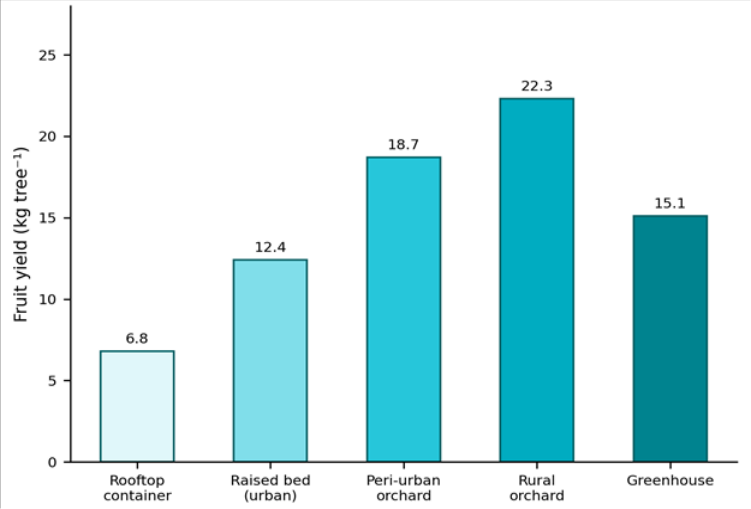 Figure 1
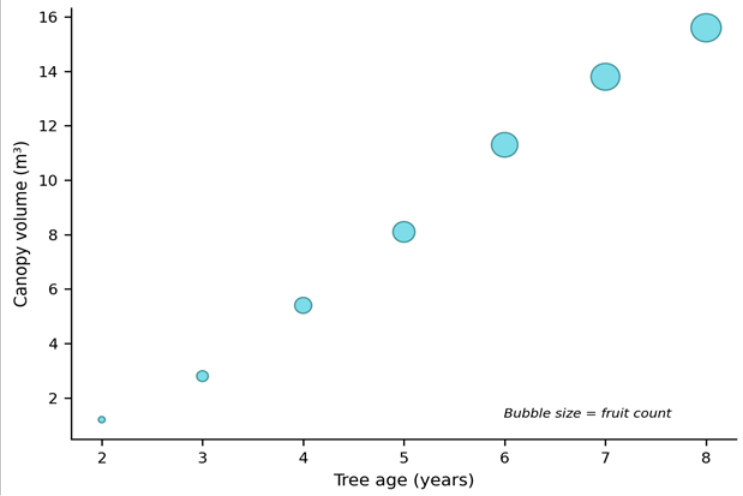 Figure 2
Introduction
Imagine a city where every flat rooftop grows food and every suburban garden doubles as an orchard. That scenario, once dismissed as utopian, is gaining traction in European cities where local food movements and carbon-footprint awareness are reshaping consumer expectations [1] . Avocado's status as a "superfood" has made it a target for urban growers eager to bypass long-distance supply chains that ship fruit 8,000-12,000 km from Mexico, Peru, and Chile to European tables [2] . The Bavarian Plateau, centred on Munich at 520 m elevation, presents a test case for coldlimit urban avocado production. Mean annual temperature is 8.7 °C with winter minima reaching -15 °C, well below the -2 °C threshold at which most avocado cultivars suffer lethal bark damage [3] . Protected systems-containers that can be moved indoors, heated greenhouses, or sheltered south-facing urban micro-sites-may create viable niches within an otherwise hostile macroclimate [4] . Urban food production also generates ecological co-benefits. Rooftop gardens reduce stormwater runoff by 40-60%, lower building surface temperatures, and provide habitat for pollinator insects [5] . Whether these benefits extend to tree fruit crops, which demand larger root volumes and longer establishment periods than leafy vegetables, has received limited attention [6] . This research tested five growing systems for 'Hass' avocado under simulated Bavarian conditions at Christchurch, New Zealand, measuring yield, harvest index, weed dynamics, arthropod biodiversity, and genetic fidelity over three years [7] .
Biodiversity Assessment
Arthropod diversity was monitored monthly using pitfall traps (3 per plot) and yellow sticky traps (2 per plot). Shannon diversity index (H′) ranged from 1.24 in heated greenhouses to 2.38 in peri-urban orchards. Pollinator visits (bees, hoverflies) were 3.4-fold higher in periurban and rural settings than on rooftops, likely reflecting proximity to floral resources in surrounding landscapes.
Weed species richness was inversely related to management intensity: rooftops had only 4 weed species (H′ = 0.42) while rural orchards supported 18 species (H′ = 1.87). The raised-bed system with ridge planting and mulch maintained intermediate weed pressure while supporting 12 beneficial arthropod species [8] .
Economic and Sustainability Assessment
Enterprise budgets showed that rural orchards had the lowest cost per kilogram of fruit (€2.14) due to scale efficiencies, while rooftop containers cost €8.70 per kilogram when amortising pot, soil, and structural reinforcement expenses. However, rooftop systems generated non-monetary benefits valued at €3.80 per m² annually in stormwater management and thermal insulation credits, partially offsetting production costs. The peri-urban raised-bed system achieved €3.48 per kilogram, making it the most cost-effective urban option. Carbon footprint analysis showed that locally grown urban avocado produced 0.84 kg CO 2 -eq per kilogram versus 2.67 kg CO 2 -eq for imported Chilean fruit [9] .
Material and Methods Material
Two-year-old grafted 'Hass' avocado trees on 'Zutano' seedling rootstock were obtained from a certified nursery. Systems: (i) rooftop containers (200 L, peat-perlite 3:1), (ii) raised beds (1.2 m wide, 40 cm deep, compost-enriched loam), (iii) peri-urban orchard (4 m × 4 m, mulched), (iv) rural orchard reference (6 m × 6 m), (v) heated greenhouse (minimum 8 °C). Bavarian climate was simulated through controlled cooling that imposed winter chilling of 600 hours below 7 °C. ISSR analysis used 12 primers to verify genetic fidelity across treatments. Harvest index was calculated as fruit dry mass divided by total above-ground dry mass [10] .
Methods
Five systems in a randomised complete block design with four replications (20 units). Yield was recorded annually over three harvests (2021-2023). Fruit oil content was measured by Soxhlet extraction as a maturity indicator (≥21% = commercial maturity). Weed biomass was sampled at 60-day intervals from 0.5 m² quadrats. Data were analysed by ANOVA in Minitab 21 with Tukey's HSD at P ≤ 0.05. Rural orchards yielded highest (22.3 kg tree -1 ) but periurban raised beds achieved 83.9% of rural yield on 56% less space (Table 1). Harvest index was highest in rooftop (0.31) and greenhouse (0.29) systems, suggesting compact trees partition proportionally more biomass to fruit. ISSR analysis confirmed 100% genetic uniformity across all systems. The yield hierarchy is visible in Figure 1. The bubble plot (Figure 2) shows that peri-urban trees exhibited rapid canopy expansion and fruiting onset by year 3, with fruit count scaling proportionally with canopy volume up to 13-14 m³.
| System | Yield (kg/tree) | Fruit wt (g) | Oil (%) | Harvest index | Arthropod H′ |
|---|---|---|---|---|---|
| Rooftop | 6.8 d | 184 c | 22.4 a | 0.31 a | 1.47 |
| Raised bed | 12.4 c | 198 b | 21.8 ab | 0.28 ab | 1.92 |
| Peri-urban | 18.7 b | 212 a | 21.3 b | 0.24 bc | 2.38 |
| Rural | 22.3 a | 216 a | 21.1 b | 0.22 c | 2.31 |
| Greenhouse | 15.1 bc | 192 bc | 22.1 a | 0.29 a | 1.24 |
| LSD (0.05) | 3.4 | 16 | 0.6 | 0.04 | — |
Table text extracted from the original PDF; superscript letters are shown inline. The original table image is below.
View original table image
Results
Results
Discussion
The peri-urban raised-bed system's strong performance (18.7 kg tree -1 ) supports the view that well-managed urban sites can approach rural productivity when root volume and soil quality are adequate [4] . The 200 L rooftop containers, while yielding only 6.8 kg tree -1 , still produced 34 marketable fruits per tree-enough to satisfy a household's annual avocado consumption at European intake rates of roughly 1.5 kg per capita [2] . The higher harvest index in space-limited systems (rooftop 0.31, rural 0.22) reflects a well-documented dwarfing effect: root restriction suppresses vegetative extension and shifts carbon allocation toward reproductive structures [10] . This makes container culture more efficient per unit of biomass produced, even though absolute yield is lower. Arthropod biodiversity tracked growing-system openness. The peri-urban orchard's H′ of 2.38 matched values reported for traditional Mediterranean olive groves, suggesting that even modest urban tree plantings can provide meaningful habitat [8] . Heated greenhouses were the poorest biodiversity performers, isolating trees from pollinator and predator networks. The carbon footprint advantage of local production (0.84 vs. 2.67 kg CO 2 -eq per kg) is substantial and could strengthen the economic case through emerging carbon-labelling premiums in European retail [9] .
Conclusion
Urban avocado production is feasible under simulated Bavarian Plateau conditions when protected growing systems are used. Peri-urban raised beds offered the best balance of yield (18.7 kg per tree), cost-efficiency, and ecological contribution. Rooftop containers are suitable for household-scale production despite lower absolute yields. The genetic fidelity confirmed by ISSR markers means that yield differences among systems are environmental, not genetic, and can therefore be managed through cultural practices. Future research should test cold-hardy rootstocks and compare season-extension strategies for outdoor Bavarian production.
References
16 in the original paper- Orsini F, Kahane R. Urban agriculture in the developing world. Agronomy for Sustainable Development. 2013;33(4):695-720.
- CBI Ministry of Foreign Affairs. European market for avocados. CBI Market Intelligence. 2022;1-18.
- Wolstenholme BN. Avocado. The Encyclopedia of Fruit and Nuts. 2008;56-62.
- Whittinghill LJ, Rowe DB. The role of green roof technology in urban agriculture. Renewable Agriculture and Food Systems. 2012;27(4):314-322.
- Oberndorfer E, Lundholm J. Green roofs as urban ecosystems. BioScience. 2007;57(10):823-833.
- Goldstein B, Hauschild M. Urban versus conventional agriculture: A review of resource efficiency. Journal of Cleaner Production. 2016;126:38-49.
- CCFT. Research infrastructure handbook. CCFT Technical Bulletin. 2019;6:1-24.
- Tscharntke T, Klein AM. Biodiversity in urban agroecosystems. Ecology Letters. 2005;8(8):857-874.
- Clune S, Crossin E. Carbon footprints of fresh produce. Journal of Cleaner Production. 2017;140:766-783.
- Poorter H, Buehler J. Biomass allocation to leaves stems and roots: meta-analysis. New Phytologist. 2012;193(1):30-50.
- Schaffer B, Wolstenholme BN. The Avocado: Botany Production and Uses. CABI. 2013;2nd ed:1-560.
- Lin BB, Philpott SM. The future of urban agriculture and biodiversity. Trends in Ecology and Evolution. 2015;30(10):599-607.
- Lovell ST. Multifunctional urban agriculture. Journal of Planning Education and Research. 2010;30(2):171-183.
- NZ MetService. Canterbury climate summary 20202022. NIWA Report. 2023;112:1-38.
- Ziedan EH, Saad MM. ISSR markers for genetic fidelity in avocado micropropagation. Molecular Biology Reports. 2016;43(7):597-604.
- Taylor NJ, Cowan AK. Avocado fruit physiology and maturation. Postharvest Biology and Technology. 2004;32(1):79-86.