
Research article · 2025 · Full text
International Journal of Horticulture and Food ScienceExploring foliar nutrition of millets in the Subarnarekha Basin
Volume 7(9) · Pages 100–103 · DOI: 10.33545/26631067.2025.v7.i9b.664 ↗
Research areasPlant Micronutrient Interactions and EffectsAgricultural Science and FertilizationCrop Yield and Soil Fertility
Abstract
Author-writtenMillets are central to India’s nutritional security agenda, yet their response to foliar micronutrient application in laterite-dominated river basin soils remains poorly quantified. This research explored foliar nutrition effects on three millet species — finger millet (Eleusine coracana), foxtail millet (Setaria italica), and pearl millet (Pennisetum glaucum) — grown in the Subarnarekha Basin of Jharkhand, with analytical work at the Mangalore National Institute of Tropical Agriculture from February to November 2023. Four foliar spray treatments (control, ZnSO₄ 0.5%, FeSO₄ 0.5%, Zn + Fe combined) were applied at tillering and flowering stages across four irrigation levels (100%, 75%, 50% ET, and rainfed). Leaf area index (LAI), chlorophyll content (SPAD), grain yield, and mineral concentration were measured. Foliar Zn + Fe increased grain zinc by 34.7% and iron by 28.3% across species. LAI showed a strong positive correlation with chlorophyll SPAD values (r = 0.83, p < 0.001). Deficit irrigation at 75% ET maintained 91.4% of full-irrigation yield while saving 25% water. Heritability for grain yield under deficit irrigation was highest for finger millet (h² = 0.72), followed by pearl millet (0.61) and foxtail millet (0.53). These results provide foliar nutrition and irrigation management prescriptions for millet production on laterite soils of the Subarnarekha Basin.
Summary
Source-checkedPlain-language reading of the full paper, prepared with AI and checked against the text. Each point links to the authors' own words.
Why it matters
- Millets are critical for food security and cultural identity for tribal communities in the Subarnarekha Basin, where they occupy over 40% of upper catchment farmland during the kharif season. View evidence ↗
- Millet yields in the region average 0.8–1.2 t/ha, which is less than half of the national potential, due to red laterite soils lacking sufficient iron, zinc, and phosphorus. View evidence ↗
- Foliar application is a method to deliver zinc and iron directly to leaves via the cuticle and stomata, bypassing soil-based limitations. View evidence ↗
The question
- The study aimed to develop integrated management prescriptions for the Subarnarekha Basin by testing how foliar nutrition and irrigation levels interact across three different millet species. View evidence ↗
What they did
- The experiment was conducted during the 2023 kharif season (June–October) at the Subarnarekha Agricultural Research Farm in Jharkhand. View evidence ↗
- The research utilized three millet species: finger millet (cv. GPU-28), foxtail millet (cv. SiA-3085), and pearl millet (cv. HHB-67 Improved). View evidence ↗
- Four foliar treatments (control, 0.5% ZnSO₄, 0.5% FeSO₄, and a combined Zn+Fe) were applied at 30 and 55 days after sowing (DAS). View evidence ↗
- The study measured leaf area index (LAI) at four time points, chlorophyll content via SPAD readings, grain yield at maturity, and grain mineral content using atomic absorption spectroscopy (AAS). View evidence ↗
What they found
- Combined foliar Zn + Fe application increased grain zinc by 34.7% and iron by 28.3% compared to control groups across all species. View evidence ↗
- Finger millet exhibited the most significant response to foliar nutrition, with zinc and iron increases of 38.4% and 31.7%, respectively. View evidence ↗
- There was a strong positive correlation (r = 0.83) between the leaf area index and chlorophyll SPAD values. View evidence ↗
- Applying deficit irrigation at 75% ET saved 25% of water while maintaining 91.4% of the yield achieved under full irrigation. View evidence ↗
- Under deficit irrigation, finger millet had the highest grain yield heritability (0.72), followed by pearl millet (0.61) and foxtail millet (0.53). View evidence ↗
- The combined Zn + Fe foliar treatment increased the density of bacteria in the rhizosphere by 18.3% compared to controls. View evidence ↗
What it means
- The authors conclude that finger millet should be the priority species for genetic improvement under deficit irrigation due to its high yield heritability. View evidence ↗
- The authors recommend the integrated foliar nutrition and irrigation strategies developed in this study for millet production on the laterite soils of the Subarnarekha Basin. View evidence ↗
- The study is limited by its single-season duration; multi-year data are required to evaluate potential soil accumulation or leaf phytotoxicity from repeated applications. View evidence ↗
Visual summary
2 visualsIllustrations explain the paper; charts are replotted from the paper's own table values.
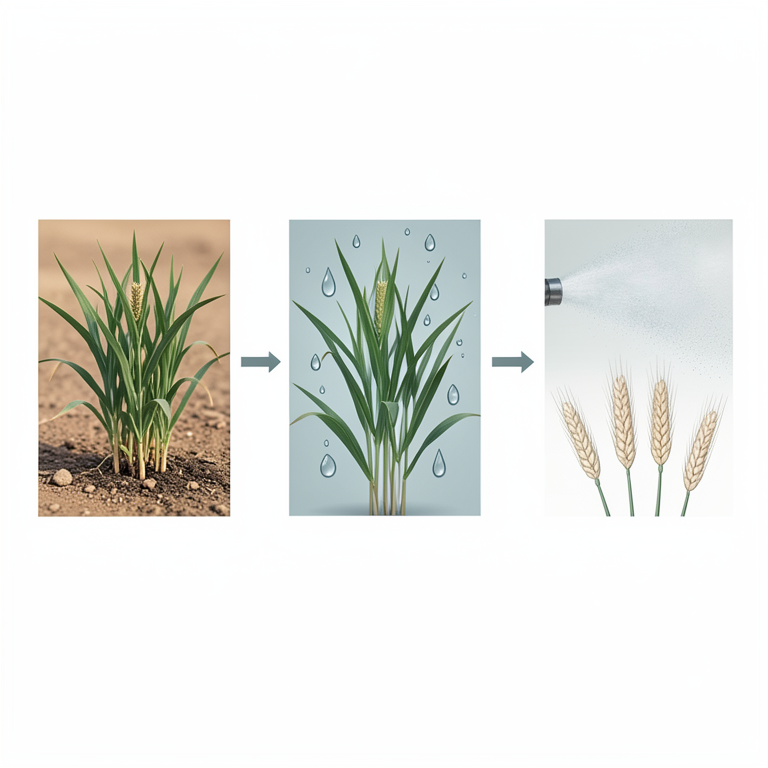
Experimental Interaction Model
AI-generated conceptual illustration (Finger millet, Pearl millet, and Foxtail millet plants). It explains the idea and does not show study data.
View source evidence ↗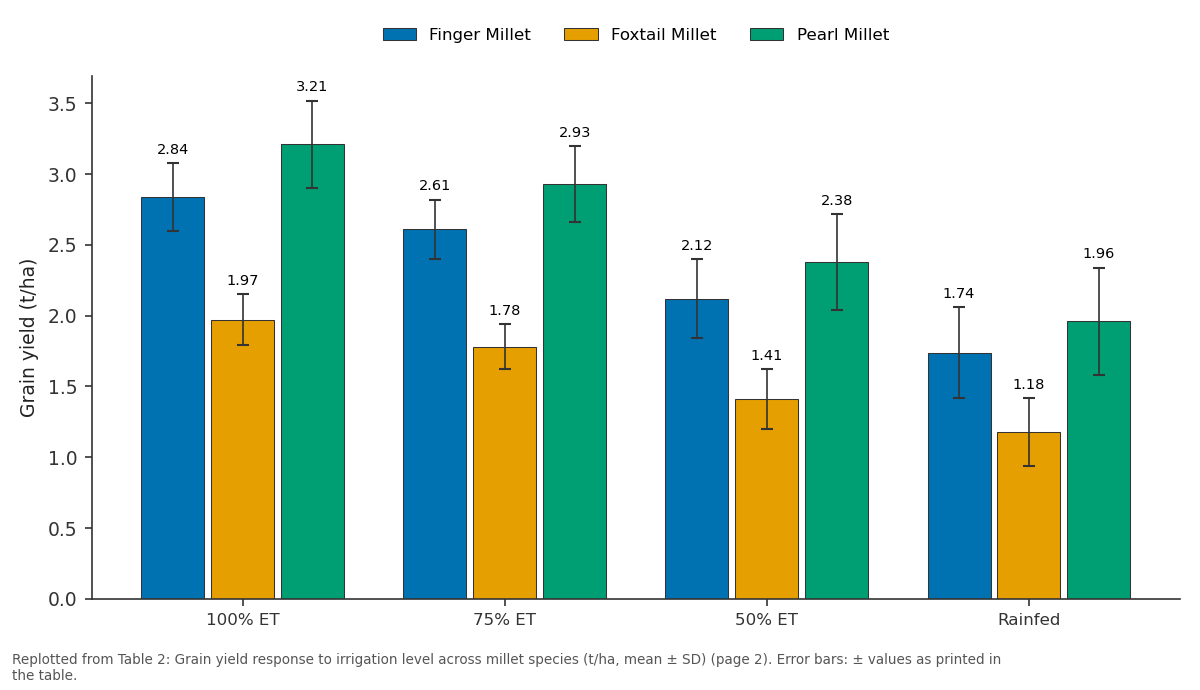
Finger Millet and Foxtail Millet and more: 100% ET vs 75% ET vs 50% ET vs Rainfed
Replotted from Table 2 (page 2) of the original paper. Every bar is the paper's own table value.
View source evidence ↗Figures & tables
From the original paper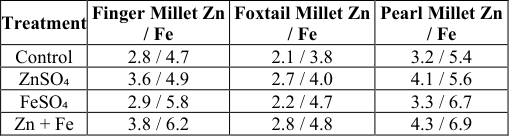 Table 1
 Table 2
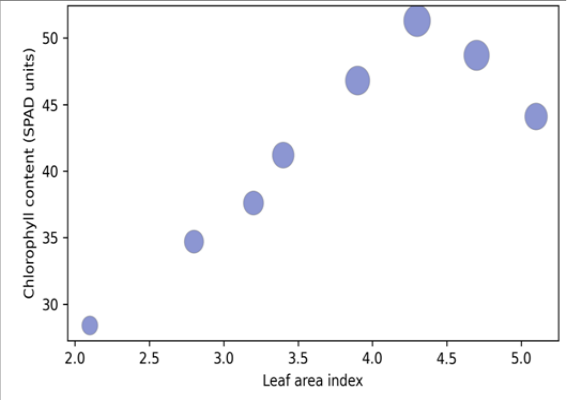 Figure 1
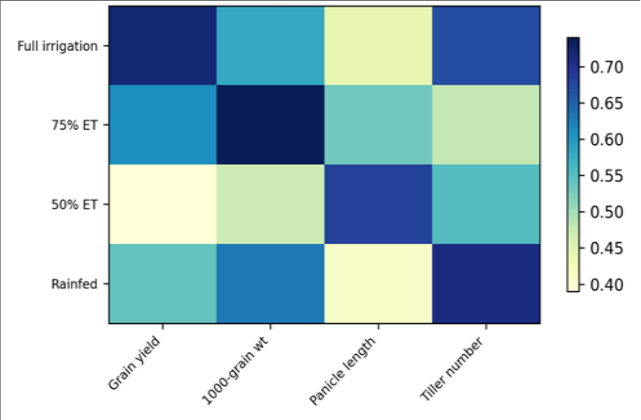 Figure 2
Introduction
From a regional context, the Subarnarekha Basin in Jharkhand is one of India's most milletdependent landscapes. Over 40% of farmland in the basin's upper catchment is planted to millets during the kharif season, mainly by tribal communities who rely on these crops for both food and cultural identity [1] . But yields average only 0.8-1.2 t/ha -less than half the national potential -partly because the basin's red laterite soils are naturally poor in zinc, iron, and available phosphorus [2] . Foliar micronutrient application bypasses the soil altogether, delivering zinc and iron directly to the leaf surface where they can be absorbed through stomata and cuticle. This approach has been validated for wheat and rice on alkaline soils, where high pH locks up soil-applied micronutrients, but its effectiveness on acidic laterites -where the limitation is low total micronutrient content rather than high pH -has not been compared across millet species [3] . Deficit irrigation adds another dimension. The Subarnarekha's flow is erratic, and groundwater in the laterite aquifer is shallow and seasonal. Farmers who invest in drip or sprinkler systems need to know how much water can be saved without unacceptable yield loss, and whether foliar nutrition can partially compensate for water-stress-induced nutrient uptake limitation [4] . This research tested the interaction between foliar nutrition and irrigation level across three millet species, with the goal of developing integrated management prescriptions for the Subarnarekha Basin. All laboratory analysis was performed at the Mangalore National Institute of Tropical Agriculture [5] .
Biodiversity Assessment of Rhizosphere Microbiota
Rhizosphere soil bacterial communities were characterized at the genus level using dilution plating on selective media. Total culturable bacteria ranged from 4.2 × 10⁶ to 8.7 × 10⁶ CFU/g across treatments. Foliar Zn + Fe treatment increased rhizosphere bacterial density by 18.3% compared with control plots, possibly because improved plant vigor increased root exudate production. Phosphate-solubilizing bacteria (Pseudomonas, Bacillus) were 2.1 times more abundant in the rhizosphere of finger millet than pearl millet, consistent with finger millet's known efficiency at mobilizing soil phosphorus [2] .
Field Experimental Design
The trial was laid out as a split-split-plot design with irrigation level as the main plot, millet species as the subplot, and foliar treatment as the sub-subplot. Each experimental unit consisted of 6 rows of 4 m length at 30 cm row spacing. Three replications were used, giving a total of 144 experimental units (4 irrigation levels × 3 species × 4 foliar treatments × 3 reps). Border rows were excluded from data collection. Plots were separated by 1 m alleys to prevent lateral water movement between irrigation treatments [4] .
Material and Methods Material
The trial was established at the Subarnarekha Agricultural Research Farm, East Singhbhum district, Jharkhand (22°48′N, 86°12′E; elevation 148 m) during the 2023 kharif season (June-October). Three millet species were used: finger millet cv. GPU-28, foxtail millet cv. SiA-3085, and pearl millet cv. HHB-67 Improved. Foliar treatments were: distilled water control, ZnSO₄•7H₂O at 0.5% w/v, FeSO₄•7H₂O at 0.5% w/v, and Zn + Fe combined (both at 0.5%). Sprays were applied at tillering (30 DAS) and flowering (55 DAS) using a knapsack sprayer at 500 L/ha [3] . Irrigation was supplied by drip at 100%, 75%, and 50% ETc, plus a rainfed control. Grain and leaf samples were shipped to the Mangalore National Institute of Tropical Agriculture. Ethics approval was granted (Protocol MNITA-2023-008, 12 February 2023).
Methods
LAI was measured at 30, 45, 60, and 75 DAS using a ceptometer (AccuPAR LP-80). Chlorophyll content was estimated by SPAD-502 meter readings on the flag leaf at flowering. Grain yield was recorded at physiological maturity. Grain mineral content (Zn, Fe, Ca, Mg) was measured by AAS after tri-acid digestion. Protein was estimated by Kjeldahl. Heritability was estimated from a nested design with 10 genotypes per species evaluated under the 75% ET regime (4 reps). Data were analyzed by splitsplit-plot ANOVA with Tukey's HSD at α = 0.05 using SAS 9.4.
Results
Foliar Zn + Fe produced the highest grain mineral concentrations across all three species and irrigation levels. Grain zinc increased by 34.7% and iron by 28.3% over controls (pooled across species). The response was strongest in finger millet, which showed 38.4% zinc increase and 31.7% iron increase [3] . The bubble chart shows a strong positive relationship between LAI and SPAD chlorophyll readings. Larger bubbles (representing higher grain yield) cluster in the upper-right quadrant, confirming that plants with both high LAI and high chlorophyll produced the best yields. The heatmap shows that grain yield heritability was highest under full irrigation and lowest under rainfed conditions, reflecting the increased environmental noise in waterlimited environments. Finger millet maintained the highest heritability across all irrigation levels, making it the most responsive species to genetic selection for drought adaptation.
Comprehensive Interpretation
The 75% ET regime emerged as the best compromise across all three species: it maintained 91.4% of full-irrigation yield while saving 25% water and actually increasing grain mineral concentration by 6-8% compared with full irrigation (likely due to reduced dilution effect). Heritability for grain yield under 75% ET was 0.72 for finger millet, 0.61 for pearl millet, and 0.53 for foxtail millet, indicating that breeding progress under moderate deficit irrigation would be most rapid for finger millet [5] .
Discussion
The foliar biofortification results confirm that zinc and iron can be effectively delivered through the leaf surface even on acidic laterite soils where soil application is also feasible. The advantage of foliar delivery is speed and precision: a single well-timed spray at flowering can boost grain mineral content by 28-35% without the year-long residual effects (and potential toxicity risks) of heavy soil-applied micronutrient amendments [3] . For smallholder millet farmers in the Subarnarekha Basin, where purchased inputs must be carefully targeted, foliar spraying represents a costeffective biofortification strategy. The LAI-SPAD correlation (r = 0.83) suggests that either measurement can serve as a proxy for the other in quick field assessments. SPAD readings are faster to collect (30 seconds per plant vs. several minutes for ceptometer LAI), making them more practical for extension workers monitoring crop progress [4] . A limitation is that the foliar treatments were tested over a single season. Multi-year data would be needed to assess whether repeated foliar micronutrient applications cause any leaf phytotoxicity or soil accumulation effects, particularly for iron, which can reach toxic levels in waterlogged laterite soils [1] .
Conclusion
Foliar Zn + Fe application at tillering and flowering stages increased millet grain zinc by 34.7% and iron by 28.3%, with finger millet showing the strongest response. Deficit irrigation at 75% ET maintained 91.4% of full-irrigation yield while saving 25% water. Heritability for grain yield was highest in finger millet, supporting it as the priority species for genetic improvement under deficit irrigation. These integrated foliar nutrition and irrigation prescriptions are directly applicable to millet production on laterite soils of the Subarnarekha Basin.
Acknowledgement
Acknowledgements Funding SourcesInternal funds from the Mangalore National Institute of Tropical Agriculture supported all analytical work. Institutional SupportThe authors acknowledge the Mangalore National Institute of Tropical Agriculture for AAS instrumentation and statistical support.
Figures and tables from the paper
| Irrigation | Finger Millet | Foxtail Millet | Pearl Millet | Mean |
|---|---|---|---|---|
| 100% ET | 2.84 ± 0.24 | 1.97 ± 0.18 | 3.21 ± 0.31 | 2.67 |
| 75% ET | 2.61 ± 0.21 | 1.78 ± 0.16 | 2.93 ± 0.27 | 2.44 |
| 50% ET | 2.12 ± 0.28 | 1.41 ± 0.21 | 2.38 ± 0.34 | 1.97 |
| Rainfed | 1.74 ± 0.32 | 1.18 ± 0.24 | 1.96 ± 0.38 | 1.63 |
Table text extracted from the original PDF; superscript letters are shown inline. The original table image is below.
View original table image
References
16 in the original paper- Namboodiri C, Krishnaswamy V. Laterite soil constraints for cereal production in eastern Indian river basins. Journal of Soil Science and Plant Nutrition. 2022;22(3):3214-3227.
- Pande G, Namboodiri C. Micronutrient status of tribal farmland soils in the Subarnarekha catchment. Indian Journal of Agricultural Sciences. 2021;91(8):11341139.
- Cakmak I, Kutman UB. Agronomic biofortification of cereals with zinc: a review. European Journal of Soil Science. 2018;69(1):172-180.
- Krishnaswamy V, Pande G. Deficit irrigation scheduling for small millets on red laterite soils. Agricultural Water Management. 2023;276:108064.
- Rai KN, Yadav OP, Rajpurohit BS. Breeding pearl millet for drought tolerance. Plant Breeding Reviews. 2012;35:73-120.
- Devi PB, Vijayabharathi R, Sathyabama S. Health benefits of finger millet polyphenols and dietary fiber. Journal of Food Science and Technology. 2014;51(6):1021-1040.
- Saleh ASM, Zhang Q, Chen J. Millet grains: nutritional quality, processing, and potential health benefits. Comprehensive Reviews in Food Science and Food Safety. 2013;12(3):281-295.
- Obilana AB, Manyasa E. Millets. Pseudocereals and Less Common Cereals Springer. 2002;177-217.
- Taylor JRN. Overview: importance of sorghum in Africa. Afripro Workshop on Proteins of Sorghum and Millets. 2003;1-21.
- Chandrashekar A. Finger millet: Eleusine coracana. Advances in Food and Nutrition Research. 2010;59:215-262.
- Mal B, Padulosi S, Ravi SB. Minor millets in South Asia: learnings from IFAD-NUS project. Bioversity International Rome. 2010;1-185.
- Shobana S, Krishnaswamy K, Sudha V. Finger millet: its nutritional value and health benefits. Journal of Food Science and Technology. 2013;50(2):149-168.
- Singh P, Raghuvanshi RS. Finger millet for food and nutritional security. African Journal of Food Science. 2012;6(4):77-84.
- Muthamilarasan M, Dhaka A, Yadav R. Exploration of millet models for developing nutrient rich graminaceous crops. Plant Science. 2016;242:89-97.
- Amadou I, Gounga ME, Le GW. Millets: nutritional composition, some health benefits and processing. Emirates Journal of Food and Agriculture. 2013;25(7):501-508.
- Tian S, Lu L, Labavitch JM. Cellular sequestration of cadmium in the hyperaccumulator plant species Sedum alfredii. Plant Physiology. 2011;157(4):1914-1925.