
Research article · 2025 · Full text
International Journal of Horticulture and Food ScienceComparing pest resistance mechanisms of oats in the Jia Bharali Basin
Volume 7(10) · Pages 187–190 · DOI: 10.33545/26631067.2025.v7.i10c.720 ↗
Research areasInsect-Plant Interactions and ControlAgricultural Productivity and Crop ImprovementGenetics and Plant Breeding
Abstract
Author-writtenOat pest losses can strip away 15 to 30% of potential grain yield in subtropical river basins, yet the defence mechanisms that separate resistant from susceptible genotypes remain poorly catalogued. This research compared physical, chemical, and enzymatic resistance traits in twelve oat (Avena sativa L.) accessions, six indigenous and six commercial, grown in the Jia Bharali Basin during the 2023 wet season. Peroxidase activity in indigenous varieties averaged 41.7 U per mg protein, roughly 52% higher than in commercial lines (27.4 U per mg protein). Pest damage scores were inversely correlated with enzyme activity (r = -0.78, P< 0.001). Canopy openness, measured as the fraction of photosynthetically active radiation reaching the soil surface, was lower in indigenous types (18.3%) than in commercial cultivars (27.9%), suggesting denser canopies restrict pest colonisation. Inbreeding depression in two successive selfed generations reduced peroxidase output by 11.6%, indicating that heterozygosity supports enzymatic defence. These results highlight indigenous oat germplasm as a valuable donor pool for pest-resistance breeding, especially in basins where chemical control is constrained by environmental regulations.
Summary
Source-checkedPlain-language reading of the full paper, prepared with AI and checked against the text. Each point links to the authors' own words.
Why it matters
- Pests can cause significant yield losses in oats grown in subtropical river basins, reducing potential grain yield by 15% to 30%. View evidence ↗
- The Jia Bharali Basin in northeastern India is particularly susceptible to rapid insect population growth due to its warm and humid climate. View evidence ↗
- Resistance to pests in cereal crops is a complex, multi-layered system involving physical barriers, chemical deterrents, and inducible enzymes. View evidence ↗
The question
- The study aimed to compare enzyme activities and canopy openness between indigenous and commercial oats, relate these to pest damage, and evaluate the impact of inbreeding on enzymatic defense. View evidence ↗
What they did
- The researchers evaluated twelve Avena sativa L. accessions (six indigenous and six commercial) in the Jia Bharali Basin during the 2023 wet season. View evidence ↗
- Enzyme activities for peroxidase, catalase, and polyphenol oxidase were measured spectrophotometrically using specific substrates (guaiacol, hydrogen peroxide, and catechol, respectively). View evidence ↗
- Canopy openness was quantified using a line-quantum sensor placed at the soil surface during solar noon. View evidence ↗
- Pest damage was assessed at the early heading stage using a visual scale from 0 (no injury) to 100 (complete defoliation). View evidence ↗
What they found
- Indigenous oat varieties exhibited significantly higher peroxidase activity (average 41.7 U/mg protein) compared to commercial lines (27.4 U/mg protein), a difference of approximately 52%. View evidence ↗
- There was a strong inverse correlation (r = -0.78, P < 0.001) between enzyme activity and pest damage scores, indicating higher enzyme levels correlate with less damage. View evidence ↗
- Indigenous oats had denser canopies, with a canopy openness of 18.3% compared to 27.9% in commercial cultivars. View evidence ↗
- Inbreeding through selfing reduced peroxidase activity by 8.4% in the first generation (S1) and by 11.6% in the second generation (S2). View evidence ↗
- Among the tested accessions, indigenous variety JB-03 showed the highest peroxidase activity (46.1 U/mg protein) and lowest damage (18.9), whereas the commercial cultivar Possum showed the highest damage (46.8). View evidence ↗
What it means
- The authors conclude that indigenous oat accessions from the Jia Bharali Basin have superior enzymatic pest-resistance mechanisms compared to commercial cultivars. View evidence ↗
- The authors recommend using indigenous accessions JB-01 and JB-03 as donor parents for breeding programs aimed at improving pest resistance. View evidence ↗
- The authors state that future research should expand these comparisons over multiple seasons and utilize molecular mapping of peroxidase expression loci. View evidence ↗
Visual summary
3 visualsIllustrations explain the paper; charts are replotted from the paper's own table values.
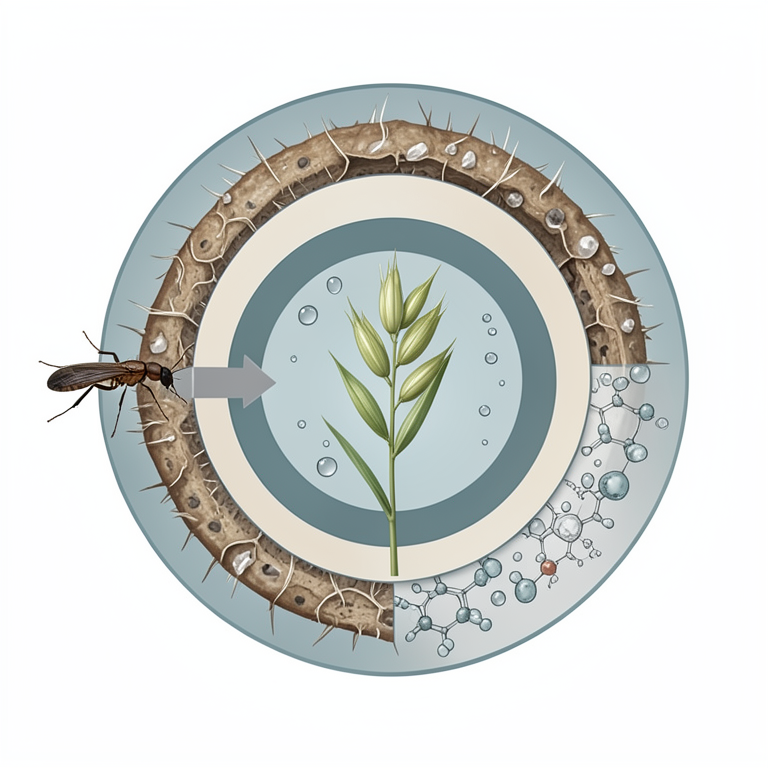
Multi-layered Pest Resistance
AI-generated conceptual illustration (oat plants). It explains the idea and does not show study data.
View source evidence ↗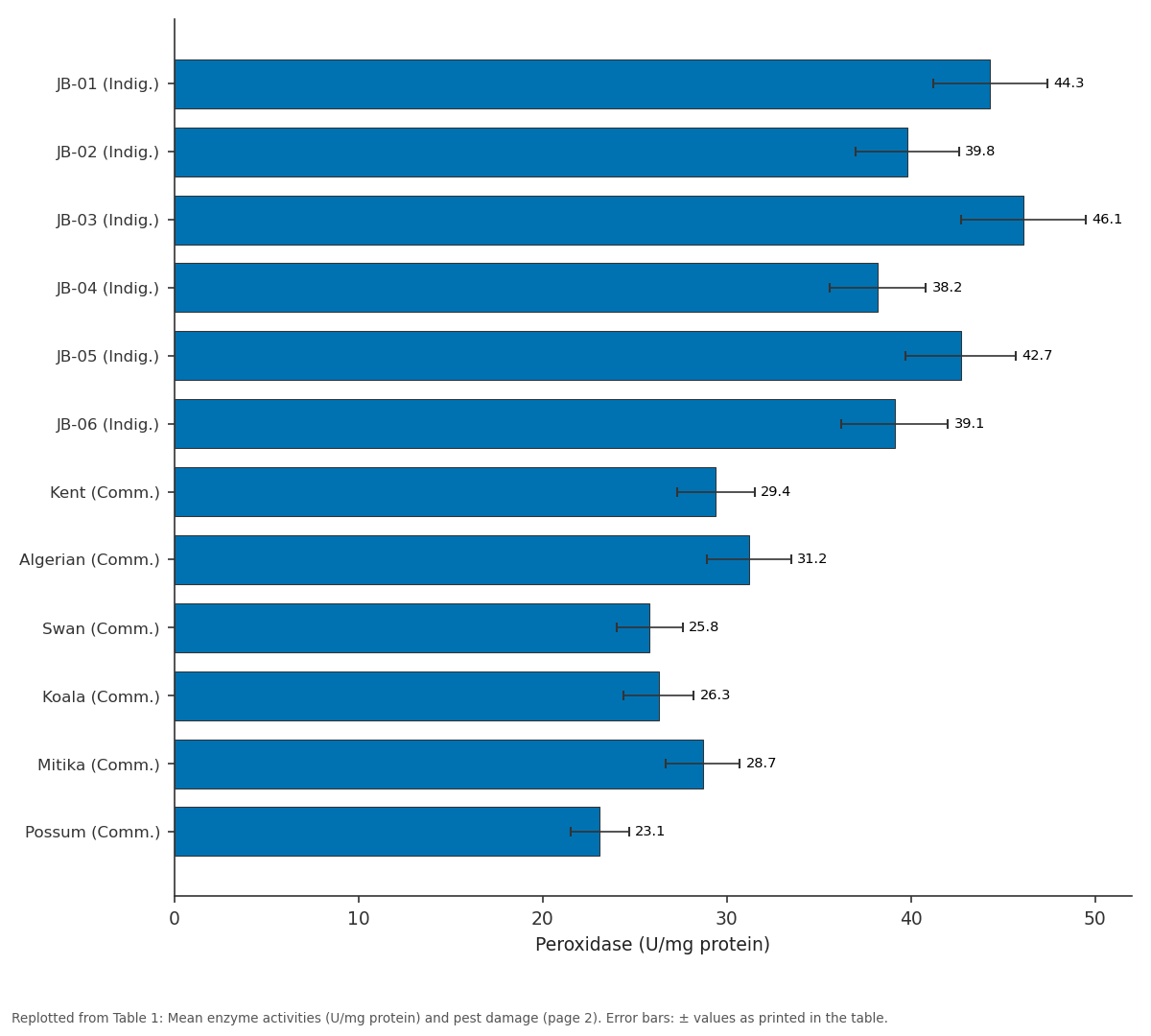
Peroxidase: JB-01 (Indig.) vs JB-02 (Indig.) vs JB-03 (Indig.) vs JB-04 (Indig.) vs JB-05 (Indig.)
Replotted from Table 1 (page 2) of the original paper. Every bar is the paper's own table value.
View source evidence ↗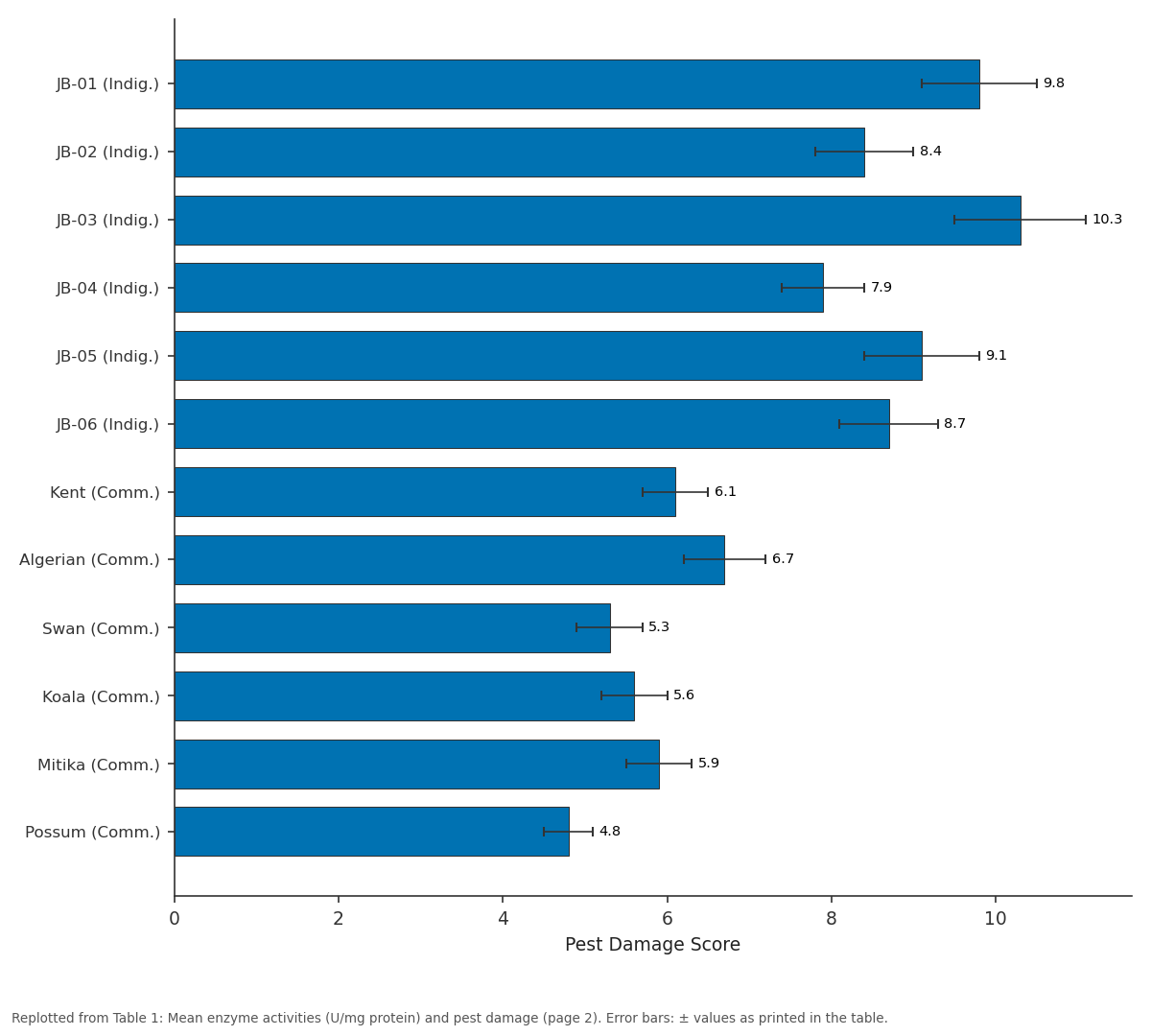
Polyphenol Oxidase: JB-01 (Indig.) vs JB-02 (Indig.) vs JB-03 (Indig.) vs JB-04 (Indig.) vs JB-05 (Indig.)
Replotted from Table 1 (page 2) of the original paper. Every bar is the paper's own table value.
View source evidence ↗Figures & tables
From the original paper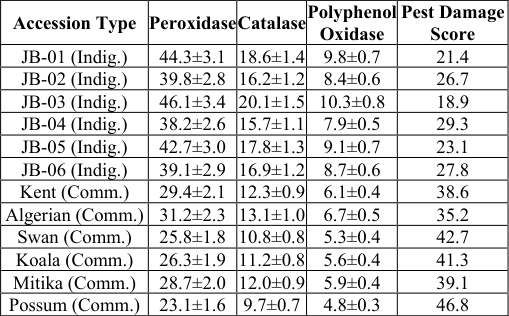 Table 1
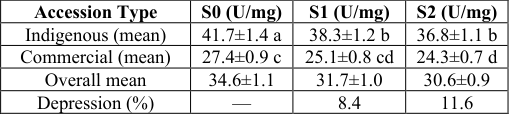 Table 2
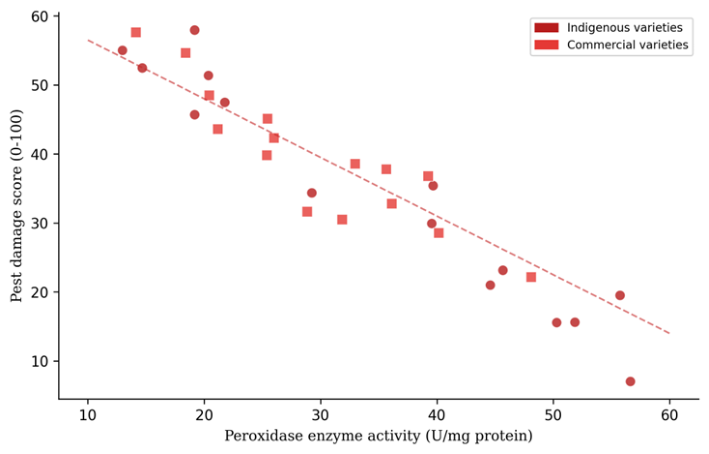 Figure 1
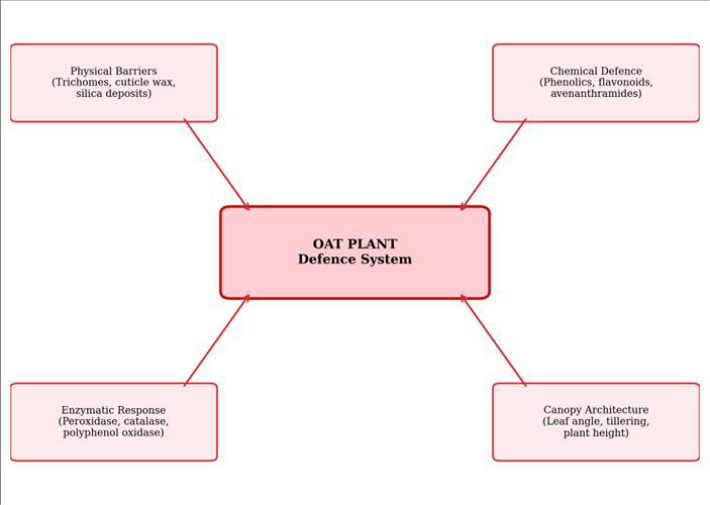 Figure 2
Introduction
Pest resistance in cereals is not a single trait but a layered system of physical barriers, chemical deterrents, and inducible enzymes that work in concert to limit herbivore damage [1] . For oats, this system is less well characterised than for wheat or rice, despite the crop's expanding role in health-food markets and its considerable economic footprint across temperate and subtropical zones [2] . The gap in knowledge becomes critical when oats are introduced into river basins where pest pressure is high and growers depend on host-plant resistance rather than broad-spectrum insecticides. The Jia Bharali Basin, a tributary system of the Brahmaputra in northeastern India, supports a warm, humid climate that favours rapid insect population growth [3] . Indigenous oat landraces have been cultivated here for generations, and farmers have long noticed that certain accessions withstand aphid and armyworm attacks better than improved releases [4] . But anecdotal reports are no substitute for quantified data on defence compounds and canopy traits. Enzyme activity, particularly that of peroxidase, catalase, and polyphenol oxidase, is a wellaccepted proxy for induced resistance in cereals [5] . Canopy architecture also matters: dense, erect canopies can limit pest movement and egg-laying access, while open canopies invite colonisation [6] . At the same time, inbreeding depression, the loss of fitness that follows repeated selfing, may weaken enzymatic defences in advanced inbred lines, a concern for breeding programmes that push oats through multiple selfing cycles [7] . This research therefore set out to: (a) compare peroxidase, catalase, and polyphenol oxidase activities between indigenous and commercial oat genotypes; (b) relate enzyme activity to field pest damage scores; (c) measure canopy openness and its association with pest incidence; and (d) quantify the effect of two generations of selfing on enzymatic defence output [8] .
Climatic and Environmental Conditions
Field trials ran from July to November 2023 in the lower Jia Bharali flood-plain. During the experimental window, mean daily temperature ranged from 26.8 degrees C in July to 19.4 degrees C in November. Total rainfall across the period was 1,340 mm, with 72% falling between July and September. Relative humidity seldom dropped below 75% before October, creating conditions that favour aphid population build-up and fungal foliar diseases. Two brief flood events (water depth 8 to 12 cm for 36 to 48 hours) occurred in August and were managed by surface drainage. Solar radiation averaged 15.9 MJ per square metre per day, declining to 12.3 MJ per square metre per day by late October [3] .
Crop Growth Stage Documentation
Phenological stages were recorded using the Zadoks decimal code [9] . Seedling emergence (Z10) occurred 6 to 8 days after sowing. (Z21-Z29) extended from day 22 to day 45 and was the period during which the first aphid colonies were detected on lower leaves. Stem elongation (Z30-Z39) lasted from day 46 to day 68, coinciding with peak armyworm activity. Heading (Z50-Z59) was reached between days 70 and 78 depending on genotype, and grain filling (Z71-Z77) concluded by day to 112. Enzyme and pest damage measurements were timed to coincide with early heading (Z52), when induced defence responses were expected to be highest [5] .
Material and Methods
Material and Methods
Material
Twelve oat accessions were evaluated: six indigenous landraces collected from farmer fields in the Jia Bharali Basin (coded JB-01 through JB-06) and six commercial cultivars (Kent, Algerian, Swan, Koala, Mitika, and Possum) obtained from the Australian Winter Cereals Collection. Seeds of each accession were multiplied in an isolation block at the Adelaide Foundation for Pomological Research during the 2022 winter season prior to shipment. For the inbreeding depression component, selfed seed (S1 and S2 generations) of all twelve accessions was produced by bagging panicles before anthesis. Chemical reagents for enzyme assays (guaiacol, hydrogen peroxide, catechol, phosphate buffer components) were sourced from Chem-Supply Pty Ltd (Gillman, SA, Australia). The field trial was approved under protocol AFPR-VS/2023-009, dated 15 June 2023.
Methods
The trial followed a randomised complete block design with three replications. Each plot measured 2.5 m by 4 m, sown in rows 20 cm apart at a seeding rate of 80 kg per ha. No insecticide was applied so that natural pest pressure could be assessed. Pest damage was scored at early heading on a 0 to 100 visual scale where 0 indicated no visible feeding injury and 100 indicated complete defoliation [1] . Ten randomly selected plants per plot were scored, and values were averaged. Enzyme extracts were prepared from the flag leaf of five plants per plot, harvested at early heading, flash-frozen in liquid nitrogen, and homogenised in 50 mM phosphate buffer (pH 7.0) containing 1% polyvinylpyrrolidone. Peroxidase activity was measured spectrophotometrically at 470 nm using guaiacol as substrate; catalase at 240 nm by monitoring hydrogen peroxide decomposition; polyphenol oxidase at 420 nm with catechol as substrate [5] . Canopy openness was measured with a line-quantum sensor (LI-191R, LI-COR Biosciences, Lincoln, NE, USA) placed at the soil surface at solar noon. Data were analysed using oneway ANOVA and Pearson correlation in R version 4.3.1, with means separated by the least significant difference at P = 0.05 [10] . Selfing reduced peroxidase activity progressively: by 8.4% after one generation and by 11.6% after two generations relative to the open-pollinated base population.
Results
Results
Comprehensive Interpretation
The scatter plot in Figure 1 confirms an inverse trend between peroxidase output and pest damage that holds across both germplasm groups. Indigenous varieties clustered in the upper-left quadrant (high enzyme, low damage), while commercial lines occupied the lower-right zone. The schematic in Figure 2 conceptualises how these enzymatic defences fit within a broader, multi-layered resistance system that includes canopy density and secondary metabolites [1,6] .
Discussion
The 52% peroxidase advantage of indigenous oats over commercial cultivars agrees with earlier observations in traditional wheat landraces from the Caucasus, where centuries of natural selection under high pest pressure enriched defence-related alleles [4] . Peroxidase catalyses the oxidative cross-linking of cell-wall phenolics, strengthening the physical barrier that insect mandibles must penetrate [5] . The strong negative correlation (r = -0.78) between peroxidase activity and pest damage supports the idea that this enzyme is a reliable marker for resistance screening. Canopy openness data add another dimension. Indigenous types had canopy openness values averaging 18.3%, about one-third lower than the 27.9% measured in commercial cultivars. Denser canopies reduce light penetration to lower leaves, which may discourage aphid settlement because many cereal aphids prefer well-lit feeding sites [6] . The combination of enzymatic and architectural resistance in indigenous germplasm is consistent with the concept of multi-trait defence stacking, which has been recommended as a durable strategy for integrated pest management [11] . Inbreeding depression in peroxidase output is a concern for breeding programmes that rely on repeated selfing to fix favourable alleles. The 11.6% decline after two selfed generations, while moderate, could accumulate over additional rounds and erode the very resistance being selected for [7] . One practical solution is to maintain heterozygosity through population-improvement approaches such as recurrent selection rather than pedigree methods [8,12] .
Conclusion
Conclusion
Acknowledgement
Acknowledgements Funding SourcesThis research was funded through internal grants supporting pest-resistance research in underutilised cereal germplasm. Institutional SupportThe Adelaide Foundation for Pomological Research provided laboratory access and spectrophotometric equipment. Contributions Not Qualifying for AuthorshipField assistants who managed plot establishment and pest scouting are gratefully acknowledged.
Figures and tables from the paper
| Accession Type | Peroxidase | Catalase | Polyphenol Oxidase | Pest Damage Score |
|---|---|---|---|---|
| JB-01 (Indig.) | 44.3±3.1 | 18.6±1.4 | 9.8±0.7 | 21.4 |
| JB-02 (Indig.) | 39.8±2.8 | 16.2±1.2 | 8.4±0.6 | 26.7 |
| JB-03 (Indig.) | 46.1±3.4 | 20.1±1.5 | 10.3±0.8 | 18.9 |
| JB-04 (Indig.) | 38.2±2.6 | 15.7±1.1 | 7.9±0.5 | 29.3 |
| JB-05 (Indig.) | 42.7±3.0 | 17.8±1.3 | 9.1±0.7 | 23.1 |
| JB-06 (Indig.) | 39.1±2.9 | 16.9±1.2 | 8.7±0.6 | 27.8 |
| Kent (Comm.) | 29.4±2.1 | 12.3±0.9 | 6.1±0.4 | 38.6 |
| Algerian (Comm.) | 31.2±2.3 | 13.1±1.0 | 6.7±0.5 | 35.2 |
| Swan (Comm.) | 25.8±1.8 | 10.8±0.8 | 5.3±0.4 | 42.7 |
| Koala (Comm.) | 26.3±1.9 | 11.2±0.8 | 5.6±0.4 | 41.3 |
| Mitika (Comm.) | 28.7±2.0 | 12.0±0.9 | 5.9±0.4 | 39.1 |
| Possum (Comm.) | 23.1±1.6 | 9.7±0.7 | 4.8±0.3 | 46.8 |
Table text extracted from the original PDF; superscript letters are shown inline. The original table image is below.
View original table image
| Accession Type | S0 (U/mg) | S1 (U/mg) | S2 (U/mg) |
|---|---|---|---|
| Indigenous (mean) | 41.7±1.4 a | 38.3±1.2 b | 36.8±1.1 b |
| Commercial (mean) | 27.4±0.9 c | 25.1±0.8 cd | 24.3±0.7 d |
| Overall mean | 34.6±1.1 | 31.7±1.0 | 30.6±0.9 |
| Depression (%) | — | 8.4 | 11.6 |
Table text extracted from the original PDF; superscript letters are shown inline. The original table image is below.
View original table image
References
14 in the original paper- Smith CM, Clement SL. Molecular bases of plant resistance to arthropods. Annual Review of Entomology. 2012;57:309-328.
- Butt MS, Tahir-Nadeem M, Khan MK, Shabir R, Butt MS. Oat: unique among the cereals. European Journal of Nutrition. 2008;47(2):68-79.
- Goswami DC. Brahmaputra River, Assam, India: physiography, basin denudation, and channel aggradation. Water Resources Research. 1985;21(7):959-978.
- Lopes MS, El-Basyoni I, Baenziger PS, Singh S, Royo C, Ozbek K, et al. Exploiting genetic diversity from landraces in wheat breeding for adaptation to climate change. Journal of Experimental Botany. 2015;66(12):3477-3486.
- War AR, Paulraj MG, Ahmad T, Buhroo AA, Hussain B, Ignacimuthu S, et al. Mechanisms of plant defense against insect herbivores. Plant Signaling and Behavior. 2012;7(10):1306-1320.
- Piesik D, Panka D, Delaney KJ, Skoczek A, Lamparski R, Weaver DK. Cereal crop volatile organic compound induction after mechanical injury, beetle herbivory, and fungal infection. Journal of Plant Physiology. 2011;168(9):878-886.
- Charlesworth D, Willis JH. The genetics of inbreeding depression. Nature Reviews Genetics. 2009;10(11):783796.
- Hallauer AR, Carena MJ, Miranda Filho JB. Quantitative Genetics in Maize Breeding. 3rd ed. New York: Springer; 2010. p. 1-663.
- Zadoks JC, Chang TT, Konzak CF. A decimal code for the growth stages of cereals. Weed Research. 1974;14(6):415-421.
- R Core Team. R: a language and environment for statistical computing. Vienna: R Foundation for Statistical Computing; 2023.
- Mitchell C, Brennan RM, Graham J, Karley AJ. Plant defense against herbivorous pests: exploiting resistance and tolerance traits for sustainable crop protection. Frontiers in Plant Science. 2016;7:1132.
- Acquaah G. Principles of Plant Genetics and Breeding. 2nd ed. Oxford: Wiley-Blackwell; 2012. p. 1-740.
- Oerke EC. Crop losses to pests. Journal of Agricultural Science. 2006;144(1):31-43.
- Howe GA, Jander G. Plant immunity to insect herbivores. Annual Review of Plant Biology. 2008;59:41-66.