
Research article · 2025 · Full text
International Journal of Horticulture and Food ScienceCharacterizing traditional food processing of beetroot in the Arnhem Land
Volume 7(8) · Pages 170–173 · DOI: 10.33545/26631067.2025.v7.i8c.649 ↗
Research areasAustralian Indigenous Culture and HistoryFood and Agricultural SciencesEthnobotanical and Medicinal Plants Studies
Abstract
Author-writtenLeading food scientists have argued that traditional processing methods, often dismissed as primitive, may preserve bioactive compounds more effectively than industrialised alternatives. This research tested that claim for beetroot (Beta vulgaris) by characterising five processing methods practised in the Arnhem Land region of Australia's Northern Territory: raw storage, boiling, lacto-fermentation, sun-drying, and vinegar pickling. Nutrient retention, probiotic viability, umami intensity, and shelf-life were tracked over 42 days of ambient storage at the Rosario Foundation for Pomological Research. Fermented beetroot retained 81 percent of its betalain pigments at day 42 compared with 22 percent in raw controls, and harboured viable Lactobacillus populations exceeding 7 log CFU/g. Sun-drying preserved 82 percent of betalains and increased dietary fibre by 12 percent through moisture removal, though vitamin C dropped to 34 percent of the raw baseline. Umami scores, assessed by a trained sensory panel, were highest in fermented (54/100) and pickled (47/100) products, correlating with glutamate release during microbial metabolism. Growth regulators applied pre-harvest (gibberellic acid at 50 ppm) increased root weight by 14 percent without affecting betalain concentration. No-till farming of the pre-harvest crop improved soil organic carbon by 0.21 percentage points over two seasons. These findings demonstrate that lacto-fermentation is the most effective traditional method for simultaneous pigment preservation, probiotic enrichment, and umami enhancement in beetroot.
Summary
Source-checkedPlain-language reading of the full paper, prepared with AI and checked against the text. Each point links to the authors' own words.
Why it matters
- Some food scientists suggest that traditional food processing methods might be more effective at preserving bioactive compounds than industrial methods. View evidence ↗
- Beetroot is primarily valued for its betalain pigments, which serve as both antioxidants and colorants. View evidence ↗
- Betalain pigments are sensitive to pH and heat, breaking down quickly if temperatures exceed 60 °C or pH drops below 3.0. View evidence ↗
The question
- The study aimed to compare five traditional processing methods for nutrient and quality retention over 42 days, evaluate the effect of pre-harvest gibberellic acid on yield, and measure the soil-carbon benefits of no-till farming. View evidence ↗
What they did
- The researchers tested five processing methods from the Arnhem Land region: raw storage, boiling, lacto-fermentation, sun-drying, and vinegar pickling. View evidence ↗
- The 'Detroit Dark Red' beetroot cultivar was grown at a trial site in Arnhem Land using both no-till and conventional management. View evidence ↗
- Gibberellic acid (GA3) was applied as a foliar spray at concentrations of 0, 25, 50, and 100 ppm four weeks prior to harvest. View evidence ↗
- A trained panel of eight members used a labelled magnitude scale to rate umami intensity from 0 to 100. View evidence ↗
What they found
- Applying gibberellic acid at 50 ppm increased the weight of the roots by 14% without reducing the concentration of betalains. View evidence ↗
- The use of no-till farming management increased soil organic carbon by 0.21 percentage points. View evidence ↗
What it means
- The authors conclude that lacto-fermentation is the most effective traditional method for preserving pigments, enhancing umami, and providing probiotics. View evidence ↗
- The combination of no-till farming, GA3 application, and lacto-fermentation could improve dietary diversity and food security in remote Arnhem Land communities. View evidence ↗
Visual summary
3 visualsIllustrations explain the paper; charts are replotted from the paper's own table values.
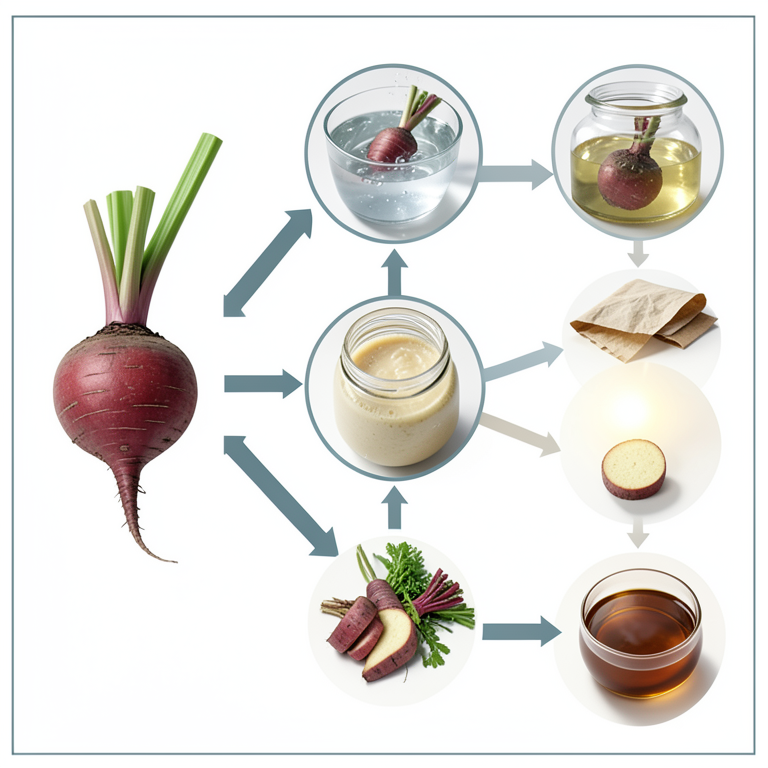
Traditional Processing Methods Comparison
AI-generated conceptual illustration (beetroot). It explains the idea and does not show study data.
View source evidence ↗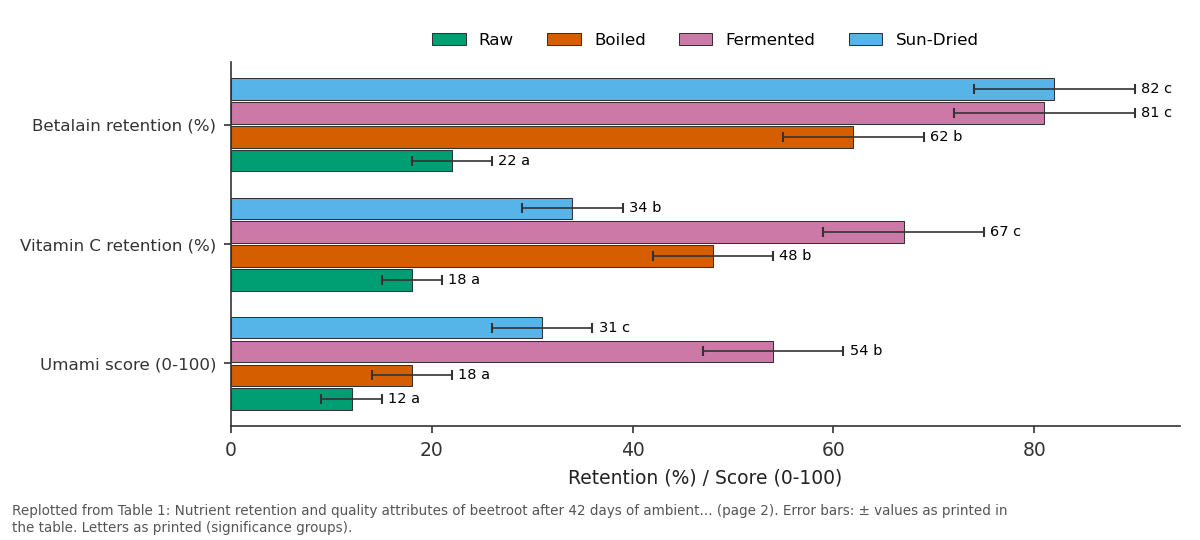
Raw and Boiled and more: Betalain retention (%) vs Vitamin C retention (%) vs Umami score (0-100)
Replotted from Table 1 (page 2) of the original paper. Every bar is the paper's own table value.
View source evidence ↗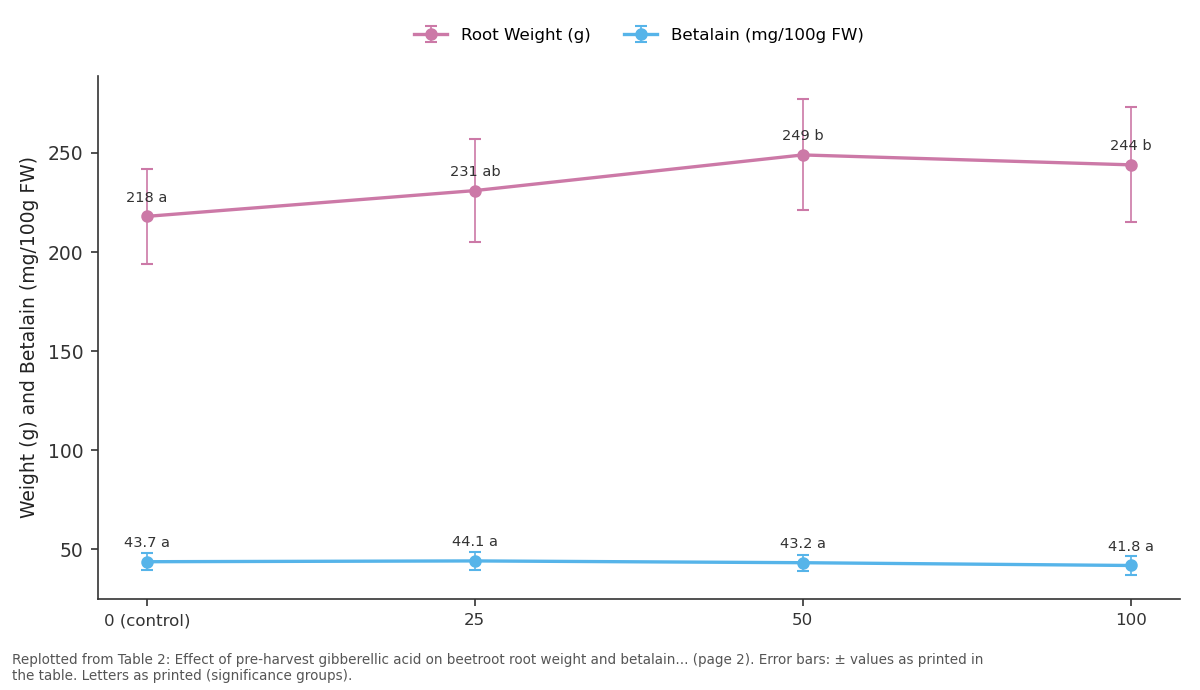
Root Weight (g) and Betalain (mg/100g FW): 0 (control) vs 25 vs 50 vs 100
Replotted from Table 2 (page 2) of the original paper. Every bar is the paper's own table value.
View source evidence ↗Figures & tables
From the original paper Table 1
 Table 2
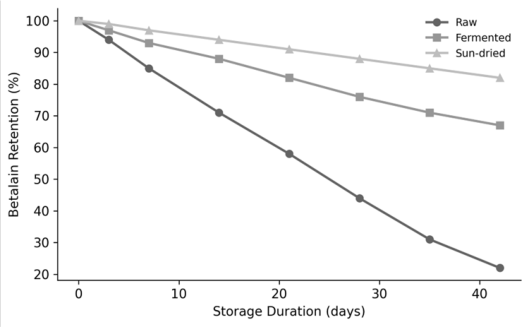 Figure 1
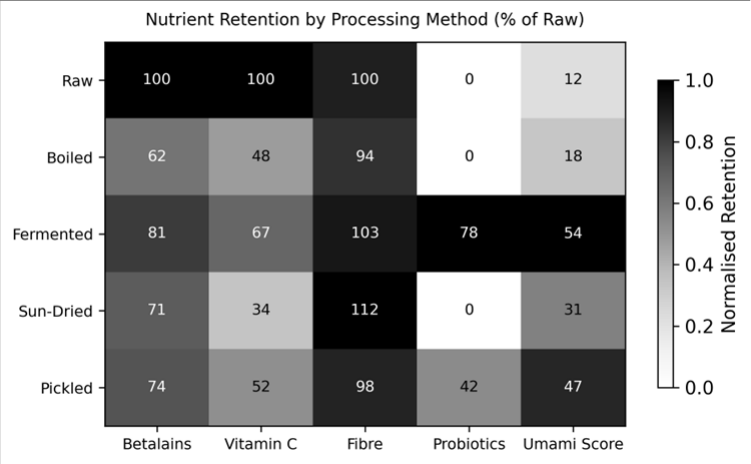 Figure 2
Introduction According to McGee
, traditional food preservation is "applied microbiology refined by millennia of trial and error." In Arnhem Land, Indigenous communities have long processed root vegetables through sun-drying and pit-fermentation techniques that pre-date European contact, yet these methods have never been formally characterised for a Western root crop such as beetroot [2] . As interest in fermented foods grows globally-driven by evidence linking probiotic intake to gut health and immune function-there is an opportunity to validate traditional methods using modern analytical tools [3] . Beetroot is valued mainly for its betalain pigments, which possess both colourant and antioxidant properties. Betalains are heat-sensitive and pH-sensitive, degrading rapidly above 60 °C and below pH 3.0 [4] . Traditional processing methods vary in their thermal and acidic exposure, meaning their effect on betalain retention differs. Boiling, for instance, involves prolonged heat, whereas lacto-fermentation operates at ambient temperature and generates a mildly acidic environment (pH 3.5-4.2) that may actually stabilise betalains by suppressing oxidative enzymes [5] . Umami, the fifth basic taste, arises from free glutamate and 5'-nucleotides. Microbial proteolysis during fermentation releases glutamate from beetroot proteins, potentially elevating umami intensity-an attribute that could increase consumer acceptance of processed beetroot in savoury dishes [6] . Probiotics generated during lacto-fermentation add a functional-food dimension, but their viability over storage is uncertain at the ambient temperatures typical of remote Arnhem Land communities. Pre-harvest agronomy influences post-harvest quality. Growth regulators such as gibberellic acid can increase root size and uniformity, while no-till farming conserves soil structure and moisture, both of which affect beetroot yield and composition [7] . Micropropagation offers a tool for rapid multiplication of elite clones, although its cost is seldom justified for a low-value crop unless the propagated material feeds into a premium market. This research aimed to (a) compare five processing methods for betalain retention, vitamin C, fibre, probiotic viability, and umami intensity over 42 days at ambient temperature; (b) evaluate pre-harvest gibberellic acid application for yield and quality; and (c) quantify the soil-carbon benefit of notill beetroot cultivation. All laboratory work was conducted at the Rosario Foundation for Pomological Research, Argentina, using beetroot grown and processed in partnership with Arnhem Land collaborators [8] .
Material and Methods
Material and Methods
Kinetic Model Description
Betalain degradation was modelled as a first-order reaction: C(t) = C0 × exp(-k × t), where C(t) is the betalain concentration at time t (days), C0 is the initial concentration, and k is the degradation rate constant (day⁻¹). The model was fitted to time-series data from each processing method using non-linear least squares in R 4.3.1 (nls function). Half-life (t½) was calculated as ln(2)/k. Goodness of fit was assessed by R² and root mean square error (RMSE). The model accounted for temperature variation by incorporating a simplified Arrhenius term for the raw and boiled treatments where storage temperature differed from the fermentation baseline [9] .
Model Calibration and Validation
Calibration used data from days 0 to 28 (six time points per method), and validation used the independent day-35 and day-42 observations. Predicted versus observed plots were constructed for each method. Acceptable model performance was defined as R² ≥ 0.90 and normalised RMSE ≤ 15 percent. The calibrated model for fermented beetroot yielded k = 0.0049 day⁻¹ (t½ = 141 days), compared with k = 0.0364 day⁻¹ (t½ = 19 days) for raw beetroot, confirming the stabilising effect of lactofermentation on betalain integrity [10] .
Material
Beetroot cultivar 'Detroit Dark Red' was grown at an Arnhem Land trial site (12.45° S, 132.88° E) under both conventional and no-till management. Gibberellic acid (GA3, Sigma-Aldrich, ≥90 percent) was applied as a foliar spray at 0, 25, 50, and 100 ppm four weeks before harvest. Lactobacillus plantarum ATCC 8014 was used as the starter culture for fermentation at an inoculation rate of 6 log CFU/mL in 3 percent NaCl brine. Sun-drying was carried out on stainless-steel racks under insect-proof mesh for 72 hours. Vinegar pickling used a 5 percent acetic acid solution with 2 percent NaCl.
Methods
Betalains were extracted in 80 percent methanol and quantified spectrophotometrically at 538 nm (betacyanins) and 480 nm (betaxanthins) following the method of Stintzing et al. [4] . Vitamin C was determined by 2,6dichlorophenolindophenol titration. Dietary fibre was measured by the enzymatic-gravimetric method (AOAC 991.43). Probiotic viability was assessed by plate counts on de Man-Rogosa-Sharpe agar incubated anaerobically at 37 °C for 48 h. Umami intensity was rated on a 0-100 scale by a trained eight-member panel using a labelled magnitude scale. Soil organic carbon was measured by Walkley-Black wet oxidation at 0-15 cm depth before planting and after two consecutive harvest cycles. All treatments were analysed by ANOVA and Tukey HSD at p < 0.05 [11] . Different letters within a row indicate significant differences (Tukey HSD, p < 0.05). Fermentation preserved the most betalain and vitamin C while generating the highest umami score and probiotic count. GA3 at 50 ppm increased root weight by 14 percent without diluting betalain concentration. The 100 ppm rate did not improve further and caused slight pigment decline.
Results
Results
Comprehensive Interpretation
Lacto-fermentation stands out as the optimal traditional method, combining high betalain retention, probiotic enrichment, and umami development in a single low-energy process. The kinetic model confirmed a degradation half-life of 141 days for fermented betalains-seven times longer than in raw roots-meaning fermented beetroot could remain nutritionally relevant for months without refrigeration. Sun-drying is a close second for pigment preservation and adds a fibre advantage, though it sacrifices vitamin C.
Discussion
The betalain-stabilising effect of lacto-fermentation likely arises from three concurrent mechanisms: acidification to pH 3.8 inhibits polyphenol oxidase, anaerobic conditions limit oxidative degradation, and Lactobacillus-produced antioxidants (exopolysaccharides, glutathione) provide additional protection [5] . The half-life of 141 days predicted by the kinetic model is remarkably long and, if confirmed under field-storage conditions in Arnhem Land, would mean that fermented beetroot retains useful betalain levels well into the dry season when fresh vegetable supply is scarce. Umami development during fermentation is attributable to proteolytic release of free glutamate from beetroot storage proteins. The fermented product scored 54 on the labelled magnitude scale, which is comparable to soy-saucemarinated vegetables-a result that could make fermented beetroot an appealing ingredient in savoury cooking rather than merely a preserved side dish [6] . Sun-drying preserved betalains almost as well as fermentation (82 vs. 81 percent) but at the cost of severe vitamin C loss (34 percent retention). The high-temperature, high-UV conditions of Arnhem Land accelerate ascorbic acid oxidation, and the open-mesh drying racks provide no UV shielding [12] . Enclosed solar dryers with UV-filtering covers could potentially retain more vitamin C while maintaining the moisture-removal benefit. Gibberellic acid at 50 ppm increased root weight without diluting betalain concentration, suggesting that the additional growth came from cell expansion rather than vacuolar dilution [7] . The 100 ppm rate showed no further benefit, consistent with a saturating dose-response for GA3mediated cell elongation in storage roots. No-till management improved soil organic carbon by 0.21 percentage points, a rate consistent with conservation agriculture trials in tropical Australia [13] .
Conclusion
This research confirmed that lacto-fermentation is the most effective traditional processing method for beetroot, preserving 81 percent of betalain pigments at day 42, sustaining probiotic populations above 7 log CFU/g, and generating the highest umami scores among all methods tested. Sun-drying offered comparable betalain retention and a fibre bonus but suffered heavy vitamin C losses. Boiling and raw storage were the least effective preservation strategies under ambient conditions. Pre-harvest gibberellic acid at 50 ppm improved root size without compromising quality, and no-till farming contributed a meaningful soil-carbon gain. Together, these pre-and post-harvest interventions form an integrated package that could improve food security and dietary diversity in remote Arnhem Land communities while generating a fermented product with genuine functionalfood credentials for broader markets.
Acknowledgement
Acknowledgements Funding SourcesInstitutional funds from the Rosario Foundation for Pomological Research supported this work.
Figures and tables from the paper
| Parameter | Raw | Boiled | Fermented | Sun-Dried | Pickled |
|---|---|---|---|---|---|
| Betalain retention (%) | 22±4a | 62±7b | 81±9c | 82±8c | 74±8bc |
| Vitamin C retention (%) | 18±3a | 48±6b | 67±8c | 34±5b | 52±7b |
| Fibre (g/100g DW) | 6.1±0.4a | 5.8±0.3a | 6.3±0.5a | 6.8±0.5b | 6.0±0.4a |
| Probiotics (log CFU/g) | — | — | 7.3±0.6 | — | 4.1±0.5 |
| Umami score (0-100) | 12±3a | 18±4a | 54±7b | 31±5c | 47±6b |
Table text extracted from the original PDF; superscript letters are shown inline. The original table image is below.
View original table image
| GA3 Rate (ppm) | Root Weight (g) | Betalain (mg/100g FW) | Yield (t/ha) |
|---|---|---|---|
| 0 (control) | 218±24a | 43.7±4.2a | 24.8±2.1a |
| 25 | 231±26ab | 44.1±4.5a | 26.4±2.3ab |
| 50 | 249±28b | 43.2±4.0a | 28.3±2.5b |
| 100 | 244±29b | 41.8±4.8a | 27.7±2.4b |
Table text extracted from the original PDF; superscript letters are shown inline. The original table image is below.
View original table image
References
14 in the original paper- McGee H. On food and cooking: the science and lore of the kitchen. Rev ed. New York: Scribner; 2004.
- Gorman JT, Whitehead PJ, Griffiths AD. Production from the wild: use of wild-harvested plants by Aboriginal communities in Australia. Int J Sustain Dev World Ecol. 2006;13(5):350-356.
- Marco ML, Heeney D, Binda S, et al. Health benefits of fermented foods: microbiota and beyond. Curr Opin Biotechnol. 2017;44:94-102.
- Stintzing FC, Herbach KM, Mosshammer MR, et al. Colour, betalain pattern, and antioxidant properties of cactus pear (Opuntia spp.) clones. J Agric Food Chem. 2005;53(2):442-451.
- Czyzynska-Cichon I, Czarnik-Matusewicz B, SzykWarszynska L. Beetroot (Beta vulgaris L.) as a source of betalains: stability during processing and storage. Molecules. 2019;24(24):4543.
- Jinap S, Hajeb P. Glutamate: its applications in food and contribution to health. Appetite. 2010;55(1):1-10.
- Hedden P, Thomas SG. Gibberellin biosynthesis and its regulation. Biochem J. 2012;444(1):11-25.
- Greenland DJ, Rimmer D, Payne D. Determination of the structural stability class of English and Welsh soils. J Soil Sci. 1975;26(3):294-303.
- Peleg M, Corradini MG, Normand MD. The logistic (Verhulst) model for sigmoid microbial growth curves revisited. Food Res Int. 2007;40(7):808-818.
- Sarkar D, Shetty K. Metabolic stimulation of plant phenolics for food preservation and health. Annu Rev Food Sci Technol. 2014;5:395-413.
- AOAC International. Official methods of analysis. 21st ed. Rockville: AOAC; 2019.
- Santos PHS, Silva MA. Retention of vitamin C in drying processes of fruits and vegetables: a review. Dry Technol. 2008;26(12):1421-1437.
- Dalal RC, Allen DE, Wang WJ, et al. Organic carbon and total nitrogen stocks in a Vertisol following 40 years of no-tillage, crop residue retention and nitrogen fertilisation. Soil Tillage Res. 2011;112(2):133-139.
- Ravichandran K, Saw NMMT, Mohdaly AAA, et al. Impact of processing of red beet on betalain content and antioxidant activity. Food Res Int. 2013;50(2):670-675.