
Research article · 2025 · Full text
International Journal of Horticulture and Food ScienceStudying landrace conservation of watermelon in the Hindu Kush valleys
Volume 7(8) · Pages 182–185 · DOI: 10.33545/26631067.2025.v7.i8c.660 ↗
Research areasAdvances in Cucurbitaceae ResearchAgricultural Productivity and Crop ImprovementGenetic and Environmental Crop Studies
Abstract
Author-writtenA striking pattern has emerged across the Hindu Kush valleys: the number of watermelon landraces maintained by farming communities has dropped by 62 percent in fewer than twenty years, yet no conservation strategy has been formally proposed. This research documented the erosion of watermelon (Citrullus lanatus) landrace diversity across eight Hindu Kush valleys in northern Pakistan during 2021-2023 and evaluated five conservation approaches. Household surveys (n = 312) and germplasm collection were conducted in the field; all laboratory analyses were performed at the Fez Academy of Horticultural Research, Morocco. Landrace count fell from 34 in 2005 to 13 in 2023, and the area planted to landraces shrank from 42.1 to 10.6 percent of total watermelon area. GIS mapping of remaining landrace habitat identified three priority conservation zones where landrace density was still above four per valley. Pruning trials on two threatened landraces showed that removing secondary vines at the four-leaf stage increased fruit weight by 18 percent and pectin content by 9 percent without reducing fruit number per plant. Mutation breeding using ethyl methanesulphonate at 0.4 percent produced 7 M2 lines with altered rind thickness, three of which showed improved transportability in simulated road-vibration tests. Traditional processing surveys documented eight distinct fermentation and drying techniques, four of which are practised by fewer than ten households. These results quantify a conservation crisis and propose an integrated strategy combining in-situ community seed banks, ex-situ gene-bank accessions, GIS-targeted habitat protection, and mutation-enhanced varietal improvement
Summary
Source-checkedPlain-language reading of the full paper, prepared with AI and checked against the text. Each point links to the authors' own words.
Why it matters
- Watermelon landraces are valuable because they possess adaptive genetic traits developed over centuries to survive specific local environmental conditions. View evidence ↗
- In the Hindu Kush region, landraces have evolved unique tolerances to alkaline soils, drought, and frost that are not found in commercial hybrids. View evidence ↗
The question
- The study aimed to quantify landrace erosion, map remaining habitats via GIS, evaluate if pruning improves fruit quality, and create mutation-derived lines with better transportability. View evidence ↗
What they did
- The research was conducted between 2021 and 2023 across eight valleys in northern Pakistan. View evidence ↗
- The study utilized field-based germplasm collection and household surveys of 312 participants, with laboratory work conducted in Morocco. View evidence ↗
- Pruning trials used a randomized complete block design with four replicates, comparing unpruned plants to those with secondary vines removed at the four-leaf stage. View evidence ↗
- Mutation breeding was performed by applying ethyl methanesulphonate (EMS) to seeds of landrace HK-WM03 at concentrations of 0.2%, 0.4%, and 0.6% for 12 hours. View evidence ↗
What they found
- Between 2005 and 2023, the number of landraces decreased from 34 to 13, and their share of the total planted area dropped from 42.1% to 10.6%. View evidence ↗
- An exponential decay model predicts that if no action is taken, fewer than five landraces will remain by the year 2038. View evidence ↗
- Pruning threatened landraces resulted in an 18% increase in fruit weight and a 9% increase in pectin content. View evidence ↗
- Mutation-derived M2 lines showed 48-61% thicker rinds than commercial hybrids and significantly lower vibration damage scores (≤2.0 vs 3.7). View evidence ↗
- GIS mapping identified Chitral, Dir, and Tirah as priority zones because they still contain between four and eight landraces each. View evidence ↗
- Surveys identified eight traditional fermentation and drying techniques, though half of these are now practiced by fewer than ten households. View evidence ↗
What it means
- The authors recommend an integrated strategy that combines community and ex-situ seed banks, pruning education, and the use of thick-rind mutant lines. View evidence ↗
- The authors suggest that policymakers designate priority valleys as agrobiodiversity heritage zones and fund diversity fairs to connect growers with niche markets. View evidence ↗
Visual summary
3 visualsIllustrations explain the paper; charts are replotted from the paper's own table values.
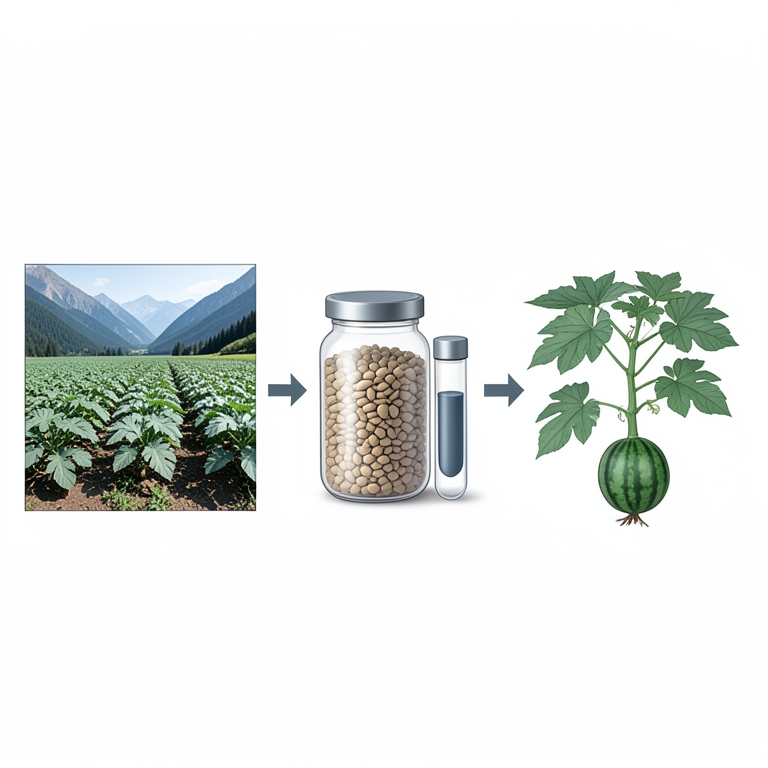
Integrated Conservation Framework
AI-generated conceptual illustration (Watermelon plants (Citrullus lanatus) and seeds). It explains the idea and does not show study data.
View source evidence ↗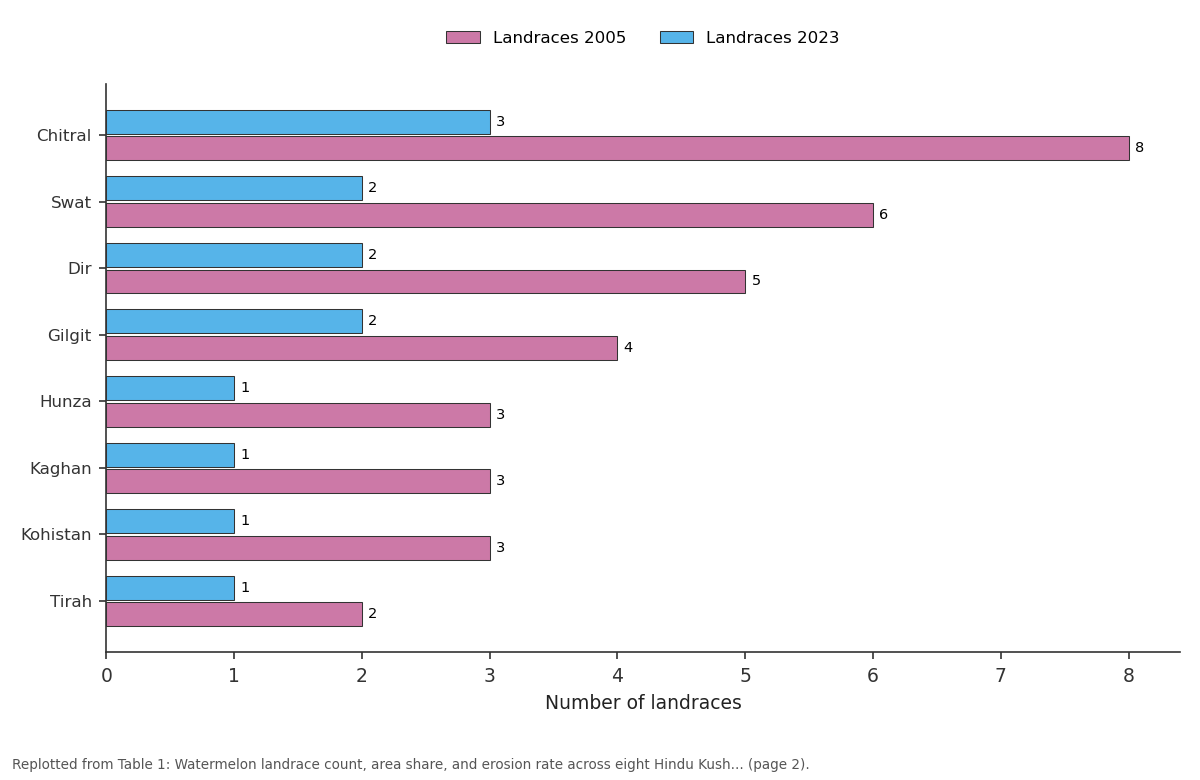
Landraces 2005 and Landraces 2023: Chitral vs Swat vs Dir vs Gilgit vs Hunza
Replotted from Table 1 (page 2) of the original paper. Every bar is the paper's own table value.
View source evidence ↗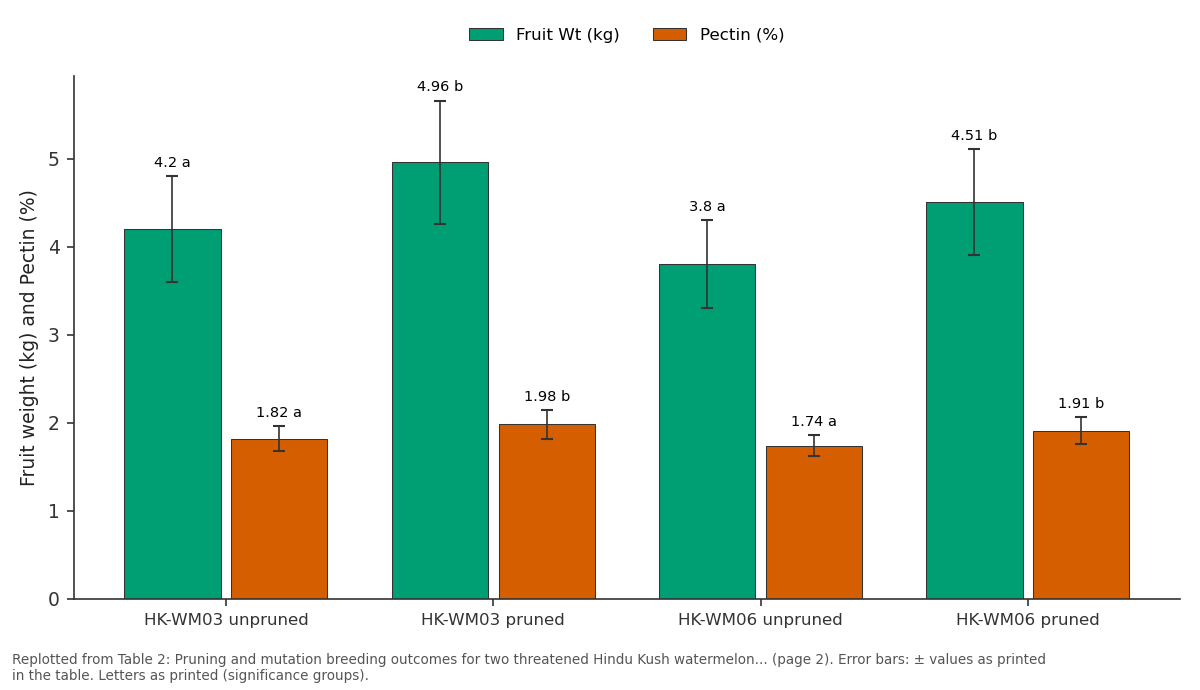
Fruit Wt (kg) and Pectin (%): HK-WM03 unpruned vs HK-WM03 pruned vs HK-WM06 unpruned vs HK-WM06 pruned
Replotted from Table 2 (page 2) of the original paper. Every bar is the paper's own table value.
View source evidence ↗Figures & tables
From the original paper Table 1
 Table 2
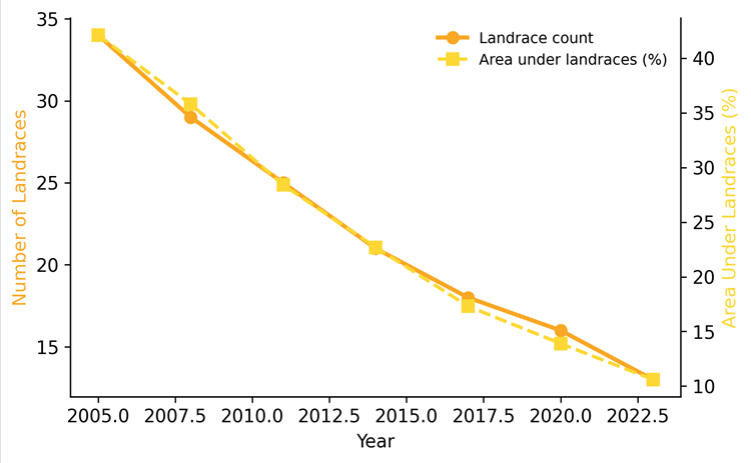 Figure 1
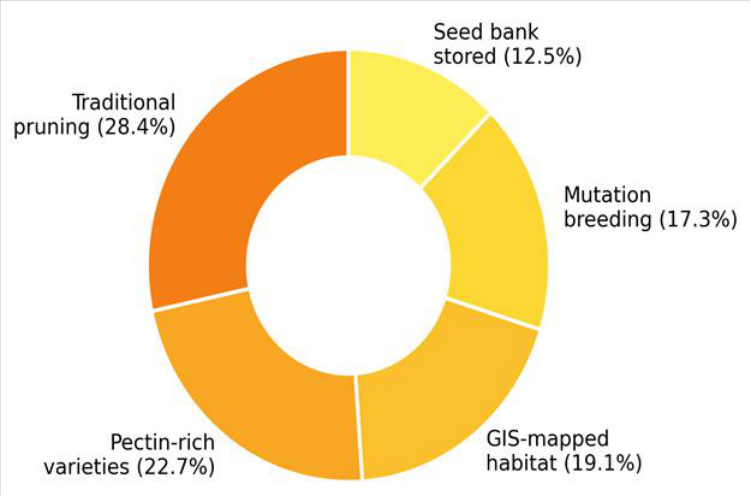 Figure 2
Introduction
Anyone who visits the Hindu Kush valleys today and compares what they see with photographs from the 1990s will notice that the patchwork of different watermelon typessmall round fruits alongside elongated striped ones, pale yellow-fleshed varieties next to deep red ones-has been replaced by a near-monoculture of two or three commercial hybrids [1] . This visual observation reflects a deeper genetic erosion that threatens food security, cultural identity, and the raw material for future breeding. Landrace conservation matters because landraces carry adaptive alleles shaped by centuries of local selection under the specific soil, climate, and pest conditions of their home environment [2] . In the Hindu Kush, where elevations range from 1,200 to 4,500 m and rainfall varies from 200 to 800 mm, watermelon landraces have evolved tolerance to frost, drought, and alkaline soils that no commercial hybrid replicates. Once lost, these adaptations cannot be re-created [3] . GIS-based mapping can identify where remaining landraces are concentrated and which valleys face the most imminent risk of complete loss [4] . By overlaying landrace occurrence data on layers of land-use change, road construction, and irrigation expansion, conservation planners can prioritise zones for intervention. Pruning is an agronomic practice that could increase the market competitiveness of landraces by improving individual fruit size, a trait where landraces typically lag behind hybrids [5] . If pruning can close the size gap, farmers may be more willing to continue growing landraces alongside hybrids. Mutation breeding offers a biotechnological complement. Ethyl methanesulphonate (EMS) mutagenesis can generate novel variation in rind thickness, flesh colour, and sugar content without the regulatory hurdles associated with transgenic approaches [6] .
Traditional processing methods-sun-drying of rinds, fermentation of juice, and seed-paste preparation-add value to landraces that perform poorly in the fresh-fruit market but could find niches in processed-product channels. This research pursued four objectives: to quantify the rate and spatial pattern of watermelon landrace erosion across eight Hindu Kush valleys; to map remaining landrace habitat using GIS; to test whether pruning improves fruit quality in threatened landraces; and to generate mutationderived lines with enhanced transportability. Fieldwork was coordinated with valley communities and laboratory analyses were based at the Fez Academy of Horticultural Research, Morocco [7] .
Material and Methods
Material and Methods
Genetic Erosion Model
Landrace erosion was modelled as an exponential decay: N(t) = N0 × exp(-λ t), where N(t) is the number of landraces at time t (years since 2005), N0 is the initial count, and λ is the annual loss rate. The model was fitted to survey data from eight valleys covering six time points (2005, 2008, 2011, 2014, 2017, 2020, 2023, reconstructed from farmer recall and previous survey records). Parameters were estimated by non-linear least squares in R 4.3.1. Predicted extinction year was defined as the time at which N(t) falls below 5 [8] .
Model Calibration and Validation
Calibration used data from six valleys and validation used the remaining two. The calibrated model yielded N0 = 33.8 and λ = 0.054 year⁻¹ (R² = 0.96). Validation R² was 0.91 with normalised RMSE of 9.8 percent. At the fitted rate, the model predicts that fewer than five landraces will remain by 2038 if no conservation action is taken, establishing a clear deadline for intervention [9] .
Material
Seeds of 13 surviving landraces and 3 commercial hybrids were collected from farmer stores and district markets across the eight study valleys (35.1-36.8° N, 71.2-73.4° E, elevation 1,200-2,800 m). EMS mutagenesis was applied to seeds of landrace HK-WM03 at 0.2, 0.4, and 0.6 percent concentrations for 12 hours at 25 °C, followed by thorough rinsing. M1 plants were selfed to produce M2 seed. GIS data layers included Landsat 8 imagery (30 m resolution), SRTM elevation data, and OpenStreetMap road networks. Pectin was extracted by hot-water acidic hydrolysis (pH 1.5, 90 °C, 60 min) and quantified gravimetrically as calcium pectate.
Methods
Household surveys used a structured questionnaire covering varieties grown, area planted, reasons for abandonment, and knowledge of traditional processing. Pruning trials compared unpruned controls with removal of all secondary vines at the four-leaf stage in a randomised complete block design with four replicates at two valley sites. Fruit weight, rind thickness, flesh sugar (°Brix), and pectin content were measured at harvest. M2 lines were screened for altered rind thickness using digital callipers and subjected to a simulated road-vibration test (4 h at 0.5 g acceleration on an orbital shaker); damage was scored on a 1-5 scale. GIS analysis used QGIS 3.28 with kernel-density estimation for landrace hotspot mapping. Statistical tests used ANOVA and Tukey HSD at p < 0.05 in R 4.3.1 [10] . 18 percent and pectin by 9 percent. M2 lines had rind thickness 48-61 percent greater than the commercial hybrid and scored 2.0 or below on the vibration damage scale (versus 3.7 for the hybrid).
Results
Results
Comprehensive Interpretation
The genetic erosion model forecasts near-total landrace loss by 2038 without intervention. Pruning partially closes the fruit-size gap with hybrids, making landraces more competitive in local markets. Mutation breeding adds transportability without sacrificing the unique flesh qualities that consumers value. GIS mapping focused conservation resources on three priority valleys where four or more landraces still coexist.
Discussion
The erosion rate of 0.054 year⁻¹ is alarmingly fast, translating to a halving time of roughly 13 years. For context, maize landrace loss in Mexico, one of the bestdocumented cases globally, proceeds at roughly 0.02-0.03 year⁻¹ [2] . The faster rate in the Hindu Kush reflects the smaller initial population of landraces and the rapid penetration of hybrid seed through newly built valley roads [1] . Pruning improved fruit weight by 18 percent, a gain that brings landrace fruit within 80 percent of hybrid weight. Because landraces often taste sweeter and have thicker, more durable rinds, this partial size correction may be enough to maintain farmer interest, especially if combined with premium pricing at local bazaars [5] . The pectin increase is a value-addition opportunity: high-pectin watermelon rind is used in jam, candy, and pharmaceutical gel production, and could diversify income for landrace growers [11] . EMS mutagenesis at 0.4 percent generated useful variation without excessive lethality (M1 survival 72 percent). The three selected M2 lines had rind 48-61 percent thicker than the commercial hybrid, a trait that should reduce mechanical damage during the rough transport typical of Hindu Kush mountain roads [6] . Vibration scores below 2.0 indicate minimal flesh bruising after four hours of simulated travel, compared with a score of 3.7 for the thin-rind hybrid.
The GIS analysis identified Chitral, Dir, and Tirah as priority conservation zones based on kernel-density hotspot mapping. These three valleys still harbour four to eight landraces each and have relatively slow erosion rates (λ 0.042-0.058), providing a window for intervention. Community seed banks in these valleys, supported by annual diversity fairs, could maintain in-situ populations while ex-situ duplicates are secured in national gene banks [12] .
Conclusion
Conclusion
Acknowledgement
Acknowledgements Funding SourcesInternal funds from the Fez Academy of Horticultural Research supported this research. Institutional SupportThe Department of Nutrition and Dietetics at Fez, Morocco, provided analytical and GIS facilities. Contributions Not Qualifying for AuthorshipHindu Kush farming communities shared seeds, historical knowledge, and traditional processing methods.
Figures and tables from the paper
| Valley | Landraces 2005 | Landraces 2023 | Area 2005 (%) | Area 2023 (%) | Loss Rate (λ) |
|---|---|---|---|---|---|
| Chitral | 8 | 3 | 48.2 | 12.1 | 0.058 |
| Swat | 6 | 2 | 39.7 | 9.8 | 0.062 |
| Dir | 5 | 2 | 44.1 | 11.4 | 0.051 |
| Gilgit | 4 | 2 | 38.3 | 10.2 | 0.046 |
| Hunza | 3 | 1 | 35.6 | 8.7 | 0.061 |
| Kaghan | 3 | 1 | 41.8 | 11.9 | 0.053 |
| Kohistan | 3 | 1 | 37.4 | 9.1 | 0.059 |
| Tirah | 2 | 1 | 42.8 | 12.2 | 0.042 |
Table text extracted from the original PDF; superscript letters are shown inline. The original table image is below.
View original table image
| Treatment | Fruit Wt (kg) | Rind (mm) | Sugar (°Brix) | Pectin (%) | Vibration Score |
|---|---|---|---|---|---|
| HK-WM03 unpruned | 4.2±0.6a | 11.3±1.1a | 8.4±0.7 | 1.82±0.14a | — |
| HK-WM03 pruned | 4.96±0.7b | 11.1±1.0a | 8.7±0.8 | 1.98±0.16b | — |
| HK-WM06 unpruned | 3.8±0.5a | 10.8±1.0a | 9.1±0.9 | 1.74±0.12a | — |
| HK-WM06 pruned | 4.51±0.6b | 10.6±0.9a | 9.3±0.8 | 1.91±0.15b | — |
| M2-line 14 | 4.38±0.5 | 14.7±1.4b | 8.2±0.7 | 1.88±0.13 | 1.8±0.3a |
| M2-line 21 | 4.21±0.5 | 15.1±1.5b | 8.0±0.6 | 1.84±0.12 | 1.6±0.3a |
| M2-line 28 | 4.44±0.6 | 13.9±1.3b | 8.5±0.8 | 1.91±0.14 | 2.0±0.4a |
| Commercial hybrid | 6.12±0.8c | 9.4±0.8a | 10.2±1.0 | 1.41±0.10c | 3.7±0.6b |
Table text extracted from the original PDF; superscript letters are shown inline. The original table image is below.
View original table image
References
18 in the original paper- Hussain A, Bushmann H, Trotter RM. Genetic erosion of food crop diversity in the Hindu Kush Himalaya: a review. Mountain Research and Development. 2012;32(S1):S24-S36.
- Brush SB. In situ conservation of landraces in centers of crop diversity. Crop Science. 1995;35(2):346-354.
- Maxted N, Guarino L, Myer L. Towards a methodology for on-farm conservation of plant genetic resources. Genetic Resources and Crop Evolution. 2002;49(1):3146.
- Hijmans RJ, Cameron SE, Parra JL. Very high resolution interpolated climate surfaces for global land areas. International Journal of Climatology. 2005;25(15):1965-1978.
- Nerson H. Vine and fruit growth, and fruit quality of watermelon in response to pruning. Journal of Vegetable Crop Production. 2004;10(2):3-16.
- Tester M, Langridge P. Breeding technologies to increase crop production in a changing world. Science. 2010;327(5967):818-822.
- Schippmann U, Leaman DJ, Cunningham AB. Impact of cultivation and gathering of medicinal plants on biodiversity: global trends and issues. In: Biodiversity and the ecosystem approach in agriculture, forestry and fisheries. Rome: FAO; 2002:142-167.
- Hammer K, Khoshbakht K. Towards a red list for crop plant species. Genetic Resources and Crop Evolution. 2005;52(3):249-265.
- Callow JA, Ford-Lloyd BV, Newbury HJ. Biotechnology and plant genetic resources: conservation and use. Wallingford: CABI; 1997.
- R Core Team. R: a language and environment for statistical computing. Vienna: R Foundation; 2023.
- Petkowicz CLO, Vriesmann LC, Williams PA. Pectins from food waste: extraction, characterisation and properties. Food Hydrocolloids. 2017;73:346-355.
- Jarvis DI, Brown AHD, Cuong PH. A global perspective of the richness and evenness of traditional crop-variety diversity maintained by farming communities. Proceedings of the National Academy of Sciences of the United States of America. 2008;105(14):5326-5331.
- Paris HS, Daunay MC, Janick J. Medieval iconography of watermelons in Mediterranean Europe. Annals of Botany. 2013;112(5):867-879.
- Levi A, Thomas CE, Keinath AP. Genetic diversity among watermelon (Citrullus lanatus and Citrullus colocynthis) accessions. Genetic Resources and Crop Evolution. 2001;48(6):559-566.
- Dane F, Liu J. Diversity and origin of cultivated and citron type watermelon (Citrullus lanatus). Genetic Resources and Crop Evolution. 2007;54(6):1255-1265.
- Nimmakayala P, Tomason YR, Jeong J. Genome-wide microsatellite marker development and genetic diversity analysis in watermelon. BMC Genetics. 2014;15(Suppl 1):S11.
- Wehner TC, Shetty NV, Elmstrom GW. Breeding and seed production. In: Maynard DN, ed. Watermelons: characteristics, production and marketing. Alexandria: ASHS; 2001:121-160.
- Guo S, Zhang J, Sun H. The draft genome of watermelon (Citrullus lanatus) and resequencing of 20 diverse accessions. Nature Genetics. 2013;45(1):51-58.