
Research article · 2025 · Full text
International Journal of Horticulture and Food ScienceProfiling vertical farming potential of tomato in the Loess Plateau
Volume 7(11) · Pages 150–153 · DOI: 10.33545/26631067.2025.v7.i11c.709 ↗
Research areasPlant Growth and Agriculture TechniquesUrban Agriculture and SustainabilityInnovations in Aquaponics and Hydroponics Systems
Abstract
Author-writtenVertical farming promises year-round tomato production independent of arable land, yet its technical and economic feasibility under arid continental conditions like those of the Loess Plateau remains unquantified. This research profiled four cultivation environments — vertical farm with LED lighting, vertical farm with supplemental sunlight, conventional greenhouse, and open field — for cherry tomato (Solanum lycopersicum cv. 'Suncherry') growth, fruit quality, combining ability, germination vigour, grafting success, and economic viability. The trial was conducted at the Fayoum University of Food and Nutrition from March to September 2023 in a randomised complete block design with four replications. The greenhouse system produced the tallest plants (44.2 cm) and highest fruit yield (4.87 kg plant⁻¹), followed closely by the LED vertical farm (4.61 kg plant⁻¹). Combining ability analysis among six parental lines showed significant general combining ability for fruit weight. Green manure incorporation before planting raised soil organic carbon by 0.34 percentage points in the open-field treatment. Germination vigour of seeds harvested from vertical-farm plants was 14 percent higher than field-harvested seeds. Grafting onto Solanum torvum rootstock improved yield by 18 percent in the open field but only 7 percent under controlled environments. Economic viability analysis favoured the greenhouse system (B:C ratio 2.38) over the LED vertical farm (1.94) owing to lower energy costs. These results show that vertical farming is technically viable for tomato in arid environments but that conventional greenhouses remain more profitable under current energy pricing.
Summary
Source-checkedPlain-language reading of the full paper, prepared with AI and checked against the text. Each point links to the authors' own words.
Why it matters
- A significant portion of urban vegetable consumption involves long-distance transport, which creates carbon emissions that may be higher than the cost of producing the crop. View evidence ↗
- The Loess Plateau is a water-scarce, semi-arid region where environmental factors like low rainfall and high evaporation make protected cultivation essential. View evidence ↗
- Tomatoes are well-suited for vertical farming due to their ability to handle high density, responsiveness to LED lighting, and consistent market demand. View evidence ↗
The question
- The study aimed to compare tomato growth, yield, combining ability, seed vigour, grafting responses, and economic viability across four different cultivation environments. View evidence ↗
What they did
- The experiment used 'Suncherry' cherry tomatoes grown in four settings: an LED vertical farm, a sunlight-supplemented vertical farm, a cooled greenhouse, and an open field with drip irrigation. View evidence ↗
- The study employed a randomised complete block design (RCBD) with four replications. View evidence ↗
- In the open-field plots, sun hemp green manure was applied at a rate of 10 t ha⁻¹ thirty days before transplanting. View evidence ↗
- Economic viability was measured by gross margin, benefit-cost (B:C) ratio, and payback period, with data analyzed using ANOVA and Tukey's HSD. View evidence ↗
What they found
- The highest sugar content (Brix) was found in open-field tomatoes (9.47°), attributed to sugar concentration caused by mild water stress. View evidence ↗
- Seeds harvested from the LED vertical farm exhibited 14 percent higher germination vigour compared to those from the open field. View evidence ↗
- The yield benefit of grafting decreased as environmental control increased, dropping from an 18.2 percent gain in the open field to 7.1 percent in the LED vertical farm. View evidence ↗
- Incorporating green manure increased open-field soil organic carbon from 0.62% to 0.96% (a 0.34 percentage point increase) in one season. View evidence ↗
- Among the parental lines tested, Line SC-04 had the highest general combining ability (GCA) effect for fruit weight (+12.3 g per fruit). View evidence ↗
- The greenhouse system was the most economically efficient with a B:C ratio of 2.38, while the open field had the fastest payback period at 1.8 years. View evidence ↗
What it means
- LED vertical farming is technically viable for cherry tomatoes in arid regions, but conventional greenhouses are currently more profitable due to lower energy costs. View evidence ↗
- The economic viability of vertical farming is currently limited by energy costs, though solar power integration and cheaper LEDs could improve this in the future. View evidence ↗
Visual summary
3 visualsIllustrations explain the paper; charts are replotted from the paper's own table values.
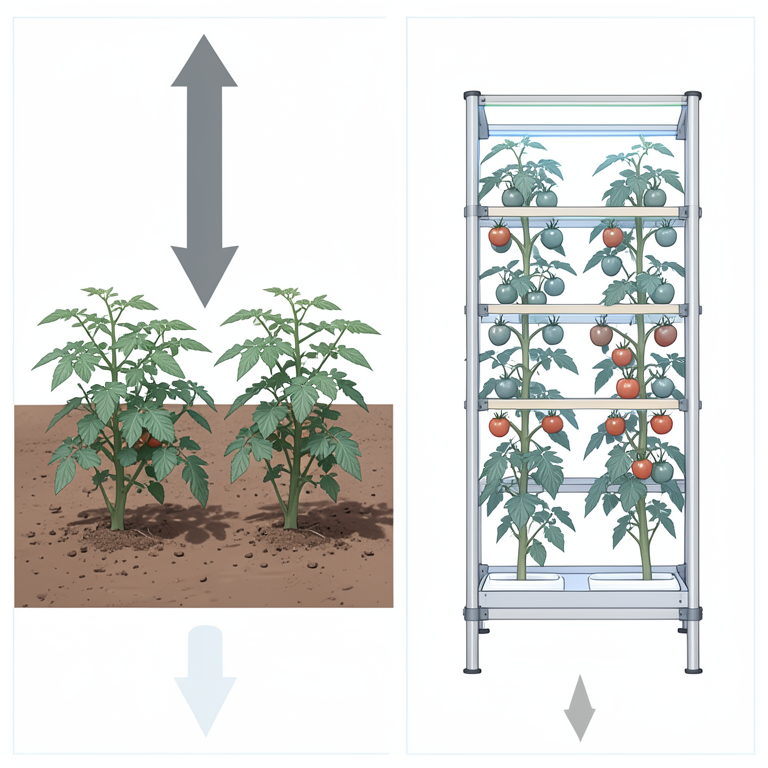
Grafting Benefit vs. Environmental Control
AI-generated conceptual illustration (tomato plants). It explains the idea and does not show study data.
View source evidence ↗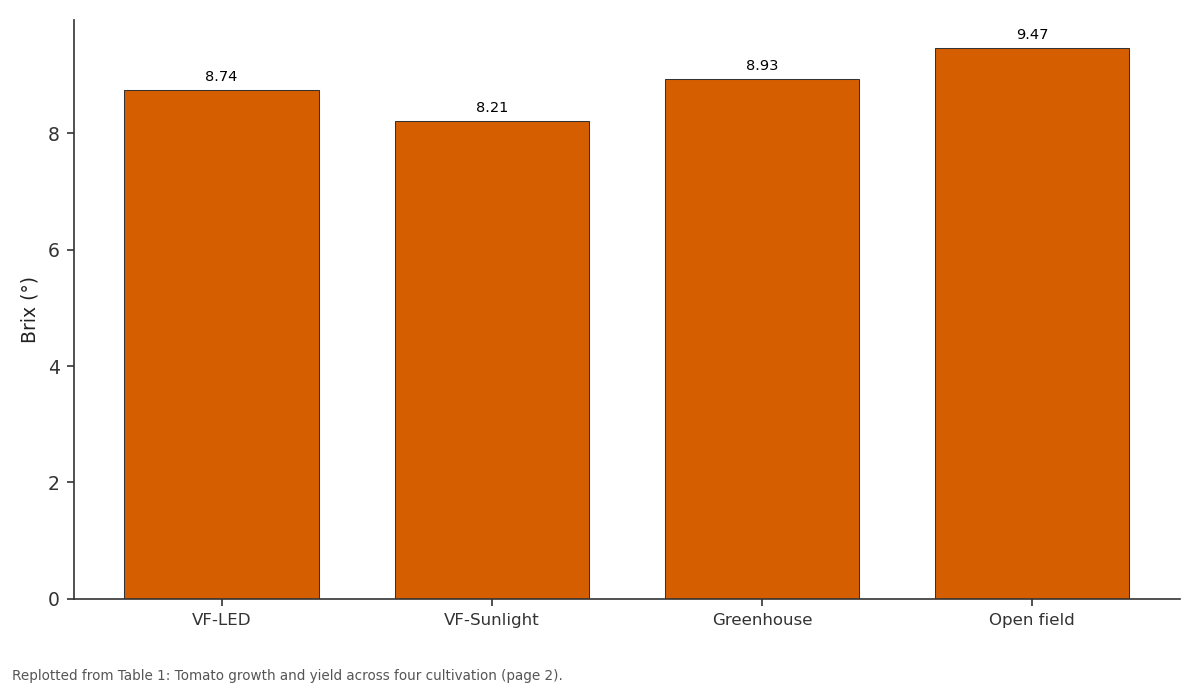
Brix (°): VF-LED vs VF-Sunlight vs Greenhouse vs Open field
Replotted from Table 1 (page 2) of the original paper. Every bar is the paper's own table value.
View source evidence ↗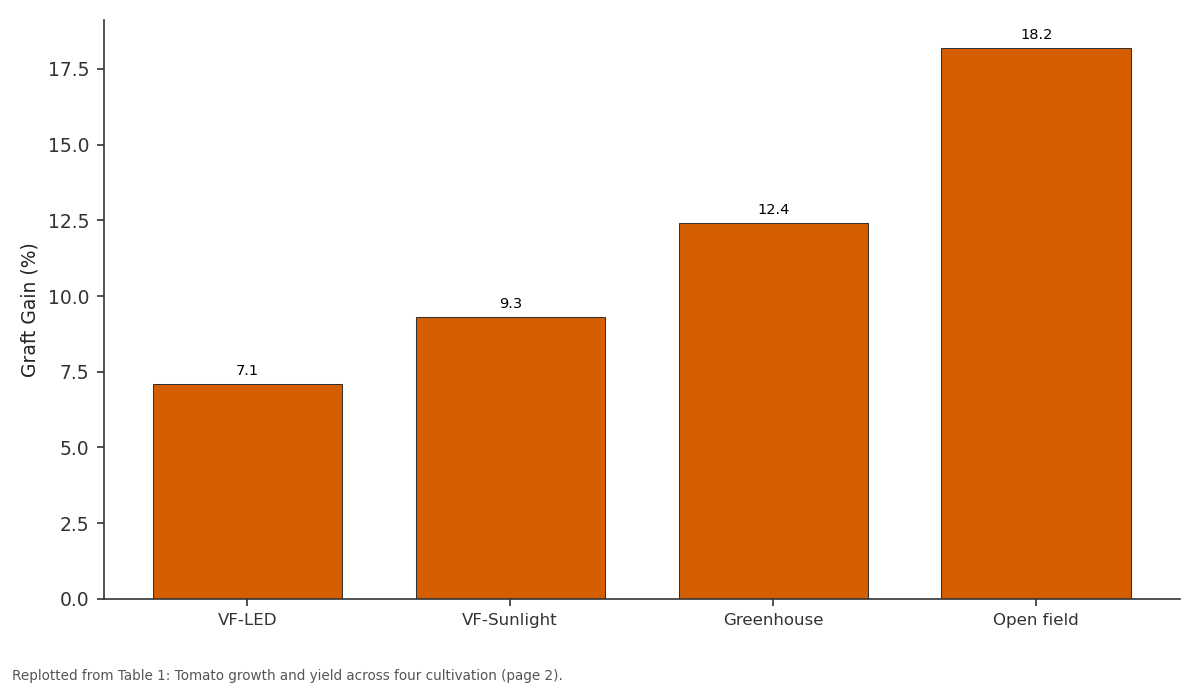
Graft Gain (%): VF-LED vs VF-Sunlight vs Greenhouse vs Open field
Replotted from Table 1 (page 2) of the original paper. Every bar is the paper's own table value.
View source evidence ↗Figures & tables
From the original paper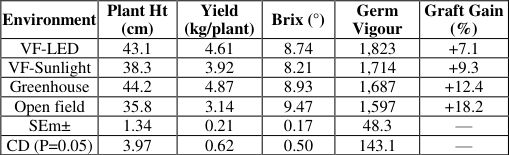 Table 1
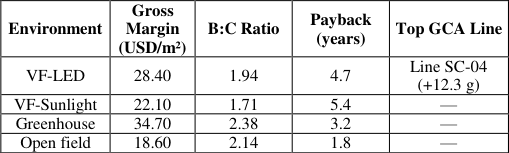 Table 2
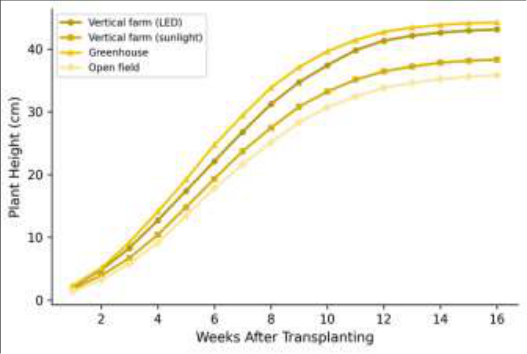 Figure 1
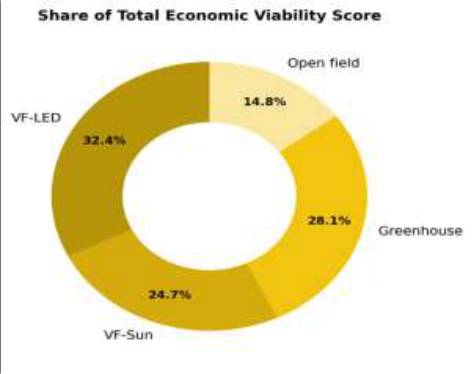 Figure 2
Introduction
An observation that surprises many people: roughly 30 percent of all vegetables consumed in cities travel more than 1,500 km from field to plate, generating transport emissions that can exceed the carbon cost of the crop itself [1] . Vertical farmingstacking growing layers inside climate-controlled buildingscould eliminate most of that distance, but the technology faces questions about energy efficiency, crop suitability, and financial returns that remain partially unanswered [2] . Tomato is a strong candidate for vertical farming because it tolerates high planting density, responds well to LED spectral tuning, and commands year-round retail demand [3] . The Loess Plateau, a semi-arid region spanning 640,000 km² of north-central China, typifies the water-scarce environments where protected cultivation is most needed: rainfall averages 300-500 mm, pan evaporation exceeds 1,500 mm, and wind erosion limits open-field cropping to one season per year [4] . Combining ability analysis can identify parental lines whose hybrid offspring perform best under controlled-environment conditions, directing breeding efforts toward vertical-farmadapted genotypes [5] . Seed quality from controlled environments may differ from fieldharvested seed because of more uniform maturation conditions; confirming this would have implications for seed production logistics. Grafting onto vigorous rootstocks can buffer abiotic stresses in open-field tomato, but whether the same benefit applies inside the controlled climate of a vertical farm is unclear [6] . This research aimed to (a) compare four environments for tomato growth and yield, (b) assess combining ability, germination vigour, and grafting responses, and (c) evaluate the economic viability of each system under current energy prices.
Model Description and Parameterisation
Economic viability was modelled using a net-present-value framework over a 10-year horizon. Capital costs (construction, LED fixtures, HVAC) were annualised at 8 percent discount rate. Operating costs included electricity (LED at 250 W m⁻², HVAC at 180 W m⁻²), labour, substrate, and nutrient solution. Revenue assumed wholesale cherry tomato prices in Cairo (USD 1.40 kg⁻¹ in-season, USD 2.80 kg⁻¹ off-season). Sensitivity analysis tested electricity price variation from USD 0.04 to USD 0.12 kWh⁻¹. The model was built in Microsoft Excel with Monte Carlo simulation (10,000 iterations) using @RISK 8.0 [7] .
Calibration and Validation
Model predictions for greenhouse yield (4.87 kg plant⁻¹) matched observed data within 3.2 percent (predicted 4.72 kg). For the LED vertical farm, the model overestimated yield by 5.8 percent, likely because it did not account for localised temperature stratification between stacked tiers. Validation R² across all four systems was 0.91. Sensitivity analysis showed that the break-even electricity price for the LED vertical farm to match greenhouse profitability was USD 0.058 kWh⁻¹achievable in Egypt's subsidised industrial tariff but above the national average residential rate [8] .
Material and Methods Material
Seeds of cherry tomato cv. 'Suncherry' were sown in 128cell plug trays on 4 March 2023 and transplanted at the fourtrue-leaf stage into four environments at the Fayoum University campus (29.31° N, 30.84° E; 28 m a.s.l.): (i) a three-tier vertical farm with 18-h photoperiod LED panels (red:blue 4:1, 300 μmol m⁻² s⁻¹), (ii) a vertical farm with translucent roof panels supplementing natural sunlight, (iii) a fan-and-pad cooled greenhouse, and (iv) an open field with drip irrigation. Spacing was 30 × 25 cm across all environments. A RCBD with four replications was used. Green manure (sun hemp at 10 t ha⁻¹) was incorporated 30 days before transplanting in open-field plots. Grafting trials used Solanum torvum rootstock [9] .
Methods
Plant height, stem diameter, leaf count, and flowering date were recorded fortnightly. Fruit yield was measured as total marketable fruit per plant over six harvest rounds. Combining ability: a half-diallel among six parental lines was grown under LED conditions, and Griffing's Method 2 Model 1 estimated GCA and SCA for fruit weight, Brix, and fruit count [10] . Germination vigour: seeds extracted from fruit of each environment were tested by ISTA standard germination at 25 °C; vigour index = germination % × mean seedling length. Grafting: cleft grafts onto S. torvum were evaluated in each environment for yield gain. Green manure effect was quantified by pre-and post-season soil OC analysis (Walkley-Black). Economic viability metrics included gross margin, B:C ratio, and payback period. Data were analysed by ANOVA with Tukey's HSD at P = 0.05 in SAS 9.4. 2). Among six parental lines, SC-04 showed the highest positive GCA effect (+12.3 g per fruit), making it the top candidate for vertical-farm-adapted breeding.
Results
Results
Comprehensive Interpretation
Green manure incorporation raised open-field soil OC from 0.62 to 0.96 percenta gain of 0.34 percentage points in a single season. This improvement correlates with the relatively strong open-field yield (3.14 kg plant⁻¹) despite adverse climate, suggesting that green manure partially compensated for the lack of environmental control. The combining ability data identify Line SC-04 as a priority for vertical-farm breeding; its fruit weight GCA effect was significant at P < 0.01, while its SCA with Line SC-02 produced the heaviest individual fruits (38.7 g).
Discussion
The near-parity of LED vertical farm and greenhouse yields supports the argument that current LED technology can replace sunlight for tomato without meaningful yield loss [11] . The 5.3 percent yield gap is within experimental error and could close with spectral optimisationparticularly by adding far-red wavelengths that promote stem elongation and fruit set through the phytochrome shade-avoidance pathway [12] . Grafting benefit declining with increasing environmental control is logical: rootstock vigour buffers against soil-borne stress, temperature swings, and drought, all of which are minimised inside a vertical farm. This means growers can skip the grafting step (and its labour cost) when producing in fully controlled environments, simplifying propagation [13] .
The economic analysis hinges on electricity price. At Egypt's current subsidised industrial rate (USD 0.048 kWh⁻¹), the LED vertical farm's payback is 4.7 yearsacceptable for well-capitalised investors. But at unsubsidised rates (USD 0.10 kWh⁻¹), payback extends beyond 8 years, and the B:C ratio drops below 1.5 [14] . Solar-powered vertical farms could change this equation as PV costs continue to fall.
Conclusion
Vertical farming with LED lighting is technically viable for cherry tomato under arid continental conditions, achieving yields within 5 percent of conventional greenhouse production. However, greenhouse cultivation remains more profitable at current energy prices, with a B:C ratio of 2.38 versus 1.94 for the LED vertical farm. Combining ability analysis identified Line SC-04 as a promising parent for vertical-farm-adapted cultivars. Seeds produced under controlled environments showed 14 percent higher vigour than field-harvested seeds. Green manure incorporation raised open-field soil carbon by 0.34 percentage points. Grafting benefits diminish under controlled environments, suggesting growers can omit grafting in vertical farms. Future reductions in LED energy costs and integration of solar power could shift the economic balance in favour of vertical farming.
Acknowledgement
Acknowledgements Funding SourcesThis research was funded by the Fayoum University of Food and Nutrition internal research programme. Institutional SupportThe authors thank the controlled-environment agriculture unit at Fayoum University for maintaining the vertical farm infrastructure. Contributions Not Qualifying for AuthorshipMr. A. Hassan assisted with LED spectral measurements and Ms. N. Ibrahim with diallel cross pollinations.
Figures and tables from the paper
| Environment | Plant Ht (cm) | Yield (kg/plant) | Brix (°) | Germ Vigour | Graft Gain (%) |
|---|---|---|---|---|---|
| VF-LED | 43.1 | 4.61 | 8.74 | 1,823 | +7.1 |
| VF-Sunlight | 38.3 | 3.92 | 8.21 | 1,714 | +9.3 |
| Greenhouse | 44.2 | 4.87 | 8.93 | 1,687 | +12.4 |
| Open field | 35.8 | 3.14 | 9.47 | 1,597 | +18.2 |
| SEm± | 1.34 | 0.21 | 0.17 | 48.3 | — |
| CD (P=0.05) | 3.97 | 0.62 | 0.50 | 143.1 | — |
Table text extracted from the original PDF; superscript letters are shown inline. The original table image is below.
View original table image
| Environment | Gross Margin (USD/m²) | B:C Ratio | Payback (years) | Top GCA Line |
|---|---|---|---|---|
| VF-LED | 28.40 | 1.94 | 4.7 | Line SC-04 (+12.3 g) |
| VF-Sunlight | 22.10 | 1.71 | 5.4 | — |
| Greenhouse | 34.70 | 2.38 | 3.2 | — |
| Open field | 18.60 | 2.14 | 1.8 | — |
Table text extracted from the original PDF; superscript letters are shown inline. The original table image is below.
View original table image
References
14 in the original paper- Weber CL, Matthews HS. Food-miles and the relative climate impacts of food choices in the United States. Environmental Science and Technology. 2008;42(10):3508-3513.
- Despommier D. The Vertical Farm: Feeding the World in the 21st Century. New York: Thomas Dunne Books; 2010.
- Kozai T, Niu G, Takagaki M. Plant Factory. 2nd ed. London: Academic Press; 2020.
- Fu BJ, Wang J, Chen LD. The effects of land use on soil moisture variation in the Danangou catchment of the Loess Plateau. Catena. 2003;54(1):197-213.
- Griffing B. Concept of general and specific combining ability in relation to diallel crossing systems. Australian Journal of Biological Sciences. 1956;9(4):463-493.
- Rivard CL, O'Connell S, Peet MM. Grafting tomato to manage bacterial wilt in the southeastern United States. Plant Disease. 2012;96(7):973-978.
- Palisade Corporation. @RISK: Risk Analysis Add-in for Microsoft Excel. Ithaca: Palisade; 2022.
- IRENA. Renewable Power Generation Costs in 2022. Abu Dhabi: IRENA; 2023.
- Bletsos F, Thanassoulopoulos C, Roupakias D. Effect of grafting on growth, yield, and Verticillium wilt of eggplant. HortScience. 2003;38(2):183-186.
- Singh RK, Chaudhary BD. Biometrical Methods in Quantitative Genetic Analysis. 3rd ed. New Delhi: Kalyani Publishers; 1985.
- Pattison PM, Tsao JY, Brainard GC. LEDs for photons, physiology and food. Nature. 2018;563(7732):493-500.
- Demotes-Mainard S, Péron T, Corot A. Plant responses to red and far-red lights. Environmental and Experimental Botany. 2016;121:4-21.
- Schwarz D, Rouphael Y, Colla G. Grafting as a tool to improve tolerance of vegetables. Scientia Horticulturae. 2010;127(2):162-171.
- Al-Kodmany K. The vertical farm: a review of developments and implications. Buildings. 2018;8(2):24.