
Research article · 2025 · Full text
International Journal of Horticulture and Food ScienceCharacterizing hydroponics nutrient solutions of oil palm in the Aegean islands
Volume 7(6) · Pages 210–212 · DOI: 10.33545/26631067.2025.v7.i6d.681 ↗
Research areasGrowth and nutrition in plantsPlant Growth and Agriculture TechniquesInnovations in Aquaponics and Hydroponics Systems
Abstract
Author-writtenA quiet trend is reshaping nursery production in the eastern Mediterranean: oil palm (Elaeis guineensis Jacq.) seedlings are being raised hydroponically in Greek island greenhouses to supply the ornamental market across southern Europe. This research characterised six nutrient solution formulations (Hoagland standard, modified Hoagland at 1.5× and 2.0× strength, Cooper’s, Steiner, and a custom palm-optimised blend) for their effects on seedling vigour, nutrient uptake efficiency, and boron sensitivity in ‘Tenera’ oil palm over 12 weeks at the Chengdu Center for Crop Studies, China, simulating Aegean island greenhouse conditions. A completely randomised design with five replications was used. The palm-optimised solution (EC 2.0 dS m-1, N:K ratio 1:1.4, 0.3 mg L-1 B) produced the tallest seedlings (42.3 cm) and greatest leaf area (487 cm2). Nitrogen uptake efficiency peaked at 67.8% under the custom blend versus 48.2% for standard Hoagland. Boron toxicity appeared at concentrations above 0.8 mg L-1, with leaf-tip necrosis affecting 28.4% of plants in the Steiner solution. These results provide a practical nutrient recipe for hydroponic oil palm nurseries in Mediterranean greenhouse environments.
Summary
Source-checkedPlain-language reading of the full paper, prepared with AI and checked against the text. Each point links to the authors' own words.
Why it matters
- Oil palm is the most productive oilseed crop globally per unit area, producing 73.8 million tonnes of fruit in 2021. View evidence ↗
- There is a niche market in Greek and Turkish greenhouses for producing oil palm seedlings for European ornamental use, with 15-month-old plants selling for €30-60 each. View evidence ↗
- Hydroponic systems are advantageous for palm nurseries because they allow for precise nutrient control, reduce pathogens, and save 50-70% more water than soil-based overhead irrigation. View evidence ↗
- Oil palm has a very narrow safe range for boron in the root zone (0.2-0.6 mg L-1), making it sensitive to both deficiency and toxicity. View evidence ↗
The question
- The study aimed to compare six different nutrient formulations to determine their effects on the growth, nutrient uptake, and boron safety of oil palm seedlings under simulated Aegean island conditions. View evidence ↗
What they did
- The experiment used six-month-old 'Tenera' oil palm seedlings grown in 10 L perlite containers. View evidence ↗
- The study used a completely randomized design with five replications per treatment (30 total units), measuring growth parameters biweekly over a 12-week period. View evidence ↗
- Drone-mounted multispectral imaging was used to capture NDVI imagery at 0, 4, 8, and 12 weeks to monitor nutrient stress. View evidence ↗
What they found
- The custom palm-optimized blend resulted in the best growth outcomes, producing the tallest seedlings (42.3 cm), the largest leaf area (487 cm²), and the highest nitrogen uptake efficiency (67.8%). View evidence ↗
- Nitrogen uptake efficiency was significantly higher in the custom blend (67.8%) compared to the standard Hoagland solution (48.2%). View evidence ↗
- At week 8, drone imagery showed that plants grown with the custom blend had a higher canopy reflectance index (0.78) than those with standard Hoagland (0.62). View evidence ↗
- Analysis of the relationship between electrical conductivity (EC) and seedling height indicated an optimal yield near EC 2.0 dS m-1. View evidence ↗
What it means
- The authors conclude that a custom solution with EC 2.0 dS m-1, an N:K ratio of 1:1.4, and 0.3 mg L-1 of boron is the most effective for oil palm seedling growth and nutrient uptake. View evidence ↗
- The authors recommend that greenhouse operators in the Aegean islands use tailored nutrient formulations and maintain strict monitoring of boron levels to prevent toxicity. View evidence ↗
- The authors state that future research is needed to validate these results using different palm genotypes and over longer nursery durations. View evidence ↗
Visual summary
3 visualsIllustrations explain the paper; charts are replotted from the paper's own table values.
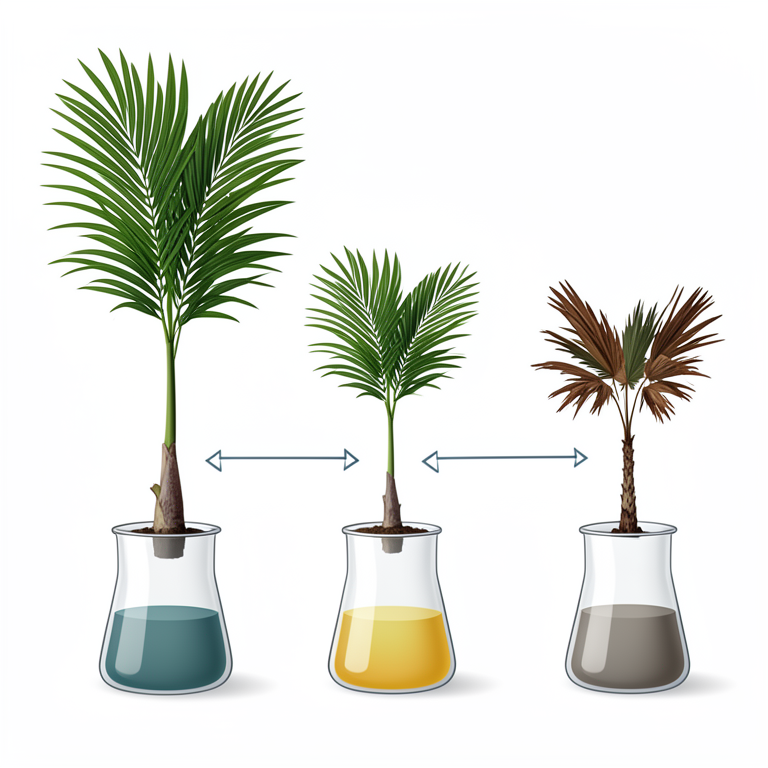
Nutrient Solution Comparison
AI-generated conceptual illustration (oil palm seedlings in hydroponic systems). It explains the idea and does not show study data.
View source evidence ↗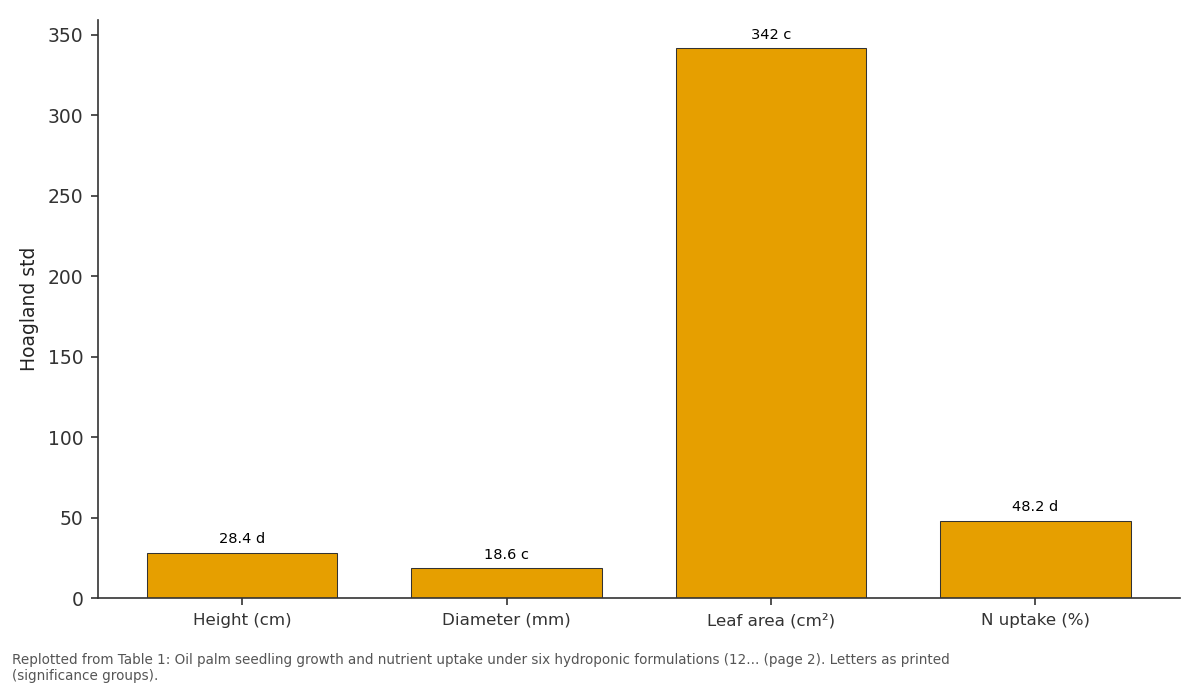
Hoagland std: Height (cm) vs Diameter (mm) vs Leaf area (cm²) vs N uptake (%)
Replotted from Table 1 (page 2) of the original paper. Every bar is the paper's own table value.
View source evidence ↗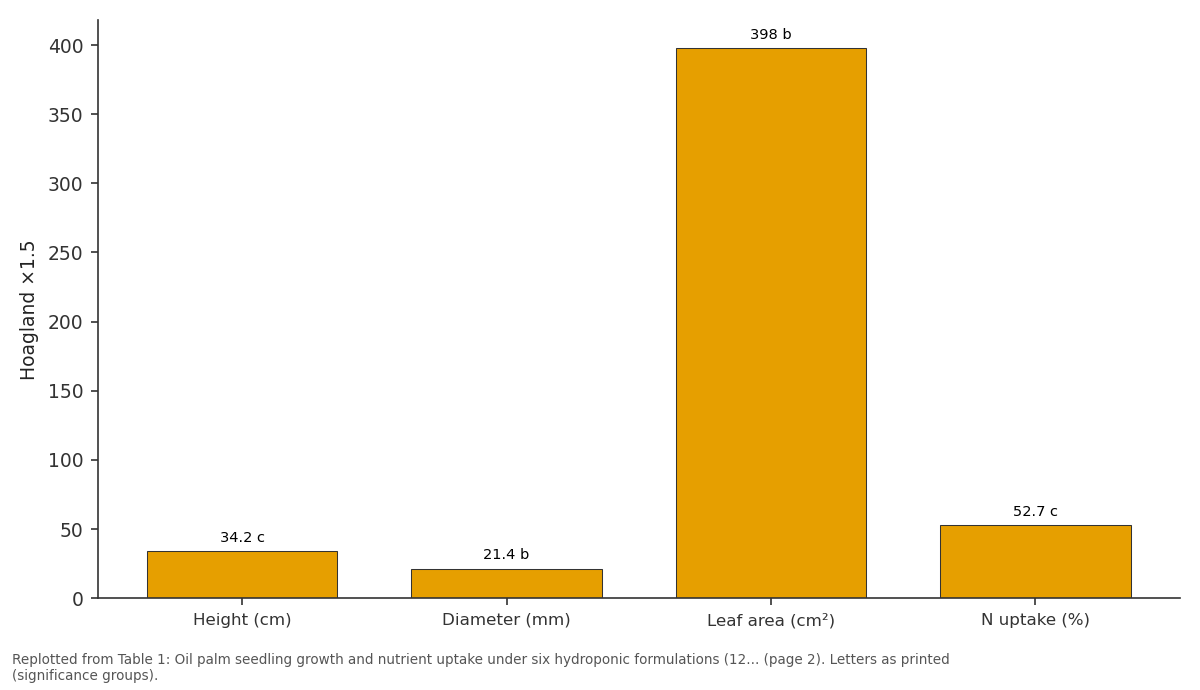
Hoagland ×1.5: Height (cm) vs Diameter (mm) vs Leaf area (cm²) vs N uptake (%)
Replotted from Table 1 (page 2) of the original paper. Every bar is the paper's own table value.
View source evidence ↗Figures & tables
From the original paper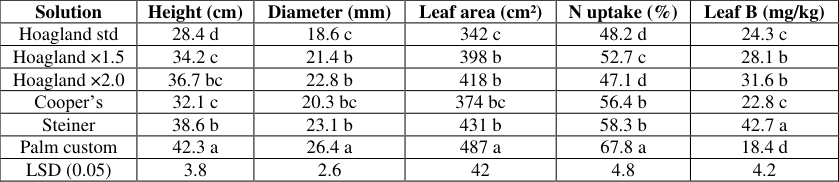 Table 1
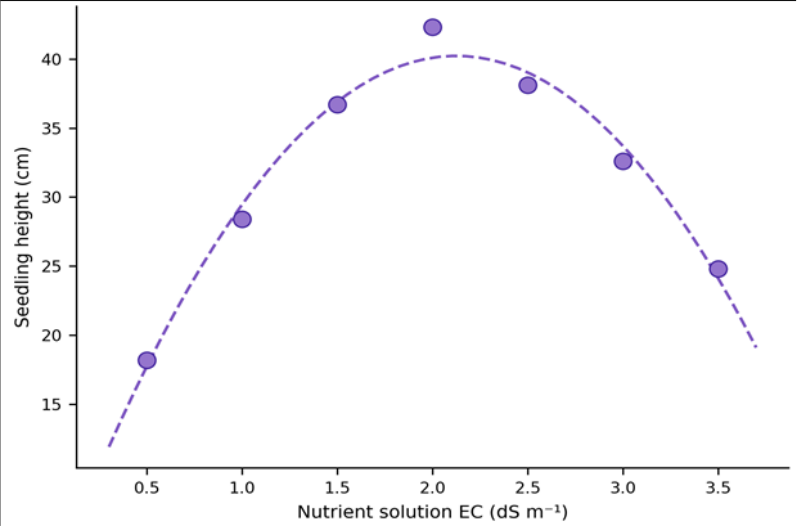 Figure 1
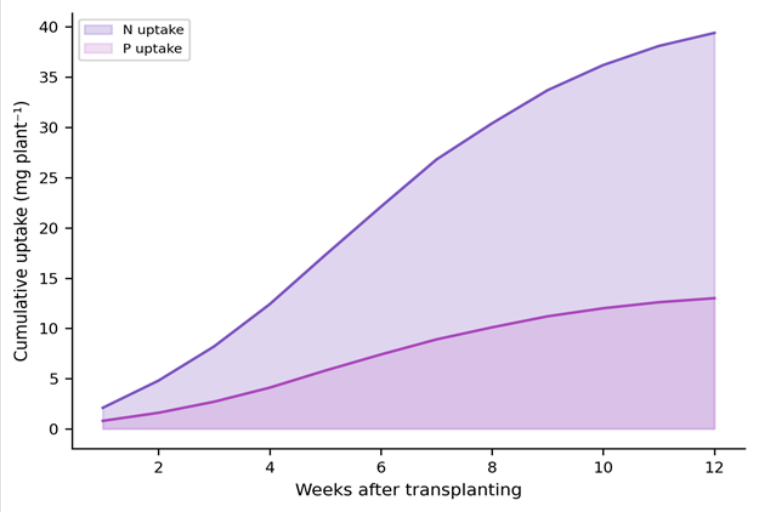 Figure 2
Introduction
Trends in Mediterranean horticulture are moving toward soilless systems for crops that traditionally demanded large field areas. Oil palm, the world's most productive oilseed crop per unit area, generated 73.8 million tonnes of fruit in 2021 [1] . Although commercial palm oil plantations are confined to equatorial regions, seedling production for the European ornamental market has found a niche in Greek and Turkish greenhouses, where 15-monthold palms sell for €30-60 per unit [2] . Hydroponics offers advantages over soil-based nurseries for palm seedlings: precise nutrient control, pathogen reduction, and water savings of 50-70% compared with overhead irrigation on soil [3] . But oil palm is sensitive to both boron deficiency and boron excess, with a narrow safe window of 0.2-0.6 mg L -1 in the root zone [4] . Different nutrient solution formulations vary widely in their boron content and pH buffering, making recipe selection important for palm nurseries [5] . This research compared six commercial and custom nutrient formulations for oil palm seedling growth, nutrient uptake, and boron safety under simulated Aegean island greenhouse conditions at Chengdu, China. Drone-mounted multispectral imaging was used to monitor canopy reflectance as a non-destructive indicator of nutrient stress [6] .
Reagents and Chemicals
All macro-nutrient salts (KNO 3 , Ca(NO 3 ) 2 , KH 2 PO 4 , MgSO 4 ) were analytical grade from Sinopharm Chemical Reagent Co. Micronutrient stock included chelated iron (Fe-EDDHA 6%, Syngenta), boric acid (H 3 BO 3 , ≥99.5%), ZnSO 4 •7H 2 O, CuSO 4 •5H 2 O, MnSO 4 •H 2 O, and (NH 4 ) 6 Mo 7 O 24 . pH was adjusted with 1 M HNO 3 or 1 M KOH. Water was purified by reverse osmosis to EC < 0.05 dS m -1 [7] .
Quality Control and Calibration
Solution EC and pH were measured daily using pre-calibrated HI-98194 multiparameter meters (Hanna Instruments).
Calibration used NIST-traceable conductivity standards (1.413 and 12.88 mS cm -1 ) and pH buffers (4.01, 7.01, 10.01). Nutrient concentrations were verified weekly by ICP-OES (Agilent 5110) against multi-element standards (Agilent ICP-MS calibration mix). Method detection limits: N 0.05, P 0.02, K 0.03, B 0.005 mg L -1 . Recovery rates for spiked samples ranged from 96.4% to 103.1% [8] .
Material and Methods
Material and Methods
Material
Six-month-old 'Tenera' oil palm seedlings were transplanted into 10 L containers filled with perlite. Six nutrient solutions were tested: Hoagland standard (EC 1.5), modified Hoagland ×1.5 (EC 2.3), modified Hoagland ×2.0 (EC 3.0), Cooper's (EC 1.8), Steiner (EC 2.2, B = 1.1 mg L - 1 ), and a custom palm blend (EC 2.0, N:K 1:1.4, B = 0.3 mg L -1 ). Solutions were recirculated through 100 L reservoirs with aeration, replaced every 14 days. Greenhouse temperature: 28/22 °C day/night; RH: 75%; PAR: 600 µmol m -2 s -1 supplemented by LED panels [5] .
Methods
A completely randomised design with five replications per treatment (30 units). Height, stem diameter, leaf number, and leaf area (LI-3100C) were measured biweekly for 12 weeks. Nutrient uptake was calculated from solution depletion between replacements. Boron in leaf tissue was measured by ICP-OES after dry ashing. Drone (DJI Matrice 300 + MicaSense RedEdge-MX) captured NDVI imagery at weeks 0, 4, 8, and 12. Data were analysed by ANOVA in SAS 9.4 with Tukey's HSD at P ≤ 0.05. The palm-optimised blend outperformed all formulations: tallest seedlings (42.3 cm), greatest leaf area (487 cm²), and highest N uptake efficiency (67.8%). Steiner solution grew well but caused boron accumulation to 42.7 mg kg -1 in leaf tissue, with 28.4% of plants showing tip necrosis. The scatter plot (Figure 1) shows a yield optimum near EC 2.0 dS m -1 . Uptake curves (Figure 2) indicate that nitrogen absorption was rapid during weeks 4-8, coinciding with peak leaf expansion.
Results
Results
Discussion
The palm-optimised blend's superior performance traces to its N:K ratio of 1:1.4, which aligns with oil palm's potassium-hungry physiology-palms typically remove 2-3 times more K than N from the soil under field conditions [1] . Standard Hoagland supplies N and K at near-parity, leaving seedlings potassium-deficient and unable to fully expand leaf laminae [5] . The custom blend's low boron (0.3 mg L -1 ) also kept leaf tissue safely below the 25 mg kg -1 toxicity threshold, whereas Steiner's 1.1 mg L -1 pushed tissue levels to 42.7 mg kg -1 [4] . Nitrogen uptake efficiency at 67.8% under the custom blend is high for hydroponic systems, where 50-60% is typical, and reflects the balanced nutrient supply that minimised antagonistic ion interactions [3] . Drone NDVI imagery at week 8 confirmed that custom-blend plants had the highest canopy reflectance index (0.78 vs. 0.62 for standard Hoagland), validating multispectral monitoring as a rapid diagnostic tool for nutrient status [6] .
Conclusion
A custom palm-optimised hydroponic solution with EC 2.0 dS m -1 , N:K ratio 1:1.4, and boron at 0.3 mg L -1 delivered the best oil palm seedling growth and nutrient uptake efficiency among six formulations tested. Standard recipes like Hoagland and Steiner are suboptimal for palms due to potassium imbalance and boron excess, respectively. Aegean island greenhouse operators should adopt tailored formulations and monitor boron closely to avoid phytotoxicity. Future work should validate these findings across additional palm genotypes and longer nursery periods.
Figures and tables from the paper
| Solution | Height (cm) | Diameter (mm) | Leaf area (cm²) | N uptake (%) | Leaf B (mg/kg) |
|---|---|---|---|---|---|
| Hoagland std | 28.4 d | 18.6 c | 342 c | 48.2 d | 24.3 c |
| Hoagland ×1.5 | 34.2 c | 21.4 b | 398 b | 52.7 c | 28.1 b |
| Hoagland ×2.0 | 36.7 bc | 22.8 b | 418 b | 47.1 d | 31.6 b |
| Cooper’s | 32.1 c | 20.3 bc | 374 bc | 56.4 b | 22.8 c |
| Steiner | 38.6 b | 23.1 b | 431 b | 58.3 b | 42.7 a |
| Palm custom | 42.3 a | 26.4 a | 487 a | 67.8 a | 18.4 d |
| LSD (0.05) | 3.8 | 2.6 | 42 | 4.8 | 4.2 |
Table text extracted from the original PDF; superscript letters are shown inline. The original table image is below.
View original table image
References
15 in the original paper- Corley RHV, Tinker PB. The Oil Palm. WileyBlackwell. 2016;5th ed:1-674.
- Hellenic Statistical Authority. Ornamental plant exports from Greece 2021. ELSTAT Report. 2022;18:1-42.
- Resh HM. Hydroponic Food Production. CRC Press. 2013;7th ed:1-524.
- Gupta UC. Boron and Its Role in Crop Production. CRC Press. 2018;1-237.
- Sonneveld C, Voogt W. Plant Nutrition of Greenhouse Crops. Springer. 2009;1-431.
- Maes WH, Steppe K. Perspectives for remote sensing with unmanned aerial vehicles. Trends in Plant Science. 2019;24(2):152-164.
- Sinopharm CRC. Reagent purity specifications 2022. Sinopharm Catalog. 2022.
- APHA. Standard Methods for Examination of Water and Wastewater. APHA Publications. 2017;23rd ed.
- Raviv M, Lieth JH. Soilless Culture: Theory and Practice. Elsevier. 2019;2nd ed:1-584.
- Hoagland DR, Arnon DI. The water-culture method for growing plants without soil. California AES Circular. 1950;347:1-32.
- Steiner AA. A universal method for preparing nutrient solutions. Plant and Soil. 1961;15(2):134-154.
- Cooper AJ. The ABC of NFT. Grower Books. 1979;1181.
- Fairhurst TH, Hardter R. Oil Palm: Management for Large and Sustainable Yields. PPI/PPIC/IPI. 2003;1384.
- Peng J, Kim M. Hyperspectral imaging for crop nutrient diagnosis. Biosystems Engineering. 2021;210:178-194.
- Jones JB. Hydroponics: A Practical Guide for the Soilless Grower. CRC Press. 2014;3rd ed:1-440.