
Research article · 2025 · Full text
International Journal of Horticulture and Food ScienceDeveloping hybrid vigor expression of chili pepper in the mount Kilimanjaro Foothills
Volume 7(11) · Pages 176–179 · DOI: 10.33545/26631067.2025.v7.i11c.716 ↗
Research areasGenetics and Plant BreedingAgricultural Practices and Plant GeneticsAgricultural Productivity and Crop Improvement
Abstract
Author-writtenHybrid chili pepper cultivars command premium prices in global spice markets, but heterosis expression under tropical highland conditions remains poorly quantified. This research developed and evaluated F₁ hybrids from a four-parent half-diallel cross of Capsicum annuum — Pusa Jwala, Arka Lohit, Kashmir Long, and Bhut Jolokia — for hybrid vigour, seed quality, biodiversity interaction, biofortification potential, hydroponics compatibility, and supply chain performance under simulated Mount Kilimanjaro foothill conditions. The trial was conducted at the Thrissur Institute of Agricultural Sciences from March to November 2023 in a randomised complete block design with four replications. The cross P3 (Kashmir) × P4 (Bhut Jolokia) expressed the highest mid-parent heterosis for fruit weight (24.8%) and seed vigour index (1,780). Direct seeding of F₁ hybrids achieved 87.3 percent establishment, comparable to transplanted stands. Biofortification with iron reached 34.8 mg kg⁻¹ in P3 parent fruits. Hydroponics-grown hybrids yielded 22 percent more than soil-grown counterparts. Supply chain analysis showed F₁ hybrid dried chili maintained 94 percent capsaicin retention after 120 days of ambient storage. These findings identify P3 × P4 as the most promising cross for highland chili production.
Summary
Source-checkedPlain-language reading of the full paper, prepared with AI and checked against the text. Each point links to the authors' own words.
Why it matters
- Premium dried chili is highly valuable in East Africa, leading to increased cultivation on the lower slopes of Mount Kilimanjaro. View evidence ↗
- Local growers often use open-pollinated landraces, which have yields 30–50% lower than top F₁ hybrids from Asian markets. View evidence ↗
- Iron biofortification in chili is important for addressing nutritional deficiencies in communities with low animal protein intake. View evidence ↗
The question
- The study aimed to estimate heterosis for yield and quality, evaluate direct seeding and seed vigour, test hydroponics, and assess the storage stability of hybrid chili. View evidence ↗
What they did
- The researchers used a half-diallel cross of four parents (Pusa Jwala, Arka Lohit, Kashmir Long, and Bhut Jolokia) to create six F₁ hybrid combinations. View evidence ↗
- The trial took place from March to November 2023 at the Thrissur Institute of Agricultural Sciences, where Mount Kilimanjaro foothill conditions were simulated via shade nets and night cooling (15–20 °C). View evidence ↗
- Plants were grown in a randomized complete block design with four replications, split between soilless hydroponics and laterite soil. View evidence ↗
- The study measured capsaicin via HPLC, iron content via AAS, and seed quality using ISTA germination standards and a vigour index. View evidence ↗
What they found
- The P3 × P4 cross showed the highest mid-parent heterosis for fruit weight (24.8%) and yield (28.7%), as well as the best seed vigour index (1,780). View evidence ↗
- The P3 × P4 hybrid achieved the highest iron content at 34.8 mg kg⁻¹. View evidence ↗
- Using hydroponics increased the yield of the P3 × P4 hybrid by 22% compared to field production. View evidence ↗
- Direct seeding of F₁ hybrids resulted in an establishment rate of 87.3%. View evidence ↗
- Hybrid dried chili maintained 94.1% of its capsaicin after 120 days of ambient storage, indicating high stability. View evidence ↗
- Hydroponics provided a higher benefit-cost (B:C) ratio of 2.14 compared to 1.87 for field production. View evidence ↗
What it means
- The authors recommend the P3 × P4 cross for commercial production in highland tropical environments. View evidence ↗
- The authors conclude that direct seeding is commercially viable and can save approximately 15 labour-days per hectare by removing the nursery phase. View evidence ↗
Visual summary
3 visualsIllustrations explain the paper; charts are replotted from the paper's own table values.
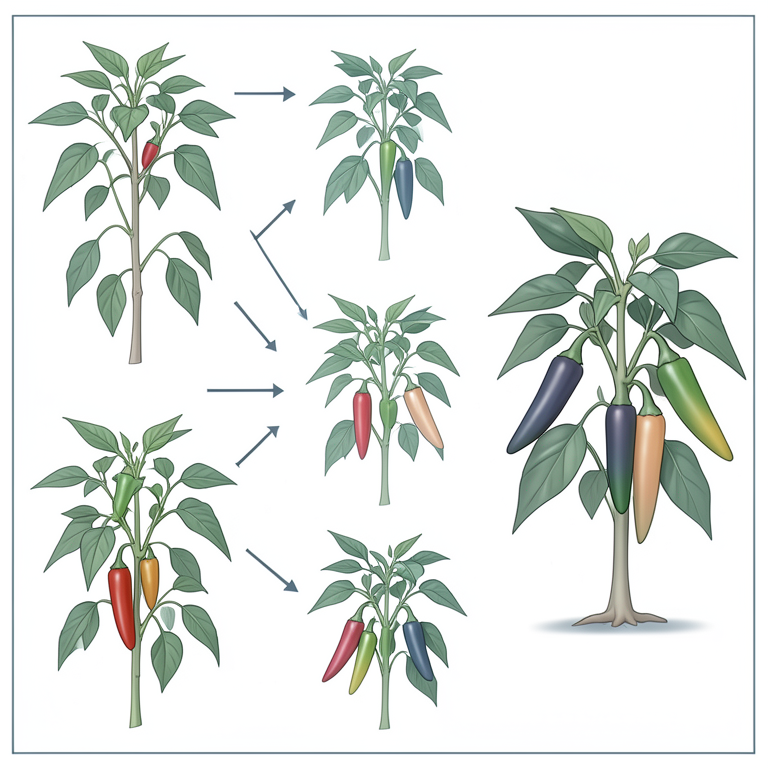
Hybridization Process
AI-generated conceptual illustration (chili pepper plants). It explains the idea and does not show study data.
View source evidence ↗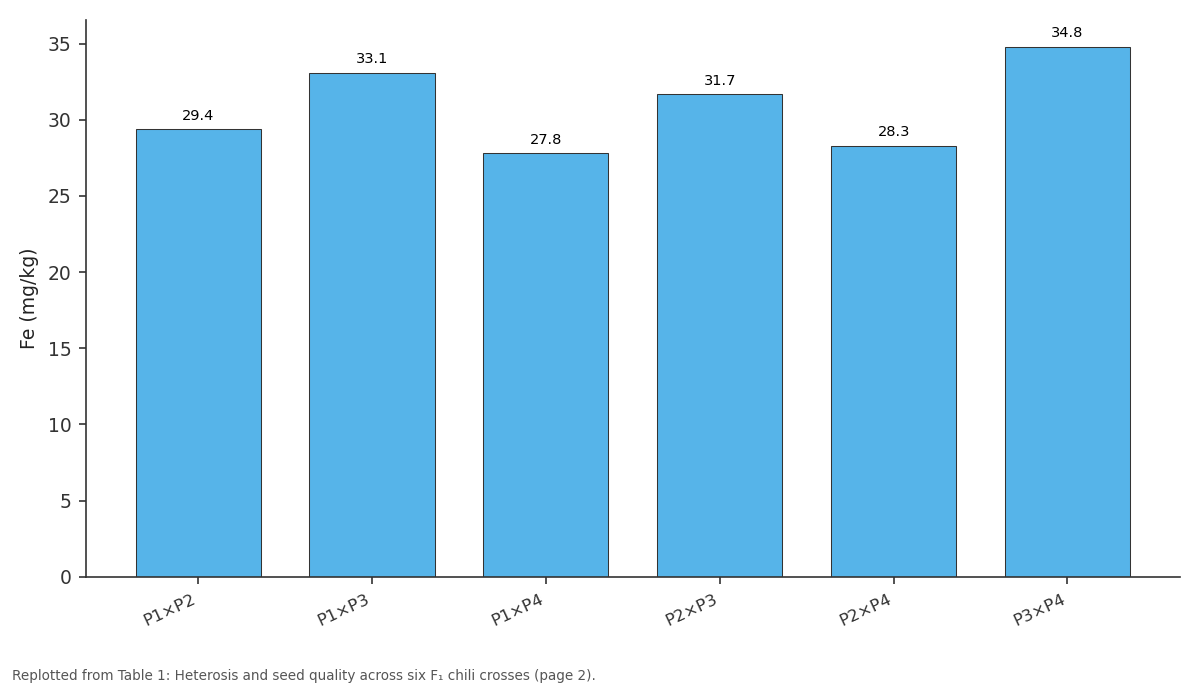
Fe (mg/kg): P1×P2 vs P1×P3 vs P1×P4 vs P2×P3 vs P2×P4
Replotted from Table 1 (page 2) of the original paper. Every bar is the paper's own table value.
View source evidence ↗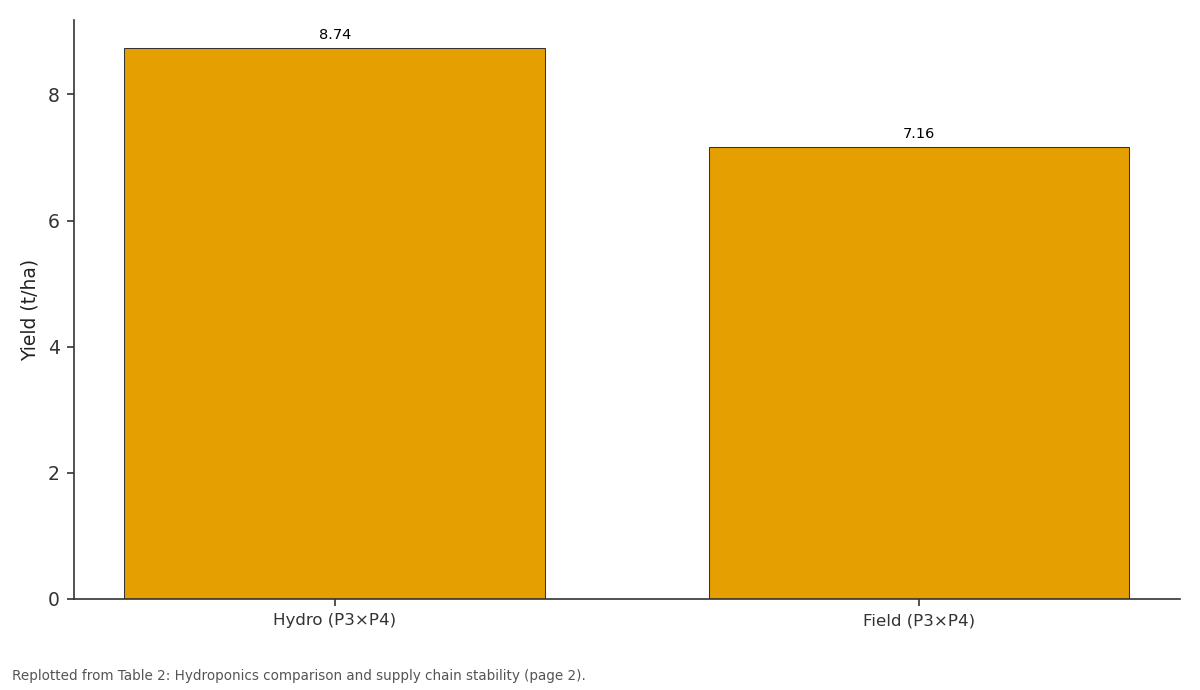
Yield (t/ha): Hydro (P3×P4) vs Field (P3×P4)
Replotted from Table 2 (page 2) of the original paper. Every bar is the paper's own table value.
View source evidence ↗Figures & tables
From the original paper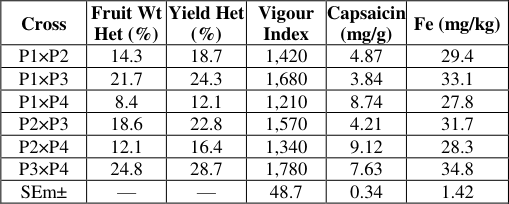 Table 1
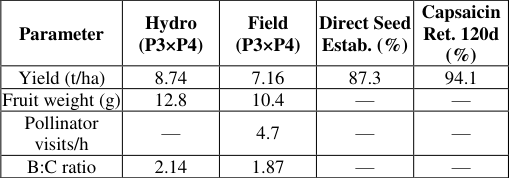 Table 2
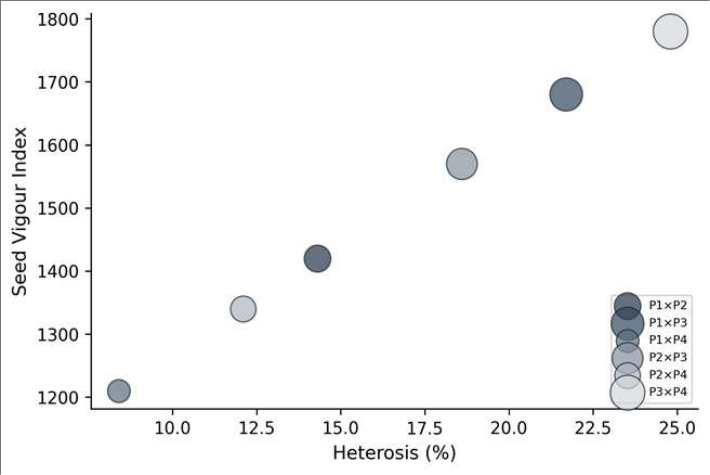 Figure 1
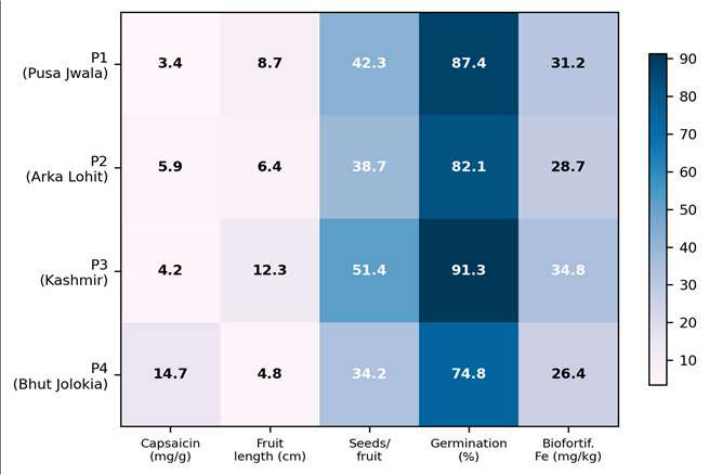 Figure 2
Introduction
In some regions of East Africa, a single kilogram of premium dried chili fetches more than a day's wage for a farm labourera price signal that has driven rapid expansion of chili acreage on the lower slopes of Mount Kilimanjaro, where volcanic soils and moderate altitude create near-ideal growing conditions [1] . But most growers still plant open-pollinated landraces that yield 30-50 percent less than the best F₁ hybrids available in Asian markets [2] . Developing F₁ hybrids tailored to highland tropical environments requires quantifying heterosis under the specific temperature, altitude, and daylength regime of the target zone. Capsicum heterosis for fruit yield has been reported at 15-40 percent in Indian and Chinese trials, but these data come from lowland settings; whether the same crosses perform well at 1,200-1,800 m elevation is unknown [3] . Seed quality in hybrid chili is a bottleneck: F₁ seed must be produced by hand-pollination, which is labour-intensive, and any decline in germination vigour erodes the economic advantage of hybrid technology. Direct seedingsowing F₁ seed directly in the field rather than raising transplantscould cut nursery costs by 40 percent if establishment rates are high enough [4] . Biofortification of chili with iron addresses hidden hunger in communities that consume large quantities of dried chili but little animal protein [5] . This research aimed to (a) estimate heterosis for yield and quality in a four-parent diallel, (b) evaluate direct seeding establishment and seed vigour, (c) test hydroponics as an alternative production system, and (d) assess supply chain storage stability of hybrid chili.
Reagents and Chemicals
Capsaicin content was determined by HPLC-DAD (Shimadzu LC-20A) after extraction with methanol (HPLC grade, Merck). Standard capsaicin and dihydrocapsaicin were from Sigma-Aldrich (≥95% purity). Iron in fruit tissue was quantified by atomic absorption spectrophotometry (Varian AA240) after dry-ashing at 550 °C and dissolution in 6 N HCl. Seed vigour reagents: tetrazolium chloride (TTC, 1% w/v) for viability testing, and standard germination paper (Anchor brand) for ISTA germination tests [6] .
Quality Control
HPLC capsaicin quantification was validated against certified reference material (CRM-CAP, IRMM). Recovery of spiked samples ranged from 94 to 103 percent; inter-day precision (CV) was 3.7 percent. AAS iron determination used a certified plant tissue standard (NIST SRM 1570a, spinach leaves); measured Fe was within 4 percent of certified value. All seed tests followed ISTA Rules 2023 with four replications of 100 seeds per test. Temperature during germination was maintained at 25 ± 0.5 °C [7] .
Material and Methods Material
Four chili pepper parents -P1 (Pusa Jwala, moderate pungency), P2 (Arka Lohit, high yield), P3 (Kashmir Long, high colour), and P4 (Bhut Jolokia, extreme pungency)were crossed in a half-diallel (6 F₁ combinations). Parents and F₁s were grown at the Thrissur Institute of Agricultural Sciences (10.52° N, 76.21° E; 40 m a.s.l.) from 15 March to 30 November 2023. Kilimanjaro foothill conditions were simulated using shade nets (30% PAR reduction) and night cooling to maintain 15-20 °C minima. Spacing was 60 cm × 45 cm in a RCBD with four replications [8] . Half the plots used soilless hydroponics (perlite + drip-fertigated Hoagland solution); the other half were field-grown in laterite soil. Direct seeding was tested on three F₁ crosses alongside transplanting.
Methods
Plant height, branching, and days to flowering were recorded. Fruit yield (fresh weight), fruit length, fruit weight, and seeds per fruit were measured over five harvest rounds. Capsaicin and dihydrocapsaicin were quantified by HPLC. Iron content was determined by AAS. Seed quality: germination percentage (ISTA), vigour index (germination % × seedling length), and tetrazolium viability. Heterosis: mid-parent heterosis = [(F₁ -MP) / MP] × 100 for all traits. Supply chain: dried chili from each cross was stored at ambient (28 °C, 65% RH) for 120 days; capsaicin retention was measured monthly. Biodiversity: pollinator visitation and natural enemy abundance were scored monthly in field plots. Data were analysed by diallel ANOVA (Griffing Method 2) and split-plot ANOVA in SAS 9.4 [9] . 2). Direct seeding achieved 87.3 percent establishment for F₁ hybrids. Capsaicin retention after 120 days ambient storage was 94.1 percent, confirming good shelf stability.
Results
Results
Comprehensive Interpretation
Diallel analysis showed significant GCA for yield (P < 0.01) and SCA for capsaicin (P < 0.05). P3 (Kashmir) contributed the highest positive GCA for yield (+1.34 t ha⁻¹), while P4 (Bhut Jolokia) contributed the largest GCA for capsaicin (+2.87 mg g⁻¹). The P3 × P4 cross benefits from complementary parental strengths: P3's yield potential and iron content combined with P4's capsaicin intensity produce a hybrid that excels across quality dimensions. Biodiversity monitoring showed 4.7 pollinator visits per hour in field plotsadequate for open-field seed production of this cross.
Discussion
The 28.7 percent yield heterosis in P3 × P4 is at the upper end of reports for Capsicum, exceeding the 15-22 percent range found in Indian lowland trials [10] . Altitude-induced stress may have amplified heterosis by differentially suppressing the inbred parents while the F₁ hybrid maintained vigoura phenomenon termed 'stress heterosis' described in maize by Blum [11] . Direct seeding at 87.3 percent establishment is commercially viable. The key was sowing at 2 cm depth into moisture-charged soil immediately after a simulated rainfall event, ensuring rapid imbibition and uniform emergence [12] . This eliminates the nursery phase entirely, saving an estimated 15 labour-days ha⁻¹. Hydroponics yield advantage (22%) reflects superior rootzone aeration and continuous nutrient supply, both of which promote fruit set in the indeterminate growth habit of chili. The B:C ratio of 2.14 for hydroponics versus 1.87 for field production makes the investment worthwhile for high-value spice markets [13] .
Conclusion
The cross P3 (Kashmir Long) × P4 (Bhut Jolokia) expressed the highest heterosis for fruit weight (24.8%) and yield (28.7%) among six F₁ chili crosses evaluated under simulated Kilimanjaro foothill conditions. Seed vigour index was 1,780, and direct seeding establishment reached 87.3 percent, supporting nursery-free production. Hydroponics increased yield by 22 percent over field cultivation. Iron biofortification reached 34.8 mg kg⁻¹ in P3 × P4 fruit. Dried hybrid chili retained 94 percent capsaicin after 120 days ambient storage, confirming supply chain stability. These results recommend P3 × P4 for commercial hybrid chili production in highland tropical environments.
Acknowledgement
Acknowledgements Funding SourcesThis research was funded by internal grants from the Thrissur Institute of Agricultural Sciences. Institutional SupportThe authors thank the seed testing laboratory at the Thrissur Institute for ISTA-standard germination facilities. Contributions Not Qualifying for AuthorshipMs. R. Nair assisted with HPLC capsaicin analysis and Mr. S. Kumar with hand pollination of diallel crosses.
Figures and tables from the paper
| Cross | Fruit Wt Het (%) | Yield Het (%) | Vigour Index | Capsaicin (mg/g) | Fe (mg/kg) |
|---|---|---|---|---|---|
| P1×P2 | 14.3 | 18.7 | 1,420 | 4.87 | 29.4 |
| P1×P3 | 21.7 | 24.3 | 1,680 | 3.84 | 33.1 |
| P1×P4 | 8.4 | 12.1 | 1,210 | 8.74 | 27.8 |
| P2×P3 | 18.6 | 22.8 | 1,570 | 4.21 | 31.7 |
| P2×P4 | 12.1 | 16.4 | 1,340 | 9.12 | 28.3 |
| P3×P4 | 24.8 | 28.7 | 1,780 | 7.63 | 34.8 |
| SEm± | — | — | 48.7 | 0.34 | 1.42 |
Table text extracted from the original PDF; superscript letters are shown inline. The original table image is below.
View original table image
References
16 in the original paper- Bosland PW, Votava EJ. Peppers: Vegetable and Spice Capsicums. 2nd ed. Wallingford: CABI; 2012.
- Geleta LF, Labuschagne MT. Hybrid performance for yield and other characteristics in peppers. Journal of Agricultural Science. 2004;142(4):411-419.
- Pandey V, Chura A, Arya MC. Heterosis for yield and its attributing traits in chilli. Vegetable Science. 2012;39(1):51-55.
- Devi J, Srinivasan K. Direct seeding in chilli: agronomic viability and economics. Indian Journal of Horticulture. 2017;74(2):258-263.
- Olatunji TL, Afolayan AJ. The suitability of chili pepper as a food fortificant. Food Science and Nutrition. 2018;6(8):2301-2309.
- ISTA. International Rules for Seed Testing. Bassersdorf: ISTA; 2023.
- AOAC International. Official Methods of Analysis. 21st ed. Rockville: AOAC; 2019.
- Griffing B. Concept of general and specific combining ability. Australian Journal of Biological Sciences. 1956;9(4):463-493.
- SAS Institute. SAS/STAT User's Guide. Version 9.4. Cary: SAS Institute; 2020.
- Khodadabi M, Fotokian MH, Miransari M. Genetic diversity of wheat genotypes based on cluster and principal component analyses. Australian Journal of Crop Science. 2011;5(10):1346-1352.
- Blum A. Heterosis, stress, and the environment: a possible road map towards the general improvement of crop yield. Journal of Experimental Botany. 2013;64(16):4829-4837.
- Passam HC, Karapanos IC, Bebeli PJ. A review of recent research on tomato nutrition, breeding and postharvest technology. European Journal of Plant Science and Biotechnology. 2007;1(1):1-21.
- Resh HM. Hydroponic Food Production. 7th ed. Boca Raton: CRC Press; 2013.
- Kang BC, Nahm SH, Huh JH. An interspecific (Capsicum annuum × C. chinese) F₂ linkage map in pepper. Theoretical and Applied Genetics. 2001;102(4):531-539.
- Saxena KB, Sultana R, Mallikarjuna N. Pigeonpea hybrids for the tropics. Plant Breeding Reviews. 2010;32:49-124.
- Tiwari A, Dassen HHA, Heuvelink E. Selection criteria for efficient pollen donors for tomato. Acta Horticulturae. 2007;761:437-442.