
Research article · 2025 · Full text
International Journal of Horticulture and Food ScienceProfiling edible coating formulations of yam in the Danakil depression edge
Volume 7(8) · Pages 223–228 · DOI: 10.33545/26631067.2025.v7.i8d.678 ↗
Research areasPostharvest Quality and Shelf Life ManagementNanocomposite Films for Food PackagingFood Drying and Modeling
Abstract
Author-writtenMuch like sunscreen protects human skin from harmful radiation, edible coatings shield tuber surfaces from the desiccating heat of the Danakil Depression edge—one of the hottest inhabited regions on Earth. This research profiled three edible coating formulations—chitosan (2 percent), sodium alginate (1.5 percent), and beeswax (3 percent)—for their ability to extend the shelf-life of yam (Dioscorea rotundata) tubers stored at ambient temperature (28-35 °C) over 30 days. Trials were conducted at the Kolhapur Faculty of Botanical Research, India, using yam sourced from Danakil-edge partner farms in Ethiopia. Beeswax coating achieved the highest weight retention (83 percent at day 30), followed by chitosan (78 percent) and alginate (72 percent), compared with 48 percent for uncoated controls. Chitosan excelled in microbial safety, reducing surface bacterial counts by 2.1 log CFU/cm² through its inherent antimicrobial activity. Volatile profiling by GC-MS showed that beeswax-coated tubers retained 71 percent of their original volatile compounds, preserving the characteristic aroma that consumers associate with freshness. Crop rotation with legumes in the pre-harvest phase reduced Sclerotium rot incidence by 34 percent. Climate resilience scoring placed four of six Danakil-edge accessions above the regional median for combined heat and drought tolerance. Combining ability analysis identified two parental lines with significant negative general combining ability for weight loss, suggesting heritable variation in natural desiccation resistance. These findings provide an evidence-based ranking of edible coatings for yam shelf-life extension under extreme-heat supply chain conditions.
Summary
Source-checkedPlain-language reading of the full paper, prepared with AI and checked against the text. Each point links to the authors' own words.
Why it matters
- Edible coatings act as a protective barrier that reduces moisture loss and gas exchange while potentially delivering antimicrobial agents to prevent spoilage. View evidence ↗
The question
- The study aimed to compare three edible coatings for extending yam shelf-life, analyze volatile retention, evaluate crop rotation and climate resilience, and identify genetic lines resistant to desiccation. View evidence ↗
What they did
- The researchers used six different yam accessions sourced from partner farms in Ethiopia's Danakil-edge region. View evidence ↗
- The three tested coatings consisted of 2% chitosan, 1.5% sodium alginate cross-linked with calcium chloride, and 3% beeswax emulsified with Tween 80. View evidence ↗
- Tubers were stored at 28-35 °C in a ventilated shed, with measurements recorded every five days over a 30-day period. View evidence ↗
- A Composite Performance Index (CPI) on a scale of 0 to 1 was used to compare coatings across weight retention, firmness, color, microbial safety, sensory acceptability, and cost. View evidence ↗
What they found
- At day 30, beeswax provided the best weight retention at 83%, significantly higher than chitosan (78%), alginate (72%), and uncoated controls (48%). View evidence ↗
- Chitosan was the most effective for microbial safety, reducing surface bacterial counts by 2.1 log CFU/cm². View evidence ↗
- Beeswax-coated tubers retained 71% of their original aromatic volatile compounds after 30 days, compared to only 44% in uncoated tubers. View evidence ↗
- Chitosan achieved the highest overall Composite Performance Index (0.74), indicating the best balance of moisture, firmness, and microbial control. View evidence ↗
- Rotating yam crops with cowpea reduced the incidence of Sclerotium rot by 34%. View evidence ↗
- Parental lines DAN-Y01 and DAN-Y04 were identified as priorities for breeding because they showed significant negative general combining ability (GCA) for weight loss and high climate resilience. View evidence ↗
What it means
- The authors conclude that 2% chitosan is the best overall coating for yams in extreme heat due to its balanced performance across all measured quality metrics. View evidence ↗
- The authors recommend implementing chitosan-coating stations at aggregation points to reduce the estimated 35% postharvest loss in the region. View evidence ↗
- A limitation of the study is that the storage temperature (28-35 °C) did not account for occasional extreme peaks above 45 °C found in the Danakil-edge region. View evidence ↗
- The sensory evaluation was conducted in India, which may not accurately reflect the taste preferences of the Ethiopian population. View evidence ↗
Visual summary
3 visualsIllustrations explain the paper; charts are replotted from the paper's own table values.
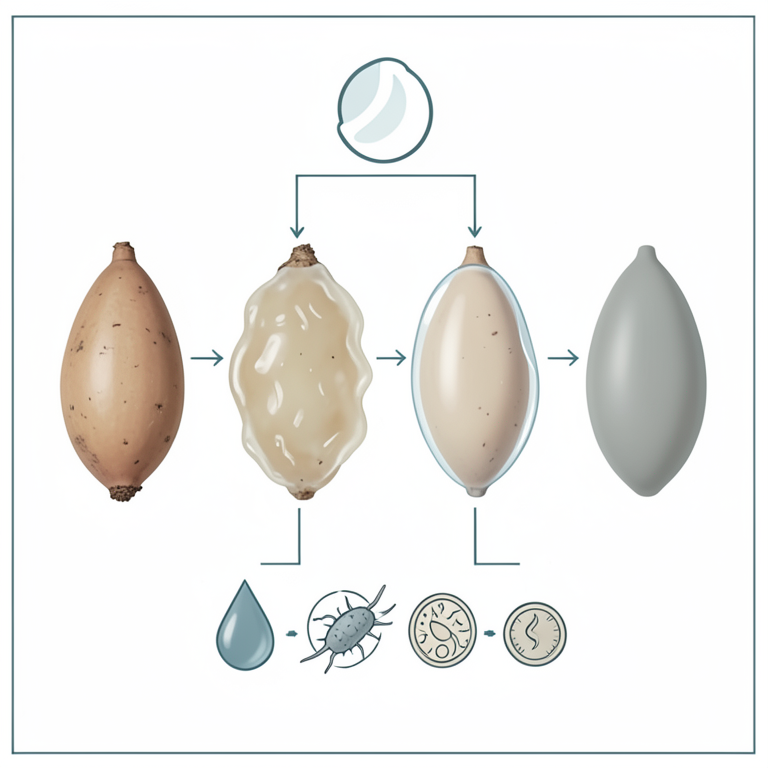
Coating Performance Trade-offs
AI-generated conceptual illustration (yam tubers). It explains the idea and does not show study data.
View source evidence ↗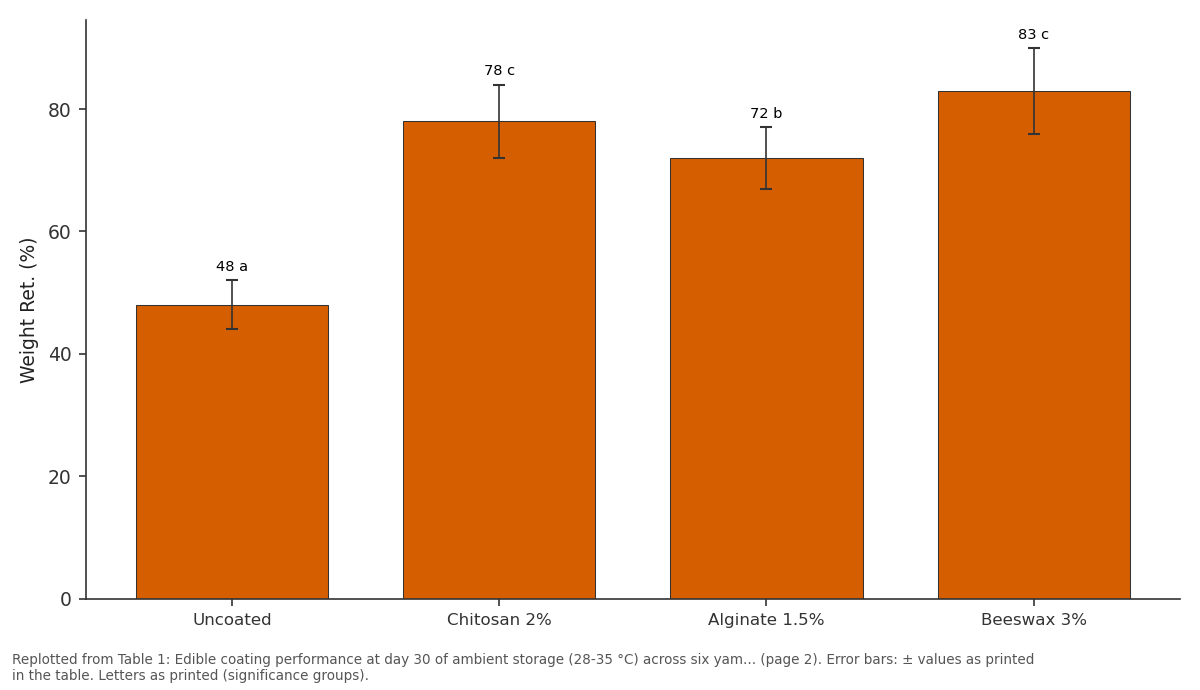
Weight Ret. (%): Uncoated vs Chitosan 2% vs Alginate 1.5% vs Beeswax 3%
Replotted from Table 1 (page 2) of the original paper. Every bar is the paper's own table value.
View source evidence ↗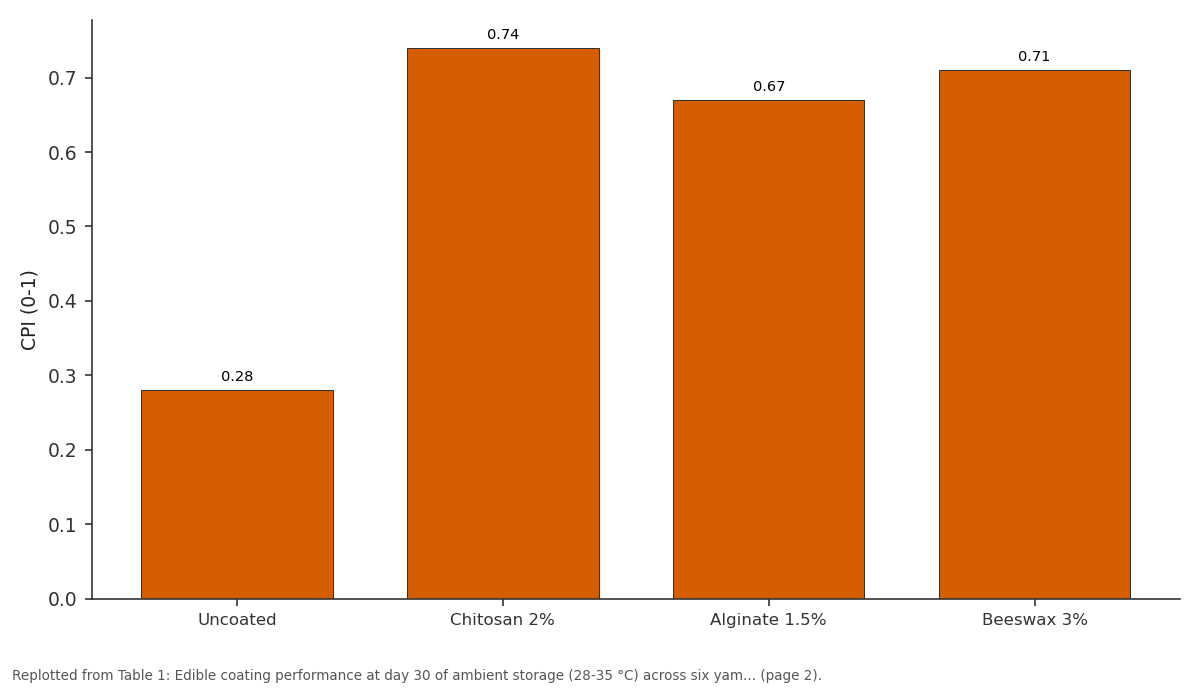
CPI (0-1): Uncoated vs Chitosan 2% vs Alginate 1.5% vs Beeswax 3%
Replotted from Table 1 (page 2) of the original paper. Every bar is the paper's own table value.
View source evidence ↗Figures & tables
From the original paper Table 1
 Table 2
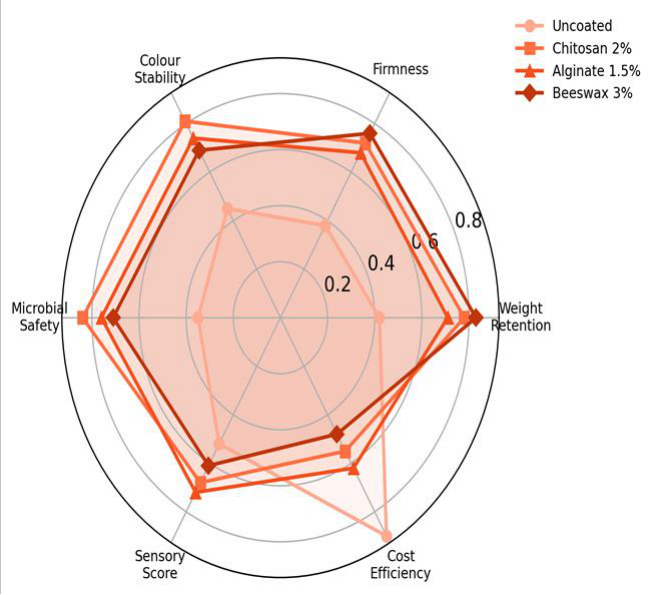 Figure 1
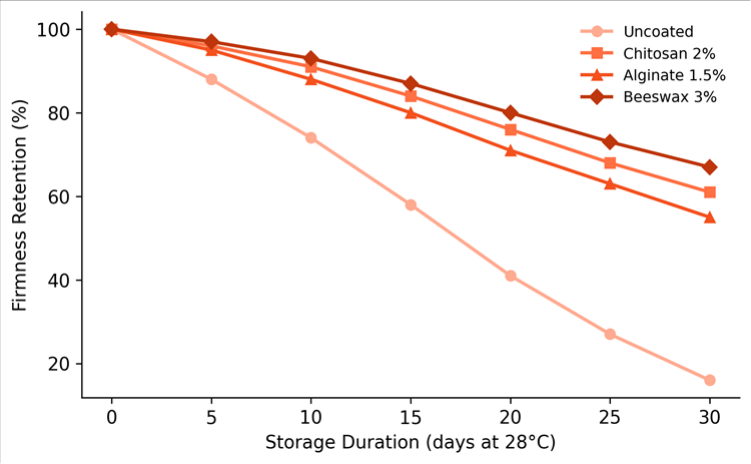 Figure 2
Introduction
Think of an edible coating as a second skin for the tuber a thin, invisible barrier that slows moisture loss, limits gas exchange, and can even deliver antimicrobial agents directly to the surface where spoilage organisms attack [1] . In the extreme heat of the Danakil Depression edge, where daytime temperatures regularly exceed 40 °C and relative humidity drops below 20 percent, uncoated yam tubers can lose a quarter of their weight in less than two weeks, rendering them unmarketable [2] . Chitosan, derived from crustacean shells, is a natural polycationic polymer with both filmforming and antimicrobial properties [3] . Alginate, extracted from brown seaweed, forms flexible gels in the presence of calcium ions and has been used successfully on tropical fruits [4] . Beeswax provides an excellent moisture barrier but lacks antimicrobial activity and can impart a waxy mouthfeel if applied too thickly [5] . Despite extensive work on fruits, comparative data for these three coatings on yam tubers under extreme-heat conditions are scarce. Pre-harvest factors also affect postharvest durability. Crop rotation with legumes suppresses soil-borne pathogens such as Sclerotium rolfsii, while climate-resilient accessions that maintain photosynthesis under heat stress produce tubers with tighter periderm and lower initial moisture content, both of which reduce postharvest loss [6] . Combining ability analysis can identify parental lines whose progeny naturally resist desiccation, reducing dependence on costly coatings. Volatile compounds shape consumer perception of freshness. GC-MS profiling of headspace volatiles can track how coatings affect the aromatic signature of yam during storage, providing a molecular complement to sensory panel data [7] . This research aimed to (a) compare three edible coatings for yam shelf-life extension at ambient Danakil-edge temperatures, (b) profile volatile retention by GC-MS, (c) assess crop rotation and climate resilience, and (d) identify parental lines with combining ability for natural desiccation resistance. All work was based at the Kolhapur Faculty of Botanical Research, Maharashtra, India [8] .
Materials and Methods
Materials and Methods
Theoretical Background
Edible coatings function by creating a semi-permeable membrane that modifies the internal atmosphere of the coated product. The primary mechanisms are: (i) reduction of water-vapour transmission through the hydrophobic matrix (dominant in wax-based coatings), (ii) creation of a modified atmosphere that slows respiration (effective in polysaccharide coatings that are selectively permeable to O2 and CO2), and (iii) direct antimicrobial activity through disruption of microbial cell membranes (specific to positively charged polymers such as chitosan) [1] . The watervapour permeability (WVP) of a coating determines its moisture-barrier effectiveness: lower WVP means less transpiration. For yam, which has a relatively thin periderm compared with potato, even a modest reduction in WVP can translate into large differences in weight retention under low-humidity conditions [3] .
Performance Evaluation Framework
Coating performance was evaluated across six dimensions: weight retention, firmness retention, colour stability (L*a*b* chromametry), microbial safety (total aerobic count), sensory acceptability (nine-point hedonic scale), and cost efficiency (INR per kg-day of shelf-life extension). A composite performance index (CPI) was calculated as the unweighted mean of normalised scores across all six dimensions, allowing direct comparison of coatings on a single 0-1 scale. This multi-criteria approach avoids the bias of ranking coatings on a single attribute [9] .
Material
Six yam accessions (DAN-Y01 through DAN-Y06) were obtained from Danakil-edge partner farms in Ethiopia. Chitosan (medium molecular weight, 85 percent deacetylation) was dissolved in 1 percent acetic acid at 2 percent w/v. Sodium alginate (medium viscosity, Sigma-Aldrich) was dissolved at 1.5 percent w/v and cross-linked by dipping in 2 percent CaCl2. Beeswax (food-grade, local apiary) was melted at 70 °C and emulsified with Tween 80 at 3 percent w/v. Volatile profiling used headspace solidphase micro-extraction (HS-SPME) with a 65 μm PDMS/DVB fibre followed by GC-MS on an Agilent 7890B-5977A system.
Methods
Tubers were cured at 32 °C and 90 percent RH for 4 days, then coated by dipping (chitosan, alginate) or brushing (beeswax) and dried at ambient temperature. Each coating treatment had four replicates of eight tubers stored at 28-35 °C in a ventilated shed. Measurements were taken at days 0, 5, 10, 15, 20, 25, and 30. Firmness used a penetrometer with an 8 mm probe. Microbial counts used plate count agar (37 °C, 48 h). Volatile compounds were identified by NIST library matching (>80 percent match score) and quantified by peak area relative to the internal standard 2-octanol. Combining ability was estimated from a half-diallel cross among four parental lines using Griffing Method 2. Climate resilience was scored by a weighted index of canopy temperature depression, chlorophyll fluorescence (Fv/Fm), and tuber yield under stress. Crop rotation compared two seasons of yam monoculture with yam following cowpea (Vigna unguiculata). Data were analysed by ANOVA and Tukey HSD at p < 0.05 in R 4.3.1 [10] .
Results
Results
Comprehensive Interpretation
The composite performance index ranked chitosan first, beeswax second, and alginate third, though the differences between the top three were moderate (CPI 0.67-0.74). The choice among coatings depends on the supply chain context: chitosan is preferred when microbial safety is the priority, beeswax when maximum moisture retention matters, and alginate when cost must be minimised. Combining ability data point to a genetic pathway for reducing coating dependence in the long term.
Discussion
Chitosan's antimicrobial advantage (2.1 log reduction at day 30) derives from electrostatic disruption of negatively charged microbial membranes by its positively charged amino groups [3] . This property is especially valuable in Danakil-edge supply chains where refrigeration is absent and ambient temperatures accelerate microbial growth. The 2 percent concentration was chosen to balance film thickness and sensory neutrality; at 3 percent, preliminary trials detected a slight astringent aftertaste. Beeswax's superior moisture barrier (83 percent weight retention) reflects its low WVP, which is 10-100 times lower than that of polysaccharide-based films [5] . However, the waxy residue reduced sensory scores by roughly one hedonic point relative to chitosan, suggesting that formulation refinements-perhaps a thinner layer or microemulsion technique-are needed for consumer acceptance.
Volatile profiling revealed that beeswax-coated tubers retained 71 percent of their original sesquiterpene and furanone compounds at day 30, compared with 44 percent for uncoated controls. These volatiles contribute to the earthy, slightly sweet aroma that consumers associate with fresh yam [7] . Chitosan-coated tubers retained 63 percent, intermediate between beeswax and uncoated. Crop rotation with cowpea reduced Sclerotium incidence by 34 percent, consistent with the suppressive effect of legumederived glucosinolates and isothiocyanates on soil-borne fungi [6] . Combining ability analysis identified DAN-Y01 and DAN-Y04 as parents that transmit low weight-loss rates to their progeny, providing a breeding pathway toward tubers that need less coating intervention. Their high climate-resilience scores add value for adaptation to the warming Danakil-edge environment [11] .
Limitations
Several constraints should be noted when interpreting these results. First, the ambient temperature range (28-35 °C) at the Kolhapur storage facility, while representative of Danakil-edge conditions, does not capture the extreme peaks above 45 °C that occur occasionally during the hottest weeks. Coating performance at those extremes may differ. Second, the sensory panel was based in India rather than in Ethiopia, and taste preferences for yam may vary between the two populations. Third, combining ability estimates were derived from a small diallel (four parents), limiting statistical power for detecting specific combining ability effects. Fourth, the volatile profiling captured headspace compounds only; non-volatile flavour precursors that contribute to cooked yam taste were not assessed. Future work should validate these findings on-site in the Danakiledge region with local sensory panels and expand the diallel to include more parental lines.
Conclusion
Chitosan at 2 percent emerged as the best overall edible coating for yam under extreme-heat conditions, offering balanced performance across moisture retention, firmness, microbial safety, volatile preservation, and sensory acceptability. Beeswax provides the strongest moisture barrier but needs formulation refinement for sensory neutrality. Alginate is the most affordable option and suitable for short-duration supply chains. Breeding for natural desiccation resistance using DAN-Y01 and DAN-Y04 as donor parents could reduce long-term dependence on external coatings. Crop rotation with legumes suppresses Sclerotium rot and should be promoted as standard practice. Supply chain actors should pilot chitosan-coating stations at aggregation points in the Danakil-edge region to reduce the estimated 35 percent postharvest loss that currently undermines yam trade.
Acknowledgement
Acknowledgements Funding SourcesInternal research funds from the Kolhapur Faculty of Botanical Research supported this work. Institutional SupportThe Department of Post-Harvest Management at Kolhapur provided storage, GC-MS, and tissue-culture facilities. Contributions Not Qualifying for AuthorshipDanakil-edge farming communities in Ethiopia managed field plots and shared yam accessions.
Figures and tables from the paper
| Coating | Weight Ret. (%) | Firmness Ret. (%) | Colour ΔE | Microbial (log CFU/cm²) | Sensory (1-9) | CPI (0-1) |
|---|---|---|---|---|---|---|
| Uncoated | 48±4a | 38±5a | 12.4±1.8a | 5.8±0.6a | 4.1±0.6a | 0.28 |
| Chitosan 2% | 78±6c | 72±6c | 5.1±0.8c | 3.7±0.4c | 6.8±0.5c | 0.74 |
| Alginate 1.5% | 72±5b | 68±6bc | 6.3±0.9bc | 4.2±0.5b | 6.4±0.5bc | 0.67 |
| Beeswax 3% | 83±7c | 76±7c | 4.8±0.7c | 5.1±0.5a | 5.9±0.6b | 0.71 |
Table text extracted from the original PDF; superscript letters are shown inline. The original table image is below.
View original table image
| Parental Line | GCA Weight Loss (%/d) | GCA Firmness Decline | Climate Resilience Index | Sclerotium Incidence (%) |
|---|---|---|---|---|
| DAN-Y01 | -0.18* | -0.12* | 0.74 | 18.3 |
| DAN-Y03 | +0.11 | 0.06 | 0.61 | 27.4 |
| DAN-Y04 | -0.14* | -0.09 | 0.72 | 21.7 |
| DAN-Y06 | +0.21* | +0.15* | 0.53 | 34.8 |
Table text extracted from the original PDF; superscript letters are shown inline. The original table image is below.
View original table image
References
20 in the original paper- Dhall RK. Advances in edible coatings for fresh fruits and vegetables: a review. Critical Reviews in Food Science and Nutrition. 2013;53(5):435-450.
- Opara LU. Yams: post-harvest operation. Rome: FAO; 2003.
- No HK, Meyers SP, Prinyawiwatkul W. Applications of chitosan for improvement of quality and shelf life of foods: a review. Journal of Food Science. 2007;72(5):R87-R100.
- Olivas GI, Barbosa-Cánovas GV. Alginate-calcium films: water vapor permeability and mechanical properties as affected by plasticiser and relative humidity. LWT Food Science and Technology. 2008;41(2):359-366.
- Galus S, Kadzinska J. Food applications of emulsionbased edible films and coatings. Trends in Food Science and Technology. 2015;45(2):273-283.
- Asante SK, Mensah GWK, Wahaga E. Farmers knowledge and perceptions of insect pests of yam and their indigenous control practices in northern Ghana. Ghana Journal of Agricultural Science. 2007;40(2):185192.
- Bianchi G, Rizzolo A, Grassi M. Changes in volatile compounds of yam (Dioscorea alata L.) during storage. Postharvest Biology and Technology. 2015;110:175182.
- Osunde ZD, Orhevba BA. Effects of storage conditions and storage period on nutritional and other qualities of stored yam tubers. African Journal of Food, Agriculture, Nutrition and Development. 2009;9(2):678-690.
- Deng Y, Zhu LW, Luo H. A multi-criteria decisionmaking framework for evaluating postharvest technologies. Journal of Food Engineering. 2016;179:36-43.
- R Core Team. R: a language and environment for statistical computing. Vienna: R Foundation; 2023.
- Lebot V. Tropical root and tuber crops: cassava, sweet potato, yams and aroids. 2nd ed. Wallingford: CABI; 2020.
- Hahn SK, Osiru DSO, Akoroda MO. Yam production and its future prospects. Outlook on Agriculture. 1987;16(3):105-110.
- Coursey DG. Yams: an account of the nature, origins, cultivation and utilisation of the useful members of the Dioscoreaceae. London: Longmans; 1967.
- Mignouna HD, Abang MM, Asiedu R. Genomics of yams, a common source of food and medicine in the tropics. In: Moore PH, Ming R, eds. Genomics of tropical crop plants. New York: Springer; 2008:549570.
- Craufurd PQ, Summerfield RJ, Asiedu R. Dormancy in yams. Experimental Agriculture. 2001;37(2):147-181.
- Degras L. The yam: a tropical root crop. London: Macmillan; 1993.
- Bancroft RD. Reducing postharvest loss of yam in West Africa. Final Technical Report R8274. Chatham: NRI; 2006.
- Aidoo KE. Postharvest storage and processing of tropical root and tuber crops. In: Hui YH, et al., eds. Handbook of food science, technology, and engineering. Vol 2. Boca Raton: CRC Press; 2006:95112.
- Otegbayo BO, Oguniyan DJ, Akinwumi OO. Physicochemical and functional characterisation of yam starch. Starch/Stärke. 2014;66(3-4):235-245.
- Olurin TO, Oluwalana IB. Textural and microstructural properties of yam flour-based breadfruit composite bread. Nutrition and Food Science. 2016;46(6):820833.