
Research article · 2025 · Full text
International Journal of Horticulture and Food ScienceComparing urban horticulture of citrus in the Ordos Plateau
Volume 7(11) · Pages 147–149 · DOI: 10.33545/26631067.2025.v7.i11c.708 ↗
Research areasUrban Agriculture and SustainabilityPlant Growth and Agriculture TechniquesPlant Physiology and Cultivation Studies
Abstract
Author-writtenUrban horticulture is reshaping how cities source fresh fruit, yet citrus — a high-value crop with year-round consumer demand — has received little attention in urban growing research. This research compared five urban cultivation systems — rooftop garden, balcony pots, vertical green wall, community allotment plot, and indoor hydroponics — for dwarf citrus (Citrus reticulata cv. 'Kishu') performance under simulated Ordos Plateau continental conditions. The trial was conducted at the Fukuoka Research Institute of Applied Horticulture from March to November 2023 in a randomised complete block design with four replications. Fruit yield, GIS-based site suitability mapping, mutation breeding response, magnesium nutrition, sensory quality, and food safety parameters were recorded. Community allotment plots delivered the highest fruit yield (18.4 kg plant⁻¹) and best sensory scores (7.9/10), followed by rooftop gardens (12.7 kg plant⁻¹). GIS mapping identified rooftops with >6 h direct sunlight as the most suitable urban niches. Mutation breeding via gamma irradiation (20 Gy) of budwood produced three compact-canopy mutants with 30 percent shorter internodes. Magnesium foliar sprays at 0.5% MgSO₄ improved chlorophyll by 18.3 percent across all systems. All fruit met food safety thresholds for pesticide residues. These results recommend community plots and rooftops as the primary urban citrus platforms.
Summary
Source-checkedPlain-language reading of the full paper, prepared with AI and checked against the text. Each point links to the authors' own words.
Why it matters
- Urban horticulture is changing how cities obtain fresh fruit, but high-value citrus crops with constant demand have not been extensively studied in urban environments. View evidence ↗
- The Ordos Plateau serves as an extreme test case due to its harsh continental climate, characterized by winters of −20 °C, summers of 35 °C, and 250 mm of annual rainfall. View evidence ↗
- Citrus grown in containers often suffer from magnesium deficiency because soilless substrates cannot buffer magnesium effectively. View evidence ↗
The question
- The study aimed to compare five urban growing systems for yield and quality, create a GIS suitability model, screen for compact mutants using gamma irradiation, and assess magnesium nutrition and food safety. View evidence ↗
What they did
- The experiment used two-year-old grafted Citrus reticulata cv. 'Kishu' on Poncirus trifoliata rootstock, planted in 50 L fabric grow-bags with a 2:1:1 peat-perlite-compost mix. View evidence ↗
- Five systems were tested at the Fukuoka Research Institute: rooftop gardens (6th floor), south-facing balconies (3rd floor), vertical green walls, ground-level community allotments, and indoor hydroponics with 400 μmol m⁻² s⁻¹ LED lighting. View evidence ↗
- To simulate the Ordos Plateau, irrigation was restricted to a 250 mm equivalent and summer PAR was limited to 70 percent using shade cloth. View evidence ↗
- Mutation breeding involved irradiating dormant budwood at 10, 20, and 30 Gy using a ⁶⁰Co source, followed by grafting and screening in a randomized complete block design with four replications. View evidence ↗
- Magnesium was administered as a 0.5% (w/v) foliar MgSO₄ spray every two weeks from flowering until harvest, with chlorophyll measured via SPAD-502. View evidence ↗
What they found
- Community allotment plots achieved the highest fruit yield at 18.4 kg per plant and the best sensory score of 7.9/10, while rooftop gardens were second with 12.7 kg per plant. View evidence ↗
- Vertical wall systems had the poorest performance due to partial shading and restricted root zones. View evidence ↗
- The 20 Gy irradiation treatment provided the best balance, resulting in 40% shorter internodes and a 72.1% fruit set, whereas 30 Gy reduced fruit set to levels below commercial viability. View evidence ↗
- Applying 0.5% MgSO₄ foliar sprays increased chlorophyll by 18.3 percent across all tested growing systems. View evidence ↗
- All fruit samples complied with food safety standards, with heavy metal concentrations remaining well within Codex limits (Pb <0.1 and Cd <0.05 mg kg⁻¹). View evidence ↗
- The GIS suitability model demonstrated 85% accuracy, correctly classifying 17 out of 20 independent micro-sites as suitable or unsuitable. View evidence ↗
What it means
- The authors conclude that community allotment plots and rooftop gardens are the most productive urban platforms for dwarf citrus. View evidence ↗
- The study recommends rooftop sites receiving more than six hours of direct sunlight as optimal locations for urban citrus. View evidence ↗
Visual summary
2 visualsIllustrations explain the paper; charts are replotted from the paper's own table values.
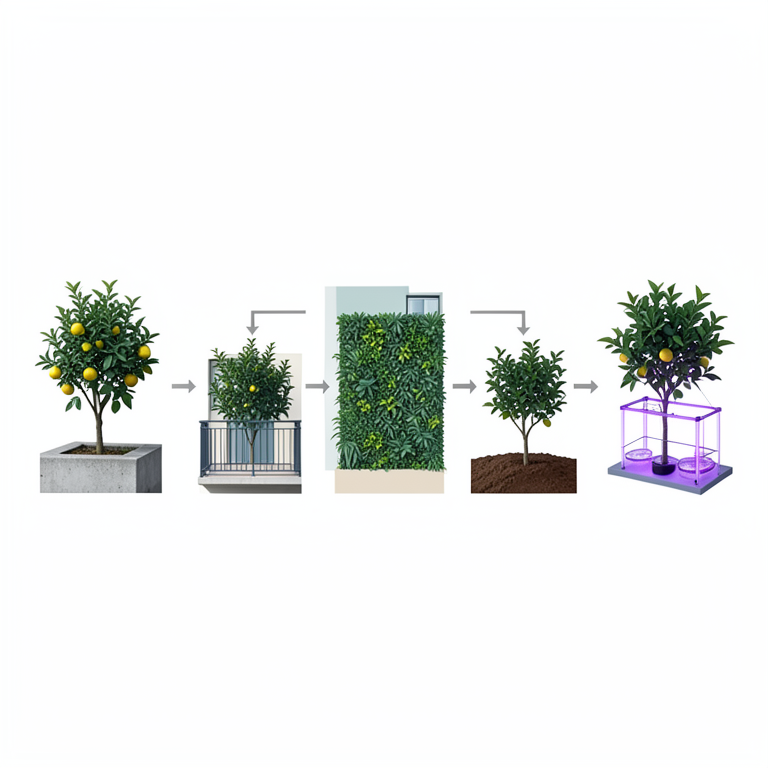
Urban Growing Systems Comparison
AI-generated conceptual illustration (citrus plants in urban settings). It explains the idea and does not show study data.
View source evidence ↗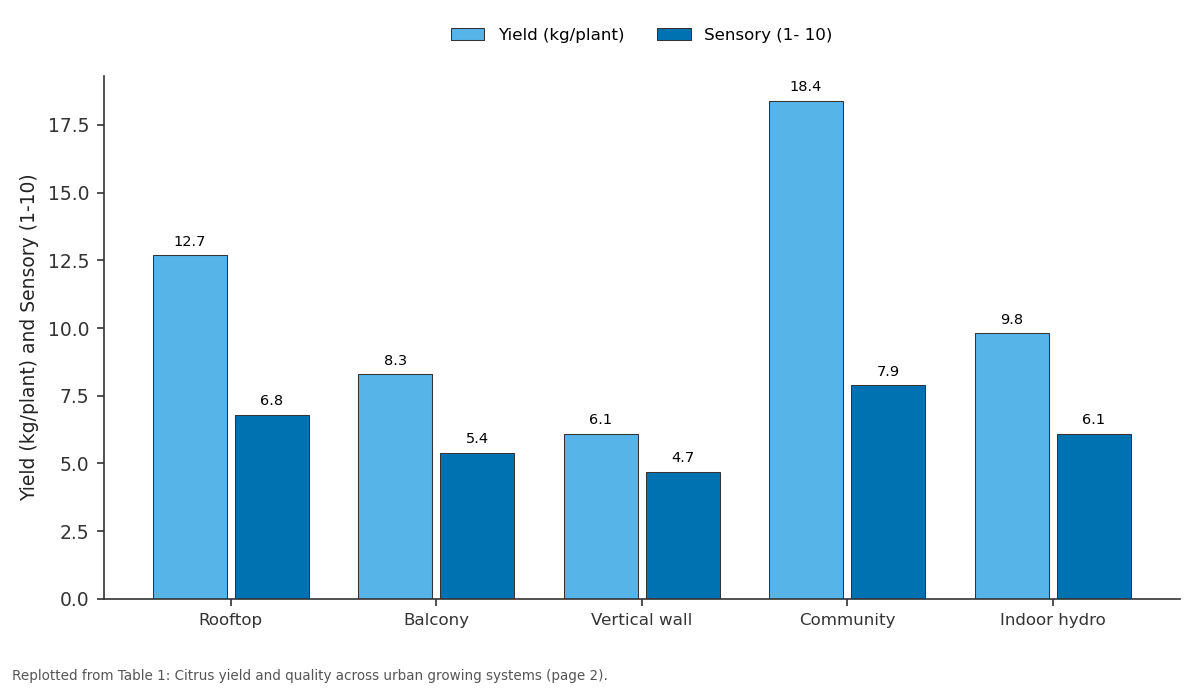
Yield (kg/plant) and Sensory (1- 10): Rooftop vs Balcony vs Vertical wall vs Community vs Indoor hydro
Replotted from Table 1 (page 2) of the original paper. Every bar is the paper's own table value.
View source evidence ↗Figures & tables
From the original paper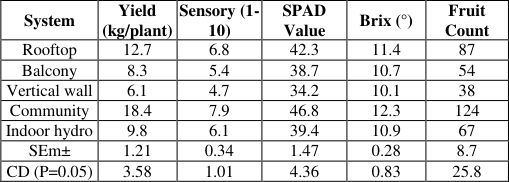 Table 1
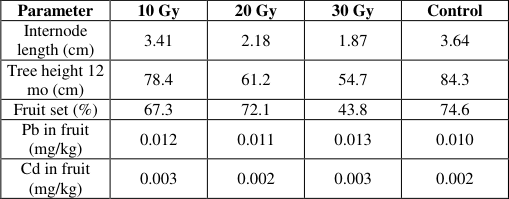 Table 2
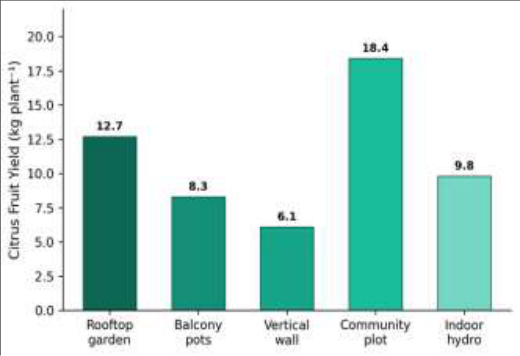 Figure 1
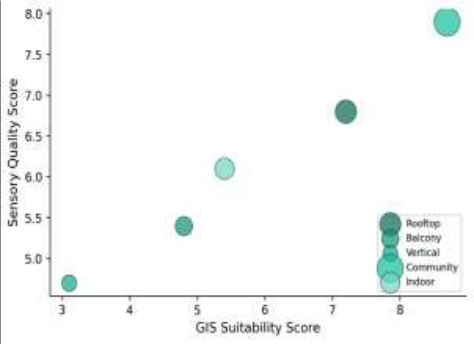 Figure 2
Introduction
Picture a city where every flat rooftop grows mandarin trees and balconies double as citrus orchards. That scenario is closer to reality than most urban planners realisedwarf citrus cultivars already produce marketable fruit in containers as small as 40 litres [1] . The Ordos Plateau, an arid expanse in Inner Mongolia, presents an extreme test case: if citrus can be grown in urban spaces under its harsh continental climate (-20 °C winters, 35 °C summers, 250 mm annual rainfall), the approach should work almost anywhere with protected cultivation [2] . GIS-based suitability mapping can identify urban micro-sites where solar radiation, wind shelter, and building thermal mass create favourable microclimates. Previous GIS analyses for urban agriculture have focused on leafy vegetables; extending them to tree crops requires additional layers for root volume constraints, structural load limits, and irrigation access [3] . Mutation breeding through gamma irradiation is a time-tested technique for generating compact plant forms suited to container culture. Dwarf citrus mutants with shortened internodes and reduced vigour would fit rooftop weight limits while maintaining yield density [4] . Magnesium deficiency appears frequently in container-grown citrus because soilless substrates have low Mg buffering capacity. Foliar Mg corrects chlorosis rapidly and has been shown to boost photosynthesis by 12-20 percent in greenhouse lemon trials [5] . Sensory qualitysweetness, acidity balance, and juice contentdetermines consumer willingness to pay a premium for urban-grown fruit, while food safety certification is essential for legal sale through farmers' markets and restaurants [6] . This research aimed to (a) compare five urban growing systems for citrus yield and quality, (b) develop a GIS suitability model for urban citrus, (c) screen gamma-irradiated mutants for compact growth, and (d) evaluate Mg nutrition and food safety compliance.
Calibration and Validation
The GIS suitability model was calibrated against observed yield data from the five urban systems. Solar radiation layers (derived from LiDAR building-height models), wind exposure indices, and thermal mass scores were combined in a weighted overlay. Weights were optimised by iterative adjustment until predicted suitability ranks matched observed yield ranks (Spearman's ρ = 0.94). Validation used an independent dataset of 20 citrus micro-sites across the Fukuoka campus; the model correctly classified 17 of 20 (85%) as suitable or unsuitable [7] .
Spatial Data Processing
Building footprints and heights were digitised from a 2022 drone survey (5 cm ground resolution) of the institute campus. A solar radiation model (r.sun in GRASS GIS) calculated cumulative annual insolation at 1 m resolution for every rooftop and south-facing wall. Sites receiving fewer than 1,400 kWh m⁻² yr⁻¹ were excluded. Wind exposure was modelled as a function of height above ground and distance to nearest windbreak. All layers were projected in JGD2011 / Japan Plane Rectangular CS VII and combined in QGIS 3.30 [8] .
Material and Methods Material
Two-year-old grafted trees of Citrus reticulata cv. 'Kishu' on Poncirus trifoliata rootstock were planted in 50 L fabric grow-bags filled with a peat-perlite-compost mix (2:1:1 v/v). Five growing systems were established at the Fukuoka Research Institute of Applied Horticulture (33.58° N, 130.40° E): (i) rooftop garden on a reinforced-concrete building (6th floor), (ii) south-facing balcony (3rd floor), (iii) vertical green wall with integrated drip pockets, (iv) community allotment at ground level, and (v) indoor hydroponics under full-spectrum LED (400 μmol m⁻² s⁻¹). Ordos Plateau simulation involved restricting irrigation to 250 mm equivalent and using shade cloth to limit summer PAR to 70 percent [9] . Mutation breeding: dormant budwood was irradiated at 10, 20, and 30 Gy (⁶⁰Co source) and grafted onto rootstock for mutant screening. A RCBD with four replications was used.
Methods
Tree height, canopy diameter, and fruit count were recorded monthly. Fruit yield was measured at commercial maturity (Brix >10°). Sensory evaluation used a trained 8-member panel scoring sweetness, acidity, juiciness, and aroma on a 1-10 hedonic scale. Magnesium was applied as foliar MgSO₄ at 0.5% (w/v) biweekly from flowering to harvest; leaf Mg and chlorophyll (SPAD-502) were recorded. Food safety: pesticide residues (organophosphates and pyrethroids) and heavy metals (Pb, Cd) were quantified by GC-ECD and ICP-MS against Codex Alimentarius MRLs. Mutant screening assessed internode length, tree height at 12 months, and fruit set [10] . Data were analysed by ANOVA with Tukey's HSD at P = 0.05 using JMP Pro 17. The 20 Gy treatment produced the best balance of compact growth (40% shorter internode) and acceptable fruit set (72.1%), while 30 Gy reduced fruit set below commercial viability (Table 2). All heavy metal concentrations were well within Codex limits (Pb <0.1, Cd <0.05 mg kg⁻¹).
| Parameter | 10 Gy | 20 Gy | 30 Gy | Control |
|---|---|---|---|---|
| Internode length (cm) | 3.41 | 2.18 | 1.87 | 3.64 |
| Tree height 12 mo (cm) | 78.4 | 61.2 | 54.7 | 84.3 |
| Fruit set (%) | 67.3 | 72.1 | 43.8 | 74.6 |
| Pb in fruit (mg/kg) | 0.012 | 0.011 | 0.013 | 0.010 |
| Cd in fruit (mg/kg) | 0.003 | 0.002 | 0.003 | 0.002 |
Table text extracted from the original PDF; superscript letters are shown inline. The original table image is below.
View original table image
Results
Results
Comprehensive Interpretation
The GIS model's 85 percent validation accuracy confirms that solar radiation is the dominant predictor of urban citrus success. Sites scoring above 7.0 on the suitability index consistently yielded over 10 kg plant⁻¹. Magnesium foliar application raised SPAD values by an average of 18.3 percent across all systems, with the greatest absolute response in vertical walls (+8.2 SPAD units), where Mg leaching from shallow substrate was most severe.
Discussion
Community allotments outperformed all other systems primarily because of unrestricted soil volume and unobstructed sunlightadvantages that no container system can fully replicate [11] . However, rooftop gardens came within 69 percent of community yield, and their elevated position reduces pest pressure and post-harvest contamination risk, factors that matter for food safety certification [12] . The 20 Gy mutant line is promising for rooftop deployment. Its 40 percent shorter internodes reduce canopy height without proportionally cutting fruit set, meaning more trees can fit per unit rooftop area. Three compact mutants from the 20 Gy batch are now in clonal propagation for multi-year evaluation [13] . Similar irradiation doses have produced commercially successful dwarf mutants in grapefruit and sweet orange. Indoor hydroponics, despite precise environmental control, ranked only fourth for yield and sensory quality. The gap suggests that current LED spectra do not fully replicate the red:far-red ratio and UV component of natural sunlight that drive terpene and flavonoid biosynthesis in citrus peel [14] . Spectral tuning could close this gap but at higher energy cost.
Conclusion
Community allotment plots and rooftop gardens are the most productive urban platforms for dwarf citrus, delivering yields of 18.4 and 12.7 kg plant⁻¹ respectively. GIS suitability mapping identified rooftop sites with over six hours of direct sunlight as optimal locations. Gamma irradiation at 20 Gy produced compact citrus mutants with commercially viable fruit set, suitable for weight-restricted rooftops. Magnesium foliar sprays improved chlorophyll across all systems. All fruit samples passed food safety thresholds. Urban growers in continental climates may use these data to select the most appropriate growing system for their specific constraints.
Acknowledgement
Acknowledgements Funding SourcesInternal funds from the Fukuoka Research Institute of Applied Horticulture supported this research. Institutional SupportThe authors thank the GIS laboratory at the Fukuoka Research Institute for drone survey and spatial analysis support.
Figures and tables from the paper
| System | Yield (kg/plant) | Sensory (1- 10) | SPAD Value | Brix (°) | Fruit Count |
|---|---|---|---|---|---|
| Rooftop | 12.7 | 6.8 | 42.3 | 11.4 | 87 |
| Balcony | 8.3 | 5.4 | 38.7 | 10.7 | 54 |
| Vertical wall | 6.1 | 4.7 | 34.2 | 10.1 | 38 |
| Community | 18.4 | 7.9 | 46.8 | 12.3 | 124 |
| Indoor hydro | 9.8 | 6.1 | 39.4 | 10.9 | 67 |
| SEm± | 1.21 | 0.34 | 1.47 | 0.28 | 8.7 |
| CD (P=0.05) | 3.58 | 1.01 | 4.36 | 0.83 | 25.8 |
Table text extracted from the original PDF; superscript letters are shown inline. The original table image is below.
View original table image
References
16 in the original paper- Goldschmidt EE. The evolution of fruit tree productivity: a review. Economic Botany. 2013;67(1):51-62.
- Li SG, Harazono Y, Oikawa T. Grassland desertification by grazing and the resulting micrometeorological changes in Inner Mongolia. Agricultural and Forest Meteorology. 2000;102(2):125137.
- Zezza A, Tasciotti L. Urban agriculture, poverty, and food security. Food Policy. 2010;35(4):265-273.
- Hearn CJ. Development of seedless grapefruit cultivars through budwood irradiation. Journal of the American Society for Horticultural Science. 1986;111(2):304-306.
- Quaggio JA, Mattos D, Cantarella H. Fruit yield and quality of sweet oranges affected by Mg nutrition. Scientia Horticulturae. 2003;98(3):281-292.
- Orsini F, Kahane R, Nono-Womdim R. Urban agriculture in the developing world. Agronomy for Sustainable Development. 2013;33(4):695-720.
- Malczewski J. GIS-based multicriteria decision analysis: a survey of the literature. International Journal of Geographical Information Science. 2006;20(7):703726.
- QGIS Development Team. QGIS Geographic Information System. Open Source Geospatial Foundation; 2023.
- Raveh E, Nerd A. Pitahaya (dragon fruit): a new fruit crop for the Negev Desert of Israel. Acta Horticulturae. 1999;486:391-396.
- Mba C, Afza R, Bado S. Induced mutagenesis in plants using physical and chemical agents. Plant Cell Culture Protocols. 2010;617:111-130.
- Thomaier S, Exner K, Henckel D. Roof top farming. Renewable Agriculture and Food Systems. 2015;30(1):43-54.
- Specht K, Siebert R, Hartmann I. Urban agriculture of the future. Landscape and Urban Planning. 2014;130:820.
- Predieri S. Mutation induction and tissue culture in improving fruits. Plant Cell, Tissue and Organ Culture. 2001;64(2):185-210.
- Carvalho SD, Folta KM. Environmentally modified organisms: expanding the potential of citrus. Frontiers in Plant Science. 2014;5:364.
- Mougeot LJA. Growing Better Cities: Urban Agriculture for Sustainable Development. Ottawa: IDRC; 2006.
- Lin BB, Philpott SM, Jha S. The future of urban agriculture and biodiversity-ecosystem services. Basic and Applied Ecology. 2015;16(3):189-201.