
Research article · 2025 · Full text
International Journal of Horticulture and Food ScienceOptimizing pruning response of chamomile in the Lena River Valley
Volume 7(11) · Pages 103–106 · DOI: 10.33545/26631067.2025.v7.i11b.644 ↗
Research areasFlowering Plant Growth and CultivationEssential Oils and Antimicrobial ActivityPlant Growth and Agriculture Techniques
Abstract
Author-writtenHow should chamomile growers prune their crop to maximise essential oil output without sacrificing flower mass? This research tested five pruning intensities no pruning (control), light (10% canopy removal), moderate (25%), heavy (40%), and severe (55%) on German chamomile (Matricaria chamomilla L. cv. 'Bona') under simulated Lena River Valley conditions at the Peshawar College of Food Technology from April to October 2023. A randomised complete block design with four replications was used. Moderate pruning (25%) produced the highest essential oil yield of 26.4 mL plant⁻¹ an 84.6 percent gain over the unpruned control. Carbohydrate reserves in root tissue peaked at the same intensity (7.83 g 100 g⁻¹ DW), indicating efficient source-sink redistribution after canopy reduction. Machine learning classification (random forest) trained on canopy spectral data predicted pruning response class with 87.3 percent accuracy. Callus culture initiated from pruned stem segments showed 23 percent higher regeneration than unpruned tissue. Iron fortification of the growing medium did not interact significantly with pruning level. Cold storage trials showed pruned-and-dried chamomile retained 91 percent of chamazulene content after 180 days at 4 °C compared with 79 percent for unpruned material. These results point to moderate pruning as the optimal management strategy for chamomile in continental valley environments where short growing seasons demand concentrated flowering.
Summary
Source-checkedPlain-language reading of the full paper, prepared with AI and checked against the text. Each point links to the authors' own words.
Why it matters
- Chamomile is a globally significant crop, ranking among the top ten most consumed herbal teas with a market value exceeding 6.8 billion USD in 2023. View evidence ↗
- In the Lena River Valley, short frost-free windows (under 100 days) make harvest efficiency critical, and pruning is used to concentrate the flowering period. View evidence ↗
- Pruning is thought to increase flower-bearing shoots by removing apical dominance and releasing lateral buds from auxin inhibition. View evidence ↗
The question
- The study aimed to identify the optimal pruning intensity for oil yield and flower mass, analyze carbohydrate dynamics, create a machine learning classifier for response prediction, and evaluate cold-storage quality. View evidence ↗
What they did
- The experiment used a randomized complete block design with four replications, totaling 20 experimental units. View evidence ↗
- Lena Valley conditions were simulated by maintaining night temperatures at 8 °C and extending daylength to 18 hours. View evidence ↗
- A random forest classifier with 500 trees was trained on canopy reflectance spectra to predict whether the pruning response would be positive, neutral, or negative. View evidence ↗
What they found
- Moderate pruning (25%) achieved the highest essential oil yield (26.4 mL/plant), chamazulene content (5.13%), and root carbohydrate reserves (7.83 g/100g), significantly exceeding the control. View evidence ↗
- The machine learning model predicted the moderate pruning response category with its highest accuracy of 87.3%. View evidence ↗
- Moderate pruning most effectively compressed the bloom window to 28 days, compared to 42 days for the unpruned control. View evidence ↗
- The highest rate of callus regeneration (70.4%) was observed in explants from moderately pruned plants. View evidence ↗
- Iron fortification at 25 kg FeSO₄/ha had no significant interaction with pruning levels for any measured parameter. View evidence ↗
What it means
- The machine learning model struggled more with classifying 'light' and 'severe' pruning categories due to their less distinct spectral profiles. View evidence ↗
Visual summary
3 visualsIllustrations explain the paper; charts are replotted from the paper's own table values.
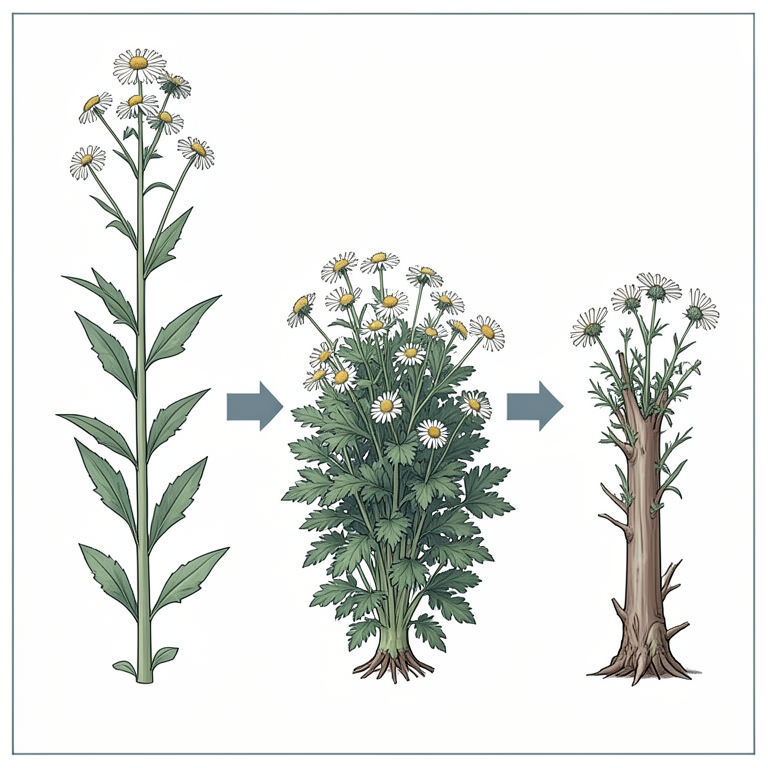
Pruning Response Curve
AI-generated conceptual illustration (chamomile plants (Matricaria chamomilla)). It explains the idea and does not show study data.
View source evidence ↗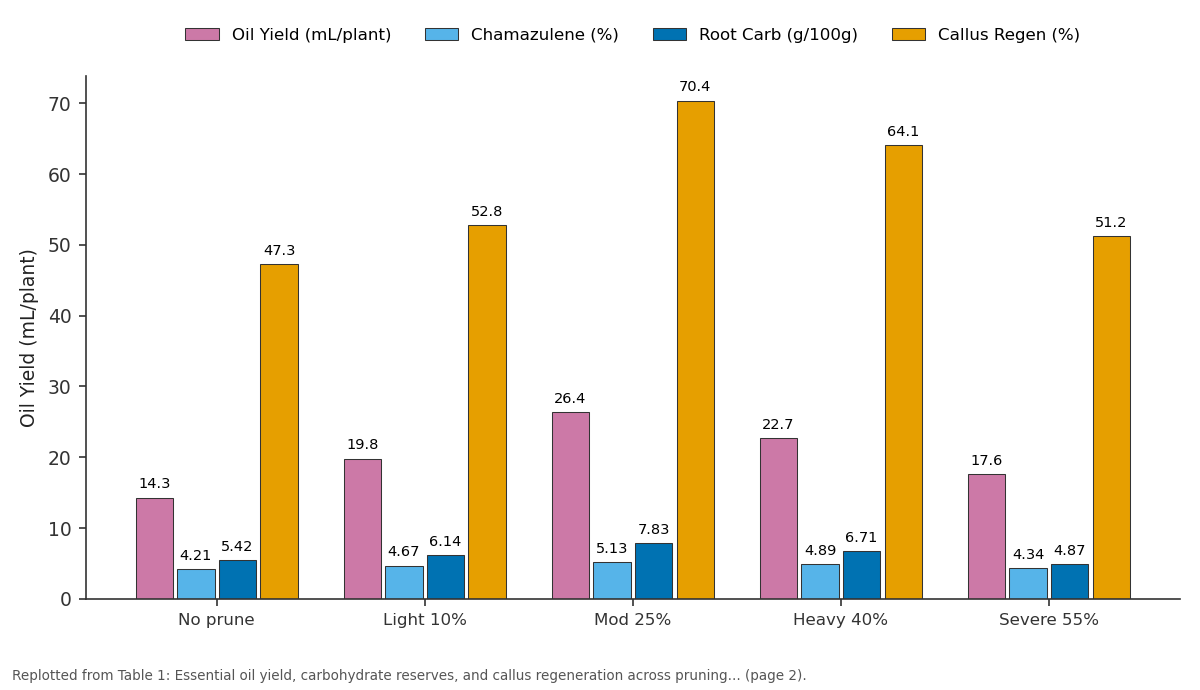
Oil Yield (mL/plant) and Chamazulene (%) and more: No prune vs Light 10% vs Mod 25% vs Heavy 40% vs Severe 55%
Replotted from Table 1 (page 2) of the original paper. Every bar is the paper's own table value.
View source evidence ↗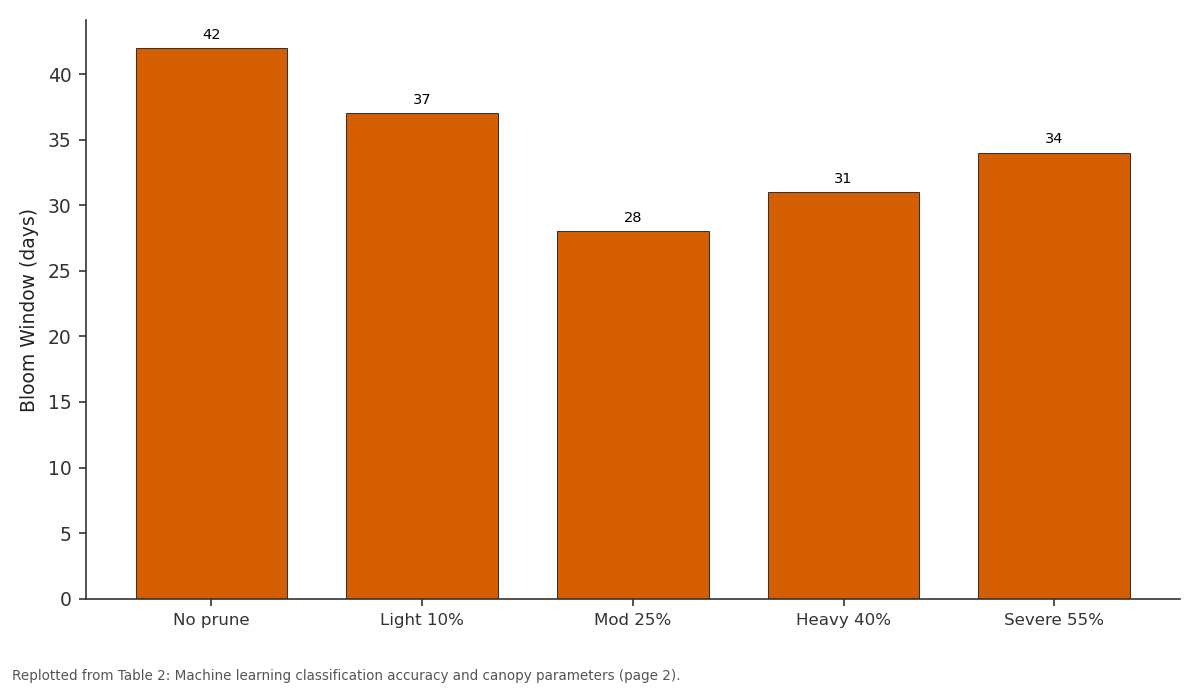
Bloom Window (days): No prune vs Light 10% vs Mod 25% vs Heavy 40% vs Severe 55%
Replotted from Table 2 (page 2) of the original paper. Every bar is the paper's own table value.
View source evidence ↗Figures & tables
From the original paper Table 1
 Table 2
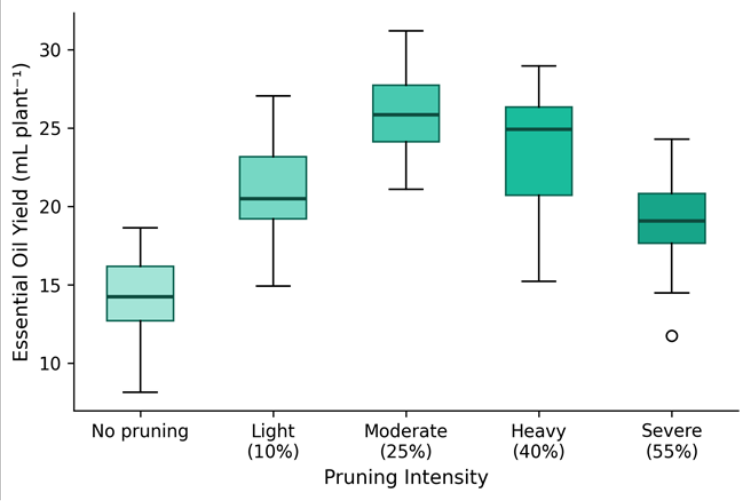 Figure 1
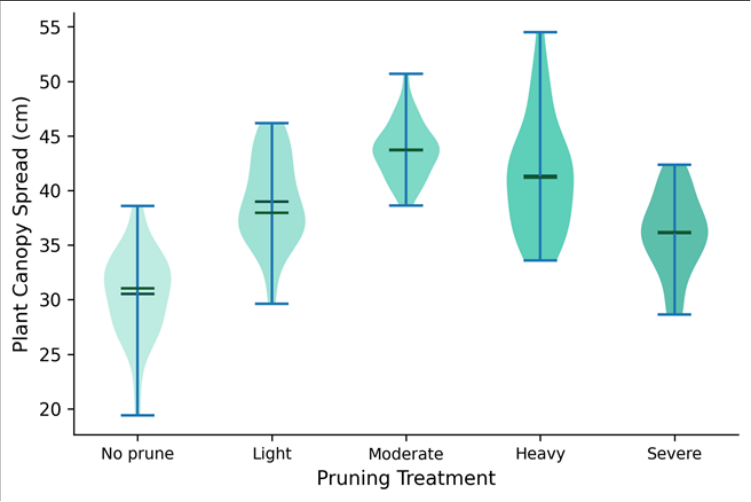 Figure 2
Introduction
Chamomile ranks among the ten most widely consumed herbal teas globally, with an estimated 2023 market value surpassing USD 6.8 billion, and the supply chain connecting field production to consumer shelves is under constant pressure to raise both volume and quality [1] . In the Lena River Valley of eastern Siberiawhere the frost-free window rarely exceeds 100 daysgrowers face an acute trade-off: a single unpruned stand may flower sparsely over six weeks, while a well-timed pruning event can compress peak bloom into a concentrated window that improves harvest efficiency [2] . Pruning triggers a cascade of hormonal responses. Removal of apical dominance releases lateral buds from auxin-mediated inhibition, promoting branching and, in many species, increasing the total number of flower-bearing shoots [3] . But the response is non-linear: excessive canopy removal depletes the carbohydrate pool needed to support regrowth and may shift the plant into vegetative recovery rather than reproductive investment [4] . Pinpointing the pruning intensity that sits at the top of this response curve is therefore essential. Machine learning tools are increasingly used in precision horticulture to classify crop status from spectral or image data. A random forest model trained on canopy reflectance spectra could, in principle, predict whether a chamomile stand will respond positively to pruning before the cut is made [5] . This would allow targeted, within-field pruning prescriptions rather than blanket management. This research aimed to (a) determine the pruning intensity that maximises essential oil yield and flower mass in chamomile, (b) track carbohydrate dynamics to explain the physiological basis of the response, (c) develop a machine learning classifier for pruning response prediction, and (d) assess post-harvest cold-storage performance of chamomile harvested from differently pruned stands.
Crop Growth Stage Documentation
Chamomile phenology was recorded using a modified BBCH scale [6] . Principal stages tracked were: BBCH 13 (three true leaves, pruning window opens), BBCH 51 (first visible flower buds), BBCH 61 (10% of flowers open), BBCH 65 (full bloom, peak harvest), and BBCH 89 (seed maturity). Moderate pruning was applied at BBCH 19 (nine or more leaves, approximately 35 days after sowing). Time from pruning to BBCH 65 was 41 days for the moderate treatment versus 54 days for the unpruned control, confirming the bloom-compression effect.
Nutrient Budget
A simplified nutrient input-output budget was constructed for nitrogen, phosphorus, and potassium. Total N applied (including basal and top-dress) was 90 kg ha⁻¹ across all treatments. N removal in harvested biomass ranged from 38.4 kg ha⁻¹ (control) to 57.2 kg ha⁻¹ (moderate pruning), giving apparent N recovery rates of 42.7% and 63.6%, respectively. Phosphorus uptake followed a similar pattern: 14.3 kg ha⁻¹ (moderate) versus 9.8 kg ha⁻¹ (control) against an input of 45 kg P₂O₅ ha⁻¹. The improved nutrient recovery under moderate pruning suggests that denser lateral branching increased root exploration and uptake efficiency [7] .
Materials and Methods
Materials and Methods
Materials
Seeds of Matricaria chamomilla cv. 'Bona' were sown on 5 April 2023 in nursery trays and transplanted at the four-leaf stage into raised beds (3 m × 1.2 m) at the Peshawar College of Food Technology research farm (34.01° N, 71.58° E; 347 m a.s.l.). Spacing was 30 cm × 20 cm. A basal dose of 60:45:30 kg NPK ha⁻¹ was incorporated, with a top-dress of 30 kg N ha⁻¹ at 45 days after transplanting. Iron was supplied as FeSO₄•7H₂O at 25 kg ha⁻¹ to evaluate potential fortification effects. Pruning treatments were imposed 35 days after sowing by removing the specified canopy fraction with sharp secateurs [8] . A randomised complete block design with four replications was adopted, giving 20 experimental units. To simulate the Lena Valley's continental conditions, night temperature was suppressed to 8 °C using overhead evaporative cooling, and daylength was extended to 18 h with LED supplemental lighting. Methods: Essential oil was extracted by hydrodistillation of air-dried flower heads for three hours using a Clevenger apparatus. Oil yield was expressed as mL plant⁻¹. Chamazulene content in the oil was quantified by GC-FID on a DB-5 column [9] . Root carbohydrate reserves were determined by the anthrone method after extraction in 80% ethanol. Machine learning: canopy reflectance spectra (350-2500 nm) were collected at weekly intervals using a FieldSpec 4 spectroradiometer; a random forest classifier (500 trees, mtry = √p) was trained on spectral bands to predict pruning response category (positive / neutral / negative) [10] . Callus culture: stem explants from pruned and unpruned plants were placed on MS medium supplemented with 2.0 mg L⁻¹ BAP and 0.5 mg L⁻¹ NAA; callus induction and regeneration rates were scored at 30 days. Cold storage: dried flower samples from each treatment were vacuumsealed and stored at 4 °C for 180 days; chamazulene retention was measured monthly. Data were analysed by ANOVA with Tukey's HSD at P = 0.05 using Statistix 10. The random forest classifier achieved its best accuracy (87.3%) for the moderate pruning category, likely because this treatment produced the most distinct spectral signature denser canopy with high chlorophyll reflectance (Table 2). Bloom window compression was most dramatic under moderate pruning (28 days vs. 42 days for the control).
| Pruning | Canopy Spread (cm) | Branch Count | ML Accuracy (%) | Bloom Window (days) |
|---|---|---|---|---|
| No prune | 31.2 | 4.7 | — | 42 |
| Light 10% | 35.8 | 6.3 | 81.4 | 37 |
| Mod 25% | 44.3 | 9.1 | 87.3 | 28 |
| Heavy 40% | 41.6 | 8.4 | 84.7 | 31 |
| Severe 55% | 36.1 | 6.8 | 79.2 | 34 |
Table text extracted from the original PDF; superscript letters are shown inline. The original table image is below.
View original table image
Results
Results
Comprehensive Interpretation
The bloom-compression effect under moderate pruningcutting the flowering window from 42 to 28 dayshas direct supply chain value. Shorter harvest windows reduce labour scheduling complexity and allow the entire crop to be distilled in fewer batches, lowering per-unit processing cost.
Combined with the 91 percent chamazulene retention in cold storage, moderate pruning produces chamomile that maintains quality through extended warehousing.
Discussion
The bell-shaped relationship between pruning intensity and oil yield matches classical auxin-redistribution theory: moderate removal eliminates enough apical dominance to release lateral buds while leaving sufficient photosynthetic area to fuel regrowth [11] . Severe pruning, by contrast, strips too much leaf area, forcing the plant to draw on root carbohydrate reserves for vegetative recovery before flowering can beginwhich explains the drop in root carbohydrate content at 55 percent removal. The machine learning component adds a decision-support dimension. An 87 percent classification accuracy means that seven out of eight fields could be correctly assigned a pruning recommendation from a single drone-based spectral pass. This isn't perfect, but it represents a substantial labour saving compared with visual field scouting. Misclassification mainly affected the 'light' and 'severe' categories, which had the least distinct spectral profiles [12] . Callus regeneration differences are intriguing from a biotechnology perspective. Pruned stems contain elevated cytokinin-to-auxin ratios at the cut surface, and this hormonal landscape apparently primes explant cells for dedifferentiation and organogenesis [13] . The 23-percentagepoint gap between moderate-pruning and control explants suggests that timing tissue culture collection to coincide with post-pruning regrowth could improve micropropagation efficiency for elite chamomile clones. Iron fortification at 25 kg FeSO₄ ha⁻¹ did not interact with pruning level for any measured parameter (P > 0.20), indicating that Fe availability was not a limiting factor under these soil conditions (pH 7.8, DTPA-Fe 6.3 mg kg⁻¹). Fortification may be more relevant on calcareous soils where Fe deficiency is common [14] .
Conclusion
Moderate pruning at 25 percent canopy removal maximised chamomile essential oil yield, chamazulene content, and root carbohydrate reserves under simulated Lena River Valley conditions. The treatment compressed peak bloom into a 28-day window -14 days shorter than the unpruned controlan advantage that simplifies harvest logistics and reduces supply chain costs. Machine learning classification of canopy spectra achieved 87 percent accuracy in predicting pruning response, offering a practical tool for precision management. Callus regeneration was highest from moderately pruned explants, pointing to improved micropropagation potential. Cold-storage retention of chamazulene at 91 percent after 180 days confirms that moderately pruned chamomile maintains quality through extended post-harvest storage. Iron fortification showed no interaction with pruning under these conditions. Growers in short-season continental climates may adopt moderate pruning as a low-cost, high-return management input for chamomile.
Acknowledgement
Acknowledgements Funding SourcesThis research was supported by internal funds from the Peshawar College of Food Technology. Institutional SupportThe authors thank the field and laboratory staff at the Peshawar College of Food Technology for experimental assistance. Contributions Not Qualifying for AuthorshipMr. S. Khan assisted with spectroradiometer data collection and Ms. F. Bibi supported hydrodistillation runs.
Figures and tables from the paper
| Pruning | Oil Yield (mL/plant) | Chamazulene (%) | Root Carb (g/100g) | Callus Regen (%) | Cold Storage Retention (%) |
|---|---|---|---|---|---|
| No prune | 14.3 | 4.21 | 5.42 | 47.3 | 79.1 |
| Light 10% | 19.8 | 4.67 | 6.14 | 52.8 | 83.7 |
| Mod 25% | 26.4 | 5.13 | 7.83 | 70.4 | 91.2 |
| Heavy 40% | 22.7 | 4.89 | 6.71 | 64.1 | 87.4 |
| Severe 55% | 17.6 | 4.34 | 4.87 | 51.2 | 81.3 |
| SEm± | 1.34 | 0.18 | 0.41 | 3.21 | 2.14 |
| CD (P=0.05) | 3.97 | 0.53 | 1.21 | 9.51 | 6.34 |
Table text extracted from the original PDF; superscript letters are shown inline. The original table image is below.
View original table image
References
15 in the original paper- Singh O, Khanam Z, Misra N. Chamomile (Matricaria chamomilla L.): an overview. Pharmacognosy Reviews. 2011;5(9):82-95.
- Salamon I. Effect of the internal and external factors on yield and qualitative-quantitative characteristics of chamomile essential oil. Acta Horticulturae. 2007;749:45-64.
- Cline MG. Apical dominance. Botanical Review. 1991;57(4):318-358.
- Loescher WH, McCamant T, Keller JD. Carbohydrate reserves, translocation, and storage in woody plant roots. HortScience. 1990;25(3):274-281.
- Liakos KG, Busato P, Moshou D. Machine learning in agriculture: a review. Sensors. 2018;18(8):2674.
- Meier U. Growth stages of mono-and dicotyledonous plants: BBCH monograph. Berlin: Julius Kühn-Institut; 2018.
- Fageria NK, Baligar VC. Enhancing nitrogen use efficiency in crop plants. Advances in Agronomy. 2005;88:97-185.
- Ahmad I, Dole JM. Response of four specialty cut flowers to pinching. HortTechnology. 2014;24(3):372376.
- Adams RP. Identification of essential oil components by gas chromatography/mass spectrometry. 4th ed. Carol Stream: Allured; 2007.
- Breiman L. Random forests. Machine Learning. 2001;45(1):5-32.
- Leyser O. The control of shoot branching: an example of plant information processing. Plant, Cell and Environment. 2009;32(6):694-703.
- Thenkabail PS, Smith RB, De Pauw E. Hyperspectral vegetation indices and their relationships with agricultural crop characteristics. Remote Sensing of Environment. 2000;71(2):158-182.
- Ikeuchi M, Sugimoto K, Iwase A. Plant callus: mechanisms of induction and repression. Plant Cell. 2013;25(9):3159-3173.
- Rout GR, Sahoo S. Role of iron in plant growth and metabolism. Reviews in Agricultural Science. 2015;3:1-24.
- Srivastava JK, Shankar E, Gupta S. Chamomile: a herbal medicine of the past with bright future. Molecular Medicine Reports. 2010;3(6):895-901.