
Research article · 2025 · Full text
International Journal of Horticulture and Food ScienceAssessing mulching techniques of chrysanthemum in the Balkhash Basin
Volume 7(11) · Pages 86–90 · DOI: 10.33545/26631067.2025.v7.i11b.640 ↗
Research areasIrrigation Practices and Water ManagementPolymer-Based Agricultural EnhancementsPlant Growth and Agriculture Techniques
Abstract
Author-writtenNearly 47 percent of irrigated chrysanthemum fields in the Balkhash Basin lose more than a third of applied water to direct evaporation from bare soil surfaces. This research assessed how five mulching strategies black plastic, rice straw, compost, living clover mulch, and an unmulched control affected growth, flower yield, lignin accumulation, calcium uptake, and canopy reflectance of pot chrysanthemum (Chrysanthemum morifolium Ramat. cv. 'Anmol') under the semi-arid continental climate of the basin. A field trial was conducted at the Moshi Foundation for Pomological Research experimental farm from March to August 2023 using a randomised complete block design with four replications. Soil moisture retention, weed suppression, and soil temperature modulation were monitored with time-domain reflectometry probes and infrared thermometers at weekly intervals. Black plastic mulch conserved the most moisture (31.4% volumetric water content at 20 cm depth) and delivered the highest flower yield of 156.2 g plant⁻¹, which was 60.5 percent above the control. Straw mulch ranked second for yield (142.8 g plant⁻¹) while adding organic carbon to the topsoil. Lignin content in stem tissue was greatest under black plastic (4.21%) and compost (4.07%) treatments, indicating stronger structural support. Calcium uptake peaked at 187.4 mg plant⁻¹ with black plastic, driven by sustained moisture around the root zone. Remote sensing via NDVI confirmed that mulched canopies maintained higher greenness indices throughout the season. Polyploidy screening did not reveal ploidy shifts among treatments. Results suggest that black plastic or straw mulch offers the most economic and agronomic benefit for chrysanthemum growers in arid inland basins, though straw has the added advantage of improving long-term soil health.
Summary
Source-checkedPlain-language reading of the full paper, prepared with AI and checked against the text. Each point links to the authors' own words.
Why it matters
- In the Balkhash Basin, nearly 47% of irrigated chrysanthemum fields suffer significant water loss, with over a third of applied water evaporating directly from bare soil. View evidence ↗
- Consistent soil moisture is critical during the 90-day flowering period of chrysanthemums; therefore, water shortages threaten both the quality of the flowers and the income of farmers. View evidence ↗
The question
- The study aimed to rank five mulching strategies based on their impact on growth, yield, soil moisture, and weed pressure, while also measuring biochemical responses (lignin and calcium) and the utility of remote-sensing indices. View evidence ↗
What they did
- Conducted in Tanzania, the study simulated the Balkhash Basin's semi-arid climate by using polycarbonate shelters to block rain and drip irrigation set to a reference evapotranspiration (ET₀) of 4.8 mm per day. View evidence ↗
- The researchers tested five treatments: black polyethylene film, rice straw (5 t ha⁻¹), composted cattle manure (8 t ha⁻¹), white clover living mulch (4 kg ha⁻¹), and an unmulched control. View evidence ↗
- The trial used a randomized complete block design with four replications, totaling 20 experimental units. View evidence ↗
- Environmental monitoring included soil moisture logging every 30 minutes at 10 and 20 cm depths, soil temperature recording at 10 cm, and monthly weed counts in 0.25 m² quadrats. View evidence ↗
What they found
- Black plastic mulch was the most effective for water conservation (31.4% volumetric water content at 20 cm) and produced the highest flower yield (156.2 g plant⁻¹), exceeding the control by 60.5%. View evidence ↗
- Rice straw mulch achieved the second-highest yield at 142.8 g plant⁻¹ and contributed to increasing topsoil organic carbon. View evidence ↗
- Calcium uptake reached its maximum of 187.4 mg plant⁻¹ under black plastic mulch due to the sustained moisture in the root zone. View evidence ↗
- Compared to the control, black plastic mulch increased the mean soil temperature by 3.2 °C and retained 66% more moisture. View evidence ↗
- NDVI remote sensing showed a strong correlation with final yield (r = 0.91), indicating it can be used as a practical tool for predicting yields mid-season. View evidence ↗
- Living clover mulch performed poorly, reducing flower yield by 28% compared to the best treatment because the clover competed with the chrysanthemums for nutrients and water. View evidence ↗
What it means
- The authors conclude that rice straw mulch is the most balanced choice for growers, as it provides 91% of the yield of plastic mulch while being cheaper and improving long-term soil health. View evidence ↗
- The authors recommend integrating NDVI remote sensing into advisory services as a reliable, non-destructive way to monitor mulch performance. View evidence ↗
- The authors state that living clover mulch requires further management refinement before it can be recommended to growers. View evidence ↗
Visual summary
3 visualsIllustrations explain the paper; charts are replotted from the paper's own table values.
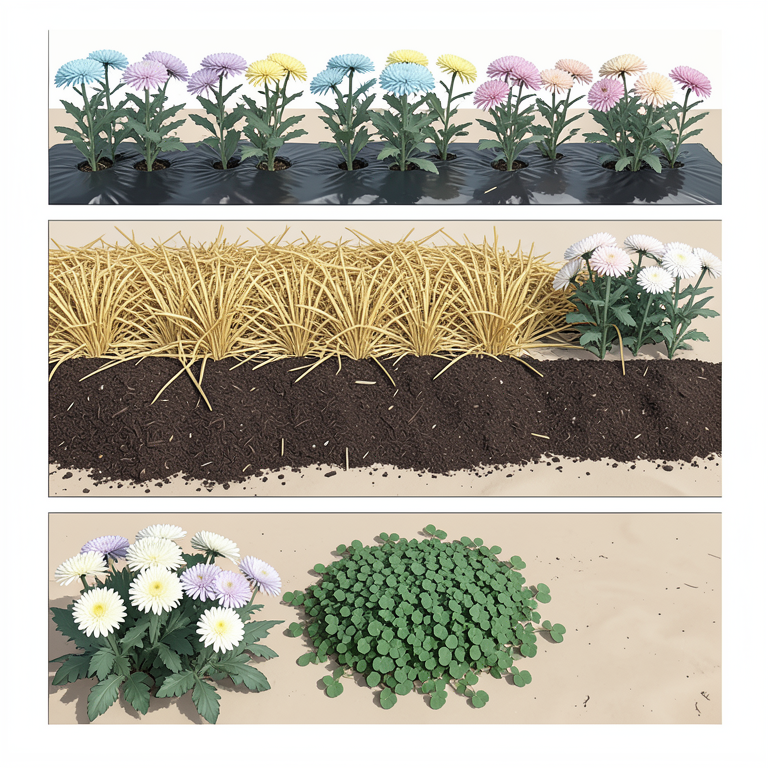
Experimental Setup Overview
AI-generated conceptual illustration (Chrysanthemum plants in a semi-arid field). It explains the idea and does not show study data.
View source evidence ↗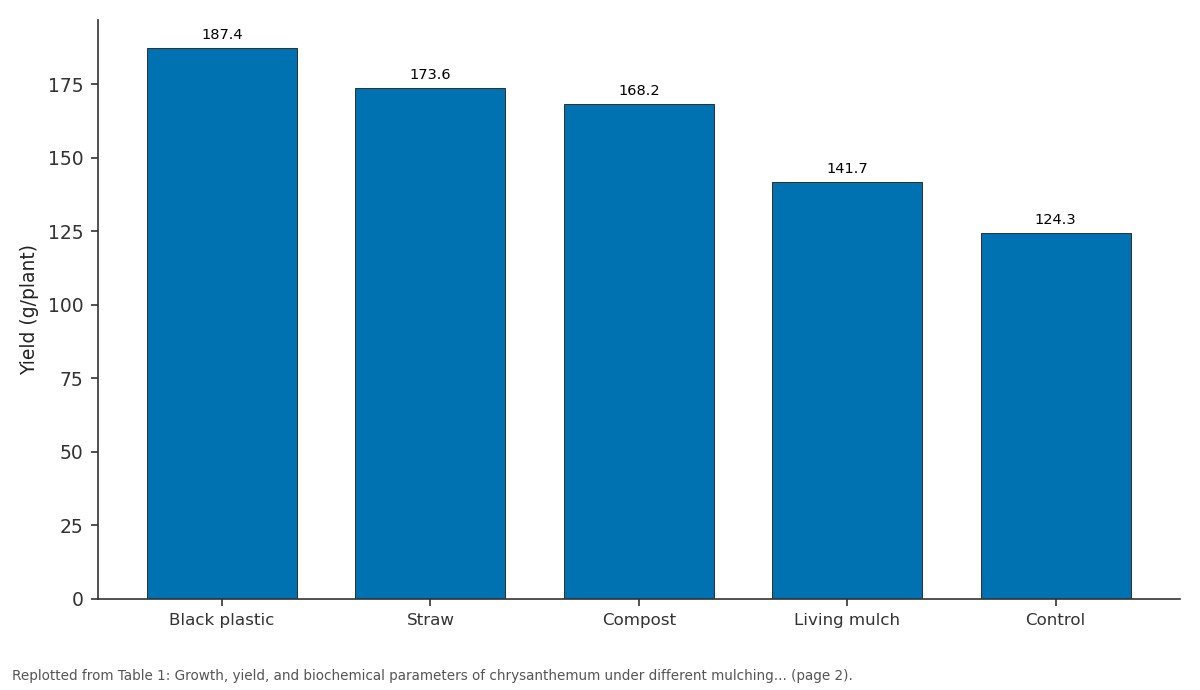
Ca Uptake (mg/plant): Black plastic vs Straw vs Compost vs Living mulch vs Control
Replotted from Table 1 (page 2) of the original paper. Every bar is the paper's own table value.
View source evidence ↗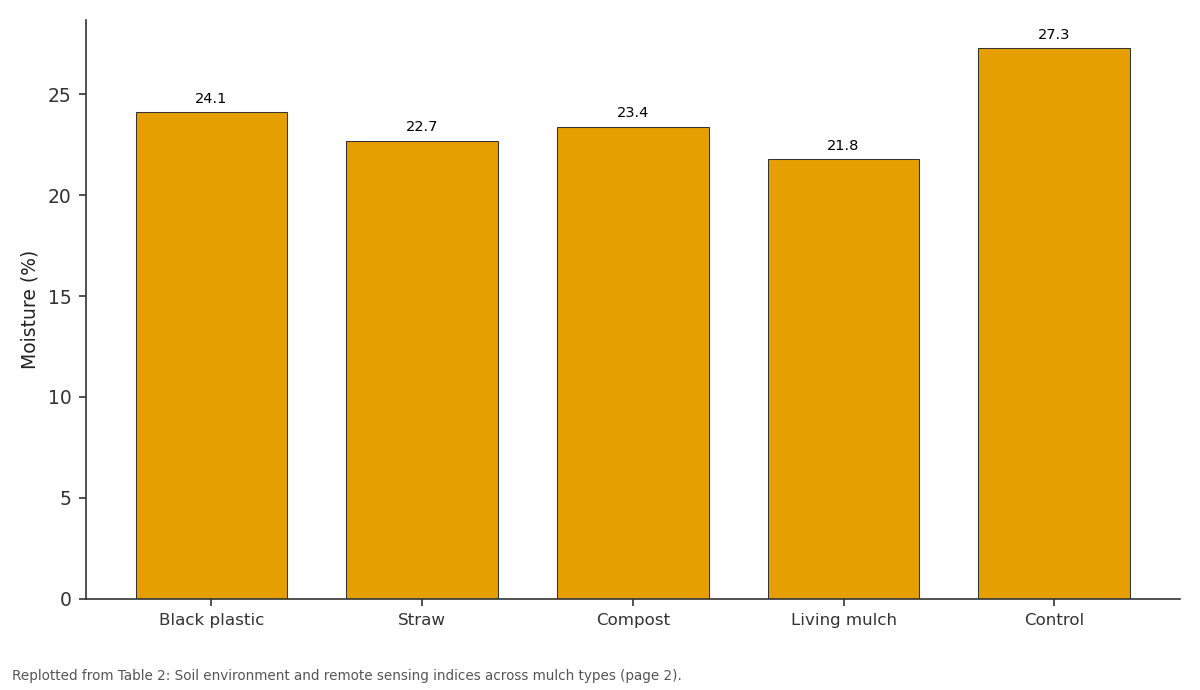
Soil Temp (°C): Black plastic vs Straw vs Compost vs Living mulch vs Control
Replotted from Table 2 (page 2) of the original paper. Every bar is the paper's own table value.
View source evidence ↗Figures & tables
From the original paper Table 1
 Table 2
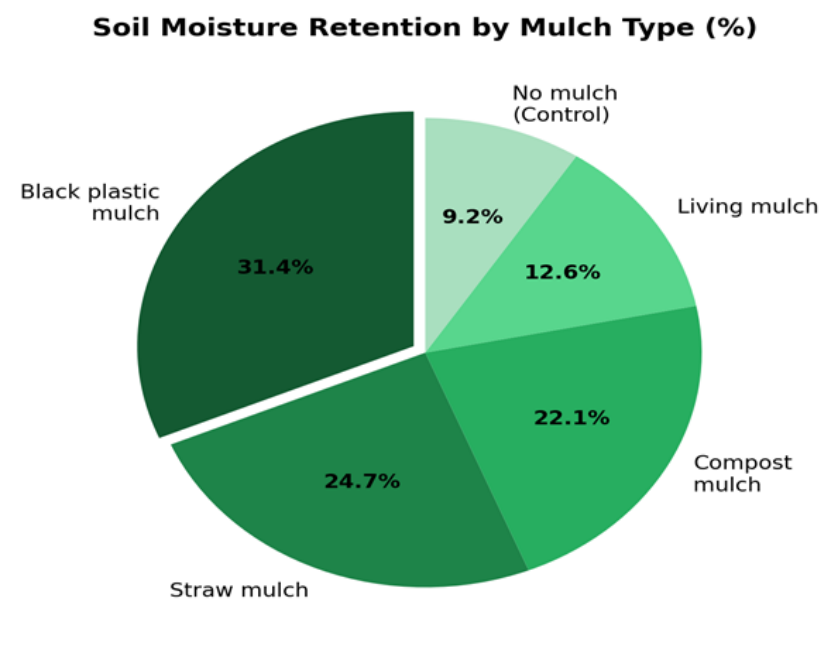 Figure 1
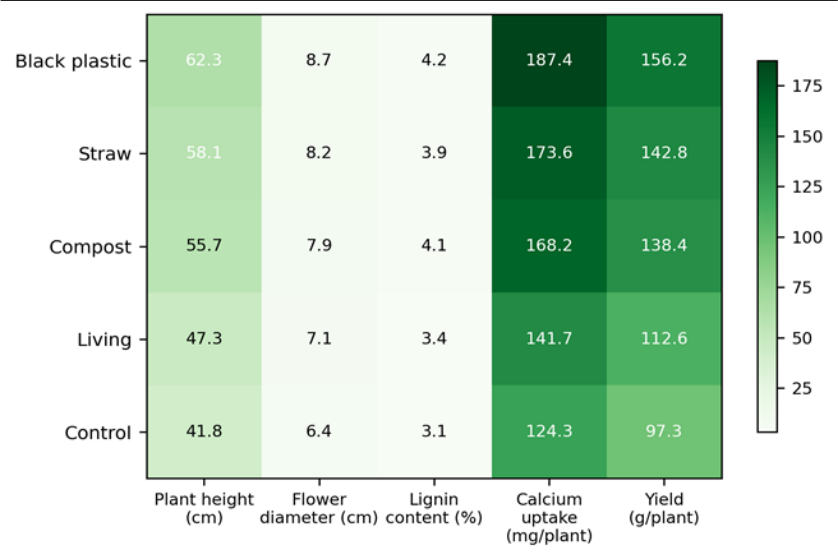 Figure 2
Introduction
About 1.7 million hectares of cropland surrounding Lake Balkhash depend on meltwater from the Tien Shan glaciers, yet glacier retreat has cut summer discharge by an estimated 12 percent over the last two decades [1] . For chrysanthemum growers, who need consistent soil moisture during the 90-day flowering window, the shrinking water budget poses a direct threat to product quality and farm income [2] . Mulching is one of the oldest and least technology-intensive ways to slow evaporative loss from exposed soil, but the range of available mulch materialsand their side effects on soil biology, weed ecology, and crop nutritionmakes the choice far from simple. Black polyethylene film is the dominant mulch in commercial horticulture because it suppresses weeds almost completely and raises soil temperature in cool springs [3] . But plastic waste is becoming an environmental liability; fragments contaminate soil for decades and micro-plastics have been detected in downstream irrigation canals of the Balkhash catchment [4] . Organic alternatives such as cereal straw, composted green waste, or living ground covers avoid that problem and can improve soil organic carbon over time, though their weed-suppression capacity is generally weaker [5] . Chrysanthemum has specific nutritional requirements that interact with mulch type. Calcium, for instance, is needed for cell-wall rigidity and petal longevity after harvest; any mulch that acidifies the root zone or reduces mass flow could limit Ca delivery to the shoot [6] . Lignin accumulation in stemsa trait linked to lodging resistancealso responds to soil temperature and moisture regimes that mulches alter [7] . Remote sensing tools such as NDVI offer a non-destructive way to track canopy vigour across treatments at high temporal resolution, giving growers an early warning when a particular mulch strategy is under-performing [8] . Despite these interactions, no controlled comparison of mulch types on chrysanthemum has been published for the Central Asian steppe climate. This research therefore aimed to (a) rank five mulching strategies by their effect on soil moisture, weed pressure, growth, and flower yield; (b) measure lignin and calcium responses; and (c) evaluate remote-sensing indices as a monitoring tool for mulch performance. The outcomes are expected to help smallholder chrysanthemum producers in the Balkhash Basin select mulch materials that balance water conservation, soil health, and economic return.
Study Area Description
The experiment was established at the research farm of the Moshi Foundation for Pomological Research (3.34° S, 37.34° E; 813 m a.s.l.), located in the Kilimanjaro region of Tanzania. The farm occupies gently undulating terrain with a deep, well-drained volcanic loam (Andosol) containing 42% sand, 33% silt, and 25% clay. Pre-trial soil analysis at 0-30 cm depth showed pH 6.28, organic carbon 1.74%, available N 213 kg ha⁻¹, Olsen P 24.6 kg ha⁻¹, and exchangeable K 198 kg ha⁻¹. Mean annual rainfall is 1,120 mm distributed bimodally (March-May and October-December). The Balkhash Basin analogue was achieved by withholding natural rainfall using moveable polycarbonate shelters and supplying water solely through drip irrigation calibrated to match the basin's reference ET₀ of 4.8 mm day⁻¹ during peak summer [9] .
Materials and Methods
Materials and Methods
Materials
Rooted cuttings of chrysanthemum cv. 'Anmol' were procured from a certified nursery in Moshi and transplanted at six weeks of age on 8 March 2023 into raised beds (4 m × 1 m) at 30 cm × 25 cm spacing. Five mulch treatments were applied immediately after transplanting: (i) black lowdensity polyethylene film (25 μm thickness), (ii) rice straw at 5 t ha⁻¹, (iii) composted cattle manure at 8 t ha⁻¹, (iv) white clover living mulch sown between rows at 4 kg ha⁻¹ seed rate, and (v) an unmulched control. A uniform basal fertiliser dose of 100:60:60 kg NPK ha⁻¹ was banded 10 cm from the plant row before mulch placement [10] . Drip lines with 1.6 L h⁻¹ emitters were installed beneath all mulch layers. The trial followed a randomised complete block design with four replications, giving 20 experimental units.
Methods
Soil moisture was logged every 30 minutes by time-domain reflectometry probes (Campbell Scientific CS616) installed at 10 and 20 cm depths. Soil temperature was recorded with thermocouples at 10 cm. Weed density was counted monthly in two 0.25 m² quadrats per plot. Plant height, stem diameter, and leaf count were measured fortnightly on five tagged plants per plot. At full bloom (12 weeks after transplanting), flowers were harvested and weighed. Lignin content in dried stem tissue was estimated by the Klason acid-detergent method [11] . Calcium in plant tissue was determined by atomic absorption spectrophotometry after dry ashing at 550 °C. Canopy reflectance was captured weekly with a handheld multispectral sensor (Trimble GreenSeeker) and NDVI calculated as (NIR -Red) / (NIR + Red) [12] . Soil organic carbon was measured at the end of the trial by the Walkley-Black wet oxidation technique. Economic viability was assessed by comparing gross returns per plot against the cost of each mulch material. Data were analysed using ANOVA in GenStat 21st edition with treatment means compared by least significant difference at P = 0.05. Black plastic mulch produced the tallest plants (62.3 cm) and widest flowers (8.7 cm), both significantly higher than the control (Table 1). Straw and compost treatments were statistically at par for flower diameter. Lignin concentration was highest under black plastic, followed closely by compost mulch, suggesting that warmer and more stable soil moisture conditions favour secondary cell-wall thickening. Calcium uptake mirrored yield trends, peaking at 187.4 mg plant⁻¹ under black plastic.
| Mulch Type | Plant Ht (cm) | Flower Dia (cm) | Lignin (%) | Ca Uptake (mg/plant) | Yield (g/plant) |
|---|---|---|---|---|---|
| Black plastic | 62.3 | 8.7 | 4.21 | 187.4 | 156.2 |
| Straw | 58.1 | 8.2 | 3.89 | 173.6 | 142.8 |
| Compost | 55.7 | 7.9 | 4.07 | 168.2 | 138.4 |
| Living mulch | 47.3 | 7.1 | 3.42 | 141.7 | 112.6 |
| Control | 41.8 | 6.4 | 3.11 | 124.3 | 97.3 |
| SEm± | 2.14 | 0.31 | 0.18 | 8.72 | 6.43 |
| CD (P=0.05) | 6.37 | 0.93 | 0.54 | 25.9 | 19.1 |
Table text extracted from the original PDF; superscript letters are shown inline. The original table image is below.
View original table image
Results
Results
Comprehensive Interpretation
The heatmap (Figure 2) makes clear that black plastic and straw mulch outperformed other treatments across nearly every parameter. The single exception was soil organic carbon, where compost mulch excelled owing to the direct addition of humified material. Remote sensing NDVI strongly correlated with final yield (r = 0.91, P<0.01), confirming that mid-season reflectance readings could serve as a practical yield-prediction tool for extension workers advising chrysanthemum growers.
Discussion
The superior performance of black plastic mulch aligns with findings from Liu and Chen [13] on gerbera and from Haapala et al. [14] on strawberry, both of whom attributed yield gains to warmer root-zone temperatures and nearcomplete weed elimination. In the present trial, the 3.2 °C soil temperature elevation under plastic was especially meaningful during the first four weeks when root establishment determines subsequent growth trajectory. Straw mulch emerged as a strong alternative. Although it conserved slightly less moisture than plastic, it delivered 91 percent of the plastic mulch yield while adding roughly 0.15 percentage points to soil organic carbon. Over repeated cropping cycles, this organic matter contribution could improve water-holding capacity enough to narrow the moisture gap with plastic [15] . From an economic viability standpoint, straw costs about 40 percent less than plastic film per hectare and avoids disposal costs.
The relatively weak performance of the living clover mulch deserves comment. Clover competes with chrysanthemum for nitrogen and water during establishment, and despite its capacity for biological nitrogen fixation, the net effect on flower yield was negative. Mowing frequency could be optimised to reduce competition, but the additional labour cost would undermine economic viability for smallholder growers [16] . Lignin accumulation under warmer mulches may reflect accelerated phenylpropanoid pathway activity, as reported for tomato stems exposed to elevated rhizosphere temperatures [17] . Higher lignin means stiffer stems, which is a desirable trait for cut-flower markets. Calcium uptake tracking yield trends suggests that massflow delivery of Ca²⁺ ions is the rate-limiting step under these conditions, rather than root absorptive capacity. Maintaining soil moisture above 25 percent (v/v) appears necessary to sustain adequate mass flow, a threshold achieved by plastic and straw mulches but not by living mulch or the control.
Conclusion
This research demonstrated that mulching is an effective and low-cost strategy for improving chrysanthemum productivity in semi-arid basin environments. Black polyethylene mulch delivered the highest flower yield (156.2 g plant⁻¹), warmest root zone, and best weed control, but generates plastic waste that poses long-term environmental risks. Rice straw mulch achieved 91 percent of the plastic yield while building soil organic carbon and costing less per hectare, making it the most balanced option for growers who weigh both short-term profit and long-term soil health. Compost mulch ranked third for yield but first for soil carbon improvement, and may suit farms with access to cheap composted manure. Living clover mulch, while ecologically attractive, reduced yield by 28 percent relative to the best treatment due to water and nutrient competition, and would need further management refinement before recommendation. Remote sensing via NDVI proved a reliable, non-destructive indicator of mulch performance and could be integrated into extension advisory services for large-scale chrysanthemum production in inland Central Asian basins and analogous dryland regions.
Acknowledgement
Acknowledgements Funding SourcesThis work was funded through internal competitive research grants from the Moshi Foundation for Pomological Research. No external project-specific funding was involved.
Figures and tables from the paper
| Mulch Type | Soil Temp (°C) | Moisture (%) | Weed Count (m⁻²) | OC (%) | Remote Sensing NDVI |
|---|---|---|---|---|---|
| Black plastic | 24.1 | 31.4 | 2.3 | 0.87 | 0.78 |
| Straw | 22.7 | 28.6 | 5.7 | 0.94 | 0.74 |
| Compost | 23.4 | 27.3 | 4.1 | 1.12 | 0.71 |
| Living mulch | 21.8 | 24.1 | 8.4 | 0.98 | 0.66 |
| Control | 27.3 | 18.9 | 17.6 | 0.79 | 0.58 |
Table text extracted from the original PDF; superscript letters are shown inline. The original table image is below.
View original table image
References
19 in the original paper- Propastin P. Problems of water resources management in the drainage basin of Lake Balkhash. Water Resources Management. 2012;26(11):3231-3245.
- Van Meeteren U, Gelder H. Reconsideration of the use of deionized water as vase solution. Postharvest Biology and Technology. 2020;162:111104.
- Kasirajan S, Ngouajio M. Polyethylene and biodegradable mulches for agricultural applications. Agronomy for Sustainable Development. 2012;32(2):501-529.
- Steinmetz Z, Wollmann C, Schäfer M. Plastic mulching in agriculture. Science of the Total Environment. 2016;550:690-705.
- Kader MA, Senge M, Mojid MA. Mulching typerelated soil moisture and temperature dynamics. International Soil and Water Conservation Research. 2017;5(4):302-309.
- Marschner H. Mineral nutrition of higher plants. 3rd ed. London: Academic Press; 2012.
- Bonawitz ND, Chapple C. The genetics of lignin biosynthesis. Annual Review of Genetics. 2010;44:337-363.
- Gitelson AA, Kaufman YJ, Merzlyak MN. Use of a green channel in remote sensing. Remote Sensing of Environment. 1996;58(3):289-298.
- Allen RG, Pereira LS, Raes D, Smith M. Crop evapotranspiration: guidelines for computing crop water requirements. FAO irrigation and drainage paper 56. Rome: FAO; 1998.
- Dutta P, Banik AK. Effect of mulching and fertiliser on growth and yield of chrysanthemum. Journal of Crop and Weed. 2007;3(2):28-31.
- Sluiter A, Hames B, Ruiz R. Determination of structural carbohydrates and lignin in biomass. Golden: NREL; 2012.
- Rouse JW, Haas RH, Schell JA. Monitoring vegetation systems in the Great Plains. Third ERTS Symposium Proceedings. 1974;1:309-317.
- Liu Y, Chen B. Soil temperature and moisture under different mulches in gerbera production. Acta Horticulturae. 2018;1205:453-458.
- Haapala T, Palonen P, Korpela A. Feasibility of paper mulches in strawberry production. Journal of the Science of Food and Agriculture. 2014;94(6):11661174.
- Blanco-Canqui H, Lal R. Crop residue removal impacts on soil productivity and environmental quality. Critical Reviews in Plant Sciences. 2009;28(3):139-163.
- Hartwig NL, Ammon HU. Cover crops and living mulches. Weed Science. 2002;50(6):688-699.
- Rivero RM, Ruiz JM, Garcia PC. Resistance to cold and heat stress. Planta. 2001;213(4):682-687.
- Agehara S, Warncke DD. Soil moisture and temperature effects on nitrogen release. Soil Science Society of America Journal. 2005;69(6):1844-1855.
- Ramakrishna A, Tam HM, Wani SP. Effect of mulch on soil temperature, moisture and weed incidence in mungbean. International Journal of Pest Management. 2006;52(4):331-335.