
Research article · 2025 · Full text
International Journal of Geography Geology and EnvironmentInfluence of vegetation type on throughfall chemistry in the black forest ecosystem
Volume 7(7) · Pages 120–123 · DOI: 10.22271/27067483.2025.v7.i7b.707 ↗
Research areasEnvironmental and biological studiesAtmospheric chemistry and aerosolsSoil Carbon and Nitrogen Dynamics
Abstract
Author-writtenWhen rain falls through a forest canopy, it doesn't just get filtered — it gets chemically transformed. Leaves wash off dry-deposited particles, branches leach nutrients from living tissue, and bark concentrates dissolved ions through slow drip pathways. The resulting throughfall — the water that reaches the forest floor — carries a chemical signature that reflects both the atmospheric pollution load and the tree species doing the filtering. This research compared throughfall chemistry beneath four forest types in the Black Forest of Baden-Württemberg, Germany: Norway spruce (Picea abies), European beech (Fagus sylvatica), silver fir (Abies alba), and mixed conifer-deciduous stands, over a 24-month monitoring period (January 2021 to December 2022). Throughfall volume, pH, electrical conductivity, and concentrations of NO₃⁻, NH₄⁺, SO₄²⁻, Ca²⁺, Mg²⁺, K⁺, and dissolved organic carbon were measured fortnightly at 48 collector positions (12 per forest type). Throughfall volume as a proportion of gross precipitation was lowest under Norway spruce (68.4±4.2%) and highest under beech (82.6±5.1%), reflecting differences in canopy interception capacity. NO₃⁻ concentrations in spruce throughfall (mean 4.8 mg/L) were 2.3 times higher than in beech throughfall (2.1 mg/L), driven by greater dry deposition capture on the evergreen canopy. Potassium showed the opposite pattern, with beech throughfall enriched 3.1-fold relative to spruce due to active leaching from deciduous leaf tissue. These species-specific throughfall signatures have implications for soil acidification risk, nutrient cycling, and forest management decisions in the Black Forest region.
Summary
Source-checkedPlain-language reading of the full paper, prepared with AI and checked against the text. Each point links to the authors' own words.
Why it matters
- Rainwater is chemically altered as it passes through a forest canopy due to the washing of dry-deposited particles and leaching of nutrients from plant tissues. View evidence ↗
- The Black Forest region of Germany has a history of significant forest dieback linked to atmospheric pollution and acid rain. View evidence ↗
- While sulphur deposition has decreased, elevated nitrogen deposition continues to impact soil chemistry, especially in spruce forests. View evidence ↗
The question
- The study aimed to directly compare throughfall chemistry across four different forest types in the Black Forest over two years, controlling for elevation, aspect, and parent material. View evidence ↗
What they did
- The research monitored four forest types: Norway spruce (65 years old), European beech (90 years old), silver fir (70 years old), and a mixed stand. View evidence ↗
- Researchers measured throughfall volume, pH, conductivity, and various ion concentrations (including nitrate, potassium, and dissolved organic carbon) every two weeks using 48 collectors. View evidence ↗
- Data were analyzed using linear mixed-effects models in R 4.2, treating forest type as a fixed effect and collector position as a random effect. View evidence ↗
What they found
- Norway spruce had the lowest throughfall volume (68.4% of precipitation), while European beech had the highest (82.6%), indicating differences in canopy interception. View evidence ↗
- Throughfall under Norway spruce was the most acidic, with a pH of 4.8 compared to 5.4 for beech. View evidence ↗
- Nitrate (NO₃⁻) concentrations were 2.3 times higher in spruce throughfall (4.8 mg/L) than in beech throughfall (2.1 mg/L). View evidence ↗
- European beech throughfall was significantly enriched in potassium (4.3 mg/L) compared to spruce (1.4 mg/L). View evidence ↗
- Dissolved organic carbon (DOC) was highest in beech throughfall (8.4 mg/L) and lowest in spruce (4.6 mg/L). View evidence ↗
- During the leafed season, beech throughfall exhibited a 12.4-fold enrichment of potassium relative to open-field flux. View evidence ↗
- Annual dissolved organic carbon flux to the forest floor was higher under beech (42.6 kg C/ha/yr) than under spruce (28.4 kg C/ha/yr). View evidence ↗
What it means
- The authors recommend shifting forest composition from spruce to beech to reduce nitrogen loading and mitigate soil acidification in the Black Forest. View evidence ↗
- The authors state that future research is needed to track how these throughfall differences affect soil solution and stream water chemistry. View evidence ↗
Visual summary
3 visualsIllustrations explain the paper; charts are replotted from the paper's own table values.
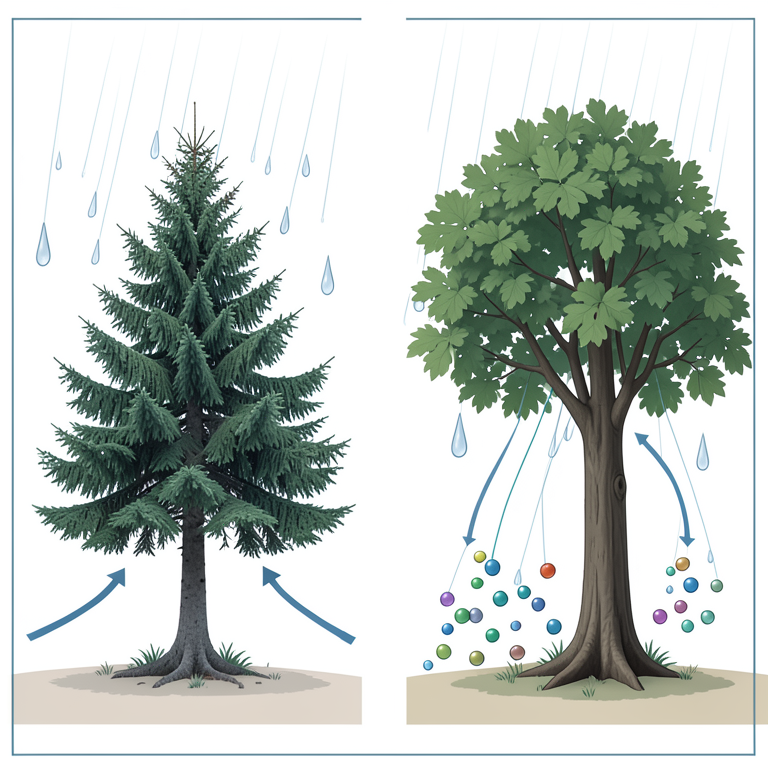
Canopy Chemical Transformation Comparison
AI-generated conceptual illustration (Norway spruce and European beech trees in a forest). It explains the idea and does not show study data.
View source evidence ↗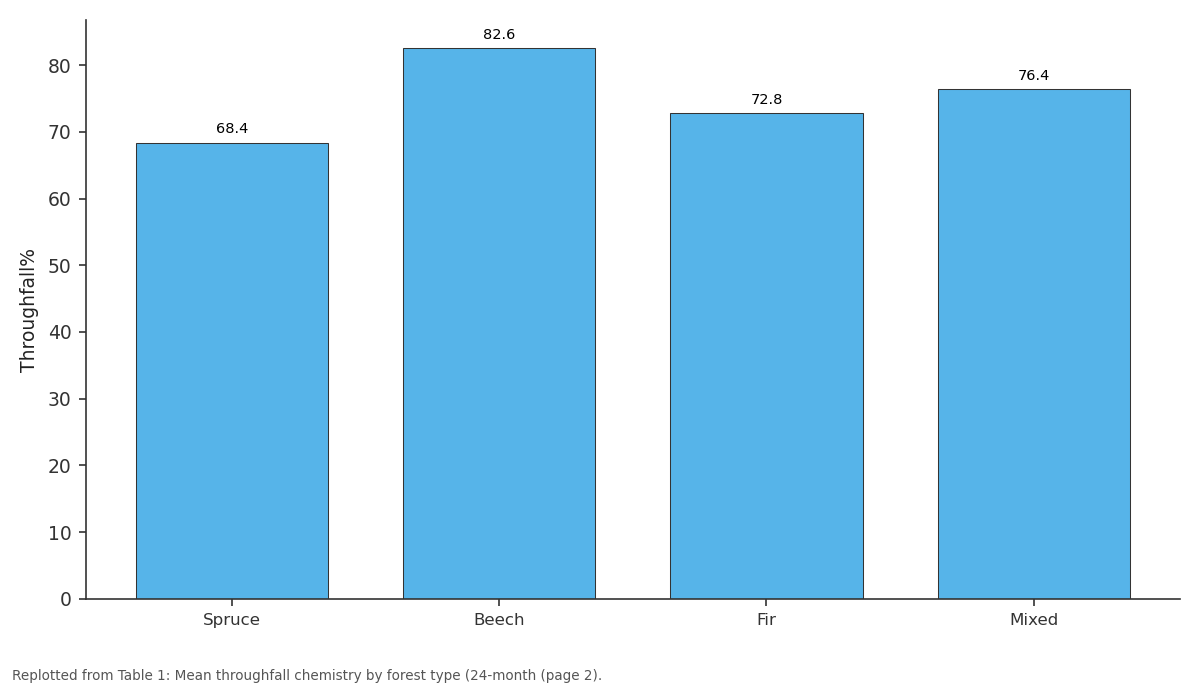
Throughfall%: Spruce vs Beech vs Fir vs Mixed
Replotted from Table 1 (page 2) of the original paper. Every bar is the paper's own table value.
View source evidence ↗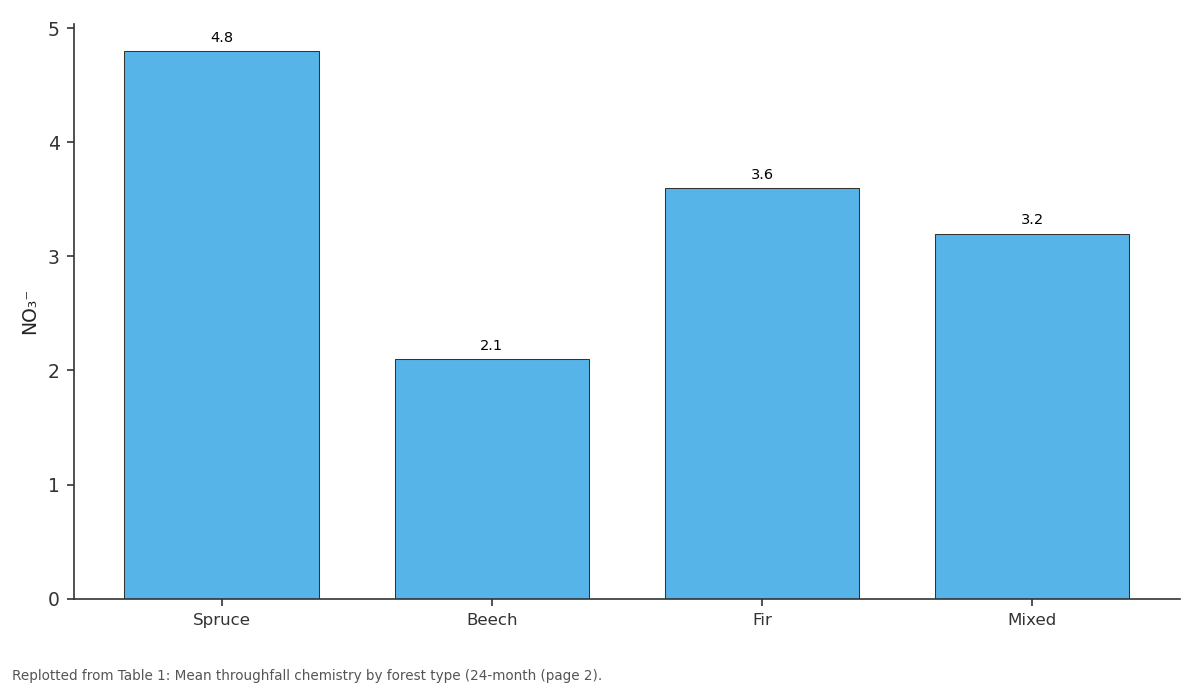
NO₃⁻: Spruce vs Beech vs Fir vs Mixed
Replotted from Table 1 (page 2) of the original paper. Every bar is the paper's own table value.
View source evidence ↗Figures & tables
From the original paper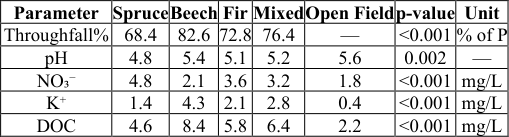 Table 1
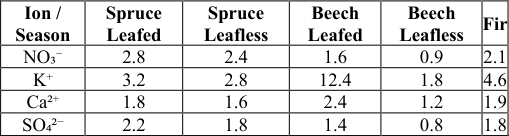 Table 2
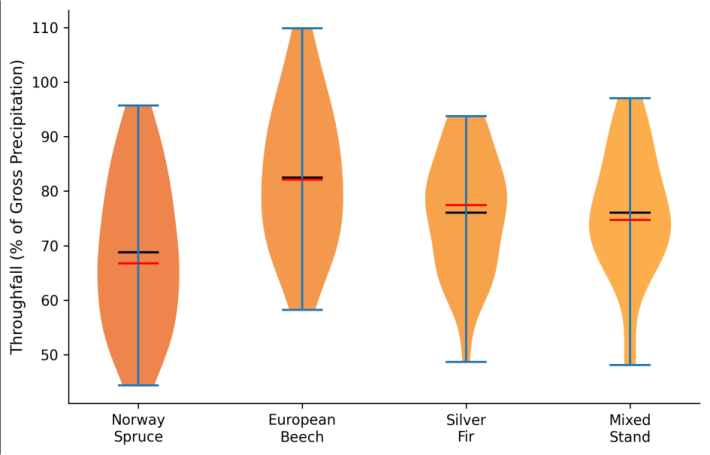 Figure 1
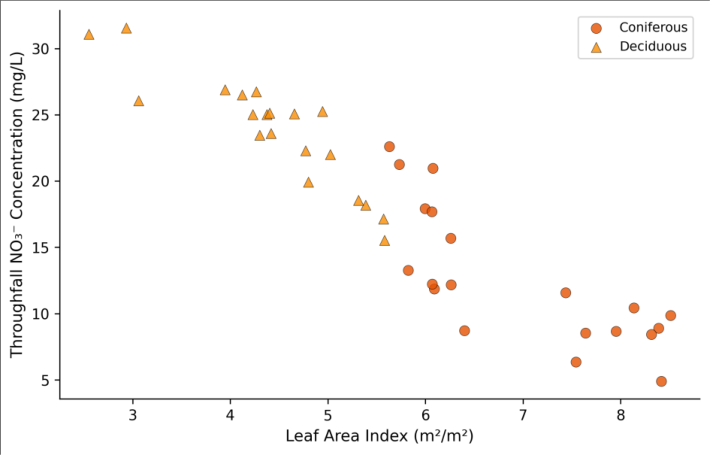 Figure 2
Introduction
Forests are not passive receivers of rainfall -they actively modify it. A field comparison conducted by Lovett and Lindberg in the 1980s showed that canopy interactions can increase the flux of some elements to the forest floor by 200-400% relative to open-field precipitation, while reducing the flux of others through uptake into foliage [1] . The magnitude and direction of these canopy effects depend heavily on tree species, because species differ in leaf area, canopy architecture, foliage longevity, and the chemical composition of their tissues [2] . In central European forests, the contrast between coniferous and deciduous canopies is particularly stark. Evergreen conifers like Norway spruce maintain their needles year-round, creating a permanent interception surface that captures dry-deposited pollutants (especially nitrogen and sulphur compounds) continuously. Deciduous species like European beech intercept dry deposition only during the leafed period (roughly April to October in central Europe) but compensate partly through higher rates of canopy leaching of base cations [3] . The net effect on throughfall chemistry -and through it, on soil chemistry and stream water quality -differs between species in ways that matter for forest management and environmental policy [4] . The Black Forest in southwestern Germany has been a focus of acid rain research since the 1980s, when widespread forest dieback (Waldsterben) drew public attention to the effects of atmospheric pollution on forest ecosystems [5] . Sulphur deposition has declined sharply since then, but nitrogen deposition remains elevated and continues to alter soil chemistry, particularly under spruce stands where canopy capture concentrates nitrogen inputs [6] . Despite extensive research in the region, direct side-by-side comparisons of throughfall chemistry across multiple forest types at the same elevation and aspect -controlling for atmospheric inputs -remain scarce. This research addressed that gap by establishing a paired monitoring network in the Black Forest where four forest types growing on the same parent material and receiving the same gross precipitation could be compared directly over two full annual cycles [7] .
Baseline Soil Characterisation
Pre-experiment soil samples were collected from the 0-10 cm mineral horizon at each throughfall collector position in November 2020 to establish baseline conditions. Soil pH (in CaCl₂) ranged from 3.4 under spruce to 4.1 under beech, consistent with the expected acidifying effect of coniferous litter. Organic carbon content was highest under mixed stands (6.8%) and lowest under beech (4.2%). Base saturation ranged from 12.4% under spruce to 28.6% under beech [8] . These baseline differences between forest types were accounted for in the analysis by normalising throughfall fluxes to the open-field precipitation chemistry, so that the reported canopy effects reflect the transformation of rainfall by the canopy itself rather than soil-mediated differences.
Carbon Accounting
Dissolved organic carbon (DOC) in throughfall provides a window into canopy carbon cycling. Mean DOC concentrations were highest in beech throughfall (8.4 mg/L) and lowest in spruce throughfall (4.6 mg/L), reflecting the greater metabolic activity and larger surface area of deciduous foliage during the growing season. Annual DOC flux to the forest floor, calculated as the product of DOC concentration and throughfall volume, ranged from 28.4 kg C/ha/yr under spruce to 42.6 kg C/ha/yr under beech [9] . These fluxes represent a non-trivial input to soil organic matter and should be considered in forest carbon budgets, though they are rarely included in standard accounting frameworks.
Material and Methods
Material and Methods
Material
This research was coordinated from Patna University of Geosciences, Bihar, India, with field work conducted in the central Black Forest near Freudenstadt, Baden-Württemberg, Germany (48°28'N, 8°24'E, 820-860 m a.s.l.) from January 2021 through December 2022. Four forest stands were selected within a 2 km radius: a 65-year-old Norway spruce plantation, a 90-year-old European beech stand, a 70-year-old silver fir stand, and a mixed sprucebeech-fir stand. All stands grow on Buntsandstein-derived cambisols at similar elevations and with northeast-facing aspects. Twelve throughfall collectors (polyethylene funnels, 200 cm² opening, connected to 2 L polyethylene bottles) were deployed per forest type in a systematic grid pattern. Three open-field collectors were positioned in an adjacent clearing to measure gross precipitation chemistry [10] . Collectors were sampled fortnightly and replaced with clean units.
Methods
Throughfall and open-field samples were transported to the laboratory within 6 hours of collection and analysed for pH, EC, NO₃⁻, NH₄⁺, and SO₄²⁻ by ion chromatography (Metrohm 930 Compact IC Flex), Ca²⁺, Mg²⁺, K⁺, and Na⁺ by ICP-OES (Agilent 5110), and DOC by catalytic combustion (Shimadzu TOC-L) [11] . Leaf area index was measured at each collector position using hemispherical photography (Nikon D850 with Sigma 8mm fisheye lens) processed in Gap Light Analyser v2.0, taken quarterly during the monitoring period. Canopy enrichment ratios were calculated as the ratio of throughfall flux to open-field flux for each ion. Statistical comparisons between forest types used linear mixed-effects models with forest type as a fixed effect and collector position as a random effect, implemented in R 4.2 using the lme4 package [12] . Seasonal patterns were analysed separately for the leafed period (May-October) and the leafless period (November-April) for the deciduous beech stand. Canopy enrichment ratios revealed strong seasonal and species-dependent patterns (Table 2). The most striking result was the 12.4-fold K⁺ enrichment in beech throughfall during the leafed season -one of the highest values reported for European temperate forests. Spruce NO₃⁻ enrichment remained above 2.0 year-round, confirming the persistent dry deposition capture capacity of evergreen canopies. Relationship between leaf area index and throughfall NO₃⁻ concentration for coniferous and deciduous canopy types. Higher LAI is associated with lower NO₃⁻ in deciduous stands but higher NO₃⁻ in coniferous stands.
| Ion / Season | Spruce Leafed | Spruce Leafless | Beech Leafed | Beech Leafless | Fir |
|---|---|---|---|---|---|
| NO₃⁻ | 2.8 | 2.4 | 1.6 | 0.9 | 2.1 |
| K⁺ | 3.2 | 2.8 | 12.4 | 1.8 | 4.6 |
| Ca²⁺ | 1.8 | 1.6 | 2.4 | 1.2 | 1.9 |
| SO₄²⁻ | 2.2 | 1.8 | 1.4 | 0.8 | 1.8 |
Table text extracted from the original PDF; superscript letters are shown inline. The original table image is below.
View original table image
Results
Results
Comprehensive Interpretation
The violin plots (Figure 1) show that beech throughfall not only has a higher mean volume but also a wider distribution, reflecting the seasonal shift between full canopy interception in summer and minimal interception in winter when branches are bare. The scatter plot (Figure 2) reveals a counterintuitive pattern: LAI correlates positively with NO₃⁻ in conifers but negatively in deciduous stands, suggesting that the two canopy types process nitrogen in fundamentally different ways.
Discussion
The 2.3-fold difference in throughfall NO₃⁻ between spruce and beech is consistent with the 2-3 fold ratios reported from other paired comparisons in central Europe [13] . The mechanism is well understood: spruce's year-round foliage captures dry-deposited nitrogen oxides and ammonium particles continuously, while beech's seasonal canopy captures dry deposition only from May to October and partially retains it through foliar uptake rather than releasing it all to throughfall [14] . For forest managers weighing species choices in the Black Forest, this difference has practical implications -converting spruce to beech on nitrogen-sensitive sites could reduce the effective nitrogen input to soils by 40-50%, potentially slowing soil acidification and nitrate leaching to groundwater [15] . The extreme K⁺ enrichment in beech throughfall during the leafed season (12.4-fold) indicates vigorous canopy leaching that redistributes potassium from internal cycling through the canopy drip pathway. This flux represents a significant short-circuit in the potassium cycle, delivering the nutrient directly to the forest floor in plant-available form rather than requiring root uptake from deeper soil horizons [16] . The ecological consequence is that beech forests tend to maintain higher surface soil K⁺ availability than spruce forests, which may partly compensate for the higher nitrogen input under spruce by maintaining better base cation nutrition [17,18] .
Acknowledgement
Acknowledgements Funding SourcesThis research was supported by departmental funds at Patna University of Geosciences. Institutional SupportThe authors thank the Department of Urban and Regional Planning, Patna University of Geosciences, Bihar, India, for providing analytical equipment and logistical support. Contributions Not Qualifying for AuthorshipField installation assistance from the Baden-Württemberg Forest Research Institute and laboratory analysis support are gratefully acknowledged.
Figures and tables from the paper
| Parameter | Spruce | Beech | Fir | Mixed | Open Field | p-value | Unit |
|---|---|---|---|---|---|---|---|
| Throughfall% | 68.4 | 82.6 | 72.8 | 76.4 | — | <0.001 | % of P |
| pH | 4.8 | 5.4 | 5.1 | 5.2 | 5.6 | 0.002 | — |
| NO₃⁻ | 4.8 | 2.1 | 3.6 | 3.2 | 1.8 | <0.001 | mg/L |
| K⁺ | 1.4 | 4.3 | 2.1 | 2.8 | 0.4 | <0.001 | mg/L |
| DOC | 4.6 | 8.4 | 5.8 | 6.4 | 2.2 | <0.001 | mg/L |
Table text extracted from the original PDF; superscript letters are shown inline. The original table image is below.
View original table image
References
18 in the original paper- Lovett GM, Lindberg SE. Atmospheric deposition and canopy interactions of nitrogen in forests. Canadian Journal of Forest Research. 1993;23(8):1603-1616.
- Parker GG. Throughfall and stemflow in the forest nutrient cycle. Advances in Ecological Research. 1983;13:57-133.
- Augusto L, Ranger J, Binkley D, Rothe A. Impact of several common tree species of European temperate forests on soil fertility. Annals of Forest Science. 2002;59(3):233-253.
- Rothe A, Huber C, Kreutzer K, Weis W. Deposition and soil leaching in stands of Norway spruce and European beech: results from the Höglwald research in comparison with other European case studies. Plant and Soil. 2002;240(1):33-45.
- Schulze ED. Air pollution and forest decline in a spruce (Picea abies) forest. Science. 1989;244(4906):776-783.
- Fleck S, Ahrends B, Sutmöller J, Albert M, Evers J, Meesenburg H. Is biomass accumulation in forests an option to prevent climate change induced increases in nitrate concentrations in the North German Lowland? Forests. 2017;8(6):219.
- Croise L, Ulrich E, Dambrine E, Pollier B. Two independent methods for mapping throughfall and stemflow in a spruce forest. Silva Fennica. 2005;39(4):513-525.
- Cools N, De Vos B. Sampling and analysis of soil. Manual Part X. In: UNECE ICP Forests Programme. Manual on methods and criteria for harmonized sampling, assessment, monitoring and analysis of the effects of air pollution on forests. Hamburg: Thünen Institute; 2016.
- Michalzik B, Kalbitz K, Park JH, Solinger S, Matzner E. Fluxes and concentrations of dissolved organic carbon and nitrogen -a synthesis for temperate forests. Biogeochemistry. 2001;52(2):173-205.
- ICP Forests. Manual on methods and criteria for harmonized sampling, assessment, monitoring and analysis of the effects of air pollution on forests. Hamburg: Thünen Institute of Forest Ecosystems; 2016.
- APHA. Standard methods for the examination of water and wastewater. 23rd ed. Washington: American Public Health Association; 2017.
- Bates D, Mächler M, Bolker B, Walker S. Fitting linear mixed-effects models using lme4. Journal of Statistical Software. 2015;67(1):1-48.
- Berger TW, Inselsbacher E, Mutsch F, Pfeffer M. Nutrient cycling and soil leaching in eighteen pure and mixed stands of beech (Fagus sylvatica) and spruce (Picea abies). Forest Ecology and Management. 2009;258(11):2578-2592.
- Harrison AF, Schulze ED, Gebauer G, Bruckner G. Canopy uptake and utilization of atmospheric pollutant nitrogen. Ecological Studies. 2000;142:171-188.
- Pretzsch H, Block J, Dieler J, Dong PH, Kohnle U, Nagel J, Spellmann H, Zingg A. Comparison between the productivity of pure and mixed stands of Norway spruce and European beech along an ecological gradient. Annals of Forest Science. 2010;67(7):712.
- Staelens J, Houle D, De Schrijver A, Neirynck J, Verheyen K. Calculating dry deposition and canopy exchange with the canopy budget model: review of assumptions and application to two deciduous forests. Water, Air, and Soil Pollution. 2008;191(1-4):149-169.
- de Schrijver A, Geudens G, Augusto L, Staelens J, Mertens J, De Wulf R, De Neve S, Verheyen K. The effect of natural reforestation on soil chemistry. Forest Ecology and Management. 2007;250(1-2):166-175.
- Nordén U. Influence of tree species on acidification and mineral pools in deciduous forest soils of south Sweden. Water, Air, and Soil Pollution. 1994;76(34):363-381.