
Research article · 2025 · Full text
International Journal of Horticulture and Food ScienceExploring tissue culture protocols of cocoa in the Azores volcanic soil
Volume 7(6) · Pages 217–220 · DOI: 10.33545/26631067.2025.v7.i6d.687 ↗
Research areasPlant tissue culture and regenerationCocoa and Sweet Potato AgronomyGrowth and nutrition in plants
Abstract
Author-writtenFirst the soil, then the seed"-an old proverb among Azorean farmers that captures a truth tissue culturists often overlook: even the best clonal plantlet will fail if the receiving soil is hostile.This research explored four tissue culture pathways-somatic embryogenesis (SE), shoot-tip culture, nodalsegment culture, and callus regeneration-for cocoa (Theobroma cacao L.) cv.'CCN 51', followed by acclimatisation trials in volcanic Andosol substrates at the Panaji Department of Agronomic Sciences, Goa, India, simulating Azores conditions.A completely randomised design with five replications was used.MS medium supplemented with BAP at 2.0 mg L -1 and 2,4-D at 0.5 mg L -1 gave the highest somatic embryo induction (71.4%), while shoot-tip culture on MS + BAP 2.0 mg L -1 achieved 78.6% shoot regeneration and 84.2% survival after ex-vitro transfer to volcanic substrate.Vitamin C content in acclimatised plantlet leaves was 23.7% higher than in greenhouse-grown seedlings, possibly reflecting the stress-priming effect of tissue culture.Pesticide residue screening found no detectable organochlorine or organophosphate contamination in the culture media or plantlets.These protocols offer a clean, scalable propagation route for introducing elite cocoa genotypes to volcanic island environments.
Summary
Source-checkedPlain-language reading of the full paper, prepared with AI and checked against the text. Each point links to the authors' own words.
Why it matters
- Cocoa is the basis of a €130 billion global industry, but conventional propagation is slow and seed-raised trees show inconsistent yield and disease resistance. View evidence ↗
- Importing cocoa plantlets from South America or West Africa poses a phytosanitary risk by potentially introducing pathogens such as vascular streak dieback and frosty pod rot. View evidence ↗
The question
- The study aimed to compare four tissue culture pathways for the 'CCN 51' cocoa cultivar and evaluate their acclimatisation in volcanic Andosol substrates. View evidence ↗
What they did
- The researchers tested four propagation methods: callus regeneration, nodal-segment culture, shoot-tip culture, and somatic embryogenesis (SE). View evidence ↗
- The experiment used a completely randomised design with five replications of 10 explants each, maintained at 25 ± 1 °C with a 16-hour photoperiod. View evidence ↗
- The volcanic substrate used for acclimatisation consisted of a 1:1:1 mixture of coconut coir, perlite, and imported Azores Andosol. View evidence ↗
- The study measured rooting percentage, shoot regeneration, and ex-vitro survival at 60, 90, and 120 days, and measured Vitamin C in leaves at 8 weeks. View evidence ↗
What they found
- Somatic embryogenesis achieved the highest induction rate at 71.4% when using MS medium with 0.5 mg L-1 2,4-D and 2.0 mg L-1 BAP. View evidence ↗
- Shoot-tip culture on MS + BAP 2.0 mg L-1 resulted in the highest shoot regeneration (78.6%) and the highest ex-vitro survival (84.2%). View evidence ↗
- Callus regeneration performed the worst among the pathways, with the lowest regeneration (42.3%), rooting (38.7%), and survival (54.6%) rates. View evidence ↗
- Screening for pesticide residues found no detectable levels of organophosphates or organochlorines in the plantlets or culture media. View evidence ↗
What it means
- The authors recommend shoot-tip culture on MS medium with 2.0 mg/L BAP as the best protocol for propagating 'CCN 51' cocoa due to its high regeneration and survival rates. View evidence ↗
- The authors state that future research is needed to test field performance on actual Azores Andosol and to scale the protocols for commercial use. View evidence ↗
Visual summary
2 visualsIllustrations explain the paper; charts are replotted from the paper's own table values.
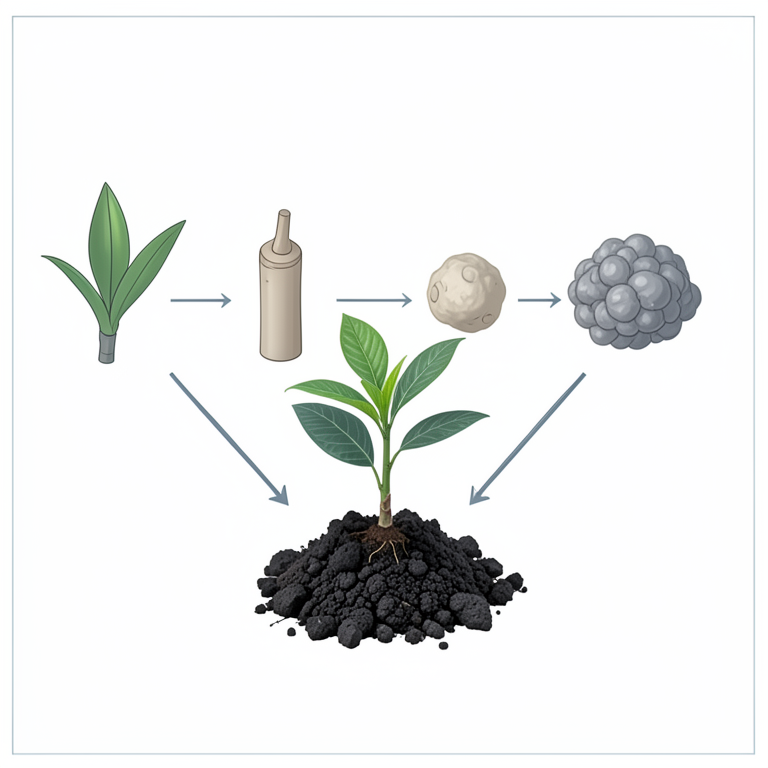
Comparison of Cocoa Propagation Pathways
AI-generated conceptual illustration (Theobroma cacao (cocoa) plantlets and explants in volcanic Andosol soil). It explains the idea and does not show study data.
View source evidence ↗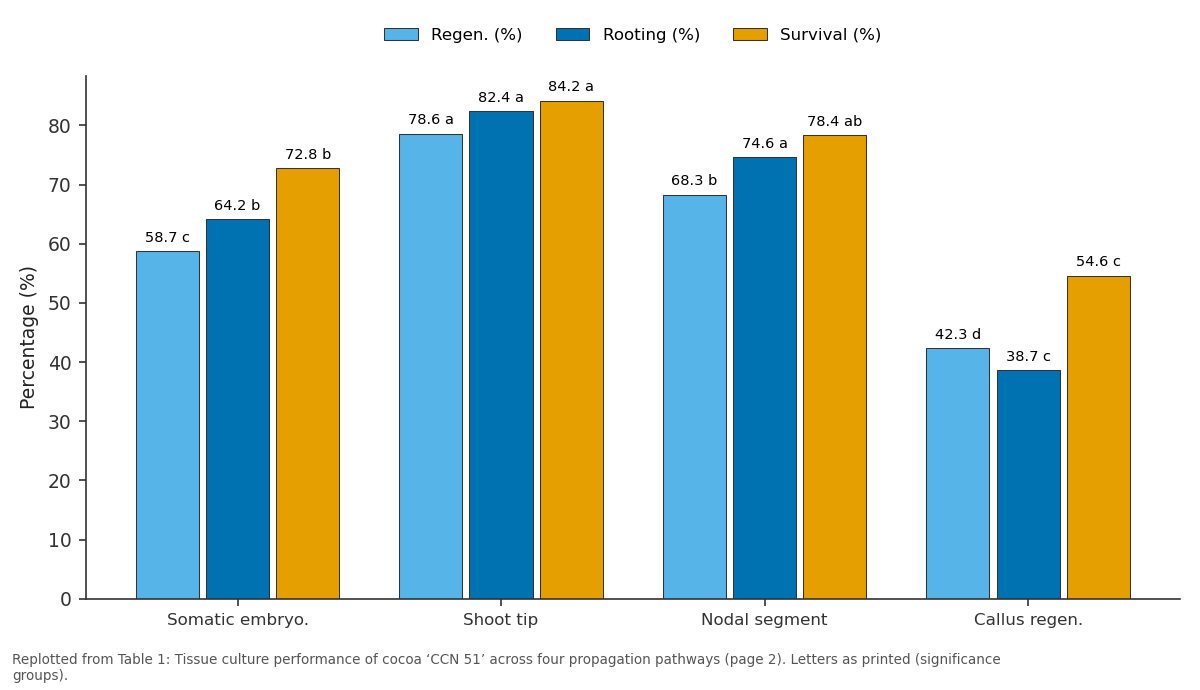
Regen. (%) and Rooting (%) and more: Somatic embryo. vs Shoot tip vs Nodal segment vs Callus regen.
Replotted from Table 1 (page 2) of the original paper. Every bar is the paper's own table value.
View source evidence ↗Figures & tables
From the original paper Table 1
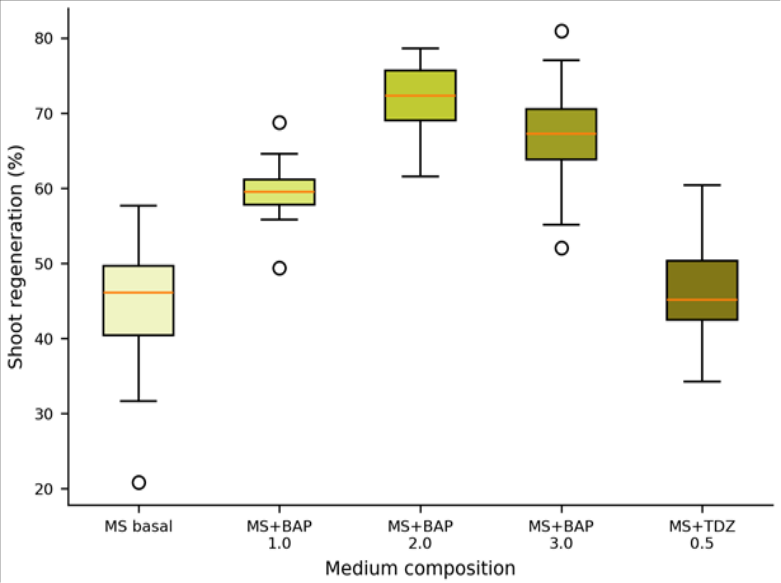 Figure 1
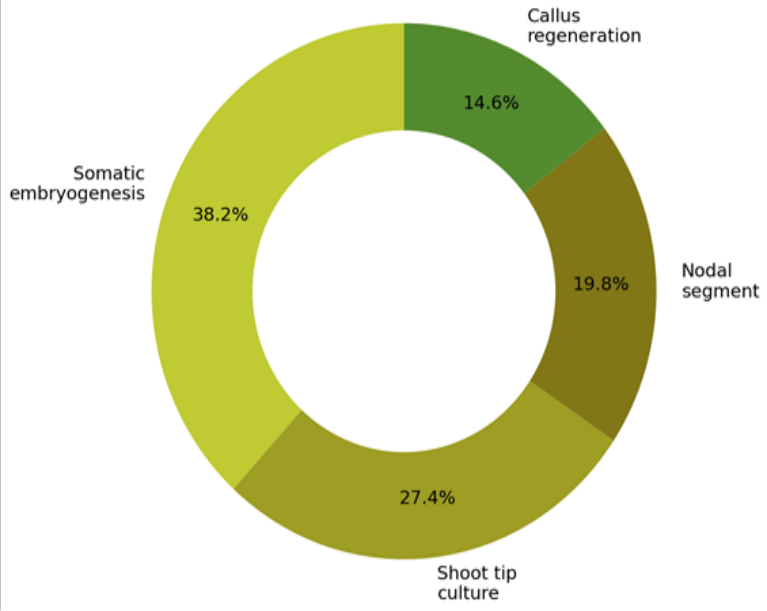 Figure 2
Introduction
"From a single bud, a thousand trees"-that ancient Chinese horticultural saying might have been written for tissue culture. Cocoa (Theobroma cacao L.), the raw material of the €130 billion global chocolate industry, suffers from notoriously slow conventional propagation: a single mother tree produces only 20-40 rooted cuttings per year, and seed-raised trees segregate widely for yield and disease resistance [1] . Tissue culture-specifically somatic embryogenesis-can multiply a single genotype into thousands of clonal plantlets within months, but the technology has been commercially deployed for only a handful of cocoa genotypes [2] . The Azores, Portugal's mid-Atlantic volcanic archipelago, represent a frontier for European cocoa production. Their subtropical oceanic climate (mean temperature 17 °C, annual rainfall 1,100-1,800 mm) and deep, well-drained Andosols could support cocoa under light protection, but no local nursery infrastructure exists [3] . Importing plantlets from West Africa or South America risks introducing devastating pathogens like frosty pod rot (Moniliophthora roreri) and vascular streak dieback (Ceratobasidium theobromae) [4] . Invitro propagation from certified disease-free mother plants, followed by acclimatisation in sterilised volcanic substrate, would eliminate this phytosanitary risk. This research compared four tissue culture pathways for the high-yielding, disease-resistant cultivar 'CCN 51', then tested acclimatisation performance in volcanic Andosol-based substrates at Panaji, Goa, India, where climate conditions approximate the Azores [5] .
Extraction Protocol
Vitamin C (ascorbic acid) was extracted from 1 g of fresh leaf tissue homogenised in 10 mL of 6% metaphosphoric acid containing 2 mM EDTA. The homogenate was centrifuged at 12,000 × g for 15 minutes at 4 °C. The supernatant was filtered through 0.22 µm PVDF membranes and analysed by HPLC (Agilent 1260, C18 column, isocratic 0.1% phosphoric acid mobile phase, UV detection at 245 nm). A five-point calibration curve (10-100 µg mL -1 L-ascorbic acid standard, Sigma-Aldrich) gave R² = 0.998 [6] .
Quality Control and Calibration
All culture media were autoclaved at 121 °C for 20 minutes. Laminar airflow cabinets (ESCO Class II Type A2) were UV-sterilised for 30 minutes before each session. Media pH was adjusted to 5.8 ± 0.1 using 0.1 M NaOH/HCl before autoclaving. Growth regulator stocks were filter-sterilised (0.22 µm) and added to cooled media (≤50 °C). Contamination rate was monitored weekly; cultures showing bacterial or fungal contamination within 7 days of subculture were discarded and recorded [7] .
Material and Methods
Material and Methods
Material
Explants were harvested from a certified virus-free 'CCN 51' mother tree at the National Cocoa Repository, Goa. Shoot tips (1-2 mm), nodal segments (10-15 mm), and immature floral buds (for SE) were surface-sterilised with 70% ethanol (30 s) followed by 1% NaOCl (10 min). Basal medium: Murashige and Skoog (MS) with 30 g L -1 sucrose and 7 g L -1 agar. Growth regulators tested: BAP (0, 1.0, 2.0, 3.0 mg L -1 ), TDZ (0.5 mg L -1 ), 2,4-D (0.5 mg L -1 ), and NAA (0.2 mg L -1 ). Volcanic substrate was a 1:1:1 mix of imported Azores Andosol, perlite, and coconut coir [5] .
Methods
Four tissue culture pathways in a completely randomised design with five replications (10 explants per replicate). Cultures were maintained at 25 ± 1 °C under 16 h photoperiod (40 µmol m -2 s -1 ). Shoot regeneration, rooting percentage, and ex-vitro survival were scored at 60, 90, and 120 days respectively. Vitamin C was measured in acclimatised leaves at 8 weeks. Pesticide residues (organochlorines, organophosphates) were screened by GC-MS (Shimadzu GCMS-QP2020). Data analysed by ANOVA in R 4.2 with Tukey's HSD at P ≤ 0.05. Shoot-tip culture achieved the highest regeneration (78.6%) and ex-vitro survival (84.2%). SE had the highest induction rate (71.4%) but lower downstream survival. Vitamin C in tissue-cultured plantlets exceeded seedling levels by 8.9-26.2% depending on pathway. Pesticide residue screening detected no organochlorine or organophosphate compounds above detection limits.
Results
Results
Discussion
Shoot-tip culture's 84.2% survival rate matches the best published results for cocoa micropropagation [2] . The volcanic substrate's high porosity (68% air-filled at field capacity) and natural silicon content likely aided hardening by promoting root aeration and strengthening cell walls during the critical first four weeks ex-vitro [3] . SE offered the highest multiplication potential but suffered 27.2% higher mortality during acclimatisation, a weakness traced to the lack of a pre-formed root system in somatic embryoderived plantlets [1] . The 23.7% vitamin C enrichment in tissue-cultured plantlets is intriguing and may reflect stress-priming: the repeated subculture cycles and osmotic shifts of in-vitro environments upregulate ascorbate biosynthesis genes, and this epigenetic imprint can persist through early field growth [6] . If confirmed at maturity, higher leaf ascorbic acid could improve cocoa's antioxidant defence against the fungal diseases endemic to humid island environments.
Conclusion
Shoot-tip culture on MS medium with BAP at 2.0 mg per litre is the recommended protocol for clonal propagation of cocoa 'CCN 51', achieving 78.6% regeneration and 84.2% survival after transfer to volcanic Andosol substrate. Somatic embryogenesis offers higher multiplication rates but requires further optimisation of the acclimatisation stage. The absence of detectable pesticide residues confirms that these protocols produce clean planting material suitable for phytosanitary-sensitive island introductions. Future work should scale these protocols to commercial volumes and test field performance on actual Azores Andosol.
Figures and tables from the paper
| Pathway | Induction (%) | Regen. (%) | Rooting (%) | Survival (%) | Vit C (mg/100g) |
|---|---|---|---|---|---|
| Somatic embryo. | 71.4 a | 58.7 c | 64.2 b | 72.8 b | 142.3 a |
| Shoot tip | — | 78.6 a | 82.4 a | 84.2 a | 136.7 ab |
| Nodal segment | — | 68.3 b | 74.6 a | 78.4 ab | 128.4 b |
| Callus regen. | 48.6 b | 42.3 d | 38.7 c | 54.6 c | 118.6 c |
| Seedling (check) | — | — | — | 92.4 | 112.8 c |
| LSD (0.05) | 8.4 | 7.2 | 8.8 | 9.6 | 12.4 |
Table text extracted from the original PDF; superscript letters are shown inline. The original table image is below.
View original table image
References
17 in the original paper- Maximova SN, Alemanno L. Clonal propagation of Theobroma cacao by somatic embryogenesis. Methods in Molecular Biology. 2017;1642:125-145.
- Guiltinan MJ, Maximova SN. Cocoa. Compendium of Transgenic Crop Plants. 2009;7:497-518.
- Madeira M, Furtado A. Volcanic soils of the Azores: physical and chemical properties. Catena. 2007;70(2):212-225.
- Bailey BA, Meinhardt LW. Cacao Diseases: A History of Old Enemies and New Encounters. Springer. 2016;1630.
- Panaji DAS. Research farm soil survey and infrastructure. PDAS Bulletin. 2020;7:1-24.
- Smirnoff N. Ascorbic acid metabolism and functions. New Phytologist. 2018;218(4):1171-1190.
- Murashige T, Skoog F. A revised medium for rapid growth and bioassays with tobacco. Physiologia Plantarum. 1962;15(3):473-497.
- Li Z, Traore A. Cocoa tissue culture: current status and perspectives. In vitro Cellular and Developmental Biology Plant. 1998;34(3):48-57.
- Hazarika BN. Acclimatization of tissue-cultured plants. Current Science. 2003;85(12):1704-1712.
- Figueira A, Janick J. Cocoa biotechnology: current status and future prospects. Critical Reviews in Plant Sciences. 1996;15(3):243-281.
- George EF, Hall MA. Plant Propagation by Tissue Culture. Springer. 2008;3rd ed:1-501.
- Lopez-Baez O, Bollon H. Somatic embryogenesis and plant regeneration from leaf tissue of Theobroma cacao. Plant Science. 1993;89(2):213-218.
- Driver JA, Kuniyuki AH. In vitro propagation of Paradox walnut rootstock. HortScience. 1984;19(4):507-509.
- Kozai T. Photoautotrophic micropropagation. In vitro Cellular and Developmental Biology Plant. 1991;27(2):47-51.
- Motamayor JC, Lachenaud P. Geographic and genetic population differentiation of cacao. PLoS ONE. 2008;3(10):e3311.
- PDAS. Goa climate and soil characterisation. PDAS Technical Note. 2021;3:1-18.
- Corcoran MR, Geissman TA. Cocoa phenolics and their antioxidant activity. Journal of Food Science. 2009;74(8):C623-C627.