
Research article · 2026 · Full text
International Journal of Biology SciencesIn-vitro evaluation of different fungicides and botanicals against Fusarium oxysporum f. sp. ciceris
Volume 8(5) · Pages 23–26 · DOI: 10.33545/26649926.2026.v8.i5a.822 ↗
Research areasFungal Plant Pathogen ControlEssential Oils and Antimicrobial ActivityPlant Disease Management Techniques
Abstract
Author-writtenFusarium wilt of chickpea caused by Fusarium oxysporum f. sp. ciceris has been emerging as one of the biotic threats in profitable cultivation of chikpea crop. The fungicides evaluated in vitro against Fusarium oxysporum f. sp. ciceris were significantly reduced the mycelial growth. Five chemicals viz. Mancozeb 63% WP, Thiophanate methyl 70WP, Carbendazim 12% WP + Mancozeb 63% WP, Carboxin 37.5% DS + Thiram 37.5% DS and Tebuconazole 25.9% SC at 100, 250 and 500 ppm concentration evaluated by poison food technique. Among that Carboxin 37.5% DS + Thiram 37.5% DS were found most effective with maximum growth inhibition (100%) while Mancozeb 63% WP was found least effective at 100, 250 and 500ppm concentration. Among the botanicals tested against Fusarium oxysporum f. sp. ciceris, the garlic bulbs extract (Allium sativum) was found most effective with minimum mycelial growth (30.42 mm) and (27.30 mm) at 5% and 10% concentration respectively with (65.23) and (68.80) growth inhibition. while maximum mycelial growth was found in ashwagandha (48.55 mm) with 44.51 percent growth inhibition at 5% concentration and (42.74 mm) with 51.15 percent growth inhibition at 10% concentration.
Summary
Source-checkedPlain-language reading of the full paper, prepared with AI and checked against the text. Each point links to the authors' own words.
Why it matters
- Pulse crops are critical for global nutritional security, providing essential proteins, vitamins, and minerals, especially for vegetarian populations. View evidence ↗
- Chickpea wilt, caused by the fungus Fusarium oxysporum f. sp. ciceris, is the most significant soil-borne disease impacting chickpea production worldwide. View evidence ↗
- Under the right conditions, Fusarium wilt can cause total crop failure, leading to yield losses of up to 100%. View evidence ↗
The question
- The study aimed to evaluate the in-vitro efficacy of various chemical fungicides and botanical extracts in inhibiting the mycelial growth of Fusarium oxysporum f. sp. ciceris. View evidence ↗
What they did
- The research was carried out at the faculty of Agriculture RNTU in Raisen, Madhya Pradesh, using both laboratory and field settings. View evidence ↗
- Five chemical fungicides (Mancozeb, Thiophanate methyl, Carbendazim+Mancozeb, Carboxin+Thiram, and Tebuconazole) were tested at concentrations of 100, 250, and 500 ppm using the poisoned food technique. View evidence ↗
- Seven botanical extracts (Neem, Tulsi, Garlic, Ashwagandha, Onion, Turmeric, and Ginger) were evaluated at concentrations of 5% and 10%. View evidence ↗
- Radial growth and percent inhibition were measured after 7 days of incubation, with data analyzed using a Completely Randomized Design (CRD). View evidence ↗
What they found
- At a concentration of 100 ppm, the combination of Carbendazim 12% WP + Mancozeb 63% WP was the most effective, achieving 100% growth inhibition (0.0 mm growth). View evidence ↗
- At 250 ppm, both Carbendazim 12% WP + Mancozeb 63% WP and Carboxin 37.5% DS + Thiram 37.5% DS provided complete growth inhibition (100%). View evidence ↗
- At 500 ppm, four fungicides (Carbendazim+Mancozeb, Carboxin+Thiram, Tebuconazole, and Thiophanate methyl) were equally most effective, all resulting in 100% growth inhibition. View evidence ↗
What it means
- The authors conclude that Carboxin 37.5% DS + Thiram 37.5% DS is the most effective chemical fungicide across all tested concentrations, and garlic bulb extract is the most effective botanical alternative. View evidence ↗
Visual summary
2 visualsIllustrations explain the paper; charts are replotted from the paper's own table values.
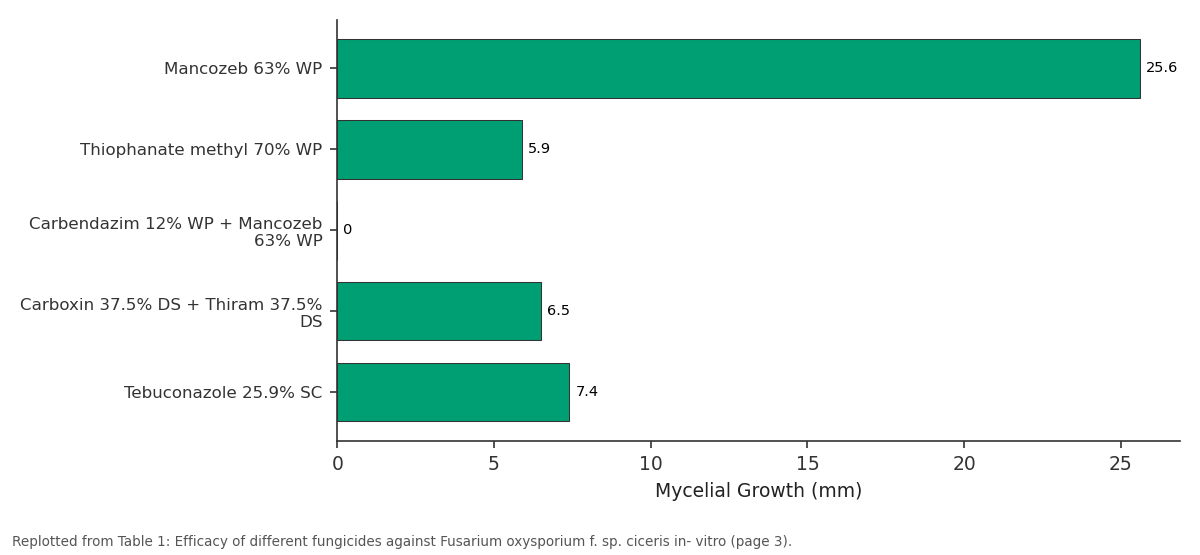
Concentrations (ppm): Mancozeb 63% WP vs Thiophanate methyl 70%... vs Carbendazim 12% WP +... vs Carboxin 37.5% DS +... vs Tebuconazole 25.9% SC
Replotted from Table 1 (page 3) of the original paper. Every bar is the paper's own table value.
View source evidence ↗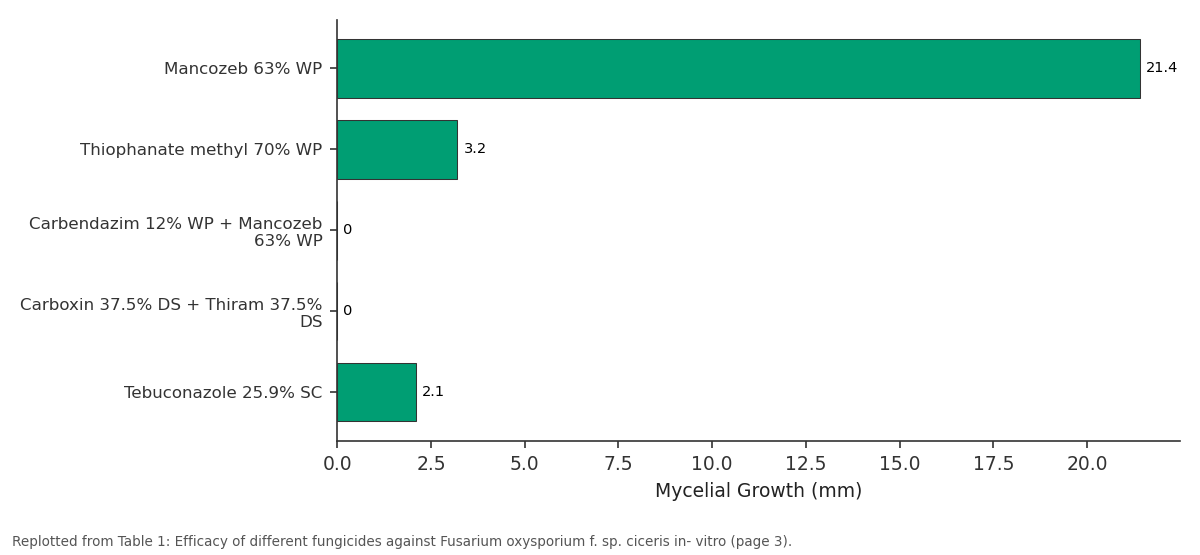
Mycelial Growth (mm): Mancozeb 63% WP vs Thiophanate methyl 70%... vs Carbendazim 12% WP +... vs Carboxin 37.5% DS +... vs Tebuconazole 25.9% SC
Replotted from Table 1 (page 3) of the original paper. Every bar is the paper's own table value.
View source evidence ↗Figures & tables
From the original paper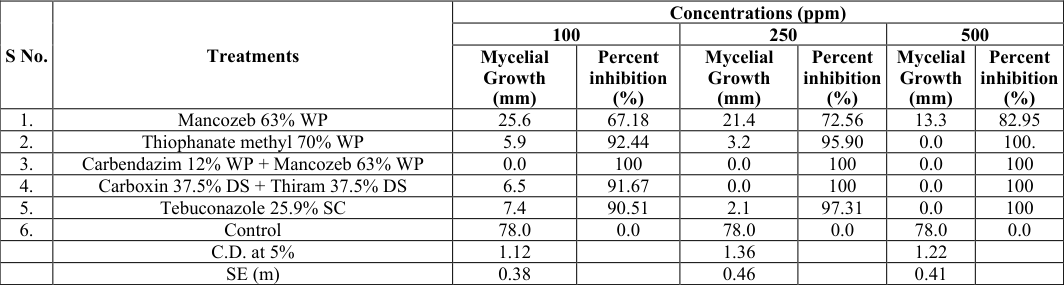 Table 1
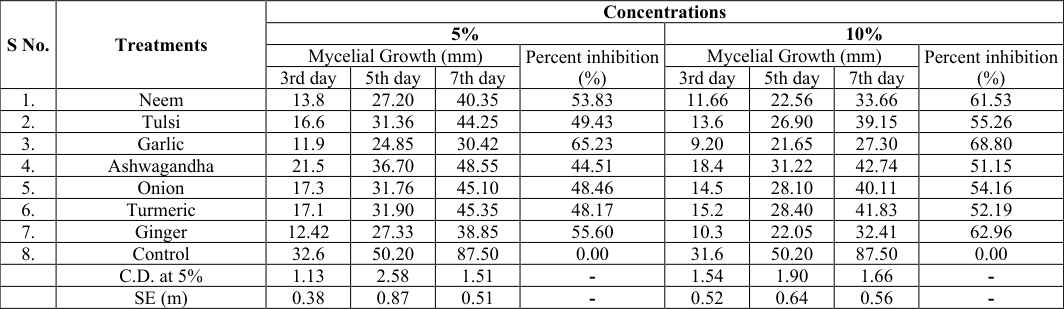 Table 2
Introduction
Pulse crops are an important source of food proteins, vitamins, lipids and certain minerals and generally grown under risk prone marginal lands. They are important crops for providing a high value food and nutritional security of a large fraction of vegetarian people of the world and are generally known as poor man's meat (Singh and Singh, 1992) [13] . Pulses being legume crops plays vital role in improving soil fertility and conserve natural resources which are essential for sustainable agriculture. Chickpeas are cultivated across India, chickpeas are grown on 10.91 million hectares, producing 130.75 million tonnes (Anonymous, 2021-22) [1] . In Madhya Pradesh (M.P.) over an area of 26.60 lakh hectares, yielding 19.88 lakh tonnes. Northern India contributes approximately 90 percent of the chickpea-growing area and 95 percent of the total production. The average yield in M.P. is about 908 kg/ha, which is relatively low. Many factors contribute to the low yield of chickpeas, with pathological constraints being the most significant. Chickpea wilt, caused by Fusarium oxysporum Schlechtend Fr. f. sp. ciceris (Padwick) Matuo & K. Sato, is the most critical soil-borne disease affecting chickpeas globally, particularly in the Indian Subcontinent, the Mediterranean Basin, and California (Haware, 1990; Jalali and Chand, 1992; Nene & Reddy, 1987) [6,8,11] . In India, the disease was first reported by Butler in 1918. The pathogen, Fusarium oxysporum f.sp. ciceris, can survive in soil and crop residues as chlamydospores for up to six years without a susceptible host and spreads through both soil and infected seeds (Haware et al., 1978) [5] . Fusarium wilt can completely destroy chickpea crops or cause significant annual yield losses, especially in low-rainfall areas, posing a continuous threat to chickpea cultivation. The pathogen also produces mycotoxins (Gopalakrishnan and Strange, 2005) [4] . Fusarium wilt is widespread in nearly all chickpea-growing regions globally, with its incidence in India ranging from 14 to 32% across different states (Dubey et al., 2010) [3] . Under favorable conditions, this disease can lead to yield losses of up to 100% (Anjaiah et al., 2003; Landa et al., 2004) [2,9] . Managing this pathogen cannot be effectively achieved through a single method, such as cultural practices, fungicides, host plant resistance, or bio-agents alone, highlighting the need for an integrated management approach. Although fungicides have shown promise in controlling the pathogen, their widespread use is limited due to concerns about phytotoxicity, fungicidal residues, environmental contamination, and human health risks. As a result, there is growing interest in replacing fungicides with botanicals and/or organic amendments products, which areseen as more sustainable, economical, and environmentally friendly alternatives for profitable agriculture.
Materials and Methods
The experiment was conducted in the central laboratory and the research field, faculty of Agriculture RNTU, Raisen (M.P.).
Chemicals and media
The chemicals have been used in the study were, Sodium chloride, D glucose, Formalin, Ethyl alcohol (90%) etc. and Potato Dextrose Agar, maize extract agar, water agar media were used.
Preparation of culture media
The pathogen that causes Fusarium wilt was isolated and purified in-vitro by the use of Potato Dextrose Agar (PDA) media. Evaluation of fungicides "Poisoned Food Technique," was employed to check the efficacy of five fungicides against F. oxysporum f. sp. ciceris was assessed in in-vitro. An autoclaved potato dextrose agar medium was filled with the necessary amount of each fungicide based on active ingredient and heated to 45°C. This resulted in the appropriate concentrations of 100, 250, and 500 ppm for all fungicides. The check was performed using the same media without the fungicide. Four replicates of the media were added to 90 mm petri plates and each plate was then inoculated with a 5 mm mycelial disc of the test fungus after it had solidified. The inoculated petri plates were incubated for 7 days at 27°C. After incubation, radial growth was measured. Percent inhibition in growth was calculated from the mean diameter after the days when petri plates incontrol was fully covered with mycelial growth of pathogen as par following formula.
Composition of Potato Dextrose Agar medium
Composition of Potato Dextrose Agar medium
Ingredients
Completely randomized design was used for statistical analysis.
Evaluation of Botanicals
The effectiveness of seven plant extracts, including Neem, Tulsi, Garlic, Ashwagandha, Onion, Turmeric and Ginger against Fusarium wilt was investigated. To prepare neem leaf extract 200g of fresh leaves were cleaned with sterilized distilled water and 200 ml of sterilized distilled water was used to ground the leaves in a mortar and pestle. The final mixture was put in a beaker and left on a lab bench for four hours, covered with sterile aluminum foil. The neem mixture was used as crude aqueous extracts in studies after being filtered through a fine muslin cloth to eliminate fibrous and suspended debris. Other extracts were made using the same procedure. Using the food poisoning technique, all plant extracts were evaluated at concentrations of 5 and 10% in in-vitro to examine their potential to suppress the radial growth of F. oxysporum f. sp. ciceris.
For the purpose to get a 5% concentration in aseptic conditions, 95 ml of cooled and sterilized PDA medium were filled with 5 ml of plant extracts from the stock solution and placed into sterilized flasks. To 90 ml of sterilized, cool PDA medium in aseptic flasks, 10 ml of plant extracts of the stock solution were added in the case of a 10% concentration. Before adding the extracts to the petri dishes, the flasks were carefully shaken to ensure an even distribution of the extracts under aseptic conditions. Each petri dish was filled with twenty-five milliliters of medium. Three replications of each treatment were kept up, while a control treatment was kept up by just adding PDA media without any plant extracts. Using a sterilized cork borer, 5 mm mycelia discs of a 7-day-old pure culture of F. oxysporum f. sp. ciceris were cut and positioned in the middle of plant extracts amended petri plates. In B.O.D., these petri plates were incubated at 25±2 ⁰C. Observation was recorded on radial growth and percent inhibition at 7 days of incubation in plant extracts amended petri plates as well as in control. CRD design was applied in this case. Per cent growth inhibition was calculated using the formula (Vincent, 1947):
where, C = Growth of test fungus in control in mm, T = Growth of test fungus in treatment in mm
Results and Discussion
In-vitro testing of fungicides against F. oxysporum f. sp. ciceris Five chemicals viz. Mancozeb 63% WP, Thiophanate methyl 70% WP, Carbendazim 12% WP + Mancozeb 63% WP, Carboxin 37.5% DS + Thiram 37.5% DS and Tebuconazole 25.9% SC at 100, 250 and 500 ppm concentration evaluated by poison food technique under in vitro condition. The effect of treatments increased with an increase in concentration. Based on the (Table 1), In 100 ppm concentration among all the treatment most effective fungicide with minimum mycelial growth was observed in combination of fungicides Carbendazim 12% WP + Mancozeb 63% WP (0.0 mm) with 100% growth inhibition. Second minimum mycelial growth recorded in Thiophanate methyl 70% WP (5.9 mm) which is at par with Carboxin 37.5% DS + Thiram 37.5% DS (6.5 mm) with 92.44 and 91.67 percent growth inhibition respectively while maximum mycelial growth recorded in Mancozeb 63% WP (25.6 mm) with 67.18 percent growth inhibition. The radial growth in control was 78 mm. In 250 ppm concentration among all the treatment most effective treatment was Carbendazim 12% WP + Mancozeb 63% WP and Carboxin 37.5% DS + Thiram 37.5% DS with minimum mycelial growth (0.0 mm) and 100% growth inhibition. Second minimum mycelial growth was found in Tebuconazole 25.9% SC (2.1 mm) and 97.31 percent growth inhibition at par with Thiophanate methyl 70% WP (3.5 mm) and 95.6 percent growth inhibition. Least effective fungicide among all treatment was Mancozeb 63% WP (21.4 mm) with 72.56 percent growth inhibition. Among all the treatment in 500 ppm concentration Carbendazim12% WP + Mancozeb 63% WP, Carboxin 37.5% DS + Thiram 37.5% DS, Tebuconazole 25.9% SC and Thiophanate methyl 70% WP were most effective and at par with each other with (0.0 mm) mycelial growth and 100 percent growth inhibition. Mancozeb 63% WP was found least effective fungicide among all the treatments with maximum mycelial growth (13.3 mm) and minimum percent growth inhibition (82.95%). The radial growth in control was 78 mm. Similarly Sahane et al (2021) reported that combination product of fungicide viz, Carbendazim + Mancozeb, Tebucconazole + Trifloxystrobin and carboxin + Thiram inhibited the complete growth of pathogen at all tested concentration of 1000, 1500 and 2000 ppm. [10] reported that garlic clove extract and neem leaf extract were the two botanicals that were most effective at preventing the growth of the test pathogen at doses of 5% and 10%. Jamwal et al. (2017) [7] tested various phyto-extracts against Fusarium oxysporum f. sp. ciceris and found that the extract of Azadirachta indica leaves exhibited the highest degree of mycelial inhibition of the fungus, with Allium sativum coming in second.
| S No. | Treatments | Concentrations (ppm) | — | — | — | — | — |
|---|---|---|---|---|---|---|---|
| 100 | 250 | 500 | |||||
| Mycelial Growth (mm) | Percent inhibition (%) | Mycelial Growth (mm) | Percent inhibition (%) | Mycelial Growth (mm) | Percent inhibition (%) | ||
| 1. | Mancozeb 63% WP | 25.6 | 67.18 | 21.4 | 72.56 | 13.3 | 82.95 |
| 2. | Thiophanate methyl 70% WP | 5.9 | 92.44 | 3.2 | 95.90 | 0.0 | 100. |
| 3. | Carbendazim 12% WP + Mancozeb 63% WP | 0.0 | 100 | 0.0 | 100 | 0.0 | 100 |
| 4. | Carboxin 37.5% DS + Thiram 37.5% DS | 6.5 | 91.67 | 0.0 | 100 | 0.0 | 100 |
| 5. | Tebuconazole 25.9% SC | 7.4 | 90.51 | 2.1 | 97.31 | 0.0 | 100 |
| 6. | Control | 78.0 | 0.0 | 78.0 | 0.0 | 78.0 | 0.0 |
| C.D. at 5% | 1.12 | 1.36 | 1.22 | ||||
| SE (m) | 0.38 | 0.46 | 0.41 |
Table text extracted from the original PDF; superscript letters are shown inline. The original table image is below.
View original table image
Figures and tables from the paper
| S No. | Treatments | Concentrations | — | — | — | — | — | — | — |
|---|---|---|---|---|---|---|---|---|---|
| 5% | 10% | ||||||||
| Mycelial Growth (mm) | Percent inhibition (%) | Mycelial Growth (mm) | Percent inhibition (%) | ||||||
| 3rd day | 5th day | 7th day | 3rd day | 5th day | 7th day | ||||
| 1. | Neem | 13.8 | 27.20 | 40.35 | 53.83 | 11.66 | 22.56 | 33.66 | 61.53 |
| 2. | Tulsi | 16.6 | 31.36 | 44.25 | 49.43 | 13.6 | 26.90 | 39.15 | 55.26 |
| 3. | Garlic | 11.9 | 24.85 | 30.42 | 65.23 | 9.20 | 21.65 | 27.30 | 68.80 |
| 4. | Ashwagandha | 21.5 | 36.70 | 48.55 | 44.51 | 18.4 | 31.22 | 42.74 | 51.15 |
| 5. | Onion | 17.3 | 31.76 | 45.10 | 48.46 | 14.5 | 28.10 | 40.11 | 54.16 |
| 6. | Turmeric | 17.1 | 31.90 | 45.35 | 48.17 | 15.2 | 28.40 | 41.83 | 52.19 |
| 7. | Ginger | 12.42 | 27.33 | 38.85 | 55.60 | 10.3 | 22.05 | 32.41 | 62.96 |
| 8. | Control | 32.6 | 50.20 | 87.50 | 0.00 | 31.6 | 50.20 | 87.50 | 0.00 |
| C.D. at 5% | 1.13 | 2.58 | 1.51 | - | 1.54 | 1.90 | 1.66 | - | |
| SE (m) | 0.38 | 0.87 | 0.51 | - | 0.52 | 0.64 | 0.56 | - |
Table text extracted from the original PDF; superscript letters are shown inline. The original table image is below.
View original table image
References
13 in the original paper- Anonymous. Agriculture statistics at a glance. New Delhi: Ministry of Economy and Statistics, Government of India; 2021. p. 47.
- Anjaiah V, Cornelis P, Koedam N. Effect of genotype and root colonization in biological control of Fusarium International Journal of Biology Sciences https://www.biologyjournal.net wilts in pigeonpea and chickpea by Pseudomonas auruginosa PNAI. Can J Microbiol. 2003;49:85-91.
- Dubey SC, Singh SR, Singh B. Morphological and pathogenic variability of Indian isolates of Fusarium oxysporum f. sp. ciceri causing chickpea wilt. Arch Phytopathol Plant Prot. 2010;43:174-190.
- Gopalakrishnan S, Beale MH, Ward JL, Strange RN. Chickpea wilt: identification and toxicity of 8-Omethyl-fusarubin from Fusarium acutatum. Phytochemistry. 2005;66(13):1536-1539.
- Haware MP, Nene YL, Rajeshwari R. Eradication of Fusarium oxysporum f. sp. ciceri transmitted in chickpea seed. Phytopathology. 1978;68:1364-1367.
- Haware MP. Fusarium wilt and other important diseases of chickpea in the Mediterranean area. Options Mediterr Ser Semin. 1990;9:61-64.
- Jamwal S, Jamwal A, Jha AC, Reena, Dutta U, Kumar A, et al. Evaluation of fungicides, botanicals and Trichoderma spp. against wilt of chickpea caused by Fusarium oxysporum f. sp. ciceri. Int J Curr Microbiol Appl Sci. 2017;6:1389-1393.
- Jalali BL, Chand H. Chickpea wilt. In: Plant diseases of international importance: diseases of cereals and pulses. Englewood Cliffs (NY): Prentice Hall; 1992. p. 429444.
- Landa BB, Navas-Cortes JA, Jimenez-Diaz RM. Integrated management of Fusarium wilt of chickpea with sowing date, host resistance and biological control. Phytopathology. 2004;94:946-960.
- Mailem YS, Bhat BN, Rao T, Maheshwari B, Rajeswari D, Reddy RR. Management of chickpea wilt, Fusarium oxysporum f. sp. ciceri using fungicides, botanicals and bioagents. Indian J Plant Prot. 2015;43(1):2249-7870.
- Nene YL, Reddy MV. Chickpea diseases and their control. In: Saxena MC, Singh KB, editors. The chickpea. Oxon (UK): CAB International; 1987. p. 233270.
- Sahane PA, Chavan RA, Brahmankar RG, Kolhe DB, Udar VB. In vitro efficacy of fungicides against Fusarium oxysporum f. sp. ciceri. J Pharmacogn Phytochem. 2021;10:978-984.
- Singh U, Singh B. Tropical grain legumes as important human foods. Econ Bot. 1992;46:310-321.