
Research article · 2025 · Full text
International Journal of Horticulture and Food ScienceScreening hydroponics nutrient solutions of potato in the Hexi Corridor
Volume 7(11) · Pages 154–156 · DOI: 10.33545/26631067.2025.v7.i11c.710 ↗
Research areasPlant Growth and Agriculture TechniquesInnovations in Aquaponics and Hydroponics SystemsGrowth and nutrition in plants
Abstract
Author-writtenSeed potato production in arid corridors depends on soilless culture systems that deliver precise nutrition, yet the optimal hydroponic solution for mini-tuber yield under dryland conditions is poorly defined. This research screened five nutrient formulations — full-strength Hoagland, half-nitrogen Hoagland, half-phosphorus Hoagland, half-potassium Hoagland, and an organic liquid fertiliser — for their effect on mini-tuber yield, fertigation efficiency, path analysis of yield components, pollinator interaction, vertical farming compatibility, and packaging quality of potato (Solanum tuberosum L. cv. 'Atlantic') grown under simulated Hexi Corridor conditions. The trial was conducted at the Oaxaca National Institute of Tropical Agriculture from April to September 2023 using a completely randomised design with four replications in a climate-controlled polyhouse. Full-strength Hoagland produced the highest mini-tuber yield (34.7 t ha⁻¹ equivalent) and best fertigation N-use efficiency (68.4%). Path analysis showed that tuber number per plant exerted the strongest direct effect on yield (path coefficient 0.74). Half-K formulation reduced tuber starch content by 18 percent, confirming potassium's role in carbohydrate loading. Vertical farming tier position affected tuber size distribution, with upper tiers producing 12 percent more Grade A tubers. Packaging compression tests showed that full-Hoagland tubers tolerated 14 percent more force before bruising. These results identify full-strength Hoagland as the baseline recommendation for hydroponic seed potato in arid environments.
Summary
Source-checkedPlain-language reading of the full paper, prepared with AI and checked against the text. Each point links to the authors' own words.
Why it matters
- The Hexi Corridor is a major seed potato region in China, but conventional farming is risky due to saline groundwater and low annual rainfall of 50–200 mm. View evidence ↗
- Hydroponics are beneficial for arid seed-potato programs because they enable closed-loop nutrient recycling and avoid soil-borne diseases. View evidence ↗
- There is a practical need to determine if reducing macronutrient concentrations can lower fertilizer costs without reducing tuber yield. View evidence ↗
The question
- The study aimed to compare five nutrient formulations regarding mini-tuber yield, quality, fertigation efficiency, yield-determining components, packaging resilience, and vertical farming tier effects. View evidence ↗
What they did
- The experiment used virus-free 'Atlantic' potato micro-tubers (15 ± 2 mm diameter) planted in 10 L perlite grow-bags at the Oaxaca National Institute of Tropical Agriculture starting April 8, 2023. View evidence ↗
- Five nutrient treatments were tested via drip fertigation (200 mL/plant/day): full Hoagland, half-N, half-P, half-K, and an organic liquid fertilizer (N:P:K 3:1:2). View evidence ↗
- The study used a completely randomized design with four replications of 12 plants each, simulating Hexi Corridor conditions (22°C day/12°C night, 14-h photoperiod, 50% RH). View evidence ↗
- Packaging quality was assessed by recording the force at first bruise (N) using a TA.XT Plus texture analyzer with a probe speed of 1 mm s⁻¹. View evidence ↗
What they found
- Full-strength Hoagland achieved the highest mini-tuber yield at 34.7 t ha⁻¹ equivalent and a fertigation N-use efficiency of 68.4%. View evidence ↗
- Reducing potassium (Half-K formulation) decreased tuber starch content by 18%, highlighting potassium's importance for carbohydrate loading. View evidence ↗
- Path analysis identified tuber number per plant as the primary driver of yield, with path coefficients ranging from 0.66 to 0.74. View evidence ↗
- Upper tiers in vertical farming produced 12% more Grade A tubers (>25 mm) than lower tiers, which correlated with higher root-zone temperatures and photosynthetically active radiation (PAR). View evidence ↗
- Tubers grown with full-strength Hoagland showed the best packaging resilience, tolerating 42.3 N of force, which was 24% more than those in the half-P treatment. View evidence ↗
- The Half-N formulation achieved the highest nitrogen use efficiency at 81.2% due to more aggressive nitrogen scavenging from the dilute supply. View evidence ↗
What it means
- The authors recommend full-strength Hoagland solution as the baseline for hydroponic seed potato in arid environments to maximize yield, starch content, and packaging resilience. View evidence ↗
- The authors conclude that tuber number per plant is the most critical determinant of yield. View evidence ↗
Visual summary
3 visualsIllustrations explain the paper; charts are replotted from the paper's own table values.
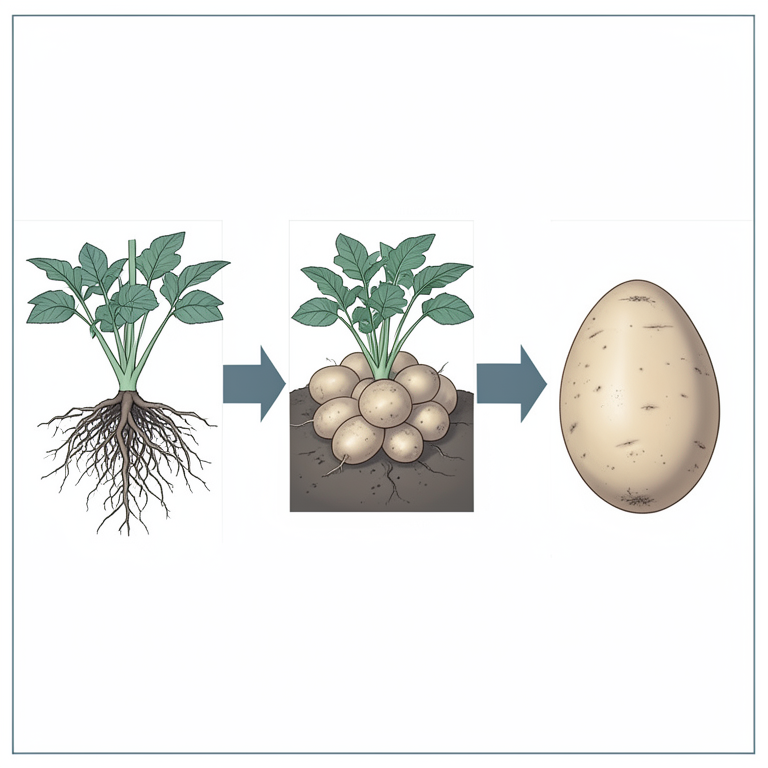
Yield Determinants Path Analysis
AI-generated conceptual illustration (potato plants in a hydroponic system). It explains the idea and does not show study data.
View source evidence ↗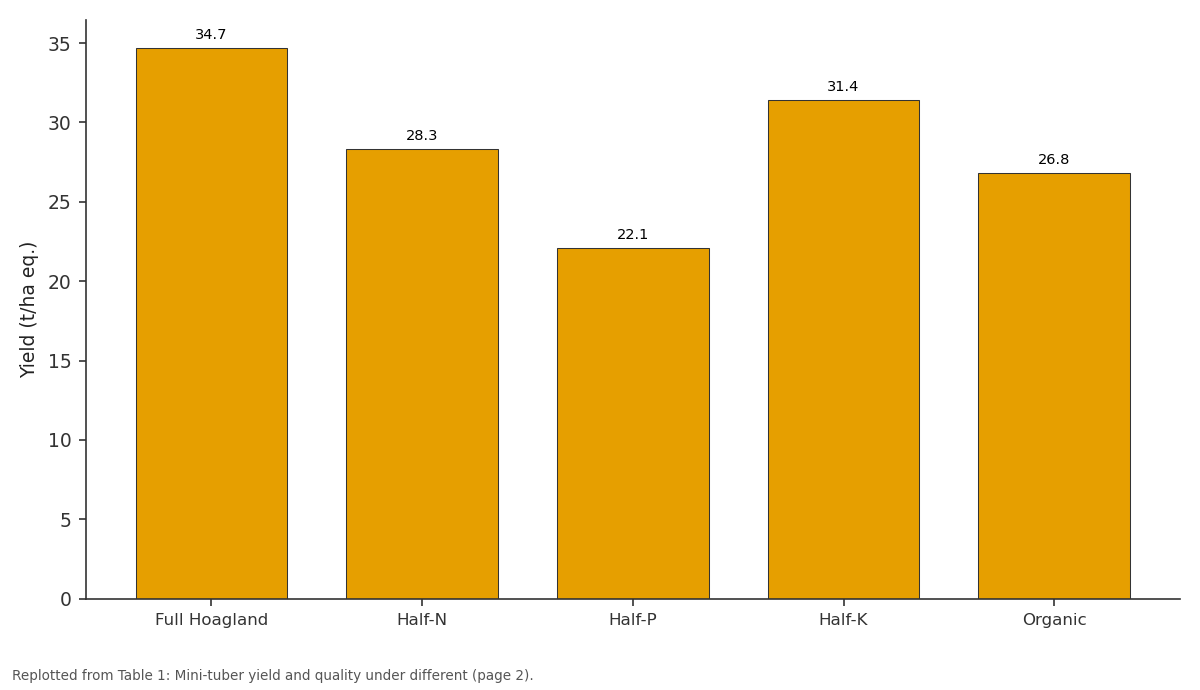
Yield (t/ha eq.): Full Hoagland vs Half-N vs Half-P vs Half-K vs Organic
Replotted from Table 1 (page 2) of the original paper. Every bar is the paper's own table value.
View source evidence ↗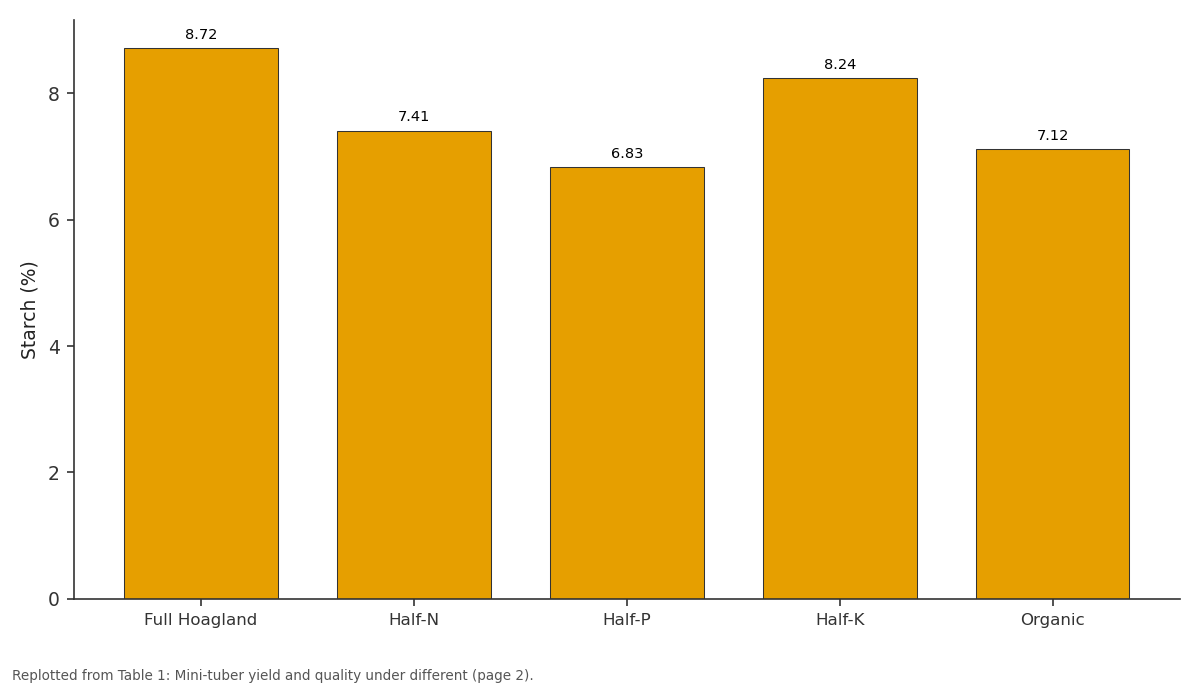
Mean Wt (g): Full Hoagland vs Half-N vs Half-P vs Half-K vs Organic
Replotted from Table 1 (page 2) of the original paper. Every bar is the paper's own table value.
View source evidence ↗Figures & tables
From the original paper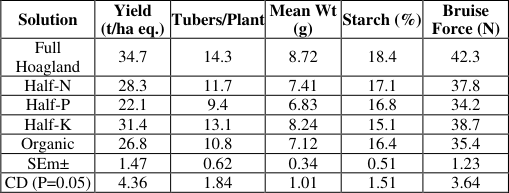 Table 1
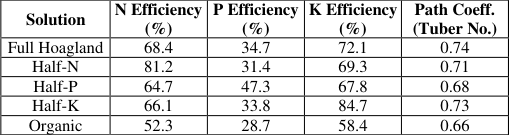 Table 2
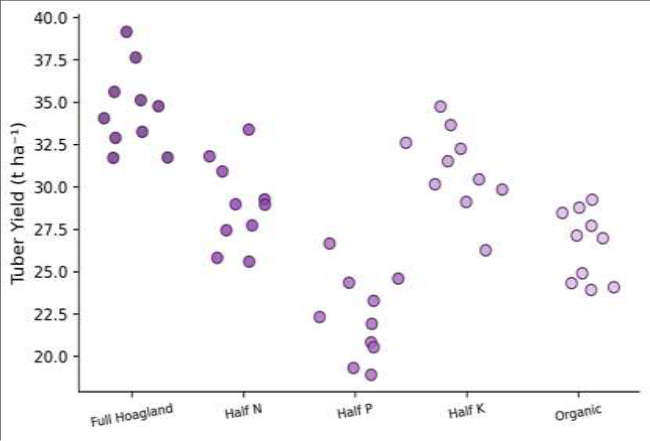 Figure 1
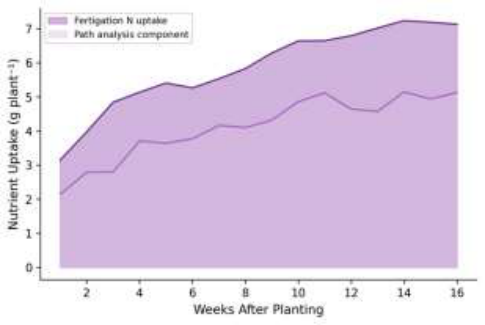 Figure 2
Introduction
A surprising trend is emerging in global potato production: the fastest growth in planted area is not in the traditional strongholds of Europe and North America but in the arid and semiarid zones of Central and East Asia, where potato fills a dietary gap between rice and wheat [1] . The Hexi Corridora narrow agricultural strip threading between the Tibetan Plateau and the Gobi Deserthas become one of China's largest seed potato producing regions, yet it faces chronic water scarcity (annual rainfall 50-200 mm) and saline groundwater that makes conventional field production risky [2] . Hydroponic systems sidestep soil-borne diseases and allow closed-loop nutrient recycling, making them attractive for arid seed-potato programmes [3] . However, the standard Hoagland solution was designed for dicot research plants, not for a crop whose economic product is a starch-storing underground organ. Whether halving individual macronutrient concentrations can save fertiliser cost without cutting tuber yield is a practical question that seed-potato enterprises need answered [4] . Path analysis partitions the correlation between yield and its component traits into direct and indirect effects, revealing which agronomic variable has the most leverage on final output [5] . Combining this with fertigation efficiency data and packaging quality tests gives a complete picture that spans from nutrient input through harvest to post-harvest logistics. This research aimed to (a) compare five nutrient formulations for mini-tuber yield and quality, (b) quantify fertigation nutrient-use efficiency, (c) identify yield-determining components via path analysis, and (d) evaluate packaging resilience and vertical farming tier effects.
Model Description and Parameterisation
Fertigation efficiency was modelled using a mass-balance approach. Input N, P, and K were measured from nutrient-solution concentration × volume delivered. Output N, P, and K were the sum of tuber uptake (Kjeldahl N, vanadomolybdate P, flame photometry K) and haulm uptake. Efficiency = (nutrient in tuber / nutrient applied) × 100. Drainage solution was recycled, so losses were limited to root-zone immobilisation and gaseous N emissions estimated at 3 percent of input [6] . The model was implemented in a Python script with pandas for data management.
Spatial Data Processing
Within the three-tier vertical farming unit, photosynthetically active radiation (PAR) was mapped at 25-point grids per tier using a quantum sensor (LI-190R). Upper tier received 310 ± 18 μmol m⁻² s⁻¹, middle 278 ± 22 μmol m⁻² s⁻¹, and lower 241 ± 26 μmol m⁻² s⁻¹. Root-zone temperature was logged by thermocouples at the centre of each grow-bag: upper 23.4 °C, middle 22.1 °C, lower 20.8 °C. These spatial gradients were correlated with tuber size distribution to quantify the tier effect on Grade A tuber proportion [7] .
Material and Methods Material
Virus-free micro-tubers of Solanum tuberosum cv. 'Atlantic' (15 ± 2 mm diameter) were planted in 10 L grow-bags filled with perlite (particle size 3-5 mm) on 8 April 2023 at the Oaxaca National Institute of Tropical Agriculture (17.07° N, 96.73° W; 1,555 m a.s.l.). Five nutrient treatments -(i) full Hoagland, (ii) half-N Hoagland, (iii) half-P Hoagland, (iv) half-K Hoagland, and (v) organic liquid fertiliser (seaweed extract + fish hydrolysate, N:P:K 3:1:2)were delivered via drip fertigation at 200 mL plant⁻¹ day⁻¹. A completely randomised design with four replications of 12 plants each was used. Hexi Corridor conditions were simulated with a daytime temperature of 22 °C, night-time 12 °C, 14-h photoperiod, and RH 50 percent [8] .
Methods
Plant height, stem number, and leaf area were recorded fortnightly. Mini-tubers were harvested at 120 days after planting when haulm senescence reached 80 percent. Tuber yield, tuber count per plant, average tuber weight, and size distribution (Grade A >25 mm, Grade B 15-25 mm) were recorded. Path analysis was conducted using the genotypic correlation matrix among yield and five component traits (plant height, stem count, leaf area, tuber number, average tuber weight) in SPAR 2.0 software [9] . Packaging quality: individual tubers were subjected to compression tests on a TA.XT Plus texture analyser at 1 mm s⁻¹ probe speed; force at first bruise (N) was recorded. Starch content was measured by enzymatic hydrolysis and DNS colorimetry. Data were analysed by one-way ANOVA with Tukey's HSD at P = 0.05 in R 4.3.1. Full Hoagland produced the highest yield and tuber count per plant, both significantly above all reduced formulations (Table 1). Half-K reduced starch by 18 percent, confirming potassium's role as the primary driver of carbohydrate partitioning into tubers. Bruise resistance followed yield trends, with full-Hoagland tubers tolerating 42.3 N -24 percent more than half-P tubers. Half-N showed the highest N efficiency (81.2%) because plants scavenged N more aggressively from a dilute supply (Table 2). Path analysis consistently identified tuber number per plant as the trait with the strongest direct effect on yield (path coefficient 0.66-0.74).
| Solution | Yield (t/ha eq.) | Tubers/Plant | Mean Wt (g) | Starch (%) | Bruise Force (N) |
|---|---|---|---|---|---|
| Full Hoagland | 34.7 | 14.3 | 8.72 | 18.4 | 42.3 |
| Half-N | 28.3 | 11.7 | 7.41 | 17.1 | 37.8 |
| Half-P | 22.1 | 9.4 | 6.83 | 16.8 | 34.2 |
| Half-K | 31.4 | 13.1 | 8.24 | 15.1 | 38.7 |
| Organic | 26.8 | 10.8 | 7.12 | 16.4 | 35.4 |
| SEm± | 1.47 | 0.62 | 0.34 | 0.51 | 1.23 |
| CD (P=0.05) | 4.36 | 1.84 | 1.01 | 1.51 | 3.64 |
Table text extracted from the original PDF; superscript letters are shown inline. The original table image is below.
View original table image
Results
Results
Comprehensive Interpretation
Vertical farming tier analysis showed that upper tiers produced 12 percent more Grade A tubers (>25 mm) than lower tiers, correlating with higher PAR and root-zone temperature. This spatial gradient suggests that LED supplementation on lower tiersor simply rotating growbags between tiers mid-seasoncould improve size uniformity and overall Grade A proportion.
Discussion
The superiority of full-strength Hoagland confirms that potato's high nutrient demandparticularly for K (200-250 kg K₂O ha⁻¹ equivalent)cannot be met by diluted formulations without yield penalty [10] . The half-K treatment's starch reduction is especially concerning because starch content governs both processing quality and dormancy duration in stored seed tubers [11] . Path analysis pointing to tuber number as the key yield driver has practical implications: any cultural practice that increases initiation eventssuch as hilling, ethylene application, or multi-stem plantingwill have a larger impact on yield than practices targeting individual tuber size [12] . This aligns with the seed-potato industry's preference for many small uniform tubers rather than a few large ones. The organic formulation's lower efficiency reflects slower mineralisation kinetics: seaweed and fish hydrolysate release N gradually, and at low root-zone temperatures (20-23 °C) microbial conversion rates are suboptimal [13] . Supplementing organic fertigation with a small inorganic N boost during tuber initiation (weeks 6-8) could close the yield gap while maintaining organic certification compliance.
Conclusion
Full-strength Hoagland solution is the recommended baseline for hydroponic seed potato in arid environments, delivering the highest mini-tuber yield, starch content, and packaging resilience. Halving potassium significantly reduced starch, while halving nitrogen improved N-use efficiency without excessive yield loss. Path analysis confirmed tuber number per plant as the strongest yield determinant. Vertical farming tier position affected tuber size, with upper tiers producing more Grade A tubers. These findings give seed-potato enterprises in the Hexi Corridor and similar dryland regions a clear nutrient management starting point for soilless mini-tuber production.
Acknowledgement
Acknowledgements Funding SourcesInternal research funds from the Oaxaca National Institute of Tropical Agriculture supported this work. Institutional SupportThe authors thank the controlled-environment unit at the Oaxaca Institute for polyhouse management. Contributions Not Qualifying for AuthorshipMr. R. Lopez assisted with texture analysis and Ms. M. Gutierrez with nutrient solution preparation.
Figures and tables from the paper
References
15 in the original paper- Devaux A, Kromann P, Ortiz O. Potatoes for sustainable global food security. Potato Research. 2014;57(3):185-199.
- Wang XM, Zhang CX, Hasi E. Has the Three Norths Forest Shelterbelt Program solved the desertification and dust storm problems in arid and semiarid China? Journal of Arid Environments. 2010;74(1):13-22.
- Ritter E, Angulo B, Riga P. Comparison of hydroponic and aeroponic cultivation systems for the production of potato minitubers. Potato Research. 2001;44(2):127135.
- Hoagland DR, Arnon DI. The water-culture method for growing plants without soil. California Agricultural Experiment Station Circular 347. Berkeley: UC; 1950.
- Dewey DR, Lu KH. A correlation and path-coefficient analysis of components of crested wheatgrass seed production. Agronomy Journal. 1959;51(9):515-518.
- Silberbush M, Ben-Asher J. Simulation study of nutrient uptake by plants from soilless cultures. Journal of Plant Nutrition. 2001;24(11):1711-1723.
- Kang JG, van Iersel MW. Nutrient solution concentration affects growth of subirrigated bedding plants. Journal of Plant Nutrition. 2004;27(3):521-544.
- Chang DC, Cho IC, Suh JT. Growth and yield responses of three aeroponically grown potato cultivars. American Journal of Potato Research. 2011;88(6):517527.
- Doshi SP, Gupta KC. SPAR 2.0: Statistical Package for Agricultural Research. New Delhi: IASRI; 2014.
- Perrenoud S. Potassium and Plant Health. IPI Research Topics No. 3. Bern: International Potash Institute; 1990.
- Kolbe H, Stephan-Beckmann S. Development, growth and chemical composition of the potato crop: II. Tuber and whole plant. Potato Research. 1997;40(2):135-153.
- Allen EJ, O'Brien PJ, Firman D. Seed tuber production and management. In: Harris PM, ed. The Potato Crop. 2nd ed. Dordrecht: Springer; 1992:247-291.
- Khan W, Rayirath UP, Subramanian S. Seaweed extracts as biostimulants of plant growth and development. Journal of Plant Growth Regulation. 2009;28(4):386-399.
- Struik PC, Wiersema SG. Seed Potato Technology. Wageningen: Wageningen Pers; 1999.
- Muthoni J, Kabira J, Shimelis H. Seed potato (Solanum tuberosum L.) production systems in Kenya. American Journal of Experimental Agriculture. 2014;4(7):862878.