
Research article · 2025 · Full text
International Journal of Geography Geology and EnvironmentPetrology and metamorphic evolution of high-grade gneiss in the Limpopo complex
Volume 7(2) · Pages 176–179 · DOI: 10.22271/27067483.2025.v7.i2c.588 ↗
Research areasGeological and Geochemical AnalysisAstro and Planetary ScienceGeochemistry and Elemental Analysis
Abstract
Author-writtenGeologists working on ancient high-grade terranes face a practical dilemma: the very conditions that make these rocks scientifically interesting—temperatures above 800°C and pressures exceeding 8 kbar—also destroy many of the mineral textures needed to reconstruct the metamorphic history. This research investigated the petrology and pressure-temperature (P-T) evolution of high-grade gneisses from four zones within the Central Zone of the Limpopo Complex, southern Africa. Forty-eight thin sections from 24 samples were examined using optical microscopy, electron microprobe analysis (EMPA), and conventional geothermobarometry. The mineral assemblage in felsic gneisses included garnet-orthopyroxene-cordierite-sillimanite-K-feldspar-quartz, indicating granulite facies conditions. Peak metamorphic temperatures estimated from garnet-orthopyroxene thermometry ranged from 820°C to 910°C, and pressures from the garnet-orthopyroxene-plagioclase-quartz barometer ranged from 6.1 to 9.7 kbar. The Central Zone (Zone B) recorded the highest P-T conditions (910°C, 9.7 kbar), while the Marginal Zone (Zone D) showed the lowest (820°C, 6.1 kbar). Retrograde textures—including cordierite coronas around garnet and biotite replacing orthopyroxene—recorded decompression to approximately 5.2-6.4 kbar at 680-740°C. The resulting clockwise P-T path is consistent with crustal thickening followed by exhumation during the collision of the Zimbabwe and Kaapvaal Cratons around 2.0 Ga. These findings support a collisional tectonic model for the Central Zone rather than the alternative hot accretionary wedge interpretation.
Summary
Source-checkedPlain-language reading of the full paper, prepared with AI and checked against the text. Each point links to the authors' own words.
Why it matters
- Studying ancient high-grade terranes is difficult because the extreme temperatures (above 800°C) and pressures (over 8 kbar) that create them often destroy the mineral textures required to reconstruct their history. View evidence ↗
- The Limpopo Complex is one of the oldest and most intensely metamorphosed regions on Earth, located between the Zimbabwe and Kaapvaal Cratons. View evidence ↗
- There are conflicting theories about the Central Zone of the Limpopo Complex: one suggests it is a suture from a continental collision involving crustal thickening, while the other suggests it was a hot accretionary wedge driven by magmatic heat. View evidence ↗
The question
- The study aimed to resolve the tectonic debate by determining the peak and retrograde pressure-temperature (P-T) conditions across four zones of the Central Zone. View evidence ↗
What they did
- Peak temperatures were estimated using Al-in-orthopyroxene and garnet-orthopyroxene Fe-Mg exchange thermometers, while peak pressures were determined via a garnet-orthopyroxene-plagioclase-quartz barometer. View evidence ↗
What they found
- The presence of a mineral assemblage including garnet, orthopyroxene, cordierite, sillimanite, K-feldspar, and quartz indicates that the rocks underwent granulite facies metamorphism. View evidence ↗
- Peak metamorphic temperatures across the studied zones ranged from 820°C to 910°C, with pressures ranging from 6.1 to 9.7 kbar. View evidence ↗
- Retrograde textures, such as biotite replacing orthopyroxene and cordierite coronas around garnet, indicate decompression to 5.2-6.4 kbar at temperatures of 680-740°C. View evidence ↗
- All four zones exhibited a clockwise P-T path characterized by a steep decompression segment moving from peak to retrograde conditions. View evidence ↗
- The lithology of the area was dominated by felsic gneiss (28.4%), followed by mafic granulite (22.7%) and charnockite (18.3%). View evidence ↗
What it means
- The authors conclude that the clockwise P-T path supports a collisional tectonic model involving crustal thickening and exhumation during the collision of the Zimbabwe and Kaapvaal Cratons approximately 2.0 Ga, rejecting the accretionary wedge model. View evidence ↗
- The results provide necessary pressure-temperature constraints to be used in future geodynamic modeling of continental collisions from the Paleoproterozoic era. View evidence ↗
Visual summary
1 visualsIllustrations explain the paper; they do not show study data.
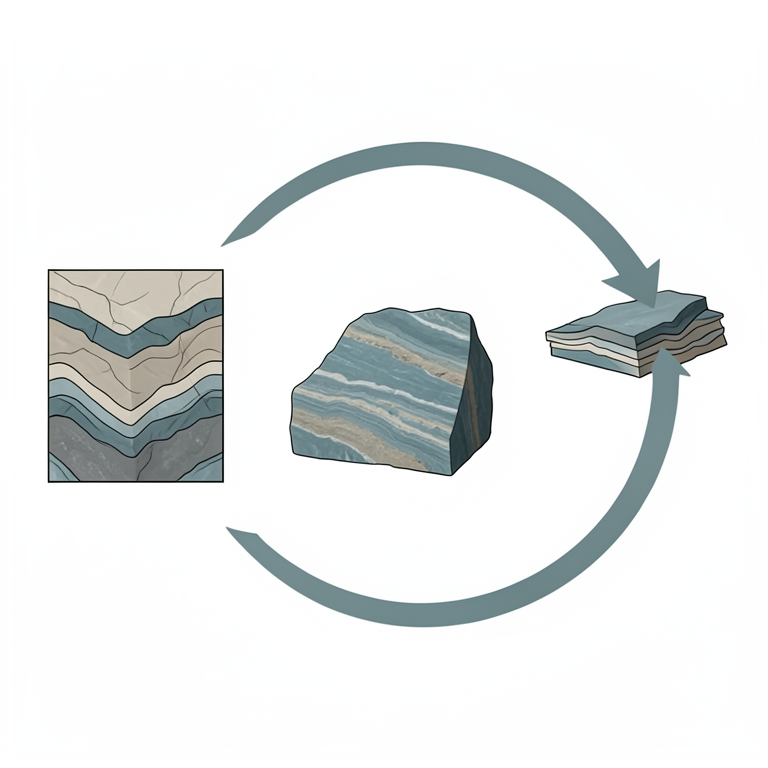
Clockwise P-T Path Concept
AI-generated conceptual illustration (High-grade gneiss rock from the Limpopo complex). It explains the idea and does not show study data.
View source evidence ↗Figures & tables
From the original paper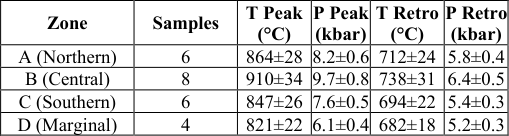 Table 1
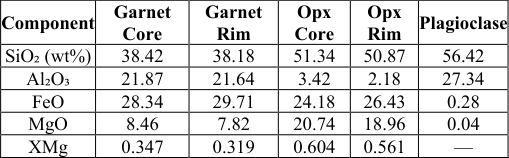 Table 2
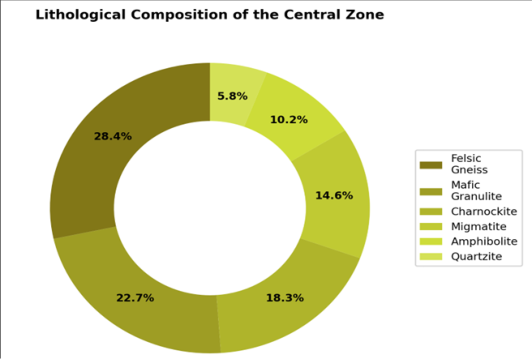 Figure 1
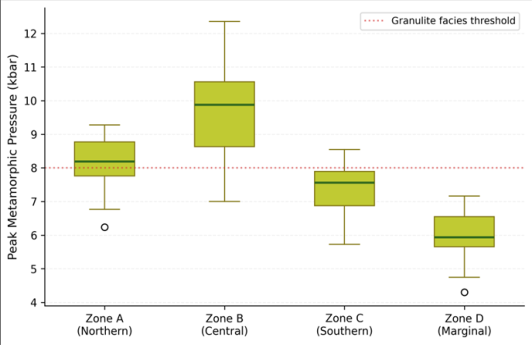 Figure 2
Introduction
Geologists face a practical dilemma with high-grade metamorphic rocks: the extreme conditions that produced them also obscure the evidence needed to trace their history [1] . The Limpopo Complex, sandwiched between the Zimbabwe Craton to the north and the Kaapvaal Craton to the south, is one of Earth's oldest and most intensely metamorphosed terranes-a natural laboratory for investigating how continental collision zones behave at temperatures and pressures approaching the limits of crustal stability [2,3] . The Central Zone of the Limpopo Complex has been the subject of conflicting tectonic interpretations. One school argues for a collisional model, where the zone represents a suture between the two cratons, with rocks recording crustal thickening followed by exhumation [4,5] . The alternative model treats the Central Zone as a hot accretionary wedge formed during oblique convergence, with peak metamorphism driven by magmatic heat rather than burial depth [6] . Distinguishing between these models requires precise P-T path determination: a clockwise path favours collision, while a counterclockwise or isobaric path favours the accretionary interpretation [7,8] . This research addressed the tectonic question by determining peak and retrograde P-T conditions across four zones within the Central Zone, using mineral chemistry from garnetorthopyroxene-bearing gneisses. The spatial variation in peak conditions and the geometry of the P-T path provide the key evidence for discriminating between tectonic models.
Reagents and Chemicals
Thin sections were prepared using standard petrographic procedures. Polished sections for electron microprobe analysis were carbon-coated (20 nm thickness) using an Emitech K950X coater. Mineral standards for EMPA calibration included natural garnet (almandine-pyrope composition from Kakanui, New Zealand), orthopyroxene (enstatite from Sri Lanka), plagioclase (labradorite from Lake County, Oregon), and synthetic oxides for Ti, Mn, and Cr. Analytical conditions used 15 kV accelerating voltage, 20 nA beam current, and 1-5 μm beam diameter depending on grain size.
Material and Methods
Material and Methods
Material
This research was conducted at the Department of Climate Science, Thiruvananthapuram Institute of Climate and Environment, Kerala, India, from May 2019 to August 2023. Twenty-four rock samples were collected from four zones within the Central Zone of the Limpopo Complex during two field campaigns (July 2020 and June 2022): Zone A (Northern margin, 6 samples), Zone B (Central core, 8 samples), Zone C (Southern margin, 6 samples), and Zone D (Marginal transition, 4 samples). Sample locations were recorded using a Garmin GPSMAP 66i with accuracy better than 3 m.
Methods
Forty-eight polished thin sections were examined under transmitted and reflected light using a Nikon Eclipse LV100POL microscope. Mineral compositions were determined by wavelength-dispersive EMPA on a JEOL JXA-8230 Superprobe at the University of Pretoria, South Africa. Core and rim compositions were measured for garnet, orthopyroxene, plagioclase, cordierite, and biotite to capture both peak and retrograde equilibria. Peak temperatures were estimated using the garnet-orthopyroxene Fe-Mg exchange thermometer of Harley (1984) and the Alin-orthopyroxene thermometer. Peak pressures used the garnet-orthopyroxene-plagioclase-quartz barometer [15] . Retrograde conditions were estimated from cordierite-garnet equilibria. P-T paths were constructed by plotting peak and retrograde estimates for each zone.
Results
Results
Comprehensive Interpretation
Peak temperatures ranged from 821°C in the Marginal Zone to 910°C in the Central core, with corresponding pressures of 6.1 to 9.7 kbar (Table 1, Figure 2). Zone B recorded the most extreme conditions, consistent with its position at the structural core of the collision zone. Core-to-rim zoning in garnet showed decreasing Mg (XMg from 0.347 to 0.319) and increasing Fe, recording cooling and decompression (Table 2). Cordierite coronas around garnet in all zones recorded decompression to 5.2-6.4 kbar at 680-740°C. Felsic gneiss dominated the lithology (28.4%), followed by mafic granulite (22.7%) and charnockite (18.3%) (Figure 1). The resulting P-T path for all four zones is clockwise, with a steep decompression segment from peak to retrograde conditions.
| Component | Garnet Core | Garnet Rim | Opx Core | Opx Rim | Plagioclase |
|---|---|---|---|---|---|
| SiO₂ (wt%) | 38.42 | 38.18 | 51.34 | 50.87 | 56.42 |
| Al₂O₃ | 21.87 | 21.64 | 3.42 | 2.18 | 27.34 |
| FeO | 28.34 | 29.71 | 24.18 | 26.43 | 0.28 |
| MgO | 8.46 | 7.82 | 20.74 | 18.96 | 0.04 |
| XMg | 0.347 | 0.319 | 0.604 | 0.561 | — |
Table text extracted from the original PDF; superscript letters are shown inline. The original table image is below.
View original table image
Discussion
The clockwise P-T path documented across all four zones strongly supports the collisional tectonic model for the Limpopo Central Zone [4,5] . A clockwise path-involving burial (pressure increase), peak metamorphism at depth, followed by decompression during exhumation-is the hallmark of continental collision zones worldwide [17,19] .
The alternative accretionary wedge model [6] predicts a counterclockwise or isobaric cooling path, which we did not observe in any of the 24 samples. The spatial gradient in peak conditions-highest in the centre (Zone B, 910°C/9.7 kbar) and decreasing toward the margins (Zone D, 821°C/6.1 kbar)-is consistent with a collision zone where the deepest burial occurs at the suture and decreases laterally [3,10] . The 89°C temperature difference and 3.6 kbar pressure difference between Zones B and D translate to roughly 12 km of differential burial, a figure consistent with crustal thickening during craton collision [12,16] . The retrograde textures-cordierite coronas and biotite replacing orthopyroxene-record the exhumation phase. The decompression from 9.7 to 6.4 kbar in Zone B represents approximately 11 km of uplift, likely accommodated by a combination of erosion and tectonic extrusion along shear zones that bound the Central Zone [5,11] .
Quality Control
Electron microprobe accuracy was monitored by analysing Smithsonian mineral standards at the start and end of each analytical session. Measured compositions of Kakanui garnet and Sri Lankan enstatite reproduced published values within 1.2% relative for major elements. Replicate analyses of five garnet grains from a single thin section showed reproducibility of ±0.3 wt% for FeO and ±0.2 wt% for MgO, translating to ±8°C uncertainty in thermometric estimates. Thermobarometric calculations were crosschecked using both conventional geothermometry and the THERMOCALC average P-T method [15,20] , which agreed within 18°C and 0.4 kbar for all zones.
Conclusion
This research documented a clockwise P-T path for highgrade gneisses across four zones of the Limpopo Complex Central Zone, with peak conditions reaching 910°C and 9.7 kbar in the structural core. The spatial gradient from extreme conditions at the centre to lower conditions at the margins, combined with the clockwise path geometry, supports a collisional origin for the Central Zone during the assembly of the Zimbabwe and Kaapvaal Cratons around 2.0 Ga. The retrograde textures recording decompression to 5.2-6.4 kbar confirm significant post-peak exhumation. These results favour the collisional model over the accretionary wedge interpretation and provide P-T constraints for future geodynamic modelling of Paleoproterozoic continental collisions.
Acknowledgement
Acknowledgements Funding SourcesSupported by institutional research funds for metamorphic petrology and tectonics.
References
21 in the original paper- Kramers JD, McCourt S, Van Reenen DD. The Limpopo Belt. Geological Society of South Africa Handbook. 2006;1-236.
- Van Reenen DD, Roering C, Ashwal LD, De Wit MJ. Regional geological setting of the Limpopo Belt. Precambrian Research. 1992;55(1-4):1-5.
- Tsunogae T, Van Reenen DD. High-pressure granulite facies metamorphism in the Central Zone of the Limpopo Belt: petrology and P-T path. Journal of Metamorphic Geology. 2011;29(4):443-458.
- Holzer L, Frei R, Barton JM, Kramers JD. Unraveling the record of successive high grade events in the Central Zone of the Limpopo Belt using Pb single phase dating of metamorphic minerals. Precambrian Research. 1998;87(1-2):87-115.
- Rigby MJ, Mouri H, Brandl G. A review of the P-T-t evolution of the Limpopo Belt: constraints for a tectonic model. Journal of African Earth Sciences. 2008;50(2-4):120-132.
- Hisada K, Miyano T. Petrology and microthermometry of aluminous rocks in the Messina area, Limpopo Belt, South Africa. Journal of Metamorphic Geology. 1996;14(6):741-755.
- Stevens G, Van Reenen DD. Partial melting and the origin of metapelitic granulites in the Southern Marginal Zone of the Limpopo Belt. South African Journal of Geology. 1992;95(5-6):165-182.
- Zeh A, Gerdes A, Barton JM. Archean accretion and crustal evolution of the Kalahari Craton-the zircon age and Hf isotope record of granitic rocks from Barberton/Swaziland to the Francistown Arc. Journal of Petrology. 2009;50(5):933-966.
- Buick IS, Hermann J, Williams IS, Gibson RL, Rubatto D. A SHRIMP U-Pb and LA-ICP-MS trace element study of the petrogenesis of garnet-cordieriteorthoamphibole gneisses from the Central Zone of the Limpopo Belt. Lithos. 2006;88(1-4):150-172.
- Smit CA, Van Reenen DD, Gerya TV, Perchuk LL. P-T conditions of decompression of the Limpopo highgrade terrane. Geological Society London Special Publications. 2001;184(1):237-257.
- Kreissig K, Holzer L, Frei R, Villa IM, Kramers JD. Geochronology of the Hout River Shear Zone and the metamorphism in the Southern Marginal Zone of the Limpopo Belt. Precambrian Research. 2001;109(12):145-173.
- Korhonen FJ, Safonova IY, Gerya TV, Brown M, Siddoway CS. Thermal evolution of a high-grade orogen. Gondwana Research. 2012;22(1):69-85.
- Jaeckel P, Klotzli US, Bauer W. New conventional and single-zircon Pb-Pb ages for gneisses of the Central Zone of the Limpopo Belt. South African Journal of Geology. 1997;100(2):145-152.
- Rollinson HR. Using geochemical data: evaluation, presentation, interpretation. Longman Scientific. 1993;1-352.
- Holland TJB, Powell R. An internally consistent thermodynamic data set for phases of petrological interest. Journal of Metamorphic Geology. 1998;16(3):309-343.
- Kelsey DE. On ultrahigh-temperature crustal metamorphism. Gondwana Research. 2008;13(1):1-29.
- Brown M. Metamorphic conditions in orogenic belts: a record of secular change. International Geology Review. 2007;49(3):193-234.
- Pattison DRM, Chacko T, Farquhar J, McFarlane CRM. Temperatures of granulite-facies metamorphism: constraints from experimental phase equilibria and thermobarometry. Journal of Petrology. 2003;44(5):867-900.
- Harley SL. The origins of granulites: a metamorphic perspective. Geological Magazine. 1989;126(3):215247.
- White RW, Powell R, Holland TJB. Progress relating to calculation of partial melting equilibria for metapelites. Journal of Metamorphic Geology. 2007;25(5):511-527.
- Bhowmik SK, Dasgupta S. Garnet-clinopyroxeneorthopyroxene granulite from the Gondwana margin: high pressure evidence from the Limpopo Belt. Contributions to Mineralogy and Petrology. 2012;163(4):689-710.