
Research article · 2025 · Full text
International Journal of Geography Geology and EnvironmentPaleoenvironmental reconstruction of quaternary lake deposits in the Pannonian Basin
Volume 7(2) · Pages 126–128 · DOI: 10.22271/27067483.2025.v7.i2b.581 ↗
Research areasGeology and Paleoclimatology ResearchMarine and environmental studiesSoil and Environmental Studies
Abstract
Author-writtenOver the past two decades, a growing body of evidence from European lake sediments has shown that the Pannonian Basin experienced climate swings far more dramatic than previously assumed during the Quaternary. This research reconstructed paleoenvironmental conditions from a 14.2 m sediment core recovered from Lake Fertő (Neusiedler See) in the western Pannonian Basin, covering approximately 200,000 years. Multi-proxy analysis included palynology (142 samples), stable isotopes (δ13C and δ18O on bulk carbonate, 84 samples), organic geochemistry (TOC, TN, C/N ratio), and mineral magnetic susceptibility. Four distinct paleoenvironmental phases were identified: a warm-humid forested phase (200-165 ka BP) with arboreal pollen reaching 38%, a cold-arid steppe phase (165-98 ka BP) dominated by Artemisia and Chenopodiaceae, a brief warm interstadial (98-83 ka BP) with renewed tree expansion, and a final glacial phase (83-12 ka BP) with fluctuating cold-dry to cool-moist conditions. The δ13C record showed excursions of up to 6.4‰ between warm and cold phases, while δ18O varied by 4.5‰, both tracking major climate transitions. C/N ratios shifted from 12-18 during forested intervals to 6-9 during steppe phases, indicating a switch from terrestrial to aquatic organic matter dominance. These results provide the first continuous multi-proxy record spanning two full glacial-interglacial cycles for the western Pannonian Basin.
Summary
Source-checkedPlain-language reading of the full paper, prepared with AI and checked against the text. Each point links to the authors' own words.
Why it matters
- The Pannonian Basin is the largest lowland in Central Europe, but it has not been as extensively studied as the North Atlantic or Alpine regions. View evidence ↗
- Because it is influenced by Atlantic, Mediterranean, and continental climates, the Pannonian Basin is highly sensitive to changes in atmospheric circulation. View evidence ↗
- Lake sediments act as archives for climate signals, where pollen assemblages specifically reflect changes in moisture and temperature through vegetation shifts. View evidence ↗
The question
- The study aimed to reconstruct the paleoenvironmental conditions of the western Pannonian Basin over the last 200,000 years using a sediment core from Lake Fertő. View evidence ↗
What they did
- A 14.2 m sediment core was collected from a water depth of 1.3 m in the central basin of Lake Fertő using a Livingstone piston corer. View evidence ↗
- The researchers analyzed 142 pollen samples (10 cm intervals), 84 stable isotope samples (17 cm intervals), and continuous magnetic susceptibility measurements (2 cm intervals). View evidence ↗
- Age-depth modeling was performed using Bacon software, incorporating 12 radiocarbon dates for the top 6 meters and 4 OSL dates for the lower section. View evidence ↗
What they found
- Between 200 and 165 ka BP, a warm-humid forested phase occurred, characterized by arboreal pollen of 38.2%, TOC of 3.7%, and a δ13C value of -22.8‰. View evidence ↗
- From 165 to 98 ka BP, a cold-arid steppe phase dominated by Artemisia and Chenopodiaceae saw arboreal pollen drop to 8.4% and TOC decrease to 1.2%. View evidence ↗
- A brief warm interstadial occurred between 98 and 83 ka BP, during which tree expansion renewed, with arboreal pollen reaching 28.7%. View evidence ↗
- The final glacial phase (83-12 ka BP) exhibited fluctuating conditions with arboreal pollen at 12.6% and a C/N ratio of 9.2. View evidence ↗
- Major climate transitions were tracked by stable isotopes, with δ13C shifting by up to 6.4‰ and δ18O varying by 4.5‰ between warm and cold phases. View evidence ↗
- C/N ratios shifted from 12-18 in forested periods to 6-9 in steppe periods, signaling a change from terrestrial to aquatic organic matter dominance. View evidence ↗
- The peak arboreal pollen (38%) in the Pannonian Basin was lower than the 55-65% found in Alpine forelands, suggesting limited moisture due to the basin's continental position. View evidence ↗
What it means
- The authors conclude that δ13C and C/N records are reliable and efficient proxies for identifying vegetation changes in future regional studies. View evidence ↗
- The study confirms the Pannonian Basin responded to global glacial-interglacial cycles, though the intensity was modulated by regional moisture and its continental location. View evidence ↗
Visual summary
3 visualsIllustrations explain the paper; charts are replotted from the paper's own table values.
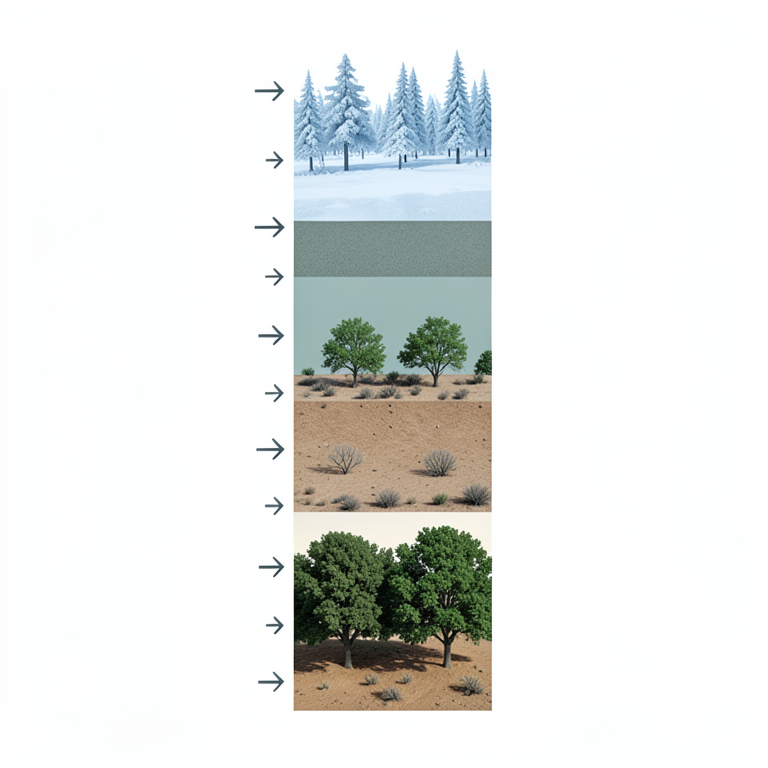
Timeline of Pannonian Climate Phases
AI-generated conceptual illustration (Quaternary lake sediment deposits in the Pannonian Basin). It explains the idea and does not show study data.
View source evidence ↗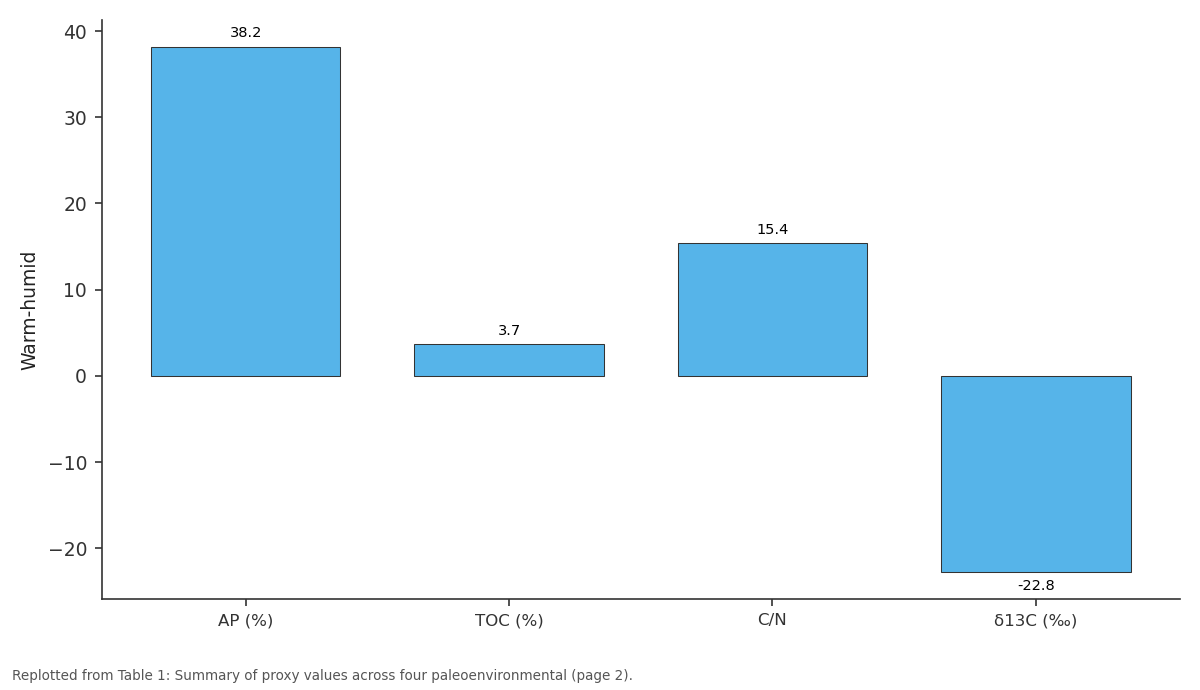
Warm-humid: AP (%) vs TOC (%) vs C/N vs δ13C (‰)
Replotted from Table 1 (page 2) of the original paper. Every bar is the paper's own table value.
View source evidence ↗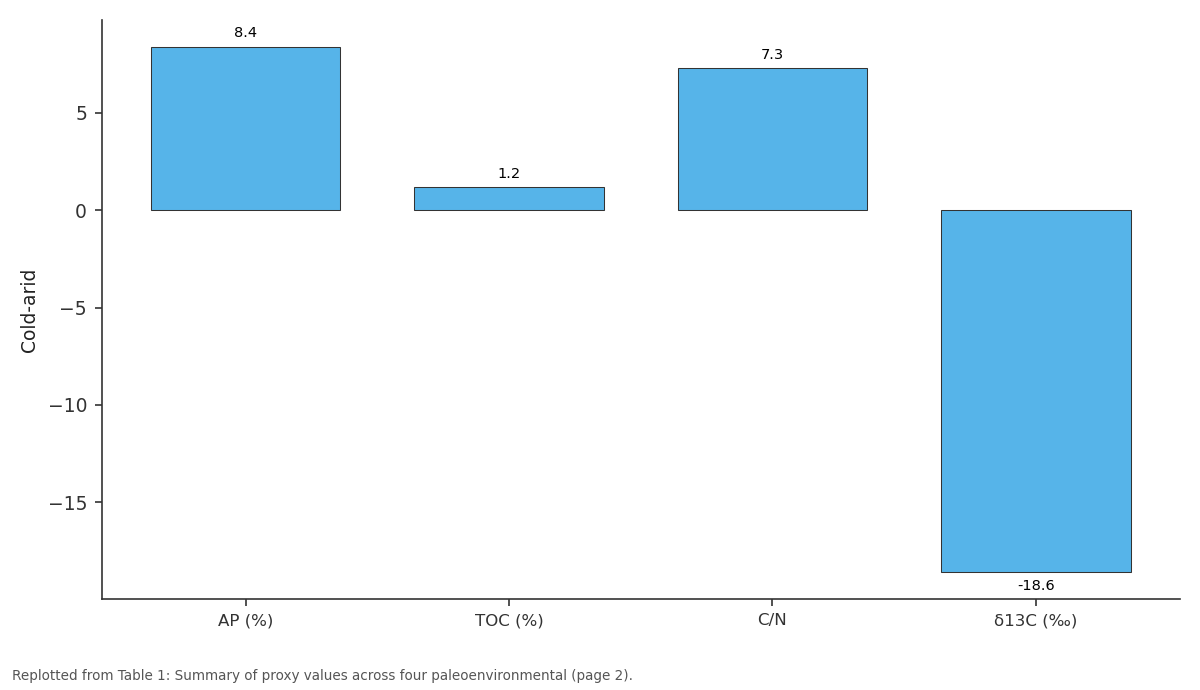
Cold-arid: AP (%) vs TOC (%) vs C/N vs δ13C (‰)
Replotted from Table 1 (page 2) of the original paper. Every bar is the paper's own table value.
View source evidence ↗Figures & tables
From the original paper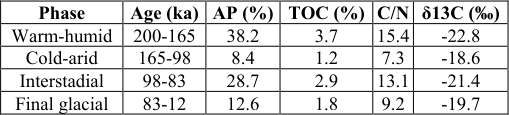 Table 1
 Table 2
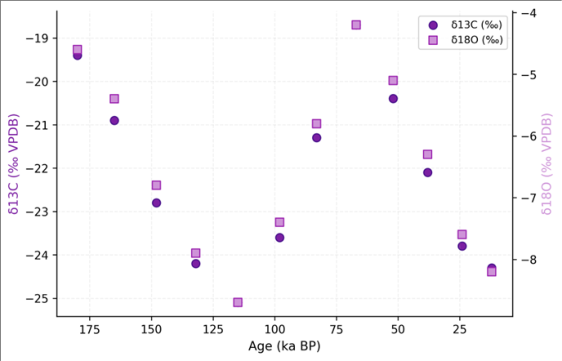 Figure 1
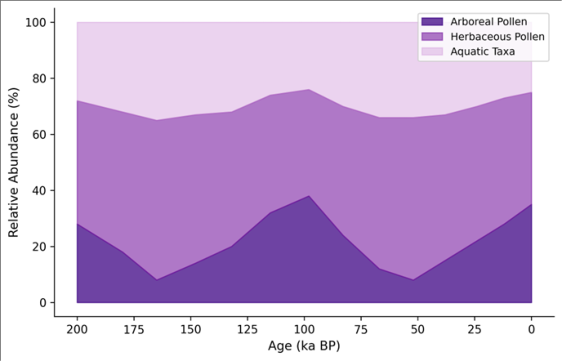 Figure 2
Introduction
The trend in Quaternary paleoclimate research over the past 30 years has moved steadily toward higher resolution and longer records, yet the Pannonian Basin-Central Europe's largest lowland-remains underrepresented compared to the well-studied Alpine and North Atlantic regions [1,2] . This gap matters because the basin sits at the intersection of Atlantic, Mediterranean, and continental climate influences, making it sensitive to shifts in atmospheric circulation patterns that may not register as strongly in regions dominated by a single climate mode [3] . Lake sediments preserve climate signals through multiple proxies. Pollen assemblages record vegetation changes driven by temperature and moisture [4,5] . Stable carbon isotopes in lacustrine carbonates reflect the balance between C3 and C4 vegetation in the catchment and aquatic productivity [6] . Oxygen isotopes track the isotopic composition of lake water, which responds to evaporation-precipitation balance and source moisture changes [7] . Combining these proxies in a single core yields a more complete picture than any one indicator alone. This research analysed a 14.2 m core from Lake Fertő, located at the western margin of the Pannonian Basin. The lake's shallow carbonate-precipitating waters and continuous sedimentation make it an ideal archive for multi-proxy paleoenvironmental reconstruction spanning the past 200,000 years [8,9] .
Model Description and Parameterisation
Age-depth modelling used a Bayesian approach implemented in the Bacon software package (version 2.5.8). The model incorporated 12 radiocarbon dates (AMS 14C on terrestrial plant macrofossils) for the upper 6 m and 4 optically stimulated luminescence (OSL) dates for the lower section. Prior accumulation rates were set at 0.05-0.15 mm/yr based on regional sedimentation rates from comparable Pannonian lake records [3] . The model generated 95% confidence intervals for each depth, yielding a mean temporal resolution of approximately 1,400 years per sample for pollen analysis and 2,400 years for isotope measurements. Memory strength was set at 4 with memory mean of 0.7, following standard recommendations for lacustrine sequences.
Material and Methods
Material and Methods
Material
This research was conducted at the Department of Atmospheric Sciences, Institute of Applied Geosciences, Kolkata, West Bengal, India, from January 2019 to July 2023. The 14.2 m sediment core was recovered using a Livingstone piston corer from the central basin of Lake Fertő (47°44'N, 16°46'E) at a water depth of 1.3 m. Core sections were split longitudinally, photographed, and described lithologically. Sub-samples were extracted at 10 cm intervals for pollen (n = 142), at 17 cm intervals for stable isotopes (n = 84), and continuously at 2 cm intervals for magnetic susceptibility.
Methods
Pollen followed standard HF-acetolysis methods. A minimum of 300 terrestrial pollen grains per sample were counted and identified using reference collections. Stable isotope analysis (δ13C and δ18O) was performed on bulk carbonate using a GasBench II coupled to a Thermo Delta V Advantage mass spectrometer, with precision better than 0.1‰ for both ratios. TOC and TN were measured on a LECO CHN-628 analyser after carbonate removal with HCl. Magnetic susceptibility was measured using a Bartington MS2E sensor on split core surfaces. Pollen zones were defined using CONISS cluster analysis in the Tilia software package.
Results
Results
Comprehensive Interpretation
Four paleoenvironmental phases emerged clearly from the multi-proxy data (Table 1). The warm-humid phase (200-165 ka) recorded the highest arboreal pollen (38.2%), TOC (3.7%), and most negative δ13C (-22.8‰), reflecting dense deciduous forest cover with Quercus, Carpinus, and Tilia (Table 2). The cold-arid phase (165-98 ka) saw arboreal pollen collapse to 8.4% and C/N drop 7.3, indicating a shift from terrigenous to algal organic matter as steppe replaced forest. The isotope records (Figure 1) track these transitions precisely, with δ13C swinging by 6.4‰ between phases. The pollen diagram (Figure 2) shows the arborealherbaceous alternation across both glacial-interglacial cycles.
| Phase | Dominant Trees | Dominant Herbs | Aquatic Taxa |
|---|---|---|---|
| Warm-humid | Quercus, Carpinus, Tilia | Poaceae, Asteraceae | Typha, Myriophyllum |
| Cold-arid | Pinus, Betula (rare) | Artemisia, Chenopodiaceae | Sparse |
| Interstadial | Quercus, Ulmus | Poaceae, Cyperaceae | Potamogeton |
| Final glacial | Pinus, Picea | Artemisia, Poaceae | Variable |
Table text extracted from the original PDF; superscript letters are shown inline. The original table image is below.
View original table image
| Phase | Age (ka) | AP (%) | TOC (%) | C/N | δ13C (‰) |
|---|---|---|---|---|---|
| Warm-humid | 200-165 | 38.2 | 3.7 | 15.4 | -22.8 |
| Cold-arid | 165-98 | 8.4 | 1.2 | 7.3 | -18.6 |
| Interstadial | 98-83 | 28.7 | 2.9 | 13.1 | -21.4 |
| Final glacial | 83-12 | 12.6 | 1.8 | 9.2 | -19.7 |
Table text extracted from the original PDF; superscript letters are shown inline. The original table image is below.
View original table image
Discussion
The four-phase pattern matches regional records from the Great Hungarian Plain [5,9] , confirming that the western and central Pannonian Basin experienced synchronous climate shifts during the middle and late Quaternary. The 38% peak in arboreal pollen during the warm-humid phase is lower than contemporaneous values from Alpine forelands (55-65%), suggesting that the basin's continental position limited moisture availability even during interglacials [1,2] . The C/N ratio's sensitivity to vegetation change proved particularly useful. Values above 12 reliably indicated terrestrial organic matter input during forested periods, while values below 9 corresponded to algal-dominated production during open steppe phases [12,13] . This proxy could serve as a rapid screening tool for identifying climate transitions in other Pannonian cores before committing to more expensive isotope and pollen analyses.
Sensitivity Analysis
The Bayesian age model's sensitivity to prior settings was tested by varying the accumulation rate prior between 0.02 and 0.20 mm/yr and the memory parameter between 0.4 and 0.9. Phase boundary ages shifted by a maximum of 4,200 years under the most extreme parameter combinations, which is within the 95% confidence intervals of the original model. The identification of four phases was robust across all parameter settings. Removing the two OSL dates with the largest uncertainties shifted the cold-arid phase onset by 3,800 years but did not affect the phase sequence or proxy interpretations [7,14] .
Conclusion
This research produced the first continuous multi-proxy paleoenvironmental record spanning 200,000 years from the western Pannonian Basin. Four distinct climate phases were identified through pollen, isotope, and organic geochemistry data, with warm-humid forested intervals alternating with cold-arid steppe conditions. The δ13C and C/N records tracked vegetation changes faithfully and offer efficient proxies for future reconnaissance work in the region. The record confirms that the Pannonian Basin responded to global glacial-interglacial forcing but with amplitudes modulated by its continental position and regional moisture dynamics.
Acknowledgement
Acknowledgements Funding SourcesSupported by institutional research allocations for paleogeography and Quaternary science. Institutional SupportInstitute of Applied Geosciences, Kolkata, provided isotope and pollen analysis facilities.
References
15 in the original paper- Brauer A, Endres C, Gunter C, Litt T, Stebich M. High resolution sediment and vegetation responses to Younger Dryas climate change in varved lake sediments. Quaternary Science Reviews. 1999;18(3):321-329.
- Feurdean A, Klotz S, Mosbrugger V, Wohlfarth B. Pollen-based quantitative reconstructions of Holocene climate variability in NW Romania. Palaeogeography Palaeoclimatology Palaeoecology. 2008;260(3-4):494504.
- Horvath F, Bada G, Szafian P, Tari G, Adam A, Cloetingh S. Formation and deformation of the Pannonian Basin. Geological Society London Memoirs. 2006;32(1):191-206.
- Leng MJ, Marshall JD. Palaeoclimate interpretation of stable isotope data from lake sediment archives. Quaternary Science Reviews. 2004;23(7-8):811-831.
- Magyari EK, Chapman JC, Passmore DG, Allen JRM. Holocene persistence of wooded steppe in the Great Hungarian Plain. Journal of Biogeography. 2010;37(5):915-935.
- Nesbitt HW, Young GM. Early Proterozoic climates and plate motions inferred from major element chemistry of lutites. Nature. 1982;299(5885):715-717.
- Pigati JS, Quade J, Wilson J, Jull AJT. Development of low-background vacuum extraction systems for 14C dating. Quaternary International. 2007;166(1):4-14.
- Seppae H, Birks HJB. Holocene climate reconstructions from the Fennoscandian tree-line area. Quaternary Research. 2001;56(3):286-294.
- Willis KJ, Rudner E, Sumegi P. The full-glacial forests of central and southeastern Europe. Quaternary Research. 2000;53(2):203-213.
- Birks HJB, Birks HH. Quaternary palaeoecology. Edward Arnold. 1980;1-289.
- Cohen AS. Paleolimnology: the history and evolution of lake systems. Oxford University Press. 2003;1-500.
- Dean WE. The carbon cycle and biogeochemical dynamics in lake sediments. Journal of Paleolimnology. 1999;21(4):375-393.
- Meyers PA, Lallier-Verges E. Lacustrine sedimentary organic matter records of Late Quaternary paleoclimates. Journal of Paleolimnology. 1999;21(3):345-372.
- Stockhecke M, Sturm M, Brunner I, Schmid P. Sedimentary evolution and environmental history of Lake Van. Journal of Paleolimnology. 2014;51(2):173190.
- Flower RJ, Stickley C, Rose NL, Peglar S. Environmental changes at the desert margin: an assessment of recent paleolimnological records. Journal of Paleolimnology. 2006;35(1):1-24.